

IEC 62548-1:2023
(Main)Photovoltaic (PV) arrays - Part 1: Design requirements
General Information
- Abstract
IEC 62548-1:2023 sets out design requirements for photovoltaic (PV) arrays including DC array wiring, electrical protection devices, switching and earthing provisions. The scope includes all parts of the PV array and final power conversion equipment (PCE), but not including energy storage devices, loads or AC or DC distribution network supplying loads. The object of this document is to address the design safety requirements arising from the particular characteristics of photovoltaic systems. This document also includes extra protection requirements of PV arrays when they are directly connected with batteries at the DC level.
This first edition cancels and replaces IEC 62548 published in 2016. This edition includes the following significant technical changes with respect to the previous edition:
a) Revised provisions for systems including DC to DC conditioning units.
b) Revision of mounting structure requirements.
c) Revised cable requirements.
d) Revision of Clause 6 on safety issues which includes provisions for protection against electric shock including array insulation monitoring and earth fault detection.
e) Revision of 7.2.7 and 7.3 with respect to isolation means.
f) Provisions for use of bifacial modules and modules mounted in non-optimal orientations.
g) New Annex F containing: KI factor calculations for bifacial and non-optimally oriented systems; anti-PID equipment and arc flash.
- Status
- Published
- Publication Date
- 14-Dec-2025
- Technical Committee
- TC 82 - Solar photovoltaic energy systems
- Drafting Committee
- WG 3 - TC 82/WG 3
- Current Stage
- PPUB - Publication issued
- Start Date
- 07-Dec-2023
- Completion Date
- 15-Dec-2023
Buy Documents
IEC 62548-1:2023 - Photovoltaic (PV) arrays - Part 1: Design requirements Released:12/7/2023
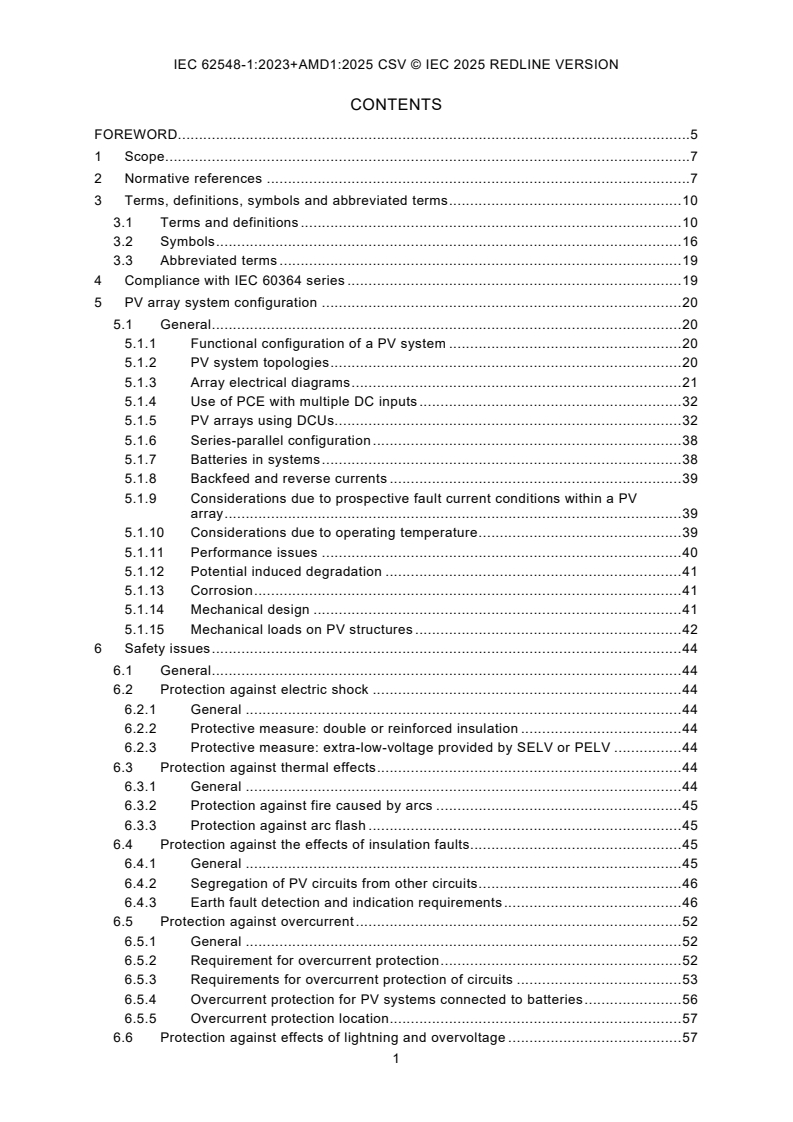
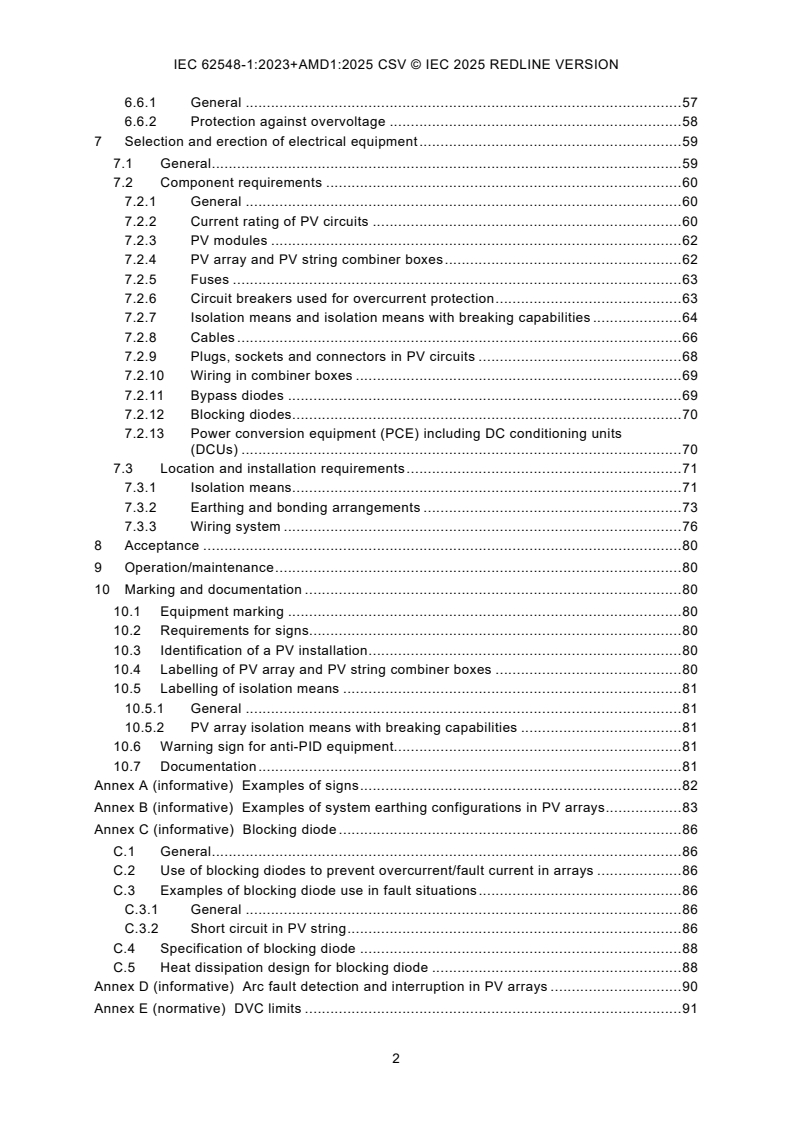
IEC 62548-1:2023+AMD1:2025 CSV - Photovoltaic (PV) arrays - Part 1: Design requirements Released:12/15/2025
Overview
IEC 62548-1:2023 establishes essential design requirements for photovoltaic (PV) arrays, with a strong focus on safety and reliability in solar power system installations. Developed by the International Electrotechnical Commission (IEC), this standard covers the full spectrum of DC-array wiring, electrical protection devices, switching, and earthing provisions for PV systems. While it includes the PV array and final power conversion equipment (PCE), it does not extend to energy storage devices, loads, or the AC/DC distribution network supplying loads.
This standard directly addresses electrical and mechanical risks specific to PV systems, such as sustained electrical arcs and unique fault conditions, equipping designers and installers with guidelines to maximize system reliability and safety.
Key Updates in IEC 62548-1:2023
- Enhanced requirements for PV systems featuring DC to DC conditioning units.
- Updated criteria for mounting structures and cable selection.
- Revised safety provisions regarding electric shock protection, insulation monitoring, and earth fault detection.
- New guidance for isolation means, including installations using bifacial modules or non-optimal orientations.
- Introduction of KI factor calculations, anti-PID (Potential Induced Degradation) protections, and arc flash considerations.
Key Topics
- Design Safety for PV Arrays: Defines robust safety measures tailored to the direct current (DC) nature of PV systems, including arc fault management and reinforced overcurrent protection.
- Electrical Protection and Isolation: Outlines requirements for fuses, circuit breakers, insulation monitoring, and earth fault detection to mitigate fire, arc, and shock risks.
- Component and Installation Requirements: Details selection criteria and installation practices for cables, connectors, combiner boxes, and switching devices to ensure system integrity.
- Mounting and Mechanical Considerations: Sets out structural and environmental requirements for PV array mounting, including specialized guidance for bifacial modules and non-optimal orientations.
- Earthing and Bonding: Provides clear directives for the earthing and bonding of exposed conductive parts and the use of equipotential bonding conductors.
- Labelling and Documentation: Specifies marking, identification, and documentation requirements to support safe operation and maintenance throughout the PV system lifecycle.
- Protection with Battery Connection: Adds requirements when PV arrays are directly connected to batteries at the DC level to avert backfeed and reverse current hazards.
Applications
IEC 62548-1:2023 is vital across the solar industry for ensuring the safe and effective deployment of PV arrays in a variety of applications, including:
- Residential and Commercial Rooftop PV Installations: Enhances safety through standardized wiring, isolation, and protection protocols.
- Utility-Scale and Ground-Mounted PV Power Plants: Provides design consistency and risk mitigation for large-scale projects, complementing IEC TS 62738 for facilities with restricted access.
- Specialized PV Installations: Informs the design of systems utilizing bifacial modules, tracking systems, or building-integrated photovoltaics (BIPV), requiring advanced mounting and configuration strategies.
- Battery-Integrated PV Systems: Offers crucial additional safeguards for arrays directly linked to energy storage at the DC level.
By adhering to IEC 62548-1, professionals can ensure PV arrays meet international safety requirements, facilitate inspection and certification, and protect both end-users and maintenance personnel from electrical or mechanical hazards.
Related Standards
To provide comprehensive PV array safety and performance, IEC 62548-1:2023 is intended for use in conjunction with related standards, such as:
- IEC 60364 Series: General requirements for low-voltage electrical installations.
- IEC 62109 Series: Safety requirements for power conversion equipment in PV systems.
- IEC 61215 & IEC 61730: Qualification and safety for PV modules.
- IEC 62446-1 & IEC 62446-2: Documentation, commissioning, and maintenance of PV systems.
- IEC TS 62738: Design guidelines for large ground-mounted PV plants.
- IEC 61643-31: Surge protection for photovoltaic installations.
- IEC 62930: Electric cables for PV systems.
Adoption of IEC 62548-1:2023 supports global harmonization of solar PV array design, fostering safer, more reliable systems and accelerating renewable energy integration worldwide.
Relations
- Effective Date
- 05-Sep-2023
- Amended By
IEC 62548-1:2023/AMD1:2025 - Amendment 1 - Photovoltaic (PV) arrays - Part 1: Design requirements - Effective Date
- 02-Aug-2024
Buy Documents
IEC 62548-1:2023 - Photovoltaic (PV) arrays - Part 1: Design requirements Released:12/7/2023
IEC 62548-1:2023+AMD1:2025 CSV - Photovoltaic (PV) arrays - Part 1: Design requirements Released:12/15/2025
Get Certified
Connect with accredited certification bodies for this standard

DNV
DNV is an independent assurance and risk management provider.

Lloyd's Register
Lloyd's Register is a global professional services organisation specialising in engineering and technology.
DNV Energy Systems
Energy and renewable energy certification.
Sponsored listings
Frequently Asked Questions
IEC 62548-1:2023 is a standard published by the International Electrotechnical Commission (IEC). Its full title is "Photovoltaic (PV) arrays - Part 1: Design requirements". This standard covers: IEC 62548-1:2023 sets out design requirements for photovoltaic (PV) arrays including DC array wiring, electrical protection devices, switching and earthing provisions. The scope includes all parts of the PV array and final power conversion equipment (PCE), but not including energy storage devices, loads or AC or DC distribution network supplying loads. The object of this document is to address the design safety requirements arising from the particular characteristics of photovoltaic systems. This document also includes extra protection requirements of PV arrays when they are directly connected with batteries at the DC level. This first edition cancels and replaces IEC 62548 published in 2016. This edition includes the following significant technical changes with respect to the previous edition: a) Revised provisions for systems including DC to DC conditioning units. b) Revision of mounting structure requirements. c) Revised cable requirements. d) Revision of Clause 6 on safety issues which includes provisions for protection against electric shock including array insulation monitoring and earth fault detection. e) Revision of 7.2.7 and 7.3 with respect to isolation means. f) Provisions for use of bifacial modules and modules mounted in non-optimal orientations. g) New Annex F containing: KI factor calculations for bifacial and non-optimally oriented systems; anti-PID equipment and arc flash.
IEC 62548-1:2023 sets out design requirements for photovoltaic (PV) arrays including DC array wiring, electrical protection devices, switching and earthing provisions. The scope includes all parts of the PV array and final power conversion equipment (PCE), but not including energy storage devices, loads or AC or DC distribution network supplying loads. The object of this document is to address the design safety requirements arising from the particular characteristics of photovoltaic systems. This document also includes extra protection requirements of PV arrays when they are directly connected with batteries at the DC level. This first edition cancels and replaces IEC 62548 published in 2016. This edition includes the following significant technical changes with respect to the previous edition: a) Revised provisions for systems including DC to DC conditioning units. b) Revision of mounting structure requirements. c) Revised cable requirements. d) Revision of Clause 6 on safety issues which includes provisions for protection against electric shock including array insulation monitoring and earth fault detection. e) Revision of 7.2.7 and 7.3 with respect to isolation means. f) Provisions for use of bifacial modules and modules mounted in non-optimal orientations. g) New Annex F containing: KI factor calculations for bifacial and non-optimally oriented systems; anti-PID equipment and arc flash.
IEC 62548-1:2023 is classified under the following ICS (International Classification for Standards) categories: 27.160 - Solar energy engineering. The ICS classification helps identify the subject area and facilitates finding related standards.
IEC 62548-1:2023 has the following relationships with other standards: It is inter standard links to IEC 62548:2016, IEC 62548-1:2023/AMD1:2025. Understanding these relationships helps ensure you are using the most current and applicable version of the standard.
IEC 62548-1:2023 is available in PDF format for immediate download after purchase. The document can be added to your cart and obtained through the secure checkout process. Digital delivery ensures instant access to the complete standard document.
Standards Content (Sample)
IEC 62548-1 ®
Edition 1.0 2023-12
INTERNATIONAL
STANDARD
colour
inside
Photovoltaic (PV) arrays –
Part 1: Design requirements
All rights reserved. Unless otherwise specified, no part of this publication may be reproduced or utilized in any form
or by any means, electronic or mechanical, including photocopying and microfilm, without permission in writing from
either IEC or IEC's member National Committee in the country of the requester. If you have any questions about IEC
copyright or have an enquiry about obtaining additional rights to this publication, please contact the address below or
your local IEC member National Committee for further information.
IEC Secretariat Tel.: +41 22 919 02 11
3, rue de Varembé info@iec.ch
CH-1211 Geneva 20 www.iec.ch
Switzerland
About the IEC
The International Electrotechnical Commission (IEC) is the leading global organization that prepares and publishes
International Standards for all electrical, electronic and related technologies.
About IEC publications
The technical content of IEC publications is kept under constant review by the IEC. Please make sure that you have the
latest edition, a corrigendum or an amendment might have been published.
IEC publications search - webstore.iec.ch/advsearchform IEC Products & Services Portal - products.iec.ch
The advanced search enables to find IEC publications by a Discover our powerful search engine and read freely all the
variety of criteria (reference number, text, technical publications previews. With a subscription you will always have
committee, …). It also gives information on projects, replaced access to up to date content tailored to your needs.
and withdrawn publications.
Electropedia - www.electropedia.org
IEC Just Published - webstore.iec.ch/justpublished
The world's leading online dictionary on electrotechnology,
Stay up to date on all new IEC publications. Just Published
containing more than 22 300 terminological entries in English
details all new publications released. Available online and once
and French, with equivalent terms in 19 additional languages.
a month by email.
Also known as the International Electrotechnical Vocabulary
(IEV) online.
IEC Customer Service Centre - webstore.iec.ch/csc
If you wish to give us your feedback on this publication or need
further assistance, please contact the Customer Service
Centre: sales@iec.ch.
IEC 62548-1 ®
Edition 1.0 2023-12
INTERNATIONAL
STANDARD
colour
inside
Photovoltaic (PV) arrays –
Part 1: Design requirements
INTERNATIONAL
ELECTROTECHNICAL
COMMISSION
ICS 27.160 ISBN 978-2-8322-7848-2
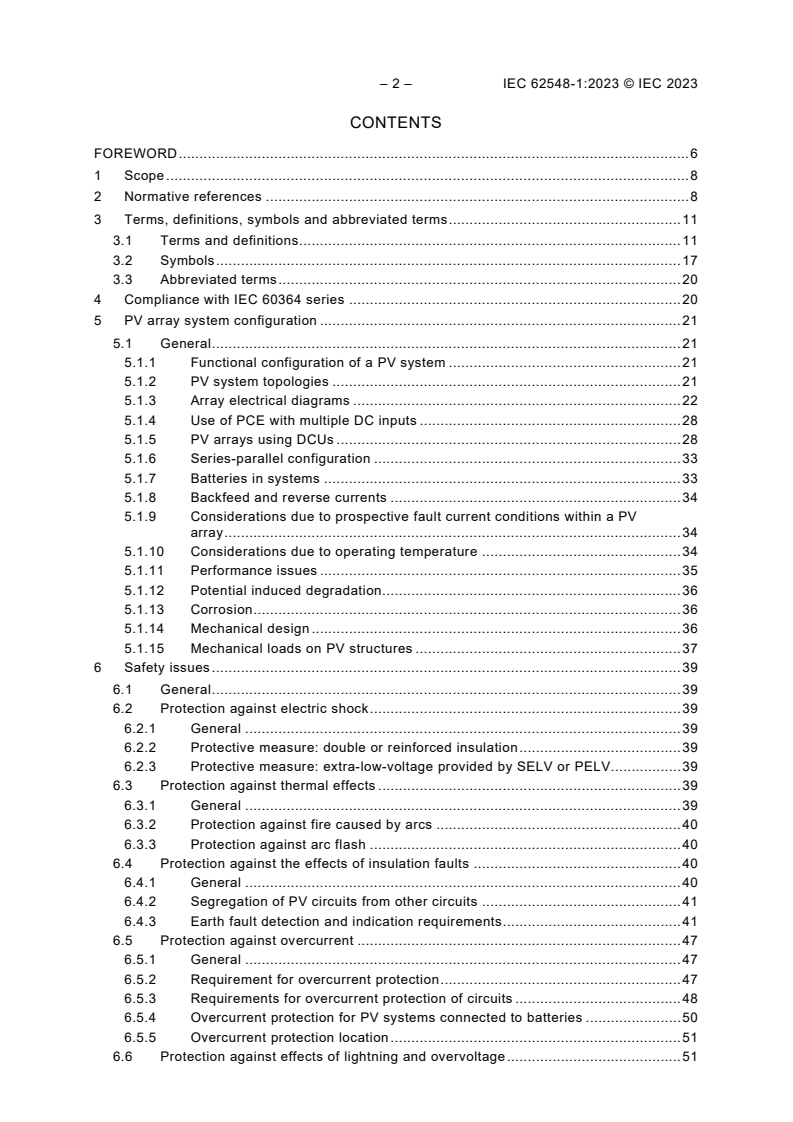
– 2 – IEC 62548-1:2023 © IEC 2023
CONTENTS
FOREWORD . 6
1 Scope . 8
2 Normative references . 8
3 Terms, definitions, symbols and abbreviated terms . 11
3.1 Terms and definitions . 11
3.2 Symbols . 17
3.3 Abbreviated terms . 20
4 Compliance with IEC 60364 series . 20
5 PV array system configuration . 21
5.1 General . 21
5.1.1 Functional configuration of a PV system . 21
5.1.2 PV system topologies . 21
5.1.3 Array electrical diagrams . 22
5.1.4 Use of PCE with multiple DC inputs . 28
5.1.5 PV arrays using DCUs . 28
5.1.6 Series-parallel configuration . 33
5.1.7 Batteries in systems . 33
5.1.8 Backfeed and reverse currents . 34
5.1.9 Considerations due to prospective fault current conditions within a PV
array . 34
5.1.10 Considerations due to operating temperature . 34
5.1.11 Performance issues . 35
5.1.12 Potential induced degradation. 36
5.1.13 Corrosion . 36
5.1.14 Mechanical design . 36
5.1.15 Mechanical loads on PV structures . 37
6 Safety issues . 39
6.1 General . 39
6.2 Protection against electric shock . 39
6.2.1 General . 39
6.2.2 Protective measure: double or reinforced insulation . 39
6.2.3 Protective measure: extra-low-voltage provided by SELV or PELV. 39
6.3 Protection against thermal effects . 39
6.3.1 General . 39
6.3.2 Protection against fire caused by arcs . 40
6.3.3 Protection against arc flash . 40
6.4 Protection against the effects of insulation faults . 40
6.4.1 General . 40
6.4.2 Segregation of PV circuits from other circuits . 41
6.4.3 Earth fault detection and indication requirements . 41
6.5 Protection against overcurrent . 47
6.5.1 General . 47
6.5.2 Requirement for overcurrent protection . 47
6.5.3 Requirements for overcurrent protection of circuits . 48
6.5.4 Overcurrent protection for PV systems connected to batteries . 50
6.5.5 Overcurrent protection location . 51
6.6 Protection against effects of lightning and overvoltage . 51
6.6.1 General . 51
6.6.2 Protection against overvoltage . 52
7 Selection and erection of electrical equipment . 53
7.1 General . 53
7.2 Component requirements . 54
7.2.1 General . 54
7.2.2 Current rating of PV circuits . 54
7.2.3 PV modules . 55
7.2.4 PV array and PV string combiner boxes . 56
7.2.5 Fuses . 57
7.2.6 Circuit breakers used for overcurrent protection . 57
7.2.7 Isolation means and isolation means with breaking capabilities . 58
7.2.8 Cables . 60
7.2.9 Plugs, sockets and connectors in PV circuits . 62
7.2.10 Wiring in combiner boxes . 63
7.2.11 Bypass diodes . 63
7.2.12 Blocking diodes . 64
7.2.13 Power conversion equipment (PCE) including DC conditioning units
(DCUs) . 64
7.3 Location and installation requirements . 65
7.3.1 Isolation means . 65
7.3.2 Earthing and bonding arrangements . 67
7.3.3 Wiring system . 70
8 Acceptance. 74
9 Operation/maintenance . 74
10 Marking and documentation . 74
10.1 Equipment marking . 74
10.2 Requirements for signs . 74
10.3 Identification of a PV installation . 74
10.4 Labelling of PV array and PV string combiner boxes . 74
10.5 Labelling of isolation means . 75
10.5.1 General . 75
10.5.2 PV array isolation means with breaking capabilities . 75
10.6 Warning sign for anti-PID equipment . 75
10.7 Documentation . 75
Annex A (informative) Examples of signs . 76
Annex B (informative) Examples of system earthing configurations in PV arrays . 77
Annex C (informative) Blocking diode . 80
C.1 General . 80
C.2 Use of blocking diodes to prevent overcurrent/fault current in arrays . 80
C.3 Examples of blocking diode use in fault situations . 80
C.3.1 General . 80
C.3.2 Short circuit in PV string . 80
C.4 Specification of blocking diode . 82
C.5 Heat dissipation design for blocking diode . 82
Annex D (informative) Arc fault detection and interruption in PV arrays . 84
Annex E (normative) DVC limits . 85
– 4 – IEC 62548-1:2023 © IEC 2023
Annex F (normative) Determination of maximum voltage and maximum currents in PV
circuits . 86
F.1 U . 86
OC MAX
F.1.1 PV array maximum voltage . 86
F.1.2 PV strings constructed using DC conditioning units . 87
F.2 String maximum current . 88
F.3 Calculation of potential fault currents originating from the array . 88
F.3.1 General . 88
F.3.2 String . 88
F.3.3 Sub-array . 88
F.3.4 Array . 88
F.4 K factor – general . 89
I
F.5 K factor – under unique environmental conditions . 89
Corr
F.6 K factor – non optimally oriented monofacial arrays. 90
Corr
F.7 K factor – bifacial arrays. 90
Corr
F.8 K factor – for arrays containing non-optimally oriented bifacial modules . 91
Corr
Annex G (normative) Backfeed current and PV reverse currents under fault conditions . 92
G.1 General . 92
G.2 Illustrated examples . 92
G.3 Backfeed currents and PV reverse currents where subarrays are not
combined in the PCE . 94
Annex H (normative) Anti-PID . 96
H.1 General . 96
H.2 DC bias applied during night . 96
H.3 DC bias applied to array output . 97
H.4 DC bias applied to AC system . 98
Annex I (informative) Arc flash . 100
Annex J (normative) Qualification of DCU group voltage . 101
J.1 Overview. 101
J.2 Test 1: Maximum voltage operational test procedure. 101
J.3 Test 2: Overvoltage test . 101
Bibliography . 103
Figure 1 – General functional configuration of a PV powered system . 21
Figure 2 – PV array diagram – single string example . 23
Figure 3 – PV array diagram – multiple parallel string example . 24
Figure 4 – PV array diagram – multiple parallel string example with array divided into
sub-arrays . 25
Figure 5 – PV array example using a PCE with multiple MPPT DC inputs . 26
Figure 6 – PV array example using a PCE with multiple DC inputs internally connected
to a common DC bus . 27
Figure 7 – PV string constructed using DCUs. 29
Figure 8 – Example of partial DCU string . 30
Figure 9 – PV parallel strings constructed using DCUs . 31
Figure 10 – PV string(s) connected to DCUs . 32
Figure 11 – Example of a PV array diagram where strings are grouped under one
overcurrent protection device per group . 50
Figure 12 – Examples of reinforced protection of wiring . 62
Figure 13 – PV array exposed conductive parts functional earthing/bonding
decision tree . 68
Figure 14 – Exposed conductive parts earthing in a PV array . 69
Figure 15 – Examples of string wiring with minimum loop area . 73
Figure A.1 – Example of sign required on PV array combiner boxes (10.4) . 76
Figure A.2 – Example of switchboard sign for identification of PV on a building . 76
Figure B.1 – Functionally earthed system topologies. 77
Figure B.2 – Non-earth-referenced system topologies . 78
Figure B.3 – Non-separated system topologies . 79
Figure C.1 – Effect of blocking diode where there is a short circuit in PV string . 81
Figure C.2 – Effect of blocking diode where there is an earth fault on a system with
earthing on the minus side . 81
Figure C.3 – Effect of blocking diode where there is an earth fault on a system with
positive side earthing . 82
Figure D.1 – Examples of types of arcs in PV arrays . 84
Figure G.1 – Backfeed from inverter with single PV input and internal battery . 92
Figure G.2 – Inverter with multiple PV inputs and external battery . 93
Figure G.3 – Backfeed where subarrays are combined externally to PCE . 94
Figure H.1 – Example anti-PID control using bias on dc side at night . 96
Figure H.2 – Example of anti-PID control using bias on DC side . 97
Figure H.3 – Example of anti-PID control using bias on AC side . 98
Table 1 – Requirements for different system types based on PCE separation and PV
array functional earthing . 43
Table 2 – Minimum insulation resistance thresholds for detection of failure of
insulation to earth . 44
Table 3 – Trip current of functional earthing overcurrent protection. . 46
Table 4 – Overcurrent protection nominal rating . 49
Table 5 – Calculation of the critical length L . 52
crit
Table 6 – Minimum current rating of circuits . 55
Table 7 – Isolation means in PV array installations . 65
Table E.1 – Summary of the limits of the decisive voltage classes . 85
Table F.1 – Voltage correction factors for crystalline and multi-crystalline silicon PV
modules . 87
Table F.2 – Environmental conditions covered by K = 1,0 . 89
Corr
Table F.3 – Example K values at different orientations and tilt for 47º north latitude . 90
Corr
– 6 – IEC 62548-1:2023 © IEC 2023
INTERNATIONAL ELECTROTECHNICAL COMMISSION
____________
PHOTOVOLTAIC (PV) ARRAYS –
Part 1: DESIGN REQUIREMENTS
FOREWORD
1) The International Electrotechnical Commission (IEC) is a worldwide organization for standardization comprising
all national electrotechnical committees (IEC National Committees). The object of IEC is to promote international
co-operation on all questions concerning standardization in the electrical and electronic fields. To this end and
in addition to other activities, IEC publishes International Standards, Technical Specifications, Technical Reports,
Publicly Available Specifications (PAS) and Guides (hereafter referred to as "IEC Publication(s)"). Their
preparation is entrusted to technical committees; any IEC National Committee interested in the subject dealt with
may participate in this preparatory work. International, governmental and non-governmental organizations liaising
with the IEC also participate in this preparation. IEC collaborates closely with the International Organization for
Standardization (ISO) in accordance with conditions determined by agreement between the two organizations.
2) The formal decisions or agreements of IEC on technical matters express, as nearly as possible, an international
consensus of opinion on the relevant subjects since each technical committee has representation from all
interested IEC National Committees.
3) IEC Publications have the form of recommendations for international use and are accepted by IEC National
Committees in that sense. While all reasonable efforts are made to ensure that the technical content of IEC
Publications is accurate, IEC cannot be held responsible for the way in which they are used or for any
misinterpretation by any end user.
4) In order to promote international uniformity, IEC National Committees undertake to apply IEC Publications
transparently to the maximum extent possible in their national and regional publications. Any divergence between
any IEC Publication and the corresponding national or regional publication shall be clearly indicated in the latter.
5) IEC itself does not provide any attestation of conformity. Independent certification bodies provide conformity
assessment services and, in some areas, access to IEC marks of conformity. IEC is not responsible for any
services carried out by independent certification bodies.
6) All users should ensure that they have the latest edition of this publication.
7) No liability shall attach to IEC or its directors, employees, servants or agents including individual experts and
members of its technical committees and IEC National Committees for any personal injury, property damage or
other damage of any nature whatsoever, whether direct or indirect, or for costs (including legal fees) and
expenses arising out of the publication, use of, or reliance upon, this IEC Publication or any other IEC
Publications.
8) Attention is drawn to the Normative references cited in this publication. Use of the referenced publications is
indispensable for the correct application of this publication.
9) IEC draws attention to the possibility that the implementation of this document may involve the use of (a)
patent(s). IEC takes no position concerning the evidence, validity or applicability of any claimed patent rights in
respect thereof. As of the date of publication of this document, IEC had not received notice of (a) patent(s), which
may be required to implement this document. However, implementers are cautioned that this may not represent
the latest information, which may be obtained from the patent database available at https://patents.iec.ch. IEC
shall not be held responsible for identifying any or all such patent rights.
IEC 62548-1 has been prepared by IEC technical committee 82: Solar photovoltaic energy
systems. It is an International Standard.
This first edition cancels and replaces IEC 62548 published in 2016. This edition constitutes a
technical revision.
This edition includes the following significant technical changes with respect to the previous
edition:
a) Revised provisions for systems including DC to DC conditioning units.
b) Revision of mounting structure requirements.
c) Revised cable requirements.
d) Revision of Clause 6 on safety issues which includes provisions for protection against
electric shock including array insulation monitoring and earth fault detection.
e) Revision of 7.2.7 and 7.3 with respect to isolation means.
f) Provisions for use of bifacial modules and modules mounted in non-optimal orientations.
g) New Annex F containing: K factor calculations for bifacial and non-optimally oriented
I
systems; anti-PID equipment and arc flash.
The text of this International Standard is based on the following documents:
Draft Report on voting
82/2174/FDIS 82/2193/RVD
Full information on the voting for its approval can be found in the report on voting indicated in
the above table.
The language used for the development of this International Standard is English.
This document was drafted in accordance with ISO/IEC Directives, Part 2, and developed in
accordance with ISO/IEC Directives, Part 1 and ISO/IEC Directives, IEC Supplement, available
at www.iec.ch/members_experts/refdocs. The main document types developed by IEC are
described in greater detail at www.iec.ch/standardsdev/publications.
The committee has decided that the contents of this document will remain unchanged until the
stability date indicated on the IEC website under webstore.iec.ch in the data related to the
specific document. At this date, the document will be
• reconfirmed,
• withdrawn, or
• revised.
IMPORTANT – The "colour inside" logo on the cover page of this document indicates
that it contains colours which are considered to be useful for the correct understanding
of its contents. Users should therefore print this document using a colour printer.
– 8 – IEC 62548-1:2023 © IEC 2023
PHOTOVOLTAIC (PV) ARRAYS –
Part 1: DESIGN REQUIREMENTS
1 Scope
This document sets out design requirements for photovoltaic (PV) arrays including DC array
wiring, electrical protection devices, switching and earthing provisions. The scope includes all
parts of the PV array and final power conversion equipment (PCE), but not including energy
storage devices, loads or AC or DC distribution network supplying loads.
The object of this document is to address the design safety requirements arising from the
particular characteristics of photovoltaic systems. Direct current systems, and PV arrays in
particular, pose some hazards in addition to those derived from conventional AC power systems,
including the ability to produce and sustain electrical arcs with currents that are not greater than
normal operating currents.
In systems supplying AC loads or circuits, the safety requirements mentioned in this document
are however critically dependent on the inverters associated with PV arrays complying with the
requirements of IEC 62109-1, IEC 62109-2 and IEC 62109-3.
Installation requirements are also critically dependent on compliance with the IEC 60364 series
(see Clause 4).
PV arrays of less than 100 W and less than 35 V DC open circuit voltage at STC are not covered
by this document.
PV arrays in grid interconnected systems connected to medium or high voltage systems are not
covered in this document, except as required by IEC TS 62738. Variations and additional
requirements for large-scale ground mounted PV power plants with restricted access to
personnel are addressed in IEC TS 62738.
Additional requirements may be needed for more specialized installations, for example
concentrating systems, tracking systems or building integrated PV.
This document also includes extra protection requirements of PV arrays when they are directly
connected with batteries at the DC level.
Attention is drawn to the co-existence of IEC 60364-7-712 and IEC 62548. Both standards have
been developed in close coordination, respectively by IEC technical committees 64 and 82.
2 Normative references
The following documents are referred to in the text in such a way that some or all of their content
constitutes requirements of this document. For dated references, only the edition cited applies.
For undated references, the latest edition of the referenced document (including any
amendments) applies.
IEC 60228, Conductors of insulated cables
IEC 60269-1, Low-voltage fuses – Part 1: General requirements
IEC 60269-6, Low-voltage fuses – Part 6: Supplementary requirements for fuse-links for the
protection of solar photovoltaic energy systems
IEC 60364-1, Low-voltage electrical installations – Part 1: Fundamental principles, assessment
of general characteristics, definitions
IEC 60364-4 (all parts), Low-voltage electrical installations – Part 4: Protection for safety
IEC 60364-4-41:2005, Low-voltage electrical installations – Part 4-41: Protection for safety –
Protection against electric shock
IEC 60364-4-41:2005/AMD1:2017
IEC 60364-4-44:2007, Low-voltage electrical installations – Part 4-44: Protection for safety –
Protection against voltage disturbances and electromagnetic disturbances
IEC 60364-4-44:2007/AMD1:2015
IEC 60364-4-44:2007/AMD2:2018
IEC 60364-5 (all parts), Electrical installations of buildings – Part 5: Selection and erection of
electrical equipment
IEC 60364-5-52, Low-voltage electrical installations – Part 5-52: Selection and erection of
electrical equipment – Wiring systems
IEC 60364-5-54, Low-voltage electrical installations – Part 5-54: Selection and erection of
electrical equipment – Earthing arrangements and protective conductors
IEC 60364-6, Low-voltage electrical installations – Part 6: Verification
IEC 60529, Degrees of protection provided by enclosures (IP Code)
IEC 60898-2, Circuit-breakers for overcurrent protection for household and similar installations
– Part 2: Circuit-breakers for AC and DC operation
IEC 60898-3, Circuit-breakers for overcurrent protection for household and similar installations
– Part 3: Circuit-breakers for DC operation
IEC 60947-1:2020, Low-voltage switchgear and controlgear – Part 1: General rules
IEC 60947-2, Low-voltage switchgear and controlgear – Part 2: Circuit-breakers
IEC 60947-3, Low-voltage switchgear and controlgear – Part 3: Switches, disconnectors,
switch-disconnectors and fuse-combination units
IEC 61215 (all parts), Terrestrial photovoltaic (PV) modules − Design qualification and type
approval
IEC 61439-1, Low-voltage switchgear and controlgear assemblies – Part 1: General rules
IEC 61439-2, Low-voltage switchgear and controlgear assemblies – Part 2: Power switchgear
and controlgear assemblies
IEC 61643-21, Low-voltage surge protective devices – Part 21: Surge protective devices
connected to telecommunications and signalling networks – Performance requirements and
testing methods
IEC 61643-22, Low-voltage surge protective devices – Part 22: Surge protective devices
connected to telecommunications and signalling networks – Selection and application principles
– 10 – IEC 62548-1:2023 © IEC 2023
IEC 61643-31:2018, Low-voltage surge protective devices – Part 31: Requirements and test
methods for SPDs for photovoltaic installations
IEC 61701, Photovoltaic (PV) modules – Salt mist corrosion testing
IEC 61730-1, Photovoltaic (PV) module safety qualification − Part 1: Requirements for
construction
IEC 61730-2, Photovoltaic (PV) module safety qualification − Part 2: Requirements for testing
IEC TS 61836:2016, Solar photovoltaic energy systems – Terms, definitions and symbols
IEC 61984, Connectors – Safety Requirements and tests
IEC 62109-1:2010, Safety of power converters for use in photovoltaic power systems – Part 1:
General requirements
IEC 62109-2, Safety of power converters for use in photovoltaic power systems – Part 2:
Particular requirements for inverters
IEC 62109-3, Safety of power converters for use in photovoltaic power systems – Part 3:
Particular requirements for electronic devices in combination with photovoltaic elements
IEC 62305-2:2010, Protection against lightning – Part 2: Risk management
IEC 62305-3, Protection against lightning – Part 3: Physical damage to structures and life
hazard
IEC 62440:2008, Electric cables with a rated voltage not exceeding 450/750 V – Guide to use
IEC 62446-1, Photovoltaic (PV) systems – Requirements for testing, documentation and
maintenance – Part 1: Grid connected systems – Documentation, commissioning tests and
inspection
IEC 62446-2, Photovoltaic (PV) systems – Requirements for testing, documentation and
maintenance – Part 2: Grid connected systems – Maintenance of PV systems
IEC 62716, Photovoltaic (PV) modules – Ammonia corrosion testing
IEC TS 62738, Ground-mounted photovoltaic power plants – Design guidelines and
recommendations
IEC TS 62804-1, Photovoltaic (PV) modules – Test methods for the detection of
potential-induced degradation – Part 1: Crystalline silicon
IEC 62817, Photovoltaic systems – Design qualification of solar trackers
IEC 62852, Connectors for DC-application in photovoltaic systems – Safety requirements and
tests
IEC 62930:2017, Electric cables for photovoltaic systems with a voltage rating of 1,5 kV DC
IEC 62938, Photovoltaic (PV) modules – Non-uniform snow load testing
IEC 62941, Terrestrial photovoltaic (PV) modules – Quality system for PV module
manufacturing
IEC 63027, Photovoltaic power systems – DC arc detection and interruption
IEC 63104, Solar trackers – Safety requirements
IEC 63112:2021, Photovoltaic (PV) arrays – Earth fault protection equipment – Safety and
safety-related functionality
IEC TS 63126:2020, Guideline for qualifying PV modules, components and materials for
operation at high temperatures
IEC TS 63209-1, Photovoltaic modules – Extended-stress testing – Part 1: Modules
IEC TR 63226:2021, Managing risk related to photovoltaic (PV) systems on buildings
IEC TR 63227, Lightning and surge voltage protection for photovoltaic (PV) power supply
systems
3 Terms, definitions, symbols and abbreviated terms
3.1 Terms and definitions
For the purposes of this document, the terms and definitions in IEC TS 61836 and the following
apply.
ISO and IEC maintain terminological databases for use in standardization at the following
addresses:
• IEC Electropedia: available at https://www.electropedia.org/
• ISO Online browsing platform: available at https://www.iso.org/obp
3.1.1
blocking diode
diode connected in series with module(s), panel(s), sub-arrays and array(s) to block reverse
current into such module(s), panel(s), sub-array(s) and array(s)
3.1.2
bifacial nameplate irradiance
BNPI
higher irradiance at which nameplate verification is performed for bifacial modules. Bifacial
nameplate irradiance (BNPI) is that which corresponds to 1 000 W/m on the module front, and
135 W/m on the module rear
Note 1 to entry: BNPI may be applied in any method allowed by IEC TS 60904-1-2.
[SOURCE: IEC 61215-1:2021, 3.11]
3.1.3
bonding conductor
conductor provided for functional or protective equipotential bonding
– 12 – IEC 62548-1:2023 © IEC 2023
3.1.4
bypass diode
diode connected across one or more cells in the forward current direction to allow the module
current to bypass shaded or broken cells to prevent hot spot or hot cell damage resulting from
the reverse voltage biasing from the other cells in that module
3.1.5
charge controller
power conversion equipment used between a battery and a PV array to regulate charge
delivered to the battery
3.1.6
DC conditioning units
DCU
DC to DC power conversion equipment connected to individual PV modules or groups of PV
modules or PV strings to modify the voltage and or current of the PV output
3.1.7
decisive voltage class
DVC
classification of voltage range used to determine the protective means against electric shock
and the requirements of protection between circuits
Note 1 to entry: See decisive voltage class limits in Clause E.1.
[SOURCE: IEC 62477-1:2022,3.15]
3.1.8
disconnector
mechanical switching device which provides, in the open position, an isolating distance in
accordance with specified requirements
Note 1 to entry: A disconnector is capable of opening and closing a circuit when either negligible current is broken
or made, or when no significant change in the voltage across the terminals of each of the poles of the disconnector
occurs. It is also capable of carrying currents under normal circuit conditions and carrying currents for a specified
time under abnormal conditions such as those of short circuit.
[SOURCE: IEC 60050-441:1984, 441-14-05]
3.1.9
double insulation
insulation comprising both basic insulation and supplementary insulation
[SOURCE: IEC 60050-195:2021, 195-06-08]
3.1.10
earth fault
ground fault (US)
occurrence of an accidental conductive path between a live part and the Earth
Note 1 to entry: The conductive path can consist of faulty insulation, structures (e.g. poles, scaffoldings, cranes,
ladders), or vegetation (e.g. trees, bushes) and can have a significant impedance.
[SOURCE: IEC 60050-195:2021, 195-04-14]
3.1.11
extraneous conductive part
conductive part not forming part of the electrical installation and liable to introduce an electric
potential, generally the electric potential of a local earth
[SOURCE: IEC 60050-851:2008, 851-14-57, modified – The note has been deleted.]
3.1.12
extreme annual mean minimum dry bulb temperature
average of at least 5 years of the lowest yearly measured dry bulb temperatures at a location
3.1.13
independent manual operation
independent manual operation of a mechanical switching device
stored energy operation where the energy originates from manual power, stored and released
in one continuous operation (e.g. spring release), such that the speed and force of the operation
are independent of the action of the operator
Note 1 to entry: See Annex F for calculation of K .
I
[SOURCE: IEC 60050-441:1984, 441-16-16, modified – The brackets have been added to the
definition.]
3.1.14
live part
conductive part intended to be energized under normal operating conditions, including the
neutral conductor and mid-point conductor, but excluding the PEN conductor, PEM conductor
and PEL conductor
Note 1 to entry: This concept does not necessarily imply a risk of electric shock.
[SOURCE: IEC 60050-195:2021, 195-02-19]
3.1.15
low voltage
voltage exceeding DVC A, but not exceeding 1 000 V AC or 1 500 V DC
3.1.16
maximum power point tracking
MPPT
control strategy whereby PV array operation is always at or near the point on a PV device's
current-voltage characteristic where the product of electric current and voltage yields the
maximum electrical power under specified operating conditions
3.1.17
non-separated PCE
PCE without at least simple separation between the input and output circuits
3.1.18
partial DCU strings
PV string where some but not all PV modules have DCUs fitted
Note 1 to entry: These configurations are sometimes used where some, but not all, modules are subject to shading
on a regular basis.
3.1.19
DCU strings
string of DCUs connected in series on the output side of the DCUs where all PV modules or
groups of PV modules have DCUs fitted
– 14 – IEC 62548-1:2023 © IEC 2023
3.1.20
power conversion equipment
PCE
electrical device converting one kind of electrical power from a voltage or current source into
another kind of electrical power with respect to voltage, current and frequency
Note 1 to entry: Examples include AC-DC converters, DC-AC inverters, DC-DC converters, DC-DC charge
controllers, frequency converters, etc. DCUs are a subset of PCEs.
Note 2 to entry: See Figure 2 to Figure 4.
3.1.21
prospective short-circuit current
RMS value of the available current which would flow from a source connected to a port of the
PCE, if the supply conductors from the source are short-circuited by a conductor of negligible
impedance located as near as practicable to the supply terminals of the PCE
Note 1 to entry: In general, the prospective short circuit current is represented by the symbol I . In the particular
CP
case of a PV port, this document uses I . See 3.2.11.
CP PV
[SOURCE: IEC 62477-1:2022,3.58, modified – The symbol has been removed and an
explanat
...
IEC 62548-1 ®
Edition 1.1 2025-12
INTERNATIONAL
STANDARD
CONSOLIDATED VERSION
Photovoltaic (PV) arrays -
Part 1: Design requirements
ICS 27.160 ISBN 978-2-8327-0955-9
All rights reserved. Unless otherwise specified, no part of this publication may be reproduced or utilized in any form or
by any means, electronic or mechanical, including photocopying and microfilm, without permission in writing from either
IEC or IEC's member National Committee in the country of the requester. If you have any questions about IEC copyright
or have an enquiry about obtaining additional rights to this publication, please contact the address below or your local
IEC member National Committee for further information.
IEC Secretariat Tel.: +41 22 919 02 11
3, rue de Varembé info@iec.ch
CH-1211 Geneva 20 www.iec.ch
Switzerland
About the IEC
The International Electrotechnical Commission (IEC) is the leading global organization that prepares and publishes
International Standards for all electrical, electronic and related technologies.
About IEC publications
The technical content of IEC publications is kept under constant review by the IEC. Please make sure that you have the
latest edition, a corrigendum or an amendment might have been published.
IEC publications search - IEC Products & Services Portal - products.iec.ch
webstore.iec.ch/advsearchform Discover our powerful search engine and read freely all the
The advanced search enables to find IEC publications by a publications previews, graphical symbols and the glossary.
variety of criteria (reference number, text, technical With a subscription you will always have access to up to date
committee, …). It also gives information on projects, content tailored to your needs.
replaced and withdrawn publications.
Electropedia - www.electropedia.org
The world's leading online dictionary on electrotechnology,
IEC Just Published - webstore.iec.ch/justpublished
Stay up to date on all new IEC publications. Just Published containing more than 22 500 terminological entries in English
details all new publications released. Available online and and French, with equivalent terms in 25 additional languages.
once a month by email. Also known as the International Electrotechnical Vocabulary
(IEV) online.
IEC Customer Service Centre - webstore.iec.ch/csc
If you wish to give us your feedback on this publication or
need further assistance, please contact the Customer
Service Centre: sales@iec.ch.
CONTENTS
FOREWORD. 5
1 Scope . 7
2 Normative references . 7
3 Terms, definitions, symbols and abbreviated terms . 10
3.1 Terms and definitions . 10
3.2 Symbols . 16
3.3 Abbreviated terms . 19
4 Compliance with IEC 60364 series . 19
5 PV array system configuration . 20
5.1 General . 20
5.1.1 Functional configuration of a PV system . 20
5.1.2 PV system topologies . 20
5.1.3 Array electrical diagrams . 21
5.1.4 Use of PCE with multiple DC inputs . 32
5.1.5 PV arrays using DCUs. 32
5.1.6 Series-parallel configuration . 38
5.1.7 Batteries in systems . 38
5.1.8 Backfeed and reverse currents . 39
5.1.9 Considerations due to prospective fault current conditions within a PV
array . 39
5.1.10 Considerations due to operating temperature . 39
5.1.11 Performance issues . 40
5.1.12 Potential induced degradation . 41
5.1.13 Corrosion . 41
5.1.14 Mechanical design . 41
5.1.15 Mechanical loads on PV structures . 42
6 Safety issues . 44
6.1 General . 44
6.2 Protection against electric shock . 44
6.2.1 General . 44
6.2.2 Protective measure: double or reinforced insulation . 44
6.2.3 Protective measure: extra-low-voltage provided by SELV or PELV . 44
6.3 Protection against thermal effects . 44
6.3.1 General . 44
6.3.2 Protection against fire caused by arcs . 45
6.3.3 Protection against arc flash . 45
6.4 Protection against the effects of insulation faults . 45
6.4.1 General . 45
6.4.2 Segregation of PV circuits from other circuits . 46
6.4.3 Earth fault detection and indication requirements . 46
6.5 Protection against overcurrent . 52
6.5.1 General . 52
6.5.2 Requirement for overcurrent protection . 52
6.5.3 Requirements for overcurrent protection of circuits . 53
6.5.4 Overcurrent protection for PV systems connected to batteries . 56
6.5.5 Overcurrent protection location . 57
6.6 Protection against effects of lightning and overvoltage . 57
6.6.1 General . 57
6.6.2 Protection against overvoltage . 58
7 Selection and erection of electrical equipment . 59
7.1 General . 59
7.2 Component requirements . 60
7.2.1 General . 60
7.2.2 Current rating of PV circuits . 60
7.2.3 PV modules . 62
7.2.4 PV array and PV string combiner boxes . 62
7.2.5 Fuses . 63
7.2.6 Circuit breakers used for overcurrent protection . 63
7.2.7 Isolation means and isolation means with breaking capabilities . 64
7.2.8 Cables . 66
7.2.9 Plugs, sockets and connectors in PV circuits . 68
7.2.10 Wiring in combiner boxes . 69
7.2.11 Bypass diodes . 69
7.2.12 Blocking diodes . 70
7.2.13 Power conversion equipment (PCE) including DC conditioning units
(DCUs) . 70
7.3 Location and installation requirements . 71
7.3.1 Isolation means . 71
7.3.2 Earthing and bonding arrangements . 73
7.3.3 Wiring system . 76
8 Acceptance . 80
9 Operation/maintenance . 80
10 Marking and documentation . 80
10.1 Equipment marking . 80
10.2 Requirements for signs. 80
10.3 Identification of a PV installation . 80
10.4 Labelling of PV array and PV string combiner boxes . 80
10.5 Labelling of isolation means . 81
10.5.1 General . 81
10.5.2 PV array isolation means with breaking capabilities . 81
10.6 Warning sign for anti-PID equipment . 81
10.7 Documentation . 81
Annex A (informative) Examples of signs . 82
Annex B (informative) Examples of system earthing configurations in PV arrays . 83
Annex C (informative) Blocking diode . 86
C.1 General . 86
C.2 Use of blocking diodes to prevent overcurrent/fault current in arrays . 86
C.3 Examples of blocking diode use in fault situations . 86
C.3.1 General . 86
C.3.2 Short circuit in PV string . 86
C.4 Specification of blocking diode . 88
C.5 Heat dissipation design for blocking diode . 88
Annex D (informative) Arc fault detection and interruption in PV arrays . 90
Annex E (normative) DVC limits . 91
Annex F (normative) Determination of maximum voltage and maximum currents in PV
circuits . 92
F.1 U . 92
OC MAX
F.1.1 PV array maximum voltage . 92
F.1.2 PV strings constructed using DC conditioning units . 93
F.2 String maximum current . 94
F.3 Calculation of potential fault currents originating from the array . 94
F.3.1 General . 94
F.3.2 String. 94
F.3.3 Sub-array . 94
F.3.4 Array . 94
F.4 K factor – general . 95
I
F.5 K factor – under unique environmental conditions . 95
Corr
F.6 K factor – non optimally oriented monofacial arrays . 96
Corr
F.7 K factor – bifacial arrays . 96
Corr
F.8 K factor – for arrays containing non-optimally oriented bifacial modules . 97
Corr
Annex G (normative) Backfeed current and PV reverse currents under fault conditions . 98
G.1 General . 98
G.2 Illustrated examples . 98
G.3 Backfeed currents and PV reverse currents where subarrays are not
combined in the PCE . 100
Annex H (normative) Anti-PID . 102
H.1 General . 102
H.2 DC bias applied during night . 102
H.3 DC bias applied to array output . 103
H.4 DC bias applied to AC system . 104
Annex I (informative) Arc flash . 106
Annex J (normative) Qualification of DCU group voltage . 107
J.1 Overview . 107
J.2 Test 1: Maximum voltage operational test procedure . 107
J.3 Test 2: Overvoltage test . 107
Bibliography . 109
Figure 1 – General functional configuration of a PV powered system. 20
Figure 2 – PV array diagram – single string example . 23
Figure 3 – PV array diagram – multiple parallel string example . 25
Figure 4 – PV array diagram – multiple parallel string example with array divided into
sub-arrays . 27
Figure 5 – PV array example using a PCE with multiple MPPT DC inputs . 29
Figure 6 – PV array example using a PCE with multiple DC inputs internally connected
to a common DC bus . 31
Figure 7 – PV string constructed using DCUs . 33
Figure 8 – Example of partial DCU string . 34
Figure 9 – PV parallel strings constructed using DCUs . 35
Figure 10 – PV string(s) connected to DCUs . 37
Figure 11 – Example of a PV array diagram where strings are grouped under one
overcurrent protection device per group . 56
Figure 12 – Examples of reinforced protection of wiring . 68
Figure 13 – PV array exposed conductive parts functional earthing/bonding
decision tree . 74
Figure 14 – Exposed conductive parts earthing in a PV array . 75
Figure 15 – Examples of string wiring with minimum loop area . 79
Figure A.1 – Example of sign required on PV array combiner boxes (10.4) . 82
Figure A.2 – Example of switchboard sign for identification of PV on a building . 82
Figure B.1 – Functionally earthed system topologies . 83
Figure B.2 – Non-earth-referenced system topologies . 84
Figure B.3 – Non-separated system topologies . 85
Figure C.1 – Effect of blocking diode where there is a short circuit in PV string . 87
Figure C.2 – Effect of blocking diode where there is an earth fault on a system with
earthing on the negative side . 87
Figure C.3 – Effect of blocking diode where there is an earth fault on a system with
positive side earthing . 88
Figure D.1 – Examples of types of arcs in PV arrays . 90
Figure G.1 – Backfeed from inverter with single PV input and internal battery . 98
Figure G.2 – Inverter with multiple PV inputs and external battery . 99
Figure G.3 – Backfeed where subarrays are combined externally to PCE . 100
Figure H.1 – Example anti-PID control using bias on dc side at night . 102
Figure H.2 – Example of anti-PID control using bias on DC side . 103
Figure H.3 – Example of anti-PID control using bias on AC side . 104
Table 1 – Requirements for different system types based on PCE separation and PV
array functional earthing . 48
Table 2 – Minimum insulation resistance thresholds for detection of failure of
insulation to earth . 49
Table 3 – Trip current of functional earthing overcurrent protection. . 51
Table 4 – Overcurrent protection nominal rating . 54
Table 5 – Calculation of the critical length L . 58
crit
Table 6 – Minimum current rating of circuits . 61
Table 7 – Isolation means in PV array installations . 71
Table E.1 – Summary of the limits of the decisive voltage classes. 91
Table F.1 – Voltage correction factors for crystalline and multi-crystalline silicon PV
modules . 93
Table F.2 – Environmental conditions covered by K = 1,0 . 95
Corr
Table F.3 – Example K values at different orientations and tilt for 47º north latitude . 96
Corr
INTERNATIONAL ELECTROTECHNICAL COMMISSION
____________
Photovoltaic (PV) arrays -
Part 1: Design requirements
FOREWORD
1) The International Electrotechnical Commission (IEC) is a worldwide organization for standardization comprising
all national electrotechnical committees (IEC National Committees). The object of IEC is to promote international
co-operation on all questions concerning standardization in the electrical and electronic fields. To this end and
in addition to other activities, IEC publishes International Standards, Technical Specifications, Technical Reports,
Publicly Available Specifications (PAS) and Guides (hereafter referred to as "IEC Publication(s)"). Their
preparation is entrusted to technical committees; any IEC National Committee interested in the subject dealt with
may participate in this preparatory work. International, governmental and non-governmental organizations liaising
with the IEC also participate in this preparation. IEC collaborates closely with the International Organization for
Standardization (ISO) in accordance with conditions determined by agreement between the two organizations.
2) The formal decisions or agreements of IEC on technical matters express, as nearly as possible, an international
consensus of opinion on the relevant subjects since each technical committee has representation from all
interested IEC National Committees.
3) IEC Publications have the form of recommendations for international use and are accepted by IEC National
Committees in that sense. While all reasonable efforts are made to ensure that the technical content of IEC
Publications is accurate, IEC cannot be held responsible for the way in which they are used or for any
misinterpretation by any end user.
4) In order to promote international uniformity, IEC National Committees undertake to apply IEC Publications
transparently to the maximum extent possible in their national and regional publications. Any divergence between
any IEC Publication and the corresponding national or regional publication shall be clearly indicated in the latter.
5) IEC itself does not provide any attestation of conformity. Independent certification bodies provide conformity
assessment services and, in some areas, access to IEC marks of conformity. IEC is not responsible for any
services carried out by independent certification bodies.
6) All users should ensure that they have the latest edition of this publication.
7) No liability shall attach to IEC or its directors, employees, servants or agents including individual experts and
members of its technical committees and IEC National Committees for any personal injury, property damage or
other damage of any nature whatsoever, whether direct or indirect, or for costs (including legal fees) and
expenses arising out of the publication, use of, or reliance upon, this IEC Publication or any other IEC
Publications.
8) Attention is drawn to the Normative references cited in this publication. Use of the referenced publications is
indispensable for the correct application of this publication.
9) [IEC/IEC and ISO] [draws/draw] attention to the possibility that the implementation of this document may involve
the use of (a) patent(s). [IEC/IEC and ISO] [takes/take] no position concerning the evidence, validity or
applicability of any claimed patent rights in respect thereof. As of the date of publication of this document,
[IEC/IEC and ISO] [had/had not] received notice of (a) patent(s), which may be required to implement this
document. However, implementers are cautioned that this may not represent the latest information, which may
be obtained from the patent database available at https://patents.iec.ch [and/or] www.iso.org/patents. [IEC/IEC
and ISO] shall not be held responsible for identifying any or all such patent rights.
This consolidated version of the official IEC Standard and its amendment has been prepared
for user convenience.
IEC 62548-1 edition 1.1 contains the first edition (2023-12) [documents 82/2174/FDIS and
82/2193/RVD] and its amendment 1 (2025-12) [documents 82/2506/FDIS and 82/2545/RVD].
In this Redline version, a vertical line in the margin shows where the technical content is
modified by amendment 1. Additions are in green text, deletions are in strikethrough red text.
A separate Final version with all changes accepted is available in this publication.
IEC 62548-1 has been prepared by IEC technical committee 82: Solar photovoltaic energy
systems. It is an International Standard.
This first edition cancels and replaces IEC 62548 published in 2016. This edition constitutes a
technical revision.
This edition includes the following significant technical changes with respect to the previous
edition:
a) Revised provisions for systems including DC to DC conditioning units.
b) Revision of mounting structure requirements.
c) Revised cable requirements.
d) Revision of Clause 6 on safety issues which includes provisions for protection against
electric shock including array insulation monitoring and earth fault detection.
e) Revision of 7.2.7 and 7.3 with respect to isolation means.
f) Provisions for use of bifacial modules and modules mounted in non-optimal orientations.
g) New Annex F containing: K factor calculations for bifacial and non-optimally oriented
I
systems; anti-PID equipment and arc flash.
The text of this International Standard is based on the following documents:
Draft Report on voting
82/2174/FDIS 82/2193/RVD
Full information on the voting for its approval can be found in the report on voting indicated in
the above table.
The language used for the development of this International Standard is English.
This document was drafted in accordance with ISO/IEC Directives, Part 2, and developed in
accordance with ISO/IEC Directives, Part 1 and ISO/IEC Directives, IEC Supplement, available
at www.iec.ch/members_experts/refdocs. The main document types developed by IEC are
described in greater detail at www.iec.ch/standardsdev/publications.
The committee has decided that the contents of this document and its amendment will remain
unchanged until the stability date indicated on the IEC website under webstore.iec.ch in the
data related to the specific document. At this date, the document will be
– reconfirmed,
– withdrawn, or
– revised.
1 Scope
This document sets out design requirements for photovoltaic (PV) arrays including DC array
wiring, electrical protection devices, switching and earthing provisions. The scope includes all
parts of the PV array and final power conversion equipment (PCE), but not including energy
storage devices, loads or AC or DC distribution network supplying loads.
The object of this document is to address the design safety requirements arising from the
particular characteristics of photovoltaic systems. Direct current systems, and PV arrays in
particular, pose some hazards in addition to those derived from conventional AC power systems,
including the ability to produce and sustain electrical arcs with currents that are not greater than
normal operating currents.
In systems supplying AC loads or circuits, the safety requirements mentioned in this document
are however critically dependent on the inverters associated with PV arrays complying with the
requirements of IEC 62109-1, IEC 62109-2 and IEC 62109-3.
Installation requirements are also critically dependent on compliance with the IEC 60364 series
(see Clause 4).
PV arrays of less than 100 W and less than 35 V DC open circuit voltage at STC are not covered
by this document.
PV arrays in grid interconnected systems connected to medium or high voltage systems are not
covered in this document, except as required by IEC TS 62738. Variations and additional
requirements for large-scale ground mounted PV power plants with restricted access to
personnel are addressed in IEC TS 62738.
Additional requirements may be needed for more specialized installations, for example
concentrating systems, tracking systems or building integrated PV.
This document also includes extra protection requirements of PV arrays when they are directly
connected with batteries at the DC level.
Attention is drawn to the co-existence of IEC 60364-7-712 and IEC 62548. Both standards have
been developed in close coordination, respectively by IEC technical committees 64 and 82.
2 Normative references
The following documents are referred to in the text in such a way that some or all of their content
constitutes requirements of this document. For dated references, only the edition cited applies.
For undated references, the latest edition of the referenced document (including any
amendments) applies.
IEC 60228, Conductors of insulated cables
IEC 60269-1, Low-voltage fuses – Part 1: General requirements
IEC 60269-6, Low-voltage fuses – Part 6: Supplementary requirements for fuse-links for the
protection of solar photovoltaic energy systems
IEC 60364-1, Low-voltage electrical installations – Part 1: Fundamental principles, assessment
of general characteristics, definitions
IEC 60364-4 (all parts), Low-voltage electrical installations – Part 4: Protection for safety
IEC 60364-4-41:2005, Low-voltage electrical installations – Part 4-41: Protection for safety –
Protection against electric shock
IEC 60364-4-41:2005/AMD1:2017
IEC 60364-4-44:2007, Low-voltage electrical installations – Part 4-44: Protection for safety –
Protection against voltage disturbances and electromagnetic disturbances
IEC 60364-4-44:2007/AMD1:2015
IEC 60364-4-44:2007/AMD2:2018
IEC 60364-5 (all parts), Electrical installations of buildings – Part 5: Selection and erection of
electrical equipment
IEC 60364-5-52, Low-voltage electrical installations – Part 5-52: Selection and erection of
electrical equipment – Wiring systems
IEC 60364-5-54, Low-voltage electrical installations – Part 5-54: Selection and erection of
electrical equipment – Earthing arrangements and protective conductors
IEC 60364-6, Low-voltage electrical installations – Part 6: Verification
IEC 60529, Degrees of protection provided by enclosures (IP Code)
IEC 60898-2, Circuit-breakers for overcurrent protection for household and similar installations
– Part 2: Circuit-breakers for AC and DC operation
IEC 60898-3, Circuit-breakers for overcurrent protection for household and similar installations
– Part 3: Circuit-breakers for DC operation
IEC 60947-1:2020, Low-voltage switchgear and controlgear – Part 1: General rules
IEC 60947-2, Low-voltage switchgear and controlgear – Part 2: Circuit-breakers
IEC 60947-3, Low-voltage switchgear and controlgear – Part 3: Switches, disconnectors,
switch-disconnectors and fuse-combination units
IEC 61215 (all parts), Terrestrial photovoltaic (PV) modules − Design qualification and type
approval
IEC 61439-1, Low-voltage switchgear and controlgear assemblies – Part 1: General rules
IEC 61439-2, Low-voltage switchgear and controlgear assemblies – Part 2: Power switchgear
and controlgear assemblies
IEC 61643-21, Low-voltage surge protective devices – Part 21: Surge protective devices
connected to telecommunications and signalling networks – Performance requirements and
testing methods
IEC 61643-22, Low-voltage surge protective devices – Part 22: Surge protective devices
connected to telecommunications and signalling networks – Selection and application principles
IEC 61643-31:2018, Low-voltage surge protective devices – Part 31: Requirements and test
methods for SPDs for photovoltaic installations
IEC 61701, Photovoltaic (PV) modules – Salt mist corrosion testing
IEC 61730-1, Photovoltaic (PV) module safety qualification − Part 1: Requirements for
construction
IEC 61730-2, Photovoltaic (PV) module safety qualification − Part 2: Requirements for testing
IEC TS 61836:2016, Solar photovoltaic energy systems – Terms, definitions and symbols
IEC 61984, Connectors – Safety Requirements and tests
IEC 62109-1:2010, Safety of power converters for use in photovoltaic power systems – Part 1:
General requirements
IEC 62109-2, Safety of power converters for use in photovoltaic power systems – Part 2:
Particular requirements for inverters
IEC 62109-3, Safety of power converters for use in photovoltaic power systems – Part 3:
Particular requirements for electronic devices in combination with photovoltaic elements
IEC 62305-2:2010, Protection against lightning – Part 2: Risk management
IEC 62305-3, Protection against lightning – Part 3: Physical damage to structures and life
hazard
IEC 62440:2008, Electric cables with a rated voltage not exceeding 450/750 V – Guide to use
IEC 62446-1, Photovoltaic (PV) systems – Requirements for testing, documentation and
maintenance – Part 1: Grid connected systems – Documentation, commissioning tests and
inspection
IEC 62446-2, Photovoltaic (PV) systems – Requirements for testing, documentation and
maintenance – Part 2: Grid connected systems – Maintenance of PV systems
IEC 62716, Photovoltaic (PV) modules – Ammonia corrosion testing
IEC TS 62738, Ground-mounted photovoltaic power plants – Design guidelines and
recommendations
IEC TS 62804-1, Photovoltaic (PV) modules – Test methods for the detection of
potential-induced degradation – Part 1: Crystalline silicon
IEC TS 62804-2, Photovoltaic (PV) modules - Test methods for detection of potential-induced
degradation – Part 2: Thin-film
IEC 62817, Photovoltaic systems – Design qualification of solar trackers
IEC 62852, Connectors for DC-application in photovoltaic systems – Safety requirements and
tests
IEC TS 62915, Photovoltaic (PV) modules - Type approval, design and safety qualification -
Retesting
IEC TS 62916, Photovoltaic modules - Bypass diode electrostatic discharge susceptibility
testing
IEC 62930:2017, Electric cables for photovoltaic systems with a voltage rating of 1,5 kV DC
IEC 62938, Photovoltaic (PV) modules – Non-uniform snow load testing
IEC 62941, Terrestrial photovoltaic (PV) modules – Quality system for PV module
manufacturing
IEC 62979, Photovoltaic modules - Bypass diode - Thermal runaway test
IEC 63027, Photovoltaic power systems – DC arc detection and interruption
IEC 63104, Solar trackers – Safety requirements
IEC 63112:2021, Photovoltaic (PV) arrays – Earth fault protection equipment – Safety and
safety-related functionality
IEC TS 63126:2020, Guideline for qualifying PV modules, components and materials for
operation at high temperatures
IEC TS 63209-1, Photovoltaic modules – Extended-stress testing – Part 1: Modules
IEC TR 63226:2021, Managing risk related to photovoltaic (PV) systems on buildings
IEC TR 63227, Lightning and surge voltage protection for photovoltaic (PV) power supply
systems
3 Terms, definitions, symbols and abbreviated terms
3.1 Terms and definitions
For the purposes of this document, the terms and definitions in IEC TS 61836 and the following
apply.
ISO and IEC maintain terminological databases for use in standardization at the following
addresses:
• IEC Electropedia: available at https://www.electropedia.org/
• ISO Online browsing platform: available at https://www.iso.org/obp
3.1.1
blocking diode
diode connected in series with module(s), panel(s), sub-arrays and array(s) to block reverse
current into such module(s), panel(s), sub-array(s) and array(s)
3.1.2
bifacial nameplate irradiance
BNPI
higher irradiance at which nameplate verification is performed for bifacial modules. Bifacial
nameplate irradiance (BNPI) is that which corresponds to 1 000 W/m on the module front, and
135 W/m on the module rear
Note 1 to entry: BNPI may be applied in any method allowed by IEC TS 60904-1-2.
[SOURCE: IEC 61215-1:2021, 3.11]
3.1.3
bonding conductor
conductor provided for functional or protective equipotential bonding
3.1.4
bypass diode
diode connected across one or more cells in the forward current direction to allow the module
current to bypass shaded or broken cells to prevent hot spot or hot cell damage resulting from
the reverse voltage biasing from the other cells in that module
3.1.5
charge controller
power conversion equipment used between a battery and a PV array to regulate charge
delivered to the battery
3.1.6
DC conditioning units
DCU
DC to DC power conversion equipment connected to individual PV modules or groups of PV
modules or PV strings to modify the voltage and or current of the PV output
3.1.7
decisive voltage class
DVC
classification of voltage range used to determine the protective means against electric shock
and the requirements of protection between circuits
Note 1 to entry: See decisive voltage class limits in Clause E.1.
[SOURCE: IEC 62477-1:2022,3.15]
3.1.8
disconnector
mechanical switching device which provides, in the open position, an isolating distance in
accordance with specified requirements
Note 1 to entry: A disconnector is capable of opening and closing a circuit when either negligible current is broken
or made, or when no significant change in the voltage across the terminals of each of the poles of the disconnector
occurs. It is also capable of carrying currents under normal circuit conditions and carrying currents for a specified
time under abnormal conditions such as those of short circuit.
[SOURCE: IEC 60050-441:1984, 441-14-05]
3.1.9
double insulation
insulation comprising both basic insulation and supplementary insulation
[SOURCE: IEC 60050-195:2021, 195-06-08]
3.1.10
earth fault
ground fault (US)
occurrence of an accidental conductive path between a live part and the Earth
Note 1 to entry: The conductive path can consist of faulty insulation, structures (e.g. poles, scaffoldings, cranes,
ladders), or vegetation (e.g. trees, bushes) and can have a significant impedance.
[SOURCE: IEC 60050-195:2021, 195-04-14]
3.1.11
extraneous conductive part
conductive part not forming part of the electrical installation and liable to introduce an electric
potential, generally the electric potential of a local earth
[SOURCE: IEC 60050-851:2008, 851-14-57, modified – The note has been deleted.]
3.1.12
extreme annual mean minimum dry bulb temperature
average of at least 5 years of the lowest yearly measured dry bulb temperatures at a location
3.1.13
independent manual operation
independent manual operation of a mechanical switching device
stored energy operation where the energy originates from manual power, stored and released
in one continuous operation (e.g. spring release), such that the speed and force of the operation
are independent of the action of the operator
Note 1 to entry: See Annex F for calculation of K .
I
[SOURCE: IEC 60050-441:1984, 441-16-16, modified – The brackets have been added to the
definition.]
3.1.14
live part
conductive part intended to be energized under normal operating conditions, including the
neutral conductor and mid-point conductor, but excluding the PEN conductor, PEM conductor
and PEL conductor
Note 1 to entry: This concept does not necessarily imply a risk of electric shock.
[SOURCE: IEC 60050-195:2021, 195-02-19]
3.1.15
low voltage
voltage exceeding DVC A, but not exceeding 1 000 V AC or 1 500 V DC
3.1.16
maximum power point tracking
MPPT
control strategy whereby PV array operation is always at or near the point on a PV device's
current-voltage characteristic where the product of electric current and voltage yields the
maximum electrical power under specified operating conditions
3.1.17
non-separated PCE
PCE without at least simple separation between the input and output circuits
3.1.18
partial DCU strings
PV string where some but not all PV modules have DCUs fitted
Note 1 to entry: These configurations are sometimes used where some, but not all, modules are subject to shading
on a regular basis.
3.1.19
DCU strings
string of DCUs connected in series on the output side of the DCUs where all PV modules or
groups of PV modules have DCUs fitted
3.1.20
power conversion equipment
PCE
electrical device converting one kind of electrical power from a voltage or current source into
another kind of electrical power with respect to voltage, current and frequency
Note 1 to entry: Examples include AC-DC converters, DC-AC inverters, DC-DC converters, DC-DC charge
controllers, frequency converters, etc. DCUs are a subset of PCEs.
Note 2 to entry: See Figure 2 to Figure 4.
3.1.21
prospective short-circuit current
RMS value of the available current wh
...