

IEC 60819-2:2001
(Main)Non-cellulosic papers for electrical purposes - Part 2: Methods of test
General Information
- Abstract
Contains the test methods to be used in testing non-cellulosic papers for electrical purposes to meet the requirements prescribed in the specification sheets of IEC 60819-3.
- Status
- Published
- Publication Date
- 03-Jul-2001
- Technical Committee
- TC 15 - Solid electrical insulating materials
- Drafting Committee
- MT 10 - TC 15/MT 10
- Current Stage
- PPUB - Publication issued
- Start Date
- 04-Jul-2001
- Completion Date
- 31-Jul-2001
Overview
IEC 60819-2:2001 – Non-cellulosic Papers for Electrical Purposes – Part 2: Methods of Test is an international standard developed by the International Electrotechnical Commission (IEC). This document specifies the fundamental test methods to be used when evaluating non-cellulosic papers intended for electrical applications. The test procedures within IEC 60819-2:2001 are designed to ensure that such materials meet the requirements given in the specification sheets outlined in IEC 60819-3.
Non-cellulosic electrical papers play a critical role in insulating systems for electrical equipment. Standardized testing methods are essential for consistent assessment of product quality, safety, and performance across international markets.
Key Topics
IEC 60819-2:2001 covers a comprehensive range of test methods that address the key properties of non-cellulosic electrical papers. The standard includes, but is not limited to:
- Thickness measurement: Procedures for determining sheet thickness to ensure conformity with design parameters.
- Grammage (mass per unit area): Methods for calculating the mass per surface area to verify material consistency and performance.
- Dissipation factor and permittivity: Guidelines for measuring electrical insulation properties, critical for dielectric applications.
- Tensile strength and elongation: Testing to determine the mechanical robustness of the material in both machine and cross directions.
- Edge-tearing resistance: Procedures for evaluating resistance to tear propagation along the paper edges, which is important for handling and durability.
- Shrinkage after heating in air: Assessments to ensure thermal stability during operation.
- Electric strength: Methods for testing the dielectric breakdown strength of the material.
- Conductivity of aqueous extract: Procedures to measure ionic purity, relevant for long-term insulation reliability.
- Moisture content and loss on ignition: Tests for assessing water content and residual mass after combustion, indicators of material composition and performance stability.
Applications
The test methods specified in IEC 60819-2:2001 are applicable to manufacturers, quality assurance laboratories, and testing centers involved in the production and certification of non-cellulosic insulating papers. Key applications include:
- Quality assurance in manufacturing: Ensuring batch-to-batch consistency through standardized thickness, grammage, and tensile tests.
- Product development and R&D: Supporting research teams in evaluating new papers and optimizing formulations for electrical insulation.
- Conformance and compliance: Providing test protocols for suppliers and users to validate that materials meet international requirements as referenced in IEC 60819-3 specification sheets.
- Performance and reliability testing: Assessing materials for use in electrical transformers, capacitors, cables, and other critical electrical equipment.
- Safety evaluations: Ensuring that insulating papers can withstand operating voltages and thermal environments as encountered in service conditions.
Related Standards
IEC 60819-2:2001 is part of a broader series for non-cellulosic papers for electrical purposes. Key related standards that complement or are referenced by IEC 60819-2:2001 include:
- IEC 60819-1: Definitions and general requirements for non-cellulosic papers.
- IEC 60819-3: Specification sheets for specific types of non-cellulosic electrical papers.
- IEC 60243-1: Electrical strength of insulating materials – Test methods at power frequencies.
- IEC 60250: Methods for determining permittivity and dielectric dissipation factor of electrical insulating materials.
- ISO 186: Sampling methods for paper and board to determine average quality.
- ISO 534: Determination of thickness and apparent density of paper and board.
- ISO 536: Determination of grammage (mass per unit area) for paper and board.
- ISO 1924: Determination of tensile properties for paper and board.
Manufacturers and testing bodies are encouraged to consult the latest editions of these referenced standards to ensure full compliance and up-to-date practices in non-cellulosic paper testing for electrical purposes.
By applying IEC 60819-2:2001, organizations can standardize their testing approaches, demonstrate compliance to international requirements, and consistently deliver high-quality insulative materials for the electrical industry.
Get Certified
Connect with accredited certification bodies for this standard

IMQ S.p.A. (Certification)
Italian electrical product certification.

SLG Prüf- und Zertifizierungs GmbH
German testing and certification body.

UL Solutions
Global safety science company with testing, inspection and certification.
Sponsored listings
Frequently Asked Questions
IEC 60819-2:2001 is a standard published by the International Electrotechnical Commission (IEC). Its full title is "Non-cellulosic papers for electrical purposes - Part 2: Methods of test". This standard covers: Contains the test methods to be used in testing non-cellulosic papers for electrical purposes to meet the requirements prescribed in the specification sheets of IEC 60819-3.
Contains the test methods to be used in testing non-cellulosic papers for electrical purposes to meet the requirements prescribed in the specification sheets of IEC 60819-3.
IEC 60819-2:2001 is classified under the following ICS (International Classification for Standards) categories: 29.035.10 - Paper and board insulating materials. The ICS classification helps identify the subject area and facilitates finding related standards.
IEC 60819-2:2001 is available in PDF format for immediate download after purchase. The document can be added to your cart and obtained through the secure checkout process. Digital delivery ensures instant access to the complete standard document.
Standards Content (Sample)
NORME CEI
INTERNATIONALE IEC
60819-2
INTERNATIONAL
Première édition
STANDARD
First edition
2001-07
Papiers non cellulosiques à usages électriques –
Partie 2:
Méthodes d'essai
Non-cellulosic papers for electrical purposes –
Part 2:
Methods of test
Numéro de référence
Reference number
CEI/IEC 60819-2:2001
Numérotation des publications Publication numbering
Depuis le 1er janvier 1997, les publications de la CEI As from 1 January 1997 all IEC publications are
sont numérotées à partir de 60000. Ainsi, la CEI 34-1 issued with a designation in the 60000 series. For
devient la CEI 60034-1. example, IEC 34-1 is now referred to as IEC 60034-1.
Editions consolidées Consolidated editions
Les versions consolidées de certaines publications de la The IEC is now publishing consolidated versions of its
CEI incorporant les amendements sont disponibles. Par publications. For example, edition numbers 1.0, 1.1
exemple, les numéros d’édition 1.0, 1.1 et 1.2 indiquent and 1.2 refer, respectively, to the base publication,
respectivement la publication de base, la publication de the base publication incorporating amendment 1 and
base incorporant l’amendement 1, et la publication de the base publication incorporating amendments 1
base incorporant les amendements 1 et 2. and 2.
Informations supplémentaires Further information on IEC publications
sur les publications de la CEI
Le contenu technique des publications de la CEI est The technical content of IEC publications is kept
constamment revu par la CEI afin qu'il reflète l'état under constant review by the IEC, thus ensuring that
actuel de la technique. Des renseignements relatifs à the content reflects current technology. Information
cette publication, y compris sa validité, sont dispo- relating to this publication, including its validity, is
nibles dans le Catalogue des publications de la CEI available in the IEC Catalogue of publications
(voir ci-dessous) en plus des nouvelles éditions, (see below) in addition to new editions, amendments
amendements et corrigenda. Des informations sur les and corrigenda. Information on the subjects under
sujets à l’étude et l’avancement des travaux entrepris consideration and work in progress undertaken by the
par le comité d’études qui a élaboré cette publication, technical committee which has prepared this
ainsi que la liste des publications parues, sont publication, as well as the list of publications issued,
également disponibles par l’intermédiaire de: is also available from the following:
• Site web de la CEI (www.iec.ch) • IEC Web Site (www.iec.ch)
• Catalogue des publications de la CEI • Catalogue of IEC publications
Le catalogue en ligne sur le site web de la CEI The on-line catalogue on the IEC web site
(www.iec.ch/catlg-f.htm) vous permet de faire des (www.iec.ch/catlg-e.htm) enables you to search
recherches en utilisant de nombreux critères, by a variety of criteria including text searches,
comprenant des recherches textuelles, par comité technical committees and date of publication. On-
d’études ou date de publication. Des informations line information is also available on recently
en ligne sont également disponibles sur les issued publications, withdrawn and replaced
nouvelles publications, les publications rempla- publications, as well as corrigenda.
cées ou retirées, ainsi que sur les corrigenda.
• IEC Just Published
• IEC Just Published
Ce résumé des dernières publications parues
This summary of recently issued publications
(www.iec.ch/JP.htm) est aussi disponible par
(www.iec.ch/JP.htm) is also available by email.
courrier électronique. Veuillez prendre contact
Please contact the Customer Service Centre (see
avec le Service client (voir ci-dessous) pour plus
below) for further information.
d’informations.
• Service clients
• Customer Service Centre
Si vous avez des questions au sujet de cette
If you have any questions regarding this
publication ou avez besoin de renseignements
publication or need further assistance, please
supplémentaires, prenez contact avec le Service
contact the Customer Service Centre:
clients:
Email: custserv@iec.ch
Email: custserv@iec.ch
Tél: +41 22 919 02 11
Tel: +41 22 919 02 11
Fax: +41 22 919 03 00
Fax: +41 22 919 03 00
.
NORME CEI
INTERNATIONALE IEC
60819-2
INTERNATIONAL
Première édition
STANDARD
First edition
2001-07
Papiers non cellulosiques à usages électriques –
Partie 2:
Méthodes d'essai
Non-cellulosic papers for electrical purposes –
Part 2:
Methods of test
IEC 2001 Droits de reproduction réservés Copyright - all rights reserved
Aucune partie de cette publication ne peut être reproduite ni No part of this publication may be reproduced or utilized in
utilisée sous quelque forme que ce soit et par aucun procédé, any form or by any means, electronic or mechanical,
électronique ou mécanique, y compris la photocopie et les including photocopying and microfilm, without permission in
microfilms, sans l'accord écrit de l'éditeur. writing from the publisher.
International Electrotechnical Commission 3, rue de Varembé Geneva, Switzerland
Telefax: +41 22 919 0300 e-mail: inmail@iec.ch IEC web site http://www.iec.ch
CODE PRIX
Commission Electrotechnique Internationale
M
PRICE CODE
International Electrotechnical Commission
Pour prix, voir catalogue en vigueur
For price, see current catalogue
– 2 – 60819-2 © CEI:2001
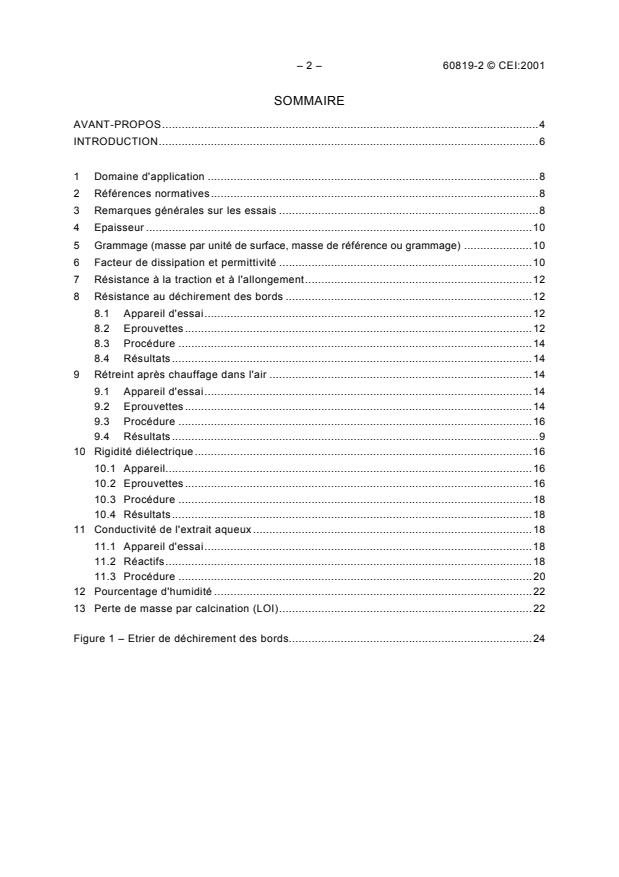
SOMMAIRE
AVANT-PROPOS.4
INTRODUCTION.6
1 Domaine d'application .8
2 Références normatives.8
3 Remarques générales sur les essais .8
4 Epaisseur .10
5 Grammage (masse par unité de surface, masse de référence ou grammage) .10
6 Facteur de dissipation et permittivité .10
7 Résistance à la traction et à l'allongement.12
8 Résistance au déchirement des bords .12
8.1 Appareil d'essai.12
8.2 Eprouvettes.12
8.3 Procédure .14
8.4 Résultats.14
9 Rétreint après chauffage dans l'air .14
9.1 Appareil d'essai.14
9.2 Eprouvettes.14
9.3 Procédure .16
9.4 Résultats.9
10 Rigidité diélectrique.16
10.1 Appareil.16
10.2 Eprouvettes.16
10.3 Procédure .18
10.4 Résultats.18
11 Conductivité de l'extrait aqueux .18
11.1 Appareil d'essai.18
11.2 Réactifs.18
11.3 Procédure .20
12 Pourcentage d'humidité .22
13 Perte de masse par calcination (LOI).22
Figure 1 – Etrier de déchirement des bords.24
60819-2 © IEC:2001 – 3 –
CONTENTS
FOREWORD.5
INTRODUCTION.7
1 Scope.9
2 Normative references .9
3 General notes on tests .9
4 Thickness .11
5 Grammage (mass per unit area, basic mass).11
6 Dissipation factor and permittivity .11
7 Tensile strength and elongation.13
8 Edge-tearing resistance.13
8.1 Test apparatus .13
8.2 Test pieces.13
8.3 Procedure .15
8.4 Results.15
9 Shrinkage due to heating in air .15
9.1 Test apparatus .15
9.2 Test pieces.15
9.3 Procedure .17
9.4 Results.9
10 Electric strength .17
10.1 Apparatus.17
10.2 Test pieces.17
10.3 Procedure .19
10.4 Results.19
11 Conductivity of aqueous extract.19
11.1 Test apparatus .19
11.2 Reagents.19
11.3 Procedure .21
12 Percentage of moisture content .23
13 Loss of mass on ignition (LOI) .23
Figure 1 – Edge-tearing stirrup .25
– 4 – 60819-2 © CEI:2001
COMMISSION ÉLECTROTECHNIQUE INTERNATIONALE
___________
PAPIERS NON CELLULOSIQUES À USAGES ÉLECTRIQUES –
Partie 2: Méthodes d’essai
AVANT-PROPOS
1) La CEI (Commission Électrotechnique Internationale) est une organisation mondiale de normalisation
composée de l'ensemble des comités électrotechniques nationaux (Comités nationaux de la CEI). La CEI a
pour objet de favoriser la coopération internationale pour toutes les questions de normalisation dans les
domaines de l'électricité et de l'électronique. A cet effet, la CEI, entre autres activités, publie des Normes
internationales. Leur élaboration est confiée à des comités d'études, aux travaux desquels tout Comité national
intéressé par le sujet traité peut participer. Les organisations internationales, gouvernementales et non
gouvernementales, en liaison avec la CEI, participent également aux travaux. La CEI collabore étroitement
avec l'Organisation Internationale de Normalisation (ISO), selon des conditions fixées par accord entre les
deux organisations.
2) Les décisions ou accords officiels de la CEI concernant les questions techniques représentent, dans la mesure
du possible, un accord international sur les sujets étudiés, étant donné que les Comités nationaux intéressés
sont représentés dans chaque comité d’études.
3) Les documents produits se présentent sous la forme de recommandations internationales. Ils sont publiés
comme normes, spécifications techniques, rapports techniques ou guides et agréés comme tels par les
Comités nationaux.
4) Dans le but d'encourager l'unification internationale, les Comités nationaux de la CEI s'engagent à appliquer de
façon transparente, dans toute la mesure possible, les Normes internationales de la CEI dans leurs normes
nationales et régionales. Toute divergence entre la norme de la CEI et la norme nationale ou régionale
correspondante doit être indiquée en termes clairs dans cette dernière.
5) La CEI n’a fixé aucune procédure concernant le marquage comme indication d’approbation et sa responsabilité
n’est pas engagée quand un matériel est déclaré conforme à l’une de ses normes.
6) L’attention est attirée sur le fait que certains des éléments de la présente Norme internationale peuvent faire
l’objet de droits de propriété intellectuelle ou de droits analogues. La CEI ne saurait être tenue pour
responsable de ne pas avoir identifié de tels droits de propriété et de ne pas avoir signalé leur existence.
La Norme internationale CEI 60819-2 a été établie par le sous-comité 15C: Spécifications, du
comité d'études 15 de la CEI: Matériaux isolants.
Le texte de cette norme est issu des documents suivants:
FDIS Rapport de vote
15C/1183/FDIS 15C/1238/RVD
Le rapport de vote indiqué dans le tableau ci-dessus donne toute information sur le vote ayant
abouti à l'approbation de cette norme.
Cette publication a été rédigée selon les Directives ISO/CEI, Partie 3.
Le comité a décidé que le contenu de cette publication ne sera pas modifié avant 2004.
A cette date, la publication sera
• reconduite;
• supprimée;
• remplacée par une édition révisée, ou
• amendée.
60819-2 © IEC:2001 – 5 –
INTERNATIONAL ELECTROTECHNICAL COMMISSION
____________
NON-CELLULOSIC PAPERS FOR ELECTRICAL PURPOSES –
Part 2: Methods of test
FOREWORD
1) The IEC (International Electrotechnical Commission) is a worldwide organization for standardization comprising
all national electrotechnical committees (IEC National Committees). The object of the IEC is to promote
international co-operation on all questions concerning standardization in the electrical and electronic fields. To
this end and in addition to other activities, the IEC publishes International Standards. Their preparation is
entrusted to technical committees; any IEC National Committee interested in the subject dealt with may
participate in this preparatory work. International, governmental and non-governmental organizations liaising
with the IEC also participate in this preparation. The IEC collaborates closely with the International
Organization for Standardization (ISO) in accordance with conditions determined by agreement between the
two organizations.
2) The formal decisions or agreements of the IEC on technical matters express, as nearly as possible, an
international consensus of opinion on the relevant subjects since each technical committee has representation
from all interested National Committees.
3) The documents produced have the form of recommendations for international use and are published in the form
of standards, technical specifications, technical reports or guides and they are accepted by the National
Committees in that sense.
4) In order to promote international unification, IEC National Committees undertake to apply IEC International
Standards transparently to the maximum extent possible in their national and regional standards. Any
divergence between the IEC Standard and the corresponding national or regional standard shall be clearly
indicated in the latter.
5) The IEC provides no marking procedure to indicate its approval and cannot be rendered responsible for any
equipment declared to be in conformity with one of its standards.
6) Attention is drawn to the possibility that some of the elements of this International Standard may be the subject
of patent rights. The IEC shall not be held responsible for identifying any or all such patent rights.
International Standard IEC 60819-2 has been prepared by subcommittee 15C: Specifications,
of IEC technical committee 15: Insulating materials.
The text of this standard is based on the following documents:
FDIS Report on voting
15C/1183/FDIS 15C/1238/RVD
Full information on the voting for the approval of this standard can be found in the report on
voting indicated in the above table.
This publication has been drafted in accordance with the ISO/IEC Directives, Part 3.
The committee has decided that the contents of this publication will remain unchanged
until 2004. At this date, the publication will be
• reconfirmed;
• withdrawn;
• replaced by a revised edition, or
• amended.
– 6 – 60819-2 © CEI:2001
INTRODUCTION
La présente Norme internationale fait partie d'une série traitant des papiers non cellulosiques
à usages électriques.
Cette série comporte trois parties:
Partie 1: Définitions et prescriptions générales (CEI 60819-1)
Partie 2: Méthodes d'essai (CEI 60819-2)
Partie 3: Spécifications pour matériaux particuliers (CEI 60819-3).
60819-2 © IEC:2001 – 7 –
INTRODUCTION
This International Standard is one of a series which deals with non-cellulosic papers for
electrical purposes.
The series consists of three parts:
Part 1: Definitions and general requirements (IEC 60819-1)
Part 2: Methods of test (IEC 60819-2)
Part 3: Specifications for individual materials (IEC 60819-3)
– 8 – 60819-2 © CEI:2001
PAPIERS NON CELLULOSIQUES À USAGES ÉLECTRIQUES –
Partie 2: Méthodes d’essai
1 Domaine d'application
La présente partie de la CEI 60819 contient les méthodes d'essai à utiliser pour essayer les
papiers non cellulosiques à usages électriques, satisfaisant aux exigences prescrites dans les
feuilles de spécifications de la CEI 60819-3.
2 Références normatives
Les documents normatifs suivants contiennent des dispositions qui, par suite de la référence
qui y est faite, constituent des dispositions valables pour la présente partie de la CEI 60819.
Pour les références datées, les amendements ultérieurs ou les révisions de ces publications
ne s’appliquent pas. Toutefois, les parties prenantes aux accords fondés sur la présente
partie de la CEI 60819 sont invitées à rechercher la possibilité d'appliquer les éditions les
plus récentes des documents normatifs indiqués ci-après. Pour les références non datées, la
dernière édition du document normatif en référence s’applique. Les membres de la CEI et de
l'ISO possèdent le registre des Normes internationales en vigueur.
CEI 60243-1:1998, Rigidité diélectrique des matériaux isolants – Méthode d’essai – Partie 1:
Essais aux fréquences industrielles
CEI 60250:1969, Méthodes recommandées pour la détermination de la permittivité et du
facteur de dissipation des isolants électriques aux fréquences industrielles, audibles et
radioélectriques (ondes métriques comprises)
CEI 60819-3 (toutes les parties), Spécification pour papiers non cellulosiques à usages
électriques – Partie 3: Spécifications pour matériaux
ISO 186:1994, Papier et carton – Echantillonnage pour déterminer la qualité moyenne
ISO 534:1988, Papier et carton – Détermination de l’épaisseur et de la masse volumique des
feuilles uniques ou des feuilles en liasse
ISO 536:1995, Papier et carton – Détermination du grammage
ISO 1924 (toutes les parties), Papier et carton – Détermination des propriétés de traction
3 Remarques générales sur les essais
Dans cette norme, il est en plusieurs endroits fait référence aux publications ISO, suivies
d'une brève description de la méthode utilisée. Il faut comprendre que cette brève description
est uniquement un moyen d'identification et qu'il convient de prendre toutes les informations
dans la publication ISO elle-même.
Dans cette norme, on utilise les définitions relatives aux termes «échantillon» et «éprouvette»,
telles qu'elles sont définies dans l’ISO 186.
– échantillon: rectangle de papier ou de planche découpé aux dimensions données,
prélevées dans des feuilles issues de lots identifiés.
NOTE Adaptée de 3.4 de l’ISO 186.
– éprouvette: quantité de papier ou de planche sur laquelle on réalise la détermination,
conformément à la méthode d'essai. Elle peut provenir d'un échantillon; dans certains cas
elle peut être l'échantillon lui-même.
NOTE Adaptée de 3.6 de l’ISO 186.
60819-2 © IEC:2001 – 9 –
NON-CELLULOSIC PAPERS FOR ELECTRICAL PURPOSES –
Part 2: Methods of test
1 Scope
This part of IEC 60819 contains the test methods to be used in testing non-cellulosic papers
for electrical purposes to meet the requirements prescribed in the specification sheets of
IEC 60819-3.
2 Normative references
The following normative documents contain provisions which, through reference in this
text, constitute provisions of this part of IEC 60819. For dated references, subsequent amend-
ments to, or revisions of, any of these publications do not apply. However, parties to
agreements based on this part of IEC 60819 are encouraged to investigate the possibility of
applying the most recent editions of the normative documents indicated below. For undated
references, the latest edition of the normative document referred to applies. Members of IEC
and ISO maintain registers of currently valid International Standards.
IEC 60243-1:1998, Electrical strength of insulating materials – Test methods – Part 1: Tests
at power frequencies
IEC 60250:1969, Recommended methods for the determination of the permittivity and
dielectric dissipation factor of electrical insulating materials at power, audio and radio
frequencies including metre wavelengths
IEC 60819-3 (all parts), Specification for non-cellulosic papers for electrical purposes –
Part 3: Specifications for individual materials
ISO 186:1994, Paper and board – Sampling to determine average quality
ISO 534:1988, Paper and board – Determination of thickness and apparent bulk density or
apparent sheet density
ISO 536:1995, Paper and board – Determination of grammage
ISO 1924 (all parts), Paper and board – Determination of tensile properties
3 General notes on tests
In this standard, reference is made in several places to ISO publications accompanied by a
short description of the method used. It is to be understood that this short description is
meant for identification purposes only and that all details should be taken from the ISO
publication itself.
In this standard, the definitions of “specimen” and “test piece” as defined in ISO 186 are used.
– specimen: a rectangle of paper or board cut to given dimensions from sheets drawn from
selected units.
NOTE Adapted from 3.4 of ISO 186.
– test piece: the quantity of paper or board on which the determination is carried out in
accordance with the method of test. It may be taken from a specimen; in some instances it
may be the specimen itself.
NOTE Adapted from 3.6 of ISO 186.
– 10 – 60819-2 © CEI:2001
3.1 Sauf spécification contraire, découper l'échantillon et conditionner les éprouvettes,
pendant au moins 16 h, dans une atmosphère à (23 ± 2) °C et à (50 ± 5) % d'humidité
relative. Réaliser les essais sur les éprouvettes dans cette atmosphère.
3.2 En cas de contestation utiliser le mode opératoire suivant.
Avant le conditionnement, sécher tous les échantillons à la température de 70 °C, pour les
amener à un taux d'humidité inférieur à 4 %. Conditionner ces échantillons pendant au moins
18 h dans une atmosphère à (23 ± 1) °C et à (50 ± 2) % d'humidité relative.
Sauf spécification contraire, réaliser les essais sur trois échantillons.
4 Epaisseur
4.1 Mesurer l'épaisseur sur une seule feuille éprouvette, conformément à l’ISO 534, en
utilisant un micromètre à cadran de précision qui applique à l'éprouvette une charge statique
équivalente à (100 ± 10) kPa.
4.2 Exceptions à l'ISO 534
– Faire une détermination sur chacune des trois éprouvettes conditionnées.
– Prendre la valeur centrale comme résultat de l'épaisseur d’une seule feuille; les deux
autres déterminations doivent être notées.
– Utiliser le millimètre comme unité pour l'épaisseur.
– L'information concernant l'écart type est facultative.
5 Grammage (masse par unité de surface, masse de référence ou grammage)
5.1 Mesurer le grammage conformément à l’ISO 536.
Principe: La surface de chaque éprouvette et sa masse sont mesurées sur des éprouvettes
conditionnées. On calcule la masse par unité de surface.
5.2 Exceptions à l'ISO 536
– Ne pas tenir compte des articles 5 et 6.
– Réaliser une détermination sur chacune des trois éprouvettes conditionnées dont la
surface n'est pas inférieure à 0,05 m .
– Déterminer la masse avec une précision de 0,5 %.
– Prendre la valeur centrale comme résultat; noter les deux autres valeurs.
6 Facteur de dissipation et permittivité
6.1 Utiliser des appareils qui sont appropriés pour mesurer le facteur de dissipation et la
permittivité décrits dans la CEI 60250. Essayer au moins trois échantillons. Sauf spécification
contraire, conditionner les éprouvettes comme en 3.1.
6.2 Sauf spécification contraire, faire les essais à température ambiante conformément
à 3.1, en utilisant une tension alternative à fréquence fixée comprise entre 48 Hz et 62 Hz,
conduisant à une contrainte approximative de 0,4 MV/m.
6.3 Noter les valeurs médianes du facteur de dissipation et de la permittivité.
60819-2 © IEC:2001 – 11 –
3.1 Unless otherwise specified, cut the specimen and condition the test pieces for not less
than 16 h in an atmosphere of (23 ± 2) °C and (50 ± 5) % r.h. Perform the tests on the test
pieces in this atmosphere.
3.2 In cases of dispute use the following procedure.
Prior to conditioning, dry all specimens at 70 °C to a moisture content below 4 %. Condition
these pieces for a minimum of 18 h at (23 ± 1) °C and (50 ± 2) % r.h.
Unless otherwise specified, ma
...