


IEC 60601-2-19:2009/COR1:2012
(Corrigendum)Corrigendum 1 - Medical electrical equipment - Part 2-19: Particular requirements for the basic safety and essential performance of infant incubators
Corrigendum 1 - Medical electrical equipment - Part 2-19: Particular requirements for the basic safety and essential performance of infant incubators
Corrigendum 1 - Appareils électromédicaux - Partie 2-19: Exigences particulières pour la sécurité de base et les performances essentielles des incubateurs pour nouveau-nés
General Information
Relations
Standards Content (Sample)
IEC 60601-2-19
(Second edition – 2009)
Medical electrical equipment –
Part 2-19: Particular requirements for the basic safety
and essential performance of infant incubators
CO RRI G ENDU M 1
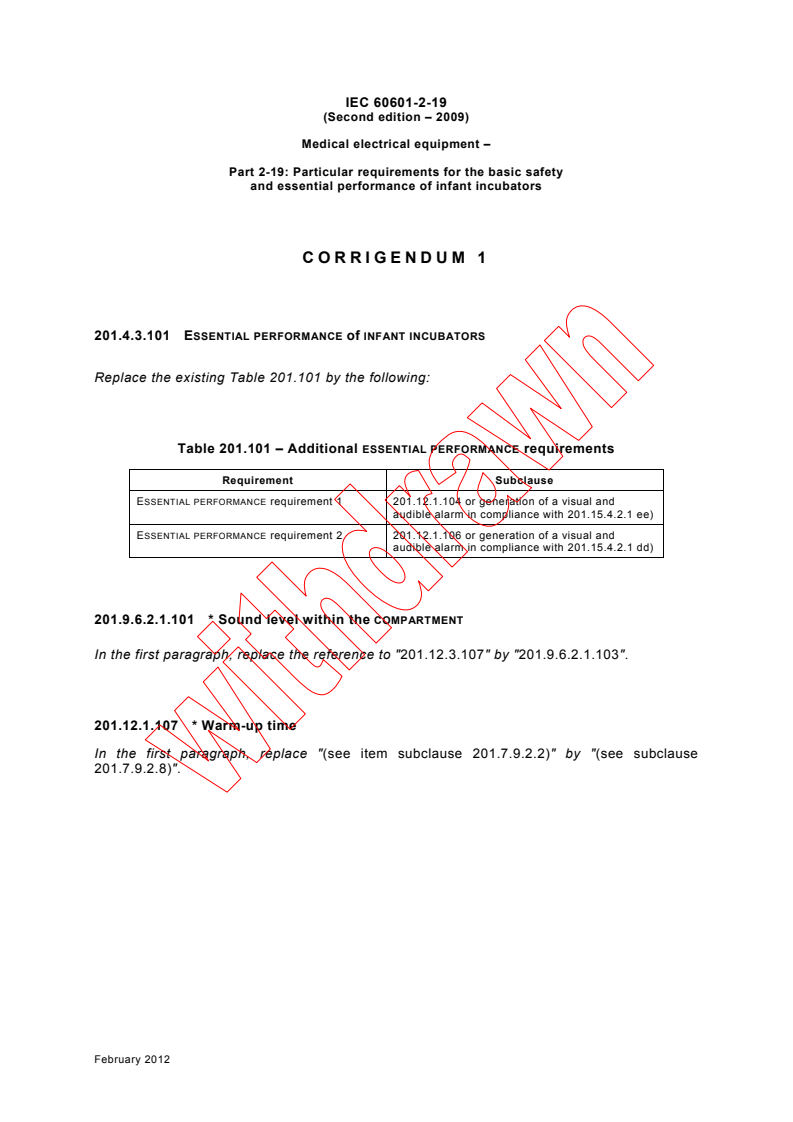
201.4.3.101 ESSENTIAL PERFORMANCE of INFANT INCUBATORS
Replace the existing Table 201.101 by the following:
Table 201.101 – Additional ESSENTIAL PERFORMANCE requirements
Requirement Subclause
ESSENTIAL PERFORMANCE requirement 1 201.12.1.104 or generation of a visual and
audible alarm in compliance with 201.15.4.2.1 ee)
ESSENTIAL PERFORMANCE requirement 2 201.12.1.106 or generation of a visual and
audible alarm in compliance with 201.15.4.2.1 dd)
201.9.6.2.1.101 * Sound level within the COMPARTMENT
In the first paragraph, replace the reference to "201.12.3.107" by "201.9.6.2.1.103".
201.12.1.107 * Warm-up time
In the first paragraph, replace "(see item subclause 201.7.9.2.2)" by "(see subclause
201.7.9.2.8)".
February 2012
CEI 60601-2-19
(Deuxième édition – 2009)
...
This May Also Interest You
This document specifies requirements for masks and accessories, including any connecting element, that are required to connect the patient-connection port of sleep apnoea breathing therapy equipment to a patient for the application of sleep apnoea breathing therapy (e.g. nasal masks, exhaust ports and headgear).
This document applies to masks and their accessories used to connect sleep apnoea breathing therapy equipment to the patient.
The requirements in this document take priority over the requirements in ISO 18190.
This document does not cover oral appliances.
NOTE This document has been prepared to address the relevant essential principles [14] and labelling principles [15] of the International Medical Devices Regulators Forum (IMDRF) as indicated in Annex I.
- Standard36 pagesEnglish languagesale 15% off
- Standard37 pagesFrench languagesale 15% off
ISO 80601-2-70:2025 This document is applicable to the basic safety and essential performance of sleep apnoea breathing therapy equipment, hereafter referred to as ME equipment, intended to alleviate the symptoms of patients who suffer from obstructive sleep apnoea by delivering a therapeutic breathing pressure to the respiratory tract of the patient. Sleep apnoea breathing therapy equipment is intended for use in the home healthcare environment by lay operators as well as in professional healthcare institutions.
Sleep apnoea breathing therapy equipment is not considered to utilize a physiologic closed-loop-control system unless it uses a physiological patient variable to adjust the therapy settings.
This document excludes sleep apnoea breathing therapy equipment intended for use with neonates.
This document is applicable to ME equipment or an ME system intended for those patients who are not dependent on artificial ventilation. This document is not applicable to ME equipment or an ME system intended for those patients who are dependent on artificial ventilation such as patients with central sleep apnoea.
This document is also applicable to those accessories intended by their manufacturer to be connected to sleep apnoea breathing therapy equipment, where the characteristics of those accessories can affect the basic safety or essential performance of the sleep apnoea breathing therapy equipment.
Masks and application accessories intended for use during sleep apnoea breathing therapy are additionally addressed by ISO 17510. Refer to Figure AA.1 for items covered further under this document.
If a clause or subclause is specifically intended to be applicable to ME equipment only, or to ME systems only, the title and content of that clause or subclause will say so. If that is not the case, the clause or subclause applies both to ME equipment and to ME systems, as relevant.
Hazards inherent in the intended physiological function of ME equipment or ME systems within the scope of this document are not covered by specific requirements in this document except in 7.2.13 and 8.4.1 of the general standard.
NOTE 2 See also 4.2 of the general standard.
This document does not specify the requirements for:
– ventilators or accessories intended for critical care ventilators for ventilator-dependent patients, which are given in ISO 80601‑2‑12.
– ventilators or accessories intended for anaesthetic applications, which are given in ISO 80601-2-13.
– ventilators or accessories intended for home care ventilators for ventilator-dependent patients, which are given in ISO 80601-2-72.
– ventilators or accessories intended for emergency and transport, which are given in ISO 80601-2-84.
– ventilators or accessories intended for home-care ventilatory support, which are given in ISO 80601‑2-79 and ISO 80601‑2‑80.
– high-frequency ventilators[23], which are given in ISO 80601-2-87.
– respiratory high flow equipment, which are given in ISO 80601‑2‑90;
NOTE 3 ISO 80601-2-80 ventilatory support equipment can incorporate high-flow therapy operational mode, but such a mode is only for spontaneously breathing patients.
– user-powered resuscitators, which are given in ISO 10651-4;
– gas-powered emergency resuscitators, which are given in ISO 10651-5;
– oxygen therapy constant flow ME equipment; and
– cuirass or “iron-lung” ventilation equipment.
- Standard78 pagesEnglish languagesale 15% off
- Standard83 pagesFrench languagesale 15% off
This document specifies general interface requirements for small-bore connectors that form part of a medical device or accessory that conveys liquids or gases to a patient. This document also identifies the applications for which these small-bore connectors are intended to be used, which include, but are not limited to:
- respiratory;
- enteral;
- limb cuff inflation;
- neural;
- intravascular or hypodermic;
- other use cases utilizing an ISO 80369-7 small-bore connector.
This document provides the methodology to assess non-interconnectable characteristics of small-bore connectors based on their inherent design in order to reduce the risk of misconnections between medical devices or between accessories for different applications as specified in this document as well as those that can be developed under future parts of the ISO and IEC 80369 series.
NOTE Clause A.2 contains guidance or rationale for this Clause.
- Standard41 pagesEnglish languagesale 15% off
NOTE 1 There is guidance or rationale for this subclause contained in Clause AA.2.
This document applies to the basic safety and essential performance of ventilatory support equipment, as defined in 201.3.302, for ventilatory insufficiency, as defined in 201.3.302, hereafter also referred to as ME equipment, in combination with its accessories:
- intended for use in the home healthcare environment;
NOTE 2 In the home healthcare environment, the supply mains driving the ventilatory support equipment is often not reliable.
NOTE 3 Such ventilatory support equipment can also be used in professional health care facilities.
- intended for use by a lay operator;
- intended for use with patients who have ventilatory insufficiency or failure, the most fragile of which would likely experience injury with the loss of this artificial ventilation;
- intended for transit-operable use; and
- not intended for patients who are dependent on artificial ventilation for their immediate life support.
EXAMPLE 1 Patients with moderate to severe chronic obstructive pulmonary disease (COPD), moderate amyotrophic lateral sclerosis (ALS), severe bronchopulmonary dysplasia or muscular dystrophy.
Ventilatory support equipment is not considered to use a physiologic closed-loop control system unless it uses a physiological patient variable to adjust the artificial ventilation therapy settings.
This document is also applicable to those accessories intended by their manufacturer to be connected to the ventilator breathing system of ventilatory support equipment for ventilatory insufficiency, where the characteristics of those accessories can affect the basic safety or essential performance of the ventilatory support equipment for ventilatory insufficiency.
EXAMPLE 2 Breathing sets, connectors, water traps, expiratory valve, humidifier, breathing system filter, external electrical power source, distributed alarm system.
If a clause or subclause is specifically intended to be applicable to ME equipment only, or to ME systems only, the title and content of that clause or subclause will say so. If that is not the case, the clause or subclause applies both to ME equipment and to ME systems, as relevant.
Hazards inherent in the intended physiological function of ME equipment or ME systems within the scope of this document are not covered by specific requirements in this document except in IEC 60601‑1:2005+AMD1:2012+AMD2:2020, 7.2.13 and 8.4.1.
NOTE 4 Additional information can be found in IEC 60601‑1:2005+AMD1:2012+AMD2:2020, 4.2.
NOTE 5 See ISO/TR 21954 for guidance on the selection of the appropriate ventilator for a given patient.
This document does not specify the requirements for:
- ventilators or accessories for ventilator-dependent patients intended for critical care applications, which are given in ISO 80601‑2‑12;
- ventilators or accessories intended for anaesthetic applications, which are given in ISO 80601‑2‑13;
- ventilators or accessories intended for the emergency medical services environment, which are given in ISO 80601‑2‑84;
- ventilators or accessories intended for ventilator-dependent patients in the home healthcare environment, which are given in ISO 80601‑2‑72;
- ventilatory support equipment or accessories intended for ventilatory impairment, which are given in ISO 80601‑2‑79;
- sleep apnoea therapy ME equipment, which are given in ISO 80601‑2‑70;
- high-frequency jet ventilators (HFJVs), which are given in ISO 80601‑2‑87;
- high-frequency oscillatory ventilators (HFOVs);
- respiratory high flow equipment, which are given in ISO 80601‑2‑90;
NOTE 6 Ventilatory support equipment can incorporate high-flow therapy operational mode, but such a mode is only for spontaneously breathing patients.
- user-powered resuscitators, which are given in ISO 10651-4;
- gas-powered emergency resuscitators, which are given in ISO 10651-5;
- oxygen therapy constant flow ME equipment; and
- cuirass or “iron-lung” ventilation equipment.
- Standard120 pagesEnglish languagesale 15% off
- Standard130 pagesFrench languagesale 15% off
NOTE 1 There is guidance or rationale for this subclause contained in Clause AA.2.
This document applies to the basic safety and essential performance of ventilatory support equipment, as defined in 201.3.302, for ventilatory impairment, as defined in 201.3.300, hereafter also referred to as ME equipment, in combination with its accessories:
- intended for use in the home healthcare environment;
NOTE 2 In the home healthcare environment, the supply mains driving the ventilatory support equipment is often not reliable.
NOTE 3 Such ventilatory support equipment can also be used in professional health care facilities.
- intended for use by a lay operator;
- intended for use with patients who have ventilatory impairment, the most fragile of these patients, would not likely experience injury with the loss of this artificial ventilation; and
- not intended for patients who are dependent on artificial ventilation for their immediate life support.
EXAMPLE 1 Patients with mild to moderate chronic obstructive pulmonary disease (COPD).
Ventilatory support equipment is not considered to use a physiologic closed-loop control system unless it uses a physiological patient variable to adjust the artificial ventilation therapy settings.
This document is also applicable to those accessories intended by their manufacturer to be connected to the breathing system of ventilatory support equipment for ventilatory impairment, where the characteristics of those accessories can affect the basic safety or essential performance of the ventilatory support equipment for ventilatory impairment.
EXAMPLE 2 Breathing sets, connectors, water traps, expiratory valve, humidifier, breathing system filter, external electrical power source, distributed alarm system.
If a clause or subclause is specifically intended to be applicable to ME equipment only, or to ME systems only, the title and content of that clause or subclause will say so. If that is not the case, the clause or subclause applies both to ME equipment and to ME systems, as relevant.
Hazards inherent in the intended physiological function of ME equipment or ME systems within the scope of this document are not covered by specific requirements in this document except in IEC 60601‑1:2005+AMD1:2012+AMD2:2020, 7.2.13 and 8.4.1.
NOTE 4 Additional information can be found in IEC 60601‑1:2005+AMD1:2012+AMD2:2020, 4.2.
NOTE 5 See ISO/TR 21954 for guidance on the selection of the appropriate ventilator for a given patient.
This document does not specify the requirements for:
- ventilators or accessories for ventilator-dependent patients intended for critical care applications, which are given in ISO 80601‑2‑12;
- ventilators or accessories intended for anaesthetic applications, which are given in ISO 80601‑2‑13;
- ventilators or accessories intended for the emergency medical services environment, which are given in ISO 80601‑2‑84;
- ventilators or accessories intended for ventilator-dependent patients in the home healthcare environment, which are given in ISO 80601‑2‑72;
- ventilatory support equipment or accessories intended for ventilatory insufficiency, which are given in ISO 80601‑2‑80;
- sleep apnoea therapy ME equipment, which are given in ISO 80601‑2‑70;
- high-frequency jet ventilators (HFJVs), which are given in ISO 80601‑2‑87;
- high-frequency oscillatory ventilators (HFOVs);
- respiratory high flow equipment, which are given in ISO 80601‑2‑90;
NOTE 6 Ventilatory support equipment can incorporate high-flow therapy operational mode, but such a mode is only for spontaneously breathing patients.
- user-powered resuscitators, which are given in ISO 10651-4;
- gas-powered emergency resuscitators, which are given in ISO 10651-5;
- oxygen therapy constant flow ME equipment; and
- cuirass or “iron-lung” ventilation equipment.
- Standard107 pagesEnglish languagesale 15% off
- Standard107 pagesFrench languagesale 15% off
This document specifies the design and dimensions for two small-bore connectors intended to be used for connections in respiratory applications of medical devices and accessories. One connector (R1) is intended for use on medical devices and accessories subjected to pressures up to 15 kPa (e.g. a breathing system). The other connector (R2) is intended for use on medical devices and accessories subjected to higher pressures between 15 kPa and 600 kPa (e.g. oxygen therapy tubing).
NOTE 1 The pressure is related to pressure available at the source to which the medical device is connected.
NOTE 2 The intended application does not preclude the use of other connectors on medical devices or accessories within this application.
NOTE 3 Requirements for alternative connectors for this intended application are specified in ISO 80369-1.
This document does not specify requirements for the medical devices or accessories that use these connectors. Such requirements are given in device-specific standards.
NOTE 4 If a device-specific standard does not exist, the performance and material requirements specified in ISO 80369-1 can be used as guidance.
- Standard50 pagesEnglish languagesale 15% off
- Standard5 pagesEnglish languagesale 15% off
- Standard5 pagesFrench languagesale 15% off
- Standard8 pagesEnglish languagesale 15% off
- Standard8 pagesFrench languagesale 15% off
- Standard22 pagesEnglish and French languagesale 15% off
- Standard21 pagesEnglish and French languagesale 15% off
Questions, Comments and Discussion
Ask us and Technical Secretary will try to provide an answer. You can facilitate discussion about the standard in here.
Loading comments...