


EN 55016-2-1:2004
(Main)Specification for radio disturbance and immunity measuring apparatus and methods - Part 2-1: Methods of measurement of disturbances and immunity - Conducted disturbance measurements
General Information
- Abstract
This part of CISPR 16 is designated a basic standard, which specifies the methods of measurement of disturbance phenomena in general in the frequency range 9 kHz to 18 GHz and especially of conducted disturbance phenomena in the frequency range 9 kHz to 30 MHz. CISPR 16-2 has been reorganised into 4 parts, to accommodate growth and easier maintenance. This first edition of CISPR 16-2-1, together with CISPR 16-2-2, CISPR 16-2-3 and CISPR 16-2-4, cancels and replaces the second edition of CISPR 16-2, published in 2003. It contains the relevant clauses of CISPR 16-2 without technical changes.
- Status
- Withdrawn
- Publication Date
- 20-Oct-2004
- Withdrawal Date
- 31-Aug-2007
- Technical Committee
- CLC/TC 210 - Electromagnetic Compatibility (EMC)
- Drafting Committee
- IEC/SC CISPR/A - Merjenje radijskih interferenc in statistične metode
- Parallel Committee
- IEC/SC CISPR/A - Merjenje radijskih interferenc in statistične metode
- Current Stage
- 9960 - Withdrawal effective - Withdrawal
- Start Date
- 01-Mar-2012
- Completion Date
- 01-Mar-2012
Not Harmonized89/336/EEC - Electromagnetic compatibility (EMC)

Relations
- Effective Date
- 28-Jan-2023
- Effective Date
- 10-Feb-2026
- Effective Date
- 10-Feb-2026
- Effective Date
- 09-Feb-2026
- Effective Date
- 03-Feb-2026
- Effective Date
- 03-Feb-2026
- Effective Date
- 03-Feb-2026
- Effective Date
- 03-Feb-2026
- Effective Date
- 03-Feb-2026
- Effective Date
- 03-Feb-2026
- Effective Date
- 03-Feb-2026
- Effective Date
- 03-Feb-2026
- Effective Date
- 03-Feb-2026
- Effective Date
- 03-Feb-2026
- Effective Date
- 03-Feb-2026
Get Certified
Connect with accredited certification bodies for this standard

ANCE
Mexican certification and testing association.

Intertek Slovenia
Intertek testing, inspection, and certification services in Slovenia.

LNE (Laboratoire National de Métrologie et d'Essais)
French national laboratory for metrology and testing.
Sponsored listings
Frequently Asked Questions
EN 55016-2-1:2004 is a standard published by CLC. Its full title is "Specification for radio disturbance and immunity measuring apparatus and methods - Part 2-1: Methods of measurement of disturbances and immunity - Conducted disturbance measurements". This standard covers: This part of CISPR 16 is designated a basic standard, which specifies the methods of measurement of disturbance phenomena in general in the frequency range 9 kHz to 18 GHz and especially of conducted disturbance phenomena in the frequency range 9 kHz to 30 MHz. CISPR 16-2 has been reorganised into 4 parts, to accommodate growth and easier maintenance. This first edition of CISPR 16-2-1, together with CISPR 16-2-2, CISPR 16-2-3 and CISPR 16-2-4, cancels and replaces the second edition of CISPR 16-2, published in 2003. It contains the relevant clauses of CISPR 16-2 without technical changes.
This part of CISPR 16 is designated a basic standard, which specifies the methods of measurement of disturbance phenomena in general in the frequency range 9 kHz to 18 GHz and especially of conducted disturbance phenomena in the frequency range 9 kHz to 30 MHz. CISPR 16-2 has been reorganised into 4 parts, to accommodate growth and easier maintenance. This first edition of CISPR 16-2-1, together with CISPR 16-2-2, CISPR 16-2-3 and CISPR 16-2-4, cancels and replaces the second edition of CISPR 16-2, published in 2003. It contains the relevant clauses of CISPR 16-2 without technical changes.
EN 55016-2-1:2004 is classified under the following ICS (International Classification for Standards) categories: 33.100.10 - Emission; 33.100.20 - Immunity. The ICS classification helps identify the subject area and facilitates finding related standards.
EN 55016-2-1:2004 has the following relationships with other standards: It is inter standard links to EN 55016-2-1:2009, CISPR 16-4-2:2003, IEC 60364-4-42:2001, EN 14626:2005, EN 55016-1-2:2004, EN 55016-2-2:2004, EN 55016-4-2:2004, EN 55016-2-4:2004, EN 55016-2-3:2004, EN 55013:2001, EN 55014-1:2000, EN 55016-1-1:2004, EN 55015:2006, EN 60601-2-2:2007, EN 55014-1:2006. Understanding these relationships helps ensure you are using the most current and applicable version of the standard.
EN 55016-2-1:2004 is associated with the following European legislation: EU Directives/Regulations: 2004/108/EC, 2004/108/EU, 89/336/EEC. When a standard is cited in the Official Journal of the European Union, products manufactured in conformity with it benefit from a presumption of conformity with the essential requirements of the corresponding EU directive or regulation.
EN 55016-2-1:2004 is available in PDF format for immediate download after purchase. The document can be added to your cart and obtained through the secure checkout process. Digital delivery ensures instant access to the complete standard document.
Standards Content (Sample)
STANDARDSpecifikacija za merilne naprave in metode za merjenje radijskih motenj in odpornosti – 2-1. del: Metode za merjenje radijskih motenj in odpornosti – Merjenje motenj po vodnikih (CISPR 16-2-1:2003)Specification for radio disturbance and immunity measuring apparatus and methods – Part 2-1: Methods of measurement of disturbances and immunity – Conducted disturbance measurements (CISPR 16-2-1:2003)©
Standard je založil in izdal Slovenski inštitut za standardizacijo. Razmnoževanje ali kopiranje celote ali delov tega dokumenta ni dovoljenoReferenčna številkaSIST EN 55016-2-1:2005(en)ICS17.220.20; 33.100.20
EUROPEAN STANDARD
EN 55016-2-1 NORME EUROPÉENNE EUROPÄISCHE NORM
October 2004 CENELEC European Committee for Electrotechnical Standardization Comité Européen de Normalisation Electrotechnique Europäisches Komitee für Elektrotechnische Normung
Central Secretariat: rue de Stassart 35, B - 1050 Brussels
© 2004 CENELEC - All rights of exploitation in any form and by any means reserved worldwide for CENELEC members.
Ref. No. EN 55016-2-1:2004 E
ICS 33.100.10; 33.100.20
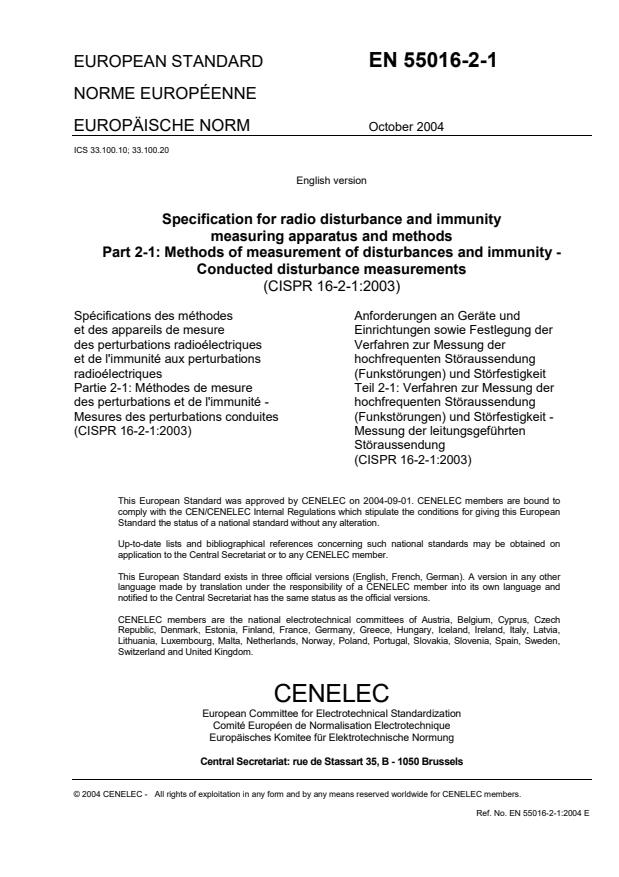
English version
Specification for radio disturbance and immunity
measuring apparatus and methods Part 2-1: Methods of measurement of disturbances and immunity - Conducted disturbance measurements (CISPR 16-2-1:2003)
Spécifications des méthodes
et des appareils de mesure
des perturbations radioélectriques
et de l'immunité aux perturbations radioélectriques Partie 2-1: Méthodes de mesure
des perturbations et de l'immunité - Mesures des perturbations conduites (CISPR 16-2-1:2003)
Anforderungen an Geräte und Einrichtungen sowie Festlegung der Verfahren zur Messung der hochfrequenten Störaussendung (Funkstörungen) und Störfestigkeit Teil 2-1: Verfahren zur Messung der hochfrequenten Störaussendung (Funkstörungen) und Störfestigkeit - Messung der leitungsgeführten Störaussendung (CISPR 16-2-1:2003)
This European Standard was approved by CENELEC on 2004-09-01. CENELEC members are bound to comply with the CEN/CENELEC Internal Regulations which stipulate the conditions for giving this European Standard the status of a national standard without any alteration.
Up-to-date lists and bibliographical references concerning such national standards may be obtained on application to the Central Secretariat or to any CENELEC member.
This European Standard exists in three official versions (English, French, German). A version in any other language made by translation under the responsibility of a CENELEC member into its own language and notified to the Central Secretariat has the same status as the official versions.
CENELEC members are the national electrotechnical committees of Austria, Belgium, Cyprus, Czech Republic, Denmark, Estonia, Finland, France, Germany, Greece, Hungary, Iceland, Ireland, Italy, Latvia, Lithuania, Luxembourg, Malta, Netherlands, Norway, Poland, Portugal, Slovakia, Slovenia, Spain, Sweden, Switzerland and United Kingdom.
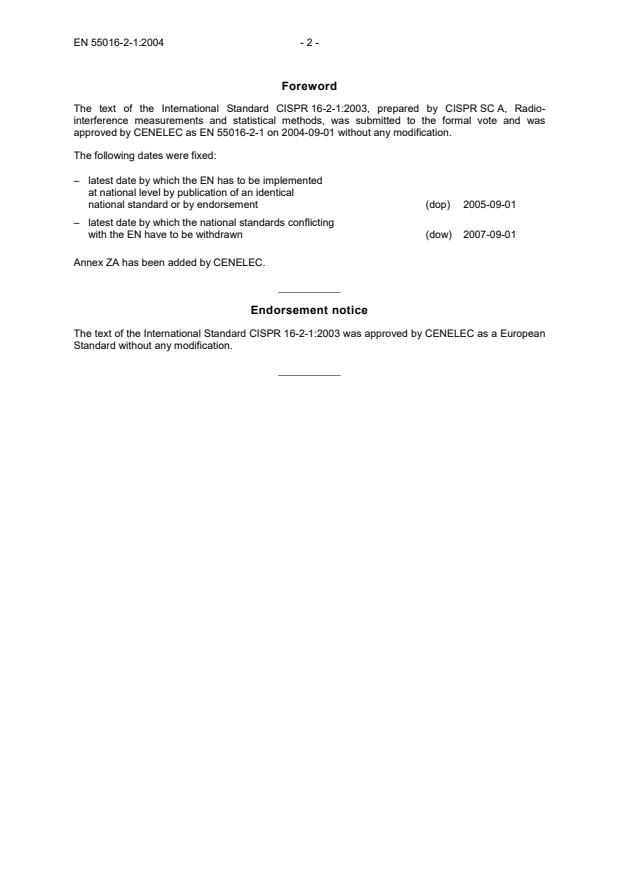
Foreword The text of the International Standard CISPR 16-2-1:2003, prepared by CISPR SC A, Radio-interference measurements and statistical methods, was submitted to the formal vote and was approved by CENELEC as EN 55016-2-1 on 2004-09-01 without any modification. The following dates were fixed: – latest date by which the EN has to be implemented
at national level by publication of an identical
national standard or by endorsement
(dop) 2005-09-01 – latest date by which the national standards conflicting
with the EN have to be withdrawn
(dow) 2007-09-01 Annex ZA has been added by CENELEC. __________ Endorsement notice The text of the International Standard CISPR 16-2-1:2003 was approved by CENELEC as a European Standard without any modification. __________
- 3 - EN 55016-2-1:2004
Annex ZA
(normative)
Normative references to international publications
with their corresponding European publications The following referenced documents are indispensable for the application of this document. For dated references, only the edition cited applies. For undated references, the latest edition of the referenced document (including any amendments) applies. NOTE When an international publication has been modified by common modifications, indicated by (mod), the relevant EN/HD applies. Publication Year Title EN/HD Year IEC 60083 1997 Plugs and socket-outlets for domestic and similar general use standardized in member countries of IEC
- - IEC 60364-4 Series Electrical installations of buildings Part 4: Protection for safety
HD 384.4/ HD 60364-4 Series CISPR 11 2003 Industrial scientific and medical (ISM) radio-frequency equipment - Electromagnetic disturbance characteristics - Limits and methods of measurement
- - CISPR 13 (mod) 2001 Sound and television broadcast receivers and associated equipment - Radio disturbance characteristics - Limits and methods of measurement
EN 55013 2001 CISPR 14-1 2000 Electromagnetic compatibility - Requirements for household appliances, electric tools and similar apparatus Part 1: Emission
EN 55014-1 2000 CISPR 16-1-1 2003 Specification for radio disturbance and immunity measuring apparatus and methods Part 1-1: Radio disturbance and immunity measuring apparatus - Measuring apparatus
EN 55016-1-1 2004 CISPR 16-1-2 2003 Part 1-2: Radio disturbance and immunity measuring apparatus - Ancillary equipment - Conducted disturbances
EN 55016-1-2 2004 CISPR 16-2-2 2003 Part 2-2: Methods of measurement of disturbances and immunity - Measurement of disturbance power
EN 55016-2-2 2004 CISPR 16-2-3 2003 Part 2-3: Methods of measurement of disturbances and immunity - Radiated disturbance measurements
EN 55016-2-3 2004
Publication Year Title EN/HD Year CISPR 16-2-4 2003 Part 2-4: Methods of measurement of disturbances and immunity - Immunity measurements
EN 55016-2-4 2004 CISPR/TR 16-3 2003 Part 3: CISPR technical reports
- - CISPR/TR 16-4-1 2003 Part 4-1: Uncertainties, statistics and limit modeling - Uncertainties in standardized EMC tests
- - CISPR 16-4-2 2003 Part 4-2: Uncertainties, statistics and limit modelling - Uncertainty in EMC measurements
EN 55016-4-2 2004 CISPR/TR 16-4-3 2003 Part 4-3: Uncertainties, statistics and limit modelling - Statistical considerations in the determination of EMC compliance of mass-produced products
- - CISPR/TR 16-4-4 2003 Part 4-4: Uncertainties, statistics and limit modeling - Statistics of complaints and a model for the calculation of limits - - ITU-R Recommendation BS.468-4 1994 Measurement of audio-frequency noise voltage level in sound broadcasting
- -
COMMISSIONÉLECTROTECHNIQUEINTERNATIONALECISPR16-2-1INTERNATIONALELECTROTECHNICALCOMMISSIONPremière éditionFirst edition2003-11COMITÉINTERNATIONAL SPÉCIAL DES PERTURBATIONS RADIOÉLECTRIQUESINTERNATIONAL SPECIALCOMMITTEE ON RADIOINTERFERENCESpécifications des méthodes et des appareils de mesure des perturbations radioélectriqueset de l'immunité aux perturbationsradioélectriques – Partie 2-1:Méthodes de mesure des perturbations et de l'immunité – Mesures des perturbations conduitesSpecification for radio disturbance and immunitymeasuring apparatus and methods – Part 2-1:Methods of measurement of disturbancesand immunity – Conducted disturbancemeasurements” IEC2003
Droits de reproduction réservés Copyright - all rights reservedAucune partie de cette publication ne peut être reproduiteniutilisée sous quelque formeque ce soit et paraucun procédé,électroniqueou mécanique, y comprisla photocopie etlesmicrofilms, sansl'accordécrit de l'éditeur.No partof this publication may be reproducedorutilized in anyform or by any means, electronic or mechanical, includingphotocopying and microfilm,withoutpermissionin writing fromthe publisher.International Electrotechnical Commission,
3, ruedeVarembé,PO Box 131, CH-1211 Geneva 20, SwitzerlandTelephone: +41 22 919 02 11 Telefax: +41 22 919 03 00E-mail: inmail@iec.chWeb: www.iec.chXBCODE PRIXPRICE CODECommission Electrotechnique InternationaleInternational ElectrotechnicalCommissionPour prix, voir catalogue en vigueur For price,see current catalogue
CISPR 16-2-1 ¤ IEC:2003 – 3 –
CONTENTS FOREWORD.5INTRODUCTION.9TABLE RECAPITULATING CROSS-REFERENCES.111Scope.132Normative references.133Definitions.154Types of disturbance to be measured.235Connection of measuring equipment.236General measurement requirements and conditions.257Measurement of disturbances conducted along leads, 9 kHz to 30 MHz.438Automated measurement of emissions.95Annex A (informative)
Guidelines to connection of electrical equipment to the artificial mains network.103Annex B (informative)
Use of spectrum analyzers and scanning receivers.121Annex C (informative)
Decision tree for use of detectors for conducted measurements.127
CISPR 16-2-1 ¤ IEC:2003 – 5 –
INTERNATIONAL ELECTROTECHNICAL COMMISSION INTERNATIONAL SPECIAL COMMITTEE ON RADIO INTERFERENCE ____________SPECIFICATION FOR RADIO DISTURBANCE AND IMMUNITY MEASURING APPARATUS AND METHODS –Part 2-1: Methods of measurement of disturbances and immunity –
Conducted disturbance measurements FOREWORD 1) The International Electrotechnical Commission (IEC) is a worldwide organization for standardization comprising all national electrotechnical committees (IEC National Committees). The object of IEC is to promote international co-operation on all questions concerning standardization in the electrical and electronic fields. To this end and in addition to other activities, IEC publishes International Standards, Technical Specifications, Technical Reports, Publicly Available Specifications (PAS) and Guides (hereafter referred to as “IEC Publication(s)”). Their preparation is entrusted to technical committees; any IEC National Committee interested in the subject dealt with may participate in this preparatory work. International, governmental and non-governmental organizations liaising with the IEC also participate in this preparation. IEC collaborates closely with the International Organization for Standardization (ISO) in accordance with conditions determined by agreement between the two organizations. 2) The formal decisions or agreements of IEC on technical matters express, as nearly as possible, an international consensus of opinion on the relevant subjects since each technical committee has representation from all interested IEC National Committees.
3) IEC Publications have the form of recommendations for international use and are accepted by IEC National Committees in that sense. While all reasonable efforts are made to ensure that the technical content of IEC Publications is accurate, IEC cannot be held responsible for the way in which they are used or for any misinterpretation by any end user. 4) In order to promote international uniformity, IEC National Committees undertake to apply IEC Publications transparently to the maximum extent possible in their national and regional publications. Any divergence between any IEC Publication and the corresponding national or regional publication shall be clearly indicated in the latter. 5) IEC provides no marking procedure to indicate its approval and cannot be rendered responsible for any equipment declared to be in conformity with an IEC Publication. 6) All users should ensure that they have the latest edition of this publication. 7) No liability shall attach to IEC or its directors, employees, servants or agents including individual experts and members of its technical committees and IEC National Committees for any personal injury, property damage or other damage of any nature whatsoever, whether direct or indirect, or for costs (including legal fees) and expenses arising out of the publication, use of, or reliance upon, this IEC Publication or any other IEC Publications.
8) Attention is drawn to the Normative references cited in this publication. Use of the referenced publications is indispensable for the correct application of this publication. 9) Attention is drawn to the possibility that some of the elements of this IEC Publication may be the subject of patent rights. IEC shall not be held responsible for identifying any or all such patent rights. International Standard CISPR 16-2-1 has been prepared by CISPR subcommittee A: Radio interference measurements and statistical methods. This first edition of CISPR 16-2-1, together with CISPR 16-2-2, CISPR 16-2-3 and CISPR 16-2-4, cancels and replaces the second edition of CISPR 16-2, published in 2003. It contains the relevant clauses of CISPR 16-2 without technical changes. This publication has been drafted in accordance with the ISO/IEC Directives, Part 2.
CISPR 16-2-1 ¤ IEC:2003 – 7 –
The committee has decided that the contents of this publication will remain unchanged until 2005. At this date, the publication will be
x reconfirmed; x withdrawn; x replaced by a revised edition, or x amended.
CISPR 16-2-1 ¤ IEC:2003 – 9 –
INTRODUCTION CISPR 16-1, CISPR 16-2, CISPR 16-3 and CISPR 16-4 have been reorganised into 14 parts, to accommodate growth and easier maintenance. The new parts have also been renumbered. See the list given below. Statistical considerations in the determination of EMC compliance of mass- produced products Statistics of complaints and a model for the calculation of limits CISPR 16-1-3Ancillary equipment – Disturbance power Ancillary equipment – Conducted disturbances CISPR 16-1-2CISPR 16-4-2Antenna calibration test sites for 30 MHz to 1 000 MHz Old CISPR 16 publicationsRadio disturbance and immunity measuring
apparatus Measuring apparatusCISPR 16-2-1New CISPR 16 publicationsCISPR 16-1CISPR 16-1-5Conducted disturbance measurements CISPR 16-2-2Measurement of disturbance power CISPR 16-2-3Radiated disturbance measurements CISPR 16-2Methods of measurement of disturbances and immunity CISPR 16-2-4Immunity measurementsCISPR 16-3CISPR technical reportsCISPR 16-4-1Uncertainties in standardised EMC testsMeasurement instrumentation uncertainty CISPR 16-3Reports and
recommendations
of CISPRCISPR 16-4-3CISPR 16-4Uncertainty in EMC measurementsCISPR 16-4-4CISPR 16-1-1CISPR 16-1-4Ancillary equipment – Radiated disturbances More specific information on the relation between the ‘old’ CISPR 16-2 and the present ‘new’ CISPR 16-2-1 is given in the table after this introduction (TABLE RECAPITULATING CROSS REFERENCES). Measurement instrumentation specifications are given in five new parts of CISPR 16-1, while the methods of measurement are covered now in four new parts of CISPR 16-2. Various reports with further information and background on CISPR and radio disturbances in general are given in CISPR 16-3. CISPR 16-4 contains information related to uncertainties, statistics and limit modelling.
CISPR 16-2 consists of the following parts, under the general title Specification for radio disturbance and immunity measuring apparatus and methods – Methods of measurement of disturbances and immunity:x Part 2-1: Conducted disturbance measurements, x Part 2-2: Measurement of disturbance power, x Part 2-3: Radiated disturbance measurements, x Part 2-4: Immunity measurements.
CISPR 16-2-1 ¤ IEC:2003 – 11 –
TABLE RECAPITULATING CROSS-REFERENCES Second edition of CISPR 16-2 First edition of CISPR 16-2-1 Clauses, subclauses Clauses, subclauses 1.1 1 1.2 2 1.3 3 2.1 4 2.2 5 2.3 6 2.4 7 4.1 8 Annexes Annexes A A B B D C Figures Figures 1, .,16 1, ., 16
CISPR 16-2-1 ¤ IEC:2003 – 13 –
SPECIFICATION FOR RADIO DISTURBANCE AND IMMUNITY
MEASURING APPARATUS AND METHODS –
Part 2-1: Methods of measurement of disturbances and immunity –
Conducted disturbance measurements 1 Scope This part of CISPR 16 is designated a basic standard, which specifies the methods of measurement of disturbance phenomena in general in the frequency range 9 kHz to 18 GHz and especially of conducted disturbance phenomena in the frequency range 9 kHz to 30 MHz. 2 Normative references The following referenced documents are indispensable for the application of this document. For dated references, only the edition cited applies. For undated references, the latest edition of the referenced document (including any amendments) applies. IEC 60083:1997, Plugs and socket-outlets for domestic and similar general use standardized in member countries of IEC IEC 60364-4: Electrical installations of buildings – Part 4: Protection for safetyCISPR 11:2003, Industrial, scientific and medical (ISM) radio-frequency equipment – Electro-magnetic disturbance characteristics – Limits and methods of measurementCISPR 13:2001, Sound and television broadcast receivers and associated equipment – Radio disturbance characteristics – Limits and methods of measurementCISPR 14-1:2000, Electromagnetic compatibility – Requirements for household appliances, electric tools and similar apparatus – Part 1: EmissionCISPR 16-1-1:2003, Specification for radio disturbance and immunity measuring apparatus and methods – Part 1-1: Radio disturbance and immunity measuring apparatus – Measuring apparatusCISPR 16-1-2:2003, Specification for radio disturbance and immunity measuring apparatus and methods – Part 1-2: Radio disturbance and immunity measuring apparatus – Ancillary equipment – Conducted disturbancesCISPR 16-2-2:2003, Specification for radio disturbance and immunity measuring apparatus and methods – Part 2-2: Methods of measurement of disturbances and immunity – Measurement of disturbance powerCISPR 16-2-3:2003, Specification for radio disturbance and immunity measuring apparatus and methods – Part 2-3: Methods of measurement of disturbances and immunity – Radiated disturbance measurements
CISPR 16-2-1 ¤ IEC:2003 – 15 –
CISPR 16-2-4:2003, Specification for radio disturbance and immunity measuring apparatus and methods – Part 2-4: Methods of measurement of disturbances and immunity – Immunity measurementsCISPR 16-3: 2003, Specification for radio disturbance and immunity measuring apparatus and methods – Part 3: CISPR technical reportsCISPR 16-4-1:2003, Specification for radio disturbance and immunity measuring apparatus and methods – Part 4-1: Uncertainties, statistics and limit modelling – Uncertainties in standardized EMC testsCISPR 16-4-2:2003, Specification for radio disturbance and immunity measuring apparatus and methods – Part 4-2: Uncertainties, statistics and limit modelling – Measurement instrumentation uncertaintyCISPR 16-4-3:2003, Specification for radio disturbance and immunity measuring apparatus and methods – Part 4-3: Uncertainties, statistics and limit modelling – Statistical considerations in the determination of EMC compliance of mass-produced productsCISPR 16-4-4:2003, Specification for radio disturbance and immunity measuring apparatus and methods – Part 4-4: Uncertainties, statistics and limit modelling – Statistics of complaints and a model for the calculation of limitsITU-R Recommendation BS.468-4: Measurement of audio-frequency noise voltage level in sound broadcasting3 Definitions For the purpose of this part of CISPR 16, the definitions of IEC 60050(161) apply, as well as the following: 3.1associated equipment1) Transducers (e.g. probes, networks and antennas) connected to a measuring receiver or test generator 2) Transducers (e.g. probes, networks, antennas) which are used in the signal or disturbance transfer between an EUT and measuring equipment or a (test-) signal generator 3.2EUT the equipment (devices, appliances and systems) subjected to EMC (emission) compliance tests 3.3product publication publication specifying EMC requirements for a product or product family, taking into account specific aspects of such a product or product family 3.4emission limit (from a disturbing source) the specified maximum emission level of a source of electromagnetic disturbance [IEV 161-03-12]
CISPR 16-2-1 ¤ IEC:2003 – 17 –
3.5ground reference a connection that constitutes a defined parasitic capacitance to the surrounding of an EUT and serves as reference potential NOTE See also IEV 161-04-36. 3.6(electromagnetic) emission the phenomenon by which electromagnetic energy emanates from a source
[IEV 161-01-08] 3.7coaxial cable a cable containing one or more coaxial lines, typically used for a matched connection of associated equipment to the measuring equipment or (test-)signal generator providing a specified characteristic impedance and a specified maximum allowable cable transfer impedance 3.8common mode (asymmetrical disturbance voltage) the RF voltage between the artificial midpoint of a two-conductor line and reference ground, or in case of a bundle of lines, the effective RF disturbance voltage of the whole bundle (vector sum of the unsymmetrical voltages) against the reference ground measured with a clamp (current transformer) at a defined terminating impedance NOTE See also IEV 161-04-09. 3.9common mode current the vector sum of the currents flowing through two or more conductors at a specified cross-section of a "mathematical" plane intersected by these conductors 3.10differential mode voltage; symmetrical voltage the RF disturbance voltage between the wires of a two conductor line
[IEV 161-04-08, modified] 3.11differential mode current half the vector difference of the currents flowing in any two of a specified set of active conductors at a specified cross-section of a "mathematical" plane intersected by these conductors 3.12unsymmetrical mode (V-terminal voltage) the voltage between a conductor or terminal of a device, equipment or system and a specified ground reference. For the case of a two-port network, the two unsymmetrical voltages are given by:
a) the vector sum of the asymmetrical voltage and half of the symmetrical voltage; and
b) the vector difference between the asymmetrical voltage and half of the symmetrical voltage.NOTE See also IEV 161-04-13.
CISPR 16-2-1 ¤ IEC:2003 – 19 –
3.13measuring receiver a receiver for the measurement of disturbances with different detectors NOTE The receiver is specified according to CISPR 16-1-1. 3.14test configuration gives the specified measurement arrangement of the EUT in which an emission level is measured NOTE The emission level is measured as required by IEV 161-03-11, IEV 161-03-12, IEV 161-03-14 and IEV 161-03-15, definitions of emission level. 3.15artificial network (AN) an agreed reference load (simulation) impedance presented to the EUT by actual networks (e.g., extended power or communication lines) across which the RF disturbance voltage is measured 3.16artificial mains network (AMN) a network inserted in the supply mains lead of apparatus to be tested which provides, in a given frequency range, a specified load impedance for the measurement of disturbance voltages and which may isolate the apparatus from the supply mains in that frequency range [IEV 161-04-05] 3.17weighting (quasi-peak detection) the repetition-rate dependent conversion of the peak-detected pulse voltages to an indication corresponding to the psychophysical annoyance of pulsive disturbances (acoustically or visually) according to the weighting characteristics, or alternatively gives the specified manner in which an emission level or an immunity level is evaluated NOTE 1 The weighting characteristics are specified in CISPR 16-1-1. NOTE 2 The emission level or immunity level is evaluated as required by IEC 60050(161) definitions of level (see IEV 161-03-01, IEV 161-03-11 and IEV 161-03-14). 3.18continuous disturbance RF disturbance with a duration of more than 200 ms at the IF-output of a measuring receiver, which causes a deflection on the meter of a measuring receiver in quasi-peak detection mode which does not decrease immediately
[IEV 161-02-11, modified] NOTE The measuring receiver is specified in CISPR 16-1-1. 3.19discontinuous disturbance for counted clicks, disturbance with a duration of less than 200 ms at the IF-output of a measuring receiver, which causes a transient deflection on the meter of a measuring receiver in quasi-peak detection mode NOTE 1 For impulsive disturbance, see IEV 161-02-08. NOTE 2 The measuring receiver is specified in CISPR 16-1-1.
CISPR 16-2-1 ¤ IEC:2003 – 21 –
3.20measurement timeTmthe effective, coherent time for a measurement result at a single frequency (in some areas also called dwell time) – for the peak detector, the effective time to detect the maximum of the signal envelope, – for the quasi-peak detector, the effective time to measure the maximum of the weighted envelope– for the average detector, the effective time to average the signal envelope – for the r.m.s. detector, the effective time to determine the r.m.s. of the signal envelope 3.21sweep a continuous frequency variation over a given frequency span 3.22scan a continuous or stepped frequency variation over a given frequency span 3.23sweep or scan time
Tsthe time between start and stop frequencies of a sweep or scan 3.24span
'fdifference between stop and start frequencies of a sweep or scan 3.25sweep or scan rate the frequency span divided by the sweep or scan time 3.26number of sweeps per time unit (e.g. per second)
ns1/(sweep time + retrace time) 3.27observation time
Tothe sum of measurement times Tm on a certain frequency in case of multiple sweeps. If nis the number of sweeps or scans, then To nuTm3.28total observation time
Ttot the effective time for an overview of the spectrum (either single or multiple sweeps). If c is the number of channels within a scan or sweep, then Ttot
cunuTm
CISPR 16-2-1 ¤ IEC:2003 – 23 –
4 Types of disturbance to be measured This clause describes the classification of different types of disturbance and the detectors appropriate for their measurement. 4.1 Types of disturbance For physical and psychophysical reasons, dependent on the spectral distribution, measuring receiver bandwidth, the duration, rate of occurrence, and degree of annoyance during the assessment and measurement of radio disturbance, distinction is made between the following types of disturbance: a) narrowband continuous disturbance, i.e. disturbance on discrete frequencies as, for example, the fundamentals and harmonics generated with the intentional application of RF energy with ISM equipment, constituting a frequency spectrum consisting only of individual spectral lines whose separation is greater than the bandwidth of the measuring receiver so that during the measurement only one line falls into the bandwidth in contrast to b); b) broadband continuous disturbance, which normally is unintentionally produced by the repeated impulses of, for example, commutator motors, and which have a repetition frequency which is lower than the bandwidth of the measuring receiver so that during the measurement more than one spectral line falls into the bandwidth; and c)broadband discontinuous disturbance is also generated unintentionally by mechanical or electronic switching procedures, for example by thermostats or programme controls with a repetition rate lower than 1 Hz (click-rate less than 30/min). The frequency spectra of b) and c) are characterized by having a continuous spectrum in the case of individual (single) impulses and a discontinuous spectrum in case of repeated impulses, both spectra being characterized by having a frequency range which is wider than the bandwidth of the measuring receiver specified in CISPR 16-1-1. 4.2 Detector functions Depending on the types of disturbance, measurements may be carried out using a measuring receiver with: a) an average detector generally used in the measurement of narrowband disturbance and signals, and particularly to discriminate between narrowband and broadband disturbance; b) a quasi-peak detector provided for the weighted measurement of broadband disturbance for the assessment of audio annoyance to a radio listener, but also usable for narrowband disturbance; c) a peak detector which may be used for either broadband or narrowband disturbance measurement. Measuring receivers incorporating these detectors are specified in CISPR 16-1-1. 5 Connection of measuring equipment This subclause describes the connection of measuring equipment, measuring receivers and associated equipment such as artificial networks, voltage and current probes, absorbing clamps and antennas.
CISPR 16-2-1 ¤ IEC:2003 – 25 –
5.1 Connection of associated equipment The connecting cable between the measuring receiver and the associated equipment shall be shielded and its characteristic impedance shall be matched to the input impedance of the measuring receiver. The output of the associated equipment shall be terminated with the prescribed impedance. 5.2 Connections to RF reference ground The artificial mains network (AMN) shall be connected to the reference ground by a low RF impedance, e.g. by direct bonding of the case of the AMN to the reference ground or reference wall of a shielded room, or with a low impedance conductor as short and as wide as practical (maximum length to width ratio is 3:1). Terminal voltage measurements shall be referenced only to the reference ground. Ground loops (common impedance coupling) shall be avoided. This should also be observed for measuring apparatus (e.g. measuring receivers and connected associated equipment, such as oscilloscopes, analyzers, recorders, etc.) fitted with a protective earth conductor (PE) of Protection Class I equipment. If the PE connection of the measuring apparatus and the PE connection of the power mains to the reference ground do not have RF isolation from the reference ground, the necessary RF isolation shall be provided by means such as RF chokes and isolation transformers, or if applicable, by powering the measuring apparatus from batteries, so that the RF connection of the measuring apparatus to the reference ground is made via only one route.
For the treatment of PE connection of the EUT to the reference ground, see clause A.4. Stationary test configurations do not require a connection with the protective earth conductor if the reference ground is connected directly and meets the safety requirements for protective earth conductors (PE connections). 5.3 Connection between the EUT and the artificial mains network General guidelines for the selection of grounded and non-grounded connections of the EUT to the AMN are discussed in annex A. 6 General measurement requirements and conditions Radio disturbance measurements shall be: a) reproducible, i.e. independent of the measurement location and environmental conditions, especially ambient noise; b) free from interactions, i.e. the connection of the EUT to the measuring equipment shall neither influence the function of the EUT nor the accuracy of the measurement equipment.
These requirements may be met by observing the following conditions: c) existence of a sufficient signal-to-noise ratio at the desired measurement level, e.g. the level of the relevant disturbance limit; d) having a defined measuring set-up, termination and operating conditions of the EUT; e) having a sufficiently high impedance of the probe at the measuring point, in the case of voltage probe measurements;
CISPR 16-2-1 ¤ IEC:2003 – 27 –
f) when using a spectrum analyzer or scanning receiver due considerations shall be given to its particular operating and calibration requirements. 6.1 Disturbance not produced by the equipment under test The measurement signal-to-noise ratio with respect to ambient noise shall meet the following requirements. Should the spurious noise level exceed the required level, it shall be recorded in the test report. 6.1.1 Compliance testing A test site shall permit emissions from the EUT to be distinguished from ambient noise. The ambient noise level should preferably be 20 dB, but at least be 6 dB below the desired measurement level. For the 6 dB condition, the apparent disturbance level from the EUT is increased by up to 3,5 dB. The suitability of the site for required ambient level may be determined by measuring the ambient noise level with the test unit in place but not operating. In the case of compliance measurement according to a limit, the ambient noise level is permitted to exceed the preferred –6 dB level provided that the level of both ambient noise and source emanation combined does not exceed the specified limit. The EUT is then considered to meet the limit. Other actions can also be taken; for example, reduce the bandwidth for narrowband signals and/or move the antenna closer to the EUT. NOTE If both the ambient field strength and field strength of ambient and EUT are measured separately, it may be possible to provide an estimate of the EUT field strength to a quantifiable level of uncertainty. Reference is made in this respect in annex C of CISPR 11.
6.2 Measurement of continuous disturbance 6.2.1 Narrowband continuous disturbance The measuring set shall be kept tuned to the discrete frequency under investigation and returned if the frequency fluctuates. 6.2.2 Broadband continuous disturbance For the assessment of broadband continuous disturbance the level of which is not steady, the maximum reproducible measurement value shall be found. See 6.4.1 for further details. 6.2.3 Use of spectrum analyzers and scanning receivers Spectrum analyzers and scanning receivers are useful for disturbance measurements, particularly in order to reduce measuring time. However, special consideration must be given to certain characteristics of these instruments, which include: overload, linearity, selectivity, normal response to pulses, frequency scan rate, signal interception, sensitivity, amplitude accuracy and peak, average and quasi-peak detection. These characteristics are considered in annex B. 6.3 Operating conditions of the EUT The EUT shall be operated under the following conditions: 6.3.1 Normal load conditions The normal load conditions shall be as defined in the product specification relevant to the EUT, and for EUTs not so covered, as indicated in the manufacturer's instructions.
CISPR 16-2-1 ¤ IEC:2003 – 29 –
6.3.2 The time of operation The time of operation shall be, in the case of EUTs with a given rated operating time, in accordance with the marking; in all other cases, the time is not restricted. 6.3.3 Running-in time No specific running-in time, prior to testing, is given, but the EUT shall be operated for a sufficient period to ensure that the modes and conditions of operation are typical of those during the life of the equipment. For some EUTs, special test conditions may be prescribed in the relevant equipment publications.
6.3.4 Supply The EUT shall be operated from a supply having the rated voltage of the EUT. If the level of disturbance varies considerably with the supply voltage, the measurements shall be repeated for supply voltages over the range of 0,9 to 1,1 times the rated voltage. EUTs with more than one rated voltage shall be tested at the rated voltage which causes maximum disturbance. 6.3.5 Mode of operation The EUT shall be operated under practical conditions which cause the maximum disturbance at the measurement frequency.
6.4 Interpretation of measuring results 6.4.1 Continuous disturbance a) If the level of disturbance is not steady, the reading on the measuring receiver is observed for at least 15 s for each measurement; the highest readings shall be recorded, with the exception of any isolated clicks, which shall be ignored (see 4.2 of CISPR 14-1). b) If the general level of the disturbance is not steady, but shows a continuous rise or fall of more than 2 dB in the 15 s period, then the disturbance voltage levels shall be observed for a further period and the levels shall be interpreted according to the conditions of normal use of the EUT, as follows: 1) if the EUT is one which may be switched on and off frequently, or the direction of rotation of which can be reversed, then at each frequency of measurement the EUT should be switched on or reversed just before each measurement, and switched off just after each measurement. The maximum level obtained during the first minute at each frequency of measurement shall be recorded; 2) if the EUT is one which in normal use runs for longer periods, then it should remain switched on for the period of the complete test, and at each frequency the level of disturbance shall be recorded only after a steady reading (subject to the provision that item a) has been obtained). c) If the pattern of the disturbance from the EUT changes from a steady to a random character part way through a test, then that EUT shall be tested in accordance with item b). d) Measurements are taken throughout the complete spectrum and are recorded at least at the frequency with maximum reading and as required by the relevant CISPR publication.
CISPR 16-2-1 ¤ IEC:2003 – 31 –
6.4.2 Discontinuous disturbance Measurement of discontinuous disturbance may be performed at a restricted number of frequencies. For further details, see CISPR 14-1. 6.4.3 Measurement of the duration of disturbances The EUT is connected to the relevant artificial mains network. If a measuring set is available, it is connected to the network and a cathode-ray oscilloscope is connected to the i.f. output of the measuring set. If a receiver is not available, the oscilloscope is connected directly to the network. The time base of the oscilloscope can be started by the disturbances to be tested; the time base is set to a value of 1 ms/div –10 ms/div for EUT with instantaneous switching and 10 ms/div – 200 ms/div for other EUT. The duration of the disturbance can either be recorded directly by a storage oscilloscope or digital oscilloscope or by photograph or hard copy recording of the screen.
6.5 Measurement times and scan rates for continuous disturbanceBoth for manual measurements and automated or semiautomated measurements, measure-ment times and scan rates of measuring and scanning receivers shall be set so as to measure the maximum emission. Especially, where a peak detector is used for prescans, the measurement times and scan rates have to take the timing of the emission under test into account. More detailed guidance on the execution of automated measurements can be found in 8. 6.5.1 Minimum measurement times Clause B.7 of the present standard gives a table of the minimum sweep times or the fastest – practically achievable – scan rates. From this table the following minimum scan times for each whole CISPR band have been derived: Table 1 – Minimum scan times for the three CISPR bands
with peak and quasi-peak detectors Frequency band Scan time Ts for peak detection Scan time Ts for
quasi-peak detection A 9 kHz – 150 kHz 14,1 s 2820 s = 47 min B 0,15 MHz – 30 MHz 2,985 s 5 970 s = 99,5 min = 1 h 39 min C/D 30 MHz – 1 000 MHz 0,97 s 19 400 s = 323,3 min = 5 h 23 min The scan times in Table 1 apply for CW signals. Depending on the type of disturbance, the scan time may have to be increased – even for quasi-peak measurements. In extreme cases, the measurement time Tm at a certain frequency may have to be increased to 15 s, if the level of the observed emission is not steady (see 6.4.1). However isolated clicks are excluded. Most product standards call out quasi-peak detection for compliance measurements which is very time consuming, if no time-saving procedures are applied (see 8). Before time-saving procedures can be applied, the emission has to be detected in a prescan. In order to ensure that e.g. intermittent signals are not overlooked during an automatic scan, the considerations in 6.5.2 to 6.5.4 need to be taken into account.
CISPR 16-2-1 ¤ IEC:2003 – 33 –
6.5.2 Scan rates for scanning receivers and spectrum analyzers
One of two conditions need to be met to ensure that signals are not missed during automatic scans over frequency spans: 1) for a single sweep: the measurement time at each frequency must be larger than the intervals between pulses for intermittent signals; 2) for multiple sweeps with maximum hold: the observation time at each frequency should be sufficient for intercepting intermittent signals. The frequency scan rate is limited by the instrument’s resolution bandwidth and the video bandwidth setting. If the scan rate is chosen too fast for the given instrument state, erroneous measurement results will be obtained. Therefore, a sufficiently long sweep time needs to be chosen for the selected frequency span. Intermittent signals may be intercepted by either a single sweep with sufficient observation time at each frequency or by multiple sweeps with maximum hold. Usually for an overview over unknown emissions, the latter will be highly efficient: as long as the spectrum display changes, there may still be intermittent signals to discover. The observation time has to be selected according to the periodicity at which interfering signals occur. In some cases, the sweep time may have to be varied in order to avoid synchronization effects. When determining the minimum sweep time for measurements with a spectrum analyzer or scanning EMI receiver, based on a given instrument setting and using peak detection, two different cases have to be distinguished. If the video bandwidth is selected to be wider than the resolution bandwidth, the following expression can be used to calculate the minimum sweep time: Ts min = (k u' f) / (Bres)2 (1) where
Ts min
=
Minimum sweep time 'f =
Frequency span Bres =
Resolution bandwidth k =
Constant of proportionality, related to the shape of the resolution filter; this constant assumes a value between 2 and 3 for synchronously-tuned, near-Gaussian filters. For nearly rectangular, stagger-tuned filters, k has a value between 10 and 15. If the video bandwidth is selected to be equal to or smaller than the resolution bandwidth, the following expression can be used to calculate the minimum sweep time: Ts min = (k u'f) / (BresuBvideo) (2) where Bvideo = Video bandwidth Most spectrum analyzers and scanning EMI receivers automatically couple the sweep time to the selected frequency span and the bandwidth settings. Sweep time is adjusted to maintain a calibrated display. The automatic sweep time selection can be overwritten if longer observation times are required, e.g., to intercept slowly varying signals.
CISPR 16-2-1 ¤ IEC:2003 – 35 –
In addition, for repetitive sweeps, the number of sweeps per second will be determined by the sweep time Ts min and the retrace time (time needed to retune the local oscillator and to store the measurement results, etc.). 6.5.3 Scan times for stepping receivers Stepping EMI receivers are consecutively tuned to single frequencies using predefined step sizes. While covering the frequency range of interest in discrete frequency steps, a minimum dwell time at each frequency is required for the instrument to accurately measure the input signal.
For the actual measurement, a frequency step size of roughly 50 % of the resolution bandwidth used or less (depending on the resolution filter shape) is required to reduce measurement uncertainty for narrowband signals due to the stepwidth. Under these assumptions the scan time Ts min for a stepping receiver can be calculated using the following equation: Ts min = Tm minu'f/(Bresu 0,5) (3) where Tm min = Minimum measurement (dwell) time at each frequency In addition to the measurement time, some time has to be taken into consideration for the synthesizer to switch to the next frequency and for the firmware to store the measurement result, which in most measuring receivers is automatically done so that the selected measurement time is the effective time for the measurement result. Furthermore, the selected detector, e.g. peak or quasi-peak, determines this time period as well. For purely broadband emissions, the frequency step size may be increased. In this case the objective is to find the maxima of the emission spectrum only. 6.5.4 Strategies for obtaining a spectrum overview using the peak detector For each prescan measurement, the probability of intercepting all critical spectral components of the EUT spec
...