

EN 60749-2:2002
(Main)Semiconductor devices - Mechanical and climatic test methods - Part 2: Low air pressure
General Information
- Abstract
Covers the testing of low air pressure on semiconductor devices. The test is intended primarily to determine the ability of component parts and materials to avoid voltage breakdown failures due to the reduced dielectric strength of air and other insulating materials at reduced pressures is only applicable to devices where the operating voltage exceeds 1 000 V. This test is applicable to all semiconductor devices provided they are in cavity type packages. The test is intended for military and space-related applications only.
- Status
- Published
- Publication Date
- 12-Aug-2002
- Withdrawal Date
- 30-Jun-2005
- Technical Committee
- CLC/TC 47X - Semiconductor devices and trusted chips
- Drafting Committee
- IEC/TC 47 - IEC_TC_47
- Parallel Committee
- IEC/TC 47 - IEC_TC_47
- Current Stage
- 6060 - Document made available - Publishing
- Start Date
- 13-Aug-2002
- Completion Date
- 13-Aug-2002

Overview
EN 60749-2:2002 is a European standard developed by CLC that specifies mechanical and climatic test methods for semiconductor devices subjected to low air pressure conditions. This standard is particularly critical for devices operating at voltages exceeding 1,000 volts and packaged in cavity-type enclosures. The test simulates the effects of reduced atmospheric pressure found in military aerospace and space applications to evaluate the device’s resistance to voltage breakdown and dielectric failures caused by diminished air insulating properties.
The document ensures that semiconductor components maintain reliable operation in high-altitude environments, such as non-pressurized aircraft sections or spacecraft, where low pressure can significantly affect electrical insulation and thermal dissipation.
Key Topics
Scope:
The standard applies exclusively to semiconductor devices in cavity packages where the operating voltage surpasses 1,000 V. It is tailored mainly for military and space-related applications due to their demanding environmental conditions.Test Methodology:
- Devices are mounted in a vacuum chamber with controlled pressure to simulate altitudes ranging from 4,500 m up to 45,000 m.
- Different test conditions (A to F) correspond with altitude categories and associated air pressure, from 59,000 Pa down to as low as 150 Pa.
- The device is subjected to its rated maximum operating voltage during the pressure reduction cycle to identify onset of corona discharge, arc-overs, or dielectric breakdown.
- Sensitive detection equipment (microammeter or oscilloscope) monitors leakage or corona currents in the frequency range from DC to 30 MHz.
- Post-test recovery under standard atmospheric conditions is required for 2 to 24 hours before final electrical performance measurements.
Failure Criteria:
A semiconductor device fails the test if it exhibits:- Exceeding parametric limits
- Loss of functionality
- Electrical phenomena such as arcing or corona discharge that indicate deterioration or risk of operational failure.
Referenced Standards:
EN 60749-2 aligns generally with IEC 60068-2-13 (Environmental testing – Low air pressure test M), but introduces specialized clauses specific to semiconductor device requirements.
Applications
Military Electronics:
Ensures semiconductor components used in avionics and defense electronics can withstand voltage stresses at high altitudes without insulation breakdown.Space Industry:
Critical for spacecraft components exposed to vacuum or near-vacuum conditions, assuring robust performance under extreme low-pressure environments.High-Voltage Semiconductor Devices:
Provides a benchmark for evaluating device reliability for applications involving high operating voltages where dielectric strength diminishes under reduced atmospheric pressure.Quality Assurance and Component Qualification:
Serves as a test method for manufacturers and procurement entities to verify the endurance of semiconductor devices against mechanical and climatic stresses due to low air pressure.
Related Standards
IEC 60068-2-13: Environmental testing – Low air pressure - forms the general framework complemented by the specific requirements of EN 60749-2 for semiconductor devices.
EN 60749-1: Semiconductor devices – Mechanical and climatic test methods – Part 1: Visual inspection - provides additional testing standards relevant to overall device qualification.
IEC 60749 series: Covers various mechanical and climatic test methods for semiconductors, offering a comprehensive suite for device reliability verification.
By adhering to EN 60749-2:2002, manufacturers and system designers ensure that high-voltage semiconductor components maintain electrical integrity and operational reliability in reduced-pressure environments typical of aerospace and defense applications. Incorporating this standard into quality control and product development contributes significantly to mission success in critical high-altitude and space systems.
Relations
- Effective Date
- 29-Jan-2023
- Effective Date
- 03-Feb-2026
- Effective Date
- 03-Feb-2026
Frequently Asked Questions
EN 60749-2:2002 is a standard published by CLC. Its full title is "Semiconductor devices - Mechanical and climatic test methods - Part 2: Low air pressure". This standard covers: Covers the testing of low air pressure on semiconductor devices. The test is intended primarily to determine the ability of component parts and materials to avoid voltage breakdown failures due to the reduced dielectric strength of air and other insulating materials at reduced pressures is only applicable to devices where the operating voltage exceeds 1 000 V. This test is applicable to all semiconductor devices provided they are in cavity type packages. The test is intended for military and space-related applications only.
Covers the testing of low air pressure on semiconductor devices. The test is intended primarily to determine the ability of component parts and materials to avoid voltage breakdown failures due to the reduced dielectric strength of air and other insulating materials at reduced pressures is only applicable to devices where the operating voltage exceeds 1 000 V. This test is applicable to all semiconductor devices provided they are in cavity type packages. The test is intended for military and space-related applications only.
EN 60749-2:2002 is classified under the following ICS (International Classification for Standards) categories: 31.080.01 - Semiconductor devices in general. The ICS classification helps identify the subject area and facilitates finding related standards.
EN 60749-2:2002 has the following relationships with other standards: It is inter standard links to EN 60749:1999/A1:2000, EN 60068-2-13:1999, EN 62047-4:2010. Understanding these relationships helps ensure you are using the most current and applicable version of the standard.
EN 60749-2:2002 is available in PDF format for immediate download after purchase. The document can be added to your cart and obtained through the secure checkout process. Digital delivery ensures instant access to the complete standard document.
Standards Content (Sample)
SLOVENSKI SIST EN 60749-2:2004
STANDARD
julij 2004
Semiconductor devices - Mechanical and climatic test methods - Part 2: Low air
pressure (IEC 60749-2:2002)
ICS 31.080.01 Referenčna številka
© Standard je založil in izdal Slovenski inštitut za standardizacijo. Razmnoževanje ali kopiranje celote ali delov tega dokumenta ni dovoljeno
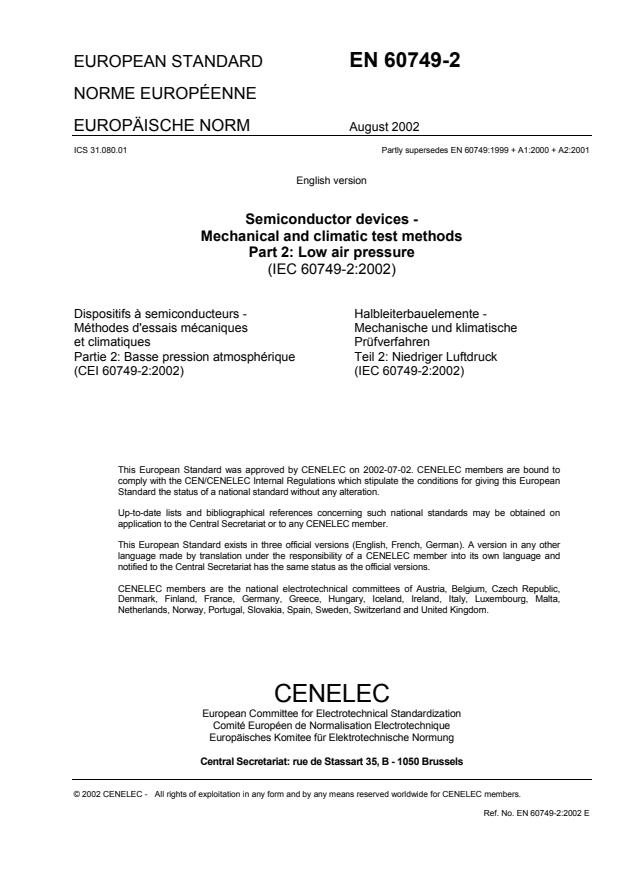
EUROPEAN STANDARD EN 60749-2
NORME EUROPÉENNE
EUROPÄISCHE NORM August 2002
ICS 31.080.01 Partly supersedes EN 60749:1999 + A1:2000 + A2:2001
English version
Semiconductor devices -
Mechanical and climatic test methods
Part 2: Low air pressure
(IEC 60749-2:2002)
Dispositifs à semiconducteurs - Halbleiterbauelemente -
Méthodes d'essais mécaniques Mechanische und klimatische
et climatiques Prüfverfahren
Partie 2: Basse pression atmosphérique Teil 2: Niedriger Luftdruck
(CEI 60749-2:2002) (IEC 60749-2:2002)
This European Standard was approved by CENELEC on 2002-07-02. CENELEC members are bound to
comply with the CEN/CENELEC Internal Regulations which stipulate the conditions for giving this European
Standard the status of a national standard without any alteration.
Up-to-date lists and bibliographical references concerning such national standards may be obtained on
application to the Central Secretariat or to any CENELEC member.
This European Standard exists in three official versions (English, French, German). A version in any other
language made by translation under the responsibility of a CENELEC member into its own language and
notified to the Central Secretariat has the same status as the official versions.
CENELEC members are the national electrotechnical committees of Austria, Belgium, Czech Republic,
Denmark, Finland, France, Germany, Greece, Hungary, Iceland, Ireland, Italy, Luxembourg, Malta,
Netherlands, Norway, Portugal, Slovakia, Spain, Sweden, Switzerland and United Kingdom.
CENELEC
European Committee for Electrotechnical Standardization
Comité Européen de Normalisation Electrotechnique
Europäisches Komitee für Elektrotechnische Normung
Central Secretariat: rue de Stassart 35, B - 1050 Brussels
© 2002 CENELEC - All rights of exploitation in any form and by any means reserved worldwide for CENELEC members.
Ref. No. EN 60749-2:2002 E
Foreword
The text of document 47/1601/FDIS, future edition 1 of IEC 60749-2, prepared by IEC TC 47,
Semiconductor devices, was submitted to the IEC-CENELEC parallel vote and was approved by
CENELEC as EN 60749-2 on 2002-07-02.
This mechanical and climatic test method, as it relates to low air pressure, is a complete rewrite of the
test contained in clause 3, chapter 3 of EN 60749:1999.
The following dates were fixed:
– latest date by which the EN has to be implemented
at national level by publication of an identical
national standard or by endorsement (dop) 2003-04-01
– latest date by which the national standards conflicting
with the EN have to be withdrawn (dow) 2005-07-01
Annexes designated "normative" are part of the body of the standard.
In this standard, annex ZA is normative.
Annex ZA has been added by CENELEC.
__________
Endorsement notice
The text of the International Standard IEC 60749-2:2002 was approved by CENELEC as a European
Standard without any modification.
__________
- 3 - EN 60749-2:2002
Annex ZA
(normative)
Normative references to international publications
with their corresponding European publications
This European Standard incorporates by dated or undated reference, provisions from other
publications. These normative references are cited at the appropriate places in the text and the
publications are listed hereafter. For dated references, subsequent amendments to or revisions of any
of these publications apply to this European Standard only when incorporated in it by amendment or
revision. For undated references the latest edition of the publication referred to applies (including
amendments).
NOTE When an international publication has been modified by common modifications, indicated by (mod), the relevant
EN/HD applies.
Publication Year Title EN/HD Year
IEC 60068-2-13 1983 Environmental testing EN 60068-2-13 1999
Part 2: Tests - Test M: Low air pressure
NORME CEI
INTERNATIONALE IEC
60749-2
INTERNATIONAL
Première édition
STANDARD
First edition
2002-04
Dispositifs à semiconducteurs –
Méthodes d'essais mécaniques et climatiques –
Partie 2:
Basse pression atmosphérique
Semiconductor devices –
Mechanical and climatic test methods –
Part 2:
Low air pressure
IEC 2002 Droits de reproduction réservés Copyright - all rights reserved
Aucune partie de cette publication ne peut être reproduite ni No part of this publication may be reproduced or utilized in any
utilisée sous quelque forme que ce soit et par aucun procédé, form or by any means, electronic or mechanical, including
électronique ou mécanique, y compris la photocopie et les photocopying and microfilm, without permission in writing from
microfilms, sans l'accord écrit de l'éditeur. the publisher.
International Electrotechnical Commission, 3, rue de Varembé, PO Box 131, CH-1211 Geneva 20, Switzerland
Telephone: +41 22 919 02 11 Telefax: +41 22 919 03 00 E-mail: inmail@iec.ch Web: www.iec.ch
CODE PRIX
F
PRICE CODE
Commission Electrotechnique Internationale
International Electrotechnical Commission
Международная Электротехническая Комиссия
Pour prix, voir catalogue en vigueur
For price, see current catalogue
60749-2 IEC:2002 – 3 –
INTERNATIONAL ELECTROTECHNICAL COMMISSION
____________
SEMICONDUCTOR DEVICES –
MECHANICAL AND CLIMATIC TEST METHODS –
Part 2: Low air pressure
FOREWORD
1) The IEC (International Electrotechnical Commission) is a worldwide organization for standardization comprising
all national electrotechnical committees (IEC National Committees). The object of the IEC is to promote
international co-operation on all questions concerning standardization in the electrical and electronic fields. To
this end and in addition to other activities, the IEC publishes International Standards. Their preparation is
entrusted to technical committees; any IEC National Committee interested in the subject dealt with may
participate in this preparatory work. International, governmental and non-governmental organizations liaising
with the IEC also participate in this preparation. The IEC collaborates closely with the International
Organization for Standardization (ISO) in accordance with conditions determined by agreement between the
two organizations.
2) The formal decisions or agreements of the IEC on technical matters express, as nearly as possible, an
international consensus of opinion on the relevant subjects since each technical committee has representation
from all interested National Committees.
3) The documents produced have the form of recommendations for international use and are published in the form
of standards, technical specifications, technical reports or guides and they are accepted by the National
Committees in that sense.
4) In order to promote international unification, IEC National Committees undertake to apply IEC International
Standards transparently to the maximum extent possible in their national and regional standards. Any
divergence between the IEC St
...