


EN 61000-4-20:2003
(Main)Electromagnetic compatibility (EMC) - Part 4-20: Testing and measurement techniques - Emission and immunity testing in transverse electromagnetic (TEM) waveguides
General Information
- Abstract
Relates to emission and immunity test methods for electrical and electronic equipment using various types of transverse electromagnetic (TEM) waveguides. This includes open (for example, striplines and EMP simulators) and closed (for example, TEM cells) structures, which can be further classified as one-, two-, or multi-port TEM waveguides. The frequency range depends on the specific testing requirements and the specific TEM waveguide type. The object of this standard is to describe · TEM waveguide characteristics, including typical frequency ranges and EUT-size limitations (EUT = equipment under test); · TEM waveguide validation methods for EMC measurements; · the EUT (i.e. EUT cabinet and cabling) definition; · test set-ups, procedures, and requirements for radiated emission testing in TEM waveguides and · test set-ups, procedures, and requirements for radiated immunity testing in TEM waveguides.
- Status
- Withdrawn
- Publication Date
- 27-Apr-2003
- Withdrawal Date
- 31-Mar-2006
- Technical Committee
- CLC/TC 210 - Electromagnetic Compatibility (EMC)
- Drafting Committee
- IEC/SC 77B - IEC_SC_77B
- Parallel Committee
- IEC/SC CISPR/A - Merjenje radijskih interferenc in statistične metode
- Current Stage
- 9960 - Withdrawal effective - Withdrawal
- Start Date
- 01-Oct-2013
- Completion Date
- 01-Oct-2013
Not Harmonized89/336/EEC - Electromagnetic compatibility (EMC)

Relations
- Effective Date
- 28-Jan-2023
- Effective Date
- 10-Feb-2026
- Effective Date
- 09-Feb-2026
- Effective Date
- 03-Feb-2026
- Effective Date
- 03-Feb-2026
- Effective Date
- 03-Feb-2026
- Effective Date
- 03-Feb-2026
- Effective Date
- 09-Feb-2026
- Effective Date
- 03-Feb-2026
- Effective Date
- 03-Feb-2026
- Effective Date
- 03-Feb-2026
- Effective Date
- 03-Feb-2026
- Effective Date
- 03-Feb-2026
- Effective Date
- 03-Feb-2026
- Effective Date
- 03-Feb-2026
Get Certified
Connect with accredited certification bodies for this standard

ANCE
Mexican certification and testing association.

Intertek Slovenia
Intertek testing, inspection, and certification services in Slovenia.

LNE (Laboratoire National de Métrologie et d'Essais)
French national laboratory for metrology and testing.
Sponsored listings
Frequently Asked Questions
EN 61000-4-20:2003 is a standard published by CLC. Its full title is "Electromagnetic compatibility (EMC) - Part 4-20: Testing and measurement techniques - Emission and immunity testing in transverse electromagnetic (TEM) waveguides". This standard covers: Relates to emission and immunity test methods for electrical and electronic equipment using various types of transverse electromagnetic (TEM) waveguides. This includes open (for example, striplines and EMP simulators) and closed (for example, TEM cells) structures, which can be further classified as one-, two-, or multi-port TEM waveguides. The frequency range depends on the specific testing requirements and the specific TEM waveguide type. The object of this standard is to describe · TEM waveguide characteristics, including typical frequency ranges and EUT-size limitations (EUT = equipment under test); · TEM waveguide validation methods for EMC measurements; · the EUT (i.e. EUT cabinet and cabling) definition; · test set-ups, procedures, and requirements for radiated emission testing in TEM waveguides and · test set-ups, procedures, and requirements for radiated immunity testing in TEM waveguides.
Relates to emission and immunity test methods for electrical and electronic equipment using various types of transverse electromagnetic (TEM) waveguides. This includes open (for example, striplines and EMP simulators) and closed (for example, TEM cells) structures, which can be further classified as one-, two-, or multi-port TEM waveguides. The frequency range depends on the specific testing requirements and the specific TEM waveguide type. The object of this standard is to describe · TEM waveguide characteristics, including typical frequency ranges and EUT-size limitations (EUT = equipment under test); · TEM waveguide validation methods for EMC measurements; · the EUT (i.e. EUT cabinet and cabling) definition; · test set-ups, procedures, and requirements for radiated emission testing in TEM waveguides and · test set-ups, procedures, and requirements for radiated immunity testing in TEM waveguides.
EN 61000-4-20:2003 is classified under the following ICS (International Classification for Standards) categories: 33.100.10 - Emission; 33.100.20 - Immunity. The ICS classification helps identify the subject area and facilitates finding related standards.
EN 61000-4-20:2003 has the following relationships with other standards: It is inter standard links to EN 61000-4-20:2010, IEC TR 61000-4-32:2002, EN 13589:2003, EN 61000-4-3:2002, EN 60068-1:1994, EN 61000-4-23:2000, EN 55022:1998, EN 1776:2025, EN 61226:2010, EN 55016-1-4:2010, EN IEC 60143-4:2024, EN IEC 61674:2024, EN 60947-4-3:2014, EN 61000-4-1:2007, EN 61000-1-2:2016. Understanding these relationships helps ensure you are using the most current and applicable version of the standard.
EN 61000-4-20:2003 is associated with the following European legislation: EU Directives/Regulations: 2004/108/EC, 2004/108/EU, 89/336/EEC; Standardization Mandates: M/490. When a standard is cited in the Official Journal of the European Union, products manufactured in conformity with it benefit from a presumption of conformity with the essential requirements of the corresponding EU directive or regulation.
EN 61000-4-20:2003 is available in PDF format for immediate download after purchase. The document can be added to your cart and obtained through the secure checkout process. Digital delivery ensures instant access to the complete standard document.
Standards Content (Sample)
SLOVENSKI SIST EN 61000-4-20:2005
STANDARD
julij 2005
Elektromagnetna združljivost (EMC) – 4-20. del: Preskusne in merilne tehnike –
Preskušanje oddajanja in odpornosti pri prečnih elektromagnetnih (TEM)
valovih (IEC 61000-4-20:2003)
Electromagnetic compatibility (EMC) – Part 4-20: Testing and measurement
techniques – Emission and immunity testing in transverse electromagnetic (TEM)
waveguides (IEC 61000-4-20:2003)
ICS 33.100.10; 33.100.20 Referenčna številka
© Standard je založil in izdal Slovenski inštitut za standardizacijo. Razmnoževanje ali kopiranje celote ali delov tega dokumenta ni dovoljeno
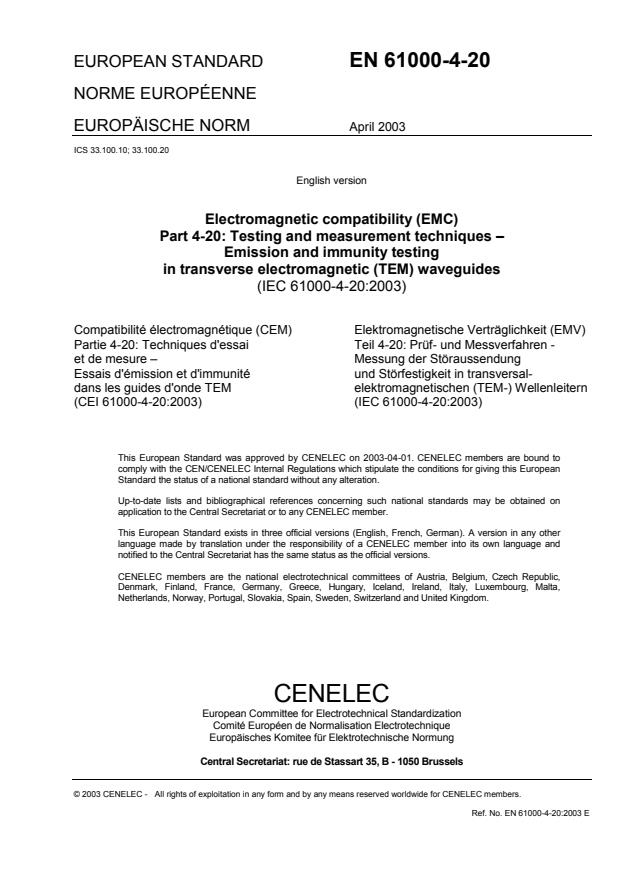
EUROPEAN STANDARD EN 61000-4-20
NORME EUROPÉENNE
EUROPÄISCHE NORM April 2003
ICS 33.100.10; 33.100.20
English version
Electromagnetic compatibility (EMC)
Part 4-20: Testing and measurement techniques –
Emission and immunity testing
in transverse electromagnetic (TEM) waveguides
(IEC 61000-4-20:2003)
Compatibilité électromagnétique (CEM) Elektromagnetische Verträglichkeit (EMV)
Partie 4-20: Techniques d'essai Teil 4-20: Prüf- und Messverfahren -
et de mesure – Messung der Störaussendung
Essais d'émission et d'immunité und Störfestigkeit in transversal-
dans les guides d'onde TEM elektromagnetischen (TEM-) Wellenleitern
(CEI 61000-4-20:2003) (IEC 61000-4-20:2003)
This European Standard was approved by CENELEC on 2003-04-01. CENELEC members are bound to
comply with the CEN/CENELEC Internal Regulations which stipulate the conditions for giving this European
Standard the status of a national standard without any alteration.
Up-to-date lists and bibliographical references concerning such national standards may be obtained on
application to the Central Secretariat or to any CENELEC member.
This European Standard exists in three official versions (English, French, German). A version in any other
language made by translation under the responsibility of a CENELEC member into its own language and
notified to the Central Secretariat has the same status as the official versions.
CENELEC members are the national electrotechnical committees of Austria, Belgium, Czech Republic,
Denmark, Finland, France, Germany, Greece, Hungary, Iceland, Ireland, Italy, Luxembourg, Malta,
Netherlands, Norway, Portugal, Slovakia, Spain, Sweden, Switzerland and United Kingdom.
CENELEC
European Committee for Electrotechnical Standardization
Comité Européen de Normalisation Electrotechnique
Europäisches Komitee für Elektrotechnische Normung
Central Secretariat: rue de Stassart 35, B - 1050 Brussels
© 2003 CENELEC - All rights of exploitation in any form and by any means reserved worldwide for CENELEC members.
Ref. No. EN 61000-4-20:2003 E
Foreword
The text of document CIS/A/419/FDIS, future edition 1 of IEC 61000-4-20, prepared by CISPR SC A,
Radio-interference measurements and statistical methods, in cooperation with SC 77B, High
frequency phenomena, of IEC TC 77, Electromagnetic compatibility, was submitted to the
IEC-CENELEC parallel vote and was approved by CENELEC as EN 61000-4-20 on 2003-04-01.
The following dates were fixed:
– latest date by which the EN has to be implemented
at national level by publication of an identical
national standard or by endorsement (dop) 2004-01-01
– latest date by which the national standards conflicting
with the EN have to be withdrawn (dow) 2006-04-01
Annexes designated "normative" are part of the body of the standard.
Annexes designated "informative" are given for information only.
In this standard, annexes A, B, C and ZA are normative and annexes D and E are informative.
Annex ZA has been added by CENELEC.
__________
Endorsement notice
The text of the International Standard IEC 61000-4-20:2003 was approved by CENELEC as a
European Standard without any modification.
In the official version, for Bibliography, the following notes have to be added for the standards
indicated:
CISPR 14 NOTE Harmonized in EN 55014 series (not modified).
CISPR 20 NOTE Harmonized as EN 55020:2002 (not modified).
IEC 61000-2-9 NOTE Harmonized as EN 61000-2-9:1996 (not modified).
__________
- 3 - EN 61000-4-20:2003
Annex ZA
(normative)
Normative references to international publications
with their corresponding European publications
This European Standard incorporates by dated or undated reference, provisions from other
publications. These normative references are cited at the appropriate places in the text and the
publications are listed hereafter. For dated references, subsequent amendments to or revisions of any
of these publications apply to this European Standard only when incorporated in it by amendment or
revision. For undated references the latest edition of the publication referred to applies (including
amendments).
NOTE When an international publication has been modified by common modifications, indicated by (mod), the relevant
EN/HD applies.
Publication Year Title EN/HD Year
1)
-
IEC 60050-161 International Electrotechnical - -
Vocabulary (IEV)
Chapter 161: Electromagnetic
compatibility
2)
- 1)
IEC 60068-1 Environmental testing EN 60068-1 1994
Part 1: General and guidance
- 1)
IEC 61000-2-11 Electromagnetic compatibility (EMC) - -
Part 2-11: Environment - Classification
of HEMP environments
- 1) 2)
IEC 61000-4-3 Part 4-3: Testing and measurement EN 61000-4-3 2002
techniques - Radiated, radio-
frequency, electromagnetic field
immunity test
- 1) 2)
IEC 61000-4-23 Part 4-23: Testing and measurement EN 61000-4-23 2000
techniques - Test methods for
protective devices for HEMP and other
radiated disturbances
- 1)
IEC/TR 61000-4-32 Electromagnetic compatibility (EMC) - - -
Part 4-32: Testing and measurement
techniques - HEMP simulator
compendium
- 1)
IEC/TR 61000-5-3 Part 5: Installation and mitigation - -
guidelines -- Section 3: HEMP
protection concepts
1)
Undated reference.
2)
Valid edition at date of issue.
Publication Year Title EN/HD Year
- 1)
CISPR 16-1 Specification for radio disturbance and - -
immunity measuring apparatus and
methods
Part 1: Radio disturbance and
immunity measuring apparatus
- 1)
CISPR 16-2 Part 2: Methods of measurement of - -
disturbances and immunity
- 1) 2)
CISPR 22 (mod) Information technology equipment - EN 55022 1998
Radio disturbance characteristics -
Limits and methods of measurement
INTERNATIONAL IEC
STANDARD
61000-4-20
First edition
2003-01
BASIC EMC PUBLICATION
Electromagnetic compatibility (EMC) –
Part 4-20:
Testing and measurement techniques –
Emission and immunity testing in transverse
electromagnetic (TEM) waveguides
IEC 2003 Copyright - all rights reserved
No part of this publication may be reproduced or utilized in any form or by any means, electronic or mechanical,
including photocopying and microfilm, without permission in writing from the publisher.
International Electrotechnical Commission, 3, rue de Varembé, PO Box 131, CH-1211 Geneva 20, Switzerland
Telephone: +41 22 919 02 11 Telefax: +41 22 919 03 00 E-mail: inmail@iec.ch Web: www.iec.ch
PRICE CODE
XB
Commission Electrotechnique Internationale
International Electrotechnical Commission
Международная Электротехническая Комиссия
For price, see current catalogue
61000-4-20 IEC:2003 – 3 –
CONTENTS
FOREWORD . 7
INTRODUCTION .11
1 Scope and object .13
2 Normative references.13
3 Definitions and abbreviations.15
3.1 Definitions .15
3.2 Abbreviations.21
4 General .21
5 TEM waveguide requirements.23
5.1 General requirements for the use of TEM waveguides .23
5.2 Special requirements for certain types of TEM waveguides.27
5.3 Measurement uncertainty considerations .29
6 Overview of EUT Types .29
6.1 Small EUT .29
6.2 Large EUT .29
Annex A (normative) Emission testing in TEM waveguides .31
Annex B (normative) Immunity testing in TEM waveguides .75
Annex C (normative) HEMP transient testing in TEM waveguides.91
Annex D (informative) TEM waveguide characterization .107
Annex E (informative) Standards including TEM waveguides.121
Bibliography.125
Figure A.1 – Routing the exit cable to the corner at the ortho-angle and the lower edge
of the test volume.55
Figure A.2 – Basic ortho-axis positioner or manipulator.57
Figure A.3 – Three orthogonal axis-rotation positions for emission measurements .59
Figure A.4 – Canonical 12-face/axis orientations for a typical EUT.61
Figure A.5 – Open-area test site geometry .63
Figure A.6 – Two-port TEM cell (symmetric septum) .65
Figure A.7 – One-port TEM cell (asymmetric septum).67
Figure A.8 – Stripline (two plates) .71
Figure A.9 – Stripline (four plates, balanced feeding) .73
Figure B.1 – Example of test set-up for single-polarization TEM waveguides.87
Figure B.2 – Uniform area calibration points in TEM waveguide .89
Figure C.1 – Frequency domain spectral magnitude between 100 kHz and 300 MHz.105
61000-4-20 IEC:2003 – 5 –
Figure D.1 – Simplest waveguide (no TEM wave!).119
Figure D.2 – Waveguides for TEM propagation .119
Figure D.3 – Polarization vector .119
Figure D.4 – Transmission line model for TEM propagation.119
Figure D.5 – One- and two-port TEM waveguides.119
Table B.1 – Uniform area calibration points.79
Table B.2 – Test levels.81
Table C.1 – Radiated immunity test levels defined in the present standard.105
61000-4-20 IEC:2003 – 7 –
INTERNATIONAL ELECTROTECHNICAL COMMISSION
____________
ELECTROMAGNETIC COMPATIBILITY (EMC) –
Part 4-20: Testing and measurement techniques –
Emission and immunity testing in
transverse electromagnetic (TEM) waveguides
FOREWORD
1) The IEC (International Electrotechnical Commission) is a worldwide organization for standardization comprising
all national electrotechnical committees (IEC National Committees). The object of the IEC is to promote
international co-operation on all questions concerning standardization in the electrical and electronic fields. To
this end and in addition to other activities, the IEC publishes International Standards. Their preparation is
entrusted to technical committees; any IEC National Committee interested in the subject dealt with may
participate in this preparatory work. International, governmental and non-governmental organizations liaising
with the IEC also participate in this preparation. The IEC collaborates closely with the International
Organization for Standardization (ISO) in accordance with conditions determined by agreement between the
two organizations.
2) The formal decisions or agreements of the IEC on technical matters express, as nearly as possible, an
international consensus of opinion on the relevant subjects since each technical committee has representation
from all interested National Committees.
3) The documents produced have the form of recommendations for international use and are published in the form
of standards, technical specifications, technical reports or guides and they are accepted by the National
Committees in that sense.
4) In order to promote international unification, IEC National Committees undertake to apply IEC International
Standards transparently to the maximum extent possible in their national and regional standards. Any
divergence between the IEC Standard and the corresponding national or regional standard shall be clearly
indicated in the latter.
5) The IEC provides no marking procedure to indicate its approval and cannot be rendered responsible for any
equipment declared to be in conformity with one of its standards.
6) Attention is drawn to the possibility that some of the elements of this International Standard may be the subject
of patent rights. The IEC shall not be held responsible for identifying any or all such patent rights.
International Standard IEC 61000-4-20 has been prepared by CISPR subcommittee A: Radio
interference measurements and statistical methods, in cooperation with subcommittee 77B:
High-frequency phenomena, of IEC technical committee 77: Electromagnetic compatibility.
This standard forms Part 4-20 of IEC 61000. It has the status of a basic EMC publication in
accordance with IEC Guide 107.
The text of this standard is based on the following documents:
Committee draft Report on voting
CIS/A/419/FDIS CIS/A/435/RVD
Full information on the voting for the approval of this standard can be found in the report on
voting indicated in the above table.
This publication has been drafted in accordance with the ISO/IEC Directives, Part 2.
61000-4-20 IEC:2003 – 9 –
The committee has decided that the contents of this publication will remain unchanged until
2004. At this date, the publication will be
• reconfirmed;
• withdrawn;
• replaced by a revised edition, or
• amended.
61000-4-20 IEC:2003 – 11 –
INTRODUCTION
IEC 61000 is published in separate parts according to the following structure:
Part 1: General
General considerations (introduction, fundamental principles)
Definitions, terminology
Part 2: Environment
Description of the environment
Classification of the environment
Compatibility levels
Part 3: Limits
Emission limits
Immunity limits (in so far as they do not fall under the responsibility of the product
committees)
Part 4: Testing and measurement techniques
Measurement techniques
Testing techniques
Part 5: Installation and mitigation guidelines
Installation guidelines
Mitigation methods and devices
Part 6: Generic Standards
Part 9: Miscellaneous
Each part is further subdivided into several parts, published either as International Standards,
Technical Specifications or Technical Reports, some of which have already been published as
sections. Others will be published with the part number followed by a dash and a second
number identifying the subdivision (example: 61000-6-1).
61000-4-20 IEC:2003 – 13 –
ELECTROMAGNETIC COMPATIBILITY (EMC) –
Part 4-20: Testing and measurement techniques –
Emission and immunity testing in
transverse electromagnetic (TEM) waveguides
1 Scope and object
This part of IEC 61000 relates to emission and immunity test methods for electrical and
electronic equipment using various types of transverse electromagnetic (TEM) waveguides.
This includes open (for example, striplines and EMP simulators) and closed (for example,
TEM cells) structures, which can be further classified as one-, two-, or multi-port TEM
waveguides. The frequency range depends on the specific testing requirements and the
specific TEM waveguide type.
The object of this standard is to describe
• TEM waveguide characteristics, including typical frequency ranges and EUT-size
limitations;
• TEM waveguide validation methods for EMC measurements;
• the EUT (i.e. EUT cabinet and cabling) definition;
• test set-ups, procedures, and requirements for radiated emission testing in TEM
waveguides and
• test set-ups, procedures, and requirements for radiated immunity testing in TEM
waveguides.
2 Normative references
The following referenced documents are indispensable for the application of this document.
For dated references, only the edition cited applies. For undated references, the latest edition
of the referenced document (including any amendments) applies.
IEC 60050(161), International Electrotechnical Vocabulary (IEV) – Chapter 161: Electro-
magnetic compatibility
IEC 60068-1, Environmental testing – Part 1: General and guidance.
IEC 61000-2-11, Electromagnetic compatibility (EMC) – Part 2-11: Environment – Classi-
fication of HEMP environments. Basic EMC publication
IEC 61000-4-3, Electromagnetic compatibility (EMC) – Part 4-3: Testing and measurement
techniques – Radiated, radio-frequency, electromagnetic field immunity test. Basic EMC
publication
IEC 61000-4-23, Electromagnetic compatibility (EMC) – Part 4-23: Testing and measurement
techniques – Test methods for protective devices for HEMP and other radiated disturbances.
Basic EMC publication
61000-4-20 IEC:2003 – 15 –
IEC/TR 61000-4-32, Electromagnetic compatibility (EMC) – Part 4-32: Testing and measure-
ment techniques – HEMP simulator compendium
IEC/TR 61000-5-3, Electromagnetic compatibility (EMC) – Part 5-3: Installation and mitigation
guidelines – HEMP protection concepts. Basic EMC publication
CISPR 16-1, Specification for radio disturbance and immunity measuring apparatus and
methods – Part 1: Radio disturbance and immunity measuring apparatus
CISPR 16-2, Specification for radio disturbance and immunity measuring apparatus and
methods – Part 2: Methods of measurement of disturbances and immunity
CISPR 22, Information technology equipment – Radio disturbance characteristics – Limits and
methods of measurement
3 Definitions and abbreviations
3.1 Definitions
For the purposes of this part of IEC 61000, the definitions given in IEC 60050(161) (IEV), as
well as the following, apply.
3.1.1
transverse electromagnetic (TEM) mode
waveguide mode in which the components of the electric and magnetic fields in the
propagation direction are much less than the primary field components across any transverse
cross-section
3.1.2
TEM waveguide
open or closed transmission line system, in which a wave is propagating in the transverse
electromagnetic mode to produce a specified field for testing purposes
3.1.3
TEM cell
enclosed TEM waveguide, often a rectangular coaxial line, in which a wave is propagated in
the transverse electromagnetic mode to produce a specific field for testing purposes. The
outer conductor completely encloses the inner conductor
3.1.4
two-port TEM waveguide
TEM waveguide with input/output measurement ports at both ends
3.1.5
one-port TEM waveguide
TEM waveguide with a single input/output measurement port. Such TEM waveguides typically
feature a broadband line termination at the non-measurement-port end
61000-4-20 IEC:2003 – 17 –
3.1.6
stripline
terminated transmission line consisting of two or more parallel plates between which a wave
is propagated in the transverse electromagnetic mode to produce a specific field for testing
purposes. Usually the sides are open for EUT access and monitoring
3.1.7
inner conductor or septum
inner conductor of a coaxial transmission line system, often flat in the case of a rectangular
cross-section. The inner conductor may be positioned symmetrically or asymmetrically with
respect to the outer conductor
3.1.8
outer conductor or housing
outer conductor of a coaxial transmission line system, often having a rectangular cross-
section
3.1.9
characteristic impedance
for any constant phase wave-front, the magnitude of the ratio of the voltage between the inner
conductor and the outer conductor to the current on either conductor. The characteristic
impedance is independent of the voltage/current magnitudes and depends only on the cross-
sectional geometry of the transmission line. TEM waveguides are typically designed to have a
50 Ω characteristic impedance. TEM waveguides with a 100 Ω characteristic impedance are
often used for transient testing
3.1.10
anechoic material
material that exhibits the property of absorbing, or otherwise reducing, the level of
electromagnetic energy reflected from that material
3.1.11
broadband line termination
termination which combines a low-frequency discrete-component load, to match the
characteristic impedance of the TEM waveguides (typically 50 Ω), and a high-frequency
anechoic-material volume
3.1.12
correlation algorithm
mathematical routine for converting TEM waveguide voltage measurements to open-area test
sites (OATS), semi-anechoic chamber (SAC), or free space field strength levels
3.1.13
EUT type
grouping of products with sufficient similarity in electromagnetic characteristics to allow
testing with the same test installation and the same test protocol
3.1.14
exit cable
cable that connects the EUT to equipment external to the TEM waveguide or exiting the
usable test volume defined in 5.1.2.
61000-4-20 IEC:2003 – 19 –
3.1.15
interconnecting cable
cable that connects subcomponents of the EUT within the test volume but does not exit the
test volume
3.1.16
test set-up support
non-reflecting, non-conducting, low-permittivity support and positioning reference that allows
for precise rotations of the EUT as required by a correlation algorithm or test protocol
NOTE 1 A typical material is foamed polystyrene. Wooden supports are not recommended (see [7] ).
3.1.17
ortho-angle
angle that the diagonal of a cube makes to each side face at the trihedral corners of the cube.
Assuming that the cube is aligned with the TEM waveguide Cartesian coordinate system, the
azimuth and elevation angles of the projection of the cube diagonal are 45°, and the angles to
the face edges are 54,7° (see Figure A.2a)
NOTE 2 When associated with the EUT, this angle is usually referred to as the ortho-axis.
3.1.18
primary (field) component
electric field component aligned with the intended test polarization
NOTE 3 For example, in conventional two-port TEM cells, the septum is parallel to the horizontal floor, and the
primary mode electric field vector is vertical at the transverse centre of the TEM cell.
3.1.19
secondary (field) component
in a Cartesian coordinate system, either of the two electric field components orthogonal to the
primary field component and orthogonal to each other
3.1.20
resultant field (amplitude)
root-sum-squared values in V/m of the primary and the two secondary field components
3.1.21
manipulator
any type of manual or automatic non-metallic fixtures similar to a turntable, and capable of
supporting an affixed EUT throughout numerous positions as required by a correlation
algorithm or test protocol. The material has to meet the requirements defined for the test set-
up support (see 3.1.16). For example, see Figure A.2
3.1.22
hyper-rotated TEM waveguide
TEM waveguide that has been reorientated such that its ortho-axis is normal to the Earth’s
surface (see [6])
———————
Figures in square brackets refer to the bibliography.
61000-4-20 IEC:2003 – 21 –
3.1.23
gravity-dependent / -independent
the gravitation force of the earth has a fixed direction. The EUT can be rotated around all
three axes. Due to different rotation positions the EUT is affected by the gravitation force in
different directions. The EUT is gravity-independent if it is working properly in all positions,
which means working properly regardless of the direction of the gravity vector relative to the
EUT. The EUT is gravity-dependent if it does not work properly in one or more test positions
3.2 Abbreviations
BALUN Balanced-to-unbalanced transformer
DFT Discrete Fourier Transform
EUT Equipment under test
FFT Fast Fourier Transform
GTEM Gigahertz transverse electromagnetic mode
HEMP High-altitude electromagnetic pulse
OATS Open-area test site
PoE Points of entry
RF Radiofrequency
SAC Semi-anechoic chamber
SPD Surge protective device
TDR Time-domain reflectometer
TE Transverse electric (mode), (H-mode)
TEM Transverse electromagnetic mode
TM Transverse magnetic (mode), (E-mode)
VSWR Voltage-standing-wave-ratio
4 General
This standard describes basic characteristics and limitations of TEM waveguides, namely test
volume, field uniformity, purity of the TEM mode, and frequency ranges. An introduction and
some fundamental characteristics of TEM waveguides are given in Annex D.
Radiated emission measurements in a TEM waveguide are usually correlated with the open-
area test site (OATS) and semi-anechoic chamber (SAC) methods, which provide valid and
repeatable measurement results of disturbance field strength from equipment. In this case so-
called correlation algorithms are used to convert TEM waveguide measurement results to
OATS-equivalent data, as described in Annex A. Product committees should demonstrate that
good correlation exists between measurement results using typical product types.
TEM waveguides can also be used as field generators for testing the immunity of equipment
to electromagnetic fields. Details are given in Annex B. Immunity testing in TEM waveguides
is cited in several other standards listed in Annex E.
TEM waveguide measurements are not restricted to radiated measurements on fully
assembled equipment; they may also be applied to the testing of components, integrated
circuits, and the shielding effectiveness of gasket materials and cables.
61000-4-20 IEC:2003 – 23 –
5 TEM waveguide requirements
TEM waveguides can be used for emission and immunity measurements when certain
requirements are met. For the validation of a TEM waveguide the following methods shall be
applied.
NOTE This clause focuses on general validation aspects such as the dominant TEM mode and field homogeneity.
Specific validation requirements for emission, immunity, and transient testing are given in the annexes.
5.1 General requirements for the use of TEM waveguides
5.1.1 TEM mode verification
TEM waveguides may exhibit resonances above a certain cut-off frequency determined by the
cross-sectional dimensions and/or the waveguide length. For practical use, the field in a TEM
waveguide is considered to propagate in a TEM mode when the following requirements are
met. Generally, a TEM waveguide manufacturer has to verify and document the TEM mode
behaviour over the desired frequency range and include verification data with the system
documentation.
NOTE 1 The TEM mode behaviour must be confirmed at regular intervals (see B.2.2).
Using an immunity-type uniform-area calibration procedure (according to B.2.2) the
magnitudes of the secondary (unintended) electric field components shall be at least 6 dB
less than the primary component of the electric field, over at least 75 % of the measured
points in a defined cross-section of the TEM waveguide (perpendicular to the propagation
direction). For this 75 % of measurement points, a primary electric field component tolerance
−0 −0
greater than dB up to dB , or a secondary electric field component level up to
+6 +10
–2 dB of the primary field component, is allowed for a maximum of 3 % of the test frequencies
(at least one frequency), provided that the actual tolerance and frequencies are stated in the
test reports. For large TEM waveguides a maximum of 3 % of the test frequencies is
recommended; up to 5 % is allowed if stated in the test reports. The frequency range is
30 MHz up to the highest frequency of intended use of the TEM waveguide. The first
frequency step shall not exceed 1 % of the fundamental frequency and thereafter 1 % of the
preceding frequency in 80 MHz to 1 000 MHz, 5 % below 80 MHz and above 1 000 MHz. One
constraint on the sweep speed is the response time of the field probe. This verification of the
TEM mode applies to waveguides used either for immunity or emissions testing.
NOTE 2 For transient measurements the start frequency should be 100 kHz.
NOTE 3 The 6 dB criterion from 5.1.1 specifies the dominant TEM mode and not the field uniformity. A field
is considered uniform if the requirements of B.2.2 are fulfilled. Further information about field uniformity is
given in [17].
5.1.2 Test volume and maximum EUT size
The maximum size of an EUT is related to the size of the “usable test volume” in the TEM
waveguide. The “usable test volume” of the TEM waveguide depends on the size, geometry,
and the spatial distribution of the electromagnetic fields.
The “usable test volume” of a TEM waveguide (see Figures A.6 to A.9) depends on the
“uniform area” as defined in B.2.2. The propagation direction of the waveguide TEM mode
(typically z-axis) is perpendicular to a uniform area (transverse plane, typically xy-plane). In
61000-4-20 IEC:2003 – 25 –
the xy-plane the whole cross-section of the usable test volume has to fulfil the requirements
of the uniform area defined in B.2.2. The minimum value for the distance h between EUT
EUT
and each conductor or absorber of the waveguide (see Figures A.6 to A.9) is given by the
distance between the boundary of the uniform area (see B.2.2) and the conductor. However,
h should not be zero, in order to avoid the possible change of the EUT operational
EUT
condition by the close coupling between EUT and conductors of the waveguide
(recommended: h should be larger than 0,05 h). Along the z-axis (propagation direction)
EUT
the usable test volume is limited by z ≤ z ≤ z . The length of the test volume is
min max
L = z − z . The requirements of a uniform area have to be fulfilled for cross-sections at
max min
each z with z ≤ z ≤ z . It can be assumed that the TEM mode requirements are fulfilled
min max
for z ≤ z ≤ z under the following conditions:
min max
• if TEM mode requirements are fulfilled at the position z , and the geometry of the
max
waveguide is similar to one of the types shown in Figures A.6 to A.9 with a constant
aspect ratio of h to w (inherent shape) for 0 < z < z , or,
max
• if TEM mode requirements are fulfilled at the positions z and z , and the waveguide
min max
cross-section is constant or uniformly tapered for z < z < z and the derivatives dh/dz
min max
and dw/dz are a smooth function for z < z < z (no kinks or steps in the conductor
min max
geometries).
The maximum size of an EUT is related to the size of the “usable test volume”. The EUT shall
not be larger than 0,6 w times 0,6 L (see Figures A.6 to A.9).
NOTE 1 The ISO 11452 series recommends an EUT size of 0,33 w × 0,6 L, and MIL-STD 462D recommends
0,5 w × 0,5 L.
The maximum usable EUT height is recommended to be 0,33 h, with h equal to the distance
between the inner and outer conductors (conductor spacing) at the centre of the EUT in the
test volume (for example, between septum and floor in a TEM cell). For all TEM waveguides,
the EUT shall fit within the usable test volume for all rotation positions.
NOTE 2 Most standards restrict EUT size to 0,33 h. Most data sheets from TEM cell suppliers limit the EUT height
to a maximum of 0,5 h. Except for highly accurate calibration, such as for field probes and sensors, the EUT height
can exceed 0,33 h, but it must not exceed the manufacturer’s recommendations. The maximum usable EUT height
can be higher than 0,33 h if the manufacturer provides information about the measurement uncertainty for larger
EUTs. The measurement uncertainty must be stated in the test report. More information about loaded waveguide
effects is given in [25].
5.1.3 Loaded waveguide effects
Under consideration.
NOTE 1 To measure the effects of a loaded waveguide, the following procedures have been proposed:
• surface current measurements on the EUT placed in free space (OATS is also an option) or in a TEM
waveguide;
• field measurements with an isotropic sensor;
• input-port time-domain reflectometer (TDR) or voltage-standing-wave-ratio (VSWR) measurements;
• insertion loss for two-port TEM waveguides;
• monopole inserted through the outer conductor of the TEM waveguide.
NOTE 2 For radiated emissions, correlations with large EUTs have shown an average 1 dB enhancement in
correlated field strength (see [20]).
NOTE 3 Influence of the test set-up support or manipulator should also be checked (see [4]).
61000-4-20 IEC:2003 – 27 –
5.2 Special requirements for certain types of TEM waveguides
5.2.1 Set-up of open TEM waveguides
To minimize ambient effects, open TEM waveguides should be installed inside a shielded
room.
NOTE 1 The permitted ambient signal is defined in Annexes A, B, and C and strongly depends on the test
objectives.
A minimum distance of one plate spacing h from the open TEM waveguide to the shielded-
room floor, walls, and ceiling is required. Additional anechoic material can be placed
appropriately in the shielded room to minimize reflections.
The distances above are given for guidance only. The reflection (and transmission in two-port
cells) is the final measure for sufficient decoupling of the TEM waveguide from the shielded
room. Note that it is possible to construct an open TEM waveguide where one plate consists
of the floor of the shielded room and the other is an installed septum.
NOTE 2 MIL-STD 462 requires open TEM waveguides to be positioned in a shielded room. The required minimum
distance to walls should be set in relation to the size of the waveguide. MIL-STD 462D RS105 requires a distance
of two times h from the closest metallic ground including ceiling, shielded room walls, and so forth, where h is the
maximum vertical separation of the plates. CISPR 20 requires a minimum distance of 800 mm from walls, floor, and
ceiling, corresponding to one h.
5.2.2 Alternative TEM mode verification for a two-port TEM waveguide
As an alternative to 5.1.1 the useful frequency range of a two-port TEM waveguide can be
established using the following measurement method.
Before testing the EUT, the TEM waveguide resonances shall be determined for two-port TEM
devices with the test set-up and EUT installed, with EUT power off. In this case, the
transmission loss of the TEM waveguide in the useful frequency range shall be
P
P
output
refl
A = 10 ⋅ lg + ≤ 1 dB (1)
tloss
P P
fwd fwd
where
A is the transmission loss of the loaded waveguide, in dB;
tloss
P is the reflected power measured at the input port, in W;
refl
P is the forward power measured at the input port, in W;
fwd
P is the output power measured at the second (output) port, in W.
output
NOTE 1 The reflected, forward and backward (output) power is measured with respect to the characteristic
impedance of the TEM waveguide. An impedance transformer is not used. It is measured "in line" only. Equation
(1) is valid for a 50 Ω characteristic impedance.
NOTE 2 This is an alternative verification method for a two-port TEM waveguide of the type listed in ISO 11452-3.
It is based on the assumption that resonating higher order modes will extract energy from the TEM mode.
61000-4-20 IEC:2003 – 29 –
5.3 Measurement uncertainty considerations
General procedures to evaluate measurement uncertainties are under consideration.
Procedures following A.4.2.1 are recommended to estimate uncertainties.
NOTE Uncertainty estimation methods for TEM waveguides are discussed, for example, in [3], [22] and [30].
6 Overview of EUT types
An EUT type is a group of products with sufficient similarity in electromagnetic characteristics
or mechanical dimensions that testing with the same test installation and the same test
protocol is allowable. The EUT type and its configuration are valid for immunity testing and
emission measurement to allow a uniform arrangement in the test volume.
6.1 Small EUT
An EUT is defined as a small EUT if the largest dimension of the case is smaller than one
wavelength at the highest test frequency (for example, at 1 GHz λ = 300 mm), and if no
cables are connected to the EUT. All other EUTs are defined as large EUTs.
6.2 Large EUT
An EUT is defined as a large EUT if it is
• a small EUT with one or more exit cables,
• a small EUT with one or more connected non-exit cables,
• an EUT with or without cable(s) which has a dimension larger than one wavelength at the
highest test frequency,
• a group of small EUTs arranged in a test set-up with interconnecting non-exit cables, and
with or without exit cables.
61000-4-20 IEC:2003 – 31 –
Annex A
(normative)
Emission testing in TEM waveguides
A.1 Introduction
This annex describes emission testing in TEM waveguides. TEM waveguide validation and
correlation data should usually be supplied by the manufacturer of the TEM waveguide
(Clauses A.3 and A.4). This allows the user to focus on Clauses A.5 and A.6.
Two methods are possible for determining the compliance of TEM waveguide emissions test
results with a limit.
• Without correlation to the OATS method
This approach has been applied to specific product families (for example, procedures for
integrated circuits, military devices, vehicle components and modules, etc., as described
in the references of Annex E. In this case, TEM waveguide readings are used and
compared directly to an independent disturbance limit or guideline, usually developed
specifically for one type of TEM waveguide. In some cases, the TEM waveguide limits may
be derived from limit values used in other test facilities (see [36]).
• With correlation to the OATS method
This approach is applicable for EUTs which have to comply with disturbance limits given in
terms of an OATS field strength at a specific distance.
Only the second test method is described in detail in this annex. Emission testing using TEM
waveguides requires a TEM waveguide validation for EUTs in order to demonstrate the
suitability of the TEM waveguide being used. For each EUT type a validation procedure shall
be carried out as described in Clause A.4. In cases where only relative comparison will be
made within the same EUT product family, correlation to OATS or other test sites is not
required. In that case, product committees shall supply specific limits to determine the
compliance of the measurement data.
Correlation or conversion algorithms are described in Clause A.3. Correlation algorithms use
TEM waveguide voltage measurements to estimate equivalent OATS field strengths. Free
space field strengths may also be estimated. These field strengths, along with test results
from the EUT type validation procedure, may then be compared to the requirements in nor-
mative standards. The test procedures typically require that the EUT be rotated about
all three axes. Thus, the EUT needs to be mechanically stable and gravity-independent (see
3.1.23).
NOTE If a hyper-rotated TEM waveguide is used (see [6]), the TEM waveguide is reorientated so that its ortho-
axis is normal to the earth’s surface. The EUT is rotated by ±120° about its vertical axis (which is its ortho-axis).
The EUT need not be rotated around its horizontal axis. The EUT can be gravity-dependent.
All requirements in this annex given for small EUTs are normative. Large EUTs and specific
considerations regarding EUT arrangements and cabling are deferred for elaboration in the
next edition of this standard.
61000-4-20 IEC:2003 – 33 –
A.2 Test equipment
The test equipment shall comply with the relevant requirements of CISPR 16-1.
NOTE An isotropic field sensor can be seen as an antenna (see CISPR 16-1 for antenna requirements). The
calibration procedures of isotropic field probes and their specifications are described in [24].
A.3 Correlating TEM waveguide voltages to E-field data
A.3.1 General remarks
This procedure is intended to establish an alternative to OATS emissions test methods. The
TEM waveguide results are converted to equivalent OATS E-field data. This clause describes
an algorithm based on the assumption that the radiated power as measured by a TEM
waveguide will be radiated by a dipole positioned above a perfectly conducting ground plane.
In case of dispute the method originally used, either OATS or TEM waveguide, takes
precedence.
Correlation routines include the distance between EUT and each conductor, h , and the
EUT
conductor spacing h (or plate separation) at the centre of the EUT (see Figures A.6b and
A.7b) in the calculation. These parameters are analogous to the EUT height over ground h
g
and the antenna separation s (Figure A.5) in an OATS measurement. The voltages measured
with the EUT placed in the TEM waveguide are generated by the EUT emissions. After
rotation (repositioning) of the EUT according to the requirements of the correlation routine,
further voltage measurements are taken until all required positions have been measured. The
correlation routine then uses this data to simulate an OATS measurement.
NOTE Information about correlation and correlation data for emission measurements can be found in [5], [8] [17]
[22], [34] [36], [40] and [41],.
The following subclause describes only an algorithm based on a three-position measurement.
Other algorithms have been proposed and may be useful for some EUTs (see [31] and [41]).
A.3.2 Correlation algorithms
The two subclauses A.3.2.1 and A.3.2.2 show different and independent correlation
approaches. Subclause A.3.2.1 describes the basic approach of correlation routines for the
“multipole model”. It uses a set of waveguide measurements in order to determine the
equivalent multipole moments. Subclause A.3.2.2 describes another correlation routine which
uses three voltage measurements. This procedure is often referred to as the “total radiated
power method”.
A.3.2.1 Multipole model
Any radiation source of finite size may be replaced by an equivalent multipole expansion
which gives the same radiation pattern outside a volume encompassing the source. If the
source is electrically small (characteristic dimensions less than 0,1 times the wavelength),
then the initial multipole expansion terms, effectively electric and magnetic dipoles, will yield
an accurate simulation of the source. The above statement holds for an arbitrary source. If the
source itself co
...