


EN 62453-302:2009
(Main)Field device tool (FDT) interface specification - Part 302: Communication profile integration - IEC 61784 CPF 2
General Information
- Abstract
IEC 62453-302:2009(E) provides information for integrating the CIP technology into the FDT interface specification (IEC 62453-2). It specifies communication and other services. This specification neither contains the FDT specification nor modifies it. Communication Profile Family 2 (commonly known as CIPTM1) defines communication profiles based on IEC 61158-2 Type 2, IEC 61158-3-2, IEC 61158-4-2, IEC 61158-5-2, IEC 61158-6-2, and IEC 62026-3. The basic profiles CP 2/1 (ControlNetTM2), CP 2/2 (EtherNet/IPTM3), and CP 2/3 (DeviceNetTM1) are defined in IEC 61784-1 and IEC 61784-2. An additional communication profile (CompoNetTM1), also based on CIPTM, is defined in [14]. This publication is to be read in conjunction with IEC 62453-2:2009.
- Status
- Withdrawn
- Publication Date
- 14-Oct-2009
- Withdrawal Date
- 31-Jul-2012
- Technical Committee
- CLC/TC 65X - Industrial-process measurement, control and automation
- Drafting Committee
- IEC/SC 65E - IEC_SC_65E
- Parallel Committee
- IEC/SC 65E - IEC_SC_65E
- Current Stage
- 9960 - Withdrawal effective - Withdrawal
- Start Date
- 08-Dec-2020
- Completion Date
- 08-Dec-2020


Relations
- Effective Date
- 29-Jan-2023
- Effective Date
- 03-Feb-2026
- Refers
EN 62453-1:2009 - Field device tool (FDT) interface specification - Part 1: Overview and guidance - Effective Date
- 03-Feb-2026
- Effective Date
- 03-Feb-2026
- Effective Date
- 03-Feb-2026
- Effective Date
- 03-Feb-2026
- Effective Date
- 03-Feb-2026
- Effective Date
- 03-Feb-2026
- Effective Date
- 03-Feb-2026
- Effective Date
- 03-Feb-2026
- Effective Date
- 03-Feb-2026
- Effective Date
- 03-Feb-2026
- Effective Date
- 03-Feb-2026
- Effective Date
- 03-Feb-2026
Get Certified
Connect with accredited certification bodies for this standard

BSI Group
BSI (British Standards Institution) is the business standards company that helps organizations make excellence a habit.

DVS-ZERT GmbH
German welding certification society.
CARES (UK Certification Authority for Reinforcing Steels)
UK certification for reinforcing steels and construction.
Sponsored listings
Frequently Asked Questions
EN 62453-302:2009 is a standard published by CLC. Its full title is "Field device tool (FDT) interface specification - Part 302: Communication profile integration - IEC 61784 CPF 2". This standard covers: IEC 62453-302:2009(E) provides information for integrating the CIP technology into the FDT interface specification (IEC 62453-2). It specifies communication and other services. This specification neither contains the FDT specification nor modifies it. Communication Profile Family 2 (commonly known as CIPTM1) defines communication profiles based on IEC 61158-2 Type 2, IEC 61158-3-2, IEC 61158-4-2, IEC 61158-5-2, IEC 61158-6-2, and IEC 62026-3. The basic profiles CP 2/1 (ControlNetTM2), CP 2/2 (EtherNet/IPTM3), and CP 2/3 (DeviceNetTM1) are defined in IEC 61784-1 and IEC 61784-2. An additional communication profile (CompoNetTM1), also based on CIPTM, is defined in [14]. This publication is to be read in conjunction with IEC 62453-2:2009.
IEC 62453-302:2009(E) provides information for integrating the CIP technology into the FDT interface specification (IEC 62453-2). It specifies communication and other services. This specification neither contains the FDT specification nor modifies it. Communication Profile Family 2 (commonly known as CIPTM1) defines communication profiles based on IEC 61158-2 Type 2, IEC 61158-3-2, IEC 61158-4-2, IEC 61158-5-2, IEC 61158-6-2, and IEC 62026-3. The basic profiles CP 2/1 (ControlNetTM2), CP 2/2 (EtherNet/IPTM3), and CP 2/3 (DeviceNetTM1) are defined in IEC 61784-1 and IEC 61784-2. An additional communication profile (CompoNetTM1), also based on CIPTM, is defined in [14]. This publication is to be read in conjunction with IEC 62453-2:2009.
EN 62453-302:2009 is classified under the following ICS (International Classification for Standards) categories: 25.040.40 - Industrial process measurement and control; 35.100.05 - Multilayer applications; 35.110 - Networking; 35.240.50 - IT applications in industry. The ICS classification helps identify the subject area and facilitates finding related standards.
EN 62453-302:2009 has the following relationships with other standards: It is inter standard links to EN 62453-302:2017, EN 61784-1:2008, EN 62453-1:2009, EN 61158-4-2:2008, EN 61158-5-2:2008, EN 61158-3-2:2008, EN 61158-2:2008, EN 62026-3:2009, EN 62453-2:2009, EN 61784-2:2008, EN 61158-6-2:2008, EN 61784-3-2:2008, EN IEC 62453-2:2022, EN 62453-2:2017. Understanding these relationships helps ensure you are using the most current and applicable version of the standard.
EN 62453-302:2009 is available in PDF format for immediate download after purchase. The document can be added to your cart and obtained through the secure checkout process. Digital delivery ensures instant access to the complete standard document.
Standards Content (Sample)
SLOVENSKI STANDARD
01-januar-2010
Specifikacija vmesnika orodja procesne naprave - 302. del: Integracija
komunikacijskih profilov - IEC 61784 CPF 2 (IEC 62453-302:2009)
Field device tool interface specification -- Part 302: Communication profile integration -
IEC 61784 CPF 2
Field Device Tool (FDT)-Schnittstellenspezifikation - Teil 302: Integration von
Kommunikationsprofilen - IEC 61784 Kommunikationsprofilfamilie (CPF) 2
Spécification des interfaces des outils des dispositifs de terrain (FDT) - Partie 302:
Intégration des profils de communication - CEI 61784 CPF 2
Ta slovenski standard je istoveten z: EN 62453-302:2009
ICS:
25.040.40 Merjenje in krmiljenje Industrial process
industrijskih postopkov measurement and control
35.240.50 Uporabniške rešitve IT v IT applications in industry
industriji
2003-01.Slovenski inštitut za standardizacijo. Razmnoževanje celote ali delov tega standarda ni dovoljeno.
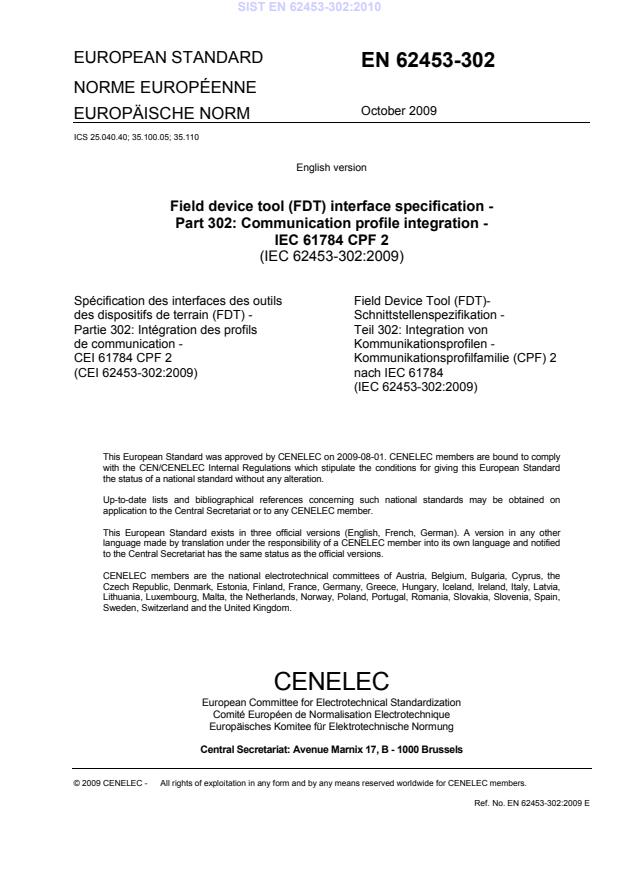
EUROPEAN STANDARD
EN 62453-302
NORME EUROPÉENNE
October 2009
EUROPÄISCHE NORM
ICS 25.040.40; 35.100.05; 35.110
English version
Field device tool (FDT) interface specification -
Part 302: Communication profile integration -
IEC 61784 CPF 2
(IEC 62453-302:2009)
Spécification des interfaces des outils Field Device Tool (FDT)-
des dispositifs de terrain (FDT) - Schnittstellenspezifikation -
Partie 302: Intégration des profils Teil 302: Integration von
de communication - Kommunikationsprofilen -
CEI 61784 CPF 2 Kommunikationsprofilfamilie (CPF) 2
(CEI 62453-302:2009) nach IEC 61784
(IEC 62453-302:2009)
This European Standard was approved by CENELEC on 2009-08-01. CENELEC members are bound to comply
with the CEN/CENELEC Internal Regulations which stipulate the conditions for giving this European Standard
the status of a national standard without any alteration.
Up-to-date lists and bibliographical references concerning such national standards may be obtained on
application to the Central Secretariat or to any CENELEC member.
This European Standard exists in three official versions (English, French, German). A version in any other
language made by translation under the responsibility of a CENELEC member into its own language and notified
to the Central Secretariat has the same status as the official versions.
CENELEC members are the national electrotechnical committees of Austria, Belgium, Bulgaria, Cyprus, the
Czech Republic, Denmark, Estonia, Finland, France, Germany, Greece, Hungary, Iceland, Ireland, Italy, Latvia,
Lithuania, Luxembourg, Malta, the Netherlands, Norway, Poland, Portugal, Romania, Slovakia, Slovenia, Spain,
Sweden, Switzerland and the United Kingdom.
CENELEC
European Committee for Electrotechnical Standardization
Comité Européen de Normalisation Electrotechnique
Europäisches Komitee für Elektrotechnische Normung
Central Secretariat: Avenue Marnix 17, B - 1000 Brussels
© 2009 CENELEC - All rights of exploitation in any form and by any means reserved worldwide for CENELEC members.
Ref. No. EN 62453-302:2009 E
Foreword
The text of document 65E/126/FDIS, future edition 1 of IEC 62453-302, prepared by SC 65E, Devices and
integration in enterprise systems, of IEC TC 65, Industrial-process measurement, control and automation,
was submitted to the IEC-CENELEC parallel vote and was approved by CENELEC as EN 62453-302 on
2009-08-01.
Each part of the EN 62453-3xy series is intended to be read in conjunction with EN 62453-2.
The following dates were fixed:
– latest date by which the EN has to be implemented
at national level by publication of an identical
national standard or by endorsement (dop) 2010-05-01
– latest date by which the national standards conflicting
with the EN have to be withdrawn (dow) 2012-08-01
Annex ZA has been added by CENELEC.
__________
Endorsement notice
The text of the International Standard IEC 62453-302:2009 was approved by CENELEC as a European
Standard without any modification.
In the official version, for Bibliography, the following notes have to be added for the standards indicated:
[2] IEC 61131-3 NOTE Harmonized as EN 61131-3:2003 (not modified).
[4] IEC/TR 62453-41 NOTE Harmonized as CLC/TR 62453-41:2009 (not modified).
[5] IEC/TR 62453-502 NOTE Harmonized as CLC/TR 62453-502:2009 (not modified).
__________
- 3 - EN 62453-302:2009
Annex ZA
(normative)
Normative references to international publications
with their corresponding European publications
The following referenced documents are indispensable for the application of this document. For dated
references, only the edition cited applies. For undated references, the latest edition of the referenced
document (including any amendments) applies.
NOTE When an international publication has been modified by common modifications, indicated by (mod), the relevant EN/HD
applies.
Publication Year Title EN/HD Year
1) 2)
IEC 61158-2 – Industrial communication networks - EN 61158-2 2008
Fieldbus specifications -
Part 2: Physical layer specification and service
definition
1) 2)
IEC 61158-3-2 – Industrial communication networks - EN 61158-3-2 2008
Fieldbus specifications - Part 3-2: Data-link
layer service definition -
Type 2 elements
1) 2)
IEC 61158-4-2 – Industrial communication networks - EN 61158-4-2 2008
Fieldbus specifications -
Part 4-2: Data-link layer protocol specification -
Type 2 elements
IEC 61158-5-2 2007 Industrial communication networks - EN 61158-5-2 2008
Fieldbus specifications -
Part 5-2: Application layer service definition -
Type 2 elements
IEC 61158-6-2 2007 Industrial communication networks - EN 61158-6-2 2008
Fieldbus specifications -
Part 6-2: Application layer protocol
specification - Type 2 elements
1) 2)
IEC 61784-1 – Industrial communication networks - Profiles - EN 61784-1 2008
Part 1: Fieldbus profiles
1) 2)
IEC 61784-2 – Industrial communication networks - Profiles - EN 61784-2 2008
Part 2: Additional fieldbus profiles for real-time
networks based on ISO/IEC 8802-3
IEC 61784-3-2 2007 Industrial communication networks - Profiles - EN 61784-3-2 2008
Part 3-2: Functional safety fieldbuses -
Additional specifications for CPF 2
1) 2)
IEC 62026-3 – Low-voltage switchgear and controlgear - EN 62026-3 2009
Controller-device interfaces (CDIs) -
Part 3: DeviceNet
IEC 62453-1 2009 Field device tool (FDT) interface specification - EN 62453-1 2009
Part 1: Overview and guidance
IEC 62453-2 2009 Field device tool (FDT) interface specification - EN 62453-2 2009
Part 2: Concepts and detailed description
ISO/IEC 19501 2005 Information technology - – –
Open Distributed Processing -
Unified Modeling Language (UML)
1)
Undated reference.
2)
Valid edition at date of issue.
Publication Year Title EN/HD Year
ISO 15745-2 2003 Industrial automation systems and integration - – –
Open systems application integration
framework -
Part 2: Reference description for
ISO 11898-based control systems
ISO 15745-3 2003 Industrial automation systems and integration - – –
Open systems application integration
framework -
Part 3: Reference description for
IEC 61158-based control systems
IEC 62453-302 ®
Edition 1.0 2009-06
INTERNATIONAL
STANDARD
Field device tool (FDT) interface specification –
Part 302: Communication profile integration – IEC 61784 CPF 2
INTERNATIONAL
ELECTROTECHNICAL
COMMISSION
PRICE CODE
V
ICS 25.040.40; 35.100.05; 35.110 ISBN 2-8318-1050-0
– 2 – 62453-302 © IEC:2009(E)
CONTENTS
FOREWORD.4
INTRODUCTION.6
1 Scope.7
2 Normative references .7
3 Terms, definitions, symbols, abbreviated terms and conventions .8
3.1 Terms and definitions .8
3.2 Symbols and abbreviated terms.8
3.3 Conventions .8
3.3.1 Data type names and references to data types .8
3.3.2 Vocabulary for requirements.9
4 Bus category .9
5 Access to instance and device data.9
6 Protocol specific behavior.9
7 Protocol specific usage of general data types .9
8 Protocol specific common data types.10
9 Network management data types.14
9.1 General .14
9.2 Node address.14
9.3 Scanner/master – Bus parameter set (CIP) .14
10 Communication data types .22
11 Channel parameter data types.24
12 Device identification .26
12.1 Device type identification data types .26
12.2 Topology scan data types.27
12.3 Scan identification data types.27
12.4 Device type identification data types .28
Annex A (informative) Implementation hints .30
Bibliography.32
Figure 1 – Part 302 of the IEC 62453 series .6
Figure A.1 – Examples of DTM naming for CompoNet.31
Table 1 – Protocol identifiers .
Table 2 – Protocol specific usage of general data types.10
Table 3 – Simple protocol specific common data types .10
Table 4 – Structured protocol specific common data types.12
Table 5 – Simple fieldbus configuration data types .14
Table 6 – Structured fieldbus configuration data types .16
Table 7 – Simple communication data types .22
Table 8 – Structured communication data types.23
Table 9 – Simple channel parameter data types.25
Table 10 – Structured channel parameter data types .25
Table 11 – Identification data types with protocol specific mapping.27
62453-302 © IEC:2009(E) – 3 –
Table 12 – Simple identification data types with protocol independent semantics.27
Table 13 – Structured identification data types with protocol independent semantics .27
Table 14 – Simple scan identification data types.28
Table 15 – Structured scan identification data types .28
Table 16 – Structured device type identification data types .29
Table A.1 – CompoNet relationship between Device Category, Node Address, MAC ID .30
– 4 – 62453-302 © IEC:2009(E)
INTERNATIONAL ELECTROTECHNICAL COMMISSION
____________
FIELD DEVICE TOOL (FDT) INTERFACE SPECIFICATION –
Part 302: Communication profile integration –
IEC 61784 CPF 2
FOREWORD
1) The International Electrotechnical Commission (IEC) is a worldwide organization for standardization comprising
all national electrotechnical committees (IEC National Committees). The object of IEC is to promote
international co-operation on all questions concerning standardization in the electrical and electronic fields. To
this end and in addition to other activities, IEC publishes International Standards, Technical Specifications,
Technical Reports, Publicly Available Specifications (PAS) and Guides (hereafter referred to as “IEC
Publication(s)”). Their preparation is entrusted to technical committees; any IEC National Committee interested
in the subject dealt with may participate in this preparatory work. International, governmental and non-
governmental organizations liaising with the IEC also participate in this preparation. IEC collaborates closely
with the International Organization for Standardization (ISO) in accordance with conditions determined by
agreement between the two organizations.
2) The formal decisions or agreements of IEC on technical matters express, as nearly as possible, an international
consensus of opinion on the relevant subjects since each technical committee has representation from all
interested IEC National Committees.
3) IEC Publications have the form of recommendations for international use and are accepted by IEC National
Committees in that sense. While all reasonable efforts are made to ensure that the technical content of IEC
Publications is accurate, IEC cannot be held responsible for the way in which they are used or for any
misinterpretation by any end user.
4) In order to promote international uniformity, IEC National Committees undertake to apply IEC Publications
transparently to the maximum extent possible in their national and regional publications. Any divergence
between any IEC Publication and the corresponding national or regional publication shall be clearly indicated in
the latter.
5) IEC provides no marking procedure to indicate its approval and cannot be rendered responsible for any
equipment declared to be in conformity with an IEC Publication.
6) All users should ensure that they have the latest edition of this publication.
7) No liability shall attach to IEC or its directors, employees, servants or agents including individual experts and
members of its technical committees and IEC National Committees for any personal injury, property damage or
other damage of any nature whatsoever, whether direct or indirect, or for costs (including legal fees) and
expenses arising out of the publication, use of, or reliance upon, this IEC Publication or any other IEC
Publications.
8) Attention is drawn to the Normative references cited in this publication. Use of the referenced publications is
indispensable for the correct application of this publication.
9) Attention is drawn to the possibility that some of the elements of this IEC Publication may be the subject of
patent rights. IEC shall not be held responsible for identifying any or all such patent rights.
International Standard IEC 62453-302 has been prepared by subcommittee 65E: Devices and
integration in enterprise systems, of IEC technical committee 65: Industrial-process
measurement, control and automation.
This part, in conjunction with the other parts of the first edition of the IEC 62453 series
cancels and replaces IEC/PAS 62453-1, IEC/PAS 62453-2, IEC/PAS 62453-3, IEC/PAS
62453-4 and IEC/PAS 62453-5 published in 2006, and constitutes a technical revision.
Each part of the IEC 62453-3xy series is intended to be read in conjunction with IEC 62453-2.
62453-302 © IEC:2009(E) – 5 –
The text of this standard is based on the following documents:
FDIS Report on voting
65E/126/FDIS 65E/139/RVD
Full information on the voting for the approval of this standard can be found in the report on
voting indicated in the above table.
This publication has been drafted in accordance with the ISO/IEC Directives, Part 2.
A list of all parts of the IEC 62453 series, under the general title Field Device Tool (FDT)
interface specification, can be found on the IEC website.
The committee has decided that the contents of this publication will remain unchanged until
the maintenance result date indicated on the IEC web site under "http://webstore.iec.ch" in
the data related to the specific publication. At this date, the publication will be
• reconfirmed,
• withdrawn,
• replaced by a revised edition, or
• amended.
A bilingual version of this publication may be issued at a later date.
– 6 – 62453-302 © IEC:2009(E)
INTRODUCTION
This part of IEC 62453 is an interface specification for developers of FDT (Field Device Tool)
components for function control and data access within a client/server architecture. The
specification is a result of an analysis and design process to develop standard interfaces to
facilitate the development of servers and clients by multiple vendors that need to interoperate
seamlessly.
With the integration of fieldbusses into control systems, there are a few other tasks which
need to be performed. In addition to fieldbus- and device-specific tools, there is a need to
integrate these tools into higher-level system-wide planning- or engineering tools. In
particular, for use in extensive and heterogeneous control systems, typically in the area of the
process industry, the unambiguous definition of engineering interfaces that are easy to use for
all those involved is of great importance.
A device-specific software component, called DTM (Device Type Manager), is supplied by the
field device manufacturer with its device. The DTM is integrated into engineering tools via the
FDT interfaces defined in this specification. The approach to integration is in general open for
all kinds of fieldbusses and thus meets the requirements for integrating different kinds of
devices into heterogeneous control systems.
Figure 1 shows how IEC 62453-302 is aligned in the structure of the IEC 62453 series.
Part 302 Communication
Profile
Integration –
IEC 61784 CPF 2
IEC 1125/09
Figure 1 – Part 302 of the IEC 62453 series
62453-302 © IEC:2009(E) – 7 –
FIELD DEVICE TOOL (FDT) INTERFACE SPECIFICATION –
Part 302: Communication profile integration –
IEC 61784 CPF 2
1 Scope
Communication Profile Family 2 (commonly known as CIP™ ) defines communication profiles
based on IEC 61158-2 Type 2, IEC 61158-3-2, IEC 61158-4-2, IEC 61158-5-2,
IEC 61158-6-2, and IEC 62026-3. The basic profiles CP 2/1 (ControlNet™ ), CP 2/2
(EtherNet/IP™ ), and CP 2/3 (DeviceNet™ ) are defined in IEC 61784-1 and IEC 61784-2. An
additional communication profile (CompoNet™ ), also based on CIP™, is defined in [14].
This part of IEC 62453 provides information for integrating the CIP™ technology into the FDT
interface specification (IEC 62453-2).
This part of IEC 62453 specifies communication and other services.
This specification neither contains the FDT specification nor modifies it.
2 Normative references
The following referenced documents are indispensable for the application of this document.
For dated references, only the edition cited applies. For undated references, the latest edition
of the referenced document (including any amendments) applies.
IEC 61158-2, Industrial communication networks – Fieldbus specifications – Part 2: Physical
layer specification and service definition
IEC 61158-3-2, Industrial communication networks – Fieldbus specifications – Part 3-2: Data-
link layer service definition – Type 2 elements
IEC 61158-4-2, Industrial communication networks – Fieldbus specifications – Part 4-2: Data-
link layer protocol specification – Type 2 elements
IEC 61158-5-2:2007, Industrial communication networks – Fieldbus specifications – Part 5-2:
Application layer service definition – Type 2 elements
———————
CIP™ (Common Industrial Protocol), DeviceNet™ and CompoNet™ are trade names of Open DeviceNet Vendor
Association, Inc (ODVA). This information is given for the convenience of users of this document and does not
constitute an endorsement by IEC of the trade name holder or any of its products. Compliance to this standard
does not require use of the trade names CIP™, DeviceNet™ or CompoNet™. Use of the trade names CIP™,
DeviceNet™ or CompoNet™ requires permission of Open DeviceNet Vendor Association,Inc.
ControlNet™ is a trade name of ControlNet International, Ltd. This information is given for the convenience of
users of this document and does not constitute an endorsement by IEC of the trademark holder or any of its
products. Compliance to this profile does not require use of the trade name ControlNet™. Use of the trade
name ControlNet™ requires permission of ControlNet International, Ltd.
EtherNet/IP™ is a trade name of ControlNet International, Ltd. and Open DeviceNet Vendor Association, Inc.
This information is given for the convenience of users of this document and does not constitute an endorsement
by IEC of the trademark holder or any of its products. Compliance to this profile does not require use of the
trade name EtherNet/IP™. Use of the trade name EtherNet/IP™ requires permission of either ControlNet
International, Ltd. or Open DeviceNet Vendor Association, Inc.
– 8 – 62453-302 © IEC:2009(E)
IEC 61158-6-2:2007, Industrial communication networks – Fieldbus specifications – Part 6-2:
Application layer protocol specification – Type 2 elements
IEC 61784-1, Industrial communication networks – Profiles – Part 1: Fieldbus profiles
IEC 61784-2, Industrial communication networks – Profiles – Part 2: Additional fieldbus
profiles for real-time networks based on ISO/IEC 8802-3
IEC 61784-3-2:2007, Industrial communication networks – Profiles – Part 3-2: Functional
safety fieldbuses – Additional specifications for CPF 2
IEC 62026-3, Low-voltage switchgear and controlgear – Controller-device interfaces (CDIs) –
Part 3: DeviceNet
IEC 62453-1:2009, Field Device Tool (FDT) interface specification – Part 1: Overview and
guidance
IEC 62453-2:2009, Field Device Tool (FDT) interface specification – Part 2: Concepts and
detailed description
ISO/IEC 19501:2005, Information technology – Open Distributed Processing – Unified
Modeling Language (UML) Version 1.4.2
ISO 15745-2:2003, Industrial automation systems and integration – Open systems application
integration framework – Part 2: Reference description for ISO 11898-based control systems
ISO 15745-3:2003, Industrial automation systems and integration – Open systems application
integration framework – Part 3: Reference description for IEC 61158-based control systems
3 Terms, definitions, symbols, abbreviated terms and conventions
3.1 Terms and definitions
For the purposes of this document, the terms and definitions given in IEC 62453-1 and
IEC 62453-2 apply.
3.2 Symbols and abbreviated terms
For the purposes of this document, the symbols and abbreviations given in IEC 62453-1,
IEC 62453-2 and the following apply.
CIP™ Common Industrial Protocol
CP Communication Profile [IEC 61784-1]
CPF Communication Profile Family [IEC 61784-1]
EDS Electronic Data Sheet [ISO 15745]
UML Unified Modelling Language [ISO/IEC 19501]
3.3 Conventions
3.3.1 Data type names and references to data types
The conventions for naming and referencing of data types are explained in IEC 62453-2
Clause A.1
62453-302 © IEC:2009(E) – 9 –
3.3.2 Vocabulary for requirements
The following expressions are used when specifying requirements.
Usage of “shall” or “mandatory” No exceptions allowed.
Usage of “should” or “recommended” Strong recommendation. It may make sense in
special exceptional cases to differ from the
described behavior.
Usage of “can’ or “optional’ Function or behavior may be provided,
depending on defined conditions.
4 Bus category
IEC 61784 CPF 2 protocol is identified in the protocolId element of the structured data type
'fdt:BusCategory' by the following unique identifiers, as specified in Table 1.
Table 1 – Protocol identifiers
Identifier value ProtocolId name Description
19B91472-EDB9-4e8c-BB61-516EEC79C1C0 ‘CIP DeviceNet’ Support for CP 2/3 (DeviceNet)
6CD80F51-019D-4e60-AEAC-B10144943B4B ‘CIP EthernetIP’ Support for CP 2/2 (EtherNet/IP)
C290CE23-62EA-478c-97F2-97EFEC602E05 ‘CIP ControlNet’ Support for CP 2/1 (ControlNet)
089BB2BC-B75A-11DB-8314-0800200C9A66 ‘CIP CompoNet’ Support for CompoNet
5 Access to instance and device data
The services InstanceDataInformation and DeviceDataInformation shall provide access at
least to all parameters defined in the Params section of the EDS.
6 Protocol specific behavior
IEC 61784 CPF 2 protocol has specific requirements related to configuration of fieldbus
masters.
It is very important to keep both data provider and consumer synchronized. Therefore data
provider shall be informed if the provided data has been modified. For instance, in case the
provided data is modified by the scanner/master DTM, then the slave/adapter DTM shall be
provided with the new data set.
NOTE For a description of data exchange between DTMs, see 6.3 of IEC 62453-2 (Configuration of fieldbus
master or communication scheduler).
7 Protocol specific usage of general data types
Table 2 shows how general data types, defined in IEC 62453-2 within the namespace ‘fdt’, are
used with IEC 61784 CPF 2 devices.
According to IEC 62453-2, at least one set of semantic information (one per supported
fieldbus protocol) shall be provided for each accessible data object, using the
‘SemanticInformation’ general data type. The corresponding data type ‘applicationDomain’
shall have the value “FDT_CIP” and the data type ‘semanticId’ shall have an appropriate
value, as specified in Table 2).
– 10 – 62453-302 © IEC:2009(E)
Table 2 – Protocol specific usage of general data types
Data type Description for use
fdt:address The “address” data type is not mandatory for the exposed parameters in
the DTMs. But if the address will be used, the string shall be
constructed according to the rules of the semanticId. That means the
data type “semanticId” is always the same as the data type “address”
fdt:protocolId See Clause 4.
fdt:deviceTypeId As defined in Identity object (see 6.2.1.2.2 of IEC 61158-5-2)
fdt:deviceTypeInformation A CIP DTM shall provide the path to the device specific EDS file with
this data type. For DTM certification, the path to the certified EDS file
shall be provided here.
NOTE The EDS information is accessible via
• IDtmParameter::GetParameters()
• IDtmInformation::GetInformation()
fdt:deviceTypeInformationPath Path to the EDS file which is also provided via the attribute
‘deviceTypeInformation’
The attribute contains full path to the EDS file including the file name in
URL notation.
For CIP devices, it is mandatory to provide information for this data
type.
This attribute is specific to FDT 1.2.1(see IEC 62453-2 and [8]),
therefore it shall not be provided if DTM is running in FDT 1.2 (see [7])
based Frame Applications
fdt:manufacturerId As defined in Identity object (see 6.2.1.2.2 of IEC 61158-5-2)
fdt:semanticId The applicationDomain is: FDT_CIP.
fdt:applicationDomain The data that is contained in the objects are addressable via classId,
instanceId and attributeId. This data may be variables or composed
blocks of data. The semanticID is directly based on the CIP address
information:
The semanticId is: CLASSxx.INSTANCEyy.ATTRIBUTEzz
xx classId
yy instanceId
zz attributeId
xx, yy, zz are based on decimal format without leading ‘0’.
Since ‘ATTRIBUTE’ is conditional in CIP in certain cases, it can be left
out. In this case, the semanticId is:
CLASSxx.INSTANCEyy
fdt:tag CIP assembly, parameter name or name of a I/O connection (in the
context of channel data)
8 Protocol specific common data types
Table 3 and Table 4 specify the protocol specific common data types, which are used in the
definition of other data types.
The data types described in this clause are defined for following namespace:
Namespace: cip
Table 3 – Simple protocol specific common data types
Data type Definition Description
attributeId USINT CIP attribute identifier
bitOffset UDINT Bit offset of a parameter in an assembly
cipStatus UINT cipStatus represents the Status (attribute 5) of
the Identity object. See 6.2.1.2.2 of
IEC 61158-5-2
62453-302 © IEC:2009(E) – 11 –
Data type Definition Description
classId UINT CIP class identifier
constValue UDINT Represents the constant value used in the data
type Constant
dataType enumeration ( byte | float | double | int Defines the different enumerations of the CIP
| unsigned | enumerator | data types
bitEnumerator | index | ascii |
password | bitString | hexString | date
| time | dateAndTime | duration |
binary | structured | dtmSpecific )
deviceType UINT Represents the DeviceType (attribute 2) of the
Identity object. See 6.2.1.2.2 of IEC 61158-5-2
ePath ARRAY OF USINT CIP EPATH, see 4.1.9 of IEC 61158-6-2
extendedIdentifier STRING Represents the address of the CIP device in the
CIPNodeID if the address used on this CIP
network is a name or IP-address. The
extendedIdentifier shall be used for CompoNet
networks to cover the CompoNet MAC ID.
See also shortIdentifier
instanceId UINT CIP object instance identifier
majorRevision USINT Represents the Major Revision (attribute 4.1) of
the Identity object. See 6.2.1.2.2 of
IEC 61158-5-2
minorRevision USINT Represents the Minor Revision (attribute 4.2) of
the Identity object. See 6.2.1.2.2 of
IEC 61158-5-2
portNumber UINT Represents the portnumber within a CIP bridging
or routing device to route a message to another
segment
productCode UINT Represents the Product code (attribute 3) of the
Identity object. See 6.2.1.2.2 of IEC 61158-5-2
productName STRING Represents the Product name (attribute 7) of the
Identity object. See 6.2.1.2.2 of IEC 61158-5-2
serialNumber ARRAY OF USINT Represents the Serialnumber (attribute 6) of the
Identity object. See 6.2.1.2.2 of IEC 61158-5-2.
If the serialNumber is not known because of
offline configuration then a 0 should be returned
serviceCode USINT CIP service code. This is a function, or method,
supported by a CIP object or attribute
serviceName STRING CIP service name. This is a function, or method,
supported by a CIP object or attribute. This
attribute provides additional human readable
information about the related service code
shortIdentifier USINT Represents the address of the CIP device in the
CIPNodeID if the address used on this CIP-
network is a simple address. See also
extendedIdentifier
symbolicAddress STRING Represents a name of a component inside the
device
vendorID UINT Represents the Vendor ID (attribute 1) of the
Identity object. See 6.2.1.2.2 of IEC 61158-5-2
– 12 – 62453-302 © IEC:2009(E)
Table 4 – Structured protocol specific common data types
Data type Definition Description
Elementary data type U Multi
sa plicit
ge y
CIPDevice STRUCT Specifies a CIP device.
CIPDevice contains manufacturer and device
information (the Identity Object), which is
present in every CIP node
cipStatus M [1.1]
CIPPath M [1.1]
CIPDeviceIdentity M [1.1]
CIPDeviceIdentity STRUCT Represents the static part of the Identity object
of the CIP device. See 6.2.1.2.2 of
IEC 61158-5-2
vendorID M [1.1]
deviceType M [1.1]
productCode M [1.1]
majorRevision M [1.1]
minorRevision M [1.1]
serialNumber M [1.1]
productName M [1.1]
CIPNodeID STRUCT Identifier used to identify a particular node
(device) on a CIP network, e.g. CIP MAC (Media
Access Control) ID (1 byte) for DeviceNet and
ControlNet; IP address for EtherNet/IP.
Since the size differs from protocol to protocol,
structure is used which contains 2 attributes:
extended identifier (n bytes string) and short
identifier (1 byte unsigned integer) and only one
of them shall be used
choice of M [1.1]
ExtendedIdentifier S [1.1]
ShortIdentifier S [1.1]
CIPObjectAddress STRUCT CIP object address as CIPObjectId,
CIPSymbolicAddress or HexAddress
choice of M [1.1]
CIPObjectId S [1.1]
CIPSymbolicAddress S [1.1]
HexAddress S [1.1]
CIPObjectId STRUCT The CIP classId, instanceId and (conditional)
attributeId ‘address’ information for a CIP object
and attribute. If used in a Process Channel this
is likely to be either an Assembly object or a
Parameter object
classId M [1.1]
instanceId M [1.1]
attributeId O [0.1]
62453-302 © IEC:2009(E) – 13 –
Data type Definition Description
Elementary data type U Multi
sa plicit
ge y
CIPPath STRUCT The full ‘address’ of the CIP node (device). In
general this consists of the Node ID stored in the
CIPNodeID element. The RoutingPath element is
used to transfer additional routing information
that can be used by the CIP FDT communication
component
RoutingPath O [0.1]
CIPNodeID M [1.1]
CIPSymbolicAddress STRUCT classId, instanceId and attributeId does not
necessarily be known, a symbolic address could
also be used.
CIPSymbolicAddress, HexAddress or
CIPObjectId could be used for
DataExchangeRequest
symbolicAddress M [1.1]
Constant STRUCT A constant value
constValue M [1.1]
ExtendedIdentifier STRUCT See attribute extendedIdentifier
extendedIdentifier M [1.1]
HexAddress STRUCT CIP object address as ePath
ePath O [0.1]
LinkAddress STRUCT Represents the CIPNodeID within a Segment
CIPNodeID M [1.1]
ParameterReference STRUCT Reference to a description of a parameter
fdt:idref M [1.1]
bitOffset O [0.1]
ReservedBits STRUCT Used wherever reserved bits are needed
RoutingPath STRUCT Any additional CIP network routing information,
which can be understood by the Communication
Channel
Segment M [1.1]
Segment STRUCT Represents the path a message shall follow to
reach the addressed CIP device
portNumber M [1.1]
LinkAddress M [1.1]
Segment O [0.1]
Service STRUCT CIP service identified by serviceCode and
serviceName. CIP service code. This is a
function, or method, supported by a CIP object
or attribute
serviceCode M [1.1]
serviceName O [0.1]
ShortIdentifier STRUCT See attribute shortIdentifier
shortIdentifier M [1.1]
– 14 – 62453-302 © IEC:2009(E)
9 Network management data types
9.1 General
The data types specified in this clause are used at following services:
• NetworkManagementInfoRead service;
• NetworkManagementInfoWrite service.
9.2 Node address
The CIPNodeID will be stored in the busAddress element of the fdt:DeviceAddress data type.
This is not used for CompoNet because the master has a fixed address – since this is a
mandatory element, the recommendation is to use the value “0”.
9.3 Scanner/master – Bus parameter set (CIP)
Information is sent to the CIP scanner/master within the UserDefinedBus element of the
NetworkInfo data type, using the data types specified in Table 5 and Table 6. This information
shall be set to configure the scan list of scanner/master.
The data types described in this clause are defined for following namespace:
Namespace: cippar
Table 5 – Simple fieldbus configuration data types
Data type Definition Description
async USINT See Table 7-2.3 of [13]. This is a CIP Safety exclusive field. Only
applies to producing connections. Field should be empty for
consuming connections. Used to calculate Network Reaction
Time
base UINT Scaling parameters. See A.4.1.4.6 of ISO 15745-2
class0 BOOL See Table A.25 of ISO 15745-3
class1 BOOL
class2 BOOL
class3 BOOL
class4 BOOL
class5 BOOL
class6 BOOL
compoNetDeviceCategory USINT Defines the different categories of CompoNet devices. See [14],
Chapter 7-4
compoNetIOLength UINT See [14], Chapter 7-5
compoNetIOLengthUnit USINT
connectionNameString STRING See Table A.24 of ISO 15745-3
connectionTypeMulticast BOOL See Table A.26 of ISO 15745-3
connectionTypeNULL BOOL
connectionTypePoint2Point BOOL
consumedConnectionSize UINT Maximum number bytes received across this connection
defaultConnection BOOL Indicates whether the CIPConnection is default or not
defaultSafetyConnections USINT See Table 7-2.2 of [13]. Instance Number
defaultValue STRING Represents the value of the attribute when in offline state
div UINT Scaling parameters. See A.4.1.4.6 of ISO 15745-2
62453-302 © IEC:2009(E) – 15 –
Data type Definition Description
expectedPacketRate UINT Scanner determines this parameter. There might be some reason
that the slave provides this parameter to the master
fixedSizeSupported BOOL See Table A.26 of ISO 15745-3
helpString STRING See Table A.24 of ISO 15745-3
inhibitTime UINT Optional for COS, for other connection types it is not valid.
Scanner determines this parameter. There might be some reason
that the slave provides this parameter to the master
maxCIPConnections UINT Communication capacity, See Chapter 7-3.6.11.7 of [9]
maxConsumerNumber USINT See Table 7-2.3 of [13]. This is a CIP Safety exclusive field.
When safety devices wish to define multi-cast connections and
need to restrict the maximum number of consumers to a value
less than the default maximum of 15, this field can define the
product limit. If this field is empty, the SNCT shall always use the
default value of 15 for the maximum number of multi-cast
connections. This field can be left empty for single-cast
connections
maxEMConnections UINT Communication capacity. See Chapter 7-3.6.11.7 of [9]
maxIOConnections UINT
maxSafetyConnections USINT See Table 7-2.2 of [13]. Optional
maxSafetyInputCnxns USINT
maxSafetyOutputCnxns USINT
multiplier UINT Scaling parameters. See A.4.1.4.6 of ISO 15745-2
offset INT
precision UINT
priorityHigh BOOL See Table A.26 of ISO 15745-3
priorityLow BOOL
priorityScheduled BOOL
producedConnectionSize UINT Maximum number of bytes transmitted across this connection
realTimeTransferFormat USINT See Table A.26 of ISO 15745-3
rpi UDINT See Table A.24 of ISO 15745-3
scId ARRAY OF Safety Configuration Identifier. See 6.6.5.17 of IEC 61784-3-2
USINT
server BOOL See Table A.25 of ISO 15745-3
transportTypeExclusiveOwner BOOL
transportTypeInputOnly BOOL
transportTypeListenOnly BOOL
transportTypeRedundantOwner BOOL
triggerApplication BOOL
triggerChangeOfState BOOL
triggerCyclic BOOL
unId ARRAY OF See 6.6.5.18 of IEC 61784-3-2
USINT
variableSizeSupported BOOL See Table A.26 of ISO 15745-3
– 16 – 62453-302 © IEC:2009(E)
Table 6 – Structured fieldbus configuration data types
Data type Definition Description
Elementary data types Us Multi
ag plicy
e
AssemblyMemberDefinition STRUCT Represents all members of an
assembly
fdt:id O [0.1]
fdt:tag M [1.1]
fdt:descriptor O [0.1]
cip:dataType M [1.1]
defaultValue O [0.1]
Scaling O [0.1]
cip:CIPObjectAddress O [0.1]
fdt:BitEnumeratorEntries O [0.1]
fdt:EnumeratorEntries O [0.1]
fdt:Unit O [0.1]
fdt:Ranges O [0.1]
fdt:SubstituteValue O [0.1]
AssemblyMemberDefinitions STRUCT See AssemblyMember
definition
AssemblyMemberDefinition O [0.*]
BitStrobeConnection STRUCT Represents the Bitstrobe IO
connection
MasterSlaveConnection M [1.1]
Capacity STRUCT Communication capacity, See
Chapter 7-3.6.11.7 of [9]
MaxCIPConnections O [0.1]
MaxIOConnections O [0.1]
MaxEMConnections O [0.1]
CIPConnection STRUCT Defines one supported CIP
connection
Contains attributes, see Table
A.24 of ISO 15745-3
For safety devices, see Chapter
7-2.2.4.3, Table 7-2-3 of [13]
connectionNameString M [1.1]
helpString M [1.1]
cip:ePath M [1.1]
defaultConnection O [0.1]
Config1 O [0.1]
Config2 O [0.1]
TriggerAndTransport M [1.1]
Originator2TargetParameters M [1.1]
Target2OriginatorParameters M [1.1]
62453-302 © IEC:2009(E) – 17 –
Data type Definition Description
Elementary data types Us Multi
ag plicy
e
CIPNode STRUCT Represents all connection
information of the device
fdt:readAccess O [0.1]
fdt:writeAccess O [0.1]
fdtpar:configurationData O [0.1]
scId O [0.1]
unId O [0.1]
cip:CIPDeviceIdentity M [1.1]
cip:CIPNodeID M [1.1]
PossibleConnections M [1.1]
CurrentConnections M [1.1]
AssemblyMemberDefinitions O [0.1]
CompoNetIO STRUCT Defines the IO of a CompoNet
device. See [14], Chapter 7-2
CompoNetInputInfo O [0.1]
CompoNetOutputInfo O [0.1]
compoNetDeviceCategory M [1.1]
CompoNetInputInfo STRUCT Represents the Inputs of the
CompoNet device
CompoNetIOInfo M [1.1]
CompoNetIOInfo STRUCT Represents the Inputs or
Outputs of the CompoNet
device
compoNetIOLengthUnit M [1.1]
compoNetIOLength M [1.1]
CompoNetOutputInfo STRUCT Represents the Outputs of the
CompoNet device
CompoNetIOInfo M [1.1]
Config STRUCT Contains elements Size and
Format
Size O [0.1]
Format O [0.1]
Config1 STRUCT See Table A.24 of ISO 15745-3
Config M [1.1]
Config2 STRUCT See Table A.24 of ISO 15745-3
Config M [1.1]
– 18 – 62453-302 © IEC:2009(E)
Data type Definition Description
...