

EN 60749-25:2003
(Main)Semiconductor devices - Mechanical and climatic test methods - Part 25: Temperature cycling
General Information
- Abstract
Provides a test procedure for determining the ability of semiconductor devices and components and/or board assemblies to withstand mechanical stresses induced by alternating high and low temperature extremes. Permanent changes in electrical and/or physical characteristics can result from these mechanical stresses. Applies to single, dual and triple chamber temperature cycling and covers component and solder interconnection testing.
- Status
- Published
- Publication Date
- 17-Sep-2003
- Withdrawal Date
- 31-Aug-2006
- Technical Committee
- CLC/TC 47X - Semiconductor devices and trusted chips
- Drafting Committee
- IEC/TC 47 - IEC_TC_47
- Parallel Committee
- IEC/TC 47 - IEC_TC_47
- Current Stage
- 9093 - Decision to confirm - Review Enquiry
- Start Date
- 15-Dec-2025
- Completion Date
- 08-Sep-2026

Overview - EN 60749-25:2003 (Temperature cycling)
EN 60749-25:2003 (equivalent to IEC 60749-25:2003) is a European/CENELEC standard that specifies a temperature cycling test method for semiconductor devices and board assemblies. The standard defines procedures to determine a device’s ability to withstand mechanical stresses produced by alternating high and low temperature extremes. These thermal-mechanical stresses can produce permanent changes in electrical or physical characteristics; the standard is intended to expose and evaluate those failure mechanisms.
Key topics and technical requirements
- Scope and purpose: Test procedure for single, dual and triple chamber temperature cycling; covers component and solder interconnection testing (e.g., BGA, flip-chip).
- Test apparatus: Requirements for chambers capable of meeting specified sample temperatures in the working zone while loaded; guidance on minimizing direct conduction and on thermocouple placement for sample temperature measurement.
- Sample temperature control: Definition of sample temperature, maximum/minimum sample temperature (Ts,max / Ts,min), soak temperature and soak time; use of thermocouples or equivalent measurement methods to verify that samples reach extremes.
- Cycle profiles: Cycle time, ramp rate (measured over the linear portion of the profile), load transfer time (for dual/triple chamber shuttling) and recovery procedures are specified. The standard defines soak modes and cycle rates tied to failure mechanisms.
- Typical cycle rates: Component-level cycling: typically 1–3 cycles/hour (faster cycles >3/h allowed where appropriate). Solder interconnect testing: typically 1–2 cycles/hour to evaluate solder joint fatigue.
- Procedure steps: Initial inspection/measurements, conditioning, cycling (with defined upper/lower soaks and transitions), recovery, final measurements and failure criteria. The standard references tables and figures (temperature cycling conditions, soak modes, recommended test conditions) to select appropriate regimes.
- Normative references: Integrates IEC 60068‑2‑14 (change of temperature) for environmental testing procedures.
Practical applications and users
Who uses EN 60749-25:
- Semiconductor manufacturers and device design teams validating mechanical reliability
- Reliability and qualification engineers for components and PCB assemblies
- Test laboratories performing environmental stress screening and failure analysis
- OEMs and contract manufacturers verifying solder interconnection robustness (BGA, flip-chip, stacked packages) Practical uses:
- Qualification of new device packages and solder interconnect processes
- Comparative reliability testing across suppliers or assembly methods
- Root-cause analysis of field failures related to thermal cycling and fatigue
Related standards
- IEC 60749 series - mechanical and climatic test methods for semiconductor devices
- IEC 60068-2-14 - Basic environmental testing procedures: Test N (Change of temperature)
- National adoptions / CENELEC implementations (EN 60749-25)
This concise guide helps reliability teams and test engineers select and apply the EN 60749-25:2003 temperature cycling method for semiconductor and solder-interconnect qualification.
Relations
- Effective Date
- 03-Feb-2026
- Effective Date
- 09-Jun-2026
- Effective Date
- 03-Feb-2026
- Effective Date
- 03-Feb-2026
- Effective Date
- 03-Feb-2026
- Effective Date
- 03-Feb-2026
- Effective Date
- 03-Feb-2026
- Effective Date
- 03-Feb-2026
- Effective Date
- 03-Feb-2026
- Effective Date
- 03-Feb-2026
- Effective Date
- 03-Feb-2026
- Effective Date
- 03-Feb-2026
- Effective Date
- 03-Feb-2026
- Referred By
EN 60747-15:2004 - Discrete semiconductor devices - Part 15: Isolated power semiconductor devices - Effective Date
- 03-Feb-2026
- Effective Date
- 03-Feb-2026
Frequently Asked Questions
EN 60749-25:2003 is a standard published by CLC. Its full title is "Semiconductor devices - Mechanical and climatic test methods - Part 25: Temperature cycling". This standard covers: Provides a test procedure for determining the ability of semiconductor devices and components and/or board assemblies to withstand mechanical stresses induced by alternating high and low temperature extremes. Permanent changes in electrical and/or physical characteristics can result from these mechanical stresses. Applies to single, dual and triple chamber temperature cycling and covers component and solder interconnection testing.
Provides a test procedure for determining the ability of semiconductor devices and components and/or board assemblies to withstand mechanical stresses induced by alternating high and low temperature extremes. Permanent changes in electrical and/or physical characteristics can result from these mechanical stresses. Applies to single, dual and triple chamber temperature cycling and covers component and solder interconnection testing.
EN 60749-25:2003 is classified under the following ICS (International Classification for Standards) categories: 31.080.01 - Semiconductor devices in general. The ICS classification helps identify the subject area and facilitates finding related standards.
EN 60749-25:2003 has the following relationships with other standards: It is inter standard links to EN 60068-2-14:1999, EN IEC 60947-10:2026, EN 62149-8:2014, EN 60749-30:2005, EN 62149-2:2014, EN IEC 62149-4:2023, EN 62047-4:2010, EN 60749-43:2017, EN IEC 62149-10:2018, EN 62149-9:2014, EN IEC 60749-30:2020, EN 60747-15:2012, EN 62572-3:2014, EN 60747-15:2004, EN IEC 62149-12:2023. Understanding these relationships helps ensure you are using the most current and applicable version of the standard.
EN 60749-25:2003 is available in PDF format for immediate download after purchase. The document can be added to your cart and obtained through the secure checkout process. Digital delivery ensures instant access to the complete standard document.
Standards Content (Sample)
STANDARDSemiconductor devices - Mechanical and climatic test methods - Part 25: Temperature cycling (IEC 60749-25:2003)©
Standard je založil in izdal Slovenski inštitut za standardizacijo. Razmnoževanje ali kopiranje celote ali delov tega dokumenta ni dovoljenoReferenčna številkaSIST EN 60749-25:2004(en)ICS31.080.01
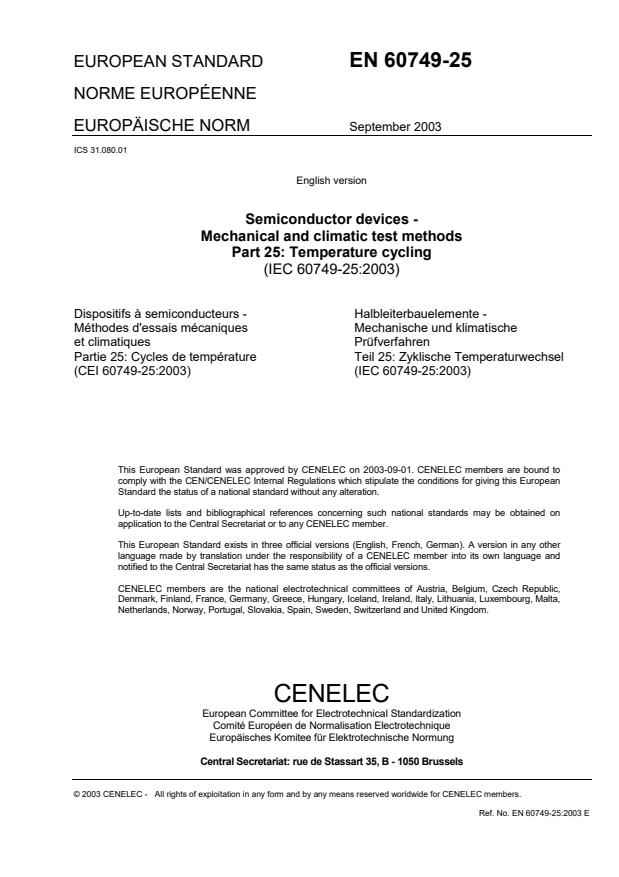
EUROPEAN STANDARD
EN 60749-25 NORME EUROPÉENNE EUROPÄISCHE NORM
September 2003 CENELEC European Committee for Electrotechnical Standardization Comité Européen de Normalisation Electrotechnique Europäisches Komitee für Elektrotechnische Normung
Central Secretariat: rue de Stassart 35, B - 1050 Brussels
© 2003 CENELEC - All rights of exploitation in any form and by any means reserved worldwide for CENELEC members.
Ref. No. EN 60749-25:2003 E
ICS 31.080.01
English version
Semiconductor devices -
Mechanical and climatic test methods Part 25: Temperature cycling (IEC 60749-25:2003)
Dispositifs à semiconducteurs -
Méthodes d'essais mécaniques
et climatiques Partie 25: Cycles de température (CEI 60749-25:2003)
Halbleiterbauelemente -
Mechanische und klimatische Prüfverfahren Teil 25: Zyklische Temperaturwechsel (IEC 60749-25:2003)
This European Standard was approved by CENELEC on 2003-09-01. CENELEC members are bound to comply with the CEN/CENELEC Internal Regulations which stipulate the conditions for giving this European Standard the status of a national standard without any alteration.
Up-to-date lists and bibliographical references concerning such national standards may be obtained on application to the Central Secretariat or to any CENELEC member.
This European Standard exists in three official versions (English, French, German). A version in any other language made by translation under the responsibility of a CENELEC member into its own language and notified to the Central Secretariat has the same status as the official versions.
CENELEC members are the national electrotechnical committees of Austria, Belgium, Czech Republic, Denmark, Finland, France, Germany, Greece, Hungary, Iceland, Ireland, Italy, Lithuania, Luxembourg, Malta, Netherlands, Norway, Portugal, Slovakia, Spain, Sweden, Switzerland and United Kingdom.
The text of document 47/1696/FDIS, future edition 1 of IEC 60749-25, prepared by IEC TC 47, Semiconductor devices, was submitted to the IEC-CENELEC parallel vote and was approved by CENELEC as EN 60749-25 on 2003-09-01.
This mechanical and climatic test method, as it relates to change of temperature, is a complete rewrite of the test contained in Subclause 1.1 of Chapter 3 of EN 60749:1999.
The following dates were fixed:
– latest date by which the EN has to be implemented
at national level by publication of an identical
national standard or by endorsement
(dop) 2004-06-01
– latest date by which the national standards conflicting
with the EN have to be withdrawn
(dow) 2006-09-01
Annexes designated "normative" are part of the body of the standard.
In this standard, annex ZA is normative. Annex ZA has been added by CENELEC. __________
Endorsement notice
The text of the International Standard IEC 60749-25:2003 was approved by CENELEC as a European Standard without any modification. __________
- 3 - EN 60749-25:2003
Annex ZA
(normative)
Normative references to international publications
with their corresponding European publications This European Standard incorporates by dated or undated reference, provisions from other publications. These normative references are cited at the appropriate places in the text and the publications are listed hereafter. For dated references, subsequent amendments to or revisions of any of these publications apply to this European Standard only when incorporated in it by amendment or revision. For undated references the latest edition of the publication referred to applies (including amendments). NOTE When an international publication has been modified by common modifications, indicated by (mod), the relevant EN/HD applies. Publication Year Title EN/HD Year IEC 60068-2-14 1984 Environmental testing Part 2: Tests - Test N: Change of temperature EN 60068-2-14 1) 1999
1) EN 60068-2-14 includes A1:1986 to IEC 60068-2-14.
NORMEINTERNATIONALECEIIECINTERNATIONALSTANDARD60749-25Première éditionFirst edition2003-07Dispositifs à semiconducteurs –Méthodes d'essais mécaniques et climatiques –Partie 25:Cycles de températureSemiconductor devices –Mechanical and climatic test methods –Part 25:Temperature cyclingPour prix, voir catalogue en vigueurFor price, see current catalogue© IEC 2003
Droits de reproduction réservés
⎯
Copyright - all rights reservedAucune partie de cette publication ne peut être reproduite niutilisée sous quelque forme que ce soit et par aucun procédé,électronique ou mécanique, y compris la photocopie et lesmicrofilms, sans l'accord écrit de l'éditeur.No part of this publication may be reproduced or utilized in anyform or by any means, electronic or mechanical, includingphotocopying and microfilm, without permission in writing fromthe publisher.International Electrotechnical Commission,
3, rue de Varembé, PO Box 131, CH-1211 Geneva 20, SwitzerlandTelephone: +41 22 919 02 11
Telefax: +41 22 919 03 00
E-mail: inmail@iec.ch
Web: www.iec.chCODE PRIXPRICE CODEMCommission Electrotechnique InternationaleInternational Electrotechnical Commission
60749-25 © IEC:2003– 3 –CONTENTSFOREWORD.51Scope.92Normative references.93Terms and definitions.94Test apparatus.135Procedure.135.1Initial measurements.135.2Conditioning.135.3Cycle rates.155.4Upper and lower soak times.195.5Upper and lower soak temperatures.195.6Soak modes.195.7Cycle time.195.8Ramp rate.215.9Load transfer time.215.10Recovery.215.11Final measurements.215.12Failure criteria.236Summary.23Figure 1 – Representative temperature profile for thermal cycle test conditions.25Table 1 – Temperature cycling test conditions.17Table 2 – Soak mode conditions.17Table 3 – Typical frequency and soak mode for test conditions.19Table 4 – Recommended test conditions for solder interconnection temperature cycling.21
60749-25 © IEC:2003– 5 –INTERNATIONAL ELECTROTECHNICAL COMMISSION____________SEMICONDUCTOR DEVICES –MECHANICAL AND CLIMATIC TEST METHODS –Part 25: Temperature cyclingFOREWORD1)The International Electrotechnical Commission (IEC) is a worldwide organization for standardization comprisingall national electrotechnical committees (IEC National Committees). The object of IEC is to promoteinternational co-operation on all questions concerning standardization in the electrical and electronic fields. Tothis end and in addition to other activities, IEC publishes International Standards, Technical Specifications,Technical Reports, and Guides (hereafter referred to as “IEC Publication(s)”). Their preparation is entrusted totechnical committees; any IEC National Committee interested in the subject dealt with may participate in thispreparatory work. International, governmental and non-governmental organizations liaising with the IEC alsoparticipate in this preparation. IEC collaborates closely with the International Organization for Standardization(ISO) in accordance with conditions determined by agreement between the two organizations.2)The formal decisions or agreements of IEC on technical matters express, as nearly as possible, an internationalconsensus of opinion on the relevant subjects since each technical committee has representation from allinterested IEC National Committees.3)IEC Publications have the form of recommendations for international use and are accepted by IEC NationalCommittees in that sense. While all reasonable efforts are made to ensure that the technical content of IECPublications is accurate, IEC cannot be held responsible for the way in which they are used or for anymisinterpretation by any end user.4)In order to promote international uniformity, IEC National Committees undertake to apply IEC Publicationstransparently to the maximum extent possible in their national and regional publications. Any divergencebetween any IEC Publication and the corresponding national or regional publication shall be clearly indicated inthe latter.5)IEC provides no marking procedure to indicate its approval and cannot be rendered responsible for anyequipment declared to be in conformity with an IEC Publication.6)All users should ensure that they have the latest edition of this publication.7)No liability shall attach to IEC or its directors, employees, servants or agents including individual experts andmembers of its technical committees and IEC National Committees for any personal injury, property damage orother damage of any nature whatsoever, whether direct or indirect, or for costs (including legal fees) andexpenses arising out of the publication, use of, or reliance upon, this IEC Publication or any other IECPublications.8)Attention is drawn to the Normative references cited in this publication. Use of the referenced publications isindispensable for the correct application of this publication.9)Attention is drawn to the possibility that some of the elements of this IEC Publication may be the subject ofpatent rights. IEC shall not be held responsible for identifying any or all such patent rights.International Standard IEC 60749-25 has been prepared by IEC technical committee 47:Semiconductor devices.This standard cancels and replaces IEC/PAS 62178 published in 2000. This first editionconstitutes a technical revision.The text of this standard is based on the following documents:FDISReport on voting47/1696/FDIS47/1706/RVDFull information on the voting for the approval of this standard can be found in the reporton voting indicated in the above table.
60749-25 © IEC:2003– 7 –This publication has been drafted in accordance with the ISO/IEC Directives, Part 2.This mechanical and climatic test method, as it relates to change of temperature, is a com-plete rewrite of the test contained in Subclause 1.1 of Chapter 3 of IEC 60749.The committee has decided that the contents of this publication will remain unchanged until2007. At this date, the publication will be•reconfirmed;•withdrawn;•replaced by a revised edition, or•amended.
60749-25 © IEC:2003– 9 –SEMICONDUCTOR DEVICES –MECHANICAL AND CLIMATIC TEST METHODS –Part 25: Temperature cycling1 ScopeThis part of IEC 60749 provides a test procedure for determining the ability of semiconductordevices and components and/or board assemblies to withstand mechanical stresses inducedby alternating high and low temperature extremes. Permanent changes in electrical and/orphysical characteristics can result from these mechanical stresses.This test method is in general accord with IEC 60068-2-14 but, due to specific requirements ofsemiconductors, the clauses of this standard apply.This test method applies to single, dual and triple chamber temperature cycling and coverscomponent and solder interconnection testing.
In single chamber cycling, the load is placedin a stationary chamber and is heated or cooled by introducing hot, ambient or cold air intothe chamber. In dual chamber cycling, the load is placed on a moving platform that shuttlesbetween stationary chambers maintained at fixed temperatures. In triple chamber temperaturecycling, the load is moved between the three chambers.2 Normative referencesThe following referenced documents are indispensable for the application of this document.For dated references, only the edition cited applies. For u
...