

EN 60512-16-20:1996
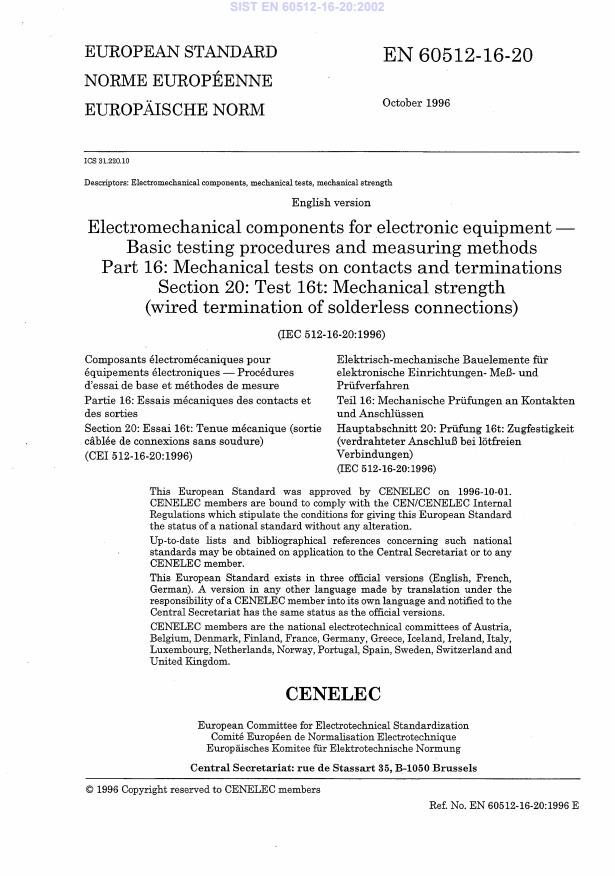
(Main)Electromechanical components for electronic equipment - Basic testing procedures and measuring methods - Part 16: Mechanical tests on contacts and terminations - Section 20: Test 16t: Mechanical strength (wired termination of solderless connections)
General Information
- Abstract
Details a standard method to assess the mechanical strength of solderless connections including integrated strain relief features.
- Status
- Published
- Publication Date
- 23-Oct-1996
- Withdrawal Date
- 30-Jun-1997
- Technical Committee
- CLC/SR 48B - Connectors
- Drafting Committee
- IEC/SC 48B - IEC_SC_48B
- Parallel Committee
- IEC/SC 48B - IEC_SC_48B
- Current Stage
- 6060 - Document made available - Publishing
- Start Date
- 24-Oct-1996
- Completion Date
- 25-Aug-2026

Overview
EN 60512-16-20:1996 is a harmonized European Standard developed by CLC for the electronics industry. It specifies testing procedures for assessing the mechanical strength of wired terminations of solderless connections (including those with integrated strain relief) within electromechanical components for electronic equipment. This standard forms part of the broader EN 60512 family, which addresses performance and reliability testing for connectors and terminations.
Mechanical strength is critical in ensuring reliable connections in plug-and-socket devices, minimizing failures due to mechanical stress or vibration. EN 60512-16-20:1996 provides manufacturers, testing laboratories, and engineers with a consistent, reproducible test method for evaluating the integrity of solderless connections under mechanical stress.
Key Topics
Scope of Testing
The standard details procedures for assessing the mechanical strength of wired terminations in solderless connectors, with a focus on:- Connections with and without integrated strain relief features
- Applicability across a range of connector types for electronic equipment
Test Methodology
- Describes a basic mechanical test (identified as Test 16t)
- Methods emphasize reproducibility and comparability of results in testing mechanical robustness
Performance Criteria
- Outlines how test results should be evaluated to ensure connectors meet required mechanical standards
Documentation
- Specifies requirements for reporting and documenting results to ensure traceability and quality control
Applications
EN 60512-16-20:1996 is vital wherever solderless electrical connections are used in electronic equipment. Key applications include:
Manufacturing and Quality Assurance
Used by connector and electronic equipment manufacturers to verify that their products meet minimum mechanical strength specs, reducing risk of premature failure in serviceProduct Development and Selection
Helps engineers compare different connector solutions based on standardized performance data, supporting reliable component selection and system designCompliance and Certification
Serves as a reference during regulatory compliance checks or third-party product testing, especially in the context of European and international marketsTesting and Inspection
Utilized by test labs and inspectors to assess long-term mechanical reliability, ensuring connectors provide secure, stable performance even under repeated mechanical stress
Related Standards
EN 60512 Series
EN 60512-16-20:1996 is part of the EN 60512 international standard series covering basic testing procedures and measuring methods for electromechanical components.ISO/IEC 61076
Addresses connector requirements for different applications, often referenced alongside EN 60512 for comprehensive connector evaluation.IEC 60603 and IEC 60352
Provide further requirements and test procedures for connectors, including those for solderless and soldered connections.
Summary
By following EN 60512-16-20:1996, organizations ensure the mechanical reliability of solderless wired terminations in electronic connectors, enhancing safety, product lifespan, and user confidence. Adopting this standard supports best practices in the design, testing, and specification of plug-and-socket devices and related components within electronic systems. For comprehensive quality assurance and market acceptance, compliance with EN 60512-16-20:1996 remains essential in the electronics sector.
Relations
- Referred By
EN IEC 62282-2-100:2020 - Fuel cell technologies - Part 2-100: Fuel cell modules - Safety - Effective Date
- 03-Feb-2026
- Effective Date
- 03-Feb-2026
- Effective Date
- 03-Feb-2026
- Effective Date
- 03-Feb-2026
- Effective Date
- 03-Feb-2026
Frequently Asked Questions
EN 60512-16-20:1996 is a standard published by CLC. Its full title is "Electromechanical components for electronic equipment - Basic testing procedures and measuring methods - Part 16: Mechanical tests on contacts and terminations - Section 20: Test 16t: Mechanical strength (wired termination of solderless connections)". This standard covers: Details a standard method to assess the mechanical strength of solderless connections including integrated strain relief features.
Details a standard method to assess the mechanical strength of solderless connections including integrated strain relief features.
EN 60512-16-20:1996 is classified under the following ICS (International Classification for Standards) categories: 31.220.10 - Plug-and-socket devices. Connectors. The ICS classification helps identify the subject area and facilitates finding related standards.
EN 60512-16-20:1996 has the following relationships with other standards: It is inter standard links to EN IEC 62282-2-100:2020, EN 60352-6:1997, EN IEC 60352-6:2023, EN IEC 60352-7:2021, EN IEC 60352-7:2026. Understanding these relationships helps ensure you are using the most current and applicable version of the standard.
EN 60512-16-20:1996 is available in PDF format for immediate download after purchase. The document can be added to your cart and obtained through the secure checkout process. Digital delivery ensures instant access to the complete standard document.
Standards Content (Sample)
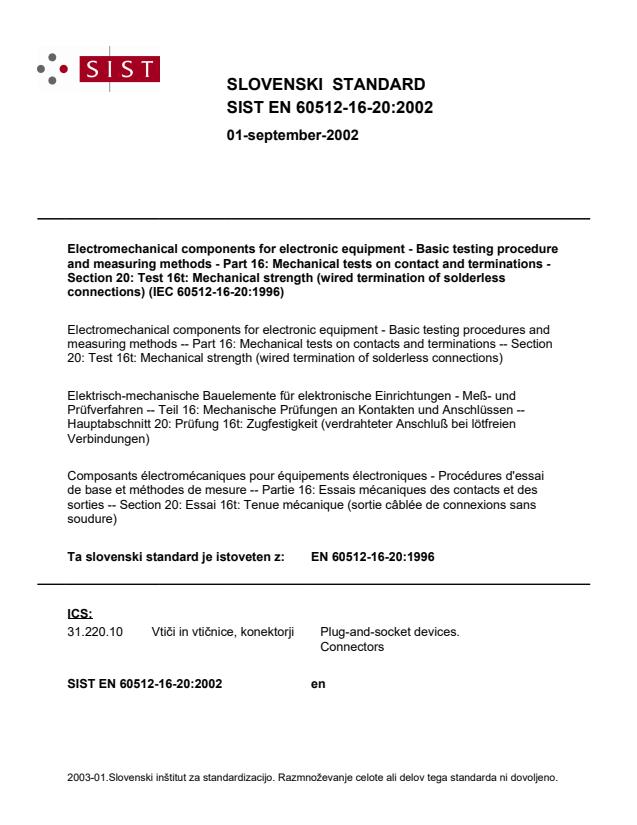
SLOVENSKI STANDARD
01-september-2002
Electromechanical components for electronic equipment - Basic testing procedure
and measuring methods - Part 16: Mechanical tests on contact and terminations -
Section 20: Test 16t: Mechanical strength (wired termination of solderless
connections) (IEC 60512-16-20:1996)
Electromechanical components for electronic equipment - Basic testing procedures and
measuring methods -- Part 16: Mechanical tests on contacts and terminations -- Section
20: Test 16t: Mechanical strength (wired termination of solderless connections)
Elektrisch-mechanische Bauelemente für elektronische Einrichtungen - Meß- und
Prüfverfahren -- Teil 16: Mechanische Prüfungen an Kontakten und Anschlüssen --
Hauptabschnitt 20: Prüfung 16t: Zugfestigkeit (verdrahteter Anschluß bei lötfreien
Verbindungen)
Composants électromécaniques pour équipem
...