


EN 55011:1998
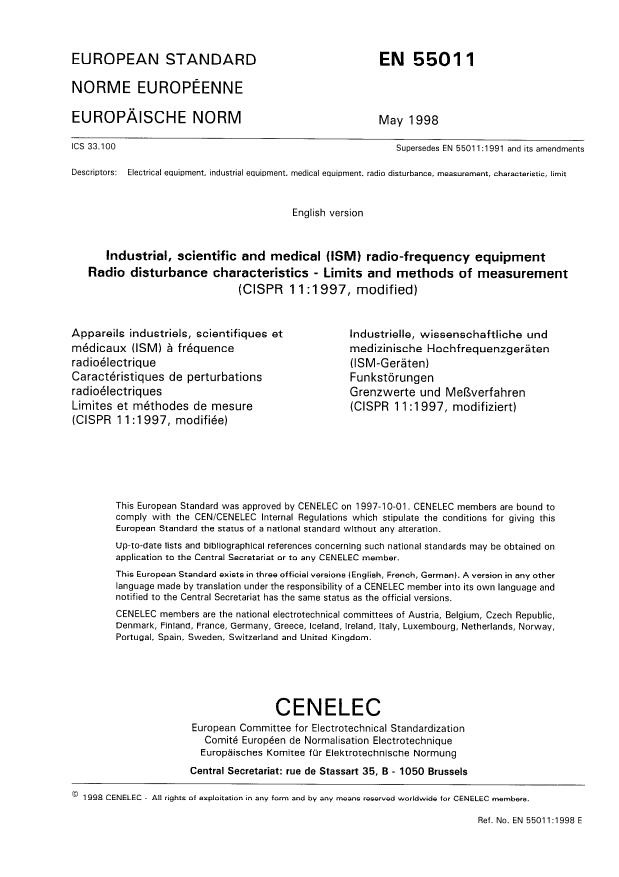
(Main)Industrial, scientific and medical (ISM) radio-frequency equipment - Radio disturbance characteristics - Limits and methods of measurement
General Information
- Abstract
Electromagnetic radiation disturbance limits are developed for the purpose of protecting radiocommunication services and signal levels, as well as for taking frequency bands, signal levels, separation distances between the interfering and interfered equipment, desired signal ratio, etc. into account.
- Status
- Withdrawn
- Publication Date
- 25-May-1998
- Withdrawal Date
- 31-Dec-2000
- Technical Committee
- CLC/TC 210 - Electromagnetic Compatibility (EMC)
- Current Stage
- 9960 - Withdrawal effective - Withdrawal
- Start Date
- 01-Nov-2009
- Completion Date
- 01-Nov-2009
- Directive
- Not Harmonized2004/108/EC - Directive 2004/108/EC of the European Parliament and of the Council of 15 December 2004 on the approximation of the laws of the Member States relating to electromagnetic compatibility and repealing Directive 89/336/EECOJ Ref: C 126, C 126/1 OJ Date: 05-Jun-2009
Not Harmonized2004/108/EU - DIRECTIVE 2004/108/EC OF THE EUROPEAN PARLIAMENT AND OF THE COUNCIL of 15 December 2004 on the approximation of the laws of the Member States relating to electromagnetic compatibility and repealing Directive 89/336/EECOJ Ref: C 126, C 126/1 OJ Date: 05-Jun-2009
Not Harmonized89/336/EEC - Electromagnetic compatibility (EMC)OJ Ref: C 201/31

Relations
- Effective Date
- 29-Jan-2023
- Effective Date
- 29-Jan-2023
- Effective Date
- 29-Jan-2023
- Effective Date
- 29-Jan-2023
- Effective Date
- 20-Feb-2026
- Effective Date
- 09-Feb-2026
- Effective Date
- 09-Feb-2026
- Effective Date
- 03-Feb-2026
- Effective Date
- 03-Feb-2026
- Effective Date
- 09-Feb-2026
- Effective Date
- 09-Feb-2026
- Effective Date
- 03-Feb-2026
- Effective Date
- 03-Feb-2026
- Effective Date
- 03-Feb-2026
- Effective Date
- 03-Feb-2026
Get Certified
Connect with accredited certification bodies for this standard

ANCE
Mexican certification and testing association.

Intertek Slovenia
Intertek testing, inspection, and certification services in Slovenia.

LNE (Laboratoire National de Métrologie et d'Essais)
French national laboratory for metrology and testing.
Sponsored listings
Frequently Asked Questions
EN 55011:1998 is a standard published by CLC. Its full title is "Industrial, scientific and medical (ISM) radio-frequency equipment - Radio disturbance characteristics - Limits and methods of measurement". This standard covers: Electromagnetic radiation disturbance limits are developed for the purpose of protecting radiocommunication services and signal levels, as well as for taking frequency bands, signal levels, separation distances between the interfering and interfered equipment, desired signal ratio, etc. into account.
Electromagnetic radiation disturbance limits are developed for the purpose of protecting radiocommunication services and signal levels, as well as for taking frequency bands, signal levels, separation distances between the interfering and interfered equipment, desired signal ratio, etc. into account.
EN 55011:1998 is classified under the following ICS (International Classification for Standards) categories: 33.100 - Electromagnetic compatibility (EMC). The ICS classification helps identify the subject area and facilitates finding related standards.
EN 55011:1998 has the following relationships with other standards: It is inter standard links to EN 55011:1991/A2:1996, EN 55011:1991/A1:1997, EN 55011:1991, EN 55011:2007, CISPR 19:1983, EN 13589:2003, EN ISO 3977-5:2003, EN 61689:1996, EN 55015:1996, EN 12957:2001+A1:2009, EN 13763-26:2004, EN 60947-5-1:2004, EN 61000-6-2:2001, EN 60519-6:2002, EN 60974-1:2005. Understanding these relationships helps ensure you are using the most current and applicable version of the standard.
EN 55011:1998 is associated with the following European legislation: EU Directives/Regulations: 2004/108/EC, 2004/108/EU, 89/336/EEC; Standardization Mandates: M/404. When a standard is cited in the Official Journal of the European Union, products manufactured in conformity with it benefit from a presumption of conformity with the essential requirements of the corresponding EU directive or regulation.
EN 55011:1998 is available in PDF format for immediate download after purchase. The document can be added to your cart and obtained through the secure checkout process. Digital delivery ensures instant access to the complete standard document.
Standards Content (Sample)
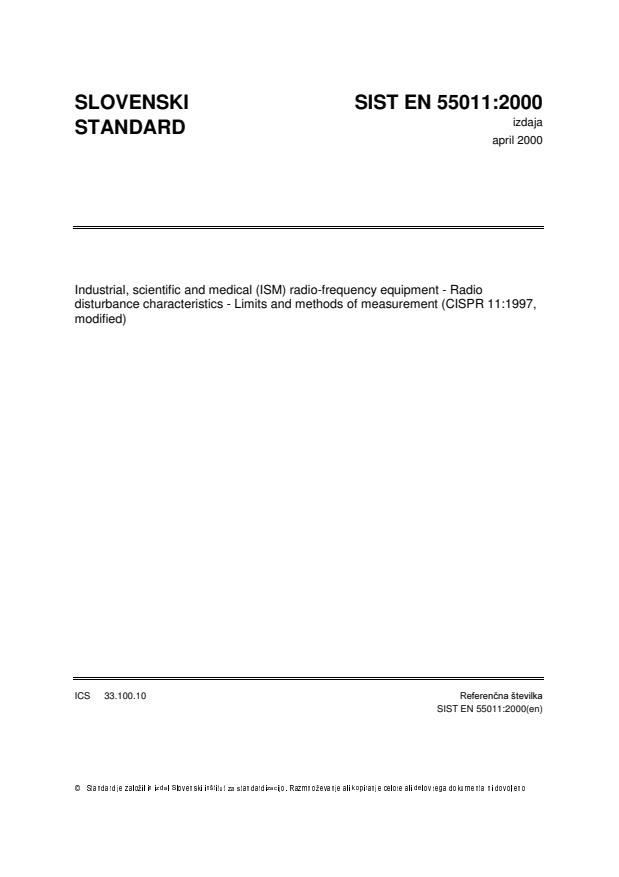
SLOVENSKI SIST EN 55011:2000
izdaja
STANDARD
april 2000
Industrial, scientific and medical (ISM) radio-frequency equipment - Radio
disturbance characteristics - Limits and meth
...