

EN 15433-2:2007
(Main)Transportation loads - Measurement and evaluation of dynamic mechanical loads - Part 2: Data acquisition and general requirements for measuring equipment
General Information
- Abstract
This standard specifies requirements for the preparation, performance and documentation of transportation measurements.
- Status
- Published
- Publication Date
- 04-Dec-2007
- Withdrawal Date
- 29-Jun-2008
- Technical Committee
- CEN/TC 261 - Packaging
- Drafting Committee
- CEN/TC 261/SC 5 - Primary packaging and transport packaging
- Current Stage
- 9093 - Decision to confirm - Review Enquiry
- Start Date
- 11-Sep-2024
- Completion Date
- 30-Sep-2026


Overview
EN 15433-2:2007 - published by CEN - defines data acquisition and general requirements for measuring equipment used to record and document dynamic mechanical transportation loads. Part of a multi‑part EN series on transportation loads, this standard specifies how to prepare, perform and document measurements so that load data are complete, comparable and reusable for evaluation and packaging design.
Key topics and technical requirements
- Scope and purpose: Measurement of dynamic mechanical loads acting on goods during transport, handling and storage; emphasis on unbiased acquisition of source data.
- Measuring chain: A measuring chain must include at least a sensor, signal conditioner, data recorder and data‑storing device.
- Source data: Raw time‑history (load‑time function) data should be recorded and stored without irreversible real‑time processing. If immediate processing is applied, the unprocessed source data must still be saved separately.
- Measurement planning: Select sensors, number of measuring points, spatial distribution, frequency and amplitude ranges, transport routes and test time based on intended data use. Avoid deliberate limitation of measurement range that could invalidate later analyses.
- Technical competence and equipment: Measuring systems must reflect the state of the art (calibration, frequency range, dynamic range) and measurements must be performed by qualified personnel.
- Measuring report: A structured questionnaire‑style report is required to document all relevant circumstances (transportation means, vehicle technical data, load description, measuring points and chain, route, climatic conditions, acquisition mode). Annexes provide blank measuring reports for specific transport modes.
- Data processing and presentation: Data validation and editing follow EN 15433‑3; data evaluation follows EN 15433‑4; presentation should comply with ISO 8002.
Applications and who uses it
EN 15433‑2:2007 is used by:
- Packaging engineers and designers to derive test specifications and optimize material use while ensuring protection against real transport loads.
- Test laboratories and measurement teams conducting field data collection on road, rail, sea, in‑plant and combined transport.
- Manufacturers and logistics providers assessing product robustness, transport risks and load mitigation measures.
- Standards bodies and researchers compiling load databases or developing further evaluation methods.
Practical uses include documenting field measurement campaigns, ensuring raw data quality for later frequency/time‑domain analysis, and supporting compliance with packaging waste and protection requirements (e.g., Directive 94/62/EC context).
Related standards
- EN 15433‑3 (data validity check and editing)
- EN 15433‑4 (data evaluation)
- ISO 8002 (presentation of mechanical vibration measured data)
Keywords: EN 15433-2:2007, transportation loads, data acquisition, measuring equipment, dynamic mechanical loads, measuring report, packaging, CEN.
Relations
- Effective Date
- 25-Aug-2026
- Effective Date
- 28-Jan-2026
- Effective Date
- 28-Jan-2026
- Refers
EN 12832:1999 - Characterization of sludges - Utilization and disposal of sludges - Vocabulary - Effective Date
- 28-Jan-2026
- Effective Date
- 28-Jan-2026
- Effective Date
- 28-Jan-2026
- Effective Date
- 28-Jan-2026
Get Certified
Connect with accredited certification bodies for this standard

TÜV Rheinland
TÜV Rheinland is a leading international provider of technical services.

TÜV SÜD
TÜV SÜD is a trusted partner of choice for safety, security and sustainability solutions.

DEKRA Certification Inc.
DEKRA US certification services.
Sponsored listings
Frequently Asked Questions
EN 15433-2:2007 is a standard published by the European Committee for Standardization (CEN). Its full title is "Transportation loads - Measurement and evaluation of dynamic mechanical loads - Part 2: Data acquisition and general requirements for measuring equipment". This standard covers: This standard specifies requirements for the preparation, performance and documentation of transportation measurements.
This standard specifies requirements for the preparation, performance and documentation of transportation measurements.
EN 15433-2:2007 is classified under the following ICS (International Classification for Standards) categories: 01.040.43 - Road vehicle engineering (Vocabularies); 43.160 - Special purpose vehicles. The ICS classification helps identify the subject area and facilitates finding related standards.
EN 15433-2:2007 has the following relationships with other standards: It is inter standard links to ISO 8002:1986, EN 15433-3:2007, EN 15433-4:2007, EN 12832:1999, EN 15433-6:2007, EN 15433-1:2007, EN 15433-6:2016. Understanding these relationships helps ensure you are using the most current and applicable version of the standard.
EN 15433-2:2007 is available in PDF format for immediate download after purchase. The document can be added to your cart and obtained through the secure checkout process. Digital delivery ensures instant access to the complete standard document.
Standards Content (Sample)
2003-01.Slovenski inštitut za standardizacijo. Razmnoževanje celote ali delov tega standarda ni dovoljeno.Transportation loads - Measurement and analysis of dynamic mechanical loads - Part 2: Data acquisition and general requirements for measuring equipmentNLKCharges de transport - Mesurage et analyse des charges mécaniques dynamiques - Partie 2 : Acquisition des données et exigences générales pour l’équipement de mesureTransportbelastungen - Messen und Auswerten von mechanisch-dynamischen Belastungen - Teil 2: Datenerfassung und allgemeine Anforderungen an MesseinrichtungenTa slovenski standard je istoveten z:EN 15433-2:2007SIST EN 15433-2:2008en,de55.180.01ICS:SLOVENSKI
STANDARDSIST EN 15433-2:200801-februar-2008
EUROPEAN STANDARDNORME EUROPÉENNEEUROPÄISCHE NORMEN 15433-2December 2007ICS 43.160; 01.040.43 English VersionTransportation loads - Measurement and evaluation of dynamicmechanical loads - Part 2: Data acquisition and generalrequirements for measuring equipmentCharges de transport - Mesurage et analyse des chargesmécaniques dynamiques - Partie 2 : Acquisition desdonnées et exigences générales pour l'équipement demesureTransportbelastungen - Messen und Auswerten vonmechanisch-dynamischen Belastungen - Teil 2:Datenerfassung und allgemeine Anforderungen anMesseinrichtungenThis European Standard was approved by CEN on 28 October 2007.CEN members are bound to comply with the CEN/CENELEC Internal Regulations which stipulate the conditions for giving this EuropeanStandard the status of a national standard without any alteration. Up-to-date lists and bibliographical references concerning such nationalstandards may be obtained on application to the CEN Management Centre or to any CEN member.This European Standard exists in three official versions (English, French, German). A version in any other language made by translationunder the responsibility of a CEN member into its own language and notified to the CEN Management Centre has the same status as theofficial versions.CEN members are the national standards bodies of Austria, Belgium, Bulgaria, Cyprus, Czech Republic, Denmark, Estonia, Finland,France, Germany, Greece, Hungary, Iceland, Ireland, Italy, Latvia, Lithuania, Luxembourg, Malta, Netherlands, Norway, Poland, Portugal,Romania, Slovakia, Slovenia, Spain, Sweden, Switzerland and United Kingdom.EUROPEAN COMMITTEE FOR STANDARDIZATIONCOMITÉ EUROPÉEN DE NORMALISATIONEUROPÄISCHES KOMITEE FÜR NORMUNGManagement Centre: rue de Stassart, 36
B-1050 Brussels© 2007 CENAll rights of exploitation in any form and by any means reservedworldwide for CEN national Members.Ref. No. EN 15433-2:2007: E
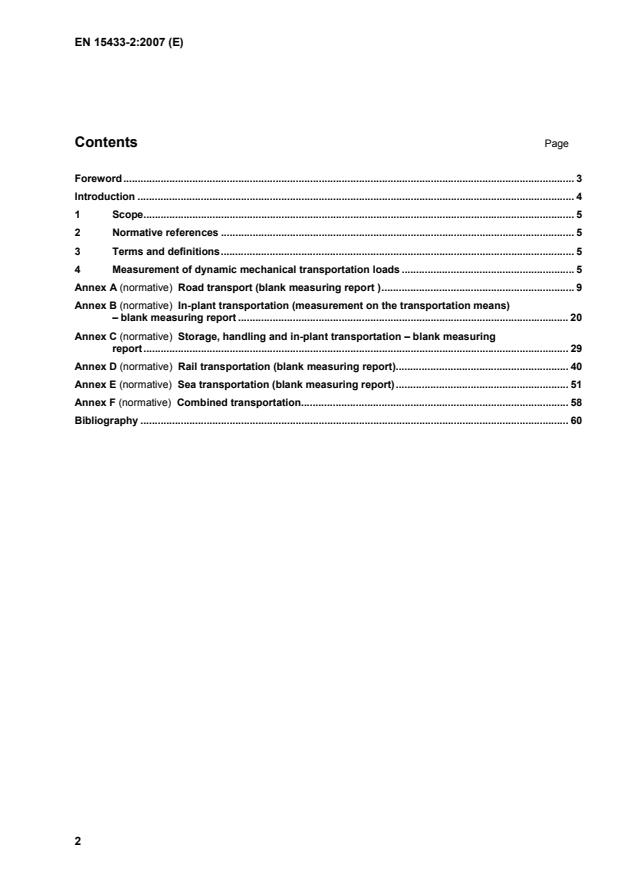
Road transport (blank measuring report ).9 Annex B (normative)
In-plant transportation (measurement on the transportation means) – blank measuring report.20 Annex C (normative)
Storage, handling and in-plant transportation – blank measuring report.29 Annex D (normative)
Rail transportation (blank measuring report).40 Annex E (normative)
Sea transportation (blank measuring report).51 Annex F (normative)
Combined transportation.58 Bibliography.60
It is part of a complete normative concept to acquire and describe the loads acting on goods and influencing them during transport, handling and storage. This standard becomes significant when related to the realisation of the European Directive on Packaging and Packaging Waste (Directive 94/62 EC, 20 December 1994). This directive specifies requirements on the avoidance or reduction of packaging waste, and requires that the amount of packaging material is adjusted to the expected transportation load, in order to protect the transportation item adequately. However, this presumes some knowledge of the transportation loads occurring during shipment. At present, basic standards, based on scientifically confirmed values, which can adequately describe and characterize the magnitudes of transportation loads, especially in the domain of dynamic mechanical loads do not exist nationally or internationally.
Reasons for this are mainly the absence of published data, insufficient description of the measurements or restrictions on the dissemination of this information. This standard will enable the measurement and evaluation of dynamic mechanical transportation loads, thus enabling the achievement of standardized and adequately documented load values. This series of standards consists of the following parts: Part 1: General requirements
Part 2: Data acquisition and general requirements for measuring equipment Part 3: Data validity check and data editing for evaluation Part 4: Data evaluation Part 5: Derivation of test specifications Part 6: Automatic recording systems for measuring randomly occurring shock during monitoring of transports.
2 Normative references The following referenced documents are indispensable for the application of this document. For dated references, only the edition cited applies. For undated references, the latest edition of the referenced document (including any amendments) applies. EN 15433-3, Transportation loads — Measurement and evaluation of dynamic-mechanical loads — Part 3: Data validity check and data editing for evaluation
EN 15433-4, Transportation loads — Measurement and evaluation of dynamic-mechanical loads — Part 4: Data evaluation ISO 8002, Mechanical vibrations — Land vehicles — Method for reporting measured data 3 Terms and definitions For the purposes of this document, the following terms and definitions apply. 3.1 data acquisition acquisition of raw data by measuring the load-time function with the aid of a measuring device 3.2 measuring equipment measuring chain consisting of at least a sensor, signal conditioner, data recorder and data-storing device 3.3 source data time function of a viewed stress amplitude, e.g. acceleration, acquired with a measuring device, but without analysing same, e.g. by frequency analysis 3.4 measuring report documentation covering the particularities gained during the acquisition of raw data 4 Measurement of dynamic mechanical transportation loads 4.1 General Measurements shall be performed independently of the transported item and performed at the site where the load is inserted into the cargo, i.e. as a rule on the cargo platform of the various transportation vehicles.
NOTE Exceptions are measurements during storage, handling, and in-plant transportation (see Annex C). 4.2 Fundamental requirements Dynamic mechanical loads shall whenever possible be acquired and recorded in an unbiased form as source data, i.e. without immediate processing, such as frequency analysis.
An immediate
As a rule, errors in the analysis can be corrected by reanalysis, whereas errors occurring during data acquisition often demand a costly repetition of the measurements.
Separate storage of the raw data ensures that analysis errors or any other analysis procedures do not necessarily require new test drives. The selection of measuring systems and their specific parameters, e.g. frequency range, shall be done in such a way that the acquired raw data can be analysed universally and reused at any other time.
A deliberate limitation of the measurement to a smaller measuring range than one that is possible with a justifiable technical effort can lead to faulty analysis and conclusions, and therefore shall be avoided. The measuring system shall comply with the technical state of the art, the relevant specifications and technical rules, e.g. relating to calibration, and shall correspond with the aims of the measuring task. The engineering personnel performing the measurements shall have the necessary knowledge to perform the measurements appropriately and plan and perform the measuring task carefully. All significant circumstances and technical parameters of the measurement are to be recorded in a measuring report (see 4.4).
Deviations from this measuring report shall be justified. NOTE 2 Occasionally, after measurements have been performed, it is necessary to retrace the conditions that occurred during the data acquisition.
Only a complete description of the measuring process, as required by the measuring report, enables the inspection and interpretation of the measurement.
Otherwise, the measured data can become invalid.
Also, apparently unimportant information, (e.g. a detailed description of the vehicle type) used for the measurement can be of great importance for later interpretation of the measured data values. 4.3 Preparation of the measurement During the planning stage of the measurement, various aspects shall be considered, in particular the: intended utilisation of the data; selection of the sensors and their number; frequency and amplitude range of the measuring chain; number of measuring points, their spatial distribution and their axes of measurement; definition of the extent of this measurement, including the selection of the transportation routes and the required test time; consideration and estimation of possible error sources. NOTE In order to reduce expensive and time-consuming test drives to a minimum, careful planning of the measurements is necessary.
Here one especially has to take into account the ratio between cost and profit, and to compare the total costs of a measuring program with the possible costs that an insufficient data acquisition can cause. Data validation and editing, as well as analysis of the measured data, shall be performed according to EN 15433-3 and EN 15433-4, and the presentation of the analysed data shall comply with ISO 8002. 4.4 Measurement The measuring report for each transportation category is defined in a corresponding annex, as follows:
A summary of the test route, as well as the possible duration of the measurement, shall also be given (see e.g. A.2). NOTE The designation of persons present during the test can be helpful for subsequent procedures. 4.5.4 Data transportation means
The data transportation means section shall contain a technical description of the transportation means and its actual condition.
These data contain information concerning the goods being transported, load factor, location of load gravity centre and method of restraint (see e.g. A.3). NOTE Experience shows that analyses can become useless due to missing information on transportation means.
This can lead to a repetition of the test drive, thereby causing considerable additional costs. 4.5.5 Measuring points and measuring chain A detailed description of the location of the measuring points on the transportation means shall be given, as well as the measuring chain used (see e.g. A.4). NOTE When acquiring data on various means of transportation, numerous parameters need to be considered.
Correspondingly, suitable sensors, amplifiers and filters should be selected for the specific measuring task.
A complete listing of technical data of the instruments used is essential to perform a proper analysis and for subsequent procedures.
As a rule, these values can be taken from the instrument data sheets. 4.5.6 Performing the measurement Information shall be provided concerning the transportation route, dynamic particularities and climatic conditions during the measurement (see e.g. A.5).
Road transport (blank measuring report) NOTE The user of this measuring report is permitted to copy this document. A.1 Scope of measuring report The information requested in A.2 to A.5 shall be completed prior to or during the measurement. A.2 General information
A.2.1 All values in A.3.2 to A5.3 that are marked with (Ã) are interdependent, and shall therefore be recorded under that particular route section in Figure A.4. A.2.2 Name and address of the institution performing the measurements: . A.2.3 Name of test manager and persons present during the measurements: . A.2.4 Date and duration of the measurements: . A.2.5 Test circuit (transportation route): . A.3 Data on transportation vehicle A.3.1 Technical description of transportation vehicle NOTE As a rule, the following information can be gathered from the vehicle registration papers. It is recommended that photographs of the vehicle are added to the measuring report. A.3.1.1 Vehicle category, e.g. commercial vehicle, general-purpose goods vehicle, goods trailer, road train, articulated vehicle, etc.: . A.3.1.2 Vehicle manufacturer and type designation according to the manufacturer: . A.3.1.3 Vehicle identification number: . A.3.1.4 Vehicle registration number, country of registration: . A.3.1.5 Manufacturer(s) of vehicle body, articulated vehicle and trailer: .
+Z+Y+XY2Y1123Y3X1X2X3 Key 1 measuring point 1 2 measuring point 2 3 measuring point 3 Figure A.2 — Location of the measuring points on the vehicle (example) A.4.1.2 Method of mounting of the accelerometers (e.g. magnet, bonded or screwed) and auxiliary fixing means (e.g. mounting cubes): . A.4.1.3 Description of the measuring axes of the sensors, e.g. 1z, 2z, 3x, 3y, 3z: . A.4.2 Instrumentation flow chart TransducerSignalConditionerFilterRecordingDeviceVoiceChannelTachometer/Generator Figure A.3 — Instrumentation flow chart (example)
Transducer No. 1 2 3 4 5 A.4.4.1 Manufacturer: . . .A.4.4.2 Type: . . .A.4.4.3 Dimensions (mm) . . .A.4.4.4 Weight (g): . . .A.4.4.5 Measuring range (±ms-2): . . .A.4.4.6 Resonance frequency in mounted
condition (see ISO 2042 and ISO 5348): . . .A.4.4.7 Sensitivity/cross-axis sensitivity
(pC/ms-2 and mV/ms-2) (see ISO 2041 and
ISO 45661): . . .
.
A.4.5 Signal conditioner Channel No. 1 2 3 4 5 A.4.5.1 Manufacturer: . . .A.4.5.2 Type: . . .A.4.5.3 Lower/upper frequency limit (Hz): . . .A.4.5.4 Measuring range: . . .A.4.5.5 Sensitivity setting (mV/ms-2) (Ã)
A.4.6 Filter Channel No. 1 2 3 4 5 A.4.6.1 Manufacturer: . . .A.4.6.2 Type: . . .A.4.6.3 Lower/upper frequency limit (Hz): . . .A.4.6.4 Frequency roll-off rate: . . .A.4.6.5 Setting: e.g. high pass, low pass, band pass, cut-off frequency (Ã)
A.4.7 Data recording device A.4.7.1 Description, e.g. tape recorder, semiconductor storage device: . A.4.7.2 Manufacturer: . A.4.7.3 Type: . A.4.7.4 Recording procedure, capacity and recording velocity (Ã) A.4.7.5 Voice channel available (yes/no): .
Resolution
.................................................................................................................................................................. A.4.7.8 Sensitivity setting (Ã) A.4.8 Tachometer/generator A.4.8.1 Installed inside the vehicle (yes/no): ................................................................................................................................................................. A.4.8.2 Manufacturer: ................................................................................................................................................................. A.4.8.3 Type: ................................................................................................................................................................. A.4.8.4 Measuring range (mV/kmh-1): ................................................................................................................................................................. A.4.9 Voice channel A.4.9.1 Applicable (yes/no): ................................................................................................................................................................ A.4.9.2 Recording mode: ................................................................................................................................................................ A.4.10 Power supply of the measuring chain A.4.10.1 Type (e.g. vehicle battery with converter, separate battery with converter, built-in accumulator, generator): ................................................................................................................................................................ A.4.10.2 Voltage: ................................................................................................................................................................ A.4.10.3 Current: ................................................................................................................................................................ A.4.10.4 Frequency: ................................................................................................................................................................ A.4.10.5 Power: ................................................................................................................................................................ A.4.11 Calibration of the measuring chain A.4.11.1 Date of last calibration of each individual instrument used in the measuring chain: ............................................................................................................................................................... A.4.11.2 Calibration of the complete measuring chain after installation in the vehicle: ...............................................................................................................................................................
A.5.1 Test circuit (transportation route) A.5.1.1 Plan view of the transportation route: A.5.1.2 Road categories of the route (motorways, long-distance primary roads, other roads interconnecting roads, town/suburb roads, unpaved roads, cross-country) (Ã) A.5.1.3 Total driving distance (km) (Ã) A.5.1.4 Driving distance per road category (km) (Ã) A.5.1.5 Privileged driving speeds during measurements motorways:
80 km/h primary roads:
60 km/h other roads:
40 km/h The listed speeds for the corresponding road categories shall be observed during measuring drives in a particular country.
NOTE Measurements at other velocities can also be performed, as long as the traffic rules are observed.
For measurements performed in any given country, the possible speeds of that particular country should be taken into consideration. A.5.1.6 Average speed per road section (rated/actual value) (Ã) A.5.1.7 Measuring duration per driving speed and road category (Ã) A.5.1.8 Road surface per road category, e.g. concrete, asphalt, cobblestones, gravel (Ã) A.5.1.9 Road condition, e.g. pot-holes, train-crossing, road surface joints, frost heaves, winding roads, dry/wet/ice-covered roads (Ã) A.5.1.10 Particularities per road section, e.g. declaration of angle of climb/descent in degrees or as a percentage (Ã) A.5.2 Climatic conditions during test drives A.5.2.1 Air temperature (0C) (Ã) A.5.2.2 Air humidity (%relative humidity) (Ã) A.5.2.3 Climatic particularities, e.g. wind gusts, precipitation (Ã) A.5.3 Characteristic dynamic driving features, e.g. evasive manoeuvres, emergency braking (ÃÃÃÃ) A.6 Data acquisition Check the level control of the measuring chain at the beginning of the measurement and at any significant change of road category.
Repeat measurements when the level control is doubtful.
The intermittent measuring mode can influence the stability of the signal.
rj = road surface joint; wi = winding roaddr = dry -, we = wet -, ic = icy road Climatic conditions:Air temperature 0C; Air Humidity % r.h.; Wind gustsSketch of transportation route:
Example: M / c / rj /we; 180C - 45 % r.h. = motor way, concrete, road surface joint, wet, 180C / 45 % r.h.Instrument settingSignal conditioner: Filter:Recording device:Channel No.:Channel No.:Measuring point:Channel No.: Filter type:Measuring point: hp = high passMeasuring point:lp = low passbp = band passSetting [m V/ms-2]:Cut-off frequency [Hz]:Setting [V / V]:0C [kg] XYZ[m/s]Remarks[km][km][min.][km / h][% / r.h.][%][cm][cm][cm][min.][Hz]12345123451234511427008:01M / a / rj / we180/45 %21' 00018010070washing-m2050001x1y1z2z3z1x1y1z2z3z1x1y1z2z3zAdditional loads such80/powder;1010111hphphphphp22222as: Test engineer +21454027011:2019085,3210/38 %75%palletised 500500500500500InstrumentsFigure A.4 — Log sheet for road transportation ( example )Beginning/end of route sectionRoad-section lengthTacho - reading of the vehicleDate/running timedriving timeaverage velocity; rated /actualroad categoryroad surfaceroad conditionslope ( % )%%climatic condition;e.g., average valuesload; load factorcenter of gravity ofpayloadload description;loading conditionload damping property;large, medium, smallmeasuring duration per: driving velocity, road -
category, and load factorrecording speed;sampling rate2 %456Project name:.Name of test manager:.Sheet No.:.
In-plant transportation (measurement on the transportation means) – blank measuring report NOTE The user of this measuring report is permitted to copy this document. B.1 Scope of measuring report This measuring report is to be used: for in-plant transportation, handling means, discontinuous transportation means with cargo platforms or load-carrying devices; for continuous transportation means with cargo platforms and load-carrying devices, which are driven by a traction mechanism. This measuring report describes a multitude of transportation means of varying design, such as sack trolleys, fork lift trucks and conveyor belts. The information required shall therefore be completed accordingly. This measuring report does not apply to continuous transportation means employing gravitational force, or during manual handling.
For this purpose, Annex C should be used instead, to perform the data acquisition. B.2 General information All values in B.3.2 to B.5, which are marked with (Ã), are interdependent, and therefore shall be recorded in Figure B.4 under that particular transportation section. B.2.1 Name and address of the institution performing the measurements: . B.2.2 Name of test manager and persons present during the measurements: . B.2.3 Date and duration of the measurements: . B.2.4 Transportation route: . B.3 Data on transportation handling means B.3.1 Technical description of transportation handling means: NOTE It is recommended that photographs of the transportation means are added to this report.
Length x width x height.(mm) B.3.1.9 Permissible payload (kg): . B.3.1.10 Number of axles and which of those are steerable or driven: Number of axles:. Steerable axles:. Driven axles:. (mark axles in Figure B.1) B.3.1.11 Information concerning the design of the axles and guidance system of the transportation or handling means: . . B.3.1.12 Permissible axle load: Axle 1:.(kg) Axle 2:.(kg) Axle 3:.(kg) Axle 4:.(kg) (mark axles in Figure B.1)
= . (m) / .(m) / .(m) / .(m) Xs / Ys / Zs
= .(m) / . .(m) / .(m) l1 / l2
= .(m) / . .(m) Figure B.1 — Dimensions of transportation means (example) B.3.1.17 Further relevant information concerning the transportation or handling means (if applicable): . B.3.2 Description of actual condition of the transportation means B.3.2.1 Kilometre or elapsed time indicator reading (Ã) B.3.2.2 Condition of suspension and guidance system of the transportation or handling means: . . NOTE Oscillatory behaviour is greatly influenced by the actual and maintenance conditions of the transportation or handling means. It is therefore desirable to describe these, although it might in practice cause problems to determine these properties. Certain noticeable characteristics should at least be described. B.3.2.3 Date of last maintenance: .
...