

EN ISO 22074-4:2024/A1:2026
(Amendment)Railway infrastructure - Rail fastening systems - Part 4: Test methods for resistance to repeated loading - Amendment 1 (ISO 22074-4:2022/Amd 1:2026)
General Information
- Abstract
- Status
- Published
- Publication Date
- 14-Apr-2026
- Technical Committee
- CEN/TC 256 - Railway applications
- Drafting Committee
- CEN/TC 256/SC 1/WG 17 - Fastening systems
- Current Stage
- 6060 - Definitive text made available (DAV) - Publishing
- Start Date
- 15-Apr-2026
- Completion Date
- 15-Apr-2026

Overview
EN ISO 22074-4:2024/A1:2026 is an amendment to the international standard for railway infrastructure, specifically focusing on rail fastening systems. This document, part of the ISO 22074 series and developed by CEN and ISO/TC 269/SC 1, provides updated test methods for evaluating the resistance of rail fastening systems to repeated loading. The amendment primarily revises the procedures for measuring clamping force during test cycles, ensuring higher accuracy and consistency with related standards, such as ISO 22074-7.
Rail fastening systems are critical for track safety, durability, and performance. This amendment is essential for manufacturers, railway operators, and testing laboratories aiming to assure the long-term reliability and safety of rail infrastructure components.
Key Topics
- Rail Fastening Systems: This amendment targets infrastructure elements that secure rails to sleepers or ties, ensuring stability under operational loads.
- Test Methods for Resistance to Repeated Loading: It outlines revised procedures to simulate the dynamic, repetitive forces experienced in railway service, supporting robust product evaluation.
- Clamping Force Measurement: The amendment specifies that clamping force must be determined using the method detailed in ISO 22074-7, aligning testing protocols for direct and indirect offset fastening systems:
- For direct offset systems, force is applied between two rail seats, and the clamping force is half the total measured force.
- For indirect offset systems, testing follows the designated procedure in ISO 22074-7:2021, section 8.5.
- Consistency Across Standards: By referencing ISO 22074-7, the amendment promotes harmonized testing methodologies that facilitate international interoperability.
Applications
Implementation of the revised EN ISO 22074-4:2024/A1:2026 amendment brings practical benefits across the railway sector, including:
- Manufacturing: Enables standardized acceptance testing for new rail fastening systems, accelerating product development and market access.
- Infrastructure Maintenance: Supports asset managers in selecting compliant fastening systems, ensuring long-term performance under cyclic loading and minimizing maintenance costs.
- Quality Assurance: Provides laboratories with clear guidance for testing, helping demonstrate compliance with international safety and durability requirements.
- Regulatory Compliance: Assists in fulfilling national and regional rail safety regulations by adopting recognized testing standards.
- Procurement Specifications: Helps rail operators and contractors precisely specify the performance criteria for fastening systems in contracts.
Related Standards
The EN ISO 22074-4:2024/A1:2026 amendment is closely connected with several international railway standards:
- ISO 22074-4:2022: The base standard detailing test methods for the resistance of rail fastening systems to repeated loading.
- ISO 22074-7:2021: Specifies methods for determining the clamping force of rail fastening assemblies, a key reference in this amendment.
- EN 13481 series: European standards regarding the requirements and testing of track fastening systems for railway applications.
- ICS 45.080: The international classification for rails and railway components, covering related products and their testing protocols.
Adhering to this amendment, together with its related standards, ensures that rail fastening systems deliver the required safety, reliability, and performance needed in modern railway infrastructure worldwide.
Keywords: Rail fastening systems, railway infrastructure, repeated loading, test methods, clamping force, ISO 22074, EN ISO 22074-4:2024/A1:2026, railway standards, track safety, international standardization, CEN.
Relations
- Effective Date
- 22-Apr-2026
- Referred By
EN 13232-5:2005+A1:2011 - Railway applications - Track - Switches and crossings - Part 5: Switches - Effective Date
- 22-Apr-2026
- Effective Date
- 22-Apr-2026
- Effective Date
- 12-Feb-2026
- Effective Date
- 03-Sep-2025
Get Certified
Connect with accredited certification bodies for this standard

IRIS Certification (UNIFE)
International Railway Industry Standard certification.

TÜV SÜD Rail GmbH
TÜV SÜD railway certification services.

Bureau Veritas Railway Certification
Railway and transportation certification.
Sponsored listings
Frequently Asked Questions
EN ISO 22074-4:2024/A1:2026 is a amendment published by the European Committee for Standardization (CEN). Its full title is "Railway infrastructure - Rail fastening systems - Part 4: Test methods for resistance to repeated loading - Amendment 1 (ISO 22074-4:2022/Amd 1:2026)". This standard covers: Railway infrastructure - Rail fastening systems - Part 4: Test methods for resistance to repeated loading - Amendment 1 (ISO 22074-4:2022/Amd 1:2026)
Railway infrastructure - Rail fastening systems - Part 4: Test methods for resistance to repeated loading - Amendment 1 (ISO 22074-4:2022/Amd 1:2026)
EN ISO 22074-4:2024/A1:2026 is classified under the following ICS (International Classification for Standards) categories: 45.080 - Rails and railway components. The ICS classification helps identify the subject area and facilitates finding related standards.
EN ISO 22074-4:2024/A1:2026 has the following relationships with other standards: It is inter standard links to EN 13232-6:2005+A1:2011, EN 13232-5:2005+A1:2011, EN 13232-7:2006+A1:2011, ISO 22074-4:2022/Amd 1:2026, EN ISO 22074-4:2024. Understanding these relationships helps ensure you are using the most current and applicable version of the standard.
EN ISO 22074-4:2024/A1:2026 is available in PDF format for immediate download after purchase. The document can be added to your cart and obtained through the secure checkout process. Digital delivery ensures instant access to the complete standard document.
Standards Content (Sample)
SLOVENSKI STANDARD
01-junij-2026
Železniška infrastruktura - Sistemi za pritrjevanje tirnic - 4. del: Preskusne metode
za določanje odpornosti na ponavljajoče se obremenitve - Dopolnilo A1 (ISO 22074
-4:2022/Amd 1:2026)
Railway infrastructure - Rail fastening systems - Part 4: Test methods for resistance to
repeated loading - Amendment 1 (ISO 22074-4:2022/Amd 1:2026)
Bahninfrastruktur - Schienenbefestigungssysteme - Teil 4: Prüfverfahren bei
wiederkehrenden Belastungen - Änderung 1 (ISO 22074-4:2022/Amd 1:2026)
Infrastructure ferroviaire - Systèmes de fixation du rail - Partie 4: Méthode d'essai pour la
détermination de résistance aux charges répétitives - Amendement 1 (ISO 22074-
4:2022/Amd 1:2026)
Ta slovenski standard je istoveten z: EN ISO 22074-4:2024/A1:2026
ICS:
45.080 Tračnice in železniški deli Rails and railway
components
2003-01.Slovenski inštitut za standardizacijo. Razmnoževanje celote ali delov tega standarda ni dovoljeno.
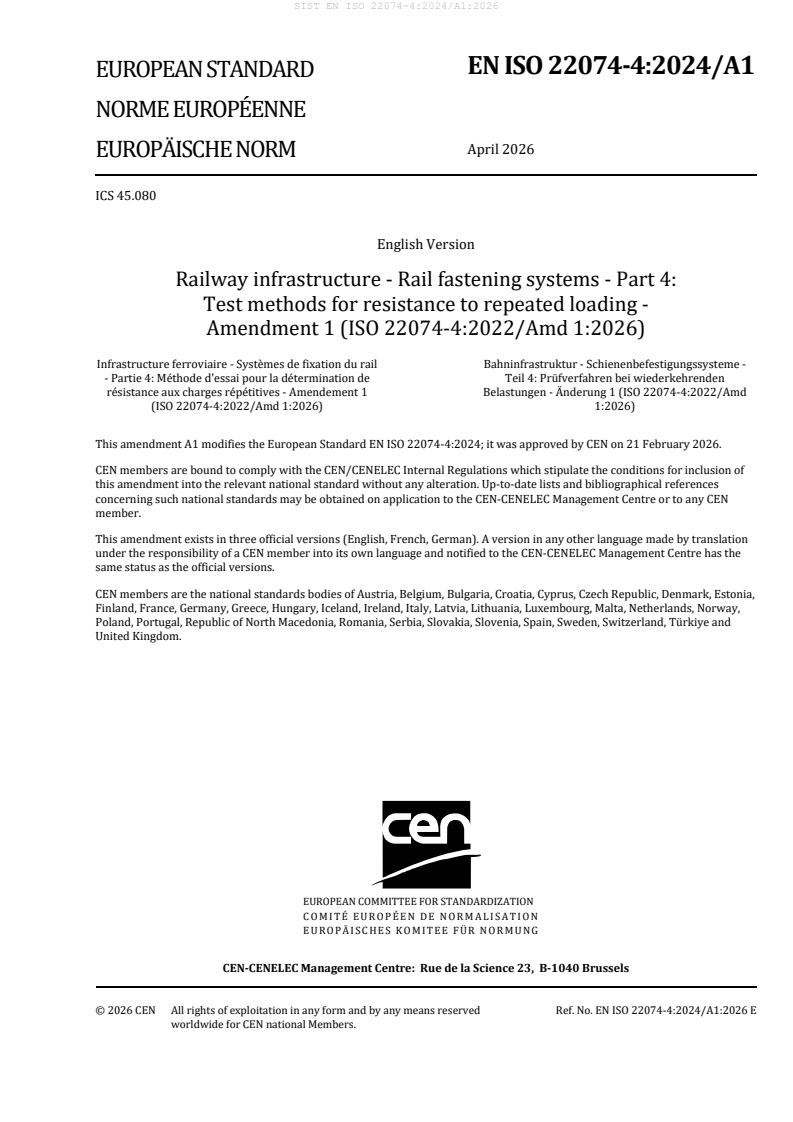
EN ISO 22074-4:2024/A1
EUROPEAN STANDARD
NORME EUROPÉENNE
April 2026
EUROPÄISCHE NORM
ICS 45.080
English Version
Railway infrastructure - Rail fastening systems - Part 4:
Test methods for resistance to repeated loading -
Amendment 1 (ISO 22074-4:2022/Amd 1:2026)
Infrastructure ferroviaire - Systèmes de fixation du rail Bahninfrastruktur - Schienenbefestigungssysteme -
- Partie 4: Méthode d'essai pour la détermination de Teil 4: Prüfverfahren bei wiederkehrenden
résistance aux charges répétitives - Amendement 1 Belastungen - Änderung 1 (ISO 22074-4:2022/Amd
(ISO 22074-4:2022/Amd 1:2026) 1:2026)
This amendment A1 modifies the European Standard EN ISO 22074-4:2024; it was approved by CEN on 21 February 2026.
CEN members are bound to comply with the CEN/CENELEC Internal Regulations which stipulate the conditions for inclusion of
this amendment into the relevant national standard without any alteration. Up-to-date lists and bibliographical references
concerning such national standards may be obtained on application to the CEN-CENELEC Management Centre or to any CEN
member.
This amendment exists in three official versions (English, French, German). A version in any other language made by translation
under the responsibility of a CEN member into its own language and notified to the CEN-CENELEC Management Centre has the
same status as the official versions.
CEN members are the national standards bodies of Austria, Belgium, Bulgaria, Croatia, Cyprus, Czech Republic, Denmark, Estonia,
Finland, France, Germany, Greece, Hungary, Iceland, Ireland, Italy, Latvia, Lithuania, Luxembourg, Malta, Netherlands, Norway,
Poland, Portugal, Republic of North Macedonia, Romania, Serbia, Slovakia, Slovenia, Spain, Sweden, Switzerland, Türkiye and
United Kingdom.
EUROPEAN COMMITTEE FOR STANDARDIZATION
COMITÉ EUROPÉEN DE NORMALISATION
EUROPÄISCHES KOMITEE FÜR NORMUNG
CEN-CENELEC Management Centre: Rue de la Science 23, B-1040 Brussels
© 2026 CEN All rights of exploitation in any form and by any means reserved Ref. No. EN ISO 22074-4:2024/A1:2026 E
worldwide for CEN national Members.
Contents Page
European foreword . 3
European foreword
This document (EN ISO 22074-4:2024/A1:2026) has been prepared by Technical Committee
ISO/TC 269 "Railway applications" in collaboration with Technical Committee CEN/TC 256 “Railway
applications” the secretariat of which is held by DIN.
This Amendment to the European Standard EN ISO 22074-4:2024 shall be given the status of a national
standard, either by publication of an identical text or by endorsement, at the latest by October 2026,
and conflicting national standards shall be withdrawn at the latest by October 2026.
Attention is drawn to the possibility that some of the elements of this document may be the subject of
patent rights. CEN shall not be held responsible for identifying any or all such patent rights.
Any feedback and questions on this document should be directed to the users’ national standards
body/national committee. A complete listing of these bodies can be found on the CEN website.
According to the CEN-CENELEC Internal Regulations, the national standards organizations of the
following countries are bound to implement this European Standard: Austria, Belgium, Bulgaria,
Croatia, Cyprus, Czech Republic, Denmark, Estonia, Finland, France, Germany, Greece, Hungary, Iceland,
Ireland, Italy, Latvia, Lithuania, Luxembourg, Malta, Netherlands, Norway, Poland, Portugal, Republic of
North Macedonia, Romania, Serbia, Slovakia, Slovenia, Spain, Sweden, Switzerland, Türkiye and the
United Kingdom.
Endorsement notice
The text of ISO 22074-4:2022/
...