

EN 12814-6:2026
(Main)Testing of welded joints of thermoplastics semi-finished products - Part 6: Low temperature tensile test
General Information
- Abstract
This document specifies the dimensions, the method of sampling and the preparation of the test specimens, also the conditions for performing the low temperature tensile test perpendicular to the weld in order to determine the low temperature tensile welding factor.
A low temperature tensile test can be used in conjunction with other tests (e.g. bend, tensile creep, macro) to assess the performance of welded assemblies, made from thermoplastics materials.
The low temperature tensile welding factor and the appearance of the fracture surface provide a guide regarding the ductility of the joint and the quality of the work.
This document is applicable to co-axial or co-planar welded assemblies made from thermoplastics materials filled or unfilled, but not reinforced, irrespective of the welding process used.
This document does not apply to co-axial welded assemblies of an external diameter less than 20 mm.
- Status
- Published
- Publication Date
- 15-Sep-2026
- Technical Committee
- CEN/TC 249 - Plastics
- Drafting Committee
- CEN/TC 249/WG 16 - Welding of thermoplastics
- Current Stage
- 6060 - Definitive text made available (DAV) - Publishing
- Start Date
- 16-Sep-2026
- Due Date
- 09-Nov-2026
- Completion Date
- 16-Sep-2026

Overview
EN 12814-6:2026 is a European Standard developed by CEN for testing welded joints of thermoplastics semi-finished products, specifically addressing the low temperature tensile test. This standard prescribes methods for specimen sampling, preparation, and testing conditions to determine the low temperature tensile welding factor. The test is conducted perpendicular to the weld to evaluate the ductility and quality of welded assemblies under low temperature conditions.
This part of the EN 12814 series is applicable to co-axial or co-planar welded assemblies made from filled or unfilled thermoplastics, regardless of the welding process used. It excludes reinforced materials and co-axial assemblies with an external diameter below 20 mm.
Adhering to EN 12814-6:2026 ensures consistent, reliable testing for manufacturers, testing laboratories, and quality assurance professionals in plastics processing and welding industries.
Key Topics
- Test Scope: Defines applicability to welded thermoplastics, specimen dimensions, and testing exclusions.
- Specimen Preparation: Outlines the procedures for sampling, cutting, and marking welded and unwelded test specimens to ensure traceability and representativeness.
- Test Execution: Details requirements for conditioning, temperature control, and mechanical testing, including the number of specimens and variables like temperature and tensile speed.
- Low Temperature Tensile Welding Factor: Specifies the method for calculating the welding factor, based on the ratio of stresses in welded and unwelded specimens, to assess joint quality.
- Reporting: Lists mandatory items for test reporting, including specimen characteristics, testing conditions, measured forces and stresses, and fracture surface appearance.
- Quality Assessment: Emphasizes visual and mechanical criteria to guide ductility and work quality evaluation based on fracture appearance.
Applications
EN 12814-6:2026 is critical for industries and professionals involved in the welding and fabrication of thermoplastics. Key practical applications include:
- Quality Control: Manufacturers use the standard to validate welded joints in thermoplastic pipes, plates, and semi-finished products.
- Research & Development: Testing new joint designs or evaluating performance of thermoplastic welds under extreme conditions.
- Inspection & Certification: Third-party laboratories and certifying bodies apply the method to ensure compliance with product requirements and regulatory expectations.
- Material Comparison: Enables comparison between different thermoplastic materials, filler types, and welding techniques.
- Failure Analysis: The analysis of fracture surfaces helps identify welding or material-related defects.
By following EN 12814-6:2026, stakeholders ensure consistency, reliability, and comparability in tensile testing at low temperatures, which is crucial for safety and performance, especially in critical applications such as piping systems for water, gas, or chemicals.
Related Standards
For comprehensive weld testing of thermoplastics, the following related standards should also be considered:
- EN 12814-1 to EN 12814-7 - Series covering additional mechanical and non-destructive tests of welded joints in thermoplastics.
- EN ISO 291 - Plastics - Standard atmospheres for conditioning and testing.
- EN 13100-1 - Non-destructive testing of welded joints of thermoplastics semi-finished products - Visual examination.
- ISO 5893 - Rubber and plastics test equipment - Tensile, flexural and compression types (constant rate of traverse) - Specification.
Implementing EN 12814-6:2026 enhances product quality, supports international trade, and strengthens confidence in welded thermoplastic assemblies across industries.
Relations
- Effective Date
- 07-Aug-2024
- Effective Date
- 17-Sep-2026
- Effective Date
- 17-Sep-2026
- Effective Date
- 17-Sep-2026
- Effective Date
- 17-Sep-2026
Get Certified
Connect with accredited certification bodies for this standard

DVS-ZERT GmbH
German welding certification society.
CARES (UK Certification Authority for Reinforcing Steels)
UK certification for reinforcing steels and construction.
EWF/IIW (European/International Welding Federation)
International welding personnel certification.
Sponsored listings
Frequently Asked Questions
EN 12814-6:2026 is a standard published by the European Committee for Standardization (CEN). Its full title is "Testing of welded joints of thermoplastics semi-finished products - Part 6: Low temperature tensile test". This standard covers: This document specifies the dimensions, the method of sampling and the preparation of the test specimens, also the conditions for performing the low temperature tensile test perpendicular to the weld in order to determine the low temperature tensile welding factor. A low temperature tensile test can be used in conjunction with other tests (e.g. bend, tensile creep, macro) to assess the performance of welded assemblies, made from thermoplastics materials. The low temperature tensile welding factor and the appearance of the fracture surface provide a guide regarding the ductility of the joint and the quality of the work. This document is applicable to co-axial or co-planar welded assemblies made from thermoplastics materials filled or unfilled, but not reinforced, irrespective of the welding process used. This document does not apply to co-axial welded assemblies of an external diameter less than 20 mm.
This document specifies the dimensions, the method of sampling and the preparation of the test specimens, also the conditions for performing the low temperature tensile test perpendicular to the weld in order to determine the low temperature tensile welding factor. A low temperature tensile test can be used in conjunction with other tests (e.g. bend, tensile creep, macro) to assess the performance of welded assemblies, made from thermoplastics materials. The low temperature tensile welding factor and the appearance of the fracture surface provide a guide regarding the ductility of the joint and the quality of the work. This document is applicable to co-axial or co-planar welded assemblies made from thermoplastics materials filled or unfilled, but not reinforced, irrespective of the welding process used. This document does not apply to co-axial welded assemblies of an external diameter less than 20 mm.
EN 12814-6:2026 is classified under the following ICS (International Classification for Standards) categories: 25.160.40 - Welded joints and welds. The ICS classification helps identify the subject area and facilitates finding related standards.
EN 12814-6:2026 has the following relationships with other standards: It is inter standard links to EN 12814-6:2000, EN 12814-8:2021, EN 12814-8:2001, EN 14879-4:2007, EN 12814-8:2024. Understanding these relationships helps ensure you are using the most current and applicable version of the standard.
EN 12814-6:2026 is available in PDF format for immediate download after purchase. The document can be added to your cart and obtained through the secure checkout process. Digital delivery ensures instant access to the complete standard document.
Standards Content (Sample)
SLOVENSKI STANDARD
01-november-2026
Preskus zvarjenih spojev plastomernih polizdelkov - 6. del: Trgalni preskus pri
nizki temperaturi
Testing of welded joints of thermoplastics semi-finished products - Part 6: Low
temperature tensile test
Prüfen von Schweißverbindungen aus thermoplastischen Kunststoffen - Teil 6:
Zugversuch bei tiefen Temperaturen
Essais des assemblages soudés sur produits semi-finis en thermoplastiques - Partie 6 :
Essai de traction à basse température
Ta slovenski standard je istoveten z: EN 12814-6:2026
ICS:
25.160.40 Varjeni spoji in vari Welded joints and welds
83.080.01 Polimerni materiali na Plastics in general
splošno
2003-01.Slovenski inštitut za standardizacijo. Razmnoževanje celote ali delov tega standarda ni dovoljeno.
EN 12814-6
EUROPEAN STANDARD
NORME EUROPÉENNE
September 2026
EUROPÄISCHE NORM
ICS 25.160.40 Supersedes EN 12814-6:2000
English Version
Testing of welded joints of thermoplastics semi-finished
products - Part 6: Low temperature tensile test
Essais des assemblages soudés sur produits semi-finis Prüfen von Schweißverbindungen aus
en thermoplastiques - Partie 6 : Essai de traction à thermoplastischen Kunststoffen - Teil 6: Zugversuch
basse température bei tiefen Temperaturen
This European Standard was approved by CEN on 26 July 2026.
CEN members are bound to comply with the CEN/CENELEC Internal Regulations which stipulate the conditions for giving this
European Standard the status of a national standard without any alteration. Up-to-date lists and bibliographical references
concerning such national standards may be obtained on application to the CEN-CENELEC Management Centre or to any CEN
member.
This European Standard exists in three official versions (English, French, German). A version in any other language made by
translation under the responsibility of a CEN member into its own language and notified to the CEN-CENELEC Management
Centre has the same status as the official versions.
CEN members are the national standards bodies of Austria, Belgium, Bulgaria, Croatia, Cyprus, Czech Republic, Denmark, Estonia,
Finland, France, Germany, Greece, Hungary, Iceland, Ireland, Italy, Latvia, Lithuania, Luxembourg, Malta, Netherlands, Norway,
Poland, Portugal, Republic of North Macedonia, Romania, Serbia, Slovakia, Slovenia, Spain, Sweden, Switzerland, Türkiye and
United Kingdom.
EUROPEAN COMMITTEE FOR STANDARDIZATION
COMITÉ EUROPÉEN DE NORMALISATION
EUROPÄISCHES KOMITEE FÜR NORMUNG
CEN-CENELEC Management Centre: Rue de la Science 23, B-1040 Brussels
© 2026 CEN All rights of exploitation in any form and by any means reserved Ref. No. EN 12814-6:2026 E
worldwide for CEN national Members.
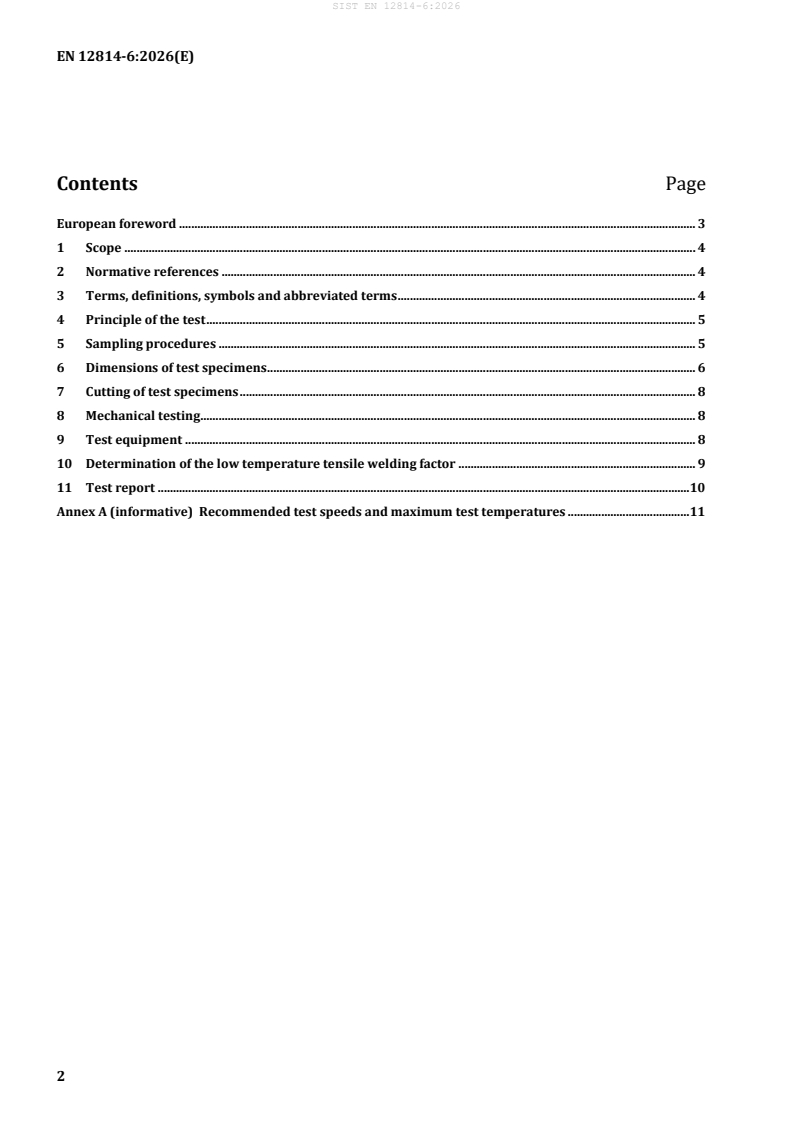
Contents Page
European foreword . 3
1 Scope . 4
2 Normative references . 4
3 Terms, definitions, symbols and abbreviated terms . 4
4 Principle of the test . 5
5 Sampling procedures . 5
6 Dimensions of test specimens . 6
7 Cutting of test specimens . 8
8 Mechanical testing. 8
9 Test equipment . 8
10 Determination of the low temperature tensile welding factor . 9
11 Test report . 10
Annex A (informative) Recommended test speeds and maximum test temperatures . 11
European foreword
This document (EN 12814-6:2026) has been prepared by Technical Committee CEN/TC 249 “Plastics”,
the secretariat of which is held by SIS.
This European Standard shall be given the status of a national standard, either by publication of an
identical text or by endorsement, at the latest by March 2027, and conflicting national standards shall be
withdrawn at the latest by March 2027.
Attention is drawn to the possibility that some of the elements of this document may be the subject of
patent rights. CEN shall not be held responsible for identifying any or all such patent rights.
This document supersedes EN 12814-6:2000.
This document includes the following significant technical changes with respect to EN 12814-6:2000:
— it has been clarified that if one test specimen yields, all of the test specimens cut from both the welded
and unwelded test piece can be tested at a temperature/speed that generates brittle fracture, not just
one specimen.
Any feedback and questions on this document should be directed to the users’ national standards body.
A complete listing of these bodies can be found on the CEN website.
According to the CEN-CENELEC Internal Regulations, the national standards organisations of the
following countries are bound to implement this European Standard: Austria, Belgium, Bulgaria, Croatia,
Cyprus, Czech Republic, Denmark, Estonia, Finland, France, Germany, Greece, Hungary, Iceland, Ireland,
Italy, Latvia, Lithuania, Luxembourg, Malta, Netherlands, Norway, Poland, Portugal, Republic of North
Macedonia, Romania, Serbia, Slovakia, Slovenia, Spain, Sweden, Switzerland, Türkiye and the United
Kingdom.
1 Scope
This document specifies the dimensions, the method of sampling and the preparation of the test
specimens, also the conditions for performing the low temperature tensile test perpendicular to the weld
in order to determine the low temperature tensile welding factor.
A low temperature tensile test can be used in conjunction with other tests (e.g. bend, tensile creep, macro)
to assess the performance of welded assemblies, made from thermoplastics materials.
The low temperature tensile welding factor and the appearance of the fracture surface provide a guide
regarding the ductility of the joint and the quality of the work.
This document is applicable to co-axial or co-planar welded assemblies made from thermoplastics
materials filled or unfilled, but not reinforced, irrespective of the welding process used.
This document does not apply to co-axial welded assemblies of an external diameter less than 20 mm.
2 Normative references
The following documents are referred to in the text in such a way that some or all of their content
constitutes requirements of this document. For dated references, only the edition cited applies. For
undated references, the latest edition of the referenced document (including any amendments) applies.
EN ISO 291, Plastics -
...