


FprEN 17124
(Main)Hydrogen fuel - Product specification and quality assurance for hydrogen refuelling points dispensing liquid or gaseous hydrogen - Proton exchange membrane (PEM) fuel cell applications for vehicles
Hydrogen fuel - Product specification and quality assurance for hydrogen refuelling points dispensing liquid or gaseous hydrogen - Proton exchange membrane (PEM) fuel cell applications for vehicles
This document specifies the quality characteristics of liquid or gaseous hydrogen fuel dispensed at hydrogen refuelling stations for use in proton exchange membrane (PEM) fuel cell vehicle systems, and the corresponding quality assurance considerations for ensuring uniformity of the hydrogen fuel.
Wasserstoff als Kraftstoff - Produktfestlegung und Qualitätssicherung für die Abgabe von flüssigem oder gasförmigem Wasserstoff - Protonenaustauschmembran (PEM)-Brennstoffzellenanwendungen für Fahrzeuge
Dieses Dokument legt die Qualitätseigenschaften von flüssigem oder gasförmigem Wasserstoff als Kraftstoff zur Abgabe an Wasserstofftankstellen für die Nutzung in Fahrzeugsystemen mit Protonenaustauschmembran-Brennstoffzellen (PEM, en: proton exchange membrane) und die zugehörige Qualitätssicherung fest, um eine Gleichförmigkeit von Wasserstoff als Kraftstoff sicherzustellen.
Carburant hydrogène - Spécification de produit et assurance qualité pour les points de ravitaillement en hydrogène distribuant de l'hydrogène liquide ou gazeux - Applications des piles à combustible à membrane d'échange de protons (MEP) pour les véhicules
Le présent document spécifie les caractéristiques de qualité du carburant hydrogène liquide ou gazeux distribué dans les stations de remplissage d'hydrogène et destiné aux systèmes de véhicules à piles à combustible à membrane d'échange de protons (MEP), ainsi que les considérations relatives à l'assurance qualité correspondante afin d'assurer l'uniformité du carburant hydrogène.
Vodik kot gorivo - Specifikacija proizvoda in zagotavljanje kakovosti tekočega ali plinastega vodika na polnilnih postajah - Gorivne celice z membrano za protonsko izmenjavo (PEM) za cestna vozila
General Information
- Status
- Not Published
- Publication Date
- 14-Apr-2026
- Technical Committee
- CEN/TC 268 - Cryogenic vessels
- Drafting Committee
- CEN/TC 268/WG 5 - Specific hydrogen technologies applications
- Current Stage
- 5060 - Closure of Vote - Formal Approval
- Start Date
- 05-Feb-2026
- Due Date
- 31-Dec-2026
- Completion Date
- 05-Feb-2026
Relations
- Effective Date
- 04-Dec-2024
Overview
The FprEN 17124:2025 standard, developed by CEN, defines the product specification and quality assurance requirements for hydrogen fuel dispensed at refuelling stations. It specifically targets hydrogen fuel-both liquid and gaseous-used in proton exchange membrane (PEM) fuel cell vehicles. This standard ensures consistent hydrogen fuel quality to optimize fuel cell vehicle performance and safety, promoting the adoption of clean hydrogen technologies in the transport sector.
Key Topics
Hydrogen Fuel Quality Characteristics
The standard specifies strict limits on hydrogen purity and allowable contaminants to safeguard PEM fuel cell systems.- Minimum hydrogen fuel index: 99.97% mole fraction
- Strict maximum limits for impurities such as water, total hydrocarbons, methane, oxygen, carbon monoxide, sulfur compounds, ammonia, and halogenated compounds
- Particulate matter concentration capped at 1 mg/kg
Quality Assurance Methodology
It outlines two main methodologies for ensuring fuel quality:- Prescriptive Approach for clearly identified supply chains
- Risk Assessment Approach that evaluates contamination risks by analyzing likelihood, severity, and consequences of impurities
Risk Assessment & Control
- Defines impurity occurrence classes from very unlikely to very likely
- Assesses severity of contaminant effects on vehicle hardware and performance, with classifications from no impact to irreversible damage
- Provides an acceptability matrix combining occurrence and severity to guide risk control decisions
- Requires ongoing monitoring, sampling, and corrective actions to maintain compliance
Supply Chain Considerations
The standard emphasizes the entire hydrogen supply chain, recognizing potential impurity sources from production to dispensing. Annexes provide templates for supply chain evaluation, risk assessment, and impurity impact.
Applications
- Hydrogen Refuelling Stations (HRS)
Ensures hydrogen fuel dispensed meets rigorous quality specifications, critical for reliable operation of fuel cell vehicles. - PEM Fuel Cell Vehicles
Enables consistent fuel quality management, minimizing degradation and performance loss in fuel cell stacks. - Hydrogen Supply Chain Management
Supports operators in designing and implementing quality assurance plans that address site-specific risks and maintain hydrogen purity. - Automotive Industry Compliance
Assists vehicle manufacturers and fuel providers in conforming to European guidelines for hydrogen fuel, fostering trust and safety in hydrogen mobility.
Related Standards
- EN 17124:2022 (superseded) – the previous version, replaced by this updated draft to enhance quality assurance measures.
- ISO and IEC Hydrogen Terminology – referenced for harmonized definitions in hydrogen fuel technology.
- CEN/TC 268 activities – covers related cryogenic tanks and hydrogen technology standards important for hydrogen fuel storage and delivery systems.
This standard is essential for stakeholders in the hydrogen fuel ecosystem aiming to ensure high-quality hydrogen supply, reduce risks from contaminants, and support the widespread adoption of PEM fuel cell technology in vehicles. Compliance with FprEN 17124 fosters uniformity in hydrogen fuel quality and enhances the durability and performance of fuel cell vehicles on European roads.

Get Certified
Connect with accredited certification bodies for this standard

DNV
DNV is an independent assurance and risk management provider.

Lloyd's Register
Lloyd's Register is a global professional services organisation specialising in engineering and technology.

ABS Quality Evaluations Inc.
American Bureau of Shipping quality certification.
Sponsored listings
Frequently Asked Questions
FprEN 17124 is a draft published by the European Committee for Standardization (CEN). Its full title is "Hydrogen fuel - Product specification and quality assurance for hydrogen refuelling points dispensing liquid or gaseous hydrogen - Proton exchange membrane (PEM) fuel cell applications for vehicles". This standard covers: This document specifies the quality characteristics of liquid or gaseous hydrogen fuel dispensed at hydrogen refuelling stations for use in proton exchange membrane (PEM) fuel cell vehicle systems, and the corresponding quality assurance considerations for ensuring uniformity of the hydrogen fuel.
This document specifies the quality characteristics of liquid or gaseous hydrogen fuel dispensed at hydrogen refuelling stations for use in proton exchange membrane (PEM) fuel cell vehicle systems, and the corresponding quality assurance considerations for ensuring uniformity of the hydrogen fuel.
FprEN 17124 is classified under the following ICS (International Classification for Standards) categories: 27.075 - Hydrogen technologies; 75.160.20 - Liquid fuels. The ICS classification helps identify the subject area and facilitates finding related standards.
FprEN 17124 has the following relationships with other standards: It is inter standard links to EN 17124:2022. Understanding these relationships helps ensure you are using the most current and applicable version of the standard.
FprEN 17124 is associated with the following European legislation: EU Directives/Regulations: 2014/94/EU; Standardization Mandates: M/533. When a standard is cited in the Official Journal of the European Union, products manufactured in conformity with it benefit from a presumption of conformity with the essential requirements of the corresponding EU directive or regulation.
FprEN 17124 is available in PDF format for immediate download after purchase. The document can be added to your cart and obtained through the secure checkout process. Digital delivery ensures instant access to the complete standard document.
Standards Content (Sample)
SLOVENSKI STANDARD
oSIST prEN 17124:2025
01-junij-2025
Vodik kot gorivo - Specifikacija proizvoda in zagotavljanje kakovosti tekočega ali
plinastega vodika na polnilnih postajah - Gorivne celice z membrano za protonsko
izmenjavo (PEM) za cestna vozila
Hydrogen fuel - Product specification and quality assurance for hydrogen refuelling
points dispensing liquid or gaseous hydrogen - Proton exchange membrane (PEM) fuel
cell applications for vehicles
Wasserstoff als Kraftstoff - Produktfestlegung und Qualitätssicherung für
Wasserstoffbetankungsanlagen zur Abgabe gasförmigen Wasserstoffs -
Protonenaustauschmembran (PEM)-Brennstoffzellenanwendungen für Fahrzeuge
Carburant hydrogène - Spécification de produit et assurance qualité pour les points de
ravitaillement en hydrogène distribuant de l'hydrogène gazeux - Applications des piles à
combustible à membrane à échange de protons (MEP) pour les véhicules
Ta slovenski standard je istoveten z: prEN 17124
ICS:
27.075 Tehnologija vodika Hydrogen technologies
43.060.40 Sistemi za gorivo Fuel systems
oSIST prEN 17124:2025 en,fr,de
2003-01.Slovenski inštitut za standardizacijo. Razmnoževanje celote ali delov tega standarda ni dovoljeno.
oSIST prEN 17124:2025
oSIST prEN 17124:2025
DRAFT
EUROPEAN STANDARD
prEN 17124
NORME EUROPÉENNE
EUROPÄISCHE NORM
June 2025
ICS 27.075; 75.160.20 Will supersede EN 17124:2022
English Version
Hydrogen fuel - Product specification and quality
assurance for hydrogen refuelling points dispensing liquid
or gaseous hydrogen - Proton exchange membrane (PEM)
fuel cell applications for vehicles
Carburant hydrogène - Spécification de produit et Wasserstoff als Kraftstoff - Produktfestlegung und
assurance qualité pour les points de ravitaillement en Qualitätssicherung für Wasserstoffbetankungsanlagen
hydrogène distribuant de l'hydrogène gazeux - zur Abgabe gasförmigen Wasserstoffs -
Applications des piles à combustible à membrane à Protonenaustauschmembran (PEM)-
échange de protons (MEP) pour les véhicules Brennstoffzellenanwendungen für Fahrzeuge
This draft European Standard is submitted to CEN members for enquiry. It has been drawn up by the Technical Committee
CEN/TC 268.
If this draft becomes a European Standard, CEN members are bound to comply with the CEN/CENELEC Internal Regulations
which stipulate the conditions for giving this European Standard the status of a national standard without any alteration.
This draft European Standard was established by CEN in three official versions (English, French, German). A version in any other
language made by translation under the responsibility of a CEN member into its own language and notified to the CEN-CENELEC
Management Centre has the same status as the official versions.
CEN members are the national standards bodies of Austria, Belgium, Bulgaria, Croatia, Cyprus, Czech Republic, Denmark, Estonia,
Finland, France, Germany, Greece, Hungary, Iceland, Ireland, Italy, Latvia, Lithuania, Luxembourg, Malta, Netherlands, Norway,
Poland, Portugal, Republic of North Macedonia, Romania, Serbia, Slovakia, Slovenia, Spain, Sweden, Switzerland, Türkiye and
United Kingdom.
Recipients of this draft are invited to submit, with their comments, notification of any relevant patent rights of which they are
aware and to provide supporting documentation.
Warning : This document is not a European Standard. It is distributed for review and comments. It is subject to change without
notice and shall not be referred to as a European Standard.
EUROPEAN COMMITTEE FOR STANDARDIZATION
COMITÉ EUROPÉEN DE NORMALISATION
EUROPÄISCHES KOMITEE FÜR NORMUNG
CEN-CENELEC Management Centre: Rue de la Science 23, B-1040 Brussels
© 2025 CEN All rights of exploitation in any form and by any means reserved Ref. No. prEN 17124:2025 E
worldwide for CEN national Members.
oSIST prEN 17124:2025
prEN 17124:2025 (E)
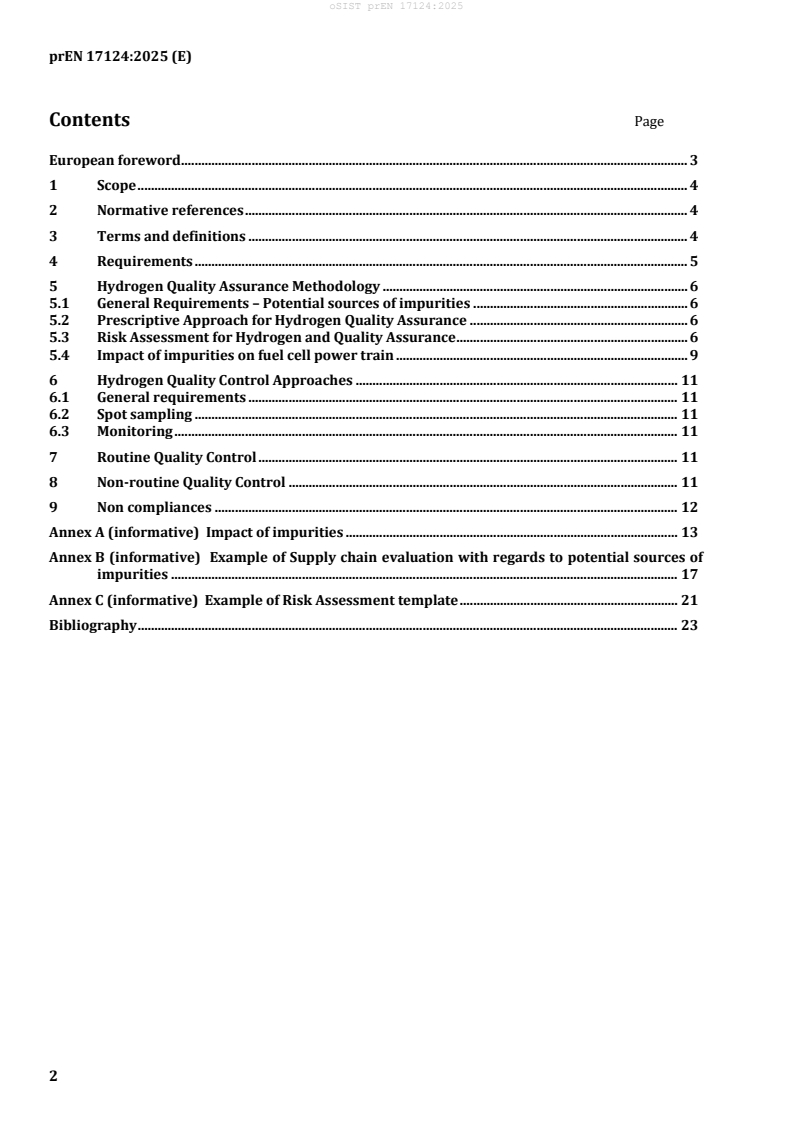
Contents Page
European foreword . 3
1 Scope . 4
2 Normative references . 4
3 Terms and definitions . 4
4 Requirements . 5
5 Hydrogen Quality Assurance Methodology . 6
5.1 General Requirements – Potential sources of impurities . 6
5.2 Prescriptive Approach for Hydrogen Quality Assurance . 6
5.3 Risk Assessment for Hydrogen and Quality Assurance . 6
5.4 Impact of impurities on fuel cell power train . 9
6 Hydrogen Quality Control Approaches . 11
6.1 General requirements . 11
6.2 Spot sampling . 11
6.3 Monitoring . 11
7 Routine Quality Control . 11
8 Non-routine Quality Control . 11
9 Non compliances . 12
Annex A (informative) Impact of impurities . 13
Annex B (informative) Example of Supply chain evaluation with regards to potential sources of
impurities . 17
Annex C (informative) Example of Risk Assessment template . 21
Bibliography . 23
oSIST prEN 17124:2025
prEN 17124:2025 (E)
European foreword
This document (prEN 17124:2025) has been prepared by Technical Committee CEN/TC 268 “Cryogenic vessels
and specific hydrogen technologies applications”, the secretariat of which is held by AFNOR.
This document supersedes EN 17124:2022.
This document has been prepared under a standardization request addressed to CEN by the European
Commission. The Standing Committee of the EFTA States subsequently approves these requests for its Member
States.
oSIST prEN 17124:2025
prEN 17124:2025 (E)
1 Scope
This document specifies the quality characteristics of liquid or gaseous hydrogen fuel dispensed at hydrogen
refuelling stations for use in proton exchange membrane (PEM) fuel cell vehicle systems, and the corresponding
quality assurance considerations for ensuring uniformity of the hydrogen fuel.
2 Normative references
There are no normative references in this document.
3 Terms and definitions
For the purposes of this document, the following terms and definitions apply.
ISO and IEC maintain terminological databases for use in standardization at the following addresses:
— ISO Online browsing platform: available at https://www.iso.org/obp
— IEC Electropedia: available at https://www.electropedia.org/
3.1
constituent
component (or compound) found within a hydrogen fuel mixture
3.2
contaminant
impurity that adversely affects the components within the fuel cell system or the hydrogen storage system
Note 1 to entry: An adverse effect can be reversible or irreversible.
3.3
detection limit
lowest quantity of a substance that can be distinguished from the absence of that substance with a stated
confidence limit
3.4
fuel cell system
power system used for the generation of electricity on a fuel cell vehicle, typically containing the following
subsystems: fuel cell stack, air processing, fuel processing, thermal management and water management
3.5
hydrogen fuel index
fraction or percentage of a fuel mixture that is hydrogen
3.6
irreversible effect
effect which results in a permanent degradation of the fuel cell power system performance that cannot be
restored by practical changes of operational conditions and/or gas composition
3.7
on-site fuel supply
hydrogen fuel supplying system with a hydrogen production system in the same site
oSIST prEN 17124:2025
prEN 17124:2025 (E)
3.8
off-site fuel supply
hydrogen fuel supplying system without a hydrogen production system in the same site, receiving hydrogen
fuel which is produced out of the site
3.9
particulate
solid or liquid particle (aerosol) that can be entrained somewhere in the delivery, storage, or transfer of the
hydrogen fuel
3.10
reversible effect
effect which results in a non-permanent degradation of the fuel cell power system performance that can be
restored by practical changes of operational conditions and/or gas composition
4 Requirements
The fuel quality requirements at the dispenser nozzle shall meet the requirements of Table 1.
NOTE The fuel specification is not process or feedstock specific. Non-listed contaminants have no guarantee of being
benign.
Table 1 — Fuel quality specifications for PEM fuel cell road vehicle applications
Constituent Characteristics
a
99,97 %
Hydrogen fuel index (minimum mole fraction)
Total non-hydrogen gases 300 μmol/mol
Maximum concentration of individual contaminants
b
5 μmol/mol
Water (H O)
c
2 μmol/mol
Total hydrocarbons (Excluding Methane) C1
equivalent
Methane (CH ) 100 µmol/mol
Oxygen (O ) 5 μmol/mol
Helium (He) 300 μmol/mol
Nitrogen (N ) 300 μmol/mol
Argon (Ar) 300 μmol/mol
Carbon dioxide (CO ) 2 μmol/mol
d
0,2 μmol/mol
Carbon monoxide (CO)
e
0,004 μmol/mol
Sulfur compounds (H S equivalent)
d
0,2 μmol/mol
Formaldehyde (HCHO)
Ammonia (NH ) 0,1 μmol/mol
f
0,05 μmol/mol
Halogenated compounds (Halogen equivalent)
oSIST prEN 17124:2025
prEN 17124:2025 (E)
Maximum particulates concentration 1 mg/kg
For the constituents that are grouped, such as hydrocarbons, sulphur compounds and
halogenated compounds, the sum of the constituents shall be less than or equal to the
acceptable limit.
a
The hydrogen fuel index is determined by substracting the “total non-hydrogen gases” in this
table, expressed in mole percent, from 100 mol percent.
b
The allowable water content is based upon a HRS operating at 70 MPa nominal pressure and −40 °C
hydrogen precooling. The allowable water content may be allowed to increase to 7 μmol/mol H2O for
a station only dispensing at a nominal working pressure of 35 MPa and a precooling temperature of
−26 °C or warmer. The change should be confirmed by the hydrogen quality plan as discussed in
Clause 5 to ensure that no water condensate can form. The potential temperatures and pressures in
the FCEV should be considered.
c
Total hydrocarbons except methane include oxygenated organic species. Total hydrocarbons
shall be measured on a C1 equivalent (μmol/mol).
d
Total of CO, HCHO shall not exceed 0,2 µmol/mol.
e
Sulphur compounds which could potentially be in the hydrogen gas (for example, H2S, COS, CS2 and
mercaptans) should be determined by the hydrogen quality control plan discussed in Clause 5.
Sulphur compounds shall be measured on a S1 equivalent (μmol/mol).
f
All halogenated compounds which could potentially be in the hydrogen gas (for example, hydrogen
chloride (HCl), and organic halides (R-X)) should be determined according to the hydrogen quality
assurance discussed in Clause 5 and the sum shall be less than 0,05 µmol /mol).
5 Hydrogen Quality Assurance Methodology
5.1 General Requirements – Potential sources of impurities
A quality assurance plan for the entire supply chain shall be created to ensure that the hydrogen quality will
meet the requirements listed in Clause 4. The methodology used to develop the quality assurance plan can vary
but shall include one of the two approaches described in this document. The general description of these two
approaches are described in 5.2 and 5.3.
For a given Hydrogen Refuelling Station (HRS), the contaminants listed in the hydrogen specification referred
to Table 1 could be present. There are several parts of the supply chain where impurities can be introduced.
Annex B describes potential impurities at each step of the supply chain.
When a contaminant is classified as potentially present, it shall be taken into account in the Quality Assurance
methodology (risk assessment or prescriptive approach) described below.
5.2 Prescriptive Approach for Hydrogen Quality Assurance
A prescriptive approach can be applied for clearly identified supply chains. The prescriptive approach is not
defined in this document.
5.3 Risk Assessment for Hydrogen and Quality Assurance
Risk assessment consists of identifying the probability of having each impurity above the threshold values of
specifications given in Table 1 and evaluating the severity of each impurity for the fuel cell car. As an aid to
clearly defining the risk(s) for risk assessment purposes, three fundamental questions are often helpful:
— What might go wrong: which event could cause the impurities to be above the threshold value?
— What is the likelihood (probability of occurrence) that impurities could be above the threshold value?
oSIST prEN 17124:2025
prEN 17124:2025 (E)
— What are the consequences (severity) for the fuel cell car?
In doing an effective risk assessment, the robustness of the data set is important because it determines the
quality of the output. Revealing assumptions and reasonable sources of uncertainty will enhance confidence in
this output and/or help identify its limitations. The output of the risk assessment is a qualitative description of
a range of risk. The probability of an occurrence, in which each hydrogen impurity exceeds the threshold value,
is defined by the following table of occurrence classes:
Table 2 — Occurrence classes for an impurity
Occurrence
a
Class name Description Occurrence (example)
class
Very unlikely Contaminant above threshold
0 (Practically never been observed for this 1 per 10 000 000 refueling
impossible) source / supply chain / station
Known to occur at least once for
1 Unlikely this source / supply chain/ 1 per 1 000 000 refueling
station
Has happened once a year for
2 Possible this source / supply chain / 1 per 100 000 refueling
station
Has happened more than once a
3 Likely year for this source / supply 1 out of 10 000 refueling
chain / station
Happens on a regular basis for
More than 1 out of 1 000
4 Very likely this source / supply chain /
refueling
station
a
Based on a refueling station supplying 100 000 refuelings per year. In case the actual refuelling use of the
subject HRS is known at a yearly base, the occurrence corresponding to all the occurrence classes should be
proportionally adjusted so that occurrence class 2 reflects one occurrence per year
The range of severity class (level of damage for vehicle) is defined in Table 3.
oSIST prEN 17124:2025
prEN 17124:2025 (E)
Table 3 — Severity classes for an impurity
Impact categories
Severity
Hardware Hardware
FCEV Performance impact or damage
Performance
class
impact impact
impact
temporary permanent
0 — No impact No No No
1 — Minor impact Yes No No
— Temporary loss of power
— No impact on hardware
— Car still operates
2 — Reversible damage Yes or No Yes No
— Requires specific light maintenance
procedure
— Car still operates
3 — Reversible damage Yes Yes No
— Requires specific immediate
maintenance procedure. Gradual
power loss that does not compromise
safety
a
— Irreversible damage Yes Yes Yes or No
— Requires major repair (e.g. stack
change)
— Power loss or Car Stop that
compromises safety
a
Any damage, whether permanent or non-permanent, which compromises safety will be categorized as 4,
otherwise non-permanent damage will be categorized as 1, 2 or 3.
The final risk is defined by Table 4, titled “Acceptability table”, and which combines results from Tables 2 and 3.
oSIST prEN 17124:2025
prEN 17124:2025 (E)
Table 4 — Acceptability table
Severity
0 1 2 3 4
Occurrence
as the
combined
probabilities
of occurrence
along the
whole supply
chain
Further investigations are
Acceptable risk area Unacceptable risk;
needed to ensure the risks
Key Existing controls additional control or
is reduced to as low as
acceptable barriers are required
reasonably practicable
For each impurity of the specification and for a given HRS (including the supply chain of hydrogen), a risk
assessment shall be applied to define the global risk. Risk control includes decision making to reduce and/or
accept risks. The purpose of risk control is to reduce the risk to an acceptable level. The amount of effort used
for risk control should be proportional to the significance of the risk. Decision makers might use different
processes, including a benefit-cost analysis, for understanding the optimal level of risk control. Risk control
might focus on the following questions:
— Is the risk above an acceptable level?
— What can be done to reduce or eliminate risks?
— What is the appropriate balance among benefits, risks and resources?
For each level of risk, decision shall be taken in order to either refuse the risk and then find mitigation or
barriers to reduce it, or accept the risk level as it is. Risk reduction focuses on processes for mitigation or
avoidance of quality risks when it exceeds an acceptable level (yellow or red zone in Table 5). Risk reduction
might include actions taken to mitigate the severity and/or probability of occurrence.
In the yellow zone, the risk could be acceptable but redesign or other changes should be considered if
reasonably practicable. Further investigation should be performed to give better estimate of the risk. When
assessing the need of remedial actions, the number of events of this risk level should be taken into consideration
in order to be As Low As Reasonably Practicable (ALARP).
The risk assessment shall be done at each step of the supply chain (production, logistics and refuelling stations)
for each impurity mentioned in Table 1. It shall consider normal operations and maintenance. An example of
such approach is given in Annex C.
5.4 Impact of impurities on fuel cell power train
The severity level of each impurity shall be determined. Indeed, the impact on the car if each impurity exceeds
the threshold values given in Table 1 will depend on the concentration of the contaminant. The following
Table 5 shows the summary of the concentration based impact of the impurities on the fuel cell.
For more information on the impact of the impurities on fuel-cell, see Annex A.
In the first two columns the contaminants with their chemical formulas are given. An estimate of the exceeded
concentration above the threshold value for each impurity is named “Level 1” and is given in column 5.
According to this concentration, a severity class is given in column 4 for each impurity. This severity class
covers the impact of this impurity above the threshold value up to this limit.
If higher concentrations that exceed Level 1 can be reached, the Severity Class is given in column 6.
oSIST prEN 17124:2025
prEN 17124:2025 (E)
Table 5 — Severity Classes (SC) — Impact of impurities on fuel cell powertrain
SC for impurity SC for
Threshold
concentration impurity
Value Level 1 Value
Impurity from threshold to concentratio
[µmol/mol]
[ µmol/mol]
level 1 where n greater
(Table 1)
applicable than Level 1
Total non-H gases
300 1 500 4
Helium He 300 1 500 4
Nitrogen N
300 1 500 4
Argon Ar 300 1 500 4
Oxygen O
5 1 50 4
Carbon dioxide CO
2 1 3 4
b
Carbon monoxide
CO 0,2 2–3 1 4
Methane CH
100 1 300 4
Water H O
5 4 NA 4
Sulfur compounds S1
equivalent 0,004 4 NA 4
Ammonia NH
0,1 4 NA 4
Total hydrocarbons C1
2 1-2 b 5 4
equivalent
b
Formaldehyde CH O
0,2 1 4
2–3
Total carbon monoxide,
Σ CO, CH O
0,2 2–3 1 4
formaldehyde
Halogenated
0,05 4 NA 4
compounds
Maximum particulates
concentration (liquid 1 mg/kg c 4 NA 4
and solid)
NA: Not applicable.
a
Threshold value according to the requirements in the hydrogen specification.
b
Higher value to be considered for risk assessment approach until more specific data are available.
c
Particulates are based upon mass density mg/kg.
oSIST prEN 17124:2025
prEN 17124:2025 (E)
6 Hydrogen Quality Control Approaches
6.1 General requirements
Quality control for the purpose of quality assurance may be performed at the dispenser nozzle or at other
location in accordance with the quality assurance risk assessment.
There are two kinds of quality control at an HRS: on line monitoring or off line analysis after spot sampling.
These methods shall be used individually or together to ensure hydrogen quality levels.
6.2 Spot sampling
Spot sampling at an HRS involves capturing a measured amount for chemical analysis. Sampling is used to
perform an accurate and comprehensive analysis of impurities, which is done externally, typically at a
laboratory. Since the sampling process involves drawing a gas sample, it is typically done on a periodic basis
and requires specialized sampling equipment and personnel to operate it.
The sampling procedure shall ensure and maintain the integrity of the sample.
NOTE ISO 19880-9 and ISO 21087 include recommendations for sampling procedure.
6.3 Monitoring
An HRS can have real time monitoring of the hydrogen gas stream for one or more impurities on a continuous
or semi-continuous basis. A critical impurity can be monitored to ensure it does not exceed a critical level, or
monitoring of canary species are used to alert of potential issues with the hydrogen production or purification
process.
When used, monitoring equipment should be installed in-line with the hydrogen gas stream and shall meet the
process requirements of the HRS, as well as be calibrated on a periodic basis.
7 Routine Quality Control
Routine analysis shall be performed on a periodic basis once every specified time period or once for each
specific number of deliveries if a quality certificate is not available. The methodology selected in hydrogen
quality assurance plan determines the type and frequency of the routine analysis. A prescriptive methodology
may be used as described in 5.2 or a risk assessment methodology may be used as described in 5.3. Information
on the routine analysis for each step of the supply chain is provided in Annex B.
8 Non-routine Quality Control
The hydrogen quality plan shall:
a) include sampling and analysis when a new fuelling station is commissioned;
b) identify any other reasonably foreseeable non-routine conditions requiring subsequent sampling
and analysis actions.
Some common non-routine conditions include but are not limited to the following:
— a new production system is constructed at a production site or a new HRS is first commissioned;
— the production system at a production site or HRS is modified;
— a routine or non-routine open inspection, repair, catalyst exchange, or the like is performed on a production
system at the production site or HRS;
oSIST prEN 17124:2025
prEN 17124:2025 (E)
— a question concerning quality is raised when, for example, there is a problem with a vehicle because of
hydrogen supplied at the production site or HRS, and a claim is received from a user directly or indirectly;
— an issue concerning quality emerges when, for example, a voluntary audit raises the possibility that quality
control is not administered properly;
— analysis necessary for
...
Questions, Comments and Discussion
Ask us and Technical Secretary will try to provide an answer. You can facilitate discussion about the standard in here.
Loading comments...