


FprEN 12390-20
(Main)Testing hardened concrete - Part 20: Determination of open porosity
General Information
- Abstract
This document describes the method for the determination of the open porosity (open pores) of hardened concrete on test specimens manufactured from moulded or cored specimens.
The test is suitable for specimens having a declared value of D of the coarsest fraction of aggregates used in concrete (Dmax) not greater than 40 mm.
The test method is not applicable for concrete containing lightweight aggregate.
- Status
- Not Published
- Publication Date
- 13-Oct-2026
- Technical Committee
- CEN/TC 104 - Concrete ( performance, production, placing and compliance criteria )
- Drafting Committee
- CEN/TC 104/SC 1 - Revision of ENV 206
- Current Stage
- 5060 - Closure of Vote - Formal Approval
- Start Date
- 23-Jul-2026
- Due Date
- 05-Jan-2026
- Completion Date
- 23-Jul-2026

Overview
FprEN 12390-20: Testing Hardened Concrete – Part 20: Determination of Open Porosity is a European draft standard published by CEN (European Committee for Standardization). This standard specifies a reliable laboratory method to determine the open porosity of hardened concrete specimens, essential for assessing concrete quality and durability. The test applies to concrete specimens manufactured from moulded, sawn, or cored samples, except those containing lightweight aggregates or with aggregates larger than 40 mm.
With open porosity being a critical parameter affecting concrete’s strength, impermeability, freeze-thaw durability, and resistance to aggressive environments, this standard facilitates uniform testing and reliable comparison across concrete products and construction projects.
Key Topics
Scope and Applicability
- The method applies to hardened concrete specimens of types including moulded, sawn, or cored samples.
- Specimens should be representative and appropriately sized based on aggregate size (Dmax ≤ 40 mm).
- Specifically excludes concrete with lightweight aggregates.
Testing Principle
- Measures the volume of pores in concrete, accessible by water (open pores), versus its apparent volume.
- The procedure involves saturating the specimen under vacuum, weighing it in air, in water, and after oven-drying.
- Calculation yields porosity as a percentage, reflecting the ratio of open pore volume to total apparent volume.
Test Procedure Outline
- Prepare and store specimens per relevant standards (EN 12390-1, EN 12390-2, EN 12504-1).
- Saturate specimens under vacuum and then submerge them in water.
- Measure three critical masses: saturated in air, saturated in water, and oven-dried.
- Calculate average open porosity from at least three test samples.
Equipment and Requirements
- Essential apparatus includes a ventilated oven, analytical balance, water tank, vacuum system, thermometer, desiccator, timer, and precise measuring tools (callipers).
- Clear procedural and reporting requirements ensure test repeatability and traceability.
Applications
Quality Control in Concrete Production
- Optimal for concrete manufacturers, testing labs, and contractors needing to certify or compare concrete mixes.
- Used for verifying compliance with technical specifications and durability requirements.
Assessment of Durability
- Open porosity measurement helps predict concrete’s potential resistance to water ingress, freeze-thaw cycles, and exposure to aggressive chemicals.
- Supports maintenance planning and lifespan assessment of concrete structures.
Research and Development
- Provides a precise method for investigating the effects of mix design, additives, or curing on the permeability and mechanical performance of concrete.
Forensic and Structural Analysis
- Useful in evaluating existing structures, particularly during renovations, auditing, or when investigating concrete failure or deterioration.
Related Standards
EN 12390 Series: Comprehensive framework for testing various properties of hardened concrete, including compressive strength, density, water penetration, and resistance to chloride ingress.
- EN 12390-1: Preparation of test specimens and moulds.
- EN 12390-2: Curing procedures for specimens.
- EN 12390-7: Density determination.
- EN 12390-8: Water penetration testing.
EN 12504-1: Core extraction and compressive testing of concrete in structures.
EN 12350-1: Sampling and common apparatus for fresh concrete.
Implementing FprEN 12390-20 ensures accurate, reproducible measurement of open porosity, aiding quality assurance and performance evaluation in the concrete industry. By harmonizing testing practices across Europe, the standard supports safer, more durable, and reliable concrete construction.
Get Certified
Connect with accredited certification bodies for this standard

DIBt (Deutsches Institut für Bautechnik)
German Institute for Building Technology.
DIN CERTCO
DIN Group product certification.

Aboma Certification B.V.
Specialized in construction, metal, and transport sectors.
Sponsored listings
Frequently Asked Questions
FprEN 12390-20 is a draft published by the European Committee for Standardization (CEN). Its full title is "Testing hardened concrete - Part 20: Determination of open porosity". This standard covers: This document describes the method for the determination of the open porosity (open pores) of hardened concrete on test specimens manufactured from moulded or cored specimens. The test is suitable for specimens having a declared value of D of the coarsest fraction of aggregates used in concrete (Dmax) not greater than 40 mm. The test method is not applicable for concrete containing lightweight aggregate.
This document describes the method for the determination of the open porosity (open pores) of hardened concrete on test specimens manufactured from moulded or cored specimens. The test is suitable for specimens having a declared value of D of the coarsest fraction of aggregates used in concrete (Dmax) not greater than 40 mm. The test method is not applicable for concrete containing lightweight aggregate.
FprEN 12390-20 is classified under the following ICS (International Classification for Standards) categories: 91.100.30 - Concrete and concrete products. The ICS classification helps identify the subject area and facilitates finding related standards.
FprEN 12390-20 is available in PDF format for immediate download after purchase. The document can be added to your cart and obtained through the secure checkout process. Digital delivery ensures instant access to the complete standard document.
Standards Content (Sample)
SLOVENSKI STANDARD
oSIST prEN 12390-20:2025
01-april-2025
Preskušanje strjenega betona - 20. del: - Določanje poroznosti
Testing hardened concrete - Part 20: Determination of porosity
Prüfung von Festbeton - Teil 20: Bestimmung der Porosität
Essais pour béton durci - Partie 20 : Détermination de la porosité
Ta slovenski standard je istoveten z: prEN 12390-20
ICS:
91.100.30 Beton in betonski izdelki Concrete and concrete
products
oSIST prEN 12390-20:2025 en,fr,de
2003-01.Slovenski inštitut za standardizacijo. Razmnoževanje celote ali delov tega standarda ni dovoljeno.
oSIST prEN 12390-20:2025
oSIST prEN 12390-20:2025
DRAFT
EUROPEAN STANDARD
prEN 12390-20
NORME EUROPÉENNE
EUROPÄISCHE NORM
February 2025
ICS 91.100.30
English Version
Testing hardened concrete - Part 20: Determination of
porosity
Essais pour béton durci - Partie 20 : Détermination de Prüfung von Festbeton - Teil 20: Bestimmung der
la porosité Porosität
This draft European Standard is submitted to CEN members for enquiry. It has been drawn up by the Technical Committee
CEN/TC 104.
If this draft becomes a European Standard, CEN members are bound to comply with the CEN/CENELEC Internal Regulations
which stipulate the conditions for giving this European Standard the status of a national standard without any alteration.
This draft European Standard was established by CEN in three official versions (English, French, German). A version in any other
language made by translation under the responsibility of a CEN member into its own language and notified to the CEN-CENELEC
Management Centre has the same status as the official versions.
CEN members are the national standards bodies of Austria, Belgium, Bulgaria, Croatia, Cyprus, Czech Republic, Denmark, Estonia,
Finland, France, Germany, Greece, Hungary, Iceland, Ireland, Italy, Latvia, Lithuania, Luxembourg, Malta, Netherlands, Norway,
Poland, Portugal, Republic of North Macedonia, Romania, Serbia, Slovakia, Slovenia, Spain, Sweden, Switzerland, Türkiye and
United Kingdom.
Recipients of this draft are invited to submit, with their comments, notification of any relevant patent rights of which they are
aware and to provide supporting documentation.
Warning : This document is not a European Standard. It is distributed for review and comments. It is subject to change without
notice and shall not be referred to as a European Standard.
EUROPEAN COMMITTEE FOR STANDARDIZATION
COMITÉ EUROPÉEN DE NORMALISATION
EUROPÄISCHES KOMITEE FÜR NORMUNG
CEN-CENELEC Management Centre: Rue de la Science 23, B-1040 Brussels
© 2025 CEN All rights of exploitation in any form and by any means reserved Ref. No. prEN 12390-20:2025 E
worldwide for CEN national Members.
oSIST prEN 12390-20:2025
prEN 12390-20:2025 (E)
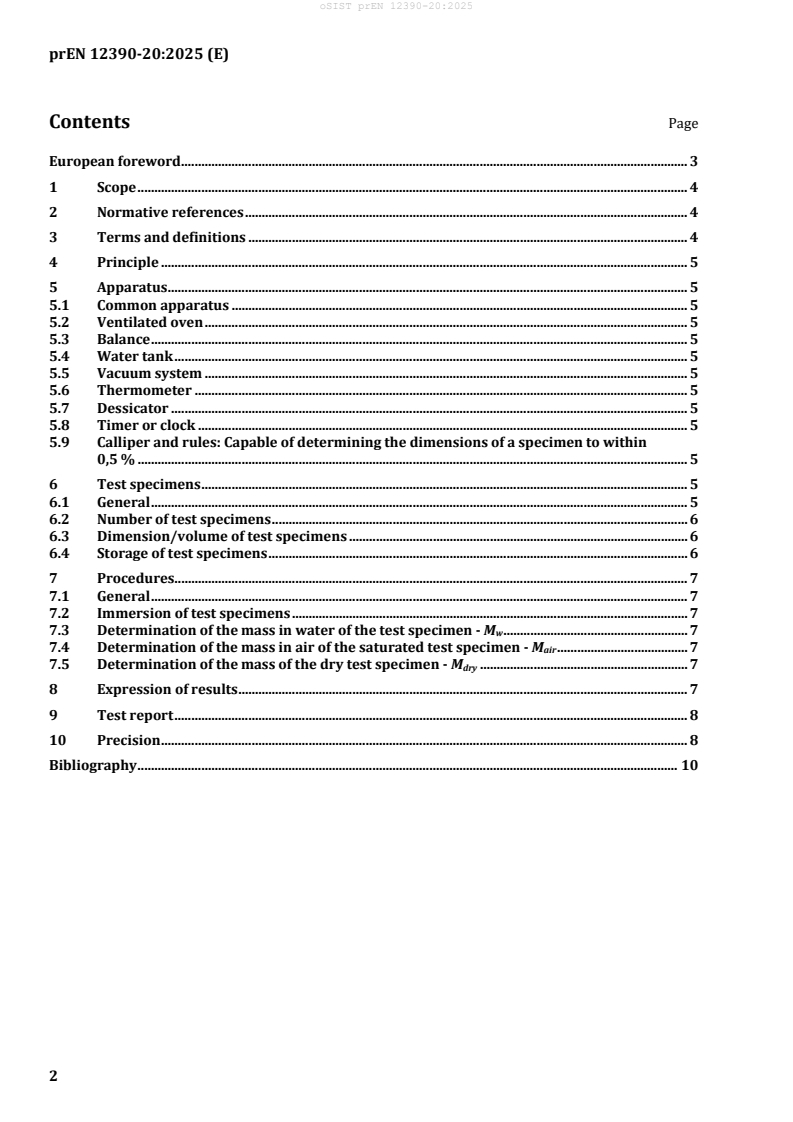
Contents Page
European foreword . 3
1 Scope . 4
2 Normative references . 4
3 Terms and definitions . 4
4 Principle . 5
5 Apparatus . 5
5.1 Common apparatus . 5
5.2 Ventilated oven . 5
5.3 Balance . 5
5.4 Water tank . 5
5.5 Vacuum system . 5
5.6 Thermometer . 5
5.7 Dessicator . 5
5.8 Timer or clock . 5
5.9 Calliper and rules: Capable of determining the dimensions of a specimen to within
0,5 % . 5
6 Test specimens . 5
6.1 General . 5
6.2 Number of test specimens . 6
6.3 Dimension/volume of test specimens . 6
6.4 Storage of test specimens . 6
7 Procedures. 7
7.1 General . 7
7.2 Immersion of test specimens . 7
7.3 Determination of the mass in water of the test specimen - M . 7
w
7.4 Determination of the mass in air of the saturated test specimen - M . 7
air
7.5 Determination of the mass of the dry test specimen - M . 7
dry
8 Expression of results . 7
9 Test report . 8
10 Precision . 8
Bibliography . 10
oSIST prEN 12390-20:2025
prEN 12390-20:2025 (E)
European foreword
This document (prEN 12390-20:2025) has been prepared by Technical Committee CEN/TC 104
“Concrete and related products”, the secretariat of which is held by SN.
This document is currently submitted to the CEN Enquiry.
It is based on the French Standard NF P 18-459 “Concrete — Testing hardened concrete — Testing
porosity and density”.
This document is one of a series on testing concrete.
EN 12390, Testing hardened concrete, consists of the following parts:
— Part 1: Shape, dimensions and other requirements for specimens and moulds
— Part 2: Making and curing specimens for strength tests
— Part 3: Compressive strength of test specimens
— Part 4: Compressive strength – Specification for testing machines
— Part 5: Flexural strength of test specimens
— Part 6: Tensile splitting strength of test specimens
— Part 7: Density of hardened concrete
— Part 8: Depth of penetration of water under pressure
— Part 10: Determination of the carbonation resistance of concrete at atmospheric levels of carbon dioxide
— Part 11: Determination of the chloride resistance of concrete, unidirectional diffusion
— Part 12: Determination of the potential carbonation resistance of concrete: Accelerated carbonation
method;
— Part 13: Determination of secant modulus of elasticity in compression;
— Part 14: Semi-adiabatic method for the determination of heat released by concrete during its hardening
process;
— Part 15: Adiabatic method for the determination of heat released by concrete during its hardening
process;
— Part 16: Determination of shrinkage of concrete;
— Part 17: Determination of creep of concrete in compression;
— Part 18: Determination of the chloride migration coefficient;
— Part19: Determination of resistivity;
oSIST prEN 12390-20:2025
prEN 12390-20:2025 (E)
1 Scope
This document describes the method for the determination of the porosity (open pores) of hardened
concrete on test specimens of any type (moulded, sawn, cored) or any shape.
The test is suitable for specimens having a declared value of D of the coarsest fraction of aggregates
actually used in the concrete (D ) not greater than 40
...