


prEN 13651
(Main)Soil improvers and growing media - Extraction of calcium chloride/DTPA (CAT) soluble nutrients
General Information
- Abstract
This European Standard specifies an extraction method for the routine determination of calcium
chloride/DTPA (CAT-method) extractable nutrients and elements (as listed in annex B) in soil improvers or growing media.
The method is not applicable to liming materials and preformed materials such as mineral wool slabs and foam slabs.
NOTE The requirements of the standard may differ from the national legal requirements for the declaration of the products concerned.
- Status
- Not Published
- Publication Date
- 06-Jan-2027
- Technical Committee
- CEN/TC 223 - Soil improvers and growing media
- Drafting Committee
- CEN/TC 223/WG 4 - Analytical methods
- Current Stage
- 4599 - Dispatch of FV draft to CMC - Finalization for Vote
- Start Date
- 27-Jul-2026
- Due Date
- 12-Oct-2024
- Completion Date
- 27-Jul-2026
- Mandate
- M/XXX - M/XXX

prEN 13651:2025 – Soil Improvers and Growing Media Nutrient Extraction Standard
Overview
prEN 13651:2025 is a European standard developed by CEN/TC 223 that specifies a reliable and routine extraction method for determining calcium chloride/DTPA (CAT) soluble nutrients and elements in soil improvers and growing media. This standardized procedure targets organic and inorganic soil enhancers, growing media, compost, and digestate samples, facilitating consistent nutrient analysis vital for agricultural and horticultural applications. The method excludes liming materials and preformed substrates like mineral wool or foam slabs.
This standard supersedes EN 13651:2001 and introduces updates such as refined extraction procedures, enhanced expression of results including dry matter basis calculations, and updated analysis techniques for extracted nutrients.
Key Topics
- Extraction Method: Utilizes calcium chloride/DTPA (CAT) extraction at controlled temperature (22 °C ± 3 °C) with a volume ratio of 1:5 to solubilize extractable nutrients from soil improvers and growing media.
- Sample Preparation: Samples should conform to related standards such as EN 12579:2024 for sampling and prEN 13040-1:2025 for sample preparation including dry matter and bulk density determination.
- Reagents and Apparatus: Specifies high-purity reagents like dihydrated calcium chloride, DTPA, and carefully prepared extracting solutions. Emphasizes contamination avoidance by using nitric acid-cleaned vessels and borosilicate glass alternatives when analyzing certain nutrients like boron.
- Testing Procedure: Categorizes extraction protocols based on sieve size retention of samples-from fine (<20 mm) to coarse (>40 mm) particles-and includes instructions for pre-shaped materials. Extraction involves shaking samples with extracting solution for 1 hour and subsequent filtration. Alternative clarification techniques such as centrifugation are permitted for slow filtration cases.
- Nutrient Determination: Extracted nutrients and elements are quantified using appropriate analytical methods detailed in Annex A of the standard. Examples include spectrometry and other chemical analyses suitable for microscopic and macronutrient assessments.
- Result Expression: Results are corrected for reagent blanks, multiplied by the extraction ratio, and can be converted to mg/l substrate on an “as received” or dry matter basis. Specific conversion factors apply to phosphorus (P₂O₅) and potassium (K₂O) oxides.
- Validation and Performance: The method meets ISO 5725-2 validation criteria, with reproducibility and repeatability verified via interlaboratory studies. Performance characteristics for nine different matrices are documented in Annex B.
Applications
- Agricultural Soil Testing: Enables accurate assessment of nutrient availability in soil improvers to support optimal plant nutrition planning.
- Horticultural Growing Media Analysis: Facilitates quality control of substrates used in nurseries and greenhouses ensuring balanced nutrient content.
- Compost and Digestate Quality Evaluation: Allows routine monitoring of nutrient extractability in organic amendments to optimize their use efficiency.
- Regulatory Compliance and Product Certification: Supports manufacturers and labs in meeting European and national declarations for soil improver and growing media products.
- Research and Development: Provides validated extraction methodology for researchers investigating nutrient dynamics in amended soils and substrates.
Related Standards
- EN 12579:2024 – Soil improvers and growing media – Sampling methods essential for obtaining representative samples.
- prEN 13040-1:2025 – Sample preparation protocols used prior to chemical and physical testing, including moisture and bulk density measures.
- CEN/TS 17732:2022 – Terminology regarding soil improvers and growing media for standardized definitions.
- ISO 5725-2 – Statistical validation approach used for repeatability and reproducibility verification of prEN 13651:2025.
Keywords: prEN 13651, soil improvers, growing media, nutrient extraction, calcium chloride/DTPA, CAT method, compost nutrient analysis, digestate testing, soil amendment testing, fertilizer quality, CEN standards, nutrient determination, agricultural soil testing.
Relations
- Effective Date
- 15-May-2019
Get Certified
Connect with accredited certification bodies for this standard

Control Union Certifications
Global certification for agriculture and sustainability.

ECOCERT
Organic and sustainability certification.

FSC International
Forest Stewardship Council certification.
Sponsored listings
Frequently Asked Questions
prEN 13651 is a draft published by the European Committee for Standardization (CEN). Its full title is "Soil improvers and growing media - Extraction of calcium chloride/DTPA (CAT) soluble nutrients". This standard covers: This European Standard specifies an extraction method for the routine determination of calcium chloride/DTPA (CAT-method) extractable nutrients and elements (as listed in annex B) in soil improvers or growing media. The method is not applicable to liming materials and preformed materials such as mineral wool slabs and foam slabs. NOTE The requirements of the standard may differ from the national legal requirements for the declaration of the products concerned.
This European Standard specifies an extraction method for the routine determination of calcium chloride/DTPA (CAT-method) extractable nutrients and elements (as listed in annex B) in soil improvers or growing media. The method is not applicable to liming materials and preformed materials such as mineral wool slabs and foam slabs. NOTE The requirements of the standard may differ from the national legal requirements for the declaration of the products concerned.
prEN 13651 is classified under the following ICS (International Classification for Standards) categories: 65.080 - Fertilizers. The ICS classification helps identify the subject area and facilitates finding related standards.
prEN 13651 has the following relationships with other standards: It is inter standard links to EN 13651:2001. Understanding these relationships helps ensure you are using the most current and applicable version of the standard.
prEN 13651 is associated with the following European legislation: EU Directives/Regulations: 2019/1009; Standardization Mandates: M/564, M/564 AMD 1, M/564 AMD 2, M/XXX. When a standard is cited in the Official Journal of the European Union, products manufactured in conformity with it benefit from a presumption of conformity with the essential requirements of the corresponding EU directive or regulation.
prEN 13651 is available in PDF format for immediate download after purchase. The document can be added to your cart and obtained through the secure checkout process. Digital delivery ensures instant access to the complete standard document.
Standards Content (Sample)
SLOVENSKI STANDARD
01-december-2025
Izboljševalci tal in rastni substrati - Ekstrakcija hranil, topnih v kalcijevem
kloridu/DTPA (CAT)
Soil improvers and growing media - Extraction of calcium chloride/DTPA (CAT) soluble
nutrients
Bodenverbesserungsmittel und Kultursubstrate - Extraktion von in Calciumchlorid/DTPA
(CAT) löslichen Nährstoffen
Amendements du sol et supports de culture - Extraction des éléments nutritifs solubles
dans le chlorure de calcium/DTPA (CAT)
Ta slovenski standard je istoveten z: prEN 13651
ICS:
65.080 Gnojila Fertilizers
2003-01.Slovenski inštitut za standardizacijo. Razmnoževanje celote ali delov tega standarda ni dovoljeno.
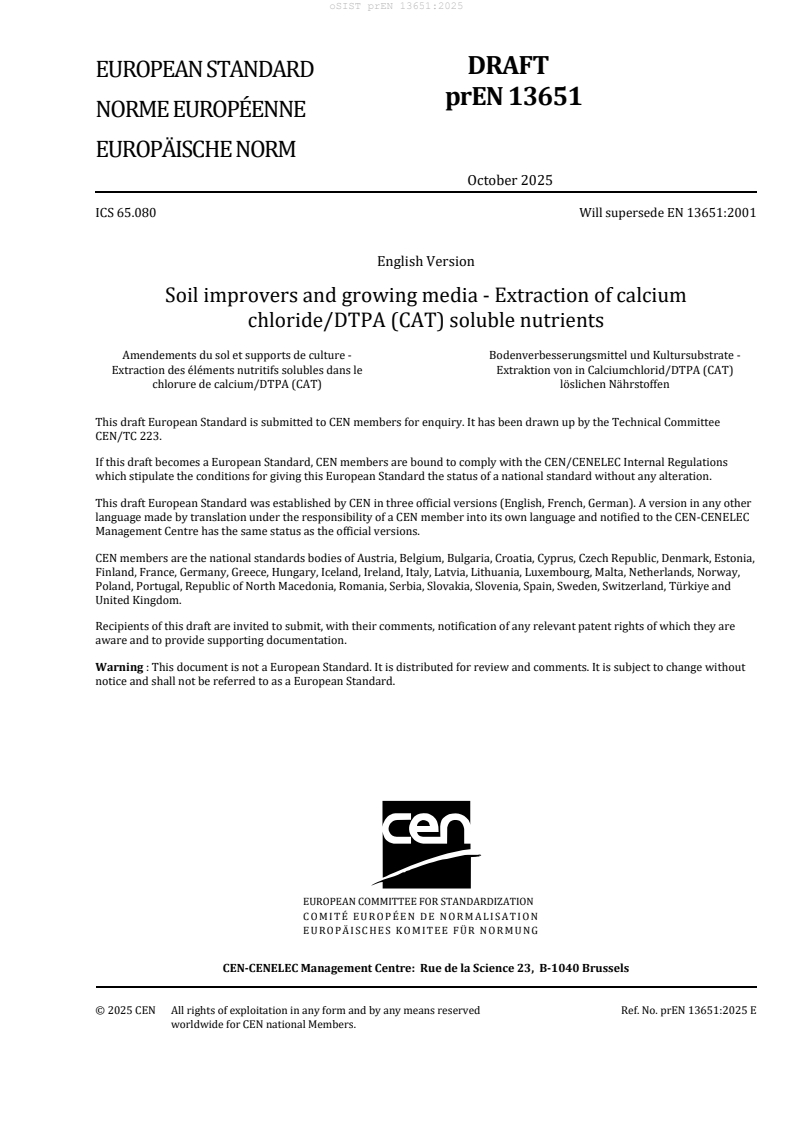
DRAFT
EUROPEAN STANDARD
NORME EUROPÉENNE
EUROPÄISCHE NORM
October 2025
ICS 65.080 Will supersede EN 13651:2001
English Version
Soil improvers and growing media - Extraction of calcium
chloride/DTPA (CAT) soluble nutrients
Amendements du sol et supports de culture - Bodenverbesserungsmittel und Kultursubstrate -
Extraction des éléments nutritifs solubles dans le Extraktion von in Calciumchlorid/DTPA (CAT)
chlorure de calcium/DTPA (CAT) löslichen Nährstoffen
This draft European Standard is submitted to CEN members for enquiry. It has been drawn up by the Technical Committee
CEN/TC 223.
If this draft becomes a European Standard, CEN members are bound to comply with the CEN/CENELEC Internal Regulations
which stipulate the conditions for giving this European Standard the status of a national standard without any alteration.
This draft European Standard was established by CEN in three official versions (English, French, German). A version in any other
language made by translation under the responsibility of a CEN member into its own language and notified to the CEN-CENELEC
Management Centre has the same status as the official versions.
CEN members are the national standards bodies of Austria, Belgium, Bulgaria, Croatia, Cyprus, Czech Republic, Denmark, Estonia,
Finland, France, Germany, Greece, Hungary, Iceland, Ireland, Italy, Latvia, Lithuania, Luxembourg, Malta, Netherlands, Norway,
Poland, Portugal, Republic of North Macedonia, Romania, Serbia, Slovakia, Slovenia, Spain, Sweden, Switzerland, Türkiye and
United Kingdom.
Recipients of this draft are invited to submit, with their comments, notification of any relevant patent rights of which they are
aware and to provide supporting documentation.
Warning : This document is not a European Standard. It is distributed for review and comments. It is subject to change without
notice and shall not be referred to as a European Standard.
EUROPEAN COMMITTEE FOR STANDARDIZATION
COMITÉ EUROPÉEN DE NORMALISATION
EUROPÄISCHES KOMITEE FÜR NORMUNG
CEN-CENELEC Management Centre: Rue de la Science 23, B-1040 Brussels
© 2025 CEN All rights of exploitation in any form and by any means reserved Ref. No. prEN 13651:2025 E
worldwide for CEN national Members.
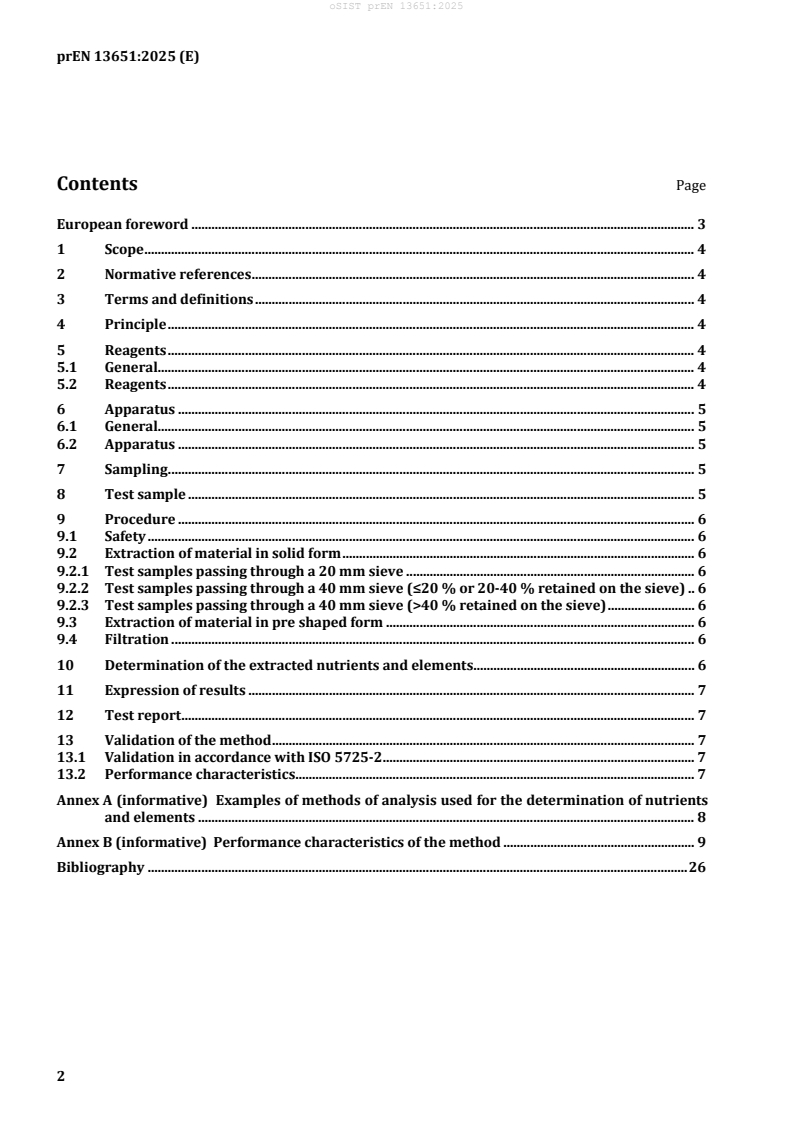
Contents Page
European foreword . 3
1 Scope . 4
2 Normative references . 4
3 Terms and definitions . 4
4 Principle . 4
5 Reagents . 4
5.1 General. 4
5.2 Reagents . 4
6 Apparatus . 5
6.1 General. 5
6.2 Apparatus . 5
7 Sampling . 5
8 Test sample . 5
9 Procedure . 6
9.1 Safety . 6
9.2 Extraction of material in solid form . 6
9.2.1 Test samples passing through a 20 mm sieve . 6
9.2.2 Test samples passing through a 40 mm sieve (≤20 % or 20-40 % retained on the sieve) . 6
9.2.3 Test samples passing through a 40 mm sieve (>40 % retained on the sieve) . 6
9.3 Extraction of material in pre shaped form . 6
9.4 Filtration . 6
10 Determination of the extracted nutrients and elements . 6
11 Expression of results . 7
12 Test report . 7
13 Validation of the method . 7
13.1 Validation in accordance with ISO 5725-2. 7
13.2 Performance characteristics. 7
Annex A (informative) Examples of methods of analysis used for the determination of nutrients
and elements . 8
Annex B (informative) Performance characteristics of the method . 9
Bibliography . 26
European foreword
This document (prEN 13651:2025) has been prepared by Technical Committee CEN/TC 223 “Soil
improvers and growing media”, the secretariat of which is held by NEN.
This document is currently submitted to the CEN Enquiry.
This document will supersede EN 13651:2001.
— The title has been changed;
— The principle (Clause 4) has been completed;
— The procedure (Clause 8) has been updated with new types of test samples;
— The expression of results (Clause 10) has been completed inserting conversion factors and a
calculation on a dry matter basis;
— Methods of analysis (Annex A) have been updated.
This document has been prepared under a standardization request addressed to CEN by the European
Commission. The Standing Committee of the EFTA States subsequently approves these requests for its
Member States.
1 Scope
This document specifies an extraction method for the routine determination of calcium chloride/DTPA
(CAT-method) extractable nutrients and elements in organic soil improver, inorganic soil improver,
growing medium, compost and digestate.
2 Normative references
The following documents are referred to in the text in such a way that some or all of their content
constitutes requirements of this document. For dated references, only the edition cited applies. For
undated references, the latest edition of the referenced document (including any amendments) applies.
CEN/TS 17732:2022, Soil improvers and growing media - Terminology
EN 12579:2024, Soil improvers and growing media - Sampling
prEN 13040-1:2025, Soil improvers and growing media — Sample preparation — Part 1: Sample
preparation for chemical and physical tests, determination of dry matter content, moisture content and
laboratory bulk density
3 Terms and definitions
For the purposes of this document, the terms and definitions given in CEN/TS 17732:2022 apply.
4 Principle
A sample is extracted with calcium chloride/DTPA at 22 °C ± 3 °C in an extraction volume ratio of 1 to 5.
The extracted nutrients and elements are determined by various methods as appropriate (see Annex A).
If soluble calcium is to be determined, a barium chloride/DTPA solution with the same molar
concentration may be used.
5 Reagents
5.1 General
All reagents used shall be of recognized analytical quality and water with a specific conductivity not
higher than 0,2 mS/m at 25 °C, free from the elements to be determined.
5.2 Reagents
5.2.1 Dihydrated calcium chloride, CaCl ·2H O.
2 2
5.2.2 Diethylenetriaminepentaacetic acid (DTPA), C H N O .
14 23 3 10
5.2.3 Hydrochloric acid, c(HCl) = 1:1 vol/vol.
5.2.4 Concentrated extracting solution CaCl /DTPA, (CAT), dissolve 14,7 g CaCl ·2H O (5.2.1) and
2 2 2
7,88 g DTPA (5.2.2) in 800 ml hot water (temperature approximately 80 °C) with stirring on a magnetic
stirrer in a 1 000 ml beaker. At 75 °C ± 10 °C the reagents will dissolve within 2 h. Allow to cool to ambient
temperature. Transfer the solution to a 1 000 ml flask and dilute to the mark with water. The solution is
stable at room temperature for several weeks. Any precipitation that occurs will disappear with warming
and stirring.
5.2.5 Extracting solution CaCl /DTPA, (CAT), dilute the concentrated extracting solution (5.2.4) with
water in the proportions one part concentrated solution with nine parts water. The final concentration
of the extracting solution should be 0,01 mol/l CaCl and 0,002 mol/l DTPA. The pH of the extracting
solution should be adjusted if necessary to be between 2,6 and 2,65 by using HCl (5.2.3).
5.2.6 Nitric acid, c(HNO ) = 15 mol/l: ⍴ ≈ 1,42 g/ml; not less than 65 % mass/volume.
5.2.7 Nitric acid, c(HNO ) = 0,5 mol/l, dilute 35 ml nitric acid (5.2.6) to one litre with water.
6 Apparatus
6.1 General
NOTE It has been found convenient to carefully clean the equipment (e.g. using nitric acid) and keep separate
sets of glassware for the determination of Boron, in order to reduce the possibility of within-laboratory
contamination.
All glass apparatus and plastic vessels used in the procedure should be subject to an appropriate
preparation procedure in order to keep the risk of contamination as low as possible. It is recommended
that all vessels (glass and plastic) are cleansed by carefully immersing in warm nitric acid (5.2.7) for a
minimum of 6 h and then rinsed in water.
Rubber stoppers, which may contain traces of metals shall not be used. It is recommended to use plastic
or any other stopper free of all substances to be analysed.
Borosilicate glassware shall not be used if boron is to be determined.
6.2 Apparatus
The apparatus consists of the usual laboratory apparatus, and in particular the following:
6.2.1 Plastic bottles or containers, sufficiently large (500 ml to 2 000 ml) with screw cap to
accommodate the volume of the sample, extractant and at least 10 % air volume.
6.2.2 Shaking or mixing machine, capable of holding the plastic bottles or containers (6.2.1) and
maintaining the sample in suspension without damaging the structure of the sample. The use of a
horizontal table shaker is recommended.
6.2.3 Filter paper, cellulose-based ashless types, with a medium pore size of approximately 8 µm and
diameter of 150 mm.
6.2.4 Analytical balance with an accuracy of 10 mg.
7 Sampling
Sampling is not part of the method specified in this document. EN 12579:2024 shall be followed dealing
with soil improvers and growing media. It is important that the laboratory receives a sample that is
representative of the product under consideration. The sample should not have been damaged or
changed during transport or storage.
8 Test sample
Prepare the laboratory sample in accordance with prEN 13040-1:2025, Clause 9, and determine the
laboratory bulk density of the sample in accordance with prEN 13040-1:2025, Annex A.
9 Procedure
9.1 Safety
SAFETY PRECAUTIONS — Care should be taken when handling substances of caustic nature or samples
that may contain sharps or is of a dusty nature.
9.2 Extraction of material in solid form
9.2.1 Test samples passing through a 20 mm sieve
Take a weight equivalent to 60 ml of the sample volume (prEN 13040-1:2025, Clause 9.2.5) to the nearest
1 g and transfer to the container (6.2.1). Add 300 ml of extracting solution (5.2.5), secure the cap and
shake for 1 h on the shaking machine (6.2.2) at 22 °C ± 3 °C. Perform the measurement at least 2 times to
obtain a mean value.
9.2.2 Test samples passing through a 40 mm sieve (≤20 % or 20-40 % retained on the sieve)
Take a weight equivalent to 250 ml of the sample volume (prEN 13040-1:2025, Clause 9.2.3 a) or b)) to
the nearest 1 g and transfer to the container (6.2.1). Add 1 250 ml of extracting solution (5.2.5) secure
the cap and shake for 1 h on the shaking machine (6.2.2) at 22 °C ± 3 °C. Perform the measurement at
least 2 times to obtain a mean value.
9.2.3 Test samples passing through a 40 mm sieve (>40 % retained on the sieve)
Take a weight equivalent to 300 ml of the sample volume (prEN 13040-1:2025, Clause 9.2.13 c)) to the
nearest 1 g and transfer to the container (6.2.1). Add 1 500 ml of extracting solution (5.2.5), secure the
cap and shake for 1 h on the shaking machine (6.2.2) at 22 °C ± 3 °C. Perform the measurement at least 2
times to obtain a mean value.
9.3 Extraction of material in pre shaped form
Take a weight equivalent to 150 ml of the sample volume (prEN 13040-1:2025, Clause 9.5.3) to the
nearest 1 g and transfer to the 1 000 ml container (6.2.1). Add 750 ml of extracting solution (5.2.5),
secure the cap and shake for 1 h on the shaking machine (6.2.2) at 22 °C ± 3 °C.
Before filtration pour out the fluid and the pre-shaped sample in a beaker. Squeeze the pre-shaped sample
in the beaker as much as possible by applying a pressure to the sample with help of a plastic masher or
pestle. Perform the measurement at least 2 times to obtain a mean value.
9.4 Filtration
Filter through filter paper (6.2.3) discarding at least the first 10 ml. In some cases, paper filtration is too
slow or even impossible. In such cases, alternative procedures prior to paper filtration (e.g.
centrifugation) for obtaining a clear supernatant are acceptable and the technique used shall be reported.
The filtered extract is stable for three days in a hermetically closed polyethylene bottle if stored in a
refrigerator at 3 °C ± 2 °C. The filtrate may be stored for longer periods in a deep freezer at about –18 °C.
Before using a solution that has been frozen, the thawed solution should be thoroughly mixed to eliminate
gradient separation that occurs on freezing and subsequent thawing.
The measurement of a blank may be used to check possible contaminations of the extracting solution,
glassware and filter paper used.
10 Determination of the extracted nutrients and elements
Appropriate methods for the determination of the extracted nutrients and elements shall be used.
Examples are provided in Annex A.
11 Expression of results
Subtract the values determined for the reagent blank from those obtained for the samples; results shall
be multiplied by 5 (the extraction volume ratio) and expressed in mg/l substrate as received basis.
If results shall be expressed on a dry matter basis (e.g. Nickel), the dry matter content of sample (dm)
shall be determined according to prEN 13040-1:2025 (Clause 11) and used in Formula (1):
mg mg 1
=×× 1000 (1)
kg l dm%
LD×
where
L is the laboratory-determined bulk density of fresh sample (in g/l)
D
dm% is the dry matter percentage of sample
Phosphorus pentoxide (P O ) shall be calculated by multiplying phosphorus (P) with the factor 2,29.
2 5
Potassium oxide (K O) shall be calculated by multiplying potassium (K) with the factor 1,20. The total
extractable nitrogen shall be calculated as the sum of ammonium nitrogen and nitrate nitrogen.
12 Test report
The test report shall contain the following information:
a) a reference to this document (including its year of publication);
b) all information necessary for complete identification of the sample;
c) the results of the determination, expressed as mg/l sample;
NOTE For macronutrients, results can be expressed in whole numbers for microelements with three significant
digits.
d) details of any operations not specified in this document or regarded as optional, as well as any factor
which may have affected the results;
e) the laboratory bulk density;
13 Validation of the method
13.1 Validation in accordance with ISO 5725-2
This standardized reference method was validated in accordance with ISO 5725-2 [1]. All relevant data
were reported in an interlaboratory study report, which has been published [15].
13.2 Performance characteristics
The performance characteristics (reproducibility and repeatability) of the method were determined in
an interlaboratory study. All data are given in Annex B. The method has been validated for nine different
matrices, as listed in Table B.1 to B.17.
Annex A
(informative)
Examples of methods of analysis used for the determination of nutrients
and elements
In Table A.1, examples for methods for the determination of nutrients and elements are provided.
Table A.1 — Examples for methods for the determination of nutrients and elements
Element Method
(Numbered References in Bibliography)
Ammonium-N 3, 4, 5
Nitrate-N 6, 7
Phosphorus 7, 8, 9, 14
Potassium 8, 9, 10
Magnesium 8, 9
Sulfate-S 7, 8
Sodium 8, 9, 10
Boron 8, 9, 11, 12
Copper 8, 9,12,13
Iron 8, 9, 12
Manganese 8, 9, 12, 13
Molybdenum 8, 9, 12
Zinc 8, 9, 12, 13
Cadmium 8, 9, 13
Nickel 8, 9, 13
Lead 8, 9, 13
Calcium 8, 9
Annex B
(informative)
Performance characteristics of the method
The interlaboratory study of extraction of calcium chloride/DTPA (CAT) soluble nutrients and elements
in growing media and soil improvers was carried out with 8 European laboratories in 7 countries on 9
different materials. The different materials, listed in Table B.1, were chosen to represent soil improvers
and growing media materials as broadly as possible. Detailed information can be found in the final report
on the validation study [15].
Table B.1 — Material tested in the interlaboratory study of the method for the extraction of
calcium chloride/DTPA (CAT) soluble nutrients and elements in growing media and soil
improvers
Code Material
M020 Coir pith (0–12 mm, washed and buffered)
M030 Composted bark (20–40 mm)
M040 Biowaste compost (Rottegrad 3)
M050 Green compost (Rottegrad 5, 0–15 mm)
M060 Solid digestate (centrifuged and dried, raw sieved 0–12 mm)
M080 Expanded clay (whole granules, 8 - 16 mm)
M110 Blend 1 (white peat, green compost, wood fibre, lime, inorganic fertilizer (NPK +
micro elements))
M120 Blend 2 (white peat, black peat, expanded perlite, lime, organic fertilizer)
M130 Blend 3 (white peat, black peat, clay, inorganic fertilizer (NPK + micro elements))
The study was organized in 2024 and 2025 by the Flanders Research Institute for Agriculture, Fisheries
and Food (ILVO) as part of Standardization Request M/564 (including amendments) aimed at providing
European standardization deliverables in support of the European Fertilising Product Regulation (FPR;
EU 2019/1009 [14]).
The values of the performance characteristics for each type of soil improver and growing media, compost
and digestate, derived from this interlaboratory study are shown in Tables B.2 to B.17, and were
calculated in accordance with ISO 5725-2 [2].
-------------------
...