

EN 12390-18:2021/FprA1
(Amendment)Testing hardened concrete - Part 18: Determination of the chloride migration coefficient
General Information
- Abstract
This document specifies the procedure for obtaining the non-steady-state chloride migration coefficient of specimens of hardened concrete at a specified age (see Annex A). The test procedure does not take into account any interaction of concrete with the saline solution over time. The test result is a durability indicator with respect to the resistance of the concrete investigated against chloride penetration.
The test procedure does not apply to concrete specimens with surface treatments such as silanes.
If the aggregate or any other embedded elements (such as metallic fibres or conducting particles) are electrically conductive, this will influence the magnitude of chloride migration. This fact is taken into account when establishing threshold values. It prevents comparison of chloride migration values between concretes if the aggregates induce a difference of half an order of magnitude (higher or lower) of chloride migration.
- Status
- Not Published
- Publication Date
- 18-Sep-2024
- Technical Committee
- CEN/TC 104 - Concrete ( performance, production, placing and compliance criteria )
- Drafting Committee
- CEN/TC 104/SC 1 - Revision of ENV 206
- Current Stage
- 5060 - Closure of Vote - Formal Approval
- Start Date
- 25-Jul-2024
- Due Date
- 26-Aug-2024
- Completion Date
- 25-Jul-2024

Overview
EN 12390-18:2021/FprA1 is a European standard developed by CEN for the testing of hardened concrete, specifically focusing on the determination of the chloride migration coefficient. This document outlines a consistent procedure to measure how effectively concrete resists chloride ion penetration, which is a critical factor in assessing the durability and longevity of concrete structures. The standard is particularly relevant for concrete used in environments where exposure to deicing salts, seawater, or other sources of chlorides is likely, as chloride ingress can lead to reinforcement corrosion and structural deterioration.
Key Topics
- Chloride Migration Coefficient: Defines the non-steady-state coefficient as a key indicator of concrete’s resistance to chloride penetration.
- Testing Procedure: Details the preparation and testing of concrete specimens at a specified age, ensuring reliable and comparable results.
- Scope Limitations: Excludes specimens with surface treatments (e.g., silanes) or with electrically conductive aggregates or embedded components, as these can distort test outcomes.
- Standardized Equipment and Calculation: Specifies required apparatus and calculation methods for the chloride migration coefficient, including temperature, voltage, specimen dimensions, and timing.
- Modifications in Amendment: Clarifies symbols, figures, and calculation updates to improve accuracy and applicability.
Applications
The methods described in EN 12390-18:2021/FprA1 are widely applicable across the construction industry, research institutions, and quality control environments, with practical uses including:
- Durability Assessment: Quantifying concrete’s resistance to chloride ingress for critical structures such as bridges, parking decks, marine infrastructure, and tunnels.
- Material Comparison and Selection: Providing a standardized measurement for comparing the chloride resistance performance of different concrete mixes or reinforcement strategies.
- Quality Control: Ensuring concrete supplied to construction meets required durability specifications.
- Research and Development: Supporting innovation in concrete materials, mix designs, and admixtures by providing a reliable indicator of chloride transport properties.
- Regulatory Compliance: Assisting in meeting performance-based standards and requirements related to chloride ingress and long-term durability.
Industries and Stakeholders
- Civil and structural engineers
- Concrete manufacturers and suppliers
- Construction companies
- Testing laboratories
- Asset owners and facility managers
- Regulatory and certification bodies
Related Standards
To provide comprehensive testing and performance evaluation for concrete structures, EN 12390-18:2021/FprA1 aligns with and complements the following related standards:
- EN 12390 Series: Covers various testing methods for hardened concrete, including compressive strength, density, and specimen preparation.
- EN 206: Specifies requirements for concrete production and compliance.
- EN 14629: Relates to the determination of chloride content of hardened concrete.
- ISO 1920 Series: Addresses broader concrete testing methods at the international level.
Practical Value
Implementing EN 12390-18:2021/FprA1 ensures a robust, industry-accepted method for measuring one of the most significant durability parameters of reinforced concrete. By following this standard, organizations can:
- Improve long-term structural integrity and sustainability
- Reduce maintenance costs related to chloride-induced corrosion
- Demonstrate compliance with European and international best practices
- Make informed decisions for materials specification and service life prediction
Adherence to this standard is a key element in advancing high-performance, durable construction and infrastructure projects throughout Europe and beyond.
Relations
- Effective Date
- 31-Jul-2024
- Effective Date
- 10-Aug-2022
Get Certified
Connect with accredited certification bodies for this standard

DIBt (Deutsches Institut für Bautechnik)
German Institute for Building Technology.
DIN CERTCO
DIN Group product certification.

Aboma Certification B.V.
Specialized in construction, metal, and transport sectors.
Sponsored listings
Frequently Asked Questions
EN 12390-18:2021/FprA1 is a draft published by the European Committee for Standardization (CEN). Its full title is "Testing hardened concrete - Part 18: Determination of the chloride migration coefficient". This standard covers: This document specifies the procedure for obtaining the non-steady-state chloride migration coefficient of specimens of hardened concrete at a specified age (see Annex A). The test procedure does not take into account any interaction of concrete with the saline solution over time. The test result is a durability indicator with respect to the resistance of the concrete investigated against chloride penetration. The test procedure does not apply to concrete specimens with surface treatments such as silanes. If the aggregate or any other embedded elements (such as metallic fibres or conducting particles) are electrically conductive, this will influence the magnitude of chloride migration. This fact is taken into account when establishing threshold values. It prevents comparison of chloride migration values between concretes if the aggregates induce a difference of half an order of magnitude (higher or lower) of chloride migration.
This document specifies the procedure for obtaining the non-steady-state chloride migration coefficient of specimens of hardened concrete at a specified age (see Annex A). The test procedure does not take into account any interaction of concrete with the saline solution over time. The test result is a durability indicator with respect to the resistance of the concrete investigated against chloride penetration. The test procedure does not apply to concrete specimens with surface treatments such as silanes. If the aggregate or any other embedded elements (such as metallic fibres or conducting particles) are electrically conductive, this will influence the magnitude of chloride migration. This fact is taken into account when establishing threshold values. It prevents comparison of chloride migration values between concretes if the aggregates induce a difference of half an order of magnitude (higher or lower) of chloride migration.
EN 12390-18:2021/FprA1 is classified under the following ICS (International Classification for Standards) categories: 91.100.30 - Concrete and concrete products. The ICS classification helps identify the subject area and facilitates finding related standards.
EN 12390-18:2021/FprA1 has the following relationships with other standards: It is inter standard links to EN 12390-18:2021+A1:2024, EN 12390-18:2021. Understanding these relationships helps ensure you are using the most current and applicable version of the standard.
EN 12390-18:2021/FprA1 is available in PDF format for immediate download after purchase. The document can be added to your cart and obtained through the secure checkout process. Digital delivery ensures instant access to the complete standard document.
Standards Content (Sample)
SLOVENSKI STANDARD
SIST EN 12390-18:2021/oprA1:2023
01-julij-2023
Preskušanje strjenega betona - 18. del: Določanje koeficienta migracije klorida -
Dopolnilo A1
Testing hardened concrete - Part 18: Determination of the chloride migration coefficient
Prüfung von Festbeton - Teil 18: Bestimmung des Chloridmigrationskoeffizienten
Essais pour béton durci - Partie 18 : Détermination du coefficient de migration des
chlorures
Ta slovenski standard je istoveten z: EN 12390-18:2021/prA1
ICS:
91.100.30 Beton in betonski izdelki Concrete and concrete
products
SIST EN 12390-18:2021/oprA1:2023 en,fr,de
2003-01.Slovenski inštitut za standardizacijo. Razmnoževanje celote ali delov tega standarda ni dovoljeno.
SIST EN 12390-18:2021/oprA1:2023
SIST EN 12390-18:2021/oprA1:2023
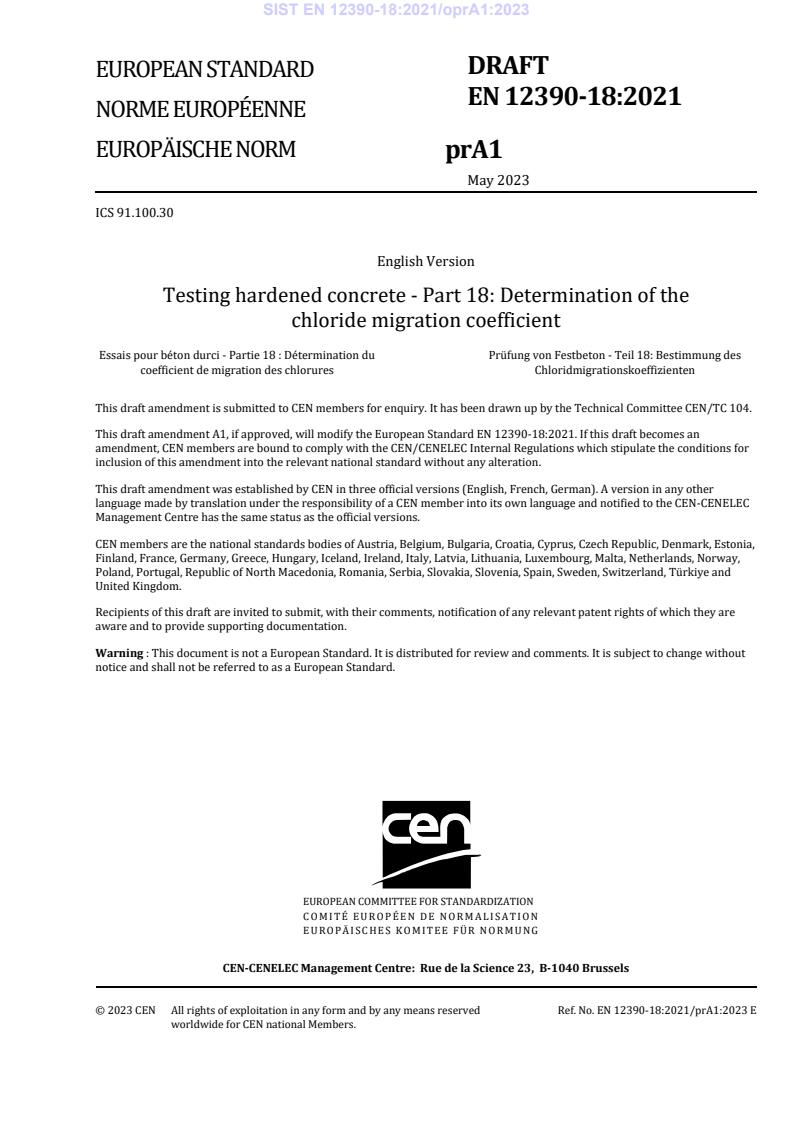
DRAFT
EUROPEAN STANDARD
EN 12390-18:2021
NORME EUROPÉENNE
EUROPÄISCHE NORM
prA1
May 2023
ICS 91.100.30
English Version
Testing hardened concrete - Part 18: Determination of the
chloride migration coefficient
Essais pour béton durci - Partie 18 : Détermination du Prüfung von Festbeton - Teil 18: Bestimmung des
coefficient de migration des chlorures Chloridmigrationskoeffizienten
This draft amendment is submitted to CEN members for enquiry. It has been drawn up by the Technical Committee CEN/TC 104.
This draft amendment A1, if approved, will modify the European Standard EN 12390-18:2021. If this draft becomes an
amendment, CEN members are bound to comply with the CEN/CENELEC Internal Regulations which stipulate the conditions for
inclusion of this amendment into the relevant national standard without any alteration.
This draft amendment was established by CEN in three official versions (English, French, German). A version in any other
language made by translation under the responsibility of a CEN member into its own language and notified to the CEN-CENELEC
Management Centre has the same status as the official versions.
CEN members are the national standards bodies of Austria, Belgium, Bulgaria, Croatia, Cyprus, Czech Republic, Denmark, Estonia,
Finland, France, Germany, Greece, Hungary, Iceland, Ireland, Italy, Latvia, Lithuania, Luxembourg, Malta, Netherlands, Norway,
Poland, Portugal, Republic of North Macedonia, Romania, Serbia, Slovakia, Slovenia, Spain, Sweden, Switzerland, Türkiye and
United Kingdom.
Recipients of this draft are invited to submit, with their comments, notification of any relevant patent rights of which they are
aware and to provide supporting documentation.
Warning : This document is not a European Standard. It is distributed for review and comments. It is subject to change without
notice and shall not be referred to as a European Standard.
EUROPEAN COMMITTEE FOR STANDARDIZATION
COMITÉ EUROPÉEN DE NORMALISATION
EUROPÄISCHES KOMITEE FÜR NORMUNG
CEN-CENELEC Management Centre: Rue de la Science 23, B-1040 Brussels
© 2023 CEN All rights of exploitation in any form and
...