

EN 2591-314:1997
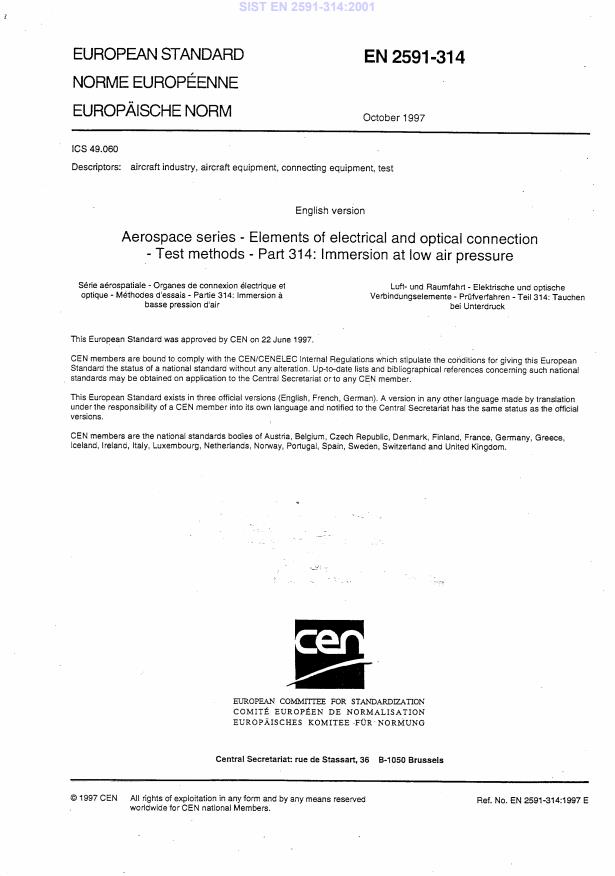
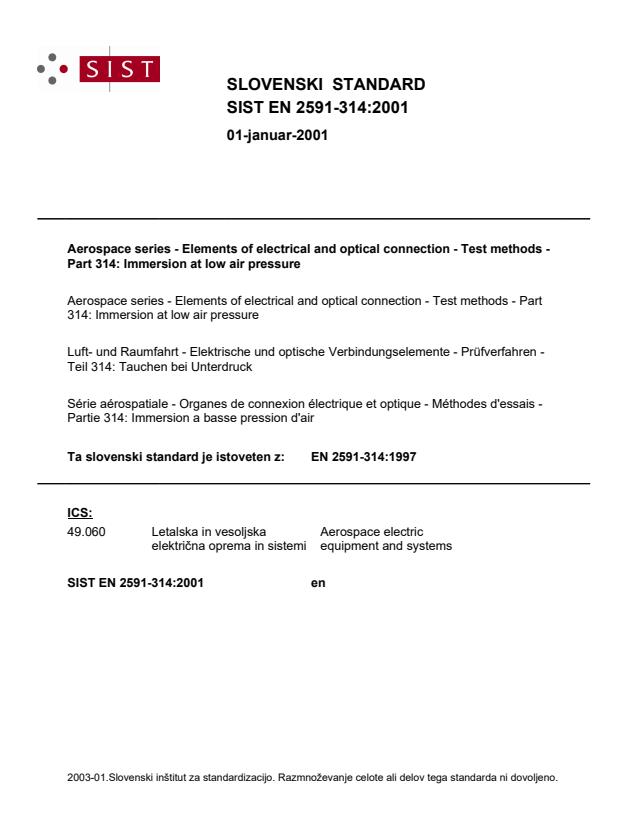
(Main)Aerospace series - Elements of electrical and optical connection - Test methods - Part 314: Immersion at low air pressure
- Abstract
This standard specifies a method of assessing the sealing ability of elements of connection immersed in salt water and exposed to low air pressure. It shall be used together with EN 2591.
- Status
- Published
- Publication Date
- 21-Oct-1997
- Withdrawal Date
- 29-Apr-1998
- Technical Committee
- ASD-STAN - Aerospace
- Drafting Committee
- ASD-STAN/D 2 - Electrical
- Current Stage
- 9093 - Decision to confirm - Review Enquiry
- Start Date
- 30-Jun-2017
- Completion Date
- 30-Sep-2026

Overview
EN 2591-314:1997 is a European standard published by CEN, focusing on aerospace series elements related to electrical and optical connections. This part of the standard defines a specific test method for assessing the sealing ability of connection elements when immersed in salt water under conditions of low air pressure. The test method ensures the reliability and durability of aerospace connectors exposed to harsh environmental conditions. This standard is intended for use alongside the general guidelines provided in EN 2591, enhancing the safety and performance of electrical and optical connection components in aerospace applications.
Key Topics
Test Method for Sealing Ability
The core of EN 2591-314:1997 is a test procedure verifying how effectively connection elements resist leakage or corrosion when submerged in salt water and subjected to low air pressure environments.Aerospace Electrical and Optical Connectors
It covers both electrical and optical connection elements used in aerospace systems, ensuring high reliability in vital operational components.Environmental Simulation
The method simulates realistic aerospace conditions, such as immersion in salt water (to mimic marine or humid environments) and exposure to low air pressure (as encountered at high altitudes or during flight).Complementary Usage with EN 2591
This part is designed to be used together with EN 2591, providing additional testing rigor and aiding in comprehensive certification of aerospace connectors.
Applications
Aerospace Industry
Ensuring the sealing integrity of connectors used in aircraft and spacecraft, critical for maintaining electrical and optical system functionality under extreme environmental conditions.Connector Manufacturing and Quality Control
Manufacturers use this standard to validate the performance of their connection elements, ensuring products meet aerospace quality requirements.Maintenance and Safety Compliance
Aerospace operators can apply this test method during maintenance or inspection to confirm ongoing connector reliability and prevent failure induced by environmental exposure.Design and Development
Engineers can adopt the guidelines during the development of new connectors or systems to certify that components will withstand immersion and low-pressure conditions during actual service.
Related Standards
EN 2591 Series
Provides overall specifications and test methods for aerospace electrical and optical connection elements, offering a comprehensive framework for designing and evaluating connectors.IEC 60512 Series
International standards addressing electrical connector testing methods, which complement EN 2591-314 by covering broader connector performance requirements.MIL-DTL-38999
A U.S. military specification widely used in aerospace applications, focusing on circular connectors and their environmental resistances, useful as a comparative reference.ISO 14685
Related to general test methods for electrical connectors, supporting international harmonization with aerospace-specific standards.
By implementing EN 2591-314:1997 test methods, aerospace manufacturers and operators ensure optimal sealing performance, durability, and safety of electrical and optical connectors exposed to challenging low-pressure and saltwater environments. This reinforces the reliability of critical systems essential to aerospace missions and enhances compliance with international aerospace quality benchmarks.
Relations
- Effective Date
- 28-Jan-2026
- Effective Date
- 28-Jan-2026
- Effective Date
- 28-Jan-2026
- Effective Date
- 28-Jan-2026
- Effective Date
- 28-Jan-2026
- Effective Date
- 24-Jun-2026
- Effective Date
- 10-Jun-2026
- Effective Date
- 28-Jan-2026
- Effective Date
- 28-Jan-2026
- Effective Date
- 28-Jan-2026
- Effective Date
- 28-Jan-2026
- Effective Date
- 28-Jan-2026
- Effective Date
- 28-Jan-2026
- Effective Date
- 28-Jan-2026
- Effective Date
- 28-Jan-2026
Get Certified
Connect with accredited certification bodies for this standard

BUREAU VERITAS Certification Germany
Bureau Veritas certification in Germany.

Element Materials Technology
Materials testing and product certification.

AQMS Ltd.
AQMS provides ISO certification to SMEs across the UK.
Sponsored listings
Frequently Asked Questions
EN 2591-314:1997 is a standard published by the European Committee for Standardization (CEN). Its full title is "Aerospace series - Elements of electrical and optical connection - Test methods - Part 314: Immersion at low air pressure". This standard covers: This standard specifies a method of assessing the sealing ability of elements of connection immersed in salt water and exposed to low air pressure. It shall be used together with EN 2591.
This standard specifies a method of assessing the sealing ability of elements of connection immersed in salt water and exposed to low air pressure. It shall be used together with EN 2591.
EN 2591-314:1997 is classified under the following ICS (International Classification for Standards) categories: 49.060 - Aerospace electric equipment and systems. The ICS classification helps identify the subject area and facilitates finding related standards.
EN 2591-314:1997 has the following relationships with other standards: It is inter standard links to EN 2591:1992, EN 2591-207:1996, EN 2591-101:1994, EN 2591-311:1997, EN 2591-206:1996, EN 3155-075:2026, EN 3155-074:2026, EN 3660-012:2008, EN 3660-015:2008, EN 3155-013:2006, EN 3660-019:2009, EN 4701-001:2013, EN 3660-026:2009, EN 4531-101:2012, EN 3660-062:2016. Understanding these relationships helps ensure you are using the most current and applicable version of the standard.
EN 2591-314:1997 is available in PDF format for immediate download after purchase. The document can be added to your cart and obtained through the secure checkout process. Digital delivery ensures instant access to the complete standard document.
Standards Content (Sample)
2003-01.Slovenski inštitut za standardizacijo. Razmnoževanje celote ali delov tega standarda ni dovoljeno.Aerospace series - Elements of electrical and optical connection - Test methods - Part 314: Immersion at low air pressureLuft- und Raumfahrt - Elektrische und optische Verbindungselemente - Prüfverfahren - Teil 314: Tauchen bei UnterdruckSérie aérospatiale - Organes de connexion électrique et optique - Méthodes d'essais - Partie 314: Immersion a basse p
...