

EN 15316-4-1:2008
(Main)Heating systems in buildings - Method for calculation of system energy requirements and system efficiencies - Part 4-1: Space heating generation systems, combustion systems (boilers)
General Information
- Abstract
This European Standard is part of a series of standards on the method for calculation of system energy requirements and system efficiencies of space heating systems and domestic hot water systems.
The scope of this specific part is to standardise the:
required inputs;
calculation method;
resulting outputs;
for space heating generation by combustion sub-systems (boilers), including control.
This European Standard is the general standard on generation by combustion sub-systems (boilers). If a combustion generation sub-system is within the scope of another specific part of the EN 15316 series (i.e. part 4.x), the latter shall be used.
EXAMPLE Biomass combustion generation sub-systems are within the scope of prEN 15316-4-7.
This European Standard is also intended for the case of generation for both domestic hot water production and space heating. The case of generation only for domestic hot water production is treated in EN 15316-3-3.
- Status
- Withdrawn
- Publication Date
- 27-May-2008
- Withdrawal Date
- 29-Sep-2026
- Technical Committee
- CEN/TC 228 - Heating systems in buildings
- Current Stage
- 9960 - Withdrawal effective - Withdrawal
- Start Date
- 17-May-2017
- Completion Date
- 30-Sep-2026

Relations
- Effective Date
- 24-May-2017
- Effective Date
- 28-Jan-2026
- Effective Date
- 28-Jan-2026
- Effective Date
- 28-Jan-2026
- Effective Date
- 28-Jan-2026
- Refers
EN 15035:2006 - Heating boilers - Special requirements for oil fired room sealed units up to 70 kW - Effective Date
- 28-Jan-2026
- Effective Date
- 28-Jan-2026
- Effective Date
- 28-Jan-2026
- Effective Date
- 28-Jan-2026
- Effective Date
- 28-Jan-2026
- Effective Date
- 28-Jan-2026
- Effective Date
- 28-Jan-2026
- Effective Date
- 28-Jan-2026
- Effective Date
- 28-Jan-2026
- Effective Date
- 28-Jan-2026
Get Certified
Connect with accredited certification bodies for this standard

DIBt (Deutsches Institut für Bautechnik)
German Institute for Building Technology.
DIN CERTCO
DIN Group product certification.

Aboma Certification B.V.
Specialized in construction, metal, and transport sectors.
Sponsored listings
Frequently Asked Questions
EN 15316-4-1:2008 is a standard published by the European Committee for Standardization (CEN). Its full title is "Heating systems in buildings - Method for calculation of system energy requirements and system efficiencies - Part 4-1: Space heating generation systems, combustion systems (boilers)". This standard covers: This European Standard is part of a series of standards on the method for calculation of system energy requirements and system efficiencies of space heating systems and domestic hot water systems. The scope of this specific part is to standardise the: required inputs; calculation method; resulting outputs; for space heating generation by combustion sub-systems (boilers), including control. This European Standard is the general standard on generation by combustion sub-systems (boilers). If a combustion generation sub-system is within the scope of another specific part of the EN 15316 series (i.e. part 4.x), the latter shall be used. EXAMPLE Biomass combustion generation sub-systems are within the scope of prEN 15316-4-7. This European Standard is also intended for the case of generation for both domestic hot water production and space heating. The case of generation only for domestic hot water production is treated in EN 15316-3-3.
This European Standard is part of a series of standards on the method for calculation of system energy requirements and system efficiencies of space heating systems and domestic hot water systems. The scope of this specific part is to standardise the: required inputs; calculation method; resulting outputs; for space heating generation by combustion sub-systems (boilers), including control. This European Standard is the general standard on generation by combustion sub-systems (boilers). If a combustion generation sub-system is within the scope of another specific part of the EN 15316 series (i.e. part 4.x), the latter shall be used. EXAMPLE Biomass combustion generation sub-systems are within the scope of prEN 15316-4-7. This European Standard is also intended for the case of generation for both domestic hot water production and space heating. The case of generation only for domestic hot water production is treated in EN 15316-3-3.
EN 15316-4-1:2008 is classified under the following ICS (International Classification for Standards) categories: 91.140.10 - Central heating systems. The ICS classification helps identify the subject area and facilitates finding related standards.
EN 15316-4-1:2008 has the following relationships with other standards: It is inter standard links to EN 15316-4-1:2017, EN 304:2017, EN ISO 52000-1:2017, EN ISO 52016-1:2017, EN 15316-3:2017, EN 15035:2006, EN 15456:2008, EN ISO 7345:1995, EN 15316-2-3:2007, EN 303-5:2021+A1:2022, EN 15316-2:2017, EN 15502-2-2:2024, EN 15034:2006, EN 656:1999, EN 14161:2011. Understanding these relationships helps ensure you are using the most current and applicable version of the standard.
EN 15316-4-1:2008 is associated with the following European legislation: Standardization Mandates: M/343. When a standard is cited in the Official Journal of the European Union, products manufactured in conformity with it benefit from a presumption of conformity with the essential requirements of the corresponding EU directive or regulation.
EN 15316-4-1:2008 is available in PDF format for immediate download after purchase. The document can be added to your cart and obtained through the secure checkout process. Digital delivery ensures instant access to the complete standard document.
Standards Content (Sample)
2003-01.Slovenski inštitut za standardizacijo. Razmnoževanje celote ali delov tega standarda ni dovoljeno.Heizanlagen in Gebäuden - Berechnung und Bewertung der Energieeffizienz von Systemen - Teil 4-1: Wärmeerzeugung für die Raumheizung, VerbrennungssystemeSystemes de chauffage dans les bâtiments - Méthode de calcul des besoins énergétiques et d'efficacité des systemes - Partie 2-2-1 : Systemes de génération de chauffage des locaux, ChaudieresHeating systems in buildings - Method for calculation of system energy requirements and system efficiencies - Part 4-1: Space heating generation systems, boilers91.140.10Sistemi centralnega ogrevanjaCentral heating systemsICS:Ta slovenski standard je istoveten z:EN 15316-4-1:2008SIST EN 15316-4-1:2008en,de01-november-2008SIST EN 15316-4-1:2008SLOVENSKI
STANDARD
EUROPEAN STANDARDNORME EUROPÉENNEEUROPÄISCHE NORMEN 15316-4-1May 2008ICS 91.140.10 English VersionHeating systems in buildings - Method for calculation of systemenergy requirements and system efficiencies - Part 4-1: Spaceheating generation systems, combustion systems (boilers)Systèmes de chauffage dans les bâtiments - Méthode decalcul des besoins énergétiques et des rendements dessystèmes - Partie 4-1 : Systèmes de génération dechauffage des locaux, systèmes de combustion(chaudières)Heizanlagen in Gebäuden - Berechnung und Bewertungder Energieeffizienz von Systemen - Teil 4-1:Wärmeerzeugung für die Raumheizung,VerbrennungssystemeThis European Standard was approved by CEN on 11 April 2008.CEN members are bound to comply with the CEN/CENELEC Internal Regulations which stipulate the conditions for giving this EuropeanStandard the status of a national standard without any alteration. Up-to-date lists and bibliographical references concerning such nationalstandards may be obtained on application to the CEN Management Centre or to any CEN member.This European Standard exists in three official versions (English, French, German). A version in any other language made by translationunder the responsibility of a CEN member into its own language and notified to the CEN Management Centre has the same status as theofficial versions.CEN members are the national standards bodies of Austria, Belgium, Bulgaria, Cyprus, Czech Republic, Denmark, Estonia, Finland,France, Germany, Greece, Hungary, Iceland, Ireland, Italy, Latvia, Lithuania, Luxembourg, Malta, Netherlands, Norway, Poland, Portugal,Romania, Slovakia, Slovenia, Spain, Sweden, Switzerland and United Kingdom.EUROPEAN COMMITTEE FOR STANDARDIZATIONCOMITÉ EUROPÉEN DE NORMALISATIONEUROPÄISCHES KOMITEE FÜR NORMUNGManagement Centre: rue de Stassart, 36
B-1050 Brussels© 2008 CENAll rights of exploitation in any form and by any means reservedworldwide for CEN national Members.Ref. No. EN 15316-4-1:2008: ESIST EN 15316-4-1:2008
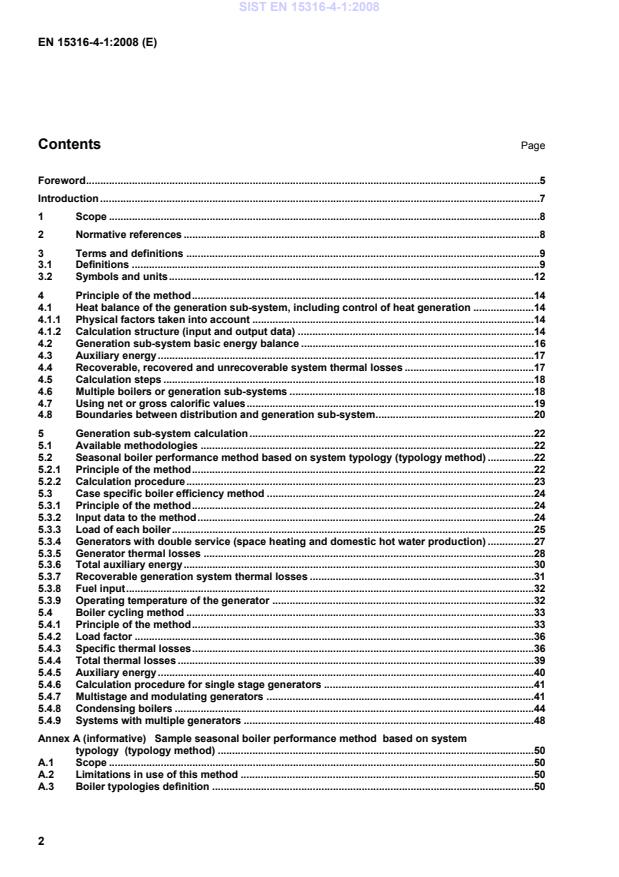
Sample seasonal boiler performance method
based on system typology
(typology method).50 A.1 Scope.50 A.2 Limitations in use of this method.50 A.3 Boiler typologies definition.50 SIST EN 15316-4-1:2008
Additional formulas and default values for parametering the case specific boiler efficiency method.56 B.1 Information on the method.56 B.1.1 Basic assumptions and intended use.56 B.1.2 Known approximations.56 B.2 Polynomial interpolation formulas.56 B.3 Generator efficiencies and stand-by losses.57 B.3.1 Default values for generator efficiency at full load and intermediate load as a function of the generator power output.57 B.3.2 Stand-by heat losses.59 B.3.3 Correction factor taking into account variation of efficiency depending on generator average water temperature.60 B.4 Auxiliary energy.61 B.5 Recoverable generation thermal losses.62 B.5.1 Auxiliary energy.62 B.5.2 Generator envelope.62 B.5.3 Default data according to boiler location.63 Annex C (informative)
Default values for parametering the boiler cycling method.64 C.1 Information on the method.64 C.1.1 Basic assumptions and intended use.64 C.1.2 Known approximations.64 C.2 Default specific losses.64 C.2.1 Default data for calculation of thermal losses through the chimney with burner on.64 C.2.2 Default values for calculation of thermal losses through the generator envelope.65 C.2.3 Default values for calculation of thermal losses through the chimney with the burner off.66 C.3 Default values for calculation of auxiliary energy.67 C.4 Additional default data for multistage and modulating burners.68 C.5 Additional default data for condensing boilers.69 Annex D (informative)
General part default values and information.71 D.1 Control factor.71 D.2 Intermediate load.71 Annex E (informative)
Calculation example for seasonal boiler performance method based on system typology.72 E.1 Introduction.72 E.2 Input data.72 E.3 Calculation procedure.73 E.4 Output data (connection to other parts of EN 15316).74 Annex F (informative)
Calculation examples for case specific boiler efficiency method.75 F.1 Condensing boiler example, data declared by the manufacturer.75 F.1.1 Input data.75 F.1.2 Calculation procedure.76 F.1.3 Output data (connection to other parts of EN 15316).77 F.1.4 Conversion of net values to gross values.77 F.2 Standard boiler example, default data.78 F.2.1 Input data.78 F.2.2 Calculation procedure.79 F.2.3 Output data (connection to other parts of EN 15316).81 Annex G (informative)
Calculation examples for boiler cycling method.82 G.1 Modulating condensing boiler.82 G.1.1 Input data.82 G.1.2 Calculation procedure.84 G.1.3 Output data (connection to other parts of EN 15316).88 G.2 Standard, on-off atmospheric boiler.88 G.2.1 Input data.88 SIST EN 15316-4-1:2008
Boiler water temperature calculation.92 H.1 Boiler flow temperature and return temperature.92 H.2 Boiler flow rate is the same as the distribution flow rate (no by-pass).93 H.3 Boiler flow rate is not the same as the distribution flow rate (by-pass connection or recirculation pump).94 H.4 Parallel connection of boilers.96 H.5 Boiler average water temperature.97 H.6 Example of water temperature calculation.98 Bibliography.99
Where possible, reference is made to other European or International Standards, a.o. product standards. However, use of products complying with relevant product standards is no guarantee of compliance with the system requirements. The requirements are mainly expressed as functional requirements, i.e. requirements dealing with the function of the system and not specifying shape, material, dimensions or the like.
The guidelines describe ways to meet the requirements, but other ways to fulfil the functional requirements might be used if fulfilment can be proved. Heating systems differ among the member countries due to climate, traditions and national regulations. In some cases requirements are given as classes so national or individual needs may be accommodated. In cases where the standards contradict with national regulations, the latter should be followed. SIST EN 15316-4-1:2008
Part 4-5: Space heating generation systems, the performance and quality of district heating and large volume systems Part 4-6: Heat generation systems, photovoltaic systems
Part 4-7: Space heating generation systems, biomass combustion systems According to the CEN/CENELEC Internal Regulations, the national standards organizations of the following countries are bound to implement this European Standard: Austria, Belgium, Bulgaria, Cyprus, Czech Republic, Denmark, Estonia, Finland, France, Germany, Greece, Hungary, Iceland, Ireland, Italy, Latvia, Lithuania, Luxembourg, Malta, Netherlands, Norway, Poland, Portugal, Romania, Slovakia, Slovenia, Spain, Sweden, Switzerland and the United Kingdom.
optimisation of the energy performance of a planned heat generation system, by applying the method to several possible options; assessing the effect of possible energy conservation measures on an existing heat generation system, by calculating the energy use with and without the energy conservation measure. The user shall refer to other European Standards or to national documents for input data and detailed calculation procedures not provided by this European Standard. SIST EN 15316-4-1:2008
1 Scope This European Standard is part of a series of standards on the method for calculation of system energy requirements and system efficiencies of space heating systems and domestic hot water systems. The scope of this specific part is to standardise the: required inputs; calculation method; resulting outputs; for space heating generation by combustion sub-systems (boilers), including control. This European Standard is the general standard on generation by combustion sub-systems (boilers). If a combustion generation sub-system is within the scope of another specific part of the EN 15316 series (i.e. part 4.x), the latter shall be used. EXAMPLE Biomass combustion generation sub-systems are within the scope of prEN 15316-4-7. This European Standard is also intended for the case of generation for both domestic hot water production and space heating. The case of generation only for domestic hot water production is treated in EN 15316-3-3. 2 Normative references The following referenced documents are indispensable for the application of this document. For dated references, only the edition cited applies. For undated references, the latest edition of the referenced document (including any amendments) applies. EN 297, Gas-fired central heating boilers - Type B11 and B11Bs boilers fitted with atmospheric burners of nominal heat input not exceeding 70 kW EN 303-5, Heating boilers – Part 5: Heating boilers for solid fuels, hand and automatically stocked, nominal heat output of up to 300 kW - Terminology, requirements, testing and marking EN 304, Heating boilers — Test code for heating boilers for atomizing oil burners EN 656, Gas-fired central heating boilers — Type B boilers of nominal heat input exceeding 70 kW but not exceeding 300 kW EN 15034:2006, Heating boilers - Condensing heating boilers for fuel oil EN 15035, Heating boilers - Special requirements for oil fired room sealed units up to 70 kW EN 15316-2-1, Heating systems in buildings - Method for calculation of system energy requirements and system efficiencies – Part 2.1: Space heating emission systems EN 15316-2-3:2007, Heating systems in building - Method for calculation of system energy requirements and system efficiencies – Part 2.3: Space heating distribution systems SIST EN 15316-4-1:2008
3.1.3 heated space room or enclosure which for the purposes of the calculation is assumed to be heated to a given set-point temperature or set-point temperatures 3.1.4 system thermal loss thermal loss from a technical building system for heating, cooling, domestic hot water, humidification, dehumidification, ventilation or lighting or other appliances that does not contribute to the useful output of the system NOTE Thermal energy recovered directly in the sub-system is not considered as a system thermal loss but as heat recovery and is directly treated in the related system standard. 3.1.5 auxiliary energy electrical energy used by technical building systems for heating, cooling, ventilation and/or domestic hot water to support energy transformation to satisfy energy needs NOTE 1 This includes energy for fans, pumps, electronics, etc. NOTE 2
In EN ISO 9488 [4], the energy used for pumps and valves is called "parasitic energy". 3.1.6 heat recovery
heat generated by a technical building system or linked to a building use (e.g. domestic hot water) which is utilised directly in the related system to lower the heat input and which would otherwise be wasted (e.g. preheating of the combustion air by flue gas heat exchanger) SIST EN 15316-4-1:2008
3.1.19 condensing boiler boiler designed to make use of the latent heat released by condensation of water vapour in the combustion flue products. The boiler must allow the condensate to leave the heat exchanger in liquid form by way of a condensate drain NOTE Boilers not so designed, or without the means to remove the condensate in liquid form, are called ‘non-condensing’. 3.1.20 oil condensing boiler boiler designed to make use of the latent heat released by condensation of water vapour in the combustion flue products of a liquid fuel [EN 15034:2006] 3.1.21 modes of operation various modes in which the heating system can operate EXAMPLES Set-point mode, cut-off mode, reduced mode, set-back mode, boost mode. 3.1.22 on/off boiler boiler without the capability to vary the fuel burning rate whilst maintaining continuous burner firing. This includes boilers with alternative burning rates set once only at the time of installation, referred to as range rating 3.1.23 multistage boiler boiler with the capability to vary the fuel burning rate stepwise whilst maintaining continuous burner firing 3.1.24 modulating boiler boiler with the capability to vary continuously (from a set minimum to a set maximum) the fuel burning rate whilst maintaining continuous burner firing SIST EN 15316-4-1:2008
3.2 Symbols and units For the purposes of this document, the following symbols and units (Table 1) and indices (Table 2) apply. Table 1 – Symbols and units Symbol Name of quantity Unit b temperature reduction factor - c coefficient various c specific heat capacity J/kg·K or Wh/kg·K a) d thickness mm E energy in general (except quantity of heat, mechanical work and auxiliary (electrical) energy) J or Wh a) e expenditure factor - f factor - H calorific value J/mass unit or
Wh/mass unit b) H heat transfer coefficient W/K k factor - m mass kg n exponent - N number of items Integer P power in general including electrical power W Q quantity of heat J or Wh a) t time, period of time s or h a) V volume L V' volume flow m³/s or m³/h a) W auxiliary (electrical) energy, mechanical work J or Wh a) x relative humidity % X volume fraction % . loss factor %
load factor - û prefix for difference
η efficiency factor % SIST EN 15316-4-1:2008
density kg/m³ - heat flow rate, thermal power W a) If seconds (s) is used as the unit of time, the unit for energy shall be J. If hours (h) is used as the unit of time, the unit for energy shall be Wh. b) Mass unit for fuel may be Stm³, Nm³ or kg.
Table 2 – Indices add additional gnr generator
plt pilot air air grs gross pmp after the combustion chamber aux auxiliary H heating Pn at nominal load
avg average i, j, k indices Px at x load br before generator in input to sub-system r return brm boiler room ins insulation rbl recoverable ch chimney lat latent ref reference ci calculation step ls losses rvd recovered cmb combustion
m mean s gross (calorific value) cond condensing max maximum sat saturation corr corrected / correction mass massic sby in stand-by operation ctr control min minimum
st stoichiometric dis distribution n nominal
sto storage dry dry gases net
net test test conditions em emission O2 oxygen th thermal emr emitter
off off W heating system water f flow (temperature) on on w water fg flue gas out output from sub-system wfg water to flue gas ge generator envelope P0 at zero load z indices gen generation sub-system
Pint at intermediate load
The calculation method of this standard shall be based on the following input data from other parts of the EN 15316-X-X series of standards: heat demand of the distribution sub-system(s) for space heating ΣQH,dis,in, calculated according to EN15316-2-3; heat demand of the distribution sub-system(s) for domestic hot water ΣQW,dis,in, calculated according to EN 15316-3-2, where appropriate.
Key SUB Generation sub-system balance boundary HF Heating fluid balance boundary (see equation (1)) QH,gen,out Generation sub-system heat output (input to distribution sub-system(s)) EH,gen,in Generation sub-system fuel input (energyware) WH,gen,aux Generation sub-system total auxiliary energy QH,gen,aux,rvd Generation sub-system recovered auxiliary energy QH,gen,ls Generation sub-system total thermal losses QH,gen,ls,rbl Generation sub-system thermal loss recoverable for space heating QH,gen,ls,th,rbl Generation sub-system thermal loss (thermal part) recoverable for space heating QH,gen,aux,rbl Generation sub-system recoverable auxiliary energy QH,gen,ls,th,nrbl Generation sub-system thermal loss (thermal part) non recoverable QH,gen,aux,nrbl Generation sub-system non recoverable auxiliary energy
NOTE Figures shown are sample percentages. Figure 1 – Generation sub-system inputs, outputs and energy balance 4.2 Generation sub-system basic energy balance The basic energy balance of the generation sub-system is given by
lsgen,H,rvdaux,gen,H,outgen,H,ingen,H,QQQE+−= (1) where EH,gen,in
heat requirement of the generation sub-system (fuel input); QH,gen,out
heat supplied to the distribution sub-systems (space heating and domestic hot water); SIST EN 15316-4-1:2008
∑∑+⋅=jjin,dis,W,iiin,dis,H,ctrloutgen,H,QQfQ (2) where fctrl
factor taking into account emission control losses. Default value of fctrl is given in Table D.1. Other values may be specified in a national annex, provided that emission control losses has not been already taken into account in the emission part (EN 15316-2-1) or in the distribution part (EN 15316-2-3). If there are multiple generation sub-systems or multiple boilers, see 4.6, 5.3.3 and 5.4.9. If the generator provides heat for heating and domestic hot water, the index H shall be replaced by HW. In the following only H is used for simplicity. 4.3 Auxiliary energy Auxiliary energy is the energy, other than fuel, required for operation of the burner, the primary pump and any equipment whose operation is related to operation of the heat generation sub-system. Auxiliary energy is counted in the generation part as long as no transport energy from the auxiliary equipment is transferred to the distribution sub-system (example: zero–pressure distribution array). Such auxiliary equipment can be (but need not be) an integral part of the generator. Auxiliary energy, normally in the form of electrical energy, may be partially recovered as heat for space heating or for the generation sub-system. Examples of recoverable auxiliary energy: electrical energy transmitted as heat to the water of the primary circuit; part of the electrical energy for the burner fan. Example of non-recoverable auxiliary energy: electrical energy for electric panel auxiliary circuits, if the generator is installed outside the heated space. 4.4 Recoverable, recovered and unrecoverable system thermal losses Not all of the calculated system thermal losses are necessarily lost. Some of the losses are recoverable and part of the recoverable system thermal losses are actually recovered. Example of recoverable system thermal losses are: thermal losses through the envelope of a generator installed within the heated space.
either as a reduction of total system thermal losses within the specific part (simplified method); or, by taking into account recoverable system thermal losses as gains (holistic method) or as a reduction of the energy use according to EN 15603. This European Standard allows both approaches. Generation system thermal losses recovered by the generation sub-system are directly taken into account in the generation performance. EXAMPLE Combustion air preheating by flue gas losses.
4.5 Calculation steps The objective of the calculation is to determine the energy input of the heating generation sub-system for the entire calculation period (usually one year). This may be done in one of the following two different ways: by using average (usually yearly) data for the entire calculation period; by dividing the calculation period into a number of calculation steps (e.g. months, weeks, bins, operation modes as defined in EN ISO 13790) and perform the calculations for each step using step-dependent values and adding up the results for all the steps over the calculation period. NOTE
Generation efficiency is strongly dependent on the load factor and this relationship is not linear. To achieve precision, the calculation steps should not be longer than 1 month.
4.6 Multiple boilers or generation sub-systems The primary scope of this European Standard is to calculate losses, fuel requirement and auxiliary energy requirements for an individual boiler. If there are multiple generation sub-systems, the general part allows for a modular approach to take into account cases where: a heating system is split up in zones with several distribution sub-systems; several heat generation sub-systems are available. EXAMPLE 1 A separate circuit may be used for domestic hot water production. EXAMPLE 2 A boiler may be used as a back-up for a solar and/or cogeneration sub-system(s). In these cases, the total heat requirement of the connected distribution sub-systems iQX,dis,in,i shall equal the total heat output of the generation sub-systems iQX,gen,out,j:
∑∑=iiin,dis,X,jjout,gen,X,QQ (3) NOTE X is used as an index in equation (3) to mean space heating, domestic hot water heating or other building services requiring heat from a generation sub-system. SIST EN 15316-4-1:2008
...