

EN 15378:2007
(Main)Heating systems in buildings - Inspection of boilers and heating systems
General Information
- Abstract
This European Standard specifies inspection procedures and optional measurement methods for the assessment of energy performance of existing boilers and heating systems.
Boiler types covered by this European Standard are:
boilers for heating, domestic hot water or both;
gas, liquid or solid fuel fired boilers.
Parts of heating systems covered by this European Standard are:
boilers, including generation control;
other generation devices;
domestic hot water production facilities;
heating distribution network, including associated components and controls;
heat emitters, including components and controls;
space heating control system;
storage and associated components;
domestic hot water control system.
This standard covers issues related to energy conservation and environmental performance.
- Status
- Withdrawn
- Publication Date
- 11-Sep-2007
- Withdrawal Date
- 29-Sep-2026
- Technical Committee
- CEN/TC 228 - Heating systems in buildings
- Current Stage
- 9960 - Withdrawal effective - Withdrawal
- Start Date
- 03-May-2017
- Completion Date
- 30-Sep-2026

Relations
- Effective Date
- 08-Jun-2022
- Effective Date
- 28-Jan-2026
- Effective Date
- 28-Jan-2026
- Effective Date
- 28-Jan-2026
Get Certified
Connect with accredited certification bodies for this standard

DIBt (Deutsches Institut für Bautechnik)
German Institute for Building Technology.
DIN CERTCO
DIN Group product certification.

Aboma Certification B.V.
Specialized in construction, metal, and transport sectors.
Sponsored listings
Frequently Asked Questions
EN 15378:2007 is a standard published by the European Committee for Standardization (CEN). Its full title is "Heating systems in buildings - Inspection of boilers and heating systems". This standard covers: This European Standard specifies inspection procedures and optional measurement methods for the assessment of energy performance of existing boilers and heating systems. Boiler types covered by this European Standard are: boilers for heating, domestic hot water or both; gas, liquid or solid fuel fired boilers. Parts of heating systems covered by this European Standard are: boilers, including generation control; other generation devices; domestic hot water production facilities; heating distribution network, including associated components and controls; heat emitters, including components and controls; space heating control system; storage and associated components; domestic hot water control system. This standard covers issues related to energy conservation and environmental performance.
This European Standard specifies inspection procedures and optional measurement methods for the assessment of energy performance of existing boilers and heating systems. Boiler types covered by this European Standard are: boilers for heating, domestic hot water or both; gas, liquid or solid fuel fired boilers. Parts of heating systems covered by this European Standard are: boilers, including generation control; other generation devices; domestic hot water production facilities; heating distribution network, including associated components and controls; heat emitters, including components and controls; space heating control system; storage and associated components; domestic hot water control system. This standard covers issues related to energy conservation and environmental performance.
EN 15378:2007 is classified under the following ICS (International Classification for Standards) categories: 91.140.10 - Central heating systems. The ICS classification helps identify the subject area and facilitates finding related standards.
EN 15378:2007 has the following relationships with other standards: It is inter standard links to EN 15378-1:2017, EN 14161:2011, EN ISO 3977-5:2003, EN 14161:2011+A1:2015. Understanding these relationships helps ensure you are using the most current and applicable version of the standard.
EN 15378:2007 is associated with the following European legislation: Standardization Mandates: M/343. When a standard is cited in the Official Journal of the European Union, products manufactured in conformity with it benefit from a presumption of conformity with the essential requirements of the corresponding EU directive or regulation.
EN 15378:2007 is available in PDF format for immediate download after purchase. The document can be added to your cart and obtained through the secure checkout process. Digital delivery ensures instant access to the complete standard document.
Standards Content (Sample)
2003-01.Slovenski inštitut za standardizacijo. Razmnoževanje celote ali delov tega standarda ni dovoljeno.Heating systems in buildings - Inspection of boilers and heating systemsGrelni sistemi v stavbah - Nadzor kurilnih naprav in grelnih sistemovSystemes de chauffage dans les bâtiments - Inspection des chaudieres et des installations de chauffageHeizungssysteme in Gebäuden - Inspektion von Kesseln und HeizungssystemenTa slovenski standard je istoveten z:EN 15378:2007SIST EN 15378:2007en,de91.140.10Sistemi centralnega ogrevanjaCentral heating systemsICS:SLOVENSKI
STANDARDSIST EN 15378:200701-december-2007
EUROPEAN STANDARDNORME EUROPÉENNEEUROPÄISCHE NORMEN 15378September 2007ICS 91.140.10 English VersionHeating systems in buildings - Inspection of boilers and heatingsystemsSystèmes de chauffage dans les bâtiments - Inspectiondes chaudières et des systèmes de chauffageHeizungssysteme in Gebäuden - Inspektion von Kesselnund HeizungssystemenThis European Standard was approved by CEN on 28 July 2007.CEN members are bound to comply with the CEN/CENELEC Internal Regulations which stipulate the conditions for giving this EuropeanStandard the status of a national standard without any alteration. Up-to-date lists and bibliographical references concerning such nationalstandards may be obtained on application to the CEN Management Centre or to any CEN member.This European Standard exists in three official versions (English, French, German). A version in any other language made by translationunder the responsibility of a CEN member into its own language and notified to the CEN Management Centre has the same status as theofficial versions.CEN members are the national standards bodies of Austria, Belgium, Bulgaria, Cyprus, Czech Republic, Denmark, Estonia, Finland,France, Germany, Greece, Hungary, Iceland, Ireland, Italy, Latvia, Lithuania, Luxembourg, Malta, Netherlands, Norway, Poland, Portugal,Romania, Slovakia, Slovenia, Spain, Sweden, Switzerland and United Kingdom.EUROPEAN COMMITTEE FOR STANDARDIZATIONCOMITÉ EUROPÉEN DE NORMALISATIONEUROPÄISCHES KOMITEE FÜR NORMUNGManagement Centre: rue de Stassart, 36
B-1050 Brussels© 2007 CENAll rights of exploitation in any form and by any means reservedworldwide for CEN national Members.Ref. No. EN 15378:2007: E
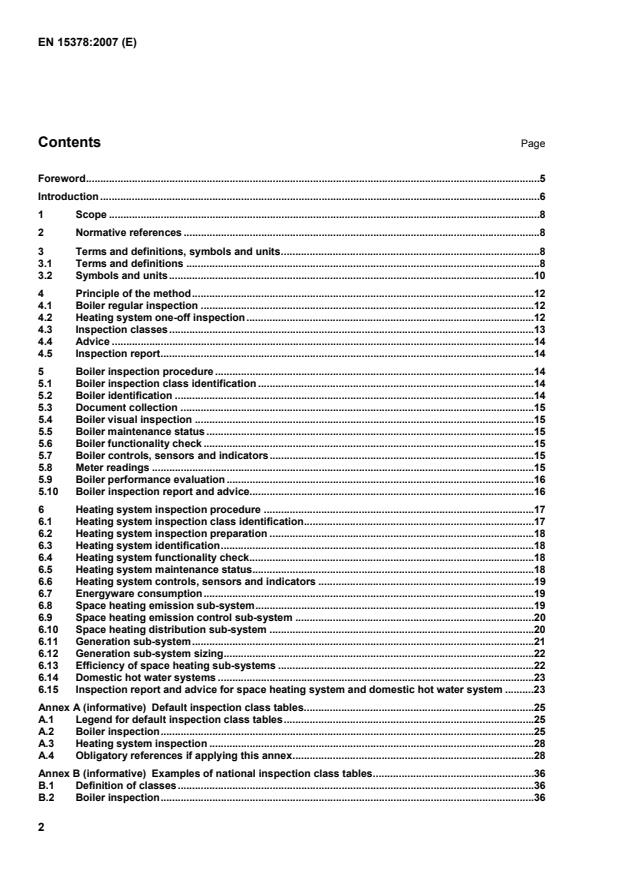
Default inspection class tables.25 A.1 Legend for default inspection class tables.25 A.2 Boiler inspection.25 A.3 Heating system inspection.28 A.4 Obligatory references if applying this annex.28 Annex B (informative)
Examples of national inspection class tables.36 B.1 Definition of classes.36 B.2 Boiler inspection.36
Flue gas analysis and boiler basic settings check.38 C.1 Measuring procedure.38 C.2 Maintenance data.42 C.3 Reference values for flue gas analysis.42 C.4 Advice on boiler basic setting.42 C.5 Obligatory references if applying this annex.43 Annex D (informative)
Sample boiler inspection report.44 Annex E (informative)
List of possible improvement actions.46 E.1 Introduction.46 E.2 Boiler.46 E.3 Heating system generation.46 E.4 Space heating distribution system.47 E.5 Space heating emission system.47 E.6 Heating system control.47 E.7 Domestic hot water.48 E.8 Other.48 Annex F (informative)
Evaluation of energyware consumption for
space heating system and domestic hot water system.50 F.1 General.50 F.2 Energyware measurement methodologies.50 F.3 Measurement period.52 F.4 Usage separation.53 F.5 Climatic data and domestic hot water production.54 F.6 Reference values.54 F.7 Advice criteria on energyware consumption.55 F.8 Obligatory references if applying this annex.56 Annex G (informative)
Stratification in high ceiling rooms.57 Annex H (informative)
Space heating emission control sub-system.58 H.1 Identification of the heat emission control level.58 H.2 Indoor temperature check.58 H.3 Advice.59 Annex I (informative)
Space heating distribution sub-system.60 I.1 Flow rate.60 I.2 Type and setting of circulation pumps.60 I.3 Distribution circuit typology.60 I.4 Compatibility of distribution circuits with boiler typology.60 I.5 Insulation.60 Annex J (informative)
Domestic hot water system.61 J.1 Recirculation losses.61 Annex K (informative)
Sample inspection report for heating system.62 Annex L (informative)
Boiler settings verification.68 Annex M (informative)
Boiler combustion power.69 M.1 Measurement methodologies.69 M.2 Maintenance data.71 M.3 Advice criteria on combustion power.71 M.4 Obligatory references if applying this annex.72 Annex N (informative)
Boiler seasonal efficiency.73 N.1 Measurement and estimation methodologies.73 N.2 Reference values.74 N.3 Advice.75 N.4 Boiler cmb (average load) determination.75 N.5 Estimation of loss factors.76 N.6 Obligatory references if applying this annex.79 Annex O (informative)
Boiler or generation sub-system sizing.80
Examples of national data.83 Bibliography.86
1 Scope This European Standard specifies inspection procedures and optional measurement methods for the assessment of energy performance of existing boilers and heating systems. Boiler types covered by this European Standard are: boilers for heating, domestic hot water or both; gas, liquid or solid fuel fired boilers. Parts of heating systems covered by this European Standard are: boilers, including generation control; other generation devices; domestic hot water production facilities; heating distribution network, including associated components and controls; heat emitters, including components and controls; space heating control system; storage and associated components; domestic hot water control system. This standard covers issues related to energy conservation and environmental performance. 2 Normative references Not applicable. 3 Terms and definitions, symbols and units 3.1 Terms and definitions For the purposes of this document, the following terms and definitions apply. 3.1.1 space heating process of heat supply for thermal comfort 3.1.2 domestic hot water heating process of heat supply to raise the temperature of the cold water to the intended delivery temperature 3.1.3 gross calorific value quantity of heat released by a unit quantity of fuel when it is burned completely with oxygen at a constant pressure equal to 101 320 Pa, and when the products of combustion are returned to ambient temperature
For active solar and wind energy systems, the incident solar radiation on solar panels or the kinetic energy of wind is not part of the energy balance of the building. Only the energy delivered by the generation devices and the auxiliary energy needed to supply the energy from the source (e.g. solar panel) to the building are taken into account in the energy balance and hence in the delivered energy. NOTE 2 Delivered energy can be calculated for defined energy uses or it can be measured. NOTE 3 It is decided on a national level whether or not renewable energy produced on site constitutes part of delivered energy. 3.1.15 operational rating energy rating based on measured amounts of delivered and exported energy NOTE The measured rating is the weighted sum of all energy carriers used by the building, as measured by meters or other means. It is a measure of the in-use performance of the building. This is particularly relevant to certification of actual energy performance. 3.2 Symbols and units For the purposes of this document, the following symbols and units (Table 1) and indices (Table 2) apply.
Wh/mass unit a b k factor - m mass kg P power in general, including electrical power W Q quantity of heat J or Wh a t time, period of time s or h a V volume m³ V' volume flow m³/s or m³/h a W auxiliary (electrical) energy, mechanical work J or Wh a x relative humidity % X volume fraction % . loss factor %
load factor - û prefix for difference - η efficiency factor % θ Celsius temperature °C
absolute humidity kg/Nm³
density kg/m³ - heat flow rate, thermal power W a If the unit seconds (s) is used for time, the unit for energy shall be J; if the unit hours (h) is used for time, the unit for energy shall be Wh. b Mass unit for fuel may be Stm³, Nm³ or kg.
near the floor O2
oxygen auxh auxiliary heater fr flow to return off
off avg average gas gas on
on ceil near the ceiling ge generator envelope P0
stand-by ch chimney gen
generation pmp
circulation pump cmb
combustion
gnr
generator r
return
CO carbon monoxide H2O
water vapour rd
reading CO2 carbon dioxide i
net (calorific value) ref
reference cond condensation
i
running index s
gross (calorific value) corr corrected ini
initial sat
saturation del delivered int
internal sens
sensible des design j
running index st
stoichiometric dry dry gases lf
liquid fuel str
stratification e external ls
loss test
in test conditions el electrical m
average vol
volumetric f fuel meas measured w
water fg flue gas mid
at 1,5 m height x
net or gross fin final min
minimum
temperature
4 Principle of the method 4.1 Boiler regular inspection Regular boiler inspection procedures and methods are intended to: verify if the boiler is set, operated and maintained correctly with regard to energy efficiency; estimate actual boiler energy performance; when required, support advice on possible boiler energy performance improvements. NOTE Council Directive 2002/91/CE does not require advice following boiler regular inspection. 4.2 Heating system one-off inspection One-off heating system inspection procedures and methods are intended to: verify if the heating systems is set, equipped, operated and maintained correctly with regard to energy efficiency; estimate actual heating system energy performance; support advice on possible heating system energy performance improvements. Inspection procedures and optional measurement methods (if any) are specified separately for each sub-system of the heating system.
Following inspection of the boiler or heating system, results shall be recorded in an inspection report for transfer to the responsible for operation and maintenance of the boiler or heating system. The report shall include: identification of the boiler or heating system; identification of the required inspection class; description of any activity (e.g. adjusting, setting) which was performed during the inspection; data recorded and/or measured as required by the inspection class; source of recorded data; reference and benchmark values, as required by the inspection class; advice, when required. Benchmark and/or reference values shall be indicated near corresponding actual values. Inspection report, results and documentation shall be archived and kept available as a reference for follow-up. 5 Boiler inspection procedure 5.1 Boiler inspection class identification The inspection class of the boiler is determined according to the relevant national annex, or, if no national annex is available, default Annex A. 5.2 Boiler identification The information on user, building (i.e. address, location) and boiler identification is recorded as specified in the appropriate table of the national annex, or, if no national annex is available, in default Table A.2. State in the report the source of information recorded.
Table A.3. Examples of methodologies related to flue gas analysis and boiler basic settings inspection are given in informative Annex C. 5.10 Boiler inspection report and advice 5.10.1 Inspection report Following inspection of the boiler, an inspection report with optional related advice shall be provided. An example of a boiler inspection report is given in informative Annex D. 5.10.2 Boiler performance advice Any advice on boiler performance shall be drafted according to the following general requirements and any specific advice criteria related to inspection items required by the inspection class.
Table A.4. Information and documentation shall at least allow identification of: functional diagram of the heating system; location of main components of the heating system; intended and actual use of the building; intended and actual operation of the heating system (e.g. heated volume, time schedules); type of control sub-system and settings; any attached systems and related requirements. If a satisfactory documentation is not available, a minimum set of information on the heating system shall be assembled by direct inspection. Correspondence between documentation and actual installed equipment shall be checked. Any differences shall be stated in the report and the documentation shall be corrected. 6.4 Heating system functionality check Check whether the heating system is capable of providing the desired and designed services (i.e. space heating, domestic hot water production and attached systems requirements). State in the report any malfunctioning. Record in the report any relevant feed-back from users and operation and maintenance personnel, as available and appropriate. 6.5 Heating system maintenance status Determine whether the heating system is regularly maintained by qualified and/or authorised personnel. Reference shall be made to: system designer’s instructions; appliances and component manufacturers’ instructions; any legal or statutory requirements. NOTE Consideration may be given to heat medium quality.
...