

EN 14531-6:2009
(Main)Railway applications - Methods for calculation of stopping and slowing distances and immobilisation braking - Part 6: Step by step calculations for train sets or single vehicles
General Information
- Abstract
This European Standard describes a general algorithm that may be used in all types of high speed
and conventional vehicle applications, including self-propelling thermal or electric trains, thermal or
electric traction units; passenger carriages, mobile railway infrastructure construction and
maintenance equipment and freight wagons. This standard does not specify the performance
requirements. It enables the calculation of the various aspects of the performance: stopping or
slowing distances, dissipated energy, force calculations and immobilization braking.
This standard enables the verification by calculation of the stopping, slowing and immobilization
performance requirements for high speed and conventional trains operating on high speed and
conventional infrastructure.
This standard presents:
a) example of distance and other dynamic calculations, see Annex C;
b) example of immobilisation calculations, see Annex D.
- Status
- Withdrawn
- Publication Date
- 19-May-2009
- Withdrawal Date
- 29-Sep-2026
- Technical Committee
- CEN/TC 256 - Railway applications
- Current Stage
- 9960 - Withdrawal effective - Withdrawal
- Start Date
- 23-Dec-2015
- Completion Date
- 30-Sep-2026

Relations
- Effective Date
- 23-Jul-2011
- Effective Date
- 25-Aug-2026
- Effective Date
- 25-Aug-2026
- Effective Date
- 28-Jan-2026
- Effective Date
- 28-Jan-2026
Get Certified
Connect with accredited certification bodies for this standard

IRIS Certification (UNIFE)
International Railway Industry Standard certification.

TÜV SÜD Rail GmbH
TÜV SÜD railway certification services.

Bureau Veritas Railway Certification
Railway and transportation certification.
Sponsored listings
Frequently Asked Questions
EN 14531-6:2009 is a standard published by the European Committee for Standardization (CEN). Its full title is "Railway applications - Methods for calculation of stopping and slowing distances and immobilisation braking - Part 6: Step by step calculations for train sets or single vehicles". This standard covers: This European Standard describes a general algorithm that may be used in all types of high speed and conventional vehicle applications, including self-propelling thermal or electric trains, thermal or electric traction units; passenger carriages, mobile railway infrastructure construction and maintenance equipment and freight wagons. This standard does not specify the performance requirements. It enables the calculation of the various aspects of the performance: stopping or slowing distances, dissipated energy, force calculations and immobilization braking. This standard enables the verification by calculation of the stopping, slowing and immobilization performance requirements for high speed and conventional trains operating on high speed and conventional infrastructure. This standard presents: a) example of distance and other dynamic calculations, see Annex C; b) example of immobilisation calculations, see Annex D.
This European Standard describes a general algorithm that may be used in all types of high speed and conventional vehicle applications, including self-propelling thermal or electric trains, thermal or electric traction units; passenger carriages, mobile railway infrastructure construction and maintenance equipment and freight wagons. This standard does not specify the performance requirements. It enables the calculation of the various aspects of the performance: stopping or slowing distances, dissipated energy, force calculations and immobilization braking. This standard enables the verification by calculation of the stopping, slowing and immobilization performance requirements for high speed and conventional trains operating on high speed and conventional infrastructure. This standard presents: a) example of distance and other dynamic calculations, see Annex C; b) example of immobilisation calculations, see Annex D.
EN 14531-6:2009 is classified under the following ICS (International Classification for Standards) categories: 45.060.01 - Railway rolling stock in general. The ICS classification helps identify the subject area and facilitates finding related standards.
EN 14531-6:2009 has the following relationships with other standards: It is inter standard links to EN 14531-2:2015, ISO 80000-3:2006, ISO 80000-4:2006, EN 14531-1:2005, EN 14478:2005. Understanding these relationships helps ensure you are using the most current and applicable version of the standard.
EN 14531-6:2009 is associated with the following European legislation: EU Directives/Regulations: 2001/16/EC, 2008/57/EC, 96/48/EC; Standardization Mandates: M/275, M/334. When a standard is cited in the Official Journal of the European Union, products manufactured in conformity with it benefit from a presumption of conformity with the essential requirements of the corresponding EU directive or regulation.
EN 14531-6:2009 is available in PDF format for immediate download after purchase. The document can be added to your cart and obtained through the secure checkout process. Digital delivery ensures instant access to the complete standard document.
Standards Content (Sample)
2003-01.Slovenski inštitut za standardizacijo. Razmnoževanje celote ali delov tega standarda ni dovoljeno.Bahnanwendungen - Verfahren zur Berechnung der Anhalte- und Verzögerungsbremswege und der Feststellbremsung - Teil 6: Schrittweise Berechnungen für Zugverbände oder EinzelfahrzeugeApplications ferroviaires - Méthodes de calcul des distances d'arrêt, de ralentissement et d'immobilisation - Partie 6: Calculs pas à pas pour des compositions de trains ou véhicules isolésRailway applications - Methods for calculation of stopping and slowing distances and immobilisation braking - Part 6: Step by step calculations for train sets or single vehicles45.020Železniška tehnika na splošnoRailway engineering in generalICS:Ta slovenski standard je istoveten z:EN 14531-6:2009SIST EN 14531-6:2009en01-september-2009SIST EN 14531-6:2009SLOVENSKI
STANDARD
EUROPEAN STANDARDNORME EUROPÉENNEEUROPÄISCHE NORMEN 14531-6May 2009ICS 45.060.01 English VersionRailway applications - Methods for calculation of stopping andslowing distances and immobilisation braking - Part 6: Step bystep calculations for train sets or single vehiclesApplications ferroviaires - Méthodes de calcul desdistances d'arrêt, de ralentissement et d'immobilisation -Partie 6: Calculs pas à pas pour des compositions de trainsou véhicules isolésBahnanwendungen - Verfahren zur Berechnung derAnhalte- und Verzögerungsbremswege und derFeststellbremsung - Teil 6: Schrittweise Berechnungen fürZugverbände oder EinzelfahrzeugeThis European Standard was approved by CEN on 23 April 2009.CEN members are bound to comply with the CEN/CENELEC Internal Regulations which stipulate the conditions for giving this EuropeanStandard the status of a national standard without any alteration. Up-to-date lists and bibliographical references concerning such nationalstandards may be obtained on application to the CEN Management Centre or to any CEN member.This European Standard exists in three official versions (English, French, German). A version in any other language made by translationunder the responsibility of a CEN member into its own language and notified to the CEN Management Centre has the same status as theofficial versions.CEN members are the national standards bodies of Austria, Belgium, Bulgaria, Cyprus, Czech Republic, Denmark, Estonia, Finland,France, Germany, Greece, Hungary, Iceland, Ireland, Italy, Latvia, Lithuania, Luxembourg, Malta, Netherlands, Norway, Poland, Portugal,Romania, Slovakia, Slovenia, Spain, Sweden, Switzerland and United Kingdom.EUROPEAN COMMITTEE FOR STANDARDIZATIONCOMITÉ EUROPÉEN DE NORMALISATIONEUROPÄISCHES KOMITEE FÜR NORMUNGManagement Centre:
Avenue Marnix 17,
B-1000 Brussels© 2009 CENAll rights of exploitation in any form and by any means reservedworldwide for CEN national Members.Ref. No. EN 14531-6:2009: ESIST EN 14531-6:2009
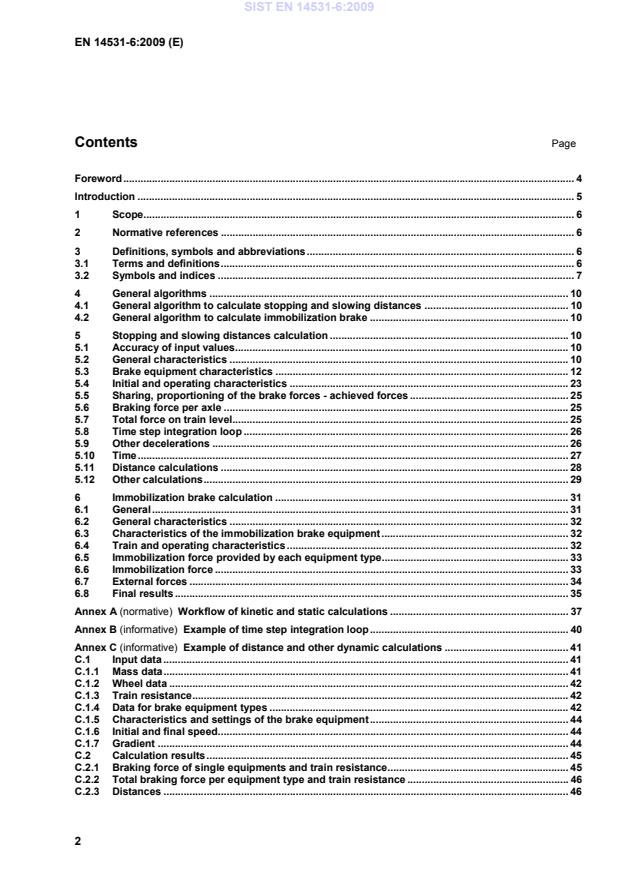
Workflow of kinetic and static calculations . 37Annex B (informative)
Example of time step integration loop . 40Annex C (informative)
Example of distance and other dynamic calculations . 41C.1Input data . 41C.1.1Mass data . 41C.1.2Wheel data . 42C.1.3Train resistance . 42C.1.4Data for brake equipment types . 42C.1.5Characteristics and settings of the brake equipment . 44C.1.6Initial and final speed. 44C.1.7Gradient . 44C.2Calculation results . 45C.2.1Braking force of single equipments and train resistance . 45C.2.2Total braking force per equipment type and train resistance . 46C.2.3Distances . 46SIST EN 14531-6:2009
Example of immobilisation calculations . 50D.1Input data . 50D.1.1Mass data . 50D.1.2Wheel data . 51D.1.3Train resistance . 51D.1.4Wind force on the train . 51D.1.5Data for axle related disc brake equipment . 51D.1.6Gradient . 52D.1.7Available adhesion . 52D.1.8Brake equipment in use. 52D.2Calculation results of the immobilisation calculation . 52D.2.1Immobilisation force . 52D.2.2Immobilisation safety factor . 53D.2.3Required adhesion per axle . 53D.2.4Maximum achievable gradient . 53Annex ZA (informative)
Relationship between this
European
Standard and the Essential Requirements
of EC Directive 2008/27/EC . 54Bibliography . 57 SIST EN 14531-6:2009
Part 1: General algorithms; Part 2: Application to Single Freight Wagon (in preparation); Part 3: Application to mass transit (in preparation); Part 4: Single passenger coaches (in preparation); Part 5: Locomotives (in preparation). This document has been prepared under a mandate given to CEN by the European Commission and the European Free Trade Association, and supports essential requirements of EU Directive 2008/57/EC. For relationship with EU Directive 2008/57/EC, see informative Annex ZA, which is an integral part of this document. According to the CEN/CENELEC Internal Regulations, the national standards organizations of the following countries are bound to implement this European Standard: Austria, Belgium, Bulgaria, Cyprus, Czech Republic, Denmark, Estonia, Finland, France, Germany, Greece, Hungary, Iceland, Ireland, Italy, Latvia, Lithuania, Luxembourg, Malta, Netherlands, Norway, Poland, Portugal, Romania, Slovakia, Slovenia, Spain, Sweden, Switzerland and the United Kingdom.
1 Although it was originally intended to prepare a series of six parts for this Standard, the intention is now to rationalize and restructure the Standard so that it comprises fewer parts. SIST EN 14531-6:2009
Other calculation methods may be used providing that the order of accuracy achieved is in accordance with this European Standard. This standard presents: a) example of distance and other dynamic calculations, see Annex C; b) example of immobilisation calculations, see Annex D. 2 Normative references The following referenced documents are indispensable for the application of this document. For dated references, only the edition cited applies. For undated references, the latest edition of the referenced document (including any amendments) applies. EN 14478:2005, Railway applications — Braking — Generic vocabulary EN 14531-1:2005, Railway applications — Methods for calculation of stopping distances, slowing distances and immobilization braking — Part 1: General algorithms prEN 15328, Railway applications - Braking - Brake pads 2 ISO 80000-3:2006, Quantities and units — Part 3: Space and time ISO 80000-4:2006, Quantities and units — Part 4: Mechanics 3 Definitions, symbols and abbreviations 3.1 Terms and definitions For the purposes of this document, the definitions given in EN 14478:2005, EN 14531-1:2005,
ISO 80000-3:2006, ISO 80000-4:2006, and the following apply. 3.1.1 static mass per axle (1) mass, measured by weighing at the wheel-rail interface, or estimated from design evaluation of each axle in a stationary condition
2 At the time of publication, this Standard was in the process of being prepared. SIST EN 14531-6:2009
-
i C cylinder ratio
- i rig rigging ratio - i tra transmission ratio - m mass kg n quantity - P power W p pressure Pa R wheel radius m r radius m s distance m S safety factor - t time s τ coefficient of adhesion
- v speed m/s W energy J WS energy per square unit J/m2 λ brake percentage
- µ coefficient of friction (brake pad or blocks) - η efficiency - a Rising gradient is positive; e.g. for a gradient of 5 ‰i= 0,005. SIST EN 14531-6:2009
a available B friction BEC braking force for an eddy current brake BED electro-dynamic braking force BFR fluid retarder braking force BMG braking force for a magnetic brake b block or pad bog bogie C cylinder cha characteristic Bd brake force demand disc disc dyn dynamic e or 2 final e equivalent ext
external H hand brake i brake equipment type im immobilization, parking, holding int internal inst instantaneous m average, mean max maximum min minimum mot motor m_unsp unsprung mass MG magnetic brake n normal direction r responsen Ra train resistance to motion req required rig rigging rot rotating R1 return spring R2 regulator S spring st static t tangential direction tot
total tra transmission wind wind 0 or 1 initial SIST EN 14531-6:2009
5.2.2 Vehicle and train characteristics 5.2.2.1 Static mass per axle, Static mass
When there are different “static mass per axle”, see 3.1.1, the location in the train shall be indicated. 5.2.2.2 Equivalent rotating masses Rotating mass (as defined in EN 14478) shall be calculated using a theoretical approach or an approved test method when applicable. It shall be indicated the wheel size and the relevant static mass condition which is related to the mass inertias (e.g. new wheel and tare load condition). When there are different “rotating mass per axle”, the location in the train shall be indicated. 5.2.2.3 Wheel diameters The wheel diameter is measured on the nominated line of contact with the running surface of the rail. The wheel diameter used in the emergency brake calculation shall be that of a wheel which gives the lowest deceleration (e.g. in the case of disc brakes, this would normally be the maximum wheel diameter). For checking the adhesion required, τreq , the wheel diameter used shall be that which gives the maximum adhesion required (e.g. in the case of disc brakes, this would normally be the minimum wheel diameter). If the train is equipped with different sizes of wheels, each size of wheel shall be indicated to the train composition. 5.2.2.4 Train resistance
The value of train resistance may be by analogy to another existing vehicle, or based on a specific calculation. When the values are the results of tests, the test conditions shall be similar to the expected operating conditions.
The train resistance is represented by a formula which consists of: a) one term independent of vehicle speed; b) one term proportional to the speed, dealing with the mechanical components (train and track); c) a third term proportional to a power n of the speed (aerodynamic resistance).
According to this formula the mathematical formulae that shall be applied are the following:
To obtain the instantaneous train resistance as a function of the speed: SIST EN 14531-6:2009
(1) where: FRa
is the instantaneous value of the train resistance
N
v
is the instantaneous speed of the vehicle
m/s
A
is the characteristic coefficient of the vehicle
N
B
is the characteristic coefficient of the vehicle.
N/(m/s)
C
is the characteristic coefficient of the vehicle.
N/(m/s)n
n
is the exponent to be defined exactly. In case there is no exact value available, n is estimated to be 2
For the application of more usual units, the coefficients of the formula shall be adapted. The above units shall be used for the calculations purpose, but the speed can be expressed usually in km/h and the train resistance in N or kN. In this case, A, B, C are expressed in N, N/(km/h), N/(km/h)n or kN, kN/(km/h), kN/(km/h)n.
NOTE 1 A, B, and C coefficients are function of various parameters, e.g. mass, train length. Values for A, B, and C may be obtained using the test method given in EN 14067-2. NOTE 2 For a first calculation, the average train resistance to motion as detailed in EN 14531-1 may be used. EXAMPLE In all these formulae, the train resistance FRa is given in N and the instantaneous speed v in m/s. A = 4 144,9 N; B = 100,8 N/(m/s); C = 7,53 N/(m/s²). For a speed of 300 km/h corresponding to 83,3 m/s, train resistance force is: FRa = 4 144,9 + 100,8 × 83,3 + 7,53 × 83,3²; FRa = 6 4791 N. NOTE Other examples of values are given in Annex C.
5.3 Brake equipment characteristics 5.3.1 General The final result of this part is the braking force generated by each brake equipment related to the top of the rail. This clause considers the braking force generated by each brake equipment type by reference to the most common brake equipment i.e. tread and disc braking. If this equipment is not applicable, other suitable methods of brake force calculation should be adopted. SIST EN 14531-6:2009
The brake equipment of a tread brake unit acts on one shoe arrangement per cylinder as shown in Figures 1 and 2.
Figure 1 — Pressure applied tread brake unit
Figure 2 — Spring applied tread brake unit The braking force characteristic of a tread brake unit can be expressed by: Output cylinder force η=⋅⋅⋅+cccccs,cFpAiF (2) Application force on the shoe
ncrigrig,dyns,rigFFiFη=⋅⋅+
(3) Braking force per unit B,CnFFµ=⋅
(4) where: pC
is the brake cylinder pressure
Pa
AC
is the brake cylinder piston area
m2
ηC
is the cylinder efficiency
-
iC
is the cylinder ratio
NOTE 1
For pressure applied brake equipment:
positive value; for spring applied brake equipment: negative value.
-
FS,C
is the cylinder spring force NOTE 2 For braking force: positive value; for releasing force: negative value.
N
is the rigging efficiency in dynamic condition
-
irig
is the rigging ratio
-
FS,rig
is the rigging spring force NOTE 3 For braking force: positive value; for releasing force: negative value.
N
µ
is the friction coefficient
-
Ab
is the area of the shoe (appear only in the Figures 1 and 2, not in the above formulae)
m2
5.3.2.2 Clasp brake If clasp brakes are utilized, then their relevant and specific brake characteristics shall be applied in accordance with EN 14531-1. 5.3.2.3 Disc brake unit A disc brake unit typically acts on one caliper per cylinder as shown in Figures 3 and 4.
Figure 3 — Pressure applied disc brake unit Figure 4 — Spring applied disc brake unit The braking force characteristic of a disc brake unit can be expressed by: Output cylinder force η=⋅⋅⋅+CCCCCS,CFpAiF (5) Clamp force on the pad ()nCrigrig,dynb,C/FFinη=⋅⋅
(6) Tangential force on the disc tnb,CFFnµ=⋅⋅
(7) SIST EN 14531-6:2009
(8) where: pC
is the brake cylinder pressure
Pa
AC
is the brake cylinder piston area
m2
ηC
is the cylinder efficiency
-
iC
is the cylinder ratio NOTE 1 For pressure applied brake equipment:
positive value; for spring applied brake equipment: negative value.
-
FS,C
is the cylinder spring force NOTE 2 For braking force: positive value; for releasing force: negative value.
N
ηrig,dyn
is the rigging efficiency in dynamic condition
-
irig
is the rigging ratio
-
µ
is the friction coefficient
-
ηtra
is the transmission efficiency
-
itra
is the transmission ratio
-
Ab
is the type and area of the pad per face of disc (appear only in the Figures 3 and 4, not in the above formulae)
m2
rs
is the mean swept radius
m
D
is the diameter of the wheel
m As
is the swept area (2 faces) of the disc (appear only in the Figures 3 and 4 , not in the above formulae)
m2
nb,C
is the quantity of pads per cylinder
-
5.3.2.4 Coefficient of friction The nominal static and dynamic values of the coefficient of friction shall be established using the methods according to prEN 15328.
Because of this large influence, information based upon test results detailing the characteristic of the coefficient of friction of the brake blocks and/or pads shall be provided. As a minimum averaged friction coefficients specific speed ranges which depends on the project shall be provided.
Corresponding test reports (or extracts of these documents) should be attached with the performance calculation. SIST EN 14531-6:2009
On vehicles, the cylinder pressure may be continuously adapted according to the static mass. ()Cstpfm=
(9) where pC
is the pressure at the brake cylinder
Pa
mst
is the static mass
kg 5.3.3 Characteristics of the other brake equipment types 5.3.3.1 Electrodynamic brake Generally, the electrodynamic brake force may be represented by a characteristic curve that is an approximation of first order. This principle is shown in Figure 5.
Figure 5 — Characteristic of the electrodynamic brake force NOTE 1 The indices 1, 2, 3, 4 of the speed v, are given in the sense of the braking process, starting with the initial speed.
NOTE 2 The section of the curve (depending on 1/v 2) is used with regenerative braking when the voltage has to be limited. When this section is not used, the maximum speed vmax equals v1. NOTE 3 The electrodynamic brake force can vary as a function of the static mass. SIST EN 14531-6:2009
(10) a constant section from v3 to v2
BEDBED,maxFF=
(11) a hyperbolic section with constant power from v2 to v1
(12) a section depending on 1/ v2 from v1 to vmax
(13) where: FBED
is the instantaneous electrodynamic braking force
N
FBED,max
is the maximum electrodynamic braking force (= value of the force in the constant section)
N
v
is the instantaneous speed
m/s
v1. v4
are the particular speeds
m/s
vmax
is the maximum operational speed
m/s
This curve can also be determined by numerical or practical methods. The values can be given as a table. 5.3.3.2 Fluid retarder If fluid retarders are utilized, then their relevant and specific brake characteristics shall be applied. 5.3.3.3 Magnetic track brake Usually, the magnetic track brake force is represented by a curve that gives the instantaneous braking force versus the instantaneous speed. This principle is shown in Figure 6. SIST EN 14531-6:2009
Figure 6 — Characteristics of the magnetic track brake force The magnetic track brake force can be expressed by: BMGAMGMGFFf=⋅
(14) where: FBMG
is the instantaneous magnetic braking force
N
FAMG
is the magnetic attraction force (≅ constant)
N
fMG
is the instantaneous coefficient of friction between the magnet and the track
-
A typical characteristic of the instantaneous coefficient of friction may be expressed by the formula MG101fava=⋅+
(15) where: fMG
is the instantaneous coefficient of friction between the magnet and the track
-
v
is the instantaneous speed
m/s
a0
is a constant coefficient
-
is a constant coefficient
(m/s)-1
This curve can also be determined by numerical or practical methods. The values can be given as a table. 5.3.3.4 Eddy current brake
Figure 7 — Characteristics of the eddy current brake force The eddy current braking force depends on: a) the gap between the shoe and the track; b) the instantaneous speed; c) the intensity of the magnetic field. Generally, the instantaneous force FBEC can be given by a general specific formula like: BECBEC,maxchacha2nnFFvvvv=⋅+
(16) with: n = n1 for
v ≥ vcha
n = n2 for
v < vcha
FBEC
is the instantaneous eddy current braking force
N
FBEC,max
is the maximum eddy current braking force
N
v
is the instantaneous speed
m/s
vcha
is the characteristic speed where FBEC = FBEC,max
m/s
n
is a specific exponent
-
This curve can also be determined by numerical or practical methods. The values can be given as a table. 5.3.4 Time characteristics of each brake equipment type 5.3.4.1 Generation of characteristics For step-by-step calculation, the time characteristic of a brake equipment type can be simulated by numerical methods or determined by practical methods or by estimations. The values can be given as a table (e.g. see C.1.4.1.2 and C.1.4.2.3). In the step-by-step calculation, an instantaneous characteristic can be expressed by multiplication of the nominal braking force with a dimensionless factor (see 5.8). As example, the braking response of a brake equipment can be considered with such dimensionless factor as a characteristic depending on time. 5.3.4.2 Creation of input data The values generated according to 5.3.4.1 can be used directly or converted to a practical approximation, e.g. a linear description (see C.1.4.1.2 and C.1.4.2.3). The plausibility calculation can be eased applying simple approximations of the time behaviour. See Annex B.
NOTE 1 Usually, the time characteristic is considered for each brake equipment when the brake force of this equipment becomes greater than zero. NOTE 2 For any change of brake force during one established braking cycle, the time characteristics for the change of force of each brake equipment type is not considered. NOTE 3 In this standard the slowing calculation generally does not consider release characteristics. For special calculations, the use of release characteristics is permitted. 5.3.4.3 Delay time (ta or tc) Period of time commencing when a change (positive or negative) in brake demand is initiated and ending when achieving a% or c% of the established braking force of the brake equipment (see Figures 8 and 9). 5.3.4.4 Build-up time (tab) / Release time (tcd) Period of time commencing at the end of the delay time and ending when achieving b% or d% of the established braking force of the brake equipment (see Figures 8 and 9). SIST EN 14531-6:2009
Key 1 factor of nominal braking force or deceleration in % 2 time in s ta
delay time tab
brake build-up time a is employed for the commencement of braking b is employed when the build-up of braking force has been achieved Figure 8 — Delay and build-up time for brake application dccdttt=+
(18) SIST EN 14531-6:2009
Key 1 factor of nominal braking force or deceleration in % 2 time in s tc delay time tcd brake release time c
is employed for the commencement of release d
is employed when the brake release has been substantially achieved Figure 9 — Delay and release time for brake release
5.3.5 Blending rules Blending rules are required when it is intended to use several types of brakes together: a) adhesion dependent/adhesion independent brakes; b) using friction brakes or not using friction brakes. The target is to maximize the use of those brakes that do not wear (the electrodynamic brakes, etc.) and minimize the use of the friction brake (which is subject to wear) within the boundaries specified for the safety and integrity of the total brake system. The blending rules permit sharing of the brake demand between the different types of brakes in such a way that the total brake demand is achieved. The total brake force on an axle (bogie) is limited by a typical value depending on the adhesion, e.g. see the limits stated in the TSI rules. This value shall be stated in the design specification if it differs from the TSI rules. The actual demand can be expressed by a typical curve or other set of data. There is not a general blending rule. Blending rules in normal mode and degraded modes (see 5.4.6) shall be designed specifically for each project. The general blending formula shall be applied, depending on the project, to one axle, one bogie, one vehicle, some vehicles controlled together or a complete train. EXAMPLE Typical projects with blending rules e.g. between the electrodynamic brake and the friction brake can be formulated as functions of speed, energy, temperatures, etc. SIST EN 14531-6:2009
Key v instantaneous speed v2 … v4 particular speeds vmax maximum operational speed 1 axis of speed (in m/s) 2 axis of braking force (in N) Figure 10 — Example of a blending rule between the electrodynamic brake and the friction brake versus speed
(19) where:
FB
is the instantaneous friction brake force
N
FB,max
is the maximum friction brake force available
N
FBd
is the brake force demand
N
FBED
is the instantaneous electrodynamic braking force
N
5.4 Initial and operating characteristics 5.4.1 Mean gradient of the track In general, design calculations and Wheel Slide Protection tests are based on the assumption of a horizontal track. NOTE A constant inclination of the track throughout the stopping or slowing distance is assumed. Otherwise the gradient is defined with: α=tani
(20) SIST EN 14531-6:2009
(21) cos1α≈
(22) This simplification creates an error of about 1 % at a gradient i = 0,08. It is mandatory to use the exact definition if higher gradients are specified. α=+2sin1ii
(23) and α=+21cos1i The effect of the gradient is: ⋅⋅=+stng21mgiFi
(24) where Fg
is the downhill force on the train
N
mst
is the static mass of the train
kg
gn
is the standard acceleration of free fall
m/s2
i
is the gradient (rising gradient is positive)
-
5.4.2 Initial speed For design and unless otherwise specified, the calculations are performed with different initial speeds.
5.4.3 Available coefficient of adhesion For calculations it is generally assumed that there is no limitation given by the coefficient of adhesion (unless otherwise specified). It shall nevertheless be checked that the required adhesion of each axle calculated according to 5.12.6 stays lower than the available adhesion. This available coefficient of adhesion is depending on the conditions of the braking (sanding, speed, environmental conditions, length of the vehicle, etc.). If the required adhesion exceeds the available one, it can lead to an increase of the stopping distance related to the theoretical calculation because of a locking of the wheel or regulation by the wheel slide protection device. SIST EN 14531-6:2009
Sharing, proportioning of the brake forces - achieved forces The achieved forces are the forces that are calculated when blending rules are used (5.3.5). They may be lower than the maximum forces. NOTE The blending rules can have an influence either on the train (motor and trailer axles) or only on some bogies (motor axles). 5.6 Braking force per axle The braking force per axle is the summation of the forces provided by all the brake equipment acting on that axle. 5.7 Total force on train level 5.7.1 External force This is the addition of the effect of the mean gradient (see 5.4.1) and specified environmental effects. If specified, the effect of external wind force shall be taken into account. NOTE The formula to be used depends upon the application. 5.7.2 Total retarding force This is the summation of the braking forces provided by:
the brakes,
the train resistance to motion, and
the external forces (see 5.7.1).
(25) where: ∆t
is the time step of integration loop
s )(tfs∆
is the distance, calculated with time step ∆t m
)2(tfs∆⋅
is the distance, calculated with doubled time step (2 x ∆t) m
∆s
is the relative distance deviation
An example of method is explained in Annex B. In the step-by-step calculation, an instantaneous characteristic, e.g. characteristic depending on time, speed, etc., can be expressed by multiplication of a dimensionless factor as a function of time, speed, etc, e.g. time characteristic of the friction brake. ()()BB,n.()FFftfvfx=⋅⋅⋅⋅
(26) where: FB
is the current brake force
N
FB,n
is the nominal brake force
N
f(x)
is a dimensionless factor (common characteristic) If the force is independent of a characteristic x,
f(x) = 1 (100 %)
-;%
t
is the current point of time
s
v
is the current speed
m/s
5.9 Othe
...