

EN 15227:2008
(Main)Railway applications - Crashworthiness requirements for railway vehicle bodies
General Information
- Abstract
This European Standard applies to new designs of locomotives and passenger carrying rolling stock as defined in categories C-I to C-IV of Clause 4 taking into consideration the recommendations given in Annex E on the application of the standard (migration rule). It is intended to protect vehicle occupants, through the preservation of structural integrity, and does not extend to other railway employees and customers who are not in vehicles, or to third parties. The specified requirements relate to the technical and operational conditions of use that prevail in the CEN member countries. The design of new vehicles for use in passenger trains is based on operations with compatible rolling stock that also meet this standard. It is recognised that operational requirements will require new crashworthy and existing non-crashworthy vehicles to exist in the same train unit but such combinations of vehicles are not required to comply with this European Standard.
The requirements apply to the vehicle body, and to those mechanical elements directly associated with it that may be used to absorb energy in a collision, such as couplers, buffing systems etc. They do not cover the safety features of doors, windows, system components or interior features except for specific issues relating to the preservation of survival space.
The requirements do not cover all possible accident scenarios but provide a level of crashworthiness that will reduce the consequences of an accident, when the active safety measures have been inadequate. The requirement is to provide a level of protection by addressing the most common types of collision that cause injuries and fatalities.
The applicable design collision scenarios, and suitable parameters for normal European operations, are given in Clause 5. Annex A gives additional information regarding the derivation of the scenarios and describes situations when they may need to be modified and the processes that should then be followed.
This European S
- Status
- Withdrawn
- Publication Date
- 22-Jan-2008
- Withdrawal Date
- 02-Nov-2010
- Technical Committee
- CEN/TC 256 - Railway applications
- Drafting Committee
- CEN/TC 256/WG 2 - Structural requirements
- Current Stage
- 9960 - Withdrawal effective - Withdrawal
- Start Date
- 03-Nov-2010
- Completion Date
- 03-Nov-2010
96/48/EC - Interoperability of the trans-European high-speed rail systemOJ Ref: C, C 97 OJ Date: 16-Apr-2010

Relations
- Effective Date
- 19-Jan-2023
- Amended By
EN 15227:2008/FprA1 - Railway applications - Crashworthiness requirements for railway vehicle bodies - Effective Date
- 15-Feb-2010
Get Certified
Connect with accredited certification bodies for this standard

IRIS Certification (UNIFE)
International Railway Industry Standard certification.

TÜV SÜD Rail GmbH
TÜV SÜD railway certification services.

Bureau Veritas Railway Certification
Railway and transportation certification.
Sponsored listings
Frequently Asked Questions
EN 15227:2008 is a standard published by the European Committee for Standardization (CEN). Its full title is "Railway applications - Crashworthiness requirements for railway vehicle bodies". This standard covers: This European Standard applies to new designs of locomotives and passenger carrying rolling stock as defined in categories C-I to C-IV of Clause 4 taking into consideration the recommendations given in Annex E on the application of the standard (migration rule). It is intended to protect vehicle occupants, through the preservation of structural integrity, and does not extend to other railway employees and customers who are not in vehicles, or to third parties. The specified requirements relate to the technical and operational conditions of use that prevail in the CEN member countries. The design of new vehicles for use in passenger trains is based on operations with compatible rolling stock that also meet this standard. It is recognised that operational requirements will require new crashworthy and existing non-crashworthy vehicles to exist in the same train unit but such combinations of vehicles are not required to comply with this European Standard. The requirements apply to the vehicle body, and to those mechanical elements directly associated with it that may be used to absorb energy in a collision, such as couplers, buffing systems etc. They do not cover the safety features of doors, windows, system components or interior features except for specific issues relating to the preservation of survival space. The requirements do not cover all possible accident scenarios but provide a level of crashworthiness that will reduce the consequences of an accident, when the active safety measures have been inadequate. The requirement is to provide a level of protection by addressing the most common types of collision that cause injuries and fatalities. The applicable design collision scenarios, and suitable parameters for normal European operations, are given in Clause 5. Annex A gives additional information regarding the derivation of the scenarios and describes situations when they may need to be modified and the processes that should then be followed. This European S
This European Standard applies to new designs of locomotives and passenger carrying rolling stock as defined in categories C-I to C-IV of Clause 4 taking into consideration the recommendations given in Annex E on the application of the standard (migration rule). It is intended to protect vehicle occupants, through the preservation of structural integrity, and does not extend to other railway employees and customers who are not in vehicles, or to third parties. The specified requirements relate to the technical and operational conditions of use that prevail in the CEN member countries. The design of new vehicles for use in passenger trains is based on operations with compatible rolling stock that also meet this standard. It is recognised that operational requirements will require new crashworthy and existing non-crashworthy vehicles to exist in the same train unit but such combinations of vehicles are not required to comply with this European Standard. The requirements apply to the vehicle body, and to those mechanical elements directly associated with it that may be used to absorb energy in a collision, such as couplers, buffing systems etc. They do not cover the safety features of doors, windows, system components or interior features except for specific issues relating to the preservation of survival space. The requirements do not cover all possible accident scenarios but provide a level of crashworthiness that will reduce the consequences of an accident, when the active safety measures have been inadequate. The requirement is to provide a level of protection by addressing the most common types of collision that cause injuries and fatalities. The applicable design collision scenarios, and suitable parameters for normal European operations, are given in Clause 5. Annex A gives additional information regarding the derivation of the scenarios and describes situations when they may need to be modified and the processes that should then be followed. This European S
EN 15227:2008 is classified under the following ICS (International Classification for Standards) categories: 45.060.01 - Railway rolling stock in general. The ICS classification helps identify the subject area and facilitates finding related standards.
EN 15227:2008 has the following relationships with other standards: It is inter standard links to EN 15227:2008+A1:2010, EN 15227:2008/FprA1. Understanding these relationships helps ensure you are using the most current and applicable version of the standard.
EN 15227:2008 is associated with the following European legislation: EU Directives/Regulations: 93/38/EEC, 96/48/EC; Standardization Mandates: M/024, M/275. When a standard is cited in the Official Journal of the European Union, products manufactured in conformity with it benefit from a presumption of conformity with the essential requirements of the corresponding EU directive or regulation.
EN 15227:2008 is available in PDF format for immediate download after purchase. The document can be added to your cart and obtained through the secure checkout process. Digital delivery ensures instant access to the complete standard document.
Standards Content (Sample)
2003-01.Slovenski inštitut za standardizacijo. Razmnoževanje celote ali delov tega standarda ni dovoljeno.Railway applications - Crashworthiness requirements for railway vehicle bodiesApplications ferroviaires - Exigences en sécurité passive contre collision pour les structures de caisses des véhicules ferroviairesBahnanwendungen - Anforderungen an die Kollisionssicherheit der Wagenkästen von SchienenfahrzeugenTa slovenski standard je istoveten z:EN 15227:2008SIST EN 15227:2008en,fr,de45.060.01ICS:SLOVENSKI
STANDARDSIST EN 15227:200801-april-2008
EUROPEAN STANDARDNORME EUROPÉENNEEUROPÄISCHE NORMEN 15227January 2008ICS 45.060.01 English VersionRailway applications - Crashworthiness requirements for railwayvehicle bodiesApplications ferroviaires - Exigences de sécurité contrecollision pour caisses des véhicules ferroviairesBahnanwendungen - Anforderungen für dieKollisionssicherheit von SchienenfahrzeugkästenThis European Standard was approved by CEN on 12 December 2007.CEN members are bound to comply with the CEN/CENELEC Internal Regulations which stipulate the conditions for giving this EuropeanStandard the status of a national standard without any alteration. Up-to-date lists and bibliographical references concerning such nationalstandards may be obtained on application to the CEN Management Centre or to any CEN member.This European Standard exists in three official versions (English, French, German). A version in any other language made by translationunder the responsibility of a CEN member into its own language and notified to the CEN Management Centre has the same status as theofficial versions.CEN members are the national standards bodies of Austria, Belgium, Bulgaria, Cyprus, Czech Republic, Denmark, Estonia, Finland,France, Germany, Greece, Hungary, Iceland, Ireland, Italy, Latvia, Lithuania, Luxembourg, Malta, Netherlands, Norway, Poland, Portugal,Romania, Slovakia, Slovenia, Spain, Sweden, Switzerland and United Kingdom.EUROPEAN COMMITTEE FOR STANDARDIZATIONCOMITÉ EUROPÉEN DE NORMALISATIONEUROPÄISCHES KOMITEE FÜR NORMUNGManagement Centre: rue de Stassart, 36
B-1050 Brussels© 2008 CENAll rights of exploitation in any form and by any means reservedworldwide for CEN national Members.Ref. No. EN 15227:2008: E
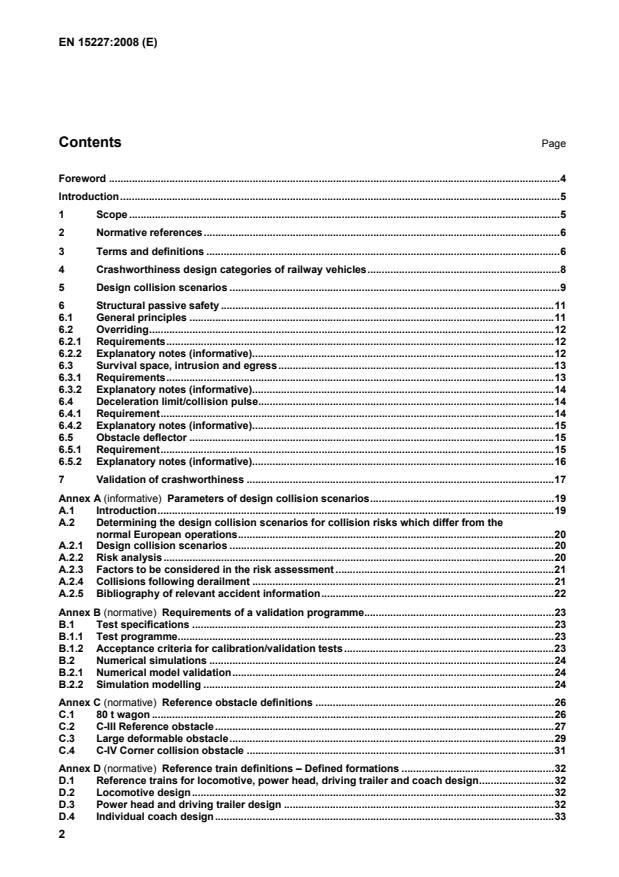
Parameters of design collision scenarios.19 A.1 Introduction.19 A.2 Determining the design collision scenarios for collision risks which differ from the normal European operations.20 A.2.1 Design collision scenarios.20 A.2.2 Risk analysis.20 A.2.3 Factors to be considered in the risk assessment.21 A.2.4 Collisions following derailment.21 A.2.5 Bibliography of relevant accident information.22 Annex B (normative)
Requirements of a validation programme.23 B.1 Test specifications.23 B.1.1 Test programme.23 B.1.2 Acceptance criteria for calibration/validation tests.23 B.2 Numerical simulations.24 B.2.1 Numerical model validation.24 B.2.2 Simulation modelling.24 Annex C (normative)
Reference obstacle definitions.26 C.1 80 t wagon.26 C.2 C-III Reference obstacle.27 C.3 Large deformable obstacle.29 C.4 C-IV Corner collision obstacle.31 Annex D (normative)
Reference train definitions – Defined formations.32 D.1 Reference trains for locomotive, power head, driving trailer and coach design.32 D.2 Locomotive design.32 D.3 Power head and driving trailer design.32 D.4 Individual coach design.33
Migration rule for this European Standard.35 Annex ZA (informative)
Relationship between this European Standard and the Essential Requirements of EU Directive 96/48 as amended by Directive 2004/50/EC.36 Bibliography.37
Figures Figure 1 — Example for clearance requirement of crumple zones in areas of temporary occupation (e.g. vestibule).13 Figure 2 — Driver's seat clearance zone.14 Figure 3 — Obstacle deflector load application.16 Figure C.1 — Buffered wagon interface.26 Figure C.2 — Wagon buffer characteristic.27 Figure C.3 — Peri-urban tram obstacle.28 Figure C.4 — Coupler characteristic.28 Figure C.5 — Deformable obstacle geometry.30 Figure C.6 — Deformable obstacle stiffness.30 Figure C.7 — Tram corner collision obstacle.31 Figure D.1 — Locomotive reference train.32 Figure D.2 — Power head/driving trailer reference train.33 Figure D.3 — Coach simplified assessment.34
Tables Table 1 — Crashworthiness design categories of railway vehicles.8 Table 2 — Collision scenarios and collision obstacles.10 Table 3 — Obstacle deflector performance requirements.11 Table ZA.1 — Correspondence between this European Standard and Directive 96/48/EC as amended by Directive2004/50/EC.36
1) Official Journal of the European Communities No L 235 of 17.09.96 2) Official Journal of the European Communities No L 164 of 30.04.04 3) Official Journal of the European Communities No L 134 of 30.04.04
full-size tests, or a combination of all these methods.
≤ 110 n.a. 25 n.a. See C.3 for representation of large obstacle 3 3 t rigid obstacle Urban line not isolated from the road traffic n.a. n.a. n.a. 25 See C.4 for representation of obstacle 4 Small, low obstacle Obstacle deflector requirements to be achieved See Table 3n.a. See Table 3 n.a. See also 6.5
6.5.1.
If there are no crashworthiness requirements specified in regulations and the normal European operating conditions assumed by this European Standard do not apply, it shall be the responsibility of the operator to determine the applicable scenarios and the appropriate limiting design case for each (see Annex A). The vehicles shall be designed to satisfy those design collision scenarios that correspond to the operational conditions they are expected to experience. If the operational conditions are such that a design collision scenario cannot occur, or there is evidence that the probability of it occurring or the associated risk is so low as to be broadly acceptable, there is no need to consider the scenario in the vehicle design. NOTE Train control systems which segregate different types of traffic on the same system may satisfy this requirement. Locomotives with centre cabs may have an inherent broadly acceptable risk under Scenario 3. If the system has characteristics that result in significant collision risks (relative to the above) not already covered, they shall also be considered in the form of additional design collision scenarios. If vehicles cannot operate up to the collision speeds specified in this European Standard (e.g. shunting locomotives) the crashworthiness requirements need not be applied. If assessing a single locomotive, power head, driving trailer or coach, which is not part of a fixed train unit, a reference train shall be used for design purposes in each of the above scenarios. Annex D specifies the choice of reference trains and the scope of approval that is possible without further re-assessment. 6 Structural passive safety 6.1 General principles To the extent required by this European Standard the following measures shall be employed to provide protection of occupants in the event of a collision: reduce the risk of overriding; absorb collision energy in a controlled manner;
or, if this cannot be achieved, the wheel lift-off distance of up to 100 mm is permitted if the anti-climb units stay fully engaged over the relevant part of the collision simulation and provide a steady interlocking feature between the colliding vehicles and the maximum interface forces induced are properly transferred into the interlocking feature. It shall also be demonstrated that the anti-climb units, as well as any subsequent crash energy absorption modules, absorb the required amount of energy. The demonstration shall be performed by calculation using a detailed model of the crumple zones at the vehicle ends. It is acceptable to have simplified equivalent mass and stiffness modelling for the residual parts of the vehicles provided that the survival space behaviour is correctly represented. 6.2.2 Explanatory notes (informative) Overriding constraint is necessary to limit the vertical displacements arising at vehicle interfaces and resist those vertical forces that are induced, so that the collision loads are directed to the energy absorbing structure. Vertical displacements and forces arise due to offsets between the interface contact/reaction points and the inertia forces associated with vehicle decelerations and accelerations. Vertical offsets can be caused by wheel wear, pitching, differences of vertical load etc. An initial vertical offset of 40 mm is regarded to be sufficient for this demonstration. Overriding constraint may be provided by: a) provision of anti-climb units (with associated coupler collapse/shear out); b) bar couplers between vehicles with movement constraint;
Key
1 vehicle end 4 maximum lateral dimension of 250 mm 2 seating area (passenger survival space) 5 longitudinal clearance not required 3 area of temporary occupation (e.g. end vestibule) 6 longitudinal clearance required Figure 1 — Example for clearance requirement of crumple zones in areas of temporary occupation (e.g. vestibule) There shall be a survival space for the driver (and other cab occupant). This shall either: surround each fixed seat with a minimum clearance ahead of the seat (measured on its centreline) as shown in Figure 2 (with the seat in its median position), or
Key h = 300 mm 1 clearance profile Figure 2 — Driver's seat clearance zone The inside face of the windscreen shall be supported along its edges by overlapping the structure of the driver’s cab to limit intrusion in case of a collision. At least one escape route (via a designated egress door or escape window) shall be maintained for every survival space. The deformation of the structure under the defined collision scenarios shall not prohibit the use of the escape routes. 6.3.2 Explanatory notes (informative) The deformation of the structure should not obviously cause any vehicle equipment or parts (e.g. driver’s desk, windscreens) to encroach into the designated survival spaces during the design collision scenarios. The structure immediately ahead of the driver’s survival space should, as far as practical, not fail in a manner that itself creates an additional hazard (e.g. exposed fracture surfaces and protrusions should be avoided). The driver should be located behind the designated structural collapse zone. The provision of support to the windscreen does not require that the windscreen has to remain intact during a collision. 6.4 Deceleration limit/collision pulse 6.4.1 Requirement The mean longitudinal deceleration in the survival spaces shall be limited to 5 g for Scenario 1 and Scenario 2 and 7,5 g for Scenario 3.
5 g the attachments of critical items of equipments should be analysed. 6.4.2 Explanatory notes (informative) The deceleration of a vehicle is determined by the magnitude of the net contact force. Force levels significantly higher than the average are permissible provided they are not sustained. If an excessive time elapses before the net contact force falls to zero then the time in which it falls to 10 % of the maximum force should be used. The ultimate strength requirements consistent with the above acceleration levels may be greater than the strength requirements specified in EN 12663. 6.5 Obstacle deflector 6.5.1 Requirement An obstacle deflector shall be fitted to leading vehicles of category C-I. For other categories an obstacle deflector shall be fitted unless the main vehicle structure is sufficiently low to perform the same function or the risk due to this scenario is broadly acceptable. The obstacle deflector needs to be of sufficient size to sweep obstacles clear of the path of the bogie. It shall be a continuous structure and shall be designed so as not to deflect objects upwards or downwards. Under normal operating conditions, the lower edge of the obstacle deflector shall be as close to the track as the vehicle movements and gauge line will permit. The structural performance requirements for the obstacle deflector and its attachment to the vehicle structure are specified in Table 3 and below, namely: each static load shall be applied independently in the vehicle longitudinal direction. The force shall be applied over an area of 0,5 m wide and up to 0,5 m high from the bottom edge of the obstacle deflector. (Note that the available height may be limited by cut-outs for the coupler or other equipment). The line of action of the resultant force shall be horizontal and through the centre of each loaded area up to a maximum height of 500 mm above rail level. Figure 3 illustrates these requirements; there shall be no significant permanent deformation (as defined in EN 12663) of the obstacle deflector and its fixations to the car body due to each static load applied separately; if the obstacle deflector is overloaded it shall not deform plastically in such a way that it becomes detached or itself becomes a danger. This can be shown, for example, by demonstrating that the deflector can absorb the energy corresponding to the specified central static load acting over a deformation of 120 mm. The obstacle deflector shall remain clear of track and other local infrastructure features when deforming under load to the extent required by this European Standard.
Key
loaded area ≤ 0,25 m2 1 centre load resultant position 2 side load resultant position (both sides) 3 top of rail 4 coupler clearance (if applicable) Figure 3 — Obstacle deflector load application
6.5.2 Explanatory notes (informative) The obstacle deflector should be placed as near to the front of the leading vehicle as the functional design will permit so that it sweeps aside debris from the initial impact and reduces the risk of them falling beneath it and into the path of the wheels. In plan view the deflector should approximate to a ‘V’ profile with an included angle of not more than 160°. It can be designed with a compatible geometry to function also as a snow plough. In some operating conditions there is a significant risk of derailment from substantial obstacles that will pass under an obstacle deflector. To address this risk, bogie-mounted guards may be fitted immediately in front of the wheels on leading bogies. If such guards are required they should be designed in accordance with national standards, infrastructure controller’s regulations or operator’s specifications where such exist.
Parameters of design collision scenarios A.1 Introduction To enable the crashworthiness requirements for a vehicle to be defined and assessed it is necessary to determine the design collision scenarios in terms of impact speed and the type and mass of potential obstacles. For normal European o
...