

EN 15227:2008+A1:2010
(Main + Amendment)Railway applications - Crashworthiness requirements for railway vehicle bodies
General Information
- Abstract
This European Standard applies to new designs of locomotives and passenger carrying rolling stock as defined in categories C-I to C-IV of Clause 4 taking into consideration the recommendations given in Annex E on the application of the standard (migration rule). It is intended to protect vehicle occupants, through the preservation of structural integrity, and does not extend to other railway employees and customers who are not in vehicles, or to third parties. The specified requirements relate to the technical and operational conditions of use that prevail in the CEN member countries. The design of new vehicles for use in passenger trains is based on operations with compatible rolling stock that also meet this standard. It is recognised that operational requirements will require new crashworthy and existing non-crashworthy vehicles to exist in the same train unit but such combinations of vehicles are not required to comply with this European Standard.
The requirements apply to the vehicle body, and to those mechanical elements directly associated with it that may be used to absorb energy in a collision, such as couplers, buffing systems etc. They do not cover the safety features of doors, windows, system components or interior features except for specific issues relating to the preservation of survival space.
The requirements do not cover all possible accident scenarios but provide a level of crashworthiness that will reduce the consequences of an accident, when the active safety measures have been inadequate. The requirement is to provide a level of protection by addressing the most common types of collision that cause injuries and fatalities.
The applicable design collision scenarios, and suitable parameters for normal European operations, are given in Clause 5. Annex A gives additional information regarding the derivation of the scenarios and describes situations when they may need to be modified and the processes that should then be followed.
- Status
- Withdrawn
- Publication Date
- 02-Nov-2010
- Withdrawal Date
- 29-Sep-2026
- Technical Committee
- CEN/TC 256 - Railway applications
- Drafting Committee
- CEN/TC 256/WG 2 - Structural requirements
- Current Stage
- 9960 - Withdrawal effective - Withdrawal
- Start Date
- 08-Apr-2020
- Completion Date
- 30-Sep-2026
- Directive
- 2008/57/EC - DIRECTIVE 2008/57/EC OF THE EUROPEAN PARLIAMENT AND OF THE COUNCIL of 17 June 2008 on the interoperability of the rail system within the Community (Recast)OJ Ref: C, C 214 OJ Date: 20-Jul-2011
Buy Documents


Relations
- Merged From
EN 15227:2008 - Railway applications - Crashworthiness requirements for railway vehicle bodies - Effective Date
- 19-Jan-2023
- Merged From
EN 15227:2008/FprA1 - Railway applications - Crashworthiness requirements for railway vehicle bodies - Effective Date
- 06-Sep-2010
- Effective Date
- 04-Dec-2013
- Effective Date
- 28-Jan-2026
- Effective Date
- 28-Jan-2026
- Effective Date
- 28-Jan-2026
Buy Documents
Get Certified
Connect with accredited certification bodies for this standard

IRIS Certification (UNIFE)
International Railway Industry Standard certification.

TÜV SÜD Rail GmbH
TÜV SÜD railway certification services.

Bureau Veritas Railway Certification
Railway and transportation certification.
Sponsored listings
Frequently Asked Questions
EN 15227:2008+A1:2010 is a standard published by the European Committee for Standardization (CEN). Its full title is "Railway applications - Crashworthiness requirements for railway vehicle bodies". This standard covers: This European Standard applies to new designs of locomotives and passenger carrying rolling stock as defined in categories C-I to C-IV of Clause 4 taking into consideration the recommendations given in Annex E on the application of the standard (migration rule). It is intended to protect vehicle occupants, through the preservation of structural integrity, and does not extend to other railway employees and customers who are not in vehicles, or to third parties. The specified requirements relate to the technical and operational conditions of use that prevail in the CEN member countries. The design of new vehicles for use in passenger trains is based on operations with compatible rolling stock that also meet this standard. It is recognised that operational requirements will require new crashworthy and existing non-crashworthy vehicles to exist in the same train unit but such combinations of vehicles are not required to comply with this European Standard. The requirements apply to the vehicle body, and to those mechanical elements directly associated with it that may be used to absorb energy in a collision, such as couplers, buffing systems etc. They do not cover the safety features of doors, windows, system components or interior features except for specific issues relating to the preservation of survival space. The requirements do not cover all possible accident scenarios but provide a level of crashworthiness that will reduce the consequences of an accident, when the active safety measures have been inadequate. The requirement is to provide a level of protection by addressing the most common types of collision that cause injuries and fatalities. The applicable design collision scenarios, and suitable parameters for normal European operations, are given in Clause 5. Annex A gives additional information regarding the derivation of the scenarios and describes situations when they may need to be modified and the processes that should then be followed.
This European Standard applies to new designs of locomotives and passenger carrying rolling stock as defined in categories C-I to C-IV of Clause 4 taking into consideration the recommendations given in Annex E on the application of the standard (migration rule). It is intended to protect vehicle occupants, through the preservation of structural integrity, and does not extend to other railway employees and customers who are not in vehicles, or to third parties. The specified requirements relate to the technical and operational conditions of use that prevail in the CEN member countries. The design of new vehicles for use in passenger trains is based on operations with compatible rolling stock that also meet this standard. It is recognised that operational requirements will require new crashworthy and existing non-crashworthy vehicles to exist in the same train unit but such combinations of vehicles are not required to comply with this European Standard. The requirements apply to the vehicle body, and to those mechanical elements directly associated with it that may be used to absorb energy in a collision, such as couplers, buffing systems etc. They do not cover the safety features of doors, windows, system components or interior features except for specific issues relating to the preservation of survival space. The requirements do not cover all possible accident scenarios but provide a level of crashworthiness that will reduce the consequences of an accident, when the active safety measures have been inadequate. The requirement is to provide a level of protection by addressing the most common types of collision that cause injuries and fatalities. The applicable design collision scenarios, and suitable parameters for normal European operations, are given in Clause 5. Annex A gives additional information regarding the derivation of the scenarios and describes situations when they may need to be modified and the processes that should then be followed.
EN 15227:2008+A1:2010 is classified under the following ICS (International Classification for Standards) categories: 45.060.01 - Railway rolling stock in general. The ICS classification helps identify the subject area and facilitates finding related standards.
EN 15227:2008+A1:2010 has the following relationships with other standards: It is inter standard links to EN 15227:2008, EN 15227:2008/FprA1, EN 15227:2020, EN 12663-2:2010+A1:2023, EN 12663-1:2010+A2:2023, EN 14033-1:2017. Understanding these relationships helps ensure you are using the most current and applicable version of the standard.
EN 15227:2008+A1:2010 is associated with the following European legislation: EU Directives/Regulations: 2008/57/EC; Standardization Mandates: M/024, M/275. When a standard is cited in the Official Journal of the European Union, products manufactured in conformity with it benefit from a presumption of conformity with the essential requirements of the corresponding EU directive or regulation.
EN 15227:2008+A1:2010 is available in PDF format for immediate download after purchase. The document can be added to your cart and obtained through the secure checkout process. Digital delivery ensures instant access to the complete standard document.
Standards Content (Sample)
2003-01.Slovenski inštitut za standardizacijo. Razmnoževanje celote ali delov tega standarda ni dovoljeno.Bahnanwendungen - Anforderungen an die Kollisionssicherheit von SchienenfahrzeugkästenApplications ferroviaires - Exigences en sécurité passive contre collision pour les structures de caisses des véhicules ferroviairesRailway applications - Crashworthiness requirements for railway vehicle bodies45.060.01Železniška vozila na splošnoRailway rolling stock in generalICS:Ta slovenski standard je istoveten z:EN 15227:2008+A1:2010SIST EN 15227:2008+A1:2010en,fr,de01-december-2010SIST EN 15227:2008+A1:2010SLOVENSKI
STANDARD
EUROPEAN STANDARD NORME EUROPÉENNE EUROPÄISCHE NORM
EN 15227:2008+A1
November 2010 ICS 45.060.01 Supersedes EN 15227:2008English Version
Railway applications - Crashworthiness requirements for railway vehicle bodies
Applications ferroviaires - Exigences en sécurité passive contre collision pour les structures de caisses des véhicules ferroviaires
Bahnanwendungen - Anforderungen an die Kollisionssicherheit von Schienenfahrzeugkästen This European Standard was approved by CEN on 12 December 2007 and includes Amendment 1 approved by CEN on 28 September 2010.
CEN members are bound to comply with the CEN/CENELEC Internal Regulations which stipulate the conditions for giving this European Standard the status of a national standard without any alteration. Up-to-date lists and bibliographical references concerning such national standards may be obtained on application to the CEN Management Centre or to any CEN member.
This European Standard exists in three official versions (English, French, German). A version in any other language made by translation under the responsibility of a CEN member into its own language and notified to the CEN Management Centre has the same status as the official versions.
CEN members are the national standards bodies of Austria, Belgium, Bulgaria, Croatia, Cyprus, Czech Republic, Denmark, Estonia, Finland, France, Germany, Greece, Hungary, Iceland, Ireland, Italy, Latvia, Lithuania, Luxembourg, Malta, Netherlands, Norway, Poland, Portugal, Romania, Slovakia, Slovenia, Spain, Sweden, Switzerland and United Kingdom.
EUROPEAN COMMITTEE FOR STANDARDIZATION
COMITÉ EUROPÉEN DE NORMALISATION EUROPÄISCHES KOMITEE FÜR NORMUNG
Management Centre:
Avenue Marnix 17,
B-1000 Brussels © 2010 CEN All rights of exploitation in any form and by any means reserved worldwide for CEN national Members. Ref. No. EN 15227:2008+A1:2010: ESIST EN 15227:2008+A1:2010
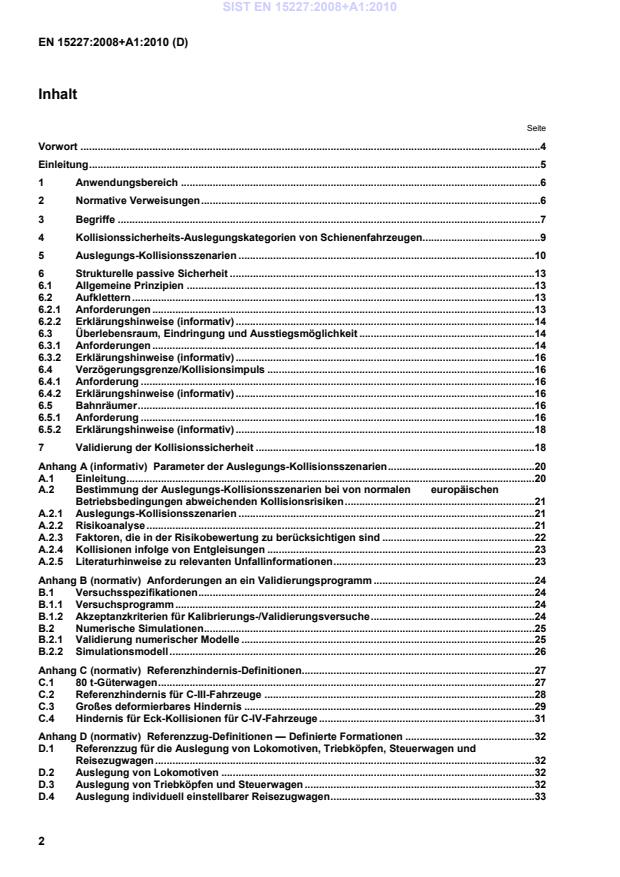
Parameters of design collision scenarios . 19A.1 Introduction . 19A.2 Determining the design collision scenarios for collision risks which differ from the normal European operations . 20A.2.1 Design collision scenarios . 20A.2.2 Risk analysis . 20A.2.3 Factors to be considered in the risk assessment . 21A.2.4 Collisions following derailment . 21A.2.5 Bibliography of relevant accident information . 22Annex B (normative)
Requirements of a validation programme. 23B.1 Test specifications . 23B.1.1 Test programme . 23B.1.2 Acceptance criteria for calibration/validation tests . 23B.2 Numerical simulations . 24B.2.1 Numerical model validation . 24B.2.2 Simulation modelling . 24Annex C (normative)
Reference obstacle definitions . 26C.1 80 t wagon . 26C.2 C-III Reference obstacle . 27C.3 Large deformable obstacle . 29C.4 C-IV Corner collision obstacle . 31Annex D (normative)
Reference train definitions – Defined formations . 32D.1 Reference trains for locomotive, power head, driving trailer and coach design . 32D.2 Locomotive design . 32D.3 Power head and driving trailer design . 32D.4 Individual coach design . 33SIST EN 15227:2008+A1:2010
Migration rule for this European Standard . 35Annex ZA (informative)
!!!!Relationship between this European Standard and the Essential Requirements of EU Directive 2008/57/EC of the European Parliament and of the Council of 17 June 2008 on the interoperability of the rail system within the Community (Recast)"""" . 36Bibliography . 39 Figures Figure 1 — Example for clearance requirement of crumple zones in areas of temporary occupation (e.g. vestibule) . 13Figure 2 — Driver's seat clearance zone . 14Figure 3 — Obstacle deflector load application . 16Figure C.1 — Buffered wagon interface . 26Figure C.2 — Wagon buffer characteristic . 27Figure C.3 — Peri-urban tram obstacle . 28Figure C.4 — Coupler characteristic . 28Figure C.5 — Deformable obstacle geometry . 30Figure C.6 — Deformable obstacle stiffness . 30Figure C.7 — Tram corner collision obstacle . 31Figure D.1 — Locomotive reference train . 32Figure D.2 — Power head/driving trailer reference train . 33Figure D.3 — Coach simplified assessment . 34 Tables Table 1 — Crashworthiness design categories of railway vehicles . 8Table 2 — Collision scenarios and collision obstacles . 10Table 3 — Obstacle deflector performance requirements . 11Table ZA.1 — Correspondence between this European Standard, the HS TSI RST published in the OJEU dated 26 March 2008 and Directive 2008/57/EC . 37Table ZA.2 — Correspondence between this European Standard, the CR LOC and PASS RST TSI (final draft Rev 4.0 dated 24 November 2009) and Directive 2008/57/EC . 38
full-size tests, or a combination of all these methods. SIST EN 15227:2008+A1:2010
≤ 110 n.a. 25 n.a. See C.3 for representation of large obstacle 3 t rigid obstacle Urban line not isolated from the road traffic n.a. n.a. n.a. 25 See C.4 for representation of obstacle 4 Small, low obstacle Obstacle deflector requirements to be achieved See Table 3n.a. See Table 3 n.a. See also 6.5
6.5.1.
If there are no crashworthiness requirements specified in regulations and the normal European operating conditions assumed by this European Standard do not apply, it shall be the responsibility of the operator to determine the applicable scenarios and the appropriate limiting design case for each (see Annex A). The vehicles shall be designed to satisfy those design collision scenarios that correspond to the operational conditions they are expected to experience. If the operational conditions are such that a design collision scenario cannot occur, or there is evidence that the probability of it occurring or the associated risk is so low as to be broadly acceptable, there is no need to consider the scenario in the vehicle design. NOTE Train control systems which segregate different types of traffic on the same system may satisfy this requirement. Locomotives with centre cabs may have an inherent broadly acceptable risk under Scenario 3. If the system has characteristics that result in significant collision risks (relative to the above) not already covered, they shall also be considered in the form of additional design collision scenarios. If vehicles cannot operate up to the collision speeds specified in this European Standard (e.g. shunting locomotives) the crashworthiness requirements need not be applied. If assessing a single locomotive, power head, driving trailer or coach, which is not part of a fixed train unit, a reference train shall be used for design purposes in each of the above scenarios. Annex D specifies the choice of reference trains and the scope of approval that is possible without further re-assessment. 6 Structural passive safety 6.1 General principles To the extent required by this European Standard the following measures shall be employed to provide protection of occupants in the event of a collision: reduce the risk of overriding; absorb collision energy in a controlled manner; SIST EN 15227:2008+A1:2010
or, if this cannot be achieved, the wheel lift-off distance of up to 100 mm is permitted if the anti-climb units stay fully engaged over the relevant part of the collision simulation and provide a steady interlocking feature between the colliding vehicles and the maximum interface forces induced are properly transferred into the interlocking feature. It shall also be demonstrated that the anti-climb units, as well as any subsequent crash energy absorption modules, absorb the required amount of energy. The demonstration shall be performed by calculation using a detailed model of the crumple zones at the vehicle ends. It is acceptable to have simplified equivalent mass and stiffness modelling for the residual parts of the vehicles provided that the survival space behaviour is correctly represented. 6.2.2 Explanatory notes (informative) Overriding constraint is necessary to limit the vertical displacements arising at vehicle interfaces and resist those vertical forces that are induced, so that the collision loads are directed to the energy absorbing structure. Vertical displacements and forces arise due to offsets between the interface contact/reaction points and the inertia forces associated with vehicle decelerations and accelerations. Vertical offsets can be caused by wheel wear, pitching, differences of vertical load etc. An initial vertical offset of 40 mm is regarded to be sufficient for this demonstration. Overriding constraint may be provided by: a) provision of anti-climb units (with associated coupler collapse/shear out); b) bar couplers between vehicles with movement constraint; SIST EN 15227:2008+A1:2010
Key
1 vehicle end 4 maximum lateral dimension of 250 mm 2 seating area (passenger survival space) 5 longitudinal clearance not required 3 area of temporary occupation (e.g. end vestibule) 6 longitudinal clearance required Figure 1 — Example for clearance requirement of crumple zones in areas of temporary occupation (e.g. vestibule) There shall be a survival space for the driver (and other cab occupant). This shall either: surround each fixed seat with a minimum clearance ahead of the seat (measured on its centreline) as shown in Figure 2 (with the seat in its median position), or SIST EN 15227:2008+A1:2010
Key h = 300 mm 1 clearance profile Figure 2 — Driver's seat clearance zone The inside face of the windscreen shall be supported along its edges by overlapping the structure of the driver’s cab to limit intrusion in case of a collision. At least one escape route (via a designated egress door or escape window) shall be maintained for every survival space. The deformation of the structure under the defined collision scenarios shall not prohibit the use of the escape routes. 6.3.2 Explanatory notes (informative) The deformation of the structure should not obviously cause any vehicle equipment or parts (e.g. driver’s desk, windscreens) to encroach into the designated survival spaces during the design collision scenarios. The structure immediately ahead of the driver’s survival space should, as far as practical, not fail in a manner that itself creates an additional hazard (e.g. exposed fracture surfaces and protrusions should be avoided). The driver should be located behind the designated structural collapse zone. The provision of support to the windscreen does not require that the windscreen has to remain intact during a collision. 6.4 Deceleration limit/collision pulse 6.4.1 Requirement The mean longitudinal deceleration in the survival spaces shall be limited to 5 g for Scenario 1 and Scenario 2 and 7,5 g for Scenario 3. SIST EN 15227:2008+A1:2010
5 g the attachments of critical items of equipments should be analysed. 6.4.2 Explanatory notes (informative) The deceleration of a vehicle is determined by the magnitude of the net contact force. Force levels significantly higher than the average are permissible provided they are not sustained. If an excessive time elapses before the net contact force falls to zero then the time in which it falls to 10 % of the maximum force should be used. The ultimate strength requirements consistent with the above acceleration levels may be greater than the strength requirements specified in EN 12663. 6.5 Obstacle deflector 6.5.1 Requirement An obstacle deflector shall be fitted to leading vehicles of category C-I. For other categories an obstacle deflector shall be fitted unless the main vehicle structure is sufficiently low to perform the same function or the risk due to this scenario is broadly acceptable. The obstacle deflector needs to be of sufficient size to sweep obstacles clear of the path of the bogie. It shall be a continuous structure and shall be designed so as not to deflect objects upwards or downwards. Under normal operating conditions, the lower edge of the obstacle deflector shall be as close to the track as the vehicle movements and gauge line will permit. The structural performance requirements for the obstacle deflector and its attachment to the vehicle structure are specified in Table 3 and below, namely: each static load shall be applied independently in the vehicle longitudinal direction. The force shall be applied over an area of 0,5 m wide and up to 0,5 m high from the bottom edge of the obstacle deflector. (Note that the available height may be limited by cut-outs for the coupler or other equipment). The line of action of the resultant force shall be horizontal and through the centre of each loaded area up to a maximum height of 500 mm above rail level. Figure 3 illustrates these requirements; there shall be no significant permanent deformation (as defined in EN 12663) of the obstacle deflector and its fixations to the car body due to each static load applied separately; if the obstacle deflector is overloaded it shall not deform plastically in such a way that it becomes detached or itself becomes a danger. This can be shown, for example, by demonstrating that the deflector can absorb the energy corresponding to the specified central static load acting over a deformation of 120 mm. The obstacle deflector shall remain clear of track and other local infrastructure features when deforming under load to the extent required by this European Standard. SIST EN 15227:2008+A1:2010
Key
loaded area ≤ 0,25 m2 1 centre load resultant position 2 side load resultant position (both sides) 3 top of rail 4 coupler clearance (if applicable) Figure 3 — Obstacle deflector load application
6.5.2 Explanatory notes (informative) The obstacle deflector should be placed as near to the front of the leading vehicle as the functional design will permit so that it sweeps aside debris from the initial impact and reduces the risk of them falling beneath it and into the path of the wheels. In plan view the deflector should approximate to a ‘V’ profile with an included angle of not more than 160°. It can be designed with a compatible geometry to function also as a snow plough. In some operating conditions there is a significant risk of derailment from substantial obstacles that will pass under an obstacle deflector. To address this risk, bogie-mounted guards may be fitted immediately in front of the wheels on leading bogies. If such guards are required they should be designed in accordance with national standards, infrastructure controller’s regulations or operator’s specifications where such exist. SIST EN 15227:2008+A1:2010
...
2003-01.Slovenski inštitut za standardizacijo. Razmnoževanje celote ali delov tega standarda ni dovoljeno.Bahnanwendungen - Anforderungen an die Kollisionssicherheit von SchienenfahrzeugkästenApplications ferroviaires - Exigences en sécurité passive contre collision pour les structures de caisses des véhicules ferroviairesRailway applications - Crashworthiness requirements for railway vehicle bodies45.060.01Železniška vozila na splošnoRailway rolling stock in generalICS:Ta slovenski standard je istoveten z:EN 15227:2008+A1:2010SIST EN 15227:2008+A1:2010en,fr,de01-december-2010SIST EN 15227:2008+A1:2010SLOVENSKI
STANDARD
EUROPÄISCHE NORM EUROPEAN STANDARD NORME EUROPÉENNE
EN 15227:2008+A1
November 2010 ICS 45.060.01 Ersatz für EN 15227:2008Deutsche Fassung
Bahnanwendungen - Anforderungen an die Kollisionssicherheit von Schienenfahrzeugkästen
Railway applications - Crashworthiness requirements for railway vehicle bodies
Applications ferroviaires - Exigences en sécurité passive contre collision pour les structures de caisses des véhicules ferroviaires Diese Europäische Norm wurde vom CEN am 12.Dezember 2007 angenommen und schließt Änderung 1 ein, die am 28.September 2010 vom CEN angenommen wurde.
Die CEN-Mitglieder sind gehalten, die CEN/CENELEC-Geschäftsordnung zu erfüllen, in der die Bedingungen festgelegt sind, unter denen dieser Europäischen Norm ohne jede Änderung der Status einer nationalen Norm zu geben ist. Auf dem letzen Stand befindliche Listen dieser nationalen Normen mit ihren bibliographischen Angaben sind beim Management-Zentrum des CEN oder bei jedem CEN-Mitglied auf Anfrage erhältlich.
Diese Europäische Norm besteht in drei offiziellen Fassungen (Deutsch, Englisch, Französisch). Eine Fassung in einer anderen Sprache, die von einem CEN-Mitglied in eigener Verantwortung durch Übersetzung in seine Landessprache gemacht und dem Zentralsekretariat mitgeteilt worden ist, hat den gleichen Status wie die offiziellen Fassungen.
CEN-Mitglieder sind die nationalen Normungsinstitute von Belgien, Bulgarien, Dänemark, Deutschland, Estland, Finnland, Frankreich, Griechenland, Irland, Island, Italien, Kroatien, Lettland, Litauen, Luxemburg, Malta, den Niederlanden, Norwegen, Österreich, Polen, Portugal, Rumänien, Schweden, der Schweiz, der Slowakei, Slowenien, Spanien, der Tschechischen Republik, Ungarn, dem Vereinigten Königreich und Zypern.
EUROPÄISCHES KOMITEE FÜR NORMUNG EUROPEAN COMMITTEE FOR STANDARDIZATION
COMITÉ EUROPÉEN DE NORMALISATION
Management-Zentrum:
Avenue Marnix 17,
B-1000 Brüssel © 2010 CEN Alle Rechte der Verwertung, gleich in welcher Form und in welchem Verfahren, sind weltweit den nationalen Mitgliedern von CEN vorbehalten.Ref. Nr. EN 15227:2008+A1:2010 DSIST EN 15227:2008+A1:2010
Parameter der Auslegungs-Kollisionsszenarien.20 A.1 Einleitung.20 A.2 Bestimmung der Auslegungs-Kollisionsszenarien bei von normalen
europäischen Betriebsbedingungen abweichenden Kollisionsrisiken.21 A.2.1 Auslegungs-Kollisionsszenarien.21 A.2.2 Risikoanalyse.21 A.2.3 Faktoren, die in der Risikobewertung zu berücksichtigen sind.22 A.2.4 Kollisionen infolge von Entgleisungen.23 A.2.5 Literaturhinweise zu relevanten Unfallinformationen.23 Anhang B (normativ)
Anforderungen an ein Validierungsprogramm.24 B.1 Versuchsspezifikationen.24 B.1.1 Versuchsprogramm.24 B.1.2 Akzeptanzkriterien für Kalibrierungs-/Validierungsversuche.24 B.2 Numerische Simulationen.25 B.2.1 Validierung numerischer Modelle.25 B.2.2 Simulationsmodell.26 Anhang C (normativ)
Referenzhindernis-Definitionen.27 C.1 80 t-Güterwagen.27 C.2 Referenzhindernis für C-III-Fahrzeuge.28 C.3 Großes deformierbares Hindernis.29 C.4 Hindernis für Eck-Kollisionen für C-IV-Fahrzeuge.31 Anhang D (normativ)
Referenzzug-Definitionen — Definierte Formationen.32 D.1 Referenzzug für die Auslegung von Lokomotiven, Triebköpfen, Steuerwagen und
Reisezugwagen.32 D.2 Auslegung von Lokomotiven.32 D.3 Auslegung von Triebköpfen und Steuerwagen.32 D.4 Auslegung individuell einstellbarer Reisezugwagen.33 SIST EN 15227:2008+A1:2010
Übergangsbestimmungen für diese Europäische Norm.35 Anhang ZA (informativ)
!Zusammenhang zwischen dieser Europäischen Norm und den wesentlichen Anforderungen der EU-Richtlinie 2008/57/EG des Europäischen Parlamentes und des Rates vom 17. Juni 2008 über die Interoperabilität des Eisenbahnsystems innerhalb der Gemeinschaft (Neufassung).36 Literaturhinweise.39 Bilder Bild 1 — Beispiel für eine Freiraumforderung an Stauchzonen in zeitweilig besetzten Bereichen (z. B. Vorraum).15 Bild 2 — Freiraumbereich für den Fahrersitz.15 Bild 3 — Lasteinleitung am Bahnräumer.17 Bild C.1 — Schnittstelle für Güterwagen mit Seitenpuffern.27 Bild C.2 — Puffercharakteristik des Güterwagens.28 Bild C.3 — Hindernis für Leichttriebwagen und Regio-Straßenbahnen.28 Bild C.4 — Kupplungscharakteristik.29 Bild C.5 — Geometrie des deformierbaren Hindernisses.30 Bild C.6 — Steifigkeit des deformierbaren Hindernisses.30 Bild C.7 — Hindernis für Eck-Kollisionen (Straßenbahn).31 Bild D.1 — Referenzzug für Lokomotiven.32 Bild D.2 — Referenzzug für Triebköpfe/Steuerwagen.33 Bild D.3 — Vereinfachte Bewertung für Reisezugwagen.34 Tabellen Tabelle 1 — Kollisionssicherheits-Auslegungskategorien von Schienenfahrzeugen.9 Tabelle 2 — Kollisionsszenarien und Kollisionshindernisse.11 Tabelle 3 —Anforderungen an Bahnräumer.12 Tabelle ZA.1 — Zusammenhang zwischen dieser Europäischen Norm, der am 26. März 2008 im Amtsblatt veröffentlichten HS TSI Fahrzeuge und der Richtlinie 2008/57/EG.37 Tabelle ZA.2 — Zusammenhang zwischen dieser Europäischen Norm, der CR TSI Fahrzeuge – Lokomotiven, Personenfahrzeuge (Schluss-Entwurf Rev 4.0 vom 24. November 2009) und der
Richtlinie 2008/57/EG.38
Lokomotiven, Reisezugwagen und Triebzüge C-II Städtische Fahrzeuge, die ausschließlich für ein geschlossenes Netz ohne Schnitt-stellen mit dem Straßenverkehr ausgelegt sind U-Bahn-Fahrzeuge C-III Leichte Nahverkehrsfahrzeuge, die für städtische und/oder regionale Netze aus-gelegt sind mit gemeinsamer Gleis-benutzung von Vollbahnstrecken und mit Schnittstellen zum Straßenverkehr Leichttriebwagen, Regio-Stadtbahnen C-IV Leichte Nahverkehrsfahrzeuge, die aus-schließlich für Stadtnetze ausgelegt sind, mit Schnittstellen zum Straßenverkehr
Innerstädtische Straßenbahnfahrzeuge SIST EN 15227:2008+A1:2010
Die nachstehend spezifizierten Kollisionsszenarien sind nicht die einzigen Fälle, die im Bereich des öffentlichen Eisenbahntransports in Europa vorkommen, aber sie stellen die häufigsten Kollisionssituationen dar und jene, die zu den meisten Unfallopfern führen. Anhang A befasst sich detaillierter mit der Herleitung und Anwendung der Kollisionsszenarien: 1) Frontalzusammenstoß von zwei identischen Zugeinheiten; 2) Frontalzusammenstoß mit einem unterschiedlichen Schienenfahrzeugtyp; 3) Zusammenprall einer Zugeinheit mit einem großen Straßenfahrzeug auf einem Bahnübergang;
4) Zusammenprall einer Zugeinheit mit einem kleinen Hindernis (z. B. Auto auf einem Bahnübergang, Tier, Unrat). Tabelle 2 fasst diese Kollisionsszenarien im Hinblick auf die verschiedenen Kollisionssicherheits-Auslegungskategorien und auf die Betriebsbedingungen zusammen, die für den Nachweis der Kollisionssicherheit anzuwenden sind. Tabelle 3 führt die Anforderungen an den Bahnräumer auf.
Gemischter Verkehr mit Fahrzeugen mit Mittel-kupplung n.a. n.a. 10 n.a. siehe C.2 zur Definition des Referenz-Regionalzuges 15 t
deformier-bares Hindernis
TEN und ähnlicher Betrieb mit Bahn-übergängen Vlc − 50
≤ 110 n.a. 25 n.a. siehe C.3 zur Definition des großen Hindernisses 3 3 t
starres Hindernis
Straßenbahn, nicht getrennt vom Straßen-verkehr
n.a. n.a. n.a. 25 siehe C.4 zur Definition des Hindernisses 4 Hindernis, schmal, klein Zu erfüllende Anforderungen an den Bahnräumer Siehe
Tabelle 3 n.a. Siehe
Tabelle 3 n.a. Siehe auch 6.5
≥ 160 km/h 140 km/h 120 km/h 100 km/h ≤ 80 km/h Statische Last in der Mittellinieb
300 kN 240 kN 180 kN 120 kN 60 kN Statische Last 750 mm seitlich von der Mittellinieb 250 kN 200 kN 150 kN 100 kN 50 kN a Für hiervon abweichende Betriebsgeschwindigkeiten dürfen die Kraftwerte interpoliert werden. b Details für die Anwendung dieser Lasten und die funktionalen Eigenschaften des Bahnräumers werden in 6.5.1
angegeben.
Wenn in den Vorschriften keine Anforderungen an die Kollisionssicherheit spezifiziert sind, und die in dieser Norm vorausgesetzten normalen europäischen Betriebsbedingungen nicht zutreffen, ist der Betreiber für die Definition der anzuwendenden Szenarien und des jeweils geeigneten Grenzfall-Kollisionsszenarios verantwortlich (siehe Anhang A). Die Fahrzeuge müssen so ausgelegt werden, dass sie die Auslegungs-Kollisionsszenarien erfüllen, welche den zu erwartenden auftretenden Betriebsbedingungen entsprechen. Wenn die Betriebsbedingungen ein Kollisionsszenario ausschließen, oder wenn nachgewiesen werden kann, dass die Wahrscheinlichkeit des Auftretens oder das damit verbundene Risiko so gering ist, dass es allgemein akzeptierbar ist, dann muss dieses Szenario bei der Fahrzeuggestaltung nicht betrachtet werden. ANMERKUNG Zugsicherungssysteme, welche verschiedene Verkehrsarten auf dem gleichen Netz trennen, können diese Anforderung erfüllen. Lokomotiven mit Mittelführerräumen können für Szenario 3 ein inhärentes, allgemein akzeptables Risiko aufweisen. Wenn das Betriebsnetz Eigenschaften aufweist, welche wesentliche, nicht bereits abgedeckte Kollisionsrisiken beinhalten (siehe oben), müssen diese in Form von zusätzlichen Auslegungs-Kollisionsszenarien berücksichtigt werden. Wenn Fahrzeuge nicht die in dieser Norm angegebenen Kollisionsgeschwindigkeiten erreichen können (z. B. Rangierlokomotiven), müssen die Anforderungen an die Kollisionssicherheit nicht angewendet werden. Bei der Bewertung einer einzelnen Lokomotive, eines Triebkopfes, eines Steuerwagens oder eines Reisezugwagens, welcher nicht Teil einer festen Zugeinheit ist, muss ein Referenzzug für Auslegungszwecke bei jedem der oben aufgeführten Szenarien verwendet werden. Anhang D definiert die Auswahl der Referenzzüge und den zulässigen Änderungsumfang, der ohne weitere Neubewertung möglich ist. SIST EN 15227:2008+A1:2010
Der Aufkletterschutz kann erreicht werden durch: a) die Bereitstellung von Aufkletterschutz-Einrichtungen (in Verbindung mit Abscher- bzw. Deformations-elementen der Kupplung); b) Kupplungsstangen zwischen den Fahrzeugen mit Bewegungsbegrenzung; c) die Zugkonfiguration (z. B. bei Gelenkfahrzeugen). 6.3 Überlebensraum, Eindringung und Ausstiegsmöglichkeit 6.3.1 Anforderungen Die vorgesehenen Überlebensräume müssen während des vollständigen Stauchens der Deformationszonen erhalten bleiben, auch beim Auftreten von signifikanten Spitzenbelastungen. Lokale plastische Deformationen und lokales Beulen sind akzeptabel, wenn nachgewiesen wird, dass sie ausreichend räumlich begrenzt sind, sodass sie den Überlebensraum nicht über die nachstehend spezifizierten Grenzen hinaus verringern. Die Verminderung des Fahrgast-Überlebensraumes in den Auslegungs-Kollisionsszenarien muss in Längsrichtung auf 50 mm je 5 m Länge begrenzt werden oder die lokale plastische Dehnung in diesen Bereichen bleibt unter 10 %. Falls ein 5-m-Längenabschnitt unmittelbar am Ende der Fahrzeugstruktur liegt, kann er in Längsrichtung um bis zu 100 mm verkürzt werden. In temporär besetzten Bereichen, wie Zugangsbereichen, die als Stauchzonen verwendet werden, dürfen Freiräume mit Querabmessungen über 250 mm nicht über 30 % in Längsrichtung gestaucht werden. Bild 1 zeigt ein Beispiel für Bereiche, wo die Anforderungen an den Freiraum in Längsrichtung gelten und wo nicht.
Legende 1 Fahrzeugende 4 maximale Querabmessung von 250 mm 2 Sitzbereich (Fahrgast-Überlebensraum) 5 Freiraum in Längsrichtung nicht erforderlich 3 temporär besetzter Bereich
(z. B. Vorraum am Fahrzeugende) 6 Freiraum in Längsrichtung erforderlich Bild 1 — Beispiel für eine Freiraumforderung an Stauchzonen in zeitweilig besetzten Bereichen (z. B. Vorraum) Es muss einen Überlebensraum für den Fahrzeugführer (und andere Führerrauminsassen) geben. Dieser muss entweder: ⎯ jeden festen Sitz mit einem Mindestfreiraum vor dem Sitz umschließen (gemessen an dessen Mittellinie), wie in Bild 2 gezeigt (mit Sitz in mittlerer Position) oder ⎯ angrenzend zur Hauptsitzposition eine Länge und Breite von mindestens 0,75 m sowie zumindest 80 % der ursprünglichen Nominalhöhe vom Fußboden zum Dach aufrechterhalten. ANMERKUNG Ein angrenzender Überlebensraum je Führerraum reicht aus. Der Überlebensraum kann außerhalb des eigentlichen Führerraumbereichs angeordnet sein, vorausgesetzt, dass ein unmittelbarer Zugang zur Verfügung steht.
Legende h = 300 mm 1 Freiraum-Profil Bild 2 — Freiraumbereich für den Fahrersitz SIST EN 15227:2008+A1:2010
Die Bestimmung der mittleren Verzögerung für jedes betrachtete Fahrzeug im Zugverband muss von dem Zeitpunkt an erfolgen, an dem die Netto-Kontaktkraft auf das Fahrzeug null überschreitet bis zum Zeitpunkt, an dem sie wieder auf null abfällt. Die Versagenslast (Traglast) der Ausrüstungsbefestigungen muss mit dem höchsten mittleren Verzögerungsniveau, welches das Fahrzeug infolge der oben aufgeführten Szenarien erfährt, vereinbar sein. ANMERKUNG Für Verzögerungen bis zu 5 g stellt der Unterschied zwischen den Anforderungen an Dehn- und Bruchfestigkeit vieler Konstruktionswerkstoffe sicher, dass diese Anforderung ohne detaillierte Analyse zu erreichen ist. Für Beschleunigungen oberhalb 5 g sollten die Befestigungen kritischer Ausrüstungselemente analysiert werden. 6.4.2 Erklärungshinweise (informativ) Die Verzögerung eines Fahrzeugs wird durch die Größe der Netto-Kontaktkraft bestimmt. Krafthöhen, die den Durchschnittswert deutlich übersteigen, sind unter der Voraussetzung zulässig, dass diese nicht beständig auftreten. Falls eine übermäßig lange Zeit verstreicht, bevor die Netto-Kontaktkraft wieder auf null abfällt, sollte die Zeit verwendet werden, in der die Kraft auf 10 % der Höchstkraft fällt. Die mit den oben angeführten Beschleunigungsgrößen konsistenten Anforderungen an die Versagenslast können größer als die in der EN 12663 spezifizierten Festigkeitsanforderungen sein. 6.5 Bahnräumer 6.5.1 Anforderung Ein Bahnräumer muss an den führenden Fahrzeugen der Kategorie C-I angebracht werden. Auch für andere Kategorien muss ein Bahnräumer angebracht werden, es sei denn, die Fahrzeugstruktur ist niedrig genug, um die gleiche Funktion zu leisten, oder das Risiko dieses Szenarios ist allgemein akzeptabel. Der Bahnräumer muss von ausreichender Größe sein, um Hindernisse aus dem Weg des Drehgestells zu räumen. Er muss eine kontinuierliche Struktur aufweisen und so ausgelegt sein, dass Gegenstände nicht aufwärts oder abwärts abgelenkt werden. Unter normalen Betriebsbedingungen muss die untere Kante des Bahnräumers so nahe am Gleis sein, wie es Fahrzeugbewegungen und Fahrzeugbegrenzungslinie erlauben. SIST EN 15227:2008+A1:2010
Legende
belasteter Bereich ≤ 0,25 m2 1 Position der zentrischen Lastresultierenden 2 Position der seitlichen Lastresultierenden (beide Seiten) 3 Schienenoberkante (SOK) 4 Kupplungsfreiraum (falls zutreffend) Bild 3 — Lasteinleitung am Bahnräumer SIST EN 15227:2008+A1:2010
...