


FprEN 16485
(Main)Round and sawn timber - Environmental product declarations - Product category rules for wood and wood-based products for use in construction
Round and sawn timber - Environmental product declarations - Product category rules for wood and wood-based products for use in construction
This document provides general Product Category Rules (PCR) for Type III environmental declarations for wood and wood-based products, including wood-based panels, for use in construction and related construction and in-service processes.
This document complements the core rules for the product category of construction products as defined in EN 15804 and is intended to be used in conjunction with EN 15804.
This document does not cover the assessment of social and economic performances at product level.
The core PCR:
- define the parameters to be declared and the way in which they are collated and reported;
- describe which stages of a product’s life cycle are considered in the EPD and which processes are to be included in the life cycle stages;
- define rules for the development of scenarios;
- include the rules for calculating the Life Cycle Inventory and the Life Cycle Impact Assessment underlying the EPD, including the specification of the data quality to be applied;
- include the rules for reporting predetermined, environmental and health information, that is not covered by LCA for a product, construction process and construction service where necessary;
- define the conditions under which construction products can be compared based on the information provided by EPD.
For the EPD of construction services, the same rules and requirements apply as for the EPD of construction products.
Additionally, to the common parts of EN 15804, this document for wood and wood-based products:
- defines the system boundaries;
- defines the rules for modelling and assessment of material-specific characteristics such as carbon content and net calorific value of wood;
- defines allocation procedures for multi-output processes along the wood chain;
- defines allocation procedures for reuse, recycling and energy recovery;
- includes the rules for calculating the Life Cycle Inventory and the Life Cycle Impact Assessment underlying the EPD, including the assessment of carbon and net calorific value of wood;
- provides guidance/specific rules for the determination of the Reference Service Life (RSL).
Rund- und Schnittholz - Umweltproduktdeklarationen - Produktkategorieregeln für Holz und Holzwerkstoffe im Bauwesen
Dieses Dokument liefert allgemeine Produktkategorieregeln (PCR) für Typ III-Umweltdeklarationen für Produkte aus Holz und Holzwerkstoffen, einschließlich Holzwerkstoffplatten, zur Verwendung in Bauwerken und die damit zusammenhängenden Bauverfahren und Dienstleistungen.
Dieses Dokument ergänzt die Grundregeln für die Produktkategorie sämtlicher Bauprodukte, wie in EN 15804 festgelegt, und ist dazu vorgesehen, in Verbindung mit EN 15804 angewendet zu werden.
Die Beurteilung der sozialen und ökonomischen Leistungen auf der Produktebene ist nicht Gegenstand dieses Dokuments.
Die grundlegenden PCR:
- legen die zu deklarierenden Parameter und die Art fest, wie sie auf Vollständigkeit überprüft und kommuniziert werden;
- beschreiben, welche Phasen des Lebenszyklus eines Produktes in der EPD berücksichtigt werden und welche Prozesse in die Phasen des Lebenszyklus einzubeziehen sind;
- legen die Regeln für die Entwicklung von Szenarien fest;
- umfassen die Regeln zur Berechnung der Sachbilanz und der Wirkungsabschätzung, die einer EPD unterliegen, einschließlich der Festlegung der zu verwendenden Datenqualität;
- umfassen die Regeln für die Kommunikation vorgegebener Umwelt- und Gesundheitsinformationen, die für ein Bauprodukt, einen Bauprozess oder eine Bauleistung nicht von einer Ökobilanz (LCA, en: Life Cycle Assessment) abgedeckt sind, soweit erforderlich;
- legen die Bedingungen fest, unter denen Bauprodukte auf der Basis der Informationen aus der EPD verglichen werden können.
Für die EPD von Bauleistungen gelten dieselben Regeln und Anforderungen wie für die EPD von Bauprodukten.
Zusätzlich zu den allgemeinen Teilen der EN 15804 legt dieses Dokument zu Produkten aus Holz und Holzwerkstoffen Folgendes fest:
- die Systemgrenzen;
- die Regeln für die Modellierung und Beurteilung von werkstoffspezifischen Eigenschaften wie etwa Kohlenstoffgehalt und spezifischer Heizwert von Holz;
- die Zuordnungs-(Allokations-)Verfahren für verschiedene Outputverfahren entlang der Holzverarbeitungskette;
- die Zuordnungs-(Allokations-)Verfahren für die Wiederverwendung, das Recycling und die Energierückgewinnung;
- sie enthält die Regeln zur Berechnung der Sachbilanz und der Wirkungsabschätzung, die einer EPD unterliegen, einschließlich der Beurteilung des Kohlenstoffgehaltes und des spezifischen Heizwertes von Holz;
- sie liefert eine Anleitung/besondere Regeln für die Festlegung der Referenz-Nutzungsdauer (RSL).
Bois ronds et sciages - Déclarations environnementales de produits - Règles de définition des catégories de produits en bois et à base de bois pour l'utilisation en construction
Le présent document fournit les règles de définition des catégories de produits (RCP) générales pour les déclarations environnementales de Type III relatives aux produits en bois et dérivés du bois, y compris les panneaux à base de bois, destinés à être utilisés dans la construction et les services de construction associés à ces produits.
Le présent document vient compléter les règles régissant les catégories de produits de construction définies dans l'EN 15804 et est destiné à être utilisé conjointement avec l'EN 15804.
Le présent document ne couvre pas l'évaluation des performances sociales et économiques au niveau des produits.
Le tronc commun des RCP :
— définit les paramètres à déclarer et la manière dont ils sont regroupés et consignés ;
— décrit les étapes du cycle de vie d'un produit prises en compte dans la DEP ainsi que les processus devant être inclus dans les étapes du cycle de vie ;
— définit les règles relatives à l'élaboration de scénarios ;
— intègre les règles de calcul de l'inventaire du cycle de vie et de l'évaluation de l'impact du cycle de vie servant de base à la DEP, y compris la spécification de la qualité des données à appliquer ;
— intègre les règles de communication d'informations environnementales et sanitaires prédéterminées, qui ne sont pas couvertes par l'analyse du cycle de vie, pour un produit, un processus de construction et un service de construction, si nécessaire ;
— définit les conditions dans lesquelles les produits de construction peuvent être comparés, sur la base des informations fournies par la DEP.
Les règles et les exigences applicables à la DEP des services de construction sont les mêmes que pour la DEP des produits de construction.
Outre les parties communes de l'EN 15804, le présent document relatif aux produits en bois et dérivés du bois :
définit les frontières du système ;
définit les règles pour la modélisation et l'évaluation de caractéristiques spécifiques du matériau telles que la teneur en carbone et le pouvoir calorifique inférieur du bois ;
définit des procédures d'affectation applicables aux processus multidébouchés de l'ensemble de la filière bois ;
définit des procédures d'affectation applicables à la réutilisation, au recyclage et à la récupération d'énergie ;
intègre les règles de calcul de l'inventaire du cycle de vie et de l'évaluation de l'impact du cycle de vie servant de base à la DEP, y compris l'évaluation du carbone et du pouvoir calorifique inférieur du bois ;
fournit des recommandations/règles spécifiques pour la détermination de la Durée de Vie de Référence (DVR).
Okrogli in žagani les - Okoljske deklaracije za proizvode - Pravila za kategorije proizvodov za les in lesne kompozite za uporabo v gradbeništvu
General Information
- Status
- Not Published
- Publication Date
- 07-Apr-2026
- Technical Committee
- CEN/TC 175 - Round and sawn timber
- Drafting Committee
- CEN/TC 175/WG 5 - Environmental topics
- Current Stage
- 5060 - Closure of Vote - Formal Approval
- Start Date
- 22-Jan-2026
- Due Date
- 10-Oct-2024
- Completion Date
- 22-Jan-2026
Relations
- Effective Date
- 19-Jan-2023
Overview
FprEN 16485 is a European standard developed by CEN that specifies Product Category Rules (PCR) for Type III Environmental Product Declarations (EPDs) related to round and sawn timber as well as wood-based products used in construction. This standard provides a framework for producing transparent, verified environmental information about wood products, complementing the core rules established in EN 15804. It is essential for manufacturers, environmental consultants, and construction professionals aiming to assess and communicate the environmental performance of wood materials.
This standard covers the entire lifecycle of wood products, from cradle to either gate or grave, depending on the defined system boundaries. It includes rules for life cycle assessment (LCA), scenario development, and data reporting, making it a crucial tool for sustainability assessment in the construction sector. FprEN 16485 does not address social or economic performance metrics but focuses solely on environmental parameters.
Key Topics
Product Category Rules (PCR) for Wood Products
Defines specific parameters required for environmental declarations, establishing how data must be collected, calculated, and reported in line with EN 15804 core rules.Lifecycle Stages and System Boundaries
Details which product life cycle stages (production, construction, use, end-of-life) should be included in the EPD and describes processes relevant to wood and wood-based products.Life Cycle Inventory (LCI) and Impact Assessment (LCIA)
Provides rigorous methodologies for calculating environmental impacts, including carbon storage and energy content unique to wood materials.Allocation Rules
Explains procedures for allocating environmental loads among co-products in multi-output processes common in the wood supply chain, as well as rules for reuse, recycling, and energy recovery.Reference Service Life (RSL)
Offers guidance on estimating the expected lifespan of wood products in construction to support accurate scenario modeling.Additional Environmental and Health Information
Includes the reporting of critical environmental and health-related data not fully covered by LCAs, addressing emissions during product use.
Applications
FprEN 16485 is applicable for:
- Manufacturers of round timber, sawn timber, and wood-based composite products aiming to produce EPDs that support environmental claim verifications.
- Environmental consultants conducting life cycle assessments and preparing verified declarations to benchmark environmental performance in construction materials.
- Construction companies and architects utilizing wood products with comprehensive EPDs to make sustainable building decisions backed by scientifically sound data.
- Policymakers and certification bodies designing or updating green building schemes where transparent environmental information is required for wood-based construction materials.
- Researchers and product developers focused on minimizing the environmental impact of timber products through informed material innovation and lifecycle management.
Related Standards
FprEN 16485 should be used in conjunction with the following key standards:
EN 15804: Sustainability of construction works – Environmental product declarations – Core rules for construction products
The foundational PCR for construction product EPDs, providing general rules that FprEN 16485 complements specifically for wood products.EN ISO 14044: Environmental management – Life cycle assessment – Requirements and guidelines
Establishes the principles and framework for conducting LCAs as referenced in the environmental assessment methodology of this standard.EN 15643: Sustainability framework for buildings and civil engineering works
Supports broader sustainability reporting into which EPDs produced under FprEN 16485 feed.EN 15978: Assessment of environmental performance of buildings
Provides calculation methods for integrating EPD data into holistic building environmental performance assessments.CEN/TR 15941: Guidance for selection and use of generic data in environmental product declarations
Offers data selection guidelines that reinforce data quality requirements of the PCR.
Conclusion
FprEN 16485 empowers stakeholders across the construction and wood product industries to produce and utilize high-quality, transparent environmental product declarations specifically tailored to wood and wood-based construction materials. By harmonizing data reporting and lifecycle assessment methods, it facilitates informed, sustainable choices and drives continuous environmental improvement within the timber sector. Incorporating this standard into environmental performance frameworks ensures credible, comparable, and science-based communication of wood product environmental impacts, essential for advancing sustainability in construction.

Get Certified
Connect with accredited certification bodies for this standard

ICC Evaluation Service
Building products evaluation and certification.

QAI Laboratories
Building and construction product testing and certification.

Aboma Certification B.V.
Specialized in construction, metal, and transport sectors.
Sponsored listings
Frequently Asked Questions
FprEN 16485 is a draft published by the European Committee for Standardization (CEN). Its full title is "Round and sawn timber - Environmental product declarations - Product category rules for wood and wood-based products for use in construction". This standard covers: This document provides general Product Category Rules (PCR) for Type III environmental declarations for wood and wood-based products, including wood-based panels, for use in construction and related construction and in-service processes. This document complements the core rules for the product category of construction products as defined in EN 15804 and is intended to be used in conjunction with EN 15804. This document does not cover the assessment of social and economic performances at product level. The core PCR: - define the parameters to be declared and the way in which they are collated and reported; - describe which stages of a product’s life cycle are considered in the EPD and which processes are to be included in the life cycle stages; - define rules for the development of scenarios; - include the rules for calculating the Life Cycle Inventory and the Life Cycle Impact Assessment underlying the EPD, including the specification of the data quality to be applied; - include the rules for reporting predetermined, environmental and health information, that is not covered by LCA for a product, construction process and construction service where necessary; - define the conditions under which construction products can be compared based on the information provided by EPD. For the EPD of construction services, the same rules and requirements apply as for the EPD of construction products. Additionally, to the common parts of EN 15804, this document for wood and wood-based products: - defines the system boundaries; - defines the rules for modelling and assessment of material-specific characteristics such as carbon content and net calorific value of wood; - defines allocation procedures for multi-output processes along the wood chain; - defines allocation procedures for reuse, recycling and energy recovery; - includes the rules for calculating the Life Cycle Inventory and the Life Cycle Impact Assessment underlying the EPD, including the assessment of carbon and net calorific value of wood; - provides guidance/specific rules for the determination of the Reference Service Life (RSL).
This document provides general Product Category Rules (PCR) for Type III environmental declarations for wood and wood-based products, including wood-based panels, for use in construction and related construction and in-service processes. This document complements the core rules for the product category of construction products as defined in EN 15804 and is intended to be used in conjunction with EN 15804. This document does not cover the assessment of social and economic performances at product level. The core PCR: - define the parameters to be declared and the way in which they are collated and reported; - describe which stages of a product’s life cycle are considered in the EPD and which processes are to be included in the life cycle stages; - define rules for the development of scenarios; - include the rules for calculating the Life Cycle Inventory and the Life Cycle Impact Assessment underlying the EPD, including the specification of the data quality to be applied; - include the rules for reporting predetermined, environmental and health information, that is not covered by LCA for a product, construction process and construction service where necessary; - define the conditions under which construction products can be compared based on the information provided by EPD. For the EPD of construction services, the same rules and requirements apply as for the EPD of construction products. Additionally, to the common parts of EN 15804, this document for wood and wood-based products: - defines the system boundaries; - defines the rules for modelling and assessment of material-specific characteristics such as carbon content and net calorific value of wood; - defines allocation procedures for multi-output processes along the wood chain; - defines allocation procedures for reuse, recycling and energy recovery; - includes the rules for calculating the Life Cycle Inventory and the Life Cycle Impact Assessment underlying the EPD, including the assessment of carbon and net calorific value of wood; - provides guidance/specific rules for the determination of the Reference Service Life (RSL).
FprEN 16485 is classified under the following ICS (International Classification for Standards) categories: 91.010.99 - Other aspects; 91.080.20 - Timber structures. The ICS classification helps identify the subject area and facilitates finding related standards.
FprEN 16485 has the following relationships with other standards: It is inter standard links to EN 16485:2014. Understanding these relationships helps ensure you are using the most current and applicable version of the standard.
FprEN 16485 is associated with the following European legislation: EU Directives/Regulations: 305/2011. When a standard is cited in the Official Journal of the European Union, products manufactured in conformity with it benefit from a presumption of conformity with the essential requirements of the corresponding EU directive or regulation.
FprEN 16485 is available in PDF format for immediate download after purchase. The document can be added to your cart and obtained through the secure checkout process. Digital delivery ensures instant access to the complete standard document.
Standards Content (Sample)
SLOVENSKI STANDARD
oSIST prEN 16485:2023
01-september-2023
Okrogli in žagani les - Okoljske deklaracije za proizvode - Pravila za kategorije
proizvodov za les in lesne kompozite za uporabo v gradbeništvu
Round and sawn timber - Environmental Product Declarations - Product category rules
for wood and wood-based products for use in construction
Rund- und Schnittholz - Umweltproduktdeklarationen - Produktkategorieregeln für Holz
und Holzwerkstoffe im Bauwesen
Bois ronds et sciages - Déclarations environnementales de produits - Règles de
définition des catégories de produits en bois et à base de bois pour l'utilisation en
construction
Ta slovenski standard je istoveten z: prEN 16485
ICS:
13.020.99 Drugi standardi v zvezi z Other standards related to
varstvom okolja environmental protection
79.040 Les, hlodovina in žagan les Wood, sawlogs and sawn
timber
91.080.20 Lesene konstrukcije Timber structures
oSIST prEN 16485:2023 en,fr,de
2003-01.Slovenski inštitut za standardizacijo. Razmnoževanje celote ali delov tega standarda ni dovoljeno.
oSIST prEN 16485:2023
oSIST prEN 16485:2023
DRAFT
EUROPEAN STANDARD
prEN 16485
NORME EUROPÉENNE
EUROPÄISCHE NORM
June 2023
ICS Will supersede EN 16485:2014
English Version
Round and sawn timber - Environmental Product
Declarations - Product category rules for wood and wood-
based products for use in construction
Bois ronds et sciages - Déclarations environnementales Rund- und Schnittholz - Umweltproduktdeklarationen
de produits - Règles de définition des catégories de - Produktkategorieregeln für Holz und Holzwerkstoffe
produits en bois et à base de bois pour l'utilisation en im Bauwesen
construction
This draft European Standard is submitted to CEN members for enquiry. It has been drawn up by the Technical Committee
CEN/TC 175.
If this draft becomes a European Standard, CEN members are bound to comply with the CEN/CENELEC Internal Regulations
which stipulate the conditions for giving this European Standard the status of a national standard without any alteration.
This draft European Standard was established by CEN in three official versions (English, French, German). A version in any other
language made by translation under the responsibility of a CEN member into its own language and notified to the CEN-CENELEC
Management Centre has the same status as the official versions.
CEN members are the national standards bodies of Austria, Belgium, Bulgaria, Croatia, Cyprus, Czech Republic, Denmark, Estonia,
Finland, France, Germany, Greece, Hungary, Iceland, Ireland, Italy, Latvia, Lithuania, Luxembourg, Malta, Netherlands, Norway,
Poland, Portugal, Republic of North Macedonia, Romania, Serbia, Slovakia, Slovenia, Spain, Sweden, Switzerland, Türkiye and
United Kingdom.
Recipients of this draft are invited to submit, with their comments, notification of any relevant patent rights of which they are
aware and to provide supporting documentation.
Warning : This document is not a European Standard. It is distributed for review and comments. It is subject to change without
notice and shall not be referred to as a European Standard.
EUROPEAN COMMITTEE FOR STANDARDIZATION
COMITÉ EUROPÉEN DE NORMALISATION
EUROPÄISCHES KOMITEE FÜR NORMUNG
CEN-CENELEC Management Centre: Rue de la Science 23, B-1040 Brussels
© 2023 CEN All rights of exploitation in any form and by any means reserved Ref. No. prEN 16485:2023 E
worldwide for CEN national Members.
oSIST prEN 16485:2023
prEN 16485:2023 (E)
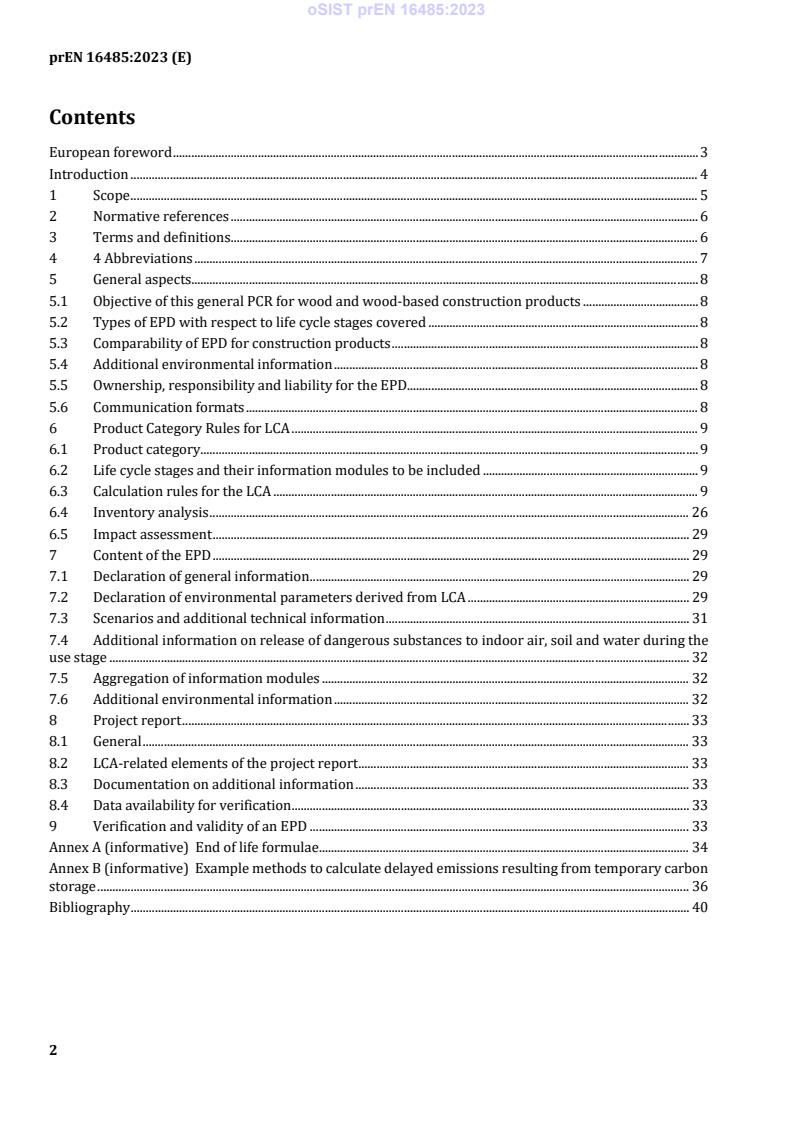
Contents
European foreword . 3
Introduction . 4
1 Scope . 5
2 Normative references . 6
3 Terms and definitions . 6
4 4 Abbreviations . 7
5 General aspects. 8
5.1 Objective of this general PCR for wood and wood-based construction products . 8
5.2 Types of EPD with respect to life cycle stages covered . 8
5.3 Comparability of EPD for construction products . 8
5.4 Additional environmental information . 8
5.5 Ownership, responsibility and liability for the EPD . 8
5.6 Communication formats . 8
6 Product Category Rules for LCA . 9
6.1 Product category . 9
6.2 Life cycle stages and their information modules to be included . 9
6.3 Calculation rules for the LCA . 9
6.4 Inventory analysis . 26
6.5 Impact assessment . 29
7 Content of the EPD . 29
7.1 Declaration of general information . 29
7.2 Declaration of environmental parameters derived from LCA . 29
7.3 Scenarios and additional technical information . 31
7.4 Additional information on release of dangerous substances to indoor air, soil and water during the
use stage . 32
7.5 Aggregation of information modules . 32
7.6 Additional environmental information . 32
8 Project report . 33
8.1 General . 33
8.2 LCA-related elements of the project report . 33
8.3 Documentation on additional information . 33
8.4 Data availability for verification . 33
9 Verification and validity of an EPD . 33
Annex A (informative) End of life formulae . 34
Annex B (informative) Example methods to calculate delayed emissions resulting from temporary carbon
storage . 36
Bibliography . 40
oSIST prEN 16485:2023
prEN 16485:2023 (E)
European foreword
This document (prEN 16485:2023) has been prepared by Technical Committee CEN/TC 175 “Round and
sawn timber”, the secretariat of which is held by AFNOR.
This document is currently submitted to the CEN Enquiry.
This document will supersede EN 16485:2014.
The main changes compared to the previous edition are listed below:
— New figures and examples for the systems boundaries in the calculation rules for the LCA (6.3.5);
— Proposal for co-product allocation (6.4.3.2);
— Add of new chapter Additional environmental information (7.6);
— Add of two informative annexes.
oSIST prEN 16485:2023
prEN 16485:2023 (E)
Introduction
EN 15804 provides core product category rules for all construction products and services. It provides a
structure to ensure that all Environmental Product Declarations (EPD) of construction products,
construction services and construction processes are derived, verified and presented in a harmonized way.
This document provides rules for Environmental Product Declarations (EPD) specifically for wood and
wood-based products. It complements the core product category rules for all construction products and
services as established in EN 15804.
An EPD communicates verifiable, accurate, non-misleading environmental information for products and
their applications, thereby supporting scientifically based, fair choices and stimulating the potential for
market-driven continuous environmental improvement.
The standardization process has taken place in accordance with EN ISO 14025. All common issues are
covered horizontally for all product types in order to minimize vertical (branch specific) deviations. All
common issues are covered horizontally for all wood and wood-based products in order to minimize intra-
sectoral deviations.
EPD information is expressed in information modules as defined in EN 15804, which allow easy
organization and expression of data packages throughout the life cycle of wood and wood-based products.
The approach requires that the underlying data should be consistent, reproducible and comparable.
In line with EN 15804, the EPD is expressed in a form that allows aggregation (addition) to provide
complete information for buildings and other construction works. This document does not deal with
aggregation at the building level nor does this standard describe the rules for applying EPD in a building
assessment.
The document deals with a limited number of quantifiable parameters as predefined in EN 15804. Future
revisions of EN 15804 may lead to the incorporation of additional predetermined parameters.
This document provides the means for developing a Type III environmental declaration of wood and wood-
based construction products in the context of the suite of standards that are intended to assess the
sustainability of construction works.
This suite of standards includes:
EN 15643, Sustainability of construction works - Framework for assessment of buildings and civil engineering
works “
EN 15978, Sustainability of construction works — Assessment of environmental performance of buildings —
Calculation method
EN 15804:2012+A2:2019, Sustainability of construction works — Environmental product declarations —
Core rules for the product category of construction products
CEN/TR 15941, Sustainability of construction works — Environmental product declarations — Methodology
for selection and use of generic data
EN 15942, Sustainability of construction works — Environmental product declarations — Communication
format business to business
oSIST prEN 16485:2023
prEN 16485:2023 (E)
1 Scope
This document provides general Product Category Rules (PCR) for Type III environmental declarations for
wood and wood-based products for use in construction and related construction and in-service processes.
This document complements the core rules for the product category of construction products as defined
in EN 15804 and is intended to be used in conjunction with EN 15804.
NOTE The assessment of social and economic performances at product level is not covered by this document.
The core PCR:
— define the parameters to be declared and the way in which they are collated and reported;
— describe which stages of a product’s life cycle are considered in the EPD and which processes are to be
included in the life cycle stages;
—define rules for the development of scenarios;
—include the rules for calculating the Life Cycle Inventory and the Life Cycle Impact Assessment
underlying the EPD, including the specification of the data quality to be applied;
— include the rules for reporting predetermined, environmental and health information, that is not
covered by LCA for a product, construction process and construction service where necessary;
— define the conditions under which construction products can be compared based on the information
provided by EPD.
For the EPD of construction services, the same rules and requirements apply as for the EPD of construction
products.
Additionally, to the common parts of EN 15804, this document for wood and wood-based products:
— defines the system boundaries;
— defines the rules for modelling and assessment of material-specific characteristics such as carbon
storage and energy content of wood;
— defines allocation procedures for multi-output processes along the wood chain;
— defines allocation procedures for reuse, recycling and energy recovery;
— includes the rules for calculating the Life Cycle Inventory and the Life Cycle Impact Assessment
underlying the EPD, including the assessment of carbon and energy content of wood;
—provides guidance/specific rules for the determination of the Reference Service Life (RSL).
This document is intended to be used for cradle to gate or cradle to grave assessment, provided the
intention is properly stated in the system boundary description.
oSIST prEN 16485:2023
prEN 16485:2023 (E)
2 Normative references
The following documents are referred to in the text in such a way that some or all of their content
constitutes requirements of this document. For dated references, only the edition cited applies. For
undated references, the latest edition of the referenced document (including any amendments) applies.
EN ISO 14044:2006, Environmental management - Life cycle assessment - Requirements and guidelines (ISO
14044:2006)
EN 15804:2012+A2:2019, Sustainability of construction works - Environmental product declarations - Core
rules for the product category of construction products
3 Terms and definitions
For the purposes of this document, the terms and definitions given in EN 15804:2012+A2:2019 and the
following apply.
ISO and IEC maintain terminology databases for use in standardization at the following addresses:
— ISO Online browsing platform: available at https://www.iso.org/obp
— IEC Electropedia: available at https://www.electropedia.org
3.1
co-product
any of two or more marketable materials, products, or fuels from the same unit process, but which is not
the object of the assessment
[SOURCE: EN 15804:2012+A2:2019, 3.7]
Note 1 to entry Co-product, by-product and product have the same status and are used for identification of several
distinguished flows of products from the same unit process. From co-product, by-product and product, waste is the
only output to be distinguished as a non-product.
Note 2 to entry When further used as a material or fuel, according to COM (2007)59, (Communication from the
Commission to the Council and the European Parliament on the Interpretative Communication on waste and by-
products) Annex I, sawdust, wood chips and off-cuts from untreated wood as generated at saw mills or at secondary
operation such as the manufacturing of furniture or pallets and packaging and customarily referred to as by-products
are, for the purpose of this document, considered co-products. Materials of this type fall outside the definition of
waste. However, where material of this kind requires a full recycling or recovery operation or contains contaminants
that need to be removed before it can be further used or processed, this would indicate that the material is a waste
until the recycling or recovery operation is completed.
3.2
biogenic carbon
carbon derived from/contained in biomass
3.3
biomass
material of biological origin excluding material embedded in geological formations and material
transformed to fossilised material
3.4
biogenic carbon neutrality
balance of biogenic carbon uptake during growth of biomass and release during natural decay or
incineration
oSIST prEN 16485:2023
prEN 16485:2023 (E)
3.5
carbon storage
biogenic carbon stored over a specific period of time
3.6
direct land use change
change in human use or management of land at the location of the production, use or disposal of raw
materials (ISO 14050:2020, 6.12), intermediate products (ISO 14050:2020, 6.2.1) and final products
(3.4.1) or wastes (ISO 14050:2020, 3.12) in the product system being assessed
3.7
forest carbon pools
compartments storing biogenic carbon in the forest: above-ground biomass, below-ground biomass, litter,
dead wood and soil organic carbon
[SOURCE: IPCC 2006, Table 1.1]
3.8
fossil carbon
carbon which is contained in fossilised material
Note 1 to entry Examples of fossilised material are coal, oil and natural gas.
3.9
recovered wood
all kind of wood material which, at the end of its life cycle in wooden products, is made available for re-use,
recycling or energy recovery
4 4 Abbreviations
EPD Environmental Product Declaration
PCR Product Category Rules
LCA Life Cycle Assessment
LCI Life Cycle Inventory analysis
LCIA Life Cycle Impact Assessment
RSL Reference Service Life
GWP Global Warming Potential
GHG Greenhouse Gas
CHP Combined Heat and Power
oSIST prEN 16485:2023
prEN 16485:2023 (E)
5 General aspects
5.1 Objective of this general PCR for wood and wood-based construction products
An EPD according to this standard provides quantified environmental information for wood and wood-
based construction product or related service on a harmonized and scientific basis. It also provides
information on health related emissions to indoor air, soil and water during the use stage of the building.
The purpose of an EPD in the construction sector is to provide the basis for assessing buildings and other
construction works and identifying those which cause less stress to the environment.
Thus, the objective of this general PCR for wood and wood-based products is to ensure:
— the provision of verifiable and consistent data for an EPD, based on LCA
— the provision of verifiable and consistent product related technical data or scenarios for the assessment
of the environmental performance of buildings;
— the provision of verifiable and consistent product related technical data or scenarios potentially related
to the health of users for the assessment of the performance of buildings;
— that comparisons between construction products are carried out in the context of their application in
the building;
—the communication of the environmental information of construction products from business to
business;
— the basis, subject to additional requirements, for the communication of the environmental information
of construction products to consumers.
Declarations based on this standard are not comparative assertions.
NOTE See definition 3.4 of EN 15804:2012+A2:2019 and EN ISO 14044:2006, 5.1 for more information
concerning LCA used for comparative assertion.
5.2 Types of EPD with respect to life cycle stages covered
As in EN 15804.
5.3 Comparability of EPD for construction products
As in EN 15804.
5.4 Additional environmental information
As in EN 15804.
5.5 Ownership, responsibility and liability for the EPD
As in EN 15804.
5.6 Communication formats
As in EN 15804.
oSIST prEN 16485:2023
prEN 16485:2023 (E)
6 Product Category Rules for LCA
6.1 Product category
The product category referred to in this standard includes all wood and wood-based construction products
as well as related construction services for buildings and other construction works.
6.2 Life cycle stages and their information modules to be included
6.2.1 General
As in EN 15804.
6.2.2 A1-A3, Product stage, information modules
As in EN 15804.
6.2.3 A4-A5, Construction process stage, information modules
As in EN 15804.
6.2.4 B1-B5, Use stage, information modules related to the building fabric
As in EN 15804.
6.2.5 B6-B7, use stage, information modules related to the operation of the building
As in EN 15804.
6.2.6 C1-C4 End-of-life stage, information modules
As in EN 15804.
6.2.7 D, Benefits and loads beyond the system boundary, information module
As in EN 15804.
6.3 Calculation rules for the LCA
6.3.1 Functional or declared unit
As in EN 15804.
6.3.2 Functional unit
6.3.2.1 General
As in EN 15804 with the following addition:
— When communicating the functional unit of an EPD, the apparent density and moisture content of wood
and wood-based products shall be provided as complementary information.
— Values for apparent density and moisture content can be taken from product or application standards
and should reflect the respective values underlying the LCA calculations.
6.3.2.2 Performance in a functional unit
As in EN 15804.
oSIST prEN 16485:2023
prEN 16485:2023 (E)
6.3.3 Declared unit
As in EN 15804 with the following addition:
The declared unit is used instead of the functional unit when the precise function of the product or
scenarios at the building level is not stated or is unknown. The declared unit shall be applied when an EPD
covers one or more life cycle stages as information modules, i.e. in the case of a “cradle to gate” EPD and
“cradle to gate with options” EPD and when the EPD is not based on a full “cradle to grave” LCA. The
declared unit provides a reference by means of which the material flows of the information module of a
construction product are normalized (in a mathematical sense) to produce data, expressed on a common
basis. It provides the reference for combining material flows attributed to the construction product and for
combining environmental impacts for the selected stages of the construction product’s incomplete life
cycle (see 7.5). The declared unit shall relate to the typical applications of products.
The declared unit in the EPD shall be one of the unit types listed below. A different unit may be declared
for reasons that shall be explained and in such cases information shall be provided on how to convert this
unit to one or more of the required unit types:
— an item, an assemblage of items, e.g. 1 wood window;
3 3
— Volume (m ), e.g. 1 m of sawn timber;
— Mass (kg), e.g. wood chips, recovered wood;
—Length (m), e.g. 1 m of wood moulding;
2 2 2 2
— Area (m ), e.g. 1m of wall elements; 1 m of wood flooring; 1 m of wood-based panel.
If the declared unit is not expressed in mass, then a conversion factor, e.g. to 1 kg of material shall be
provided.
For the development of, for example, transport and disposal scenarios, conversion factors to mass per
declared unit shall be provided.
For the development of, e.g. transport and disposal scenarios, the apparent density and moisture content
shall be part of the declared unit provided.
NOTE 1 Reasons for declaring units other than those listed include the need to use units normally used for design,
planning, procurement and sale.
NOTE 2 CEN Technical Committees for product standards are expected to harmonize the declared unit to be used
for their product families.
6.3.4 Reference service life (RSL) (valid for cradle to gate with options and cradle to grave EPDs)
6.3.4.1 General
As in EN 15804.
6.3.4.2 Scenarios for RSL and functional unit
As in EN 15804.
oSIST prEN 16485:2023
prEN 16485:2023 (E)
6.3.5 System boundaries
6.3.5.1 General
As in EN 15804 with the addition under 6.3.5.1.1.
6.3.5.1.1 Carbon fluxes over the life cycle
Carbon fluxes within the system boundary with nature is set to include those technical processes that
provide the material and energy inputs into the system and the following manufacturing (module A1 to
A3), as well as the processing of any waste arising from those processes, and construction processes
(module A5) and end-of-life modules C3 and C4 as well as benefits and loads beyond the system boundary
(module D).
Natural growth and decay processes including natural disturbances etc. shall not be attributed to the
production function of forests and therefore shall not be considered in the LCA.
Resulting from the fundamental principle of sustainable forest management to preserve the production
function of forest, total forest carbon pools shall be considered stable (or increasing) under sustainable
forest management. This is due to the fact that temporal decreases of forest carbon pools resulting from
harvesting on one site are compensated by increases of carbon pools on the other sites, forming together
the forest area under sustainable forest management.
Effects on forest carbon pools related to the extraction of slash, litter or roots shall not be attributed to the
material use of wood and are therefore not considered in this document.
NOTE 1 In accordance with European policies forests are understood as a natural system with multiple functions,
the production function of timber being one of them. The existence of forests as natural systems is protected by
European and national legislation.
NOTE 2 Harvesting operations lead to temporal decreases in forest carbon pools in the respective stand. Impacts
on forest carbon pools resulting from the sustainable or unsustainable management of forests, however, cannot be
defined or assessed on stand level but requires the consideration of carbon pool changes on landscape level, i.e. the
level based on which management decisions are made.
NOTE 3 It is acknowledged that excessive extraction of slash, litter or roots for the purpose of bioenergy
generation can lead to decreases in forest carbon pools. These activities, however, are not causally linked to the
extraction of timber for the material use of wood.
In order to reflect the biogenic nature of wood, its renewability and its potential carbon neutrality, the
system boundary between nature and the product system under study is defined as follows:
— Wood entering the product system from nature accounts for the energy content and the biogenic carbon
content as material inherent properties.
— All technical processes related to forestry operations intended to produce timber, (e.g. stand
establishment, tending, thinning(s), harvesting, establishment and maintenance of forest roads) are
considered within the system boundary and are subject to co-product allocations as outlined in 6.4.3.2.
— Potential implications due to the unknown origin of wood or unsustainably produced timber are
considered.
— Human induced impacts on forest carbon pools resulting deforestation are accounted in the impact
category Global Warming Potential land use and land use change (GWP-luluc).
GWP-luluc is 0 for countries that have decided to account for Art. 3.4 of the Kyoto Protocol or for wood
originating from forests which are operating under established certification schemes for sustainable forest
management.
oSIST prEN 16485:2023
prEN 16485:2023 (E)
NOTE 4 Currently, all major European producing countries of timber report increasing forest carbon pools under
Art. 3.4 of the Kyoto Protocol.
NOTE 5 Chain of custody certification demonstrates that wood meets the requirement to originate from certified
forests.
In order to systematically quantify as part of the GWP, the input and output of stored carbon as a material
inherent property in line with 6.4.3.2 of EN 15804:2012+A2:2019 in the framework of the modularity of
EN 15804, I.e. Material flows carrying specific inherent properties, e.g. biogenic carbon content, shall
always be allocated reflecting the physical flows, irrespective of the allocation chosen for the process.
Following approaches are described:
—Non-native forest (includes short term forests, degraded forests, managed forest, or forests with short-
term or long-term rotations - Sequestration reported): Impacts are reported as GWP-Biogenic.
—Native Forest (excludes short-term forests, degraded forests, managed forest, or forests with short-term
or long-term rotations - No sequestration reported): Impacts are reported as GWP-luluc.
—Recovered wood (all kind of wood material which, at the end of its life cycle in wooden products, made
available for re-use, recycling or energy recovery - Sequestration reported): Impacts are reported as
GWP-Biogenic.
The same principle applies for the consideration of inputs and outputs biogenic carbon flows as material
inherent properties of wood for module D.
6.3.5.1.2 Use of wood from non-native forest in the product system
Under the consideration of the forest not being native as defined above, the factors to be applied for the
characterization of biogenic carbon fluxes when calculating the Global Warming Potential (GWP) are
detailed in Figure 1.
oSIST prEN 16485:2023
prEN 16485:2023 (E)
Key
a Non-native Forest
b Product
c Packaging
d Biomass (energy)
e Product installation waste
f Co-product
g Product system
h Co-product system
i Product – Preparation for reuse, recycling and recovery
j Produtc -Waste incineration
k Reuse and recycling
l Product – Energy recovery
Figure 1— Characterization of biogenic carbon fluxes where the wood is extracted from a non-
native forest (in CO2eq. stored in wood)
oSIST prEN 16485:2023
prEN 16485:2023 (E)
NOTE 6 For all product systems over the wood chain:
— Biogenic carbon balance over life cycle = 0;
— Contribution of biogenic CO to GWP over life cycle = 0.
EXAMPLE 1 In line with the rules established in EN 16449:2014, biogenic carbon content of wood is calculated
according dry mass of wood excluding e.g. glues from the weight of the product. Dry density of timber, with a density
3 3 3
of 450 kg/m with a 12 % moisture content, would be 450 kg/m / (1+0,12) = 402 kg/m . Biogenic carbon content
would be 402 kg x 0,5 kg C/kg = 201 kg C, and the amount of sequestered CO would be 201 kg C x 44/12 = 737 kg
CO
EXAMPLE 2 The biogenic carbon content of wood-based products is calculated for a functional/declared unit. 1 m
is imported from a non-native forest into the product system
of wood at an oven-dry density (MC 0 %) of 400 kg/m
(product). Biogenic carbon content of wood is 400 kg x 0,5 kg C/kg = 200 kg C. This import of wood is quantified as
part of the GWP-biogenic for module A1 as 200 kg C x 44/12 CO2/C x (−1 kg CO2 eq./kg CO2 in wood) = - 733 kg CO2
eq. In line with the rules established in 6.4.3.2 of EN 15804:2012+A2:2019, co-products associated to production
energy (e.g. bark) are part of the production system. 50 kg oven-dry matter of co-products from processing in module
A1–A3 are quantified as part of the GWP-biogenic for module A1–A3 as 50 kg of wood x 0,5 kg C/kg dry matter x
44/12 × (−1 kg CO2 eq./kg CO2 in wood) = −92 kg CO2 eq. Within same module co-product (50 kg) is recovered to
energy, GWP-biogenic for module A1–A3 as 50 kg of wood x 0,5 kg C/kg dry matter x 44/12 × (+1 kg CO2 eq./kg CO2
in wood) = +92 kg CO eq. As removals and emissions are accruing within same module results is 0 for CO (neglecting
2 2
the contribution of other emissions (e.g. GH4-bio, N2O-bio) to the GWP-biogenic for the sake of the example).
According rules in 7.2.5 of EN 15804:2012+A2:2019, biogenic carbon content of accompanying packaging material is
reported separately from the biogenic carbon content in product. Assuming product packaging includes 10 kg of
timber (MC 0 %), where biogenic carbon content is 5 kg C (10 kg x 0,5 kg C / kg). Packaging material biogenic carbon
may be report in GWP-biogenic, as 5 kg C x 44 / 12 CO2/C x (−1 kg CO2 eq./kg CO2 in wood) = −18 kg CO2 eq.
In module A5 accompanying packaging is leaving from the products systems, as well biogenic carbon
(+18 kg CO eq.). All end-of-life treatment for accompanying packaging are reported in A5. In end-of-life
stage biogenic carbon is leaving from the product system. “Emissions” from the systems are reported in
module C3 or C4 depending on end-of-life scenario/s (total +733 kg CO eq.). Reuse, recycling, and energy
recovery scenarios are reported in module C3, whereas incineration and landfilling are reported in module
C4. In module D, depend on end-of-life scenario/s, can be reported the avoided emissions, and material
and energy recovery.
As EPD is reporting a product, co-products which are processed for other product (e.g. particle board or
pulp) in the same mill are not associated to the products system, but are handled as their own product
system (e.g. EPD of particle board or carbon footprinting of pulp).
oSIST prEN 16485:2023
prEN 16485:2023 (E)
Table 1 — Biogenic carbon fluxes reporting in case of wood from non-native forest
kg CO eq./kg CO A1-A3 A4 A5 B1-B7 C1-C2 C3/C4
2 2
a b
Biogenic carbon containing materials in the –733 +733
product
a a
Biogenic carbon containing materials in the –18 +18
accompanying packaging
a
Biogenic carbon containing materials for –92 /+92
b
energy
Total biogenic carbon fluxes in GWP-lucluc −751 +18 +733
(kg CO eq.)
a
Biomass from non-native forests to the product system.
b
The amount of CO2 taken up in biomass and the equivalent amount of CO2 emissions from the biomass at
the point of complete oxidation results in zero net CO emissions when biomass carbon is not converted into
methane, non-methane volatile organic compounds (NMVOC) or other precursor gases.
c
Biomass is leaving from the product system.
6.3.5.1.3 Use of wood from native forest in the product system
Under all other circumstances, the characterization factors to be applied when calculating the global
warming potential (GWP) are detailed in Figure 2.
NOTE 7 Emissions related to native forest are reported in GWP LULUC
oSIST prEN 16485:2023
prEN 16485:2023 (E)
Key
a Native forest
b Product
c Packaging
d Biomass (energy)
e Product installation waste
f Co-product
g Product system
h Co-product system
i Product – Preparation for reuse, recycling and recovery
j Product – Waste incineration
k Reuse and recycling
l Product – Energy recovery
Figure 2 — Characterization of biogenic carbon fluxes in cases where the wood is extracted from a
native forest (in CO2eq. stored in wood)
oSIST prEN 16485:2023
prEN 16485:2023 (E)
NOTE 8 For all product systems over the wood chain:
— Biogenic carbon balance over life cycle = 0;
— Contribution of biogenic CO to GWP over life cycle > 0.
EXAMPLE 3 The biogenic carbon content of wood-based products is calculated for a functional/declared unit. 1
m3 of wood at an oven-dry density (MC 0 %) of 400 kg/m3 is imported from a native forest into the product system
(product). Biogenic carbon content of wood is 400 kg x 0,5 kg C/kg = 200 kg C. This import of wood is quantified as
part of the GWP-luluc for module A1 as 200 kg C x 44/12 CO /C x (0 kg CO eq./kg CO in wood) = 0 kg CO eq. In line
2 2 2 2
with the rules established in 6.4.3.2 of EN 15804:2012+A2:2019, co-products associated to production energy (e.g.
bark) are part of the production system. 50 kg oven-dry matter of co-products from processing in module A1–A3 are
quantified as part of the GWP-luluc for module A1–A3 as 50 kg of wood x 0,5 kg C/kg dry matter x 44/12 × (0 kg CO2
eq./kg CO in wood) = 0 kg CO eq. Within same module co-product (50 kg) is recovered to energy, GWP-luluc for
2 2
module A1–A3 as 50 kg of wood x 0,5 kg C/kg dry matter x 44/12 CO2/C x (+1 kg CO2 eq./kg CO2 in wood) = +92 kg
CO2 eq. (neglecting the contribution of other emissions (e.g. GH4-bio, N2O-bio) to the GWP-biogenic for the sake of
the example). According rules in 7.2.5 of EN 15804:2012+A2:2019, biogenic carbon content of accompanying
packaging material is reported separately from the biogenic carbon content in product. Assuming product packaging
includes 10 kg of timber (MC 0 %), where biogenic carbon content is 5 kg C (10 kg x 0,5 kg C/kg). Packaging material
biogenic carbon is reported in GWP-luluc as 5 kg C x 44 / 12 CO2/C x (0 kg CO2 eq./kg CO2 in wood) = 0 kg CO2 eq.
In module A5 accompanying packaging is leaving from the products systems, as well biogenic carbon
(+18 kg CO eq.). All end-of-life treatment for accompanying packaging are reported in A5. In end-of-life
stage biogenic carbon is leaving from the product system. “Emissions” from the systems are reported in
module C3 or C4 depending on end-of-life scenario/s (total +733 kg CO eq.). Reuse, recycling, and energy
recovery scenarios are reported in module C3, whereas incineration and landfilling are reported in module
C4.
As EPD is reporting a product, co-products which are processed for other product (e.g. particle board or
pulp) in the same mill are not associated to the products system, but are handled as their own product
system (e.g. EPD of particle board or carbon footprinting of pulp).
Table 2 — Biogenic carbon fluxes reporting in case of wood from native forest
kg CO eq./kg CO A1-A3 A4 A5 B1- C1-C2 C3/C4
2 2
B7
a b
Biogenic carbon containing materials in the 0 +733
product
a c
Biogenic carbon containing materials in the 0 +18
accompanying packaging
a b
biogenic carbon containing materials for 0 /+183
energy
Total biogenic carbon fluxes in GWP-lucluc (kg +184 +18 +733
CO eq.)
a
Biomass from native forests to the product system.
b
The amount of CO2 taken up in biomass and the equivalent amount of CO2 emissions from the biomass
at the point of complete oxidation results in zero net CO2 emissions when biomass carbon is not converted
into methane, non-methane volatile organic compounds (NMVOC) or other precursor gases.
c
Biomass is leaving from the product system.
oSIST prEN 16485:2023
prEN 16485:2023 (E)
6.3.5.1.4 Use of recovered wood in the product system
After the intended period of life duration of the product (e.g. for structural wood products 50 years or
more), and taken from a previous application, the wood is considered as recovered wood from a unknown
origin (unless if it is known to originate from a non-native or a native forest).
Use of recovered wood in the product system can be either for material purposes or energy production.
This group mainly includes wood from pre-fabrication, construction and demolition processes as well from
other product systems e.g. packaging materials.
NOTE 9 Recovered wood regardless of its origin is not increasing deforestation and the use of recycled wood
maintaining the carbon stock.
Biogenic carbon content in material is continued by re-using and recycling.
Under the consideration of recovered wood from earlier product system as below, the factors to be applied
for the characterization of biogenic carbon fluxes when calculating the global warming potential (GWP)
are detailed in Figure 3.
oSIST prEN 16485:2023
prEN 16485:2023 (E)
Key
a Recovered wood
b Product
c Packaging
d Biomass (energy)
e Product installation waste
f Co-product
g Product system
h Co-product system
i Product – Preparation for reuse, recycling and recovery
j Product – Waste incineration
k Reuse and recycling
l Product – Energy recovery
Figure 3 — Characterization of biogenic carbon fluxes in cases in the case of recover wood (in
CO2eq. stored in wood)
oSIST prEN 16485:2023
prEN 16485:2023 (E)
EXAMPLE 4 The input of recovered wood is treated in analogy to wood being imported into the product system
from a non-native forest, as is not increasing deforestation and the use of recycled wood maintaining the carbon stock.
3 3
1 m of recycled wood at an oven-dry density (MC 0 %) of 400 kg/m is imported into the product system (product).
This import of wood is quantified as part of the GWP-biogenic for module A1 as 400 kg of wood x 0,5 kg C/kg dry
matter x 44/12 CO2/C x (−1 kg CO2-eq/kg CO2 in wood) = - 733 kg CO2 eq.
In end-of-life stage biogenic carbon is leaving from the product system. “Emissions” from the systems are
eq.). Reuse, recycling,
reported in module C3 or C4 depending on end-of-life scenario/s (total +733 kg CO2
and energy recovery scenarios are reported in module C3, whereas incineration and landfilling are
reported in module C4. In module D, depend on end-of-life scenario/s, can be reported the avoided
emissions, and material and energy recovery.
As EPD is reporting a product, co-products which are processed for other product (e.g. particle board or
pulp) in the same mill are not associated to the products system, but are handled as their own product
system (e.g. EPD of particle board or carbon footprinting of pulp).
Table 3 — Biogenic carbon fluxes reporting in case of wood from recover sources
kg CO eq./kg CO A1-A3 A4 A5 B1-B7 C1-C2 C3/C4
2 2
a b
Biogenic carbon containing materials –733 +733
in the product
Total biogenic carbon fluxes in GWP- −733 +733
biogenic (kg CO eq.)
a
Biomass from recycled/recovered content to the product system.
b
Biomass is leaving from the product system.
In addition, and when significant, the GHG emissions occurring in forest carbon pools as a result of the land
use change ‘deforestation’ resulting from harvesting operations should be assessed in accordance with
internationally recognized methods such as the Intergovernmental Panel on Climate Change (IPCC)
Guid
...
Questions, Comments and Discussion
Ask us and Technical Secretary will try to provide an answer. You can facilitate discussion about the standard in here.
Loading comments...