

EN 15691:2023
(Main)Ethanol as a blending component for petrol - Determination of dry residue (involatile material) - Gravimetric method
General Information
- Abstract
This document specifies a procedure for the determination of dry residue in ethanol by gravimetric (desiccation) method in the range (10 to 25) mg/100 ml.
NOTE In an interlaboratory study [2] the method described has been tested at levels down to 3,5 mg/100 ml, but the precision appeared to be insufficient at such low levels.
WARNING - Use of this document can involve hazardous equipment, materials and operations. This method does not purport to address to all of the safety problems associated with its use. It is the responsibility of the user of this document to take appropriate measures to ensure the safety and health of personnel prior to the application of the document, and to fulfil statutory and regulatory restrictions for this purpose.
- Status
- Published
- Publication Date
- 06-Jun-2023
- Technical Committee
- CEN/TC 19 - Petroleum products, lubricants and related products
- Drafting Committee
- CEN/TC 19/WG 21 - Specification for unleaded petrol
- Current Stage
- 6060 - Definitive text made available (DAV) - Publishing
- Start Date
- 07-Jun-2023
- Due Date
- 10-May-2023
- Completion Date
- 07-Jun-2023

Overview
EN 15691:2023 is a European Standard published by CEN that outlines a gravimetric method for determining the dry residue (involatile material) in ethanol when it is used as a blending component for petrol. The standard provides a precise procedure for measuring the non-volatile content in ethanol samples within the range of 10 to 25 mg per 100 ml. This method ensures ethanol quality and conformity in the context of automotive fuel applications, supporting both regulatory compliance and fuel performance.
The method primarily involves evaporating a defined volume of ethanol and measuring the residue left, which is vital for ensuring ethanol’s purity and suitability for blending with petrol. Safety considerations and strict control procedures are emphasized due to the involvement of hazardous materials and equipment.
Key Topics
Scope and Applicability
- Specifies dry residue determination in ethanol intended for petrol blending
- Suitable for dry residue content between 10 and 25 mg/100 ml
- Not recommended for levels below 3.5 mg/100 ml due to insufficient precision
Testing Principle
- Uses a gravimetric (desiccation) method: ethanol is evaporated and remaining involatile material is weighed
- Residue includes all materials non-volatile under standard testing conditions
- Results provide an indicator of sample purity and potential contaminants
Equipment and Requirements
- Uses standard laboratory apparatus, including evaporating dishes, water baths, ovens, analytical balances, and desiccators
- Sampling and quality control must conform to EN ISO 3170
- Results are expressed in mg/100 ml, rounded to the nearest 1 mg/100 ml
Precision and Reporting
- Precision determined through interlaboratory studies
- Scientific calculation for both repeatability and reproducibility is included
- Test reports must detail references, procedures, sampling methods, test results, and any deviations or incidents
Applications
The standardized method detailed in EN 15691:2023 has practical applications across the fuel and ethanol industries, especially in contexts where ethanol is used as a gasoline additive. Key uses include:
Fuel Quality Assurance
- Routine quality control in ethanol production and fuel blending operations to ensure compliance with regulatory and industry standards
- Detection of non-volatile impurities which could compromise engine performance or emissions
Regulatory Compliance
- Supports manufacturers, fuel suppliers, and regulatory bodies in adhering to legal requirements for petrol/ethanol blends in Europe and globally
- Ensures product uniformity across markets, meeting both environmental and technical standards
Research and Development
- Provides a scientifically valid method used in developing new ethanol products or testing alternative sources of ethanol
- Enhances the reliability of laboratory analyses for fuel additive research and comparative studies
Related Standards
For comprehensive quality assurance and regulatory alignment when working with ethanol and petrol blends, the following related standards are relevant:
EN ISO 3170: Petroleum liquids - Manual sampling (ISO 3170)
Guidance on sampling procedures for petroleum liquids and derivatives.EN ISO 4259-1: Petroleum and related products - Precision of measurement methods and results
Framework for evaluating and stating precision data for fuel testing and analysis.European Commission Regulation (EC) No. 625/2003:
References gravimetric methods for neutral alcohol, contributing to the regulatory background.Other Related Fuel Standards:
Compliance with further CEN and ISO standards on liquid fuels and alcohols ensures thorough coverage from sampling to analysis.
Integrating EN 15691:2023 into ethanol quality control processes supports safer, cleaner, and more efficient fuel blending, contributing to industry best practice and regulatory fulfillment.
Relations
- Effective Date
- 19-Jan-2023
- Effective Date
- 28-Jan-2026
Get Certified
Connect with accredited certification bodies for this standard

Element Materials Technology
Materials testing and product certification.

ABS Group Brazil
ABS Group certification services in Brazil.

ABS Quality Evaluations Inc.
American Bureau of Shipping quality certification.
Sponsored listings
Frequently Asked Questions
EN 15691:2023 is a standard published by the European Committee for Standardization (CEN). Its full title is "Ethanol as a blending component for petrol - Determination of dry residue (involatile material) - Gravimetric method". This standard covers: This document specifies a procedure for the determination of dry residue in ethanol by gravimetric (desiccation) method in the range (10 to 25) mg/100 ml. NOTE In an interlaboratory study [2] the method described has been tested at levels down to 3,5 mg/100 ml, but the precision appeared to be insufficient at such low levels. WARNING - Use of this document can involve hazardous equipment, materials and operations. This method does not purport to address to all of the safety problems associated with its use. It is the responsibility of the user of this document to take appropriate measures to ensure the safety and health of personnel prior to the application of the document, and to fulfil statutory and regulatory restrictions for this purpose.
This document specifies a procedure for the determination of dry residue in ethanol by gravimetric (desiccation) method in the range (10 to 25) mg/100 ml. NOTE In an interlaboratory study [2] the method described has been tested at levels down to 3,5 mg/100 ml, but the precision appeared to be insufficient at such low levels. WARNING - Use of this document can involve hazardous equipment, materials and operations. This method does not purport to address to all of the safety problems associated with its use. It is the responsibility of the user of this document to take appropriate measures to ensure the safety and health of personnel prior to the application of the document, and to fulfil statutory and regulatory restrictions for this purpose.
EN 15691:2023 is classified under the following ICS (International Classification for Standards) categories: 75.160.20 - Liquid fuels. The ICS classification helps identify the subject area and facilitates finding related standards.
EN 15691:2023 has the following relationships with other standards: It is inter standard links to EN 15691:2009, EN ISO 3170:2025. Understanding these relationships helps ensure you are using the most current and applicable version of the standard.
EN 15691:2023 is associated with the following European legislation: EU Directives/Regulations: 98/70/EC. When a standard is cited in the Official Journal of the European Union, products manufactured in conformity with it benefit from a presumption of conformity with the essential requirements of the corresponding EU directive or regulation.
EN 15691:2023 is available in PDF format for immediate download after purchase. The document can be added to your cart and obtained through the secure checkout process. Digital delivery ensures instant access to the complete standard document.
Standards Content (Sample)
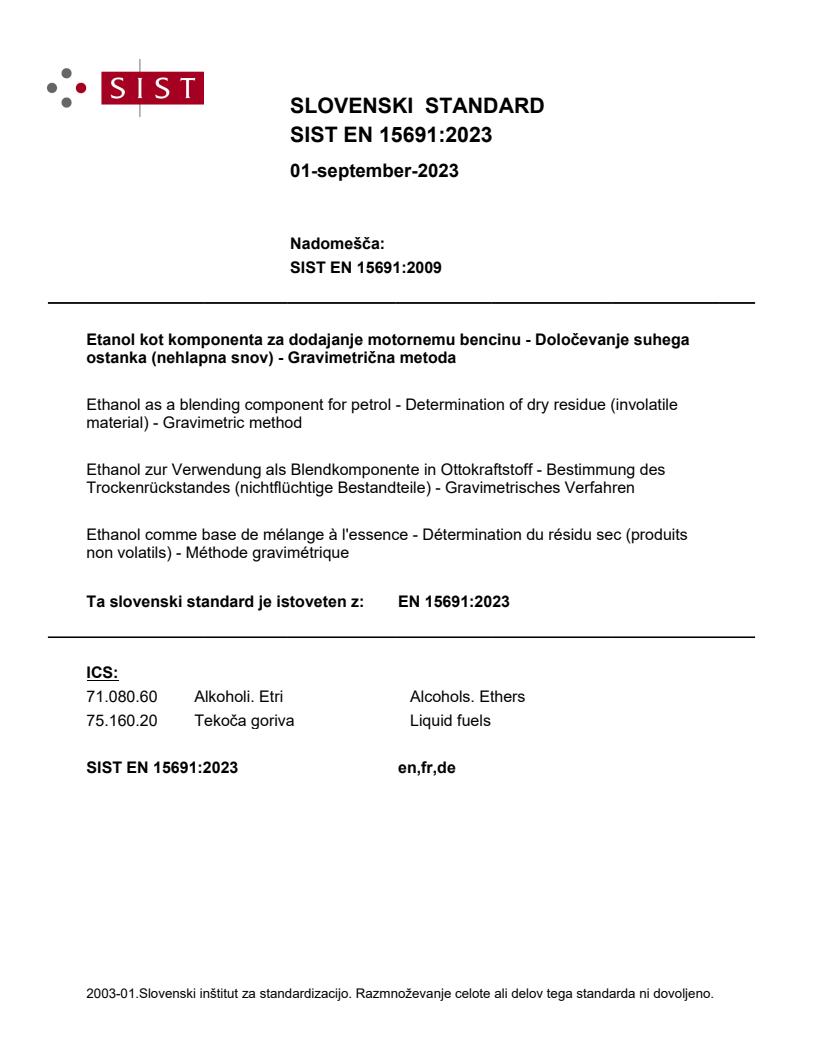
SLOVENSKI STANDARD
01-september-2023
Nadomešča:
SIST EN 15691:2009
Etanol kot komponenta za dodajanje motornemu bencinu - Določevanje suhega
ostanka (nehlapna snov) - Gravimetrična metoda
Ethanol as a blending component for petrol - Determination of dry residue (involatile
material) - Gravimetric method
Ethanol zur Verwendung als Blendkomponente in Ottokraftstoff - Bestimmung des
Trockenrückstandes (nichtflüchtige Bestandteile) - Gravimetrisches Verfahren
Ethanol comme base de mélange à l'essence - Détermination du résidu sec (produits
non volatils) - Méthode gravimétrique
Ta slovenski standard je istoveten z: EN 15691:2023
ICS:
71.080.60 Alkoholi. Etri Alcohols. Ethers
75.160.20 Tekoča goriva Liquid fuels
2003-01.Slovenski inštitut za standardizacijo. Razmnoževanje celote ali delov tega standarda ni dovoljeno.
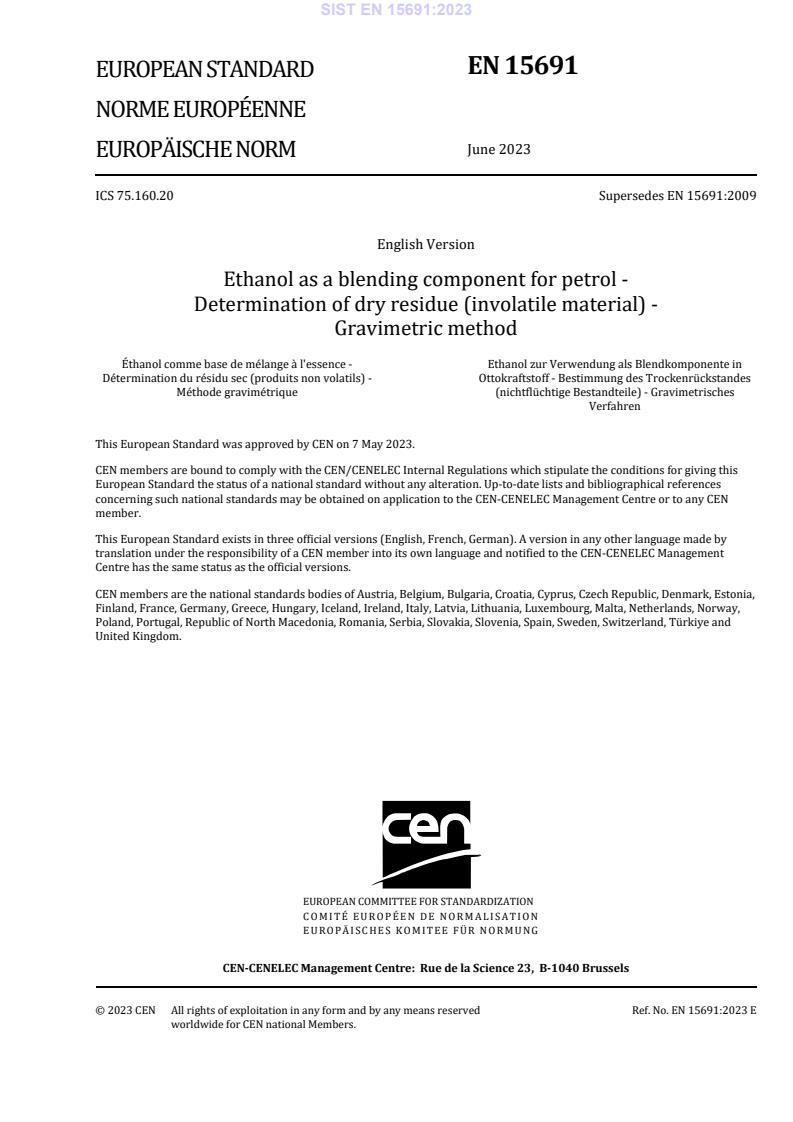
EN 15691
EUROPEAN STANDARD
NORME EUROPÉENNE
June 2023
EUROPÄISCHE NORM
ICS 75.160.20 Supersedes EN 15691:2009
English Version
Ethanol as a blending component for petrol -
Determination of dry residue (involatile material) -
Gravimetric method
Éthanol comme base de mélange à l'essence - Ethanol zur Verwendung als Blendkomponente in
Détermination du résidu sec (produits non volatils) - Ottokraftstoff - Bestimmung des Trockenrückstandes
Méthode gravimétrique (nichtflüchtige Bestandteile) - Gravimetrisches
Verfahren
This European Standard was approved by CEN on 7 May 2023.
CEN members are bound to comply with the CEN/CENELEC Internal Regulations which stipulate the conditions for giving this
European Standard the status of a national standard without any alteration. Up-to-date lists and bibliographical references
concerning such national standards may be obtained on application to the CEN-CENELEC Management Centre or to any CEN
member.
This European Standard exists in three official versions (English, French, German). A version in any other language made by
translation under the responsibility of a CEN member into its own language and notified to the CEN-CENELEC Management
Centre has the same status as the official versions.
CEN members are the national standards bodies of Austria, Belgium, Bulgaria, Croatia, Cyprus, Czech Republic, Denmark, Estonia,
Finland, France, Germany, Greece, Hungary, Iceland, Ireland, Italy, Latvia, Lithuania, Luxembourg, Malta, Netherlands, Norway,
Poland, Portugal, Republic of North Macedonia, Romania, Serbia, Slovakia, Slovenia, Spain, Sweden, Switzerland, Türkiye and
United Kingdom.
EUROPEAN COMMITTEE FOR STANDARDIZATION
COMITÉ EUROPÉEN DE NORMALISATION
EUROPÄISCHES KOMITEE FÜR NORMUNG
CEN-CENELEC Management Centre: Rue de la Science 23, B-1040 Brussels
© 2023 CEN All rights of exploitation in any form and by any means reserved Ref. No. EN 15691:2023 E
worldwide for CEN national Members.
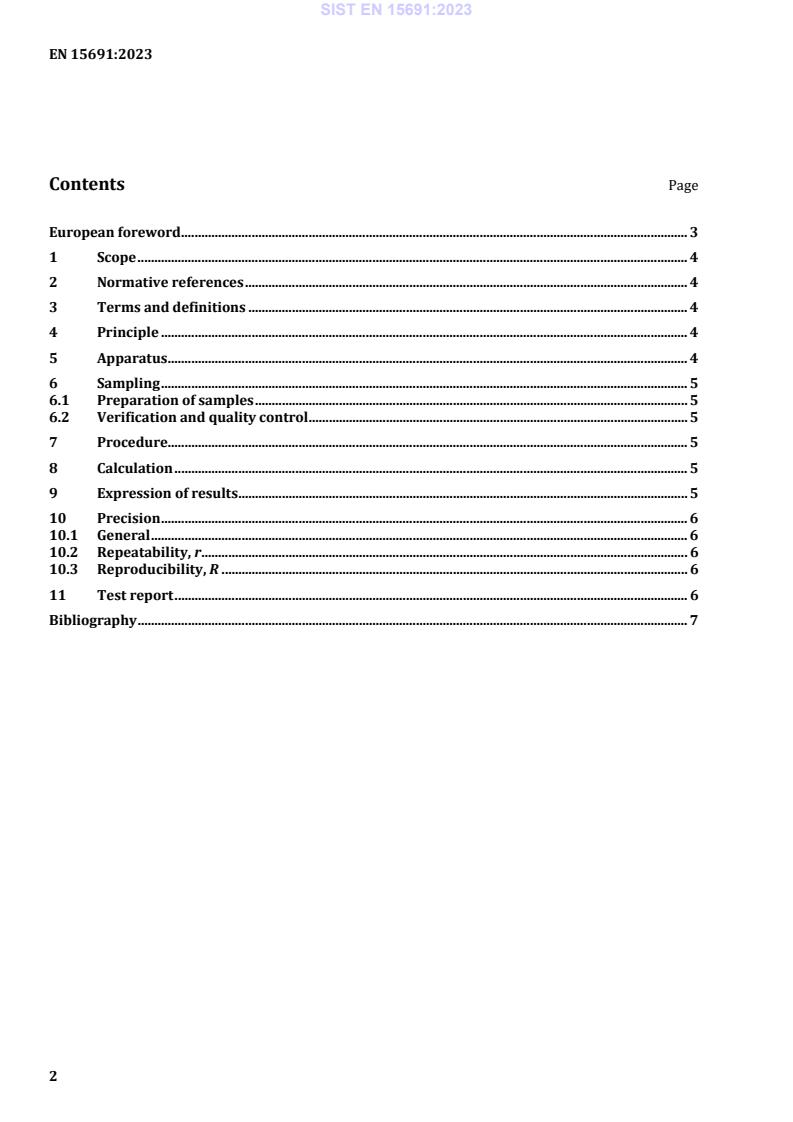
Contents Page
European foreword . 3
1 Scope . 4
2 Normative references . 4
3 Terms and definitions . 4
4 Principle . 4
5 Apparatus . 4
6 Sampling . 5
6.1 Preparation of samples . 5
6.2 Verification and quality control . 5
7 Procedure. 5
8 Calculation . 5
9 Expression of results . 5
10 Precision . 6
10.1 General . 6
10.2 Repeatability, r . 6
10.3 Reproducibility, R . 6
11 Test report . 6
Bibliography . 7
European foreword
This document (EN 15691:2023) has been prepared by Technical Committee CEN/TC 19 “Gaseous and
liquid fuels, lubricants and related products of petroleum, synthetic and biological origin”, the secretariat
of which is held by NEN.
This European Standard shall be given the status of a national standard, either by publication of an
identical text or by endorsement, at the latest by December 2023, and conflicting national standards shall
be withdrawn at the latest by December 2023.
Attention is drawn to the possibility that some of the elements of this document may be the subject of
patent rights. CEN shall not be held responsible for identifying any or all such patent rights.
This document supersedes EN 15691:2009.
It was originally prepared by CEN/TC 19’s Ethanol Task Force based on a regulated analysis method for
neutral alcohol [1].
In comparison with the previous edition EN 15691:2009, based on a re-evaluation of the interlaboratory
study the precision statement (Clause 10) has been replaced by the recalculated version. Following the
same re-evaluation the scope of the method (Clause 1) has not been extended.
Any feedback and questions on this document should be directed to the users’ national standards body.
A complete listing of these bodies can be found on the CEN website.
According to the CEN-CENELEC Internal Regulations, the national standards
...