

EN 15240:2007
(Main)Ventilation for buildings - Energy performance of buildings - Guidelines for inspection of air-conditioning systems
General Information
- Abstract
This European Standard describes the common methodology for inspection of air conditioning systems in buildings for space cooling and or heating from an energy consumption standpoint. The inspection can consider for instance the following points to assess the energy performance and proper sizing of the system:
- System conformity to the original and subsequent design modifications, actual requirements and the present state of the building.
- Correct system functioning.
- Function and settings of various controls.
- Function and fitting of the various components.
- Power input and the resulting energy output.
It is not intended that a full audit of the air conditioning system is carried out, but a correct assessment of its functioning and main impacts on energy consumption, and as a result determine any recommendations on improvement of the system or use of alternative solutions. National regulations and guidelines targeting energy efficiency and in line with the main objectives of this standard are also applicable.
NOTE Provision of adequate ventilation and system balancing are dealt with in EN 15239.
The qualification of the persons or organisation responsible for inspections is not covered by this standard, but the requirements for inspections are covered.
The frequency of the mandatory inspection is defined on national level. Features affecting the frequency and duration of inspection are introduced in Annex C.
- Status
- Withdrawn
- Publication Date
- 24-Apr-2007
- Withdrawal Date
- 29-Sep-2026
- Technical Committee
- CEN/TC 156 - Ventilation for buildings
- Drafting Committee
- CEN/TC 156 - Ventilation for buildings
- Current Stage
- 9960 - Withdrawal effective - Withdrawal
- Start Date
- 07-Jun-2017
- Completion Date
- 30-Sep-2026

Relations
- Effective Date
- 14-Jun-2017
- Effective Date
- 28-Jan-2026
- Effective Date
- 28-Jan-2026
Get Certified
Connect with accredited certification bodies for this standard

DIBt (Deutsches Institut für Bautechnik)
German Institute for Building Technology.
DIN CERTCO
DIN Group product certification.

Aboma Certification B.V.
Specialized in construction, metal, and transport sectors.
Sponsored listings
Frequently Asked Questions
EN 15240:2007 is a standard published by the European Committee for Standardization (CEN). Its full title is "Ventilation for buildings - Energy performance of buildings - Guidelines for inspection of air-conditioning systems". This standard covers: This European Standard describes the common methodology for inspection of air conditioning systems in buildings for space cooling and or heating from an energy consumption standpoint. The inspection can consider for instance the following points to assess the energy performance and proper sizing of the system: - System conformity to the original and subsequent design modifications, actual requirements and the present state of the building. - Correct system functioning. - Function and settings of various controls. - Function and fitting of the various components. - Power input and the resulting energy output. It is not intended that a full audit of the air conditioning system is carried out, but a correct assessment of its functioning and main impacts on energy consumption, and as a result determine any recommendations on improvement of the system or use of alternative solutions. National regulations and guidelines targeting energy efficiency and in line with the main objectives of this standard are also applicable. NOTE Provision of adequate ventilation and system balancing are dealt with in EN 15239. The qualification of the persons or organisation responsible for inspections is not covered by this standard, but the requirements for inspections are covered. The frequency of the mandatory inspection is defined on national level. Features affecting the frequency and duration of inspection are introduced in Annex C.
This European Standard describes the common methodology for inspection of air conditioning systems in buildings for space cooling and or heating from an energy consumption standpoint. The inspection can consider for instance the following points to assess the energy performance and proper sizing of the system: - System conformity to the original and subsequent design modifications, actual requirements and the present state of the building. - Correct system functioning. - Function and settings of various controls. - Function and fitting of the various components. - Power input and the resulting energy output. It is not intended that a full audit of the air conditioning system is carried out, but a correct assessment of its functioning and main impacts on energy consumption, and as a result determine any recommendations on improvement of the system or use of alternative solutions. National regulations and guidelines targeting energy efficiency and in line with the main objectives of this standard are also applicable. NOTE Provision of adequate ventilation and system balancing are dealt with in EN 15239. The qualification of the persons or organisation responsible for inspections is not covered by this standard, but the requirements for inspections are covered. The frequency of the mandatory inspection is defined on national level. Features affecting the frequency and duration of inspection are introduced in Annex C.
EN 15240:2007 is classified under the following ICS (International Classification for Standards) categories: 91.140.30 - Ventilation and air-conditioning systems. The ICS classification helps identify the subject area and facilitates finding related standards.
EN 15240:2007 has the following relationships with other standards: It is inter standard links to EN 16798-17:2017, EN 12792:2003, EN 14511-1:2004. Understanding these relationships helps ensure you are using the most current and applicable version of the standard.
EN 15240:2007 is associated with the following European legislation: Standardization Mandates: M/343. When a standard is cited in the Official Journal of the European Union, products manufactured in conformity with it benefit from a presumption of conformity with the essential requirements of the corresponding EU directive or regulation.
EN 15240:2007 is available in PDF format for immediate download after purchase. The document can be added to your cart and obtained through the secure checkout process. Digital delivery ensures instant access to the complete standard document.
Standards Content (Sample)
2003-01.Slovenski inštitut za standardizacijo. Razmnoževanje celote ali delov tega standarda ni dovoljeno.Ventilation for buildings - Energy performance of buildings - Guidelines for inspection of air-conditioning systemsRUVWYRVentilation des bâtiments - Performance énergétique des bâtiments - Lignes directrices pour l'inspection des systemes de climatisationLüftung von Gebäuden - Gesamtenergieeffizienz von Gebäuden - Leitlinien für die Inspektion von KlimaanlagenTa slovenski standard je istoveten z:EN 15240:2007SIST EN 15240:2007en91.140.30VLVWHPLVentilation and air-conditioningICS:SLOVENSKI
STANDARDSIST EN 15240:200701-julij-2007
EUROPEAN STANDARDNORME EUROPÉENNEEUROPÄISCHE NORMEN 15240April 2007ICS 91.140.30 English VersionVentilation for buildings - Energy performance of buildings -Guidelines for inspection of air-conditioning systemsVentilation des bâtiments - Performance énergétique desbâtiments - Lignes directrices pour l'inspection dessystèmes de climatisationLüftung von Gebäuden - Gesamtenergieeffizienz vonGebäuden - Leitlinien für die Inspektion von KlimaanlagenThis European Standard was approved by CEN on 26 March 2007.CEN members are bound to comply with the CEN/CENELEC Internal Regulations which stipulate the conditions for giving this EuropeanStandard the status of a national standard without any alteration. Up-to-date lists and bibliographical references concerning such nationalstandards may be obtained on application to the CEN Management Centre or to any CEN member.This European Standard exists in three official versions (English, French, German). A version in any other language made by translationunder the responsibility of a CEN member into its own language and notified to the CEN Management Centre has the same status as theofficial versions.CEN members are the national standards bodies of Austria, Belgium, Bulgaria, Cyprus, Czech Republic, Denmark, Estonia, Finland,France, Germany, Greece, Hungary, Iceland, Ireland, Italy, Latvia, Lithuania, Luxembourg, Malta, Netherlands, Norway, Poland, Portugal,Romania, Slovakia, Slovenia, Spain, Sweden, Switzerland and United Kingdom.EUROPEAN COMMITTEE FOR STANDARDIZATIONCOMITÉ EUROPÉEN DE NORMALISATIONEUROPÄISCHES KOMITEE FÜR NORMUNGManagement Centre: rue de Stassart, 36
B-1050 Brussels© 2007 CENAll rights of exploitation in any form and by any means reservedworldwide for CEN national Members.Ref. No. EN 15240:2007: E
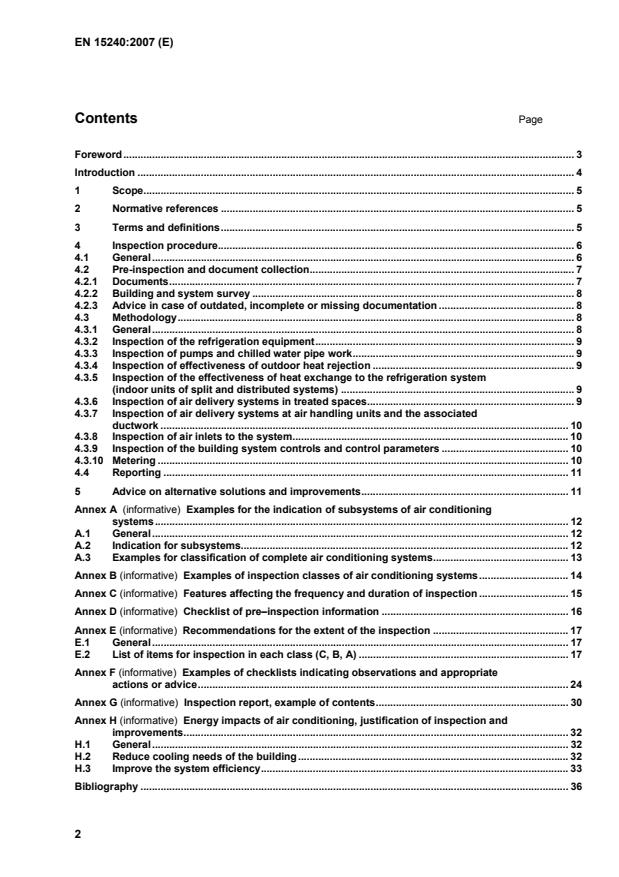
(informative)
Examples for the indication of subsystems of air conditioning systems.12 A.1 General.12 A.2 Indication for subsystems.12 A.3 Examples for classification of complete air conditioning systems.13 Annex B (informative)
Examples of inspection classes of air conditioning systems.14 Annex C (informative)
Features affecting the frequency and duration of inspection.15 Annex D (informative)
Checklist of pre–inspection information.16 Annex E (informative)
Recommendations for the extent of the inspection.17 E.1 General.17 E.2 List of items for inspection in each class (C, B, A).17 Annex F (informative)
Examples of checklists indicating observations and appropriate actions or advice.24 Annex G (informative)
Inspection report, example of contents.30 Annex H (informative)
Energy impacts of air conditioning, justification of inspection and improvements.32 H.1 General.32 H.2 Reduce cooling needs of the building.32 H.3 Improve the system efficiency.33 Bibliography.36
Existing national regulations with or without reference to national standards, may restrict for the time being the implementation of the European Standards mentioned in this report. According to the CEN/CENELEC Internal Regulations, the national standards organizations of the following countries are bound to implement this European Standard: Austria, Belgium, Bulgaria, Cyprus, Czech Republic, Denmark, Estonia, Finland, France, Germany, Greece, Hungary, Iceland, Ireland, Italy, Latvia, Lithuania, Luxembourg, Malta, Netherlands, Norway, Poland, Portugal, Romania, Slovakia, Slovenia, Spain, Sweden, Switzerland and United Kingdom.
The possibility to introduce classes is given in this standard in order to leave Member States freedom to choose between different objectives and extent of inspection, within a harmonised framework.
Air conditioning systems can be described according to the list of systems and subsystems presented in Annex A. Inspection classes can also be specified on national level. Examples of inspection classes are introduced in Annex B.
NOTE Provision of adequate ventilation and system balancing are dealt with in EN 15239. The qualification of the persons or organisation responsible for inspections is not covered by this standard, but the requirements for inspections are covered.
The frequency of the mandatory inspection is defined on national level. Features affecting the frequency and duration of inspection are introduced in Annex C. 2 Normative references The following referenced documents are indispensable for the application of this document. For dated references, only the edition cited applies. For undated references, the latest edition of the referenced document (including any amendments) applies. EN 12792:2003, Ventilation for buildings — Symbols, terminology and graphical symbols
EN 14511-1:2004, Air conditioners, liquid chilling packages and heat pumps with electrically driven compressors for space heating and cooling — Part 1: Terms and definitions 3 Terms and definitions For the purposes of this document, the terms and definitions given in EN 12792:2003 and EN 14511-1:2004 and the following apply.
3.1 air conditioning system combination of all components required to provide a form of air treatment in which temperature is controlled, possibly in combination with the control of ventilation, humidity and air cleanliness
3.3 air conditioning system control measures taken in ensuring the system operates in accordance with the design criteria
NOTE It may be a part of the building system control
3.4 commissioning sequence of events that ensure the building and its associated heating, ventilation and air conditioning systems are functioning in accordance with the design parameters 3.5 design criteria set of descriptions based on particular environmental elements such as indoor air quality, thermal and acoustical comfort, energy efficiency and the associated system controls to be used for assessing the plant operation 3.6 control parameters set values of the internal environmental conditions 3.7 design documentation written descriptions of the essential design elements of the plant
3.8 cooling energy distribution system (abbreviated CED-system) subsystem, where the cooling energy is transported and distributed from the CES-system to CEE-system by a distribution medium, inclusive control systems (examples for the distribution medium are air, water, refrigeration fluid) 3.9 cooling energy emission system (abbreviated CEE-system) subsystem, where the cooling energy is emitted to the space (for example air outlets, fan coils, chilled ceiling, surface cooling) inclusive control systems 3.10 cooling energy generation system (abbreviated CEG-system) subsystem, where the cooling energy is generated by refrigeration units (examples are chillers, absorber unit, heat pumps) inclusive control systems 3.11 energy supply system (abbreviated ES-system) system supplying the necessary energy to generate the CEG-system (examples are electricity, gas, solar) inclusive control systems 4 Inspection procedure 4.1 General The inspection shall commence with examination of the relevant design and system documentation and visual checks as far as possible to ensure that the equipment described is present and according to system specification. If the documentation is not available, then an additional part of this procedure is to locate the equipment and assemble a minimum portfolio of relevant documentation.
Comments on the frequency and scope of maintenance of the air conditioning systems shall be covered in relation to national requirements and good practice, e.g. industry guidelines, This, and the dates of most recent maintenance may be referred to during the ‘physical’ inspection. Where there is clear evidence that a good practice program of maintenance is being carried out, then the inspection described in this standard may be simplified or reduced in accordance with the classification.
When checking the performance of different parts of an air-conditioning system, the measurement methods employed will assist subsequent follow-ups. To make this possible, the instructions for each measurement method shall be followed and the instruments for the measurements calibrated in accordance with the manufacturer's instructions.
Compare system sizes with likely loads. Annex F contains procedures for assessing whether refrigeration systems and air supply and extract systems are likely to be oversized. Estimate the Specific Fan Power of the air movement systems whenever relevant, from the installed fan capacities and the flow rates, noted in the commissioning records.
4.2 Pre-inspection and document collection 4.2.1 Documents 4.2.1.1 General
Prior to inspection, where possible, the design criteria, system characteristics and the operational regime shall be determined. All available original documentation relating to the building and the installed systems shall be collected and assessed. Additional documentation, if it exists, indicating any modifications or alterations to the building, the systems or the use since the original documents, shall also be obtained and assessed. Annex D provides examples of documents needed. 4.2.1.2 Design documentation Collect and identify available current relevant documents to support the inspection and the relevant subsystems and components.
The energy certificate, if available, shall be used. Correspondence between documentation and actual installed components shall be checked. Any difference shall be stated in the report.
The design documents, where available, which define the relevant design criteria, shall be checked against the actual installation and the present use. 4.2.1.3 System characteristics Working or as installed drawings shall be checked against the actual installation and use of the building.
An equipment list shall be obtained or prepared. If available, the commissioning data shall be checked against the present system. 4.2.1.4 Building and system operation and maintenance status Determine whether the air conditioning system, subsystems or components are regularly and correctly operated, and maintained by qualified and/or authorised personnel according to: • System designer’s instructions • Manufacturer’s instructions of the subsystems and components • Any legal or statutory requirements The maintenance status is an important part of the inspection. Check the maintenance records for the system and for individual items of the system, as well as the building and system log book.
4.2.2 Building and system survey Advise the user to keep and maintain any documentation determined above and any survey or calculations carried out during the initial (first) pre-inspection in a file so that they are available for subsequent inspections of the building and system(s).
4.2.3 Advice in case of outdated, incomplete or missing documentation In existing buildings the design and system documentation may be incomplete or even missing. The existing documentation may be partly outdated, due to undocumented changes in the use, loads, construction elements or building services systems during the building's lifetime.
In these cases, the lacking or outdated documentation shall be identified (the checklists given in Annexes F and G may be used whenever relevant), and the organisation or person responsible for the inspection shall provide the user advice on how to develop a plan to complete the documentation.
4.3 Methodology 4.3.1 General The inspection shall determine if the equipment operates in an appropriate environment and with acceptable efficiency and if maintenance and control checking operations are regularly carried out.
NOTE 1 Some of the checks and tests described here are obligatory in some countries, and may be done separately or in connection with the full inspection, and also more frequently than the full inspection if required. The inspection should take these into account as a part of the inspection if relevant.
Check the refrigeration equipment.
NOTE The checks would typically include the following items:
-refrigeration plant and its immediate surroundings; -compressors; -measurement records; -capability of providing cooling: operating temperatures, refrigerant charge, refrigerant leak; -insulation of refrigerant lines; -vibration and noise level; -condensing pressure; -efficiency data of the chillers. If any regulation requires periodic leak detection and repair, the documentation of the leak test shall be examined.
4.3.3 Inspection of pumps and chilled water pipe work Check the condition and operation of chilled water pipe work and its insulation. A good insulation, especially on chilled water systems where lengths of chilled water lines can be considerable, can have a significant influence on the system energy efficiency of the system. Check for signs of leakage from the pipe work. Check the pumps and valves for the distribution of water as an energy carrier.
4.3.4 Inspection of effectiveness of outdoor heat rejection
Locate and check the condition and operation of the outdoor heat rejection units.
4.3.5 Inspection of the effectiveness of heat exchange to the refrigeration system (indoor units of split and distributed systems) Check the condition and operation of heat exchangers inside those units installed within the treated spaces. 4.3.6 Inspection of air delivery systems in treated spaces NOTE 4.3.6 to 4.3.8 is applied in cases where the air-conditioning system includes distribution of cooling energy using ventilation. See also EN 15239. In the treated indoor spaces, locate and check the air delivery openings, grilles or diffusers, and locate the route by which air is extracted from the spaces. Note if there is any evidence that occupants find the air delivery arrangement unacceptable. Assess the positioning and geometry of air supply openings in relation to extract openings, and the potential to short-circuit from supply to extract.
Determine and record the frequency of filter changing or cleaning, and the time elapsed since the last change or cleaning. Assess the current state of cleanliness, damage or blockage of filters. Assess the condition of heat exchangers.
4.3.8 Inspection of air inlets to the system
Locate and check the air inlets to the system. 4.3.9 Inspection of the building system controls and control parameters Identify and provide advice of all controls, sensors and indicators which are relevant for energy performance, as appropriate, on: • location
• function • settings Locate and inspect the controls responsible for the operation of the air conditioning or comfort cooling system, the heating system controls, and their associated temperature sensors. Review documentation or other sources of information to determine the individual control zones for heating and cooling. Determine the appropriateness of zoning in relation to factors such as local levels of internal gain, orientation and exposure to solar radiation.
Determine, where applicable, the method used to set, modulate or control air flow rate in the air supply, recirculation and exhaust ducts. Provide a view of the efficiency compared to good current practice.
4.3.10 Metering
Meters may have been installed to air conditioning systems, such as energy consumption or running time meters. Regularly noting the readings of such meters can help assess the operation of the air conditioning system.
Where energy consumption has been recorded on a regular basis, an estimate shall be done from the rated input power and the consumption record, whether the equipment is running in accordance with the use of the building. If not, the inspection shall include advice to the owner to reduce the energy consumption.
Where meters are installed, but no consumption records are available, the inspection shall include advice to record meter readings on a regular basis. Where no such metering is in place, a part of the advice provided would be to install appropriate energy consumption metering at least to the more significant energy consuming air conditioning plant, and subsequently to record the consumption on a regular basis.
A report of the air conditioning inspection shall be prepared. The inspection report shall include at least the identification data of the property inspected and person and organisation in charge of the inspection, list of the relevant documents, and results of the inspection. One example of the list of the inspection report is given in Annex G.
The inspection report shall give an assessment of the total energy efficiency of the systems inspected.
5 Advice on alternative solutions and improvements
According to Article 9 of the EPBD, advice is to be provided to the users on “possible improvement or replacement of the air-conditioning system and on alternative solutions”. As the pre-inspected and collected information, as well the inspection results are different according to the system, the advice vary regarding the improvements and alternative solutions. The advice shall consider the main impacts for improvements: • Adaptation to the actual use of the building • Reduction of the cooling load • Improvement of the maintenance • Incorrect function of the system, the subsystems and components • Replacement of the system, subsystems or components NOTE 1 Alternative solutions may be necessary for such air conditioning systems which are far away from agreed reference values, like replacement of the whole system. Detailed cost effectiveness studies are outside the scope of this assessment, but a number of opportunities may be considered worthwhile recommending for further study by specialists. These should generally include alterations that could be made at relatively low cost, particularly those that might be considered when older equipment is due for replacement. This will allow the loading on cooling equipment to be reduced or would increase the opportunity to make use of available solutions alternative to mechanical cooling, for at least part of the time.
NOTE 2 Annex H describes in more detail some of these issues. The checklists presented in Annex F give also guidance on advice and recommendations.
(informative)
Examples for the indication of subsystems of air conditioning systems
A.1 General Air conditioning systems are varied and for the specification they should be split into the various subsystems. An indication of subsystems is written in A.2. The complete air conditioning system is the sum of the subsystems. Examples for classification of complete air conditioning systems are described in A.3 A.2 Indication for subsystems
Table A.1 - Terms of subsystems Subsystem Main components Term Remarks CEE-system Air outlets E.1
Fan coils E.2
Cooling ceiling system E.3
Surface cooling system E.4
Heat exchangers for ventilation system E.5
Air filter
E.6
Split unit evaporator E.7
Optional
E.xx
CED-system Ventilation duct system D.1
Water pipe system D.2
Refrigeration pipe system D.3
Optional
D.xx
CEG-system Chiller air-cooled G.1
Chiller water-cooled G.2
Split-unit condenser G.3
Air-to-water heat pump
G.4
Water-to-water heat pump
G.5
Absorption system G.6
Single-package system
G.7
Air-to-air heat pumps G.8
Water-to-air heat pumps G.9
Optional
G.xx
ES-System Electric supply system S.1
Gas supply system S.2
Solar energy supply system S.3
District heat system S.4
Optional S.xx
Advice:
1)
More detailing of main components can be done by adding further numbers (e.g. G.xx)
see term Gx.x. )
2)
Missing main components can be added as optional.
A.3 Examples for classification of complete air conditioning systems
a)
Single split room conditioner systems is classified as:
E.7 + D.3 + G.3 + S.1
b)
System with air cooled chiller and fan coils is classified as:
E.2 + D.2 + G.1 + S.1
c)
System with gas motor driven heat pump with surface cooling:
E.4 + D.2 + G.5 + S.2
(informative)
Examples of inspection classes of air conditioning systems
The inspection class can be determined according to different criteria, such as:
- type of air conditioning system (generation and emission), - cooling capacity,
- annual running time,
- age of the installation, - use of the building (e.g. residential, office…) - location of the system (e.g. outdoor/indoor) and the building
-etc. The following table gives an example how to classify the system inspection class.
Table B.1 - Example of a classification system, with three inspection classes
Inspection class Specification Details Dim. Remarks 1 Nominal cooling capacity:
Annual running time:
Date of installation:
12,0 – 49,9 under 2000 a
less than 10 kW h/a years
2 Nominal cooling capacity:
Annual running time:
Date of installation: 50,0 – 399,9 up to 5000 less than 15 kW h/a years
3 Nominal cooling capacity:
Annual running time:
Date of installation: Above 400,0 up to 5000 b
Less than 20 kW h/a years
a summer cooling only b all year cooling
If one of the details is not fulfilled the inspection class is upgraded to the next higher class.
(informative)
Features affecting the frequency and duration of inspection
The minimum contents and frequency of mandatory inspection is defined on national level, with a recommended default value of 5 years. On voluntary basis, more extensive and more frequent inspections are possible.
The inspection may be more or less frequent, depending on: type of building, energy impact of the system, type of equipment, quality of system documentation, availability of records of measurements and/or energy consumption metering, and quality of maintenance. For centralised systems for cooling and ventilation, different parts and system components may require more frequent checks, and in this case these records should be available for inspection.
After the initial inspection, the time for the next inspection may be longer or shorter depending on the results from the initial inspection and on the level of maintenance.
The inspection intervals recommended should be given on national level as tabled values and compared to the default frequency given above.
The outcome of the inspection will be to generate advice for the owner or manager to improve the system, or improve system maintenance. A part of that advice will be to recommend more frequent routine inspection and maintenance, for a good practice maintenance programme. The advice shall be integrated and balanced with other energy conservation recommendations. The time taken for the inspection obviously depends on the size and age of the system, type of building, time since latest inspection, quality of documentation and maintenance of the systems installed. In many cases the required extent of the inspection can be estimated from the quality of system documentation (including balancing and maintenance records), checking of self-inspection records and a relatively short visual check. In the best cases these, if they clearly give an impression of properly maintained systems and meeting the requirements of Article 9, the scope of inspection may be reduced. The checklist given in Annex F is suitable for a relatively "simple" inspection for a combined system. However, this inspection will not provide a complete picture of the system energy performance including the performance of controls.
Checklist of pre–inspection information Information needed
Present Y/N 1 Itemised list of installed air-conditioning systems, with >12kW rated output for the buildinga, with locations of the indoor and outdoor components of each system.
2 Description of system control zones.
3 Description of method of control of temperature.
4 Description of method of control of periods of operation.
5 Maintenance plan and records of maintenance to refrigeration systems, including cleaning indoor and outdoor heat exchangers, refrigerant leakage tests, repairs to refrigeration components or replenishing with refrigerant.
6 Maintenance plan, and records of maintenance to air delivery systems, including filter cleaning and changing, and cleaning of heat exchangers.
7 Records of calibration and maintenance operations carried out on building automation and control systems and sensors, or building management systems and sensors.
8 For relevant air supply and extract systems, commissioning results of measured absorbed power at normal air delivery and extract air rates and commissioning results for normal delivered delivery and extract air flow rates (or independently calculated Specific Fan Power for the systems).
9 An estimate of the design cooling load for each system (if available). Otherwise, a brief description of the occupation of the cooled spaces, and of power consuming equipment normally used in those spaces.
10 Energy consumption counters; location, target values for consumption, records of consumption, compared measured vs. target consumption
11 Records of any issues or complaints that have been raised concerning the indoor comfort conditions achieved in the indoor spaces.
12 Where a Building Management System (BMS) is used, a statement describing its capabilities, the plant it is connected to control, the set points for the control of temperature, the frequency with which it is maintained, and the date of the last inspection and maintenance. See also prEN 15232
13 Where a monitoring station, or remote monitoring facility, is used to continually observe the performance of equipment such as chillers, a statement describing the parameters monitored, and a statement reviewing the operating efficiency of the equipment.
a unless the 12 kW limit is specified otherwise on national level
(informative)
Recommendations for the extent of the inspection E.1
General The list according to E.2 describes an example of the minimum recommended extent for inspection. The extent may be different for different inspection classes. In the following example of E.2, the recommended extent for three different classes (C for low level, B for medium level, A for high level) are given for a few subsystems defined in Annex A. Additional classes and features for the inspection are possible.
E.2
List of items for inspection in each class (C, B, A)
DOCUMENTATION No. Item Details C BAC.1.1 Inspection class determined O
O
O
O
O x x x C.2.1 State of the building design documentation No
O
notcomplete
O
complete
O
x x x C.2.2
Missing parts …………………………………………
x x C.3.1 Air conditioning system design documentation No
O
notcomplete
O
complete
O
x x x C.3.2
Missing parts ….……………………………………….
x x C.4.1 Cooling load estimated ………….kW x
C.4.2
calculated ………….kW
x x C.5 Air conditioned building volume …………. m3 x x x C.6.1 Operation mode free cooling
O
outdoor cooling
O recirculation air cooling
O
x x x C.6.2 Mode of running operation
……….h
x
Optional
BUILDING No. Item Details C BAB.1 Address …………………………………………. x x x B.2 Location ………………………………………… x x x B.3 User name …………………………………………. x x x B.4 User address …………………………………………. x x x B.5 Responsible person …………………………………………. x x x B.6 Building / zone type space
O
office
O
hotel
O
factory
O
service appliances
O
…………………………………………………………………………………… x x x B.7 Date erection …………changes ………….
x x x B.8 Relevant changes building ………………………………………….
B.9 Usage
residential
O
non residential
O x x x B.10 Air conditioned volume …………… m3 x x x B.11 Required services humification
O
dehumification
O cooling
O x x x B.12 Required values
indoor air temperature
…………º
indoor humidity
…………%.
x x XB.13 Building mass specification heavy
O
middle
O
low
O
x x B.14.1 Sun radiation protection
No
O
Yes
O
x x x B.14.2
type
…………………………………………
x x B.14.3
shielding factor
……………
x XB.14.4
function correct
No
O
Yes
O x x x B.15.1 Internal load persons No
O
Yes
O
x x x B.15.2
number of persons
…………………………………………
x x B.15.3
relevant appliances No
O
Yes
O
type ……………….
x x B.15.4
total internal load: ……………kW
x x B.16.1 External load outdoor air . ………….kW x x x B.16.2
recirculation air …….……. kW x x x B.16.3
cooled appliances No
O
Yes
O
type
…….………. x x x B.16.4
appliances load …………kW
x x x
Optional
CEE-SYSTEMS (cooling energy emission) – example: fan coils
No. Item Details C BAE.2.1.1 Documentation
No
O
not complete
O
complete
O x x x E.2.1.2
missing parts …………………………………………
x x E.2.2 Number/type ………………………………………… x x x E.2.3 Total air flow
………….m3/s
x x E.2.4 Total cooling capacity
………… kW
x x x E.2.5.1 Running time estimated .…….…h/a
x
E.2.5.2.
measured
……… …h/a
x x E.2.6.1 Total fan power calculated ………… kW
x x
E.2,6.2.
measured
………… kW
x E.2.7 Specific fan power .………. W.m-3.s
x E.2.8 Maintenance state Regular
O
on demand
O
No
O x x x E.2.9 State of operation satisfied
O
not satisfied
O x x x E.2.10.1 Control system
No
O
Yes
O
type
…………………. x x x E.2.10.2
setting satisfied
O
not satisfied
O
x x . Optional
CEE-SYSTEMS – example: Split unit room conditioner No. Item Details C BAE.7.1.1 Documentation
No
O
not complete
O
complete
O x x x E.7.1.2
missing parts …………………………………………
x x E.7.2 Type/ Specification ………………………………………… x x x E.7.3 Total air flow
………….m3/s
x x E.7.4 Total cooling capacity
….………kW
x x E.7.5.1 Running time estimated ………….h/a
x
E.7.5.2
measured
………….h/a
x x E.7.6.1 Total fan power calculated .………. .kW
x
E.7.6.2
measured
………….kW
Xx E.7.7 Specific fan power .………. .W.m-3.s
x x x E.7.8.1 Control system
No
O
Yes
O
type
……………… x x x E.7.8.2
setting satisfied
O
not satisfied
O
x x E.7.9 Maintenance state regular
O
on demand
O
No
O x x x E.7.10 State of operation satisfied
O
not satisfied
O x x x
Optional
CED-SYSTEM (cooling energy distribution)-example: Water pipe system No. Item Details C BAD.2.1.1 Documentation
No
O
not complete
O
complete
O x x x D.2.1.2
missing parts …………………………………………
x x D.2.2 Tightness visual satisfied
O
not satisfied
O x x x D.2.3.1 Isolation
visual satisfied
O
not satisfied
O x x x D.2.3.2
surface temperature
measured…….ºC
x x D.2.4 Condensation outside No
O
Yes
O x x x D.2.5.1 Water flow calculated
………. m3/s x
D.2.5.2.
measured ………. m3/s
x x D.2.6.1 Pressure drop calculated
………. Pa x
D.2.6.2
measured ………. Pa
x x D.2.7 Temperatures supply ……… ºC
return
………
ºC
x x x D.2.8 Number cooling circles
………………………………………….
x x x D.2.9 Labelling Yes
O
No
O
necessary
O x x x D.2.10.1 Isolation piping
visual satisfied
O
not satisfied
O x x x D.2.10.2
armatures visual satisfied
O
not satisfied
O x x x D.2.11 Condensation outside No
O
Yes
O x x x D.2.12.1 Circulating pump number …………………………….
x x D.2.12.2
type
…………………………….
x x D.2.12.3
total nominal power ………….kW
x x D.2.13 Total water flow ………… m3/s
x x D.2.14 Pressure drop ………….Pa
x x D.2.15 Running mode
modulating
O
on demand
O x x x . Optional
CEG-SYSTEM (cooling energy generation) – example: Chiller air-cooled No. Item Details C BAG.1.1.1 Documentation
No
O
not complete
O
complete
O x x x G.1.1.2
missing parts …………………………………………
x x G.1.2 Type of thermodynamic system
Compressor
O
Ab( Ad )sorber x x x G.1.3 Type of refrigeration fluid ………………………………………… x x x G.1.4 COP calculated …………. x x x G.1.5 Running time estimated …………h/a
x
G.1.5.1
measured …………h/a
x x G.1.6
Condenser type ?
O
?
O x x x G.1.7.1 Fan power measured
…………h/a
x
G.1.7.2
calculated
………. kW
x x G.1.8 Total air flow
. ………. m3/s
x x G.1.9 Specific fan power value ………….W.m-3.s
x G.1.10.1 Storage tank No
O
Yes
O
x x x G.1.10.2
volume ………….m3 x x x G.1.10.3
Isolation
visual satisfied
O
not satisfied
O x x x G.1.10.4
Surface temperature
measured….ºC
x G.1.11 Total cooling capacity
………… kW
x x x G.1.12.1 Control system
No
O
Yes
O
type ……………… x x x G.1.12.2
setting satisfied
O
not satisfied
O
x x G.13 Maintenance state regular
O
on demand
O
No
O x x x G.14 State of operation satisfied
O
not satisfied
O x x x
Optional
CEG-SYSTEM-example: Split unit condenser No. Item Details C BAG.3.1.1 Documentation
No
O
not complete
O
complete
O x x x G.3.1.2
missing parts ……………………………………………
x x G.3.2 Type
Single split unit
O
Multi split unit
x x x G.3.3 Condenser location
indoor
O
outdoor
O x x x G.3.4 Supply of outdoor air
satisfied
O
not satisfied
O x x x G.3.5 Total cooling capacity
…………kW
x x x G.3.6 COP calculated ………….
x x G.3.7.1 Running time estimated …………h/a
x
G.3.7.2
measured …………h/a
x x G.3.8 Total power specific value …………W.m-3.s
x G.3.9
Maintenance state regular
O
on demand
O
No
O x x x G.3.10
State of operation satisfied
O
not satisfied
O x x
...