

EN 12693:2026
(Main)Refrigerating systems and heat pumps - Safety and environmental requirements - Positive displacement refrigerant compressors
General Information
- Abstract
This document is applicable to positive displacement refrigerant compressors for stationary and mobile refrigerating systems and heat pumps, hereafter called compressors.
It is applicable for compressors used in commercial and industrial appliances and with electrical energy supply including integral motors, up to 1 000 VAC and 1 500 VDC.
It is applicable to open drive, semi hermetic and hermetic motor compressors, which contain a positive compression function.
This document is not applicable to:
- compressors used in household appliance for which EN IEC 60335-2-34 applies;
- compressors using water or air as refrigerant;
- compressors in vehicle air conditioning systems covered by a specific product standard, e.g. ISO 13043.
This document does not deal with requirements for emission of noise.
NOTE 1 Compressors for automotive comfort air conditioning systems can be developed according e.g. SAE J 639.
NOTE 2 Noise emission depends on the complete installation of the built-in compressors and the corresponding operating conditions.
For semi-hermetic and open drive compressors which include moving parts and for which the external envelope is primarily designed for mechanical loads, thermal loads (to limit the possible deformation due to temperature), stiffness of the structure (external mechanical loads and weight of the equipment), taking into account established safe industrial practice, it is considered that pressure is not a significant design factor.
Attached parts covering other functions e.g. oil separators, oil coolers, suction accumulators comply to EN 14276-1 or EN 13445-6 (cast iron) or EN 13445-8 (aluminium) or show compliance to the relevant European requirements. This is applicable also to shells for hermetic compressors either welded or with any kind of permanent joint.
Requirements for compressors used in explosive atmospheres are not covered by this document.
NOTE 3 For further guidance see EN 1127-1.
This document deals with significant hazards, hazardous situations and events relevant to compressors, when they are used as intended and under conditions for misuse which are reasonably foreseeable by the manufacturer (see Clause 4).
This document specifies safety requirements for the design, construction, manufacture and testing, documentation and marking of compressors, including integral accessories, e.g. shut-off valve, if necessary.
This document relates to the compressor itself which is to be incorporated in a refrigerating system.
This document is not applicable to compressors as specified in the scope which are manufactured before the date of publication.
- Status
- Published
- Publication Date
- 09-Jun-2026
- Technical Committee
- CEN/TC 182 - Refrigerating systems, safety and environmental requirements
- Drafting Committee
- CEN/TC 182/WG 2 - Design and testing
- Current Stage
- 6060 - Definitive text made available (DAV) - Publishing
- Start Date
- 10-Jun-2026
- Due Date
- 21-Feb-2023
- Completion Date
- 10-Jun-2026
- Directive
- 2006/42/EC - Directive 2006/42/EC of the European Parliament and of the Council of 17 May 2006 on machinery, and amending Directive 95/16/EC (recast)OJ Ref: OJ L, 2026/2015 OJ Date: 07-Sep-2026

Overview
EN 12693:2026 - "Refrigerating systems and heat pumps - Safety and environmental requirements - Positive displacement refrigerant compressors" is a European Standard developed by CEN. This standard specifies the critical safety and environmental requirements for positive displacement refrigerant compressors intended for use in both stationary and mobile refrigerating systems and heat pumps. It covers applications in commercial and industrial appliances powered by electrical supplies up to 1,000 VAC or 1,500 VDC and addresses compressors including open drive, semi-hermetic, and hermetic types.
Importantly, EN 12693:2026 clarifies requirements related to hazards, safe practices, and testing, supporting compliance with key European directives, including the Machinery Directive (2006/42/EC). The standard is intended to promote high safety, reliability, and environmental performance, ensuring compressors meet the necessary requirements for integration into modern refrigerating and heat pump systems.
Key Topics
Scope and Applicability
- Applies to positive displacement compressors for stationary/mobile systems.
- Intended for commercial and industrial use, not household appliances.
- Covers compressors with integral motors up to specified voltages.
Safety Requirements
- Identification of significant hazards associated with compressor operation.
- Specifies protective measures, including guarding moving parts, preventing ruptures, and ensuring stability.
- Requirements for preventing electrical hazards and ensuring safe earthing, wiring, and insulation.
Environmental Considerations
- Outlines methods to reduce emissions of substances harmful to the environment.
- Sets testing and documentation requirements to demonstrate environmental compliance.
Testing and Verification
- Details procedures for type and individual testing of compressors for mechanical strength, tightness, and electrical safety.
- Includes requirements for routine manufacturer checks and verification of compliance.
Documentation and Marking
- Mandatory information to be provided: marking, warnings, instructions, and documentation for users and integrators.
- Graphical symbols and safety instructions to support safe installation and operation.
Applications
The requirements of EN 12693:2026 apply to a wide range of industrial and commercial cooling and heat pump systems using positive displacement compressors, such as:
- Commercial refrigeration units and cold stores
- Industrial process cooling systems
- Heat pumps for space heating or industrial applications
- Stationary and mobile systems (excluding household and specific vehicle air-conditioning equipment)
The standard contributes to the safe design, construction, installation, and maintenance of refrigerating equipment by ensuring the core component - the refrigerant compressor - meets uniform European safety and environmental benchmarks. It benefits manufacturers, system integrators, facility operators, and maintenance professionals aiming to fulfill regulatory obligations and minimize operational risks.
Limitations:
- Not applicable to household appliances (see EN 60335-2-34).
- Excludes compressors using water or air as refrigerants.
- Does not apply to vehicle air conditioning systems (see ISO 13043).
- Does not address noise or vibration requirements.
- Not intended for compressors used in explosive atmospheres (see related standards).
Related Standards
When implementing EN 12693:2026, consider integration with related standards to ensure comprehensive compliance:
- EN 378 (all parts) - Refrigerating systems and heat pumps: safety and environmental requirements.
- EN 14276-1, EN 13445-6, EN 13445-8 - Pressure equipment and components.
- EN ISO 12100 - Safety of machinery: general principles for design, risk assessment, and risk reduction.
- EN 60335-2-34 - Household and similar electrical appliances: safety requirements for compressors.
- EN ISO 9606/15607/15614 series - Welding and material testing requirements.
- ISO 13043, SAE J639 - Standards relevant for vehicle air conditioning compressors.
- EN 60999, EN 60529, EN 60204-1 - Electrical safety and performance standards.
By following EN 12693:2026 along with these related standards, organizations ensure their refrigerant compressors are safe, reliable, environmentally responsible, and fit for current and emerging regulatory frameworks across the European market.
Relations
- Effective Date
- 28-Jan-2023
- Effective Date
- 16-Sep-2026
- Effective Date
- 16-Sep-2026
- Effective Date
- 16-Sep-2026
- Refers
EN 61140:2016 - Protection against electric shock - Common aspects for installation and equipment - Effective Date
- 16-Sep-2026
- Effective Date
- 16-Sep-2026
- Effective Date
- 16-Sep-2026
- Effective Date
- 16-Sep-2026
- Effective Date
- 16-Sep-2026
- Effective Date
- 16-Sep-2026
- Effective Date
- 16-Sep-2026
- Effective Date
- 16-Sep-2026
- Effective Date
- 16-Sep-2026
- Effective Date
- 16-Sep-2026
- Effective Date
- 16-Sep-2026
Get Certified
Connect with accredited certification bodies for this standard

DNV
DNV is an independent assurance and risk management provider.

Lloyd's Register
Lloyd's Register is a global professional services organisation specialising in engineering and technology.
DNV Energy Systems
Energy and renewable energy certification.
Sponsored listings
Frequently Asked Questions
EN 12693:2026 is a standard published by the European Committee for Standardization (CEN). Its full title is "Refrigerating systems and heat pumps - Safety and environmental requirements - Positive displacement refrigerant compressors". This standard covers: This document is applicable to positive displacement refrigerant compressors for stationary and mobile refrigerating systems and heat pumps, hereafter called compressors. It is applicable for compressors used in commercial and industrial appliances and with electrical energy supply including integral motors, up to 1 000 VAC and 1 500 VDC. It is applicable to open drive, semi hermetic and hermetic motor compressors, which contain a positive compression function. This document is not applicable to: - compressors used in household appliance for which EN IEC 60335-2-34 applies; - compressors using water or air as refrigerant; - compressors in vehicle air conditioning systems covered by a specific product standard, e.g. ISO 13043. This document does not deal with requirements for emission of noise. NOTE 1 Compressors for automotive comfort air conditioning systems can be developed according e.g. SAE J 639. NOTE 2 Noise emission depends on the complete installation of the built-in compressors and the corresponding operating conditions. For semi-hermetic and open drive compressors which include moving parts and for which the external envelope is primarily designed for mechanical loads, thermal loads (to limit the possible deformation due to temperature), stiffness of the structure (external mechanical loads and weight of the equipment), taking into account established safe industrial practice, it is considered that pressure is not a significant design factor. Attached parts covering other functions e.g. oil separators, oil coolers, suction accumulators comply to EN 14276-1 or EN 13445-6 (cast iron) or EN 13445-8 (aluminium) or show compliance to the relevant European requirements. This is applicable also to shells for hermetic compressors either welded or with any kind of permanent joint. Requirements for compressors used in explosive atmospheres are not covered by this document. NOTE 3 For further guidance see EN 1127-1. This document deals with significant hazards, hazardous situations and events relevant to compressors, when they are used as intended and under conditions for misuse which are reasonably foreseeable by the manufacturer (see Clause 4). This document specifies safety requirements for the design, construction, manufacture and testing, documentation and marking of compressors, including integral accessories, e.g. shut-off valve, if necessary. This document relates to the compressor itself which is to be incorporated in a refrigerating system. This document is not applicable to compressors as specified in the scope which are manufactured before the date of publication.
This document is applicable to positive displacement refrigerant compressors for stationary and mobile refrigerating systems and heat pumps, hereafter called compressors. It is applicable for compressors used in commercial and industrial appliances and with electrical energy supply including integral motors, up to 1 000 VAC and 1 500 VDC. It is applicable to open drive, semi hermetic and hermetic motor compressors, which contain a positive compression function. This document is not applicable to: - compressors used in household appliance for which EN IEC 60335-2-34 applies; - compressors using water or air as refrigerant; - compressors in vehicle air conditioning systems covered by a specific product standard, e.g. ISO 13043. This document does not deal with requirements for emission of noise. NOTE 1 Compressors for automotive comfort air conditioning systems can be developed according e.g. SAE J 639. NOTE 2 Noise emission depends on the complete installation of the built-in compressors and the corresponding operating conditions. For semi-hermetic and open drive compressors which include moving parts and for which the external envelope is primarily designed for mechanical loads, thermal loads (to limit the possible deformation due to temperature), stiffness of the structure (external mechanical loads and weight of the equipment), taking into account established safe industrial practice, it is considered that pressure is not a significant design factor. Attached parts covering other functions e.g. oil separators, oil coolers, suction accumulators comply to EN 14276-1 or EN 13445-6 (cast iron) or EN 13445-8 (aluminium) or show compliance to the relevant European requirements. This is applicable also to shells for hermetic compressors either welded or with any kind of permanent joint. Requirements for compressors used in explosive atmospheres are not covered by this document. NOTE 3 For further guidance see EN 1127-1. This document deals with significant hazards, hazardous situations and events relevant to compressors, when they are used as intended and under conditions for misuse which are reasonably foreseeable by the manufacturer (see Clause 4). This document specifies safety requirements for the design, construction, manufacture and testing, documentation and marking of compressors, including integral accessories, e.g. shut-off valve, if necessary. This document relates to the compressor itself which is to be incorporated in a refrigerating system. This document is not applicable to compressors as specified in the scope which are manufactured before the date of publication.
EN 12693:2026 is classified under the following ICS (International Classification for Standards) categories: 23.140 - Compressors and pneumatic machines; 27.080 - Heat pumps. The ICS classification helps identify the subject area and facilitates finding related standards.
EN 12693:2026 has the following relationships with other standards: It is inter standard links to EN 12693:2008, ISO 20816-3:2022, EN ISO 4126-1:2013/A2:2019, EN 60204-1:2018, EN 61140:2016, EN 10204:2004, EN ISO 21922:2021, EN ISO 4126-1:2013/A1:2016, ISO 20816-1:2016, EN 378-1:2016+A1:2020, EN 60529:1991/A1:2000, EN ISO 13732-1:2008, EN ISO 9606-2:2004, EN ISO 4126-4:2013, EN ISO 24664:2024. Understanding these relationships helps ensure you are using the most current and applicable version of the standard.
EN 12693:2026 is associated with the following European legislation: EU Directives/Regulations: 2006/42/EC; Standardization Mandates: M/396. When a standard is cited in the Official Journal of the European Union, products manufactured in conformity with it benefit from a presumption of conformity with the essential requirements of the corresponding EU directive or regulation.
EN 12693:2026 is available in PDF format for immediate download after purchase. The document can be added to your cart and obtained through the secure checkout process. Digital delivery ensures instant access to the complete standard document.
Standards Content (Sample)
SLOVENSKI STANDARD
01-september-2026
Hladilni sistemi in toplotne črpalke - Varnostnotehnične in okoljevarstvene
zahteve - Kompresorji za hladilne tekočine z iztiskavanjem
Refrigerating systems and heat pumps - Safety and environmental requirements -
Positive displacement refrigerant compressors
Kälteanlagen und Wärmepumpen - Sicherheitstechnische und umweltrelevante
Anforderungen - Verdrängerverdichter für Kältemittel
Systèmes de réfrigération et pompes à chaleur - Exigences de sécurité et
d'environnement - Compresseurs volumétriques pour fluides frigorigènes
Ta slovenski standard je istoveten z: EN 12693:2026
ICS:
23.140 Kompresorji in pnevmatični Compressors and pneumatic
stroji machines
27.080 Toplotne črpalke Heat pumps
27.200 Hladilna tehnologija Refrigerating technology
2003-01.Slovenski inštitut za standardizacijo. Razmnoževanje celote ali delov tega standarda ni dovoljeno.
EN 12693
EUROPEAN STANDARD
NORME EUROPÉENNE
June 2026
EUROPÄISCHE NORM
ICS 23.140 Supersedes EN 12693:2008
English Version
Refrigerating systems and heat pumps - Safety and
environmental requirements - Positive displacement
refrigerant compressors
Systèmes de réfrigération et pompes à chaleur - Kälteanlagen und Wärmepumpen -
Exigences de sécurité et d'environnement - Sicherheitstechnische und umweltrelevante
Compresseurs volumétriques pour fluides frigorigènes Anforderungen - Verdrängerverdichter für Kältemittel
This European Standard was approved by CEN on 16 February 2026.
CEN members are bound to comply with the CEN/CENELEC Internal Regulations which stipulate the conditions for giving this
European Standard the status of a national standard without any alteration. Up-to-date lists and bibliographical references
concerning such national standards may be obtained on application to the CEN-CENELEC Management Centre or to any CEN
member.
This European Standard exists in three official versions (English, French, German). A version in any other language made by
translation under the responsibility of a CEN member into its own language and notified to the CEN-CENELEC Management
Centre has the same status as the official versions.
CEN members are the national standards bodies of Austria, Belgium, Bulgaria, Croatia, Cyprus, Czech Republic, Denmark, Estonia,
Finland, France, Germany, Greece, Hungary, Iceland, Ireland, Italy, Latvia, Lithuania, Luxembourg, Malta, Netherlands, Norway,
Poland, Portugal, Republic of North Macedonia, Romania, Serbia, Slovakia, Slovenia, Spain, Sweden, Switzerland, Türkiye and
United Kingdom.
EUROPEAN COMMITTEE FOR STANDARDIZATION
COMITÉ EUROPÉEN DE NORMALISATION
EUROPÄISCHES KOMITEE FÜR NORMUNG
CEN-CENELEC Management Centre: Rue de la Science 23, B-1040 Brussels
© 2026 CEN All rights of exploitation in any form and by any means reserved Ref. No. EN 12693:2026 E
worldwide for CEN national Members.
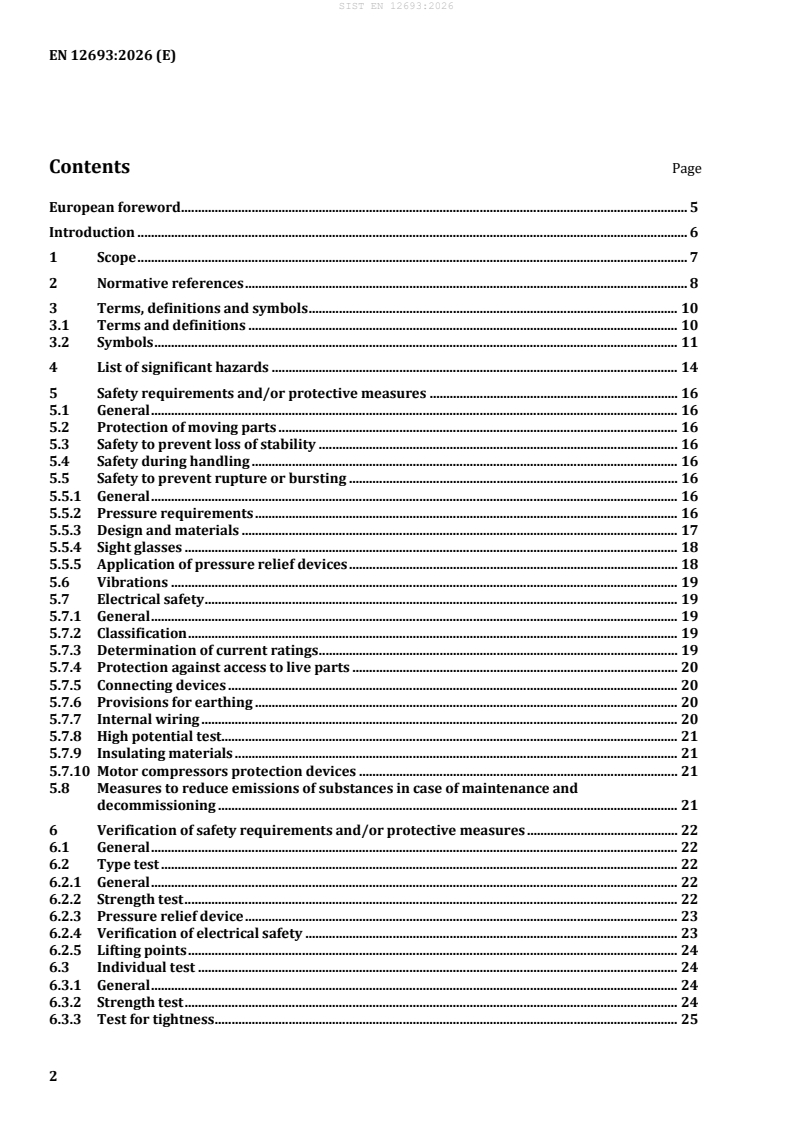
Contents Page
European foreword . 5
Introduction . 6
1 Scope . 7
2 Normative references . 8
3 Terms, definitions and symbols . 10
3.1 Terms and definitions . 10
3.2 Symbols . 11
4 List of significant hazards . 14
5 Safety requirements and/or protective measures . 16
5.1 General . 16
5.2 Protection of moving parts . 16
5.3 Safety to prevent loss of stability . 16
5.4 Safety during handling . 16
5.5 Safety to prevent rupture or bursting . 16
5.5.1 General . 16
5.5.2 Pressure requirements . 16
5.5.3 Design and materials . 17
5.5.4 Sight glasses . 18
5.5.5 Application of pressure relief devices . 18
5.6 Vibrations . 19
5.7 Electrical safety . 19
5.7.1 General . 19
5.7.2 Classification . 19
5.7.3 Determination of current ratings . 19
5.7.4 Protection against access to live parts . 20
5.7.5 Connecting devices . 20
5.7.6 Provisions for earthing . 20
5.7.7 Internal wiring . 20
5.7.8 High potential test. 21
5.7.9 Insulating materials . 21
5.7.10 Motor compressors protection devices . 21
5.8 Measures to reduce emissions of substances in case of maintenance and
decommissioning . 21
6 Verification of safety requirements and/or protective measures . 22
6.1 General . 22
6.2 Type test . 22
6.2.1 General . 22
6.2.2 Strength test . 22
6.2.3 Pressure relief device . 23
6.2.4 Verification of electrical safety . 23
6.2.5 Lifting points . 24
6.3 Individual test . 24
6.3.1 General . 24
6.3.2 Strength test . 24
6.3.3 Test for tightness . 25
6.3.4 Verification of electrical safety . 25
7 Marking, graphical symbols, written warnings . 26
7.1 General . 26
7.2 Marking . 26
7.3 Graphical symbols, written warnings and information . 27
7.3.1 Lifting points . 27
7.3.2 Pressurizing the housing . 27
7.3.3 Lubricant charge . 27
8 Appropriate manufacturing procedures . 27
9 Documentation and information for the user . 28
9.1 General . 28
9.2 Instruction handbook . 28
Annex A (normative) Procedure for the design of a refrigerant compressor by calculation . 29
A.1 Calculation method . 29
A.2 Design stress to be used for the calculation . 30
Annex B (normative) Experimental design method for refrigerant compressors . 33
B.1 Experimental design method . 33
B.2 Determination of maximum allowable design test pressure P . 34
F
B.3 Determination of the minimum burst test pressure P . 35
Test
B.4 Correction for the actual wall thickness . 36
Annex C (normative) Determination of the allowable pressure at the maximum operating
temperature . 38
C.1 Relation of the allowable pressure and higher temperatures . 38
C.2 Determination of the maximum allowable pressure at higher temperatures . 38
Annex D (normative) Determination of the allowable pressure at minimum operating
temperature — Requirements to avoid brittle fracture . 39
D.1 Relation of the allowable pressure and lower temperatures . 39
D.2 Determination of the maximum allowable pressure at the minimum operating
temperature . 40
D.3 Determination of the maximum allowable pressure at the minimum operating
temperature on the basis of an empirical method (t -Method) . 40
min
based on reference
D.4 Determination of the minimum operating temperature TS
min
thickness e . 42
B
D.5 Determination of screws, fasteners, nuts and bolts below –10 °C . 55
Annex E (informative) Compilation of material characteristics of often used materials . 57
Annex F (informative) Basic design criteria for refrigerant compressors . 81
F.1 General . 81
F.2 Compressor capability against technical performance . 81
F.3 Compressor capability against user requirements . 81
Annex G (normative) Grouping system for materials . 83
G.1 Grouping system for steels . 83
G.2 Grouping system for aluminium and aluminium alloys . 84
G.3 Grouping system for copper and copper alloys . 85
G.4 Grouping system for titanium . 85
G.5 Grouping system for cast irons . 85
Annex ZA (informative) Relationship between this European Standard and the essential
requirements of Directive 2006/42/EC aimed to be covered . 86
Bibliography . 88
European foreword
This document (EN 12693:2026) has been prepared by Technical Committee CEN/TC 182 “Refrigerating
systems, safety and environmental requirements”, the secretariat of which is held by DIN.
This European Standard shall be given the status of a national standard, either by publication of an
identical text or by endorsement, at the latest by December 2026, and conflicting national standards shall
be withdrawn at the latest by December 2026.
Attention is drawn to the possibility that some of the elements of this document may be the subject of
patent rights. CEN shall not be held responsible for identifying any or all such patent rights.
This document supersedes EN 12693:2008.
a) normative references updated;
b) thermal hazards added to Clause 4, Table 2;
c) requirements on vibration added in 5.6;
d) requirements for spacings in 5.7.4, Table 3 adjusted;
e) NOTE in 6.2.3 transferred to normative text;
f) requirements for testing in 6.3.4 modified;
g) editorially revised including the rearrangement of the Annexes and introducing the new Annex G.
This document has been prepared under a standardization request addressed to CEN by the European
Commission. The Standing Committee of the EFTA States subsequently approves these requests for its
Member States.
For the relationship with EU Legislation, see informative Annex ZA, which is an integral part of this
document.
Any feedback and questions on this document should be directed to the users’ national standards body.
A complete listing of these bodies can be found on the CEN website.
According to the CEN-CENELEC Internal Regulations, the national standards organisations of the
following countries are bound to implement this European Standard: Austria, Belgium, Bulgaria, Croatia,
Cyprus, Czech Republic, Denmark, Estonia, Finland, France, Germany, Greece, Hungary, Iceland, Ireland,
Italy, Latvia, Lithuania, Luxembourg, Malta, Netherlands, Norway, Poland, Portugal, Republic of North
Macedonia, Romania, Serbia, Slovakia, Slovenia, Spain, Sweden, Switzerland, Türkiye and the United
Kingdom.
Introduction
This document is a type C standard as stated in EN ISO 12100:2010.
The machinery concerned and the extent to which hazards, hazardous situations and hazardous events
are covered are indicated in the scope of this document.
When provisions of this type C standard are different from those which are stated in type A or B
standards, the provisions of this type C standard take precedence over the provisions of the other
standards, for machines that have been designed and built according to the provisions of this type C
standard.
1 Scope
This document is applicable to positive displacement refrigerant compressors for stationary and mobile
refrigerating systems and heat pumps, hereafter called compressors.
It is applicable for compressors used in commercial and industrial appliances and with electrical energy
supply including integral motors, up to 1 000 VAC and 1 500 VDC.
It is applicable to open drive, semi hermetic and hermetic motor compressors, which contain a positive
compression function.
This document is not applicable to:
— compressors used in household appliance for which EN IEC 60335-2-34 applies;
— compressors using water or air as refrigerant;
— compressors in vehicle air conditioning systems covered by a specific product standard, e.g.
ISO 13043.
This document does not deal with requirements for emission of noise.
NOTE 1 Compressors for automotive comfort air conditioning systems can be developed according e.g. SAE J
639.
NOTE 2 Noise emission depends on the complete installation of the built-in compressors and the corresponding
operating conditions.
For semi-hermetic and open drive compressors which include moving parts and for which the external
envelope is primarily designed for mechanical loads, thermal loads (to limit the possible deformation due
to temperature), stiffness of the structure (external mechanical loads and weight of the equipment),
taking into account established safe industrial practice, it is considered that pressure is not a significant
design factor.
Attached parts covering other functions e.g. oil separators, oil coolers, suction accumulators comply to
EN 14276-1 or EN 13445-6 (cast iron) or EN 13445-8 (aluminium) or show compliance to the relevant
European requirements. This is applicable also to shells for hermetic compressors either welded or with
any kind of permanent joint.
Requirements for compressors used in explosive atmospheres are not covered by this document.
NOTE 3 For further guidance see EN 1127-1.
This document deals with significant hazards, hazardous situations and events relevant to compressors,
when they are used as intended and under conditions for misuse which are reasonably foreseeable by
the manufacturer (see Clause 4).
This document specifies safety requirements for the design, construction, manufacture and testing,
documentation and marking of compressors, including integral accessories, e.g. shut-off valve, if
necessary.
This document relates to the compressor itself which is to be incorporated in a refrigerating system.
This document is not applicable to compressors as specified in the scope which are manufactured before
the date of publication.
2 Normative references
The following documents are referred to in the text in such a way that some or all of their content
constitutes requirements of this document. For dated references, only the edition cited applies. For
undated references, the latest edition of the referenced document (including any amendments) applies.
EN 378-1:2016+A1:2020, Refrigerating systems and heat pumps — Safety and environmental
requirements — Part 1: Basic requirements, definitions, classification and selection criteria
EN 378-2:2016, Refrigerating systems and heat pumps — Safety and environmental requirements —
Part 2: Design, construction, testing, marking and documentation
EN 1779:1999, Non-destructive testing — Leak testing — Criteria for method and technique selection
EN 10204:2004, Metallic products — Types of inspection documents
EN ISO 24664:2024, Refrigerating systems and heat pumps — Pressure relief devices and their associated
piping — Methods for calculation (ISO 24664:2024)
EN 60034-1:2010, Rotating electrical machines — Part 1: Rating and performance (IEC 60034-1:2010,
modified)
EN 60204-1:2018, Safety of machinery — Electrical equipment of machines — Part 1: General
requirements (IEC 60204-1:2016, modified)
EN 60529:1991, Degrees of protection provided by enclosures (IP Code) (IEC 60529 1989, modified)
EN IEC 60947-4-1:2019, Low-voltage switchgear and controlgear — Part 4-1: Contactors and motor-
starters — Electromechanical contactors and motor-starters (IEC 60947-4-1:2018, modified)
EN 60999-1:2000, Connecting devices — Electrical copper conductors — Safety requirements for screw-
type and screwless-type clamping units — Part 1: General requirements and particular requirements for
2 2
clamping units for conductors from 0,2 mm up to 35 mm (included) (IEC 60999-1:1999)
EN 60999-2:2003, Connecting devices — Electrical copper conductors — Safety requirements for screw-
type and screwless-type clamping units — Part 2: Particular requirements for clamping units for conductors
2 2
above 35 mm up to 300 mm (included) (IEC 60999-2:2003)
EN 61010-1:2010, Safety requirements for electrical equipment for measurement, control and laboratory
use — Part 1: General requirements (IEC 61010-1:2010, modified)
Document impacted by EN 1779:1999/A1:2003.
Document impacted by EN 60034-1:2010/Corrigendum Oct. 2010.
Document impacted by EN 60204-1:2018/A1:2025.
Document impacted by EN 60529:1991/A1:2000, EN 60529:1991/A2:2013 and EN 60529:1991/AC:2019-02.
Document impacted by EN IEC 60947-4-1:2019/AC:2020-05 and EN IEC 60947-4-1:2019/AC:2021-04.
Document impacted by EN 61010-1:2010/A1:2019 and EN 61010-1:2010/A1:2019/AC:2019-04.
EN 61140:2016, Protection against electric shock — Common aspects for installation and equipment
(IEC 61140:2016)
EN ISO 4126-1:2013, Safety devices for protection against excessive pressure — Part 1: Safety valves
(ISO 4126-1:2013)
EN ISO 4126-2:2019, Safety devices for protection against excessive pressure — Part 2: Bursting disc safety
devices (ISO 4126-2:2018)
EN ISO 4126-3:2020, Safety devices for protection against excessive pressure — Part 3: Safety valves and
bursting disc safety devices in combination (ISO 4126-3:2020)
EN ISO 4126-4:2013, Safety devices for protection against excessive pressure — Part 4: Pilot-operated
safety valves (ISO 4126-4:2013)
EN ISO 9606-1:2017, Qualification testing of welders — Fusion welding — Part 1: Steels (ISO 9606-1:2012
including Cor 1:2012 and Cor 2:2013)
EN ISO 9606-2:2004, Qualification test of welders — Fusion welding — Part 2: Aluminium and aluminium
alloys (ISO 9606-2:2004)
EN ISO 12100:2010, Safety of machinery — General principles for design — Risk assessment and risk
reduction (ISO 12100:2010)
EN ISO 13732-1:2008, Ergonomics of the thermal environment — Methods for the assessment of human
responses to contact with surfaces — Part 1: Hot surfaces (ISO 13732-1:2006)
EN ISO 13857:2019, Safety of machinery — Safety distances to prevent hazard zones being reached by
upper and lower limbs (ISO 13857:2019)
EN ISO 14120:2015, Safety of machinery — Guards — General requirements for the design and
construction of fixed and movable guards (ISO 14120:2015)
EN ISO 15607:2019, Specification and qualification of welding procedures for metallic materials — General
rules (ISO 15607:2019)
EN ISO 15614-1:2017, Specification and qualification of welding procedures for metallic materials —
Welding procedure test — Part 1: Arc and gas welding of steels and arc welding of nickel and nickel alloys
(ISO 15614-1:2017 , modified)
EN ISO 15614-2:2025, Specification and qualification of welding procedures for metallic materials —
Welding procedure test — Part 2: Arc welding of aluminium and its alloys (ISO 15614-2:2025)
EN ISO 21922:2021, Refrigerating systems and heat pumps — Valves — Requirements, testing and
marking (ISO 21922:2021)
Document impacted by EN ISO 4126-1:2013/A1:2016 and EN ISO 4126-1:2013/A2:2019.
Document impacted by EN ISO 15614-1:2017/A1:2019.
Document impacted by EN ISO 21922:2021/A1:2024.
ISO 20816-1:2016, Mechanical vibration — Measurement and evaluation of machine vibration — Part 1:
General guidelines
ISO 20816-3:2022, Mechanical vibration — Measurement and evaluation of machine vibration — Part 3:
Industrial machinery with a power rating above 15 kW and operating speeds between 120 r/min and
30 000 r/min
ISO 20816-8:2018, Mechanical vibration — Measurement and evaluation of machine vibration — Part 8:
Reciprocating compressor systems
3 Terms, definitions and symbols
3.1 Terms and definitions
For the purposes of this document, the terms and definitions given in EN 378-1:2016+A1:2020,
EN ISO 12100:2010 and the following apply.
ISO and IEC maintain terminology databases for use in standardization at the following addresses:
— ISO Online browsing platform: available at https://www.iso.org/obp
— IEC Electropedia: available at https://www.electropedia.org
NOTE All pressures are gauge pressures unless otherwise specified.
3.1.1
positive displacement compressor
compressor in which compression is obtained by changing the internal volume of the compression
chamber
3.1.2
maximum allowable pressure
PS
maximum allowable pressure as stated by the compressor manufacturer, chosen by the manufacturer for
each pressure stage of the compressor
Note 1 to entry: The common situation is that different values for PS are chosen for each pressure stage of the
compressor.
Note 2 to entry: There are in minimum two pressure stages on each compressor: the low pressure side (LP) and
the high pressure side (HP), but additional intermediate pressure stage(s) can be present.
Note 3 to entry: The individual pressure stage of a compressor is connected to the corresponding “part of the
refrigerating system”, as defined in EN 378-1:2016+A1:2020, 3.1.8.
3.1.3
compressor overflow device
pressure relief device specifically intended to protect only the compressor against bursting caused by
abnormal conditions, e.g. the discharge valve shut
Note 1 to entry: The compressor overflow device relieves from the high pressure/intermediate side of the
compressor to a lower pressure side.
Note 2 to entry: The compressor overflow device may be a bursting disc or may be a spring loaded overflow valve.
Spring loaded overflow valves can be either back pressure compensating or back pressure dependent type.
3.1.4
corrosion
all forms of material waste (e. g. oxidation, erosion, wear and abrasion)
3.1.5
maximum operating temperature
highest temperature that can occur during operation or standstill of the refrigerating system or during
testing under test conditions
3.1.6
minimum operating temperature
lowest temperature that can occur during operation or standstill of the refrigerating system or during
testing under test conditions
3.1.7
pressure bearing part
part, which is subject to stress due to internal pressure greater than 50 kPa (0,5 bar) gauge
3.1.8
main pressure bearing part
part, which constitute the envelope under pressure, essential for the integrity of the equipment
Note 1 to entry: Examples are housings, ends and flanges.
[SOURCE: EN 13445-1:2021, 3.6, modified - The term has been changed to the singular.]
3.1.9
maximum allowable pressure at ambient temperature of –10 °C to +50 °C
PS
maximum pressure for which the refrigerant compressor is designed, as specified by the manufacturer,
at ambient temperature of –10 °C to +50 °C
3.1.10
intended use
use of a machine in accordance with the information for use provided in the instructions
[SOURCE: EN ISO 12100:2010, 3.23]
3.2 Symbols
For the purposes of this document, the symbols of Table 1 apply.
Table 1 — Symbols
A Elongation after fracture where the measured length is equal or greater mm
L
than 0,4 times of diameter of the rod
A Elongation after fracture where the measured length is equal to 5 times of %
diameter of the rod
a Lifetime in years for calculating effect of corrosion; typically 20 years —
C Factor to compensate for the quality of a casting —
Q
δ Negative wall thickness tolerance mm
e
e Actual wall thickness at given measuring points of the refrigerant mm
act
compressor to be tested
e Reference thickness is the minimum material thickness needed to give mm
B
adequate strength to pressure bearing parts
e Reduction in wall thickness caused by occurrence of corrosion mm
c
e Wall thickness as specified in the design drawing mm
con
KV Impact rupture energy J
KV Threshold value of impact rupture energy, where the impact rupture energy J
is defined as independent of the temperature
t
Standard value of impact rupture energy at standard temperature of the J
KV
material
KV Impact rupture energy at minimum operating temperature TS J
TS min min
P Maximum allowable design test pressure bar
F
PS Maximum allowable pressure bar
PS Maximum allowable pressure at ambient temperature (−10 °C to + 50 °C) bar
PS Maximum allowable pressure at maximum operating temperature bar
TS max
PS Maximum allowable pressure at minimum operating temperature bar
TS min
P Minimum burst test pressure (greater than P ) bar
Test F
R Proof strength, 0,2 % offset at ambient temperature MPa,
p 0,2
N/mm
R Proof strength, 0,2 % offset at minimum operating temperature MPa,
p 0,2 TS min
N/mm
R Proof strength, 0,2 % offset at temperature t MPa,
p 0,2/t
N/mm
R Proof strength, 0,2 % offset at maximum operating temperature MPa,
p 0,2 TS max
N/mm
R Proof strength, 1,0 % offset at ambient temperature MPa,
p 1,0
N/mm
R Upper yield strength MPa,
eH
N/mm
R Upper yield strength at maximum operating temperature MPa,
eH TS max
N/mm
R Tensile strength MPa,
m
N/mm
R Tensile strength at maximum operating temperature MPa,
m TS max
N/mm
R Actual tensile strength of the material of the refrigerant compressor to be MPa,
m act
tested
N/mm
R Tensile strength used for the design MPa,
m con
N/mm
S Factor to compensate effects of corrosion —
C
S relation between maximum allowable strength at operating temperature —
fast
and the maximum allowable strength at ambient temperature
S Factor taking into consideration the impact rupture energy reduction due —
TS min
to minimum operating temperature
S Factor to allow for the reduction in strength due to the maximum operating —
TS max
temperature
S Factor to allow for the test pressure —
σ
σ Initial design stress MPa,
con
N/mm
σ Allowable stress values derived from σ MPa,
corr con
N/mm
t Lowest temperature at which pressure bearing parts can be used, if their °C
min 25
load amounts to 25 % of the allowable design stress at 20 °C, taking the
safety factors according to Table A.1 into account
t Lowest temperature at which pressure bearing parts can be used, if their °C
min 75
load amounts to 75 % of the allowable design stress at 20 °C, taking the
safety factors according to Table A.1 into account
t Lowest temperature at which pressure bearing parts can be used, if their °C
min 100
load amounts to 100 % of the allowable design stress at 20 °C, taking the
safety factors according to Table A.1 into account
T Design reference temperature is the minimum operating temperature TS
R min
adjusted. Used when determining TS based on reference thickness e
min B
T Temperature adjustment of the design reference temperature T
S R
T Impact test temperature
KV
TS Operating temperature °C
TS Lowest operating temperature °C
min
TS Maximum operating temperature °C
max
X Correction of the actual wall thickness relative to the wall thickness of the —
design
Y Correction on the basis of current strength values of the test sample relative —
to the strength parameters for the design of refrigerant compressor
Z Factor to allow for the quality of a joint (e.g. welded joint) —
∂ Wall thickness reduction per year mm
NOTE 1 bar = 0,1 MPa.
4 List of significant hazards
Table 2 contains all significant hazards, hazardous situations and events, as far as they are dealt with in this document, identified by risk assessment
as significant for type of compressors and which requires action to eliminate or reduce the risk. The risk assessment shall be made according to
EN ISO 12100:2010. The compressors shall be manufactured in accordance with the principle listed in EN ISO 12100:2010 to eliminate or reduce
the foreseeable risk.
Table 2 — List of significant hazards, hazardous situations, safety requirements and/or measures
Significant hazard
Safety requirements and/or
Hazardous situation Reference Verification
according to
measures
EN ISO 12100:2010
Mechanical
Moving parts Possible injuries to human body Guards 5.2 V
Loss of stability Possible injuries at transport and Fixing points 5.3 V
operation
Lifting points 5.4, 7.3.1 D / V
Lifting points 6.2.5 T
Rupture or bursting Possible injuries from ejected parts or Design criteria 5.5 D
fluid
Strength test 6.2.2, 6.2.3, 6.3.2 T
Tightness test 6.3.3 T
Electrical
Contact live parts Possible injuries from electrocution Design criteria 5.7.1, 5.7.2, 5.7.3, 5.7.4, D
5.7.5, 5.7.9
Earthing 5.7.6 D
Internal wiring 5.7.7 D
High potential test 5.7.8, 6.2.4, 6.3.4 T
Protection devices 5.7.10 V
Significant hazard
Safety requirements and/or
Hazardous situation Reference Verification
according to
measures
EN ISO 12100:2010
Electrostatic phenomena Possible injuries from electric shock Earthing 5.7.6 D
Thermal
Contact with hot or cold Possible injuries to the skin Design criteria, Warning signs 5.1, 9.2
objects
Vibration
vibrating equipment Possible injuries from ejected parts or Design criteria 5.6
fluid
Materials and substances
Contact or inhaling gasses Possible injuries from aggressive Means and instructions 5.8 V
media at draining
Warning 7.3.2 V
Possible injuries from aggressive Use of suitable material 5.5.3 T
media during operation (metallic and non-metallic)
NOTE Verification methods:
V Visual inspection, verifies the required features of the components
T A test or check verifies that the features provided perform their function in such a way that the requirement is met
M Measurement verifies that requirements are met to the specified limits
D Drawing and / or calculations verify that the design characteristics meet the requirements
5 Safety requirements and/or protective measures
5.1 General
Compressors shall comply with the safety requirements and/or measures of this clause.
In addition, the compressors shall be designed according to the principles of EN ISO 12100:2010 for
relevant but not significant hazard, which are not dealt with by this document.
Furthermore, the refrigerating system which the compressor is part of, shall be in accordance with the
requirements of the EN 378-2:2016.
As surface temperatures on a refrigerant compressor and the attached parts and piping depend on
operating conditions and properties of specific refrigerants, protection shall be provided considering the
requirements in EN ISO 13732-1:2008.
5.2 Protection of moving parts
Protection shall be provided for moving parts such as automatic drives, fans or indicators of capacity
controls by fixed guards according to EN ISO 14120:2015. Openings such as slots, holes, etc. shall comply
with EN ISO 13857:2019, Table 4.
5.3 Safety to prevent loss of stability
Compressors shall be equipped with fixing points to ensure that they shall not tip or fall over during
transport and operation.
5.4 Safety during handling
Compressors above 25 kg weight shall be equipped with lifting points or arrangement to enable safe
lifting, installation and maintenance. Lifting points or arrangements shall be designed for to carry
1,25 times the weight of the compressor allocated to the individual lifting point.
For design it is sufficient to use a factor 2 against deformation and a factor 3 against fracture correlated
to vertical lifting.
5.5 Safety to prevent rupture or bursting
5.5.1 General
Compressors and associated components shall be designed and manufactured to withstand the pressure
and temperatures which can occur during operation, standstill and transportation taking into account
the thermal, chemical and mechanical stresses to be expected.
The materials shall be selected based upon suitability for the application. The choice of materials and
selection of dimensions shall be based on the need for sufficient strength, rigidity and stability to cope
with dynamic effects. The ability of the compressor to withstand internal pressure shall be demonstrated
by type test in accordance with 6.2 or by individual test in accordance with 6.3.
5.5.2 Pressure requirements
The compressor shall be designed to withstand the pressures occurring during its intended use in a
refrigerating system with regard to the conditions given in EN 378-2:2016, 6.2.2.
NOTE This typically includes saturation pressures according to relevant ambient and operating temperatures,
but is not limited to this.
For refrigerants and applications not covered by EN 378-2:2016, the maximum allowable pressure(s) PS
shall be determined with regard to the required application ranges, especially pressures, temperatures
and allowed refrigerant(s).
5.5.3 Design and materials
5.5.3.1 Materials
The materials, including structural materials and welding consumables, solders, brazing metals and
sealants, shall be selected to allow for the thermal, chemical and mechanical stresses expected during
operation, standstill and transportation throughout the foreseeable life of the compressor parts.
Materials for compressor casings and casing parts shall be selected from the following materials with
group numbers according to Annex G:
— steels, groups St 1.1, St 1.2, St 8.1;
— aluminium and aluminium alloys, groups 21 to 26;
— copper and copper alloys, groups 31 to 36;
— spheroidal graphite cast iron, group 72.2;
— spheroidal graphite cast iron, group 72.1;
— grey cast iron, group 71.
Other metallic materials may be used provided that the mechanical properties are not altered by the
manufacturing process of the casing.
Non-metallic materials, e.g. for gaskets, coatings, insulating materials and sight glasses shall only be used,
if they are compatible with the refrigerants and refrigerant and oil mixtures.
5.5.3.2 Materials certificates
Materials for compressor enclosure parts > [0,001 m ] shall be supplied with a specific inspection
certificate for the product in accordance with the specifications of EN 10204:2004
NOTE Examples are 3.1 and 3.2 in EN 10204:2004.
If material properties are changed during the method of manufacture to such an extent that the strength
and/or notched impact energies are reduced, these reduced values shall be taken into consideration by
correction factors, according to Annex C and Annex D, or shall be subject to suitable compensatory
material treatment (e.g. heat treatment).
5.5.3.3 Design
The refrigerant compressor shall be verified for sufficient strength in the entire operating range.
Verification for refrigerant compressors shall be done either:
a) by calculation according to Annex A, Annex C and Annex D, or
b) by experimental method according to Annex B and Annex D.
Annex A and Annex B are used to verify the maximum allowable pressure at ambient temperatures PS ,
Annex C is used to determine PS based on the maximum allowable pressure PS at higher temperatures
and Annex D is used to determine PS based on the maximum allowable pressure PS at lower
temperatures.
NOTE Annex E provides a compilation of material characteristics of often used materials.
For refrigerant compressor materials with reduced ductility at low temperatures the allowed stress shall
be reduced according to Annex D.
If valves and similar parts are not verifi
...