

prEN ISO 10416
(Main)Oil and gas industries including lower carbon energy - Drilling fluids - Laboratory testing (ISO/DIS 10416:2026)
- Abstract
ISO 10416:2008 provides procedures for the laboratory testing of both drilling-fluid materials and drilling-fluid physical, chemical and performance properties. It is applicable to both water-based and oil-based drilling fluids, as well as the base or “make-up” fluid.
ISO 10416:2008 is not applicable as a detailed manual on drilling fluid control procedures. Recommendations regarding agitation and testing temperature are presented because the agitation history and temperature have a profound effect on drilling fluid properties.
- Status
- Not Published
- Publication Date
- 19-Mar-2028
- Current Stage
- 4020 - Submission to enquiry - Enquiry
- Start Date
- 01-Oct-2026
- Completion Date
- 01-Oct-2026
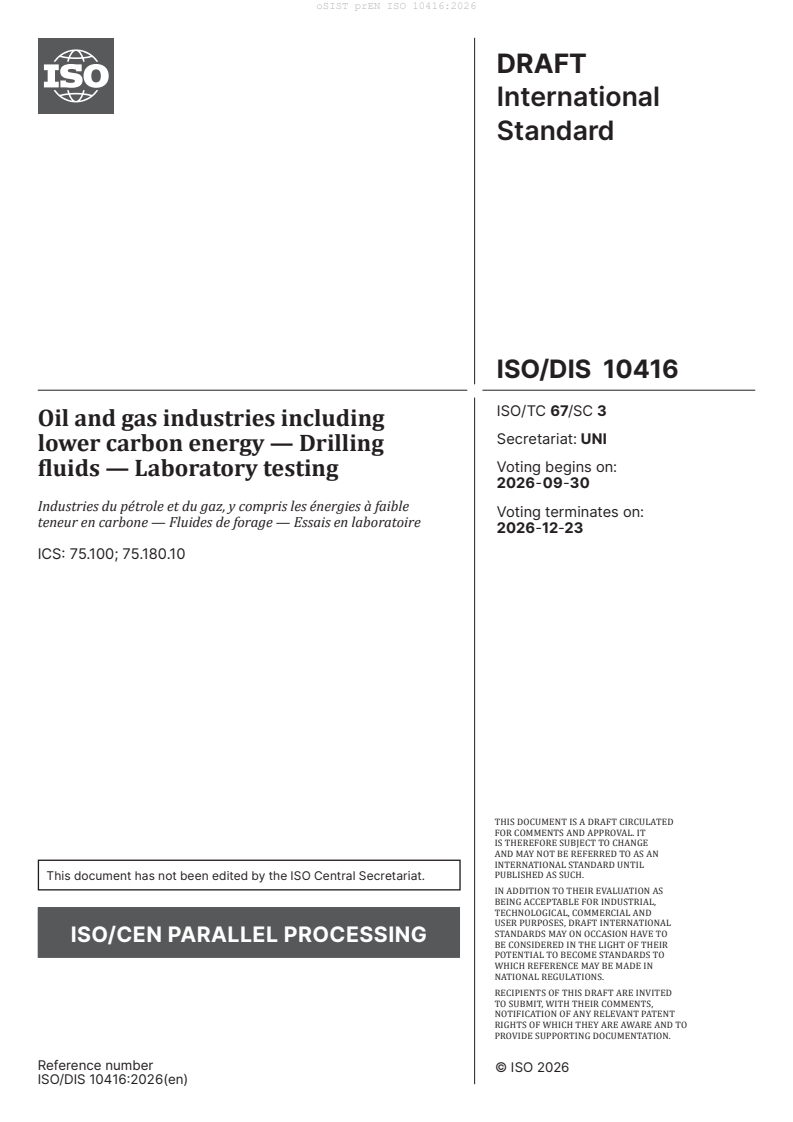

prEN ISO 10416 is a draft CEN/ISO standard for the oil and gas industries including lower carbon energy. It specifies a laboratory accretion test for drilling fluids and drilling cuttings, so users can assess the tendency of active clay to stick to metal surfaces during drilling.
It supplements API RP 13I:2020/Amd 1:2023 and is aimed at oil companies, service companies and other users in the oil and gas industry. In practice, it gives a shared test method for judging shale and clay accretion and for comparing mud systems under controlled laboratory conditions.
What does prEN ISO 10416 specify?
prEN ISO 10416 specifies one laboratory method: the accretion test used to determine the accretion tendency of active clay in drilling. The document is a supplement to API RP 13I:2020/Amd 1:2023, so the base requirements from that document apply except where this standard adds its own procedure.
The document is organized into four main clauses plus a bibliography:
- Clause 1, Scope
- Clause 2, Normative references
- Clause 3, Terms and definitions
- Clause 4, Supplements to API RP 13I:2020/Amd 1:2023, including the accretion test procedure
Clause 4 is the technical core. It gives the general requirements, the test principle, the reagents and apparatus, the step-by-step procedure, and the calculation of accretion rate.
What are the key requirements of prEN ISO 10416?
prEN ISO 10416 requires users to follow API RP 13I:2020/Amd 1:2023 together with the accretion test procedure in this document. That means the test is not a standalone lab method; it is a supplement to the referenced drilling-fluid testing practice.
Test principle
The accretion test measures how shale and clay adhere to a rolling bar or tube during hot rolling. The result is a qualitative indicator of possible bit-balling and rate-of-penetration problems in the field. In practice, this helps users compare mud systems and see whether a fluid promotes sticking of cuttings to metal surfaces.
Test materials and equipment
The test uses actual cuttings or selected active clays, and the cuttings are sized between 4 mm and 8 mm. The document also identifies the main apparatus: a rolling bar or tube, a heat-aging cell, a balance, a roller oven, a drying oven, a sieve shaker, and 200-grit wet abrasive paper. In practice, the lab needs controlled equipment and traceable sample preparation to get comparable results.
Sample preparation and conditioning
The cuttings are sieved, dried, and prepared before the test. The rolling bar or tube must be cleaned carefully, especially if carbon steel is used. This matters because rust, deposits, or inconsistent sample size can change the amount of accretion measured.
Test conditions
The bar or tube is placed in drilling fluid in the aging cell, the cuttings are added, and the cell is rolled at 65 °C for 30 minutes. The document allows slight adjustment of temperature, duration, and rolling speed when agreed, and these conditions must be recorded in the report. That gives users a way to match the test more closely to downhole conditions.
Measurement and reporting
After the rolling step, the bar or tube is drained, dried, and weighed again, and the accretion is photographed. The report should record the material and size of the bar or tube, plus the test temperature, duration, and rolling speed. In practice, this makes the result auditable and easier to compare between laboratories.
Calculation
Clause 4.2.4 gives the calculation of accretion rate as a percentage based on the dry mass of accretion relative to the initial mass of the cutting samples. The equation turns the mass gain on the bar or tube into a single comparison value for testing mud performance.
The document also cautions that dispersion testing should be run in parallel so low accretion is not mistaken for simple particle breakup.
What terms does prEN ISO 10416 define?
- Accretion - growth by gradual buildup through adhesion or accumulation; in this document, it is the material that builds up on the bar or tube.
- Accretion test - the laboratory hot-rolling test used to measure the tendency of shale and clay to stick to metal surfaces.
- Active clay - clay used in the test to represent reactive material that can adhere during drilling.
- API RP 13I:2020/Amd 1:2023 - the referenced drilling-fluids laboratory testing document that provides the base requirements supplemented by this standard.
- ROP (rate of penetration) - the drilling performance measure that accretion can reduce when cuttings ball up on the bit.
Who uses prEN ISO 10416?
prEN ISO 10416 is intended for oil companies, service companies, and other users in the oil and gas industry. It is used by laboratory staff, drilling-fluids specialists, and technical managers who need a repeatable way to check shale compatibility and accretion tendency before or during drilling operations.
What changed in prEN ISO 10416 from the previous edition?
prEN ISO 10416 is the third edition and cancels and replaces ISO 10416:2008. The foreword states that the document has been technically revised.
The main change named in the document is the addition of the accretion test method. The foreword also says the edition updates the reference to the current edition of API RP 13I and includes supplementary content.
Which standards are used with prEN ISO 10416?
- API RP 13I:2020/Amd 1:2023, Laboratory Testing of Drilling Fluids - the normative reference that supplies the base requirements this document supplements.
Clause 4 also names ASTM A240/A240M-19 and ASTM A36 for the materials of the rolling bar or tube, which helps users select suitable test hardware.
What does the prEN ISO 10416 document contain?
prEN ISO 10416 contains a short technical document focused on one laboratory test method. The body of the standard covers the test principle, the required samples and apparatus, the step-by-step test sequence, and the calculation of accretion rate.
Clause 4.2.2 gives the practical laboratory setup, including the rolling bar or tube, heat-aging cell, ovens, sieve shaker, balance, and abrasive paper. Clause 4.2.3 describes sample sizing, cleaning, rolling, drying, weighing, and photographing the accretion. Clause 4.2.4 gives the calculation used to turn the observed buildup into a reported percentage. The bibliography lists two technical references on shale compatibility and drill cuttings agglomeration.
Relations
- Effective Date
- 29-Jul-2026
Get Certified
Connect with accredited certification bodies for this standard

Element Materials Technology
Materials testing and product certification.

ABS Group Brazil
ABS Group certification services in Brazil.

ABS Quality Evaluations Inc.
American Bureau of Shipping quality certification.
Sponsored listings
Frequently Asked Questions
prEN ISO 10416 is a draft published by the European Committee for Standardization (CEN). Its full title is "Oil and gas industries including lower carbon energy - Drilling fluids - Laboratory testing (ISO/DIS 10416:2026)". This standard covers: ISO 10416:2008 provides procedures for the laboratory testing of both drilling-fluid materials and drilling-fluid physical, chemical and performance properties. It is applicable to both water-based and oil-based drilling fluids, as well as the base or “make-up” fluid. ISO 10416:2008 is not applicable as a detailed manual on drilling fluid control procedures. Recommendations regarding agitation and testing temperature are presented because the agitation history and temperature have a profound effect on drilling fluid properties.
ISO 10416:2008 provides procedures for the laboratory testing of both drilling-fluid materials and drilling-fluid physical, chemical and performance properties. It is applicable to both water-based and oil-based drilling fluids, as well as the base or “make-up” fluid. ISO 10416:2008 is not applicable as a detailed manual on drilling fluid control procedures. Recommendations regarding agitation and testing temperature are presented because the agitation history and temperature have a profound effect on drilling fluid properties.
prEN ISO 10416 is classified under the following ICS (International Classification for Standards) categories: 75.180.10 - Exploratory, drilling and extraction equipment. The ICS classification helps identify the subject area and facilitates finding related standards.
prEN ISO 10416 has the following relationships with other standards: It is inter standard links to EN ISO 10416:2009. Understanding these relationships helps ensure you are using the most current and applicable version of the standard.
prEN ISO 10416 is available in PDF format for immediate download after purchase. The document can be added to your cart and obtained through the secure checkout process. Digital delivery ensures instant access to the complete standard document.
Standards Content (Sample)
SLOVENSKI STANDARD
01-december-2026
Naftna in plinska industrija, vključno z nizkoogljično energijo - Vrtalne tekočine -
Laboratorijsko preskušanje (ISO/DIS 10416:2026)
Oil and gas industries including lower carbon energy - Drilling fluids - Laboratory testing
(ISO/DIS 10416:2026)
Öl- und Gasindustrie einschließlich kohlenstoffarmer Energieträger - Bohrspülungen -
Laborversuche (ISO/DIS 10416:2026)
Industries du pétrole et du gaz, y compris les énergies à faible teneur en carbone -
Fluides de forage - Essais en laboratoire (ISO/DIS 10416:2026)
Ta slovenski standard je istoveten z: prEN ISO 10416
ICS:
75.100 Maziva Lubricants, industrial oils and
related products
75.180.10 Oprema za raziskovanje, Exploratory, drilling and
vrtanje in odkopavanje extraction equipment
2003-01.Slovenski inštitut za standardizacijo. Razmnoževanje celote ali delov tega standarda ni dovoljeno.
DRAFT
International
Standard
ISO/DIS 10416
ISO/TC 67/SC 3
Oil and gas industries including
Secretariat: UNI
lower carbon energy — Drilling
Voting begins on:
fluids — Laboratory testing
2026-09-30
Industries du pétrole et du gaz, y compris les énergies à faible
Voting terminates on:
teneur en carbone — Fluides de forage — Essais en laboratoire
2026-12-23
ICS: 75.100; 75.180.10
THIS DOCUMENT IS A DRAFT CIRCULATED
FOR COMMENTS AND APPROVAL. IT
IS THEREFORE SUBJECT TO CHANGE
AND MAY NOT BE REFERRED TO AS AN
INTERNATIONAL STANDARD UNTIL
PUBLISHED AS SUCH.
This document has not been edited by the ISO Central Secretariat.
IN ADDITION TO THEIR EVALUATION AS
BEING ACCEPTABLE FOR INDUSTRIAL,
TECHNOLOGICAL, COMMERCIAL AND
USER PURPOSES, DRAFT INTERNATIONAL
STANDARDS MAY ON OCCASION HAVE TO
ISO/CEN PARALLEL PROCESSING
BE CONSIDERED IN THE LIGHT OF THEIR
POTENTIAL TO BECOME STANDARDS TO
WHICH REFERENCE MAY BE MADE IN
NATIONAL REGULATIONS.
RECIPIENTS OF THIS DRAFT ARE INVITED
TO SUBMIT, WITH THEIR COMMENTS,
NOTIFICATION OF ANY RELEVANT PATENT
RIGHTS OF WHICH THEY ARE AWARE AND TO
PROVIDE SUPPORTING DOCUMENTATION.
Reference number
ISO/DIS 10416:2026(en)
DRAFT
ISO/DIS 10416:2026(en)
International
Standard
ISO/DIS 10416
ISO/TC 67/SC 3
Oil and gas industries including
Secretariat: UNI
lower carbon energy — Drilling
Voting begins on:
fluids — Laboratory testing
Industries du pétrole et du gaz, y compris les énergies à faible
Voting terminates on:
teneur en carbone — Fluides de forage — Essais en laboratoire
ICS: 75.100; 75.180.10
THIS DOCUMENT IS A DRAFT CIRCULATED
FOR COMMENTS AND APPROVAL. IT
IS THEREFORE SUBJECT TO CHANGE
AND MAY NOT BE REFERRED TO AS AN
INTERNATIONAL STANDARD UNTIL
PUBLISHED AS SUCH.
This document has not been edited by the ISO Central Secretariat.
IN ADDITION TO THEIR EVALUATION AS
BEING ACCEPTABLE FOR INDUSTRIAL,
© ISO 2026
TECHNOLOGICAL, COMMERCIAL AND
USER PURPOSES, DRAFT INTERNATIONAL
All rights reserved. Unless otherwise specified, or required in the context of its implementation, no part of this publication may
STANDARDS MAY ON OCCASION HAVE TO
ISO/CEN PARALLEL PROCESSING
be reproduced or utilized otherwise in any form or by any means, electronic or mechanical, including photocopying, or posting on
BE CONSIDERED IN THE LIGHT OF THEIR
the internet or an intranet, without prior written permission. Permission can be requested from either ISO at the address below
POTENTIAL TO BECOME STANDARDS TO
WHICH REFERENCE MAY BE MADE IN
or ISO’s member body in the country of the requester.
NATIONAL REGULATIONS.
ISO copyright office
RECIPIENTS OF THIS DRAFT ARE INVITED
CP 401 • Ch. de Blandonnet 8
TO SUBMIT, WITH THEIR COMMENTS,
CH-1214 Vernier, Geneva
NOTIFICATION OF ANY RELEVANT PATENT
Phone: +41 22 749 01 11
RIGHTS OF WHICH THEY ARE AWARE AND TO
PROVIDE SUPPORTING DOCUMENTATION.
Email: copyright@iso.org
Website: www.iso.org
Published in Switzerland Reference number
ISO/DIS 10416:2026(en)
ii
ISO/DIS 10416:2026(en)
Contents Page
Foreword .iv
1 Scope . 1
2 Normative references . 1
3 Terms and definitions . 1
4 Supplements to API RP 13I:2020/Amd 1:2023 . 1
4.1 General requirements .1
4.2 Accretion test procedure .1
4.2.1 Principle .1
4.2.2 Reagents and apparatus .2
4.2.3 Procedure for accretion test .2
4.2.4 Calculation of accretion rate .3
Bibliography . 5
iii
ISO/DIS 10416:2026(en)
Foreword
ISO (the International Organization for Standardization) is a worldwide federation of national standards
bodies (ISO member bodies). The work of preparing International Standards is normally carried out through
ISO technical committees. Each member body interested in a subject for which a technical committee
has been established has the right to be represented on that committee. International organizations,
governmental and non-governmental, in liaison with ISO, also take part in the work. ISO collaborates closely
with the International Electrotechnical Commission (IEC) on all matters of electrotechnical standardization.
The procedures used to develop this document and those intended for its further maintenance are described
in the ISO/IEC Directives, Part 1. In particular, the different approval criteria needed for the different types
of ISO documents should be noted. This document was drafted in accordance with the editorial rules of the
ISO/IEC Directives, Part 2 (see www.iso.org/directives).
ISO draws attention to the possibility that the implementation of this document may involve the use of (a)
patent(s). ISO takes no position concerning the evidence, validity or applicability of any claimed patent
rights in respect thereof. As of the date of publication of this document, ISO had not received notice of (a)
patent(s) which may be required to implement this document. However, implementers are cautioned that
this may not represent the latest information, which may be obtained from the patent database available at
www.iso.org/patents. ISO shall not be held responsible for identifying any or all such patent rights.
Any trade name used in this document is information given for the convenience of users and does not
constitute an endorsement.
For an explanation of the voluntary nature of standards, the meaning of ISO specific terms and expressions
related to conformity assessment, as well as information about ISO's adherence to the World Trade
Organization (WTO) principles in the Technical Barri
...