

EN 13001-2:2014
(Main)Crane safety - General design - Part 2: Load actions
General Information
- Abstract
This European Standard specifies load actions to be used together with the standard EN 13001 1 and EN 13001 3, and as such they specify conditions and requirements on design to prevent mechanical hazards of cranes, and a method of verification of those requirements.
NOTE Specific requirements for particular types of crane are given in the appropriate European Standard for the particular crane type.
The following is a list of significant hazardous situations and hazardous events that could result in risks to persons during normal use and foreseeable misuse. Clause 4 of this standard is necessary to reduce or eliminate the risks associated with the following hazards:
a) Instability of the crane or its parts (tilting).
b) Exceeding the limits of strength (yield, ultimate, fatigue).
c) Elastic instability of the crane or its parts (buckling, bulging).
d) Exceeding temperature limits of material or components.
e) Exceeding the deformation limits.
This document is not applicable to cranes that are manufactured before the date of its publication as EN.
- Status
- Withdrawn
- Publication Date
- 05-Aug-2014
- Withdrawal Date
- 29-Sep-2026
- Technical Committee
- CEN/TC 147 - Cranes - Safety
- Drafting Committee
- CEN/TC 147/WG 2 - Design - General
- Current Stage
- 9960 - Withdrawal effective - Withdrawal
- Start Date
- 17-Mar-2021
- Completion Date
- 30-Sep-2026
- Directive
- 2006/42/EC - Directive 2006/42/EC of the European Parliament and of the Council of 17 May 2006 on machinery, and amending Directive 95/16/EC (recast)OJ Ref: C, C 14 OJ Date: 15-Jan-2016


Relations
- Effective Date
- 13-Aug-2014
- Effective Date
- 13-Aug-2014
- Effective Date
- 22-Aug-2018
- Effective Date
- 25-Aug-2026
- Effective Date
- 28-Jan-2026
- Effective Date
- 28-Jan-2026
- Effective Date
- 28-Jan-2026
- Effective Date
- 28-Jan-2026
- Effective Date
- 28-Jan-2026
- Effective Date
- 28-Jan-2026
- Effective Date
- 28-Jan-2026
- Effective Date
- 28-Jan-2026
- Referred By
EN 12999:2020 - Cranes - Loader cranes - Effective Date
- 28-Jan-2026
- Effective Date
- 28-Jan-2026
Frequently Asked Questions
EN 13001-2:2014 is a standard published by the European Committee for Standardization (CEN). Its full title is "Crane safety - General design - Part 2: Load actions". This standard covers: This European Standard specifies load actions to be used together with the standard EN 13001 1 and EN 13001 3, and as such they specify conditions and requirements on design to prevent mechanical hazards of cranes, and a method of verification of those requirements. NOTE Specific requirements for particular types of crane are given in the appropriate European Standard for the particular crane type. The following is a list of significant hazardous situations and hazardous events that could result in risks to persons during normal use and foreseeable misuse. Clause 4 of this standard is necessary to reduce or eliminate the risks associated with the following hazards: a) Instability of the crane or its parts (tilting). b) Exceeding the limits of strength (yield, ultimate, fatigue). c) Elastic instability of the crane or its parts (buckling, bulging). d) Exceeding temperature limits of material or components. e) Exceeding the deformation limits. This document is not applicable to cranes that are manufactured before the date of its publication as EN.
This European Standard specifies load actions to be used together with the standard EN 13001 1 and EN 13001 3, and as such they specify conditions and requirements on design to prevent mechanical hazards of cranes, and a method of verification of those requirements. NOTE Specific requirements for particular types of crane are given in the appropriate European Standard for the particular crane type. The following is a list of significant hazardous situations and hazardous events that could result in risks to persons during normal use and foreseeable misuse. Clause 4 of this standard is necessary to reduce or eliminate the risks associated with the following hazards: a) Instability of the crane or its parts (tilting). b) Exceeding the limits of strength (yield, ultimate, fatigue). c) Elastic instability of the crane or its parts (buckling, bulging). d) Exceeding temperature limits of material or components. e) Exceeding the deformation limits. This document is not applicable to cranes that are manufactured before the date of its publication as EN.
EN 13001-2:2014 is classified under the following ICS (International Classification for Standards) categories: 53.020.20 - Cranes. The ICS classification helps identify the subject area and facilitates finding related standards.
EN 13001-2:2014 has the following relationships with other standards: It is inter standard links to EN 13001-2:2011/AC:2012, EN 13001-2:2011, EN 13001-2:2021, ISO 4306-1:2007, EN 840-3:2012, EN 13001-1:2015, EN 13852-3:2021, EN 13155:2020, EN 13001-3-5:2016+A1:2021, EN 15011:2020, EN 13001-3-6:2018+A1:2021, EN ISO/IEC 5259-2:2025, EN 12999:2020, EN 16851:2017+A1:2020. Understanding these relationships helps ensure you are using the most current and applicable version of the standard.
EN 13001-2:2014 is associated with the following European legislation: EU Directives/Regulations: 2006/42/EC; Standardization Mandates: M/396. When a standard is cited in the Official Journal of the European Union, products manufactured in conformity with it benefit from a presumption of conformity with the essential requirements of the corresponding EU directive or regulation.
EN 13001-2:2014 is available in PDF format for immediate download after purchase. The document can be added to your cart and obtained through the secure checkout process. Digital delivery ensures instant access to the complete standard document.
Standards Content (Sample)
SLOVENSKI STANDARD
01-oktober-2014
Nadomešča:
SIST EN 13001-2:2011
SIST EN 13001-2:2011/AC:2012
Varnost žerjava - Konstrukcija, splošno - 2. del: Učinki obremenitev
Crane safety - General design - Part 2: Load actions
Kransicherheit - Konstruktion allgemein - Teil 2: Lasteinwirkungen
Sécurité des appareils de levage à charge suspendue - Conception générale - Partie 2:
Effets de charge
Ta slovenski standard je istoveten z: EN 13001-2:2014
ICS:
53.020.20 Dvigala Cranes
2003-01.Slovenski inštitut za standardizacijo. Razmnoževanje celote ali delov tega standarda ni dovoljeno.
EUROPEAN STANDARD
EN 13001-2
NORME EUROPÉENNE
EUROPÄISCHE NORM
August 2014
ICS 53.020.20 Supersedes EN 13001-2:2011
English Version
Crane safety - General design - Part 2: Load actions
Sécurité des appareils de levage à charge suspendue - Kransicherheit - Konstruktion allgemein - Teil 2:
Conception générale - Partie 2: Charges Lasteinwirkungen
This European Standard was approved by CEN on 14 June 2014.
CEN members are bound to comply with the CEN/CENELEC Internal Regulations which stipulate the conditions for giving this European
Standard the status of a national standard without any alteration. Up-to-date lists and bibliographical references concerning such national
standards may be obtained on application to the CEN-CENELEC Management Centre or to any CEN member.
This European Standard exists in three official versions (English, French, German). A version in any other language made by translation
under the responsibility of a CEN member into its own language and notified to the CEN-CENELEC Management Centre has the same
status as the official versions.
CEN members are the national standards bodies of Austria, Belgium, Bulgaria, Croatia, Cyprus, Czech Republic, Denmark, Estonia,
Finland, Former Yugoslav Republic of Macedonia, France, Germany, Greece, Hungary, Iceland, Ireland, Italy, Latvia, Lithuania,
Luxembourg, Malta, Netherlands, Norway, Poland, Portugal, Romania, Slovakia, Slovenia, Spain, Sweden, Switzerland, Turkey and United
Kingdom.
EUROPEAN COMMITTEE FOR STANDARDIZATION
COMITÉ EUROPÉEN DE NORMALISATION
EUROPÄISCHES KOMITEE FÜR NORMUNG
CEN-CENELEC Management Centre: Avenue Marnix 17, B-1000 Brussels
© 2014 CEN All rights of exploitation in any form and by any means reserved Ref. No. EN 13001-2:2014 E
worldwide for CEN national Members.
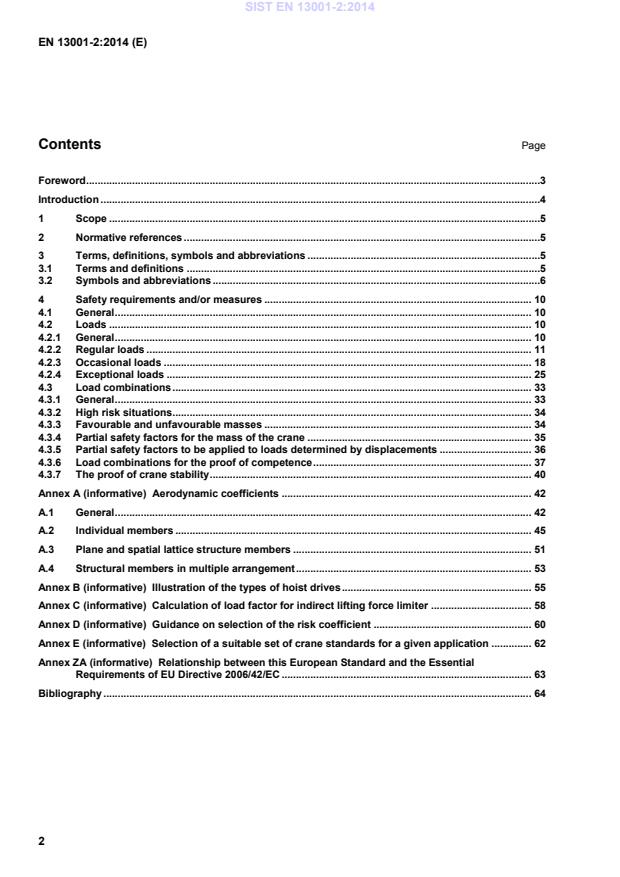
Contents Page
Foreword .3
Introduction .4
1 Scope .5
2 Normative references .5
3 Terms, definitions, symbols and abbreviations .5
3.1 Terms and definitions .5
3.2 Symbols and abbreviations .6
4 Safety requirements and/or measures . 10
4.1 General . 10
4.2 Loads . 10
4.2.1 General . 10
4.2.2 Regular loads . 11
4.2.3 Occasional loads . 18
4.2.4 Exceptional loads . 25
4.3 Load combinations . 33
4.3.1 General . 33
4.3.2 High risk situations. 34
4.3.3 Favourable and unfavourable masses . 34
4.3.4 Partial safety factors for the mass of the crane . 35
4.3.5 Partial safety factors to be applied to loads determined by displacements . 36
4.3.6 Load combinations for the proof of competence . 37
4.3.7 The proof of crane stability . 40
Annex A (informative) Aerodynamic coefficients . 42
A.1 General . 42
A.2 Individual members . 45
A.3 Plane and spatial lattice structure members . 51
A.4 Structural members in multiple arrangement . 53
Annex B (informative) Illustration of the types of hoist drives . 55
Annex C (informative) Calculation of load factor for indirect lifting force limiter . 58
Annex D (informative) Guidance on selection of the risk coefficient . 60
Annex E (informative) Selection of a suitable set of crane standards for a given application . 62
Annex ZA (informative) Relationship between this European Standard and the Essential
Requirements of EU Directive 2006/42/EC . 63
Bibliography . 64
Foreword
This document (EN 13001-2:2014) has been prepared by Technical Committee CEN/TC 147 “Crane —
Safety”, the secretariat of which is held by BSI.
This European Standard shall be given the status of a national standard, either by publication of an identical
text or by endorsement, at the latest by February 2015 and conflicting national standards shall be withdrawn
at the latest by February 2015.
Attention is drawn to the possibility that some of the elements of this document may be the subject of patent
rights. CEN [and/or CENELEC] shall not be held responsible for identifying any or all such patent rights.
This document supersedes EN 13001-2:2011.
The major changes in this revision are in 4.2.2.2, 4.2.3.4, 4.2.4.10, 4.3.2, 4.3.4 and 4.3.7. There are new
issues in 4.2.4.7, 4.2.4.8, Annex B, Annex C and Annex D.
This document has been prepared under a mandate given to CEN by the European Commission and the
European Free Trade Association, and supports essential requirements of EU Directive(s).
For relationship with EU Directive(s), see informative Annex ZA, which is an integral part of this document.
This European Standard is one Part of EN 13001. The other parts are as follows:
— Part 1: General principles and requirements
— Part 2: Load actions
— Part 3-1: Limit states and proof of competence of steel structures
— Part 3-2: Limit states and proof of competence of wire ropes in reeving systems
— Part 3-3: Limit states and proof of competence of wheel/rail contacts
— Part 3-4: Limit states and proof of competence of machinery
— Part 3-5: Limit states and proof of competence of forged hooks
For the relationship with other European Standards for cranes, see Annex E.
According to the CEN-CENELEC Internal Regulations, the national standards organizations of the following
countries are bound to implement this European Standard: Austria, Belgium, Bulgaria, Croatia, Cyprus, Czech
Republic, Denmark, Estonia, Finland, Former Yugoslav Republic of Macedonia, France, Germany, Greece,
Hungary, Iceland, Ireland, Italy, Latvia, Lithuania, Luxembourg, Malta, Netherlands, Norway, Poland, Portugal,
Romania, Slovakia, Slovenia, Spain, Sweden, Switzerland, Turkey and the United Kingdom.
Introduction
This European Standard has been prepared to be a harmonized standard to provide one means for the
mechanical design and theoretical verification of cranes to conform to the essential health and safety
requirements of the Machinery Directive, as amended. This standard also establishes interfaces between the
user (purchaser) of the crane and the designer, as well as between the designer and the component
manufacturer, in order to form a basis for selecting cranes and components.
This European Standard is a type C standard as stated in the EN ISO 12100.
The machinery concerned and the extent to which hazards are covered are indicated in the scope of this
standard.
When provisions of this type C standard are different from those, which are stated in type A or B standards,
the provisions of this type C standard take precedence over the provisions of the other standards, for
machines that have been designed and built according to the provisions of this type C standard.
1 Scope
This European Standard specifies load actions to be used together with the standard EN 13001-1 and
EN 13001-3, and as such they specify conditions and requirements on design to prevent mechanical hazards
of cranes, and provides a method of verification of those requirements.
NOTE Specific requirements for particular types of crane are given in the appropriate European Standard for the
particular crane type.
The following is a list of significant hazardous situations and hazardous events that could result in risks to
persons during normal use and foreseeable misuse. Clause 4 of this standard is necessary to reduce or
eliminate the risks associated with the following hazards:
a) Instability of the crane or its parts (tilting).
b) Exceeding the limits of strength (yield, ultimate, fatigue).
c) Elastic instability of the crane or its parts (buckling, bulging).
d) Exceeding temperature limits of material or components.
e) Exceeding the deformation limits.
This document is not applicable to cranes that are manufactured before the date of its publication as EN.
2 Normative references
The following documents, in whole or in part, are normatively referenced in this document and are
indispensable for its application. For dated references, only the edition cited applies. For undated references,
the latest edition of the referenced document (including any amendments) applies.
EN 1990, Eurocode - Basis of structural design
EN 13001-1, Cranes — General Design — Part 1: General principles and requirements
ISO 4306-1:2007, Cranes — Vocabulary — Part 1: General
3 Terms, definitions, symbols and abbreviations
3.1 Terms and definitions
For the purposes of this document, the terms and definitions given in EN 1990, Clause 6 of ISO 4306-1:2007
and the following apply.
3.1.1
hoist load
sum of the masses lifted by the crane, taken as the maximum that the crane is designed to lift in the
configuration and operational conditions being considered
3.1.2
single failure proof system
force carrying arrangement of several components, arranged so that in case of a failure of any single
component in the arrangement, the capability to carry the force is not lost
3.2 Symbols and abbreviations
For the purposes of this document, the symbols and abbreviations given in Table 1 apply.
Table 1 — Symbols and abbreviations
Symbols,
Description
abbreviations
A1 to A4 Load combinations including regular loads
A
Characteristic area of a crane member
A Projection of the hoist load on a plane normal to the direction of the wind velocity
g
Area enclosed by the boundary of a lattice work member in the plane of its
A
c
characteristic height d
A Area of an individual crane member projected to the plane of the characteristic
j
height d
b Width of the rail head
h
b Characteristic width of a crane member
B1 to B5 Load combinations including regular and occasional loads
c
Spring constant
c , c , c , c Aerodynamic coefficients
o a oy oz
C1 to C11 Load combinations including regular, occasional and exceptional loads
CFF, CFM Coupled wheel pairs of system F/F or F/M
d
Characteristic dimension of a crane member
d , d
Distance between wheel pair i or n and the guide means
i n
e
Width of the gap of a rail
G
f Friction coefficient
f
Loads
i
f
natural frequency
q
f
Term used in calculating v(z)
rec
F Force in general
F, F , F
Wind loads
y z
ˆ
Maximum buffer force
F
F F
, Initial and final drive force
i f
ΔF Change of drive force
F , F , F , F
Tangential wheel forces
x1i x2i y1i y2i
F
Guide force
y
F , F
Vertical wheel forces
z1i z2i
Symbols,
Description
abbreviations
Abbreviations for Fixed/Fixed and Fixed/Moveable, characterizing the possibility of
F/F, F/M
lateral movements of the crane wheels
g Acceleration due to gravity
h Distance between instantaneous slide pole and guide means of a skewing crane
h(t) Time dependent unevenness function
h
Height of the step of a rail
s
Lateral wheel forces induced by drive forces acting on a crane or trolley with
H , H
1 2
asymmetrical mass distribution
HC1 to HC4 Stiffness classes
HD1 to HD5 Classes of the type of hoist drive and its operation method
i Serial number
IFF, IFM Independent wheel pairs of system F/F or F/M
j Serial number
k
Serial number
K Drag coefficient of terrain
K , K
Roughness factors
1 2
l Span of a crane
l
Aerodynamic length of a crane member
a
l
Geometric length of a crane member
o
m
Mass of the hoist load
H
m Mass of the crane and the hoist load
Δm
Released or dropped part of the hoist load
H
n Number of wheels at each side of the crane runway
n
Exponent used in calculating the shielding factor η
m
p Number of pairs of coupled wheels
q
Equivalent static wind pressure
q
Mean wind pressure
q(z) Equivalent static storm wind pressure
q(3) Wind pressure at v(3)
r Wheel radius
R Out-of-service wind recurrence interval
Re Reynold number
s
Slack of the guide
g
s
Lateral slip at the guide means
y
Symbols,
Description
abbreviations
s
Lateral slip at wheel pair i
yi
S Load effect
ˆ
Maximum load effect
S
S , S
Initial and final load effects
i f
ΔS Change of load effect
t
Time
u Buffer stroke
û Maximum buffer stroke
v Travelling speed of the crane
v Constant mean wind velocity
Constant mean wind velocity if the wind direction is not normal to the longitudinal
v *
axis of the crane member under consideration
v(z) Equivalent static storm wind velocity
Equivalent static storm wind velocity if the wind direction is not normal to the
v(z)*
longitudinal axis of the crane member under consideration
v(3) Gust wind velocity averaged of a period of 3 seconds
v
Three seconds gust amplitude
g
v
Hoisting speed
h
v
Maximum steady hoisting speed
h,max
v
Steady hoisting creep speed
h,CS
v (z)
Ten minutes mean storm wind velocity in the height z
m
v
Reference storm wind velocity
ref
w
Distance between the guide means
b
z Height above ground level
z(t) Time-dependent coordinate of the mass centre
α
Relative aerodynamic length
r
Angle between the direction of the wind velocity v or v(z) and the longitudinal axis
α
w
of the crane member under consideration
α Skewing angle
α
Part of the skewing angle α due to the slack of the guide
g
α , α Terms used in calculating ϕ
G s 4
α
Part of the skewing angle α due to tolerances
t
α
Part of the skewing angle α due to wear
w
β Angle between horizontal plane and non-horizontal wind direction
Symbols,
Description
abbreviations
β Term used in calculating ϕ
2 2
β Term used in calculating ϕ
3 3
γ
Overall safety factor
f
γ
Resistance coefficient
m
γ
Risk coefficient
n
γ
Partial safety factor
p
γ
Additional safety factor for stability
s
Term used in calculating ϕ
δ
ε
Conventional start force factor
S
ε
Conventional mean drive force factor
M
η Shielding factor
η
Factor for remaining hoist load in out of service condition
W
λ
Aerodynamic slenderness ratio
μ, μ′ Parts of the span l
Term used in calculating the guide force F
F
y
F , F Terms used in calculating F and F
1i 2i y1i y2i
Term used in calculating ϕ
ξ
ξ , ξ Term used in calculating F and F
1i 2i x1i x2i
ξ (α ), ξ (α )
Curve factors
G G s s
ρ Density of the air
φ
Solidity ratio
ϕ
Dynamic factors
i
ϕ
Dynamic factor acting on the mass of the crane
Dynamic factor on hoist load when hoisting an unrestrained grounded load in
ϕ
regular operation
Dynamic factor on hoist load when hoisting an unrestrained grounded load under
ϕ
2C
exceptional conditions
ϕ Term used in calculating ϕ
2,min 2
Dynamic factor for inertial and gravity effects by sudden release of a part of the
ϕ
hoist load
ϕ
Dynamic factor for loads caused by travelling on uneven surface
ϕ
Dynamic factor for loads caused by acceleration of all crane drives
ϕ
Dynamic factor for test loads
Symbols,
Description
abbreviations
ϕ
Dynamic factor for loads due to buffer forces
ϕ
Gust response factor
ϕ , ϕ
Factors for calculation of force in case the load or moment limiter is activated
L ML
ψ
Reduction factor used in calculating aerodynamic coefficients
4 Safety requirements and/or measures
4.1 General
Loads and load combinations, as given in 4.2 and 4.3, shall only be applied as relevant for specified
configurations and operational conditions of the crane.
The load actions shall be taken into account in proofs against failure by uncontrolled movement, yielding,
elastic instability and, where applicable, against fatigue.
4.2 Loads
4.2.1 General
4.2.1.1 Introduction
The loads acting on a crane are divided into the categories of regular, occasional and exceptional as given in
4.2.1.2, 4.2.1.3 and 4.2.1.4. For the proof calculation of means of access, loads only acting locally are given in
4.2.4.13. Combinations of regular, occasional and exceptional loads into load combinations A, B and C are
given in 4.3.
4.2.1.2 Regular loads
Regular loads are those loads that occur frequently under normal operation.
a) Hoisting and gravity effects acting on the mass of the crane;
b) inertial and gravity effects acting vertically on the hoist load;
c) loads caused by travelling on uneven surface;
d) loads caused by acceleration of all crane drives;
e) loads induced by displacements.
4.2.1.3 Occasional loads
a) Loads due to in-service wind;
b) snow and ice loads;
c) loads due to temperature variation;
d) loads caused by skewing.
Occasional loads occur infrequently. They are usually neglected in fatigue assessment.
4.2.1.4 Exceptional loads
a) Loads caused by hoisting a grounded load under exceptional circumstances;
b) loads due to out-of-service wind;
c) test loads;
d) loads due to buffer forces;
e) loads due to tilting forces;
f) loads caused by emergency cut-out;
g) loads due to dynamic cut-off by lifting force limiting device;
h) loads due to dynamic cut-off by lifting moment limiting device;
i) loads due to unintentional loss of hoist load;
j) loads caused by failure of mechanism or components;
k) loads due to external excitation of crane support;
l) loads caused by erection and dismantling.
Exceptional loads are also infrequent and are likewise usually excluded from fatigue assessment.
4.2.2 Regular loads
4.2.2.1 Hoisting and gravity effects acting on the mass of the crane
When lifting the load off the ground or when releasing the load or parts of the load, the crane structure is
under effect of vibration excitation, which shall be taken into account as a load effect. The gravitational force
induced by the mass of the crane or crane part shall be multiplied by the factor ϕ . Dependent upon the
gravitational load effect of the mass and load combination in question, the factor ϕ is calculated in
accordance with either Formula (1) or (2). For definitions of unfavourable and favourable load effects see
4.3.3.
The gravitational load effect of the mass is unfavourable, Formula (1) applies:
(1)
φδ1+ with 0≤≤δ 0,1
The gravitational load effect of the mass is favourable, Formula (2) applies:
φδ1− with 0≤≤δ 0,05 (2)
The maximum values of δ from the Formulae (1) and (2) shall be used unless other values are justified by
measurements, calculations or obtained from the appropriate European Standard for the particular type of
crane.
The mass of the crane includes those components which are always in place during operation except for the
net load itself. For some cranes or applications, it may be necessary to add mass to account for accumulation
of debris.
=
=
4.2.2.2 Hoisting an unrestrained grounded load
When hoisting an unrestrained grounded load, the crane is subject to dynamic effects of transferring the load
off the ground onto the crane. These dynamic effects shall be taken into account by multiplying the
gravitational force due to the mass of the hoist load m by a factor ϕ , see Figure 1.
H 2
The mass of the hoist load includes the masses of the payload, lifting attachments and a portion of the
suspended hoist ropes or chains.
Figure 1 — Dynamic effects when hoisting a grounded load
The values of ϕ and ϕ shall be either calculated from the Formula (3) or be determined experimentally or by
2 2C
dynamic analysis. Where the Formula (3) is not used, the true characteristics of the drive system and the
elastic properties of the overall load supporting system shall be taken into account.
The dynamic factor ϕ (and respectively ϕ for Load combination C1, see 4.2.4.1) is calculated with the
2 2C
Formula (3):
(3)
φφ +×βv
2 2,min 2 h
where
β is the factor dependent upon the stiffness class of the crane in accordance with the Table 2,
v is the characteristic hoisting speed of the load in [m/s] in accordance with the Table 3,
h
different for calculations of ϕ and ϕ ,
2 2C
ϕ is the minimum value of ϕ and ϕ in accordance with Table 4.
2,min 2 2C
For the purposes of this standard, cranes may be assigned to stiffness classes ranging from HC1 to HC4 in
accordance with the elastic properties of the crane and its support. The stiffness classes given in the Table 2
shall be selected on the basis of the characteristic vertical load displacement δ.
Table 2 — Stiffness classes
Factor
Stiffness Characteristic vertical load
class displacement δ
β [s/m]
HC1 0,17
0,8 m ≤ δ
HC2 0,34
0,3 m ≤ δ < 0,8 m
HC3 0,15 m ≤ δ < 0,3 m 0,51
HC4 δ < 0,15 m 0,68
The stiffness classes were called hoisting classes in the
earlier versions of this standard.
=
The characteristic vertical load displacement δ shall be obtained by measurement or calculated from the
elasticity of the crane structure, the rope system and the crane support, using the maximum hoist load value
and setting the partial safety factors and dynamic factors to 1,0. Product type crane standards may give
specific guidance on selection of stiffness classes.
Where the characteristic vertical load displacement δ varies for differing crane configurations, the maximum
value of δ may be used for the selection of the stiffness class.
For the purposes of this standard, hoist drives shall be assigned to classes HD1 to HD5 depending on the
control characteristics as the weight of the load is transferred from the ground onto the crane. The hoist drive
classes are specified as follows:
HD1: Creep speed is not available or the start of the drive without creep speed is possible;
HD2: Hoist drive can only start at creep speed of at least a preset duration;
HD3: Hoist drive control maintains creep speed until the load is lifted off the ground;
HD4: Step-less hoist drive control, which performs with continuously increasing speed;
HD5: Step-less hoist drive control automatically ensures that the dynamic factor ϕ does not exceed
ϕ .
2,min
See Annex B for illustration of the types of hoist drives.
The characteristic hoisting speed v to be used in load combinations A, B and C is given in the Table 3.
h
Table 3 — Characteristic hoisting speeds v for calculation of ϕ and ϕ
h 2 2C
Load Factor
Hoist drive class
combination calculated by
HD1 HD2 HD3 HD4 HD5
(see 4.3.6) Formula (3)
A1, B1 v v v 0,5 ⋅ v v = 0 ϕ
h,max h,CS h,CS h,max h 2
C1 – v – v 0,5 ⋅ v ϕ
h,max h,max h,max 2C
Key
v for load combinations A1 and B1: the maximum steady hoisting speed of the load;
h,max
v for load combination C1 (see 4.2.4.1): the maximum hoisting speed resulting from all drives
h,max
(e.g. luffing and hoisting motion) contributing to the hoisting speed of the load;
is the steady hoisting creep speed.
v
h,CS
The minimum value ϕ depends upon the combination of the classes HC and HD and shall be selected in
2,min
accordance with the Table 4.
Table 4 — Selection of ϕ
2,min
Hoist drive class
Stiffness
class
HD1 HD2 HD3 HD4 HD5
HC1 1.05 1.05 1.05 1.05 1.05
HC2 1.1 1.1 1.05 1.1 1.05
HC3 1.15 1.15 1.05 1.15 1.05
HC4 1.2 1.2 1.05 1.2 1.05
4.2.2.3 Sudden release of a part of the hoist load
For cranes that release a part of the hoist load as a normal working procedure, the peak dynamic action on
the crane can be taken into account by multiplying the hoist load by the factor ϕ (see Figure 2). Negative
value of ϕ means an uplifting force on the crane.
Figure 2 — Factor ϕ
The factor ϕ shall be taken as follows:
∆m
H
φ=11−+β (4)
( )
m
H
where
Δm is the released part of the hoist load;
H
m is the mass of the hoist load;
H
β = 0,5 for cranes equipped with grabs or similar slow-release devices;
β = 1,0 for cranes equipped with magnets or similar rapid-release devices.
4.2.2.4 Loads caused by travelling on uneven surface
When calculating the dynamic actions on the crane by travelling, with or without load, on or off roadways or on
rail tracks, the induced accelerations shall be taken into account by multiplying the gravitational forces due to
the masses of the crane and hoist load by a factor ϕ .
The dynamic actions shall be determined in one of the following methods:
— the factor ϕ is calculated using a simple single mass — spring — model for the crane as shown below.
The use of this simplified model is restricted to cranes whose actual dynamic behaviour corresponds to
that of the model. Where more than one natural mode contributes a significant response and/or rotation
occurs, the designer may estimate the dynamic loads using an appropriate model for the circumstances.
— dynamic actions are determined by experiments or by calculation using an appropriate model for the
crane or the trolley and the travel surface or the track. Conditions for the travel surface (gaps, steps) shall
be specified.
— a conventional value for the factor ϕ may be taken from a European Standard for the specific crane type,
with specified conditions for the travel surface.
Key
m mass of the crane and the hoist load
v
constant horizontal travelling speed of the crane
c spring constant representing the stiffness of the crane in the vertical direction
z(t) coordinate of the mass centre
h(t) unevenness function describing the step or gap of the rail
Figure 3 — Single mass model of a crane for determining the factor ϕ
The factor ϕ may be calculated as follows:
2 2 for travelling over a step (see Figure 4a) (5)
π v
φξ1+
4s
2 g r
2 2 for travelling over a gap (see Figure 4b) (6)
π v
φξ1+
4G
2 g r
where
v
is the constant horizontal travelling speed of the crane;
r is the wheel radius;
g =
9,81 m/s is the acceleration due to gravity.
ξ (α ), are curve factors that become maximum for the time period after the wheel has
s s
passed the unevenness; they can be determined for α < 1,3 and α < 1,3 by the
ξ (α )
s G
G G
diagrams given in Figure 5.
where
(see Figure 5a);
2 fh
2r
qs
α =
s
vh
s
=
=
(see Figure 5b);
fe
qG
α =
G
v
h is the height of the step (see Figure 4);
s
e is the width of the gap (see Figure 4), gaps at a plan (top view) angle of
G
60° or smaller in respect to the travel direction (e.g. rail joint cuts), may be
neglected;
is the natural frequency of a single mass model of the crane (see
c / m
Figure 3), if unknown, to be taken as 10 Hz.
2π
f =
q
a) Travelling over a step b)Travelling over a gap
Figure 4 — Step and gap
a) Travelling over a step b) Travelling over a gap
Figure 5 — Curve factors ξ (α ) and ξ (α )
s s G G
4.2.2.5 Loads caused by acceleration of drives
Loads induced in a crane by accelerations or decelerations caused by drive forces shall be calculated. A rigid
body kinetic model may be used. For this purpose, the hoist load is taken to be fixed at the top of the jib or
immediately below the crab.
ˆ
The load effect S shall be applied to the components exposed to the drive forces and where applicable to the
crane and the hoist load as well. As a rigid body analysis does not directly reflect elastic effects, the load
ˆ
effect S shall be calculated by using a factor ϕ as follows (see Figure 6):
ˆ
S= S+φ ∆S (7)
i 5
where
ΔS = S − S is the change of the load effect due to the change of the drive force ΔF = F − F ;
f i f i
S , S are the initial (i) and final (f) load effects caused by F and F ;
i f i f
F , F are the initial (i) and final (f) drive forces.
i f
a) for the change of drive forces b) for the positioning case
from steady-state
Figure 6 — Factor ϕ
Following values of ϕ shall be applied:
ϕ = 1 for centrifugal forces;
1 ≤ ϕ ≤ 1,5 for drives with no backlash or in cases where existing backlash does not affect the dynamic
forces (e.g. typical for gear boxes) and with smooth change of forces;
1,5 ≤ ϕ ≤ 2 for drives with no backlash or in cases where existing backlash does not affect the dynamic
forces (e.g. typical for gear boxes) and with sudden change of forces;
ϕ = 3 for drives with considerable backlash (e.g. open gears) and when not calculated more
accurately from dynamic analysis using a spring-mass model.
Where a force that can be transmitted is limited by friction or by the nature of the drive mechanism, the limited
force and a factor ϕ appropriate to that system shall be used.
Drive forces F acting on a crane or a trolley with asymmetrical mass distribution induce horizontal forces H
and H , as shown in Figure 11. Those shall be taken into account as regular loads acting on guiding means in
the corners of the crane. Where a guide roller is provided, the whole horizontal force in the corner shall be
applied on that. Where the guiding is by flanges of travel wheels, the horizontal forces may be distributed
between the wheels in a corner as follows:
— 1 or 2 wheels per corner: force applied on the outermost wheel
— 3 or 4 wheels per corner: force distributed equally on the two outermost wheels
— More than 4 wheels per corner: force distributed equally on the three outermost wheels
Key
1 gravity centre
Figure 7 — Forces acting on rail mounted cranes or trolleys with asymmetrical mass distribution,
forces due to acceleration by travel drives
4.2.2.6 Loads determined by displacements
Account shall be taken of loads arising from deformations caused by intended displacements within set limits
and included in the design such as
— elastic displacements determined by skew control of the travelling movement,
— to close gaps in connections.
Other loads to be considered include those that can arise from deformations caused by unintended
displacements that are within specified limits and include allowance for
— the variations in the height between rails, or the gauge,
— uneven settlement of supports.
4.2.3 Occasional loads
4.2.3.1 Loads due to in-service wind
The wind loads in respect to different design criteria are calculated as follows:
Wind effect level W1, for the calculation of the structure of the crane; (8)
Fq(3)××c A
a
Wind effect level W2, for the calculation of the required starting drive (9)
F=ε× q(3)××cA
Sa
forces;
Wind effect level W3, for the calculation of power requirements of (10)
F=ε× q(3)××cA
M a
drive systems during steady movements;
where
F is the wind load acting perpendicularly to the longitudinal axis of the member under
consideration;
c is the aerodynamic coefficient of the member under consideration; it shall be used in
a
combination with the characteristic area A. Values of c shall be those from Annex A or shall
a
=
be those derived by recognized theoretical or experimental methods.
A
is the characteristic area of the member under consideration (see Annex A);
with
is the wind pressure at v(3);
q(3) = 0,5 × ρ × v(3)
is the density of the air;
ρ = 1,25 kg/m
ε = 0,7 is the factor for the Wind effect level W2;
S
ε = 0,37 is the factor for the Wind effect level W3;
M
v(3) = 1,5 × v is the gust wind velocity averaged over a period of 3 seconds;
v is the mean wind velocity, averaged over 10 min in 10 m height above flat ground
or sea level.
For the calculation of loads due to in-service wind it is assumed that the wind blows horizontally at a constant
mean velocity v at all heights.
Considering a crane member, the component v * of the wind velocity acting perpendicularly to the longitudinal
axis of the crane member shall be applied; it is calculated by v * = v × sin α , where α is the angle between
w w
the direction of the wind velocity v and the longitudinal axis of the member under consideration.
The wind load assumed to act on the hoist load in direction of the wind velocity is determined by analogy to
the wind loads assumed to act on a crane member, whereas a substitution of v by v * shall not be applied.
The factors in the given formulae for F (see above) are as follows:
F is the wind load acting on the hoist load in direction of the wind velocity;
c is the aerodynamic coefficient of the hoist load in direction of the wind velocity;
a
A is the projection of the hoist load on a plane normal to the direction of the wind velocity, in square
g
metres.
In absence of detailed information of the load it should be assumed c = 2,4 and A = 0,000 5 × m , where m
a g H H
is the mass of the hoist load in kilograms. A shall not be taken less than 0,8 m .
g
Depending upon the type of crane, its configuration, operation and service conditions and the specified
number of out-of-service days per year, a mean wind velocity shall be specified. Table 5 gives values of the
v
mean velocity v for standardized wind states.
Table 5 — In-service wind states and design wind pressures
Design wind pressures at different
Wind State
Wind effect levels [N/m ]
Designation Characteristic wind speeds W1 W2 W3
ε ⋅ q(3) ε ⋅ q(3)
v [m/s] v(3) [m/s] q(3)
S M
Light 9,4 14 125 88 46
Normal 13,3 20 250 175 92
Heavy 18,9 28 500 350 185
Other wind states may be specified for a crane. The specification shall be based on
either of the characteristic wind speeds v or v(3).
The correlation of the mean wind velocity, the Beaufort scale and the in-service wind states is shown in
Figure 8.
Key
X Beaufort
1 Wind state: Light
2 Wind state: Normal
3 Wind state: Heavy
Figure 8 — Correlation of the mean wind velocity v ,
the Beaufort scale and the in-service wind states
The design is based on the following requirement for the operation of the crane: If the wind velocity, measured
at the highest point of the crane, increases and tends to reach v(3), the crane shall be secured or its
configuration shall be transformed into a safe configuration. As the methods and/or means for this securing
are different and need different time (locking devices at special locations of the crane runway, hand-operated
or automatic rail clamps) a lower level of mean wind velocity shall be chosen to start the securing. Wind
velocities for the use of different crane configurations and for the starting of securing shall be specified.
Any slender structural member, when placed in a wind stream with its longitudinal axis perpendicular to this
stream, may become aero-elastically unstable. Means to prevent these effects (e.g. galloping or formation of
eddies) by design shall be considered both for in-service and out-of-service wind conditions.
4.2.3.2 Snow and ice loads
Where relevant, snow and ice loads shall be specified and taken into account. The increased wind exposure
surfaces shall be considered.
4.2.3.3 Loads due to temperature variation
Where relevant, local temperature variation shall be specified and taken into account.
4.2.3.4 Loads caused by skewing
Skewing loads occur at the guidance means of guided wheel-mounted cranes or trolleys while they are
travelling or traversing at constant speed. These loads are induced by guidance reactions which force the
wheels to deviate from their free-rolling, natural travelling or traversing direction.
Skewing loads as described above are usually taken as occasional loads but their frequency of occurrence
varies with the type, configuration, and accuracies of wheel axle parallelism and service of the crane or trolley.
In individual cases, the frequency of occurrence will determine whether they are taken as occasional or
regular loads. Guidance for estimating the magnitude of skewing loads and the category into which they are
placed is given in the European Standards for specific crane types.
The lateral and tangential forces between wheels and rails as well as between guide means and guidance
caused by skewing of the crane shall be calculated. A simplified mechanical model may be used, where the
crane is considered to be travelling at a constant speed without anti-skewing control.
The model consists of n pairs of wheels transversally in line, of which p pairs are coupled. A coupled pair of
wheels (C) is coupled mechanically or electrically. Independently supported non-driven or also — in
approximation — single-driven wheels are considered as independent wheel pair (I). The latter condition is
also valid in the case of independent single drives.
The wheels are arranged in ideal geometric positions in a rigid crane structure which is travelling on a rigid
track. Differences in wheel diameters are neglected in this model. They are either fixed (F) or movable (M) in
respect of lateral movement.
The different combinations of transversally in-line wheel pairs that are possible are shown in Figure 9.
Coupled (C) Independent (I)
Fixed/Fixed
(F/F)
CFF
IFF
Fixed/Movable
(F/M)
CFM
IFM
Figure 9 — Different combinations of wheel pairs
The positions of the wheel pairs relative to the position of the guide means in front of the travelling crane are
given by the distance d as shown in Figure 10. Where flanged wheels are used instead of an external guide
i
means, it shall be set d = 0.
It is assumed that the gravitational forces due to the masses of the loaded appliance are acting at a distance
μl from rail 1 and may be distributed equally to the n wheels at each side of the crane runway.
Key
1 wheel pair 1 5 rail 2
2 wheel pair 2 6 rail 1
3 wheel pair I 7 travelling direction
4 wheel pair n 8 guide means
Figure 10 — Positions of wheel pairs
The crane model is assumed to be travelling at constant speed and to have skewed to an angle α, as shown
in Figure 10. The crane may be guided horizontally by external means or by wheel flanges.
Key
1 direction of motion 5 instantaneous slide pole
2 direction of rail 6 rail 1
3 wheel pair i 7 slip
4 rail 2 8 guide means
Figure 11 — Loads acting on crane in skewed position
A guide force F may be applied on the guiding means as given in 4.2.2.5.
y
The guide force F is in balance with the wheel forces F , F , F , F , which are caused by rotation of the
y x1i y1i x2i y2i
= α at the guide means and a linear
crane about the instantaneous slide pole. With the maximum lateral slip s
y
distribution of the lateral slip s between guide means and instantaneous slide pole, the corresponding
yi
skewing forces may be calculated as follows:
The guide force F is calculated by
y
F=ν× f× mg× (11)
y
where
m × g is the gravitational force due to the mass of the loaded crane;
(−250α)
is the friction coefficient of the rolling wheel;
f = µ ×−1 e
μ is the friction factor; μ = 0,3 for cleaned rails;
0 0
μ = 0,2 for non-cleaned rails in usual environment;
α is the skew angle (see Figure 10), in radians;
ν = 1 − ∑d /nh for systems F/F (see Figure 9);
i
ν = μ′(1 − ∑d /nh) for systems F/M (see Figure 9);
i
h is the distance between the instantaneous slide pole and the guide means;
2 2
h =
(pμμ′l + ∑ d )/∑ d (for systems F/F);
i i
2 2
h =
(pμl + ∑ d )/∑ d (for systems F/M);
i i
n is the number of wheels at each side of the crane runway;
p is the number of pairs of coupled wheels;
l
is the span of the crane (see Figure 10);
μ, μ′ are parts of the span
...