

EN 1264-2:2008
(Main)Water based surface embedded heating and cooling systems - Part 2: Floor heating: Prove methods for the determination of the thermal output using calculation and test methods
General Information
- Abstract
This European Standard specifies the boundary conditions and the prove methods for the determination of the thermal output of hot water floor heating systems as a function of the temperature difference between the heating medium and the room temperature.
This standard shall be applied to commercial trade and practical engineering if proved and certifiable values of the thermal output shall be used.
This European Standard applies to heating and cooling systems embedded into the enclosure surfaces of the room to be heated or to be cooled. This Part of this European Standard applies to hot water floor heating systems. Applying of Part 5 of this European Standard requires the prior use of this Part of this European Standard. Part 5 of this European Standard deals with the conversion of the thermal output of floor heating systems determined in Part 2 into the thermal output of heating surfaces embedded in walls and ceilings as well as into the thermal output of cooling surfaces embedded in floors, walls and ceilings.
The thermal output is proved by a calculation method (Clause 6) and by a test method (Clause 9). The calculation method is applicable to systems corresponding to the definitions in EN 1264 1 (type A, type B, type C, type D). For systems not corresponding to these definitions, the test method shall be used. The calculation method and the test method are consistent with each other and provide correlating and adequate prove results.
The prove results, expressed depending on further parameters, are the standard specific thermal output and the associated standard temperature difference between the heating medium and the room temperature as well as fields of characteristic curves showing the relationship between the specific thermal output and the temperature difference between the heating medium and the room.
- Status
- Withdrawn
- Publication Date
- 21-Oct-2008
- Withdrawal Date
- 13-Nov-2012
- Technical Committee
- CEN/TC 130 - Space heating appliances without integral heat sources
- Drafting Committee
- CEN/TC 130/WG 9 - Floor heating - Systems and components
- Current Stage
- 9960 - Withdrawal effective - Withdrawal
- Start Date
- 14-Nov-2012
- Completion Date
- 14-Nov-2012

Relations
- Effective Date
- 22-Dec-2008
- Effective Date
- 18-Jan-2023
- Effective Date
- 28-Jan-2026
Get Certified
Connect with accredited certification bodies for this standard

DIBt (Deutsches Institut für Bautechnik)
German Institute for Building Technology.
DIN CERTCO
DIN Group product certification.

Aboma Certification B.V.
Specialized in construction, metal, and transport sectors.
Sponsored listings
Frequently Asked Questions
EN 1264-2:2008 is a standard published by the European Committee for Standardization (CEN). Its full title is "Water based surface embedded heating and cooling systems - Part 2: Floor heating: Prove methods for the determination of the thermal output using calculation and test methods". This standard covers: This European Standard specifies the boundary conditions and the prove methods for the determination of the thermal output of hot water floor heating systems as a function of the temperature difference between the heating medium and the room temperature. This standard shall be applied to commercial trade and practical engineering if proved and certifiable values of the thermal output shall be used. This European Standard applies to heating and cooling systems embedded into the enclosure surfaces of the room to be heated or to be cooled. This Part of this European Standard applies to hot water floor heating systems. Applying of Part 5 of this European Standard requires the prior use of this Part of this European Standard. Part 5 of this European Standard deals with the conversion of the thermal output of floor heating systems determined in Part 2 into the thermal output of heating surfaces embedded in walls and ceilings as well as into the thermal output of cooling surfaces embedded in floors, walls and ceilings. The thermal output is proved by a calculation method (Clause 6) and by a test method (Clause 9). The calculation method is applicable to systems corresponding to the definitions in EN 1264 1 (type A, type B, type C, type D). For systems not corresponding to these definitions, the test method shall be used. The calculation method and the test method are consistent with each other and provide correlating and adequate prove results. The prove results, expressed depending on further parameters, are the standard specific thermal output and the associated standard temperature difference between the heating medium and the room temperature as well as fields of characteristic curves showing the relationship between the specific thermal output and the temperature difference between the heating medium and the room.
This European Standard specifies the boundary conditions and the prove methods for the determination of the thermal output of hot water floor heating systems as a function of the temperature difference between the heating medium and the room temperature. This standard shall be applied to commercial trade and practical engineering if proved and certifiable values of the thermal output shall be used. This European Standard applies to heating and cooling systems embedded into the enclosure surfaces of the room to be heated or to be cooled. This Part of this European Standard applies to hot water floor heating systems. Applying of Part 5 of this European Standard requires the prior use of this Part of this European Standard. Part 5 of this European Standard deals with the conversion of the thermal output of floor heating systems determined in Part 2 into the thermal output of heating surfaces embedded in walls and ceilings as well as into the thermal output of cooling surfaces embedded in floors, walls and ceilings. The thermal output is proved by a calculation method (Clause 6) and by a test method (Clause 9). The calculation method is applicable to systems corresponding to the definitions in EN 1264 1 (type A, type B, type C, type D). For systems not corresponding to these definitions, the test method shall be used. The calculation method and the test method are consistent with each other and provide correlating and adequate prove results. The prove results, expressed depending on further parameters, are the standard specific thermal output and the associated standard temperature difference between the heating medium and the room temperature as well as fields of characteristic curves showing the relationship between the specific thermal output and the temperature difference between the heating medium and the room.
EN 1264-2:2008 is classified under the following ICS (International Classification for Standards) categories: 91.140.10 - Central heating systems. The ICS classification helps identify the subject area and facilitates finding related standards.
EN 1264-2:2008 has the following relationships with other standards: It is inter standard links to EN 1264-2:1997, EN 1264-2:2008+A1:2012, EN 1264-5:2008. Understanding these relationships helps ensure you are using the most current and applicable version of the standard.
EN 1264-2:2008 is available in PDF format for immediate download after purchase. The document can be added to your cart and obtained through the secure checkout process. Digital delivery ensures instant access to the complete standard document.
Standards Content (Sample)
2003-01.Slovenski inštitut za standardizacijo. Razmnoževanje celote ali delov tega standarda ni dovoljeno.SUHVNXãDQMHPRaumflächenintegrierte Heiz- und Kühlsysteme mit Wasserdurchströmung - Teil 2: Fußbodenheizung: Prüfverfahren für die Bestimmung der Wärmeleistung von Fußbodenheizsystemen unter Benutzung von Berechnungsmethoden und experimentellen MethodenSystemes de refroidissement et de chauffage intégrés a circulation d'eau - Partie 2: Chauffage par le sol: Méthodes éprouvées pour la détermination de la puissance thermique des systemes de chauffage par le sol, par calcul et a l'aide de méthodes d'essaiWater based surface embedded
heating and cooling systems - Part 2: Floor heating: Prove methods for the determination of the thermal output of floor heating systems using calculation and test methods91.140.10Sistemi centralnega ogrevanjaCentral heating systemsICS:Ta slovenski standard je istoveten z:EN 1264-2:2008SIST EN 1264-2:2009en,fr,de01-januar-2009SIST EN 1264-2:2009SLOVENSKI
STANDARDSIST EN 1264-2:19971DGRPHãþD
EUROPEAN STANDARDNORME EUROPÉENNEEUROPÄISCHE NORMEN 1264-2October 2008ICS 91.140.10Supersedes EN 1264-2:1997
English VersionWater based surface embedded heating and cooling systems -Part 2: Floor heating: Prove methods for the determination of thethermal output using calculation and test methodsSystèmes de surfaces chauffantes et rafraîchissanteshydrauliques intégrées - Partie 2 : Chauffage par le sol:Méthodes de démonstration pour la détermination del'émission thermique utilisant des méthodes par le calcul età l'aide de méthodes d'essaiRaumflächenintegrierte Heiz- und Kühlsysteme mitWasserdurchströmung - Teil 2: Fußbodenheizung:Prüfverfahren für die Bestimmung der Wärmeleistung vonFußbodenheizsystemen unter Benutzung vonBerechnungsmethoden und experimentellen MethodenThis European Standard was approved by CEN on 13 September 2008.CEN members are bound to comply with the CEN/CENELEC Internal Regulations which stipulate the conditions for giving this EuropeanStandard the status of a national standard without any alteration. Up-to-date lists and bibliographical references concerning such nationalstandards may be obtained on application to the CEN Management Centre or to any CEN member.This European Standard exists in three official versions (English, French, German). A version in any other language made by translationunder the responsibility of a CEN member into its own language and notified to the CEN Management Centre has the same status as theofficial versions.CEN members are the national standards bodies of Austria, Belgium, Bulgaria, Cyprus, Czech Republic, Denmark, Estonia, Finland,France, Germany, Greece, Hungary, Iceland, Ireland, Italy, Latvia, Lithuania, Luxembourg, Malta, Netherlands, Norway, Poland, Portugal,Romania, Slovakia, Slovenia, Spain, Sweden, Switzerland and United Kingdom.EUROPEAN COMMITTEE FOR STANDARDIZATIONCOMITÉ EUROPÉEN DE NORMALISATIONEUROPÄISCHES KOMITEE FÜR NORMUNGManagement Centre: rue de Stassart, 36
B-1050 Brussels© 2008 CENAll rights of exploitation in any form and by any means reservedworldwide for CEN national Members.Ref. No. EN 1264-2:2008: ESIST EN 1264-2:2009
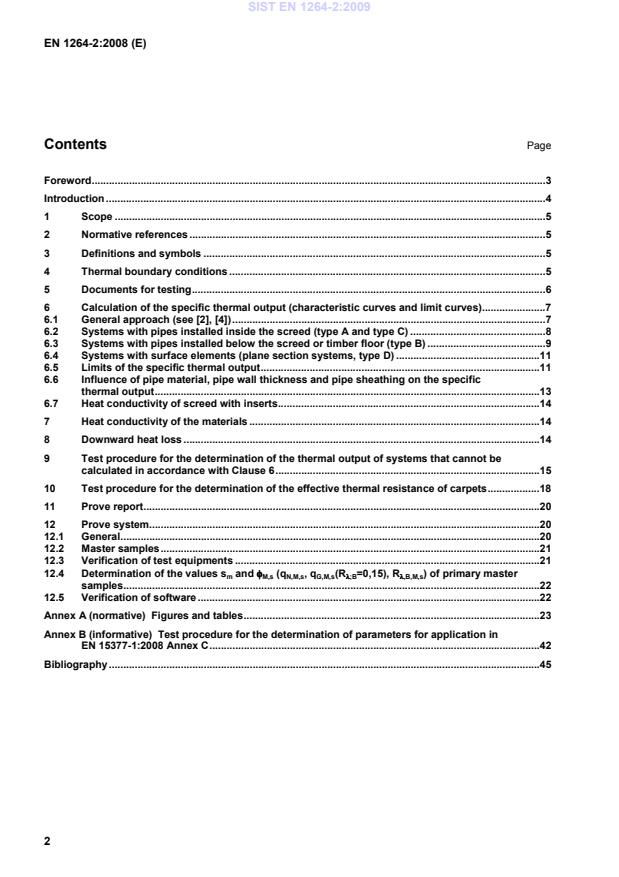
Figures and tables.23 Annex B (informative)
Test procedure for the determination of parameters for application in EN 15377-1:2008 Annex C.42 Bibliography.45
Introduction This European Standard is based on the realisation that in the field of commercial trade, the thermal output of heating and cooling systems represents the basis of rating. In order to be able to evaluate and compare different heating and/or cooling systems, it is, therefore, necessary to refer to values determined using one single, unambiguously defined method. The basis for doing so are the prove methods for the determination of the thermal output of floor heating systems specified in Part 2 of this European Standard. In analogy to the European Standard EN 442-2 (Radiators and convectors — Part 2: Test methods and rating), these prove methods provide characteristic partial load curves under defined boundary conditions as well as the characteristic output of the system represented by the standard thermal output together with the associated standard temperature difference between the heating medium and the room temperature. SIST EN 1264-2:2009
1 Scope This European Standard specifies the boundary conditions and the prove methods for the determination of the thermal output of hot water floor heating systems as a function of the temperature difference between the heating medium and the room temperature. This standard shall be applied to commercial trade and practical engineering if proved and certifiable values of the thermal output shall be used. This European Standard applies to heating and cooling systems embedded into the enclosure surfaces of the room to be heated or to be cooled. This Part of this European Standard applies to hot water floor heating systems. Applying of Part 5 of this European Standard requires the prior use of this Part of this European Standard. Part 5 of this European Standard deals with the conversion of the thermal output of floor heating systems determined in Part 2 into the thermal output of heating surfaces embedded in walls and ceilings as well as into the thermal output of cooling surfaces embedded in floors, walls and ceilings. The thermal output is proved by a calculation method (Clause 6) and by a test method (Clause 9). The calculation method is applicable to systems corresponding to the definitions in EN 1264-1 (type A, type B, type C, type D). For systems not corresponding to these definitions, the test method shall be used. The calculation method and the test method are consistent with each other and provide correlating and adequate prove results. The prove results, expressed depending on further parameters, are the standard specific thermal output and the associated standard temperature difference between the heating medium and the room temperature as well as fields of characteristic curves showing the relationship between the specific thermal output and the temperature difference between the heating medium and the room. 2 Normative references The following referenced documents are indispensable for the application of this document. For dated references, only the edition cited applies. For undated references, the latest edition of the referenced document (including any amendments) applies. EN 1264-1:1997, Floor heating — Systems and components — Part 1: Definitions and symbols prEN 1264-3:2007, Water based surface embedded heating and cooling systems — Part 3: Dimensioning 3 Definitions and symbols For the purposes of this document, the terms and definitions given in EN 1264-1:1997 apply. 4 Thermal boundary conditions A floor heating surface with a given average surface temperature exchanges the same thermal output in any room with the same indoor room temperature (standard indoor room temperature ϑi). It is, therefore, possible to give a basic characteristic curve of the relationship between specific thermal output and average surface temperature that is independent of the heating system and applicable to all floor heating surfaces (including those having peripheral areas with greater heat emissions) (see Figure A.1). In contrast, every floor heating system has its own maximum permissible specific thermal output, the limit specific thermal output, qG. This output is calculated for an ambient (standard) indoor room temperature SIST EN 1264-2:2009
1) National regulations may limit this temperature to a lower value 2) Some floor covering materials may require lower temperatures SIST EN 1264-2:2009
= 1,06; au is the covering factor in accordance with Equation (12); aB is the floor covering factor: B,TuBTRaaBam⋅⋅⋅+=11 (17) 6.5 Limits of the specific thermal output The procedure for the determination of the limits of the specific thermal output is shown in principle within Figure A.5. The limit curve (see Figure A.5) gives the relationship between the specific thermal output and the temperature difference between the heating medium and the room for cases where the maximum permissible difference between surface temperature and indoor room temperature (9 K or 15 K respectively) is achieved. The limit curve is calculated using the following expression in form of a product: GHGGnBq⋅⋅=ϕθ∆ϕ (18) where SIST EN 1264-2:2009
11GiiGGH,nmiaBB−⋅⋅=ϕϑ∆ (20) For type A and type C systems, the above mentioned Equations (18) and (20) apply directly to pipe spacing T ≤ 0,375 m. In case of spacing T > 0,375 m, for these systems the following conversion shall be made: GGGfTqq⋅=375,0375,0; (21) GGH,GH,f⋅=375,0;ûûϑϑ (22) where qG; 0,375 is the limit specific thermal output, calculated for a spacing T = 0,375 m; ϑH, G; 0,375 is the limit temperature difference between the heating medium and the room, calculated for a spacing T = 0,375 m. The factor fG shall be determined as follows, depending on the ratio su/T: For su/T ≤ 0,173, fG = 1 applies. For su/T > 0,173, the following equation applies: TqeTqqqfTs375,0)375,0(375,0)173,0/(20375,02⋅⋅⋅−−=−⋅−G;G;maxG,maxG,Gu (23) where SIST EN 1264-2:2009
∆ϑH, G is designated as standard temperature difference between the heating medium and the room ∆ϑN (see Figure A.5). These values serve as characteristic values in the system comparison. The maximum possible value of the specific thermal output qG, max for an isothermal surface temperature distribution is represented by the ordinate value for ϑF, m = ϑF, max on the basic characteristic curve (see Figure A.1). Table A.12 gives values for qG, max, depending on the maximum floor surface temperature ϑF, max and the standard indoor room temperature ϑi. If (due to calculation and interpolation inaccuracies as well as linearization) higher values for qG than qG, max are calculated using Equations (18), (21), (24), qG, max has to be used. 6.6 Influence of pipe material, pipe wall thickness and pipe sheathing on the specific thermal output The factors B0 are specified in Equations (4a) and (11) for a pipe heat conductivity λR, 0 = 0,35 W/(m ⋅ K), a wall thickness sR, 0 = 0,002 m. For other materials (see Table A.13) with a heat conductivity of the pipe material λR or other wall thicknesses sR, the factor B shall be calculated using: ()⋅⋅Π⋅π+=Ta1,1B1B1mi0ii (25) −λ−−λ00,s2ddln21s2ddln21R,aaRRaaR If the pipe has an additional sheathing with an external diameter dM, an internal diameter da and a heat conductivity of the sheathing λM, the following equation applies: SIST EN 1264-2:2009
)qR(R1qUiOUUϑ−ϑ+⋅⋅=
(28)
where qU
downward specific heat loss q
specific thermal output of the floor heating system RU
downwards partial heat transmission resistance of the floor structure RO
upwards partial heat transmission resistance of the floor structure ϑi
standard indoor room temperature of the floor heated room SIST EN 1264-2:2009
indoor room temperature of a room under the floor heated room
With respect to Figure 5 of prEN 1264-3 the following applies:
UUB,OsR1Rλ++α=λ
(29) where 1/. = 0,0926 m2·K/W RU = R,ins + R,ceiling + R,plaster + R.,ceiling
(30) where R.,ceiling = 0,17 m2·K/W In the special case of ϑi = ϑU the simple equation
UOURRqq⋅=
(31) applies. For a more detailed calculation of the downward heat loss, see Part 3 of this European Standard. 9 Test procedure for the determination of the thermal output of systems that cannot be calculated in accordance with Clause 6 For constructions which do not correspond to the basic construction of the types A, B, C or D, or in case of dimensions or material data outside the scope of the calculation method, the specific thermal output shall be determined by testing (experimentally) as follows. A test sample consisting of at least three heating pipes, with the pipe spacing to be tested, in accordance with the system design of the floor heating to be investigated is positioned in the testing equipment according to Figure A.6 [4]. The size of the test sample shall be approximate 1 m × 1 m on appointment with the test laboratory and shall cover preferably three-pipe spacing. In Figure A.6 the cooling plates simulate the room above the floor heating system (see key 1), i.e. the temperature of the heated room ϑi, and the room below (see key 4). For the cooling plates the construction according to Figure A.7 is recommended consisting of panel radiators with flat tubes in which disconnecting points realize the appropriate cooling water flow. The heat transfer resistance
1/α at the floor surface is simulated by the heat transfer layer (see key 2).The two lateral heating pipes serve as a protection field to enable the optimum undisturbed temperature field around the central pipe. The heat transfer resistance 1/α at the floor surface, given by the basic characteristic curve, is replaced by the heat conduction resistance s/λ of the heat transfer layer (see key 2) of equal magnitude (mean value): 1/α = s/λ = 0,092 6 m2 ⋅ K/W
(32) The tolerance on the value s/λ is ± 0,01 m2 ⋅ K/W. SIST EN 1264-2:2009
is the heat water supply temperature of the sample ϑR
is the heat water return temperature of the sample ϑC,out
is the outlet cooling water temperature of the cooling plates ϑC,in
is the inlet cooling water temperature of the cooling plates Temperatures shall be measured with a permissible uncertainty of ± 0,1 K. The temperature field of the floor surface is measured in order to determine the values ϑF, m andϑF, max. The measurement shall be carried out in the undisturbed area around the central pipe or central pipes and, at least, over the width of one pipe spacing. If possible, it is recommended using two pipe spacing. The configuration of the measuring points using two pipe spacing should be done in principle as shown in Figure A.8. For an example, with the measuring values ϑF, i (see Figure A.8) the calculation procedure is as follows:
16/)2(18,F10,F9,F1,F1711i,F82i,Fm,Fϑ+ϑ+ϑ+ϑ+ϑ+ϑ=ϑ∑∑
214,F5,Fmax,Fϑ+ϑ=ϑ where i,Fϑ
are the local floor surface temperatures (measuring points) m,Fϑ is the average floor surface temperature max,Fϑ is the maximum floor surface temperature In the case of not feasible values of the measured temperature field caused by inhomogeneity of the screed, another part of the surface shall be taken. NOTE 1 Because of the fact that the temperature drop of the sample ϑV –ϑR is very little and the fact that the temperature measurements shall be carried out in the undisturbed area around the central pipe no variation is necessary depending on the laying system (spirally or meandering). NOTE 2 The explanations above refer to the most usual case that the floor heating system is characterized by the repetition of the pipe spacing. The test sample in Figure A.6 which is symmetrical with respect to the central pipe is based on this fact. If another dimension characterizes the system the procedure has to be adjusted. In a first working step the test is realized for R,B = 0. The average floor surface temperature ϑF, m is determining the specific thermal output, and the maximum floor surface temperature ϑF, max is limiting the thermal output. The measurement is carried out when steady state conditions are reached and a temperature of both cooling plates of ϑi = 20 °C ± 0,5 K is maintained. Under these conditions the average temperature of the heating medium ϑH is set to achieve a maximum floor surface temperature of ϑF, max = 29 °C (i.e. ϑF, max – ϑi = 9 K), and in this case the difference between SIST EN 1264-2:2009
(33) The standard specific thermal output qN, together with the above determined corresponding value of the standard temperature difference ∆ϑ N, gives the equation for the characteristic curve for Rλ, B = 0: qN = KH, N ⋅ ∆ϑ N with the following gradient of the characteristic curve (the equivalent heat transmission coefficient): NNNH,ϑ∆qK=
(34) If for a given resistance of the covering ,B,λR′ the gradient of the characteristic curve HK′ applies (determination of HK′ see below Equation (36)), for any resistance of the floor covering Rλ, B > 0, the associated gradient of the characteristic curve KH(Rλ, B) can be determined in accordance with the following equation: )1(1)(−′′+==HNH,B,B,NH,B,HHKKRRKRKK
(35) Using Equation (35), the gradients of the characteristic curves KH(Rλ, B) can be calculated for thermal resistances Rλ, B = 0,05 m2 ⋅ K/W, 0,10 m2 ⋅ K/W and 0,15 m2 ⋅ K/W. In order to establish the gradient of the characteristic curve HK′ to be used in Equation (35), another measurement like the one described above for Rλ, B = 0, has to be carried out, but with a resistance of the floor covering B,λR′ = 0,15 m2 ⋅ K/W ± 0,01 m2 ⋅ K/W. By doing this measurement, the limit specific thermal output Gq′ and the limit temperature difference ∆GH,ϑ′are determined, which give the needed value HK′: GH,B,HHϑ′′=′′=′û)(GqRKK
(36) In accordance with the following Equation (37), the limit temperature differences ∆ϑH, G for the heat conduction resistances Rλ, B > 0 are given by the interfaces of the characteristic curves and the limit curve resulting from the measurement data and the gradient KH of the characteristic curve calculated from Equation (35): ∆ϑH, G = ϕ ⋅ GGqqqq′+−′−⋅′−⋅′NGHNHGHNNK)ûû(ûû,,ϑϑϑϑ
(37) SIST EN 1264-2:2009
1m x 1m. The equipment is situated in the centre of the floor of a test booth in accordance with EN 14037-2 (Figure A.9), i.e. in a room with constant controlled ambient room temperatures. Between the test equipment and the floor of the booth insulation is recommended (key 3). The essential parts of the equipment are a heating plate (key 2) in accordance with the cooling plate in Figure A.7, a heat flow meter plate (key 1) with a well-known thermal conduction resistance RHFM, temperature measuring sensors on the surfaces and a globe thermometer Gl according to EN 14037-2. NOTE Between the heat flow meter plate (key 1) and the heating plate (key 2) an elastic layer shall be interposed, for instance consisting of PE lather of about 2 mm thickness. The meaning of the used symbols is as follows: q
specific thermal output ϑGl
ambient reference temperature measured with globe thermometer ϑH
average heating medium temperature ϑHFM,a
temperature of the surface on top of the heat flow meter plate ϑHFM,b
temperature of the surface at the bottom of the heat flow meter plate R.
heat exchange resistance on the heating surface RHFM
thermal conduction resistance of the heat flow meter plate Rλ,B
effective thermal resistance of carpet covering subscripts 1: means test 1 (example: ϑGl,1 is the valid value of ϑGl of test 1) 2: means test 2 (example: ϑGl,2 is the valid value of ϑGl of test 2) For the thermal conduction resistance of the heat flow meter plate the following specification is valid: The material of the plate is plexiglass with the thickness of 10 mm. Its thermal conduction resistance depends on the temperature t as follows: RHFM = - 0,000188 ⋅ t + 0,0578 m2·K/W
with t = (ϑHFM,a + ϑHFM,b)/2 Temperatures shall be measured with a permissible uncertainty of ± 0,1 K. Temperature differences shall be measured with a permissible uncertainty of ± 0,05 K. The temperature drop of the heating medium shall not exceed 0,5 K if possible.
(38) During the test the ambient reference temperature is maintained on ϑGl,1 = 20 °C ± 0,5 K by appropriate cooling of the test booth and the average heating medium temperature ϑH,1 is set to achieve with Equation (38) a value q = 80 ± 2,0 W/m2. With this result and the measured corresponding temperatures ϑHFM,a,1, ϑGl,1 the heat exchange resistance R. can be calculated according to: q)(R1,Gl1,a,HFMϑ−ϑ=α
(39)
Test 2 Test 2 aims to the determination of the effective thermal resistance of carpet covering Rλ,B using the result R. of test 1. In this test the respective carpet lies on the upper surface of the heat flow meter plate, see Figure A. 11. Corresponding to test 1 ϑGl,2 is maintained on 20 °C ± 0,5 K. With the measured temperatures ϑHFM,a,2, ϑHFM,b,2 the specific thermal output is given by the following equation:
HFM2,a,HFM2,b,HFMR)(qϑ−ϑ=
(40)
The average heating medium temperature ϑH,2 is set to achieve with Equation (40) again a value
q = 80 ± 2,0 W/m2 With this value, the measured temperatures ϑHFM,a,2, ϑGl,2 and the value R. of test 1 the effective thermal resistance of the carpet covering can be calculated as follows:
αλ−ϑ−ϑ=Rq)(R2,Gl2,a,HFMB,
(41) SIST EN 1264-2:2009
Following from the described procedure, i.e. the determination of R. without carpet, the gained value Rλ,B of Equation (41) includes not only the thermal conduction resistance but also (should the occasion arise) the above mentioned effect of a changed heat exchange coefficient. This attribute is necessary for using this value for the determination of the thermal output according to the calculation method (Clause 6) and to the test procedure (Clause 9). For that reason the supplement "effective" is used. For carpets used in practice as floor covering for floor heating systems only values Rλ,B determined by the test method described above are valid to determinate the thermal output in accordance with this standard. This means that the effective thermal resistance Rλ,B of the respective carpet must be available. 11 Prove report For a given construction the results shall be documented for each scheduled pipe spacing T and each scheduled thickness sU above the pipe. The testing body presents this valid results in a prove report. The results are documented in a field of characteristic curves with linear coordinates, using the following equation: q = f (∆ϑH, Rλ, B) (42) The characteristic curves are drawn for values of the thermal resistance Rλ, B = 0, Rλ, B = 0,05, Rλ, B = 0,10 and Rλ, B = 0,15 ·m2 K/W. Values of Rλ, B > 0,15 m2 ·K/W are not in accordance with this standard. Into this field of characteristic curves, also the limit curves in accordance with Equ
...