

EN 12312-3:2017
(Main)Aircraft ground support equipment - Specific requirements - Part 3: Conveyor belt vehicles
General Information
- Abstract
This European Standard specifies the technical requirements to minimise the hazards listed in Clause 4 which can arise during the commissioning, the operation and the maintenance of conveyor belt vehicles when used as intended, including misuse reasonably foreseeable by the manufacturer, when carried out in accordance with the specifications given by the manufacturer or his authorised representative. It also takes into account some requirements recognised as essential by authorities, aircraft and ground support equipment (GSE) manufacturers as well as airlines and handling agencies.
This European Standard applies to
a) self-propelled conveyor belt vehicles with or without driver's accommodation,
b) self-propelled conveyor belt vehicles equipped with a van body,
c) towed conveyor belt vehicles,
intended to be used for manual loading/unloading of aircraft.
This European Standard does not apply to any extensions or appurtenances of conveyor belt vehicles entering the aircraft cargo compartment in order to facilitate loading and unloading therein ("Aircraft Bulk Loading Systems", ABLS).
This European Standard does not apply to pneumatic systems and to cable-less remote controls.
This part of EN 12312 is not applicable to conveyor belt vehicles which were manufactured before the date of publication of this European Standard by CEN.
This part of EN 12312 when used in conjunction with EN 1915-1, EN 1915-2, EN 1915-3 and EN 1915-4 provides the requirements for conveyor belt vehicles.
- Status
- Withdrawn
- Publication Date
- 10-Jan-2017
- Withdrawal Date
- 29-Sep-2026
- Technical Committee
- CEN/TC 274 - Aircraft ground support equipment
- Drafting Committee
- CEN/TC 274/WG 1 - Working Group Revision
- Current Stage
- 9960 - Withdrawal effective - Withdrawal
- Start Date
- 29-Jul-2020
- Completion Date
- 30-Sep-2026
- Directive
- 2006/42/EC - Directive 2006/42/EC of the European Parliament and of the Council of 17 May 2006 on machinery, and amending Directive 95/16/EC (recast)OJ Ref: C, C 183 OJ Date: 09-Jun-2017



Relations
- Effective Date
- 18-Jan-2017
- Effective Date
- 18-Jan-2023
- Effective Date
- 17-Sep-2026
- Effective Date
- 25-Aug-2026
- Refers
ISO 11228-3:2007 - Ergonomics — Manual handling — Part 3: Handling of low loads at high frequency - Effective Date
- 25-Aug-2026
- Effective Date
- 25-Aug-2026
- Effective Date
- 28-Jan-2026
- Effective Date
- 28-Jan-2026
- Effective Date
- 28-Jan-2026
- Effective Date
- 28-Jan-2026
- Effective Date
- 28-Jan-2026
- Effective Date
- 28-Jan-2026
- Effective Date
- 28-Jan-2026
- Effective Date
- 28-Jan-2026
- Effective Date
- 28-Jan-2026
Get Certified
Connect with accredited certification bodies for this standard

BUREAU VERITAS Certification Germany
Bureau Veritas certification in Germany.

Element Materials Technology
Materials testing and product certification.

AQMS Ltd.
AQMS provides ISO certification to SMEs across the UK.
Sponsored listings
Frequently Asked Questions
EN 12312-3:2017 is a standard published by the European Committee for Standardization (CEN). Its full title is "Aircraft ground support equipment - Specific requirements - Part 3: Conveyor belt vehicles". This standard covers: This European Standard specifies the technical requirements to minimise the hazards listed in Clause 4 which can arise during the commissioning, the operation and the maintenance of conveyor belt vehicles when used as intended, including misuse reasonably foreseeable by the manufacturer, when carried out in accordance with the specifications given by the manufacturer or his authorised representative. It also takes into account some requirements recognised as essential by authorities, aircraft and ground support equipment (GSE) manufacturers as well as airlines and handling agencies. This European Standard applies to a) self-propelled conveyor belt vehicles with or without driver's accommodation, b) self-propelled conveyor belt vehicles equipped with a van body, c) towed conveyor belt vehicles, intended to be used for manual loading/unloading of aircraft. This European Standard does not apply to any extensions or appurtenances of conveyor belt vehicles entering the aircraft cargo compartment in order to facilitate loading and unloading therein ("Aircraft Bulk Loading Systems", ABLS). This European Standard does not apply to pneumatic systems and to cable-less remote controls. This part of EN 12312 is not applicable to conveyor belt vehicles which were manufactured before the date of publication of this European Standard by CEN. This part of EN 12312 when used in conjunction with EN 1915-1, EN 1915-2, EN 1915-3 and EN 1915-4 provides the requirements for conveyor belt vehicles.
This European Standard specifies the technical requirements to minimise the hazards listed in Clause 4 which can arise during the commissioning, the operation and the maintenance of conveyor belt vehicles when used as intended, including misuse reasonably foreseeable by the manufacturer, when carried out in accordance with the specifications given by the manufacturer or his authorised representative. It also takes into account some requirements recognised as essential by authorities, aircraft and ground support equipment (GSE) manufacturers as well as airlines and handling agencies. This European Standard applies to a) self-propelled conveyor belt vehicles with or without driver's accommodation, b) self-propelled conveyor belt vehicles equipped with a van body, c) towed conveyor belt vehicles, intended to be used for manual loading/unloading of aircraft. This European Standard does not apply to any extensions or appurtenances of conveyor belt vehicles entering the aircraft cargo compartment in order to facilitate loading and unloading therein ("Aircraft Bulk Loading Systems", ABLS). This European Standard does not apply to pneumatic systems and to cable-less remote controls. This part of EN 12312 is not applicable to conveyor belt vehicles which were manufactured before the date of publication of this European Standard by CEN. This part of EN 12312 when used in conjunction with EN 1915-1, EN 1915-2, EN 1915-3 and EN 1915-4 provides the requirements for conveyor belt vehicles.
EN 12312-3:2017 is classified under the following ICS (International Classification for Standards) categories: 49.100 - Ground service and maintenance equipment. The ICS classification helps identify the subject area and facilitates finding related standards.
EN 12312-3:2017 has the following relationships with other standards: It is inter standard links to EN 12312-3:2003+A1:2009, EN 12312-3:2017+A1:2020, EN ISO 31915-3:2026, ISO 11532:2012, ISO 11228-3:2007, ISO 11228-1:2003, EN 15811:2014, EN ISO 13849-1:2015, EN 1175:2025, EN 1915-3:2004+A1:2009, EN 4604-001:2006, EN 1915-4:2004+A1:2009, EN 1915-2:2001+A1:2009, EN ISO 14122-1:2016, EN ISO 13854:2019. Understanding these relationships helps ensure you are using the most current and applicable version of the standard.
EN 12312-3:2017 is associated with the following European legislation: EU Directives/Regulations: 2006/42/EC; Standardization Mandates: M/396. When a standard is cited in the Official Journal of the European Union, products manufactured in conformity with it benefit from a presumption of conformity with the essential requirements of the corresponding EU directive or regulation.
EN 12312-3:2017 is available in PDF format for immediate download after purchase. The document can be added to your cart and obtained through the secure checkout process. Digital delivery ensures instant access to the complete standard document.
Standards Content (Sample)
2003-01.Slovenski inštitut za standardizacijo. Razmnoževanje celote ali delov tega standarda ni dovoljeno.WUDQVSRUWHUMLLuftfahrt-Bodengeräte - Besondere Anforderungen - Teil 3: FörderbandwagenMatériel au sol pour aéronefs - Exigences particulières - Partie 3 : Convoyeurs à bandeAircraft ground support equipment - Specific requirements - Part 3: Conveyor belt vehicles53.040.10TransporterjiConveyors49.100Oprema za servis in vzdrževanje na tlehGround service and maintenance equipmentICS:Ta slovenski standard je istoveten z:EN 12312-3:2017SIST EN 12312-3:2017en,fr,de01-marec-2017SIST EN 12312-3:2017SLOVENSKI
STANDARDSIST EN 12312-3:2004+A1:20091DGRPHãþD
EUROPEAN STANDARD NORME EUROPÉENNE EUROPÄISCHE NORM
EN 12312-3
January
t r s y ICS
v {ä s r r Supersedes EN
s t u s tæ uã t r r u ªA sã t r r {English Version
Aircraft ground support equipment æ Specific requirements æ Part
uã Conveyor belt vehicles Matériel au sol pour aéronefs æ Exigences particulières æ Partie
u ã Convoyeurs à bande
LuftfahrtæBodengeräte æ Besondere Anforderungen æ Teil
uã Förderbandwagen This European Standard was approved by CEN on
u r October
t r s xä
egulations which stipulate the conditions for giving this European Standard the status of a national standard without any alterationä Upætoædate lists and bibliographical references concerning such national standards may be obtained on application to the CENæCENELEC Management Centre or to any CEN memberä
translation under the responsibility of a CEN member into its own language and notified to the CENæCENELEC Management Centre has the same status as the official versionsä
CEN members are the national standards bodies of Austriaá Belgiumá Bulgariaá Croatiaá Cyprusá Czech Republicá Denmarká Estoniaá Finlandá Former Yugoslav Republic of Macedoniaá Franceá Germanyá Greeceá Hungaryá Icelandá Irelandá Italyá Latviaá Lithuaniaá Luxembourgá Maltaá Netherlandsá Norwayá Polandá Portugalá Romaniaá Serbiaá Slovakiaá Sloveniaá Spainá Swedená Switzerlandá Turkey and United Kingdomä
EUROPEAN COMMITTEE FOR STANDARDIZATION COMITÉ EUROPÉEN DE NORMALISATION EUROPÄISCHES KOMITEE FÜR NORMUNG
CEN-CENELEC Management Centre:
Avenue Marnix 17,
B-1000 Brussels
t r s y CEN All rights of exploitation in any form and by any means reserved worldwide for CEN national Membersä Refä Noä EN
s t u s tæ uã t r s y ESIST EN 12312-3:2017
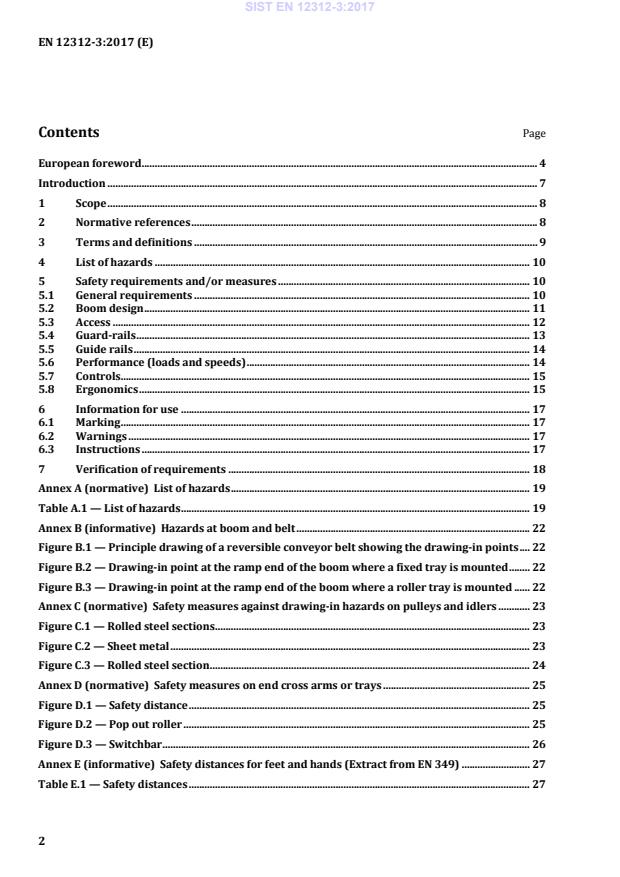
List of hazards . 19 Table A.1 — List of hazards . 19 Annex B (informative)
Hazards at boom and belt . 22 Figure B.1 — Principle drawing of a reversible conveyor belt showing the drawing-in points . 22 Figure B.2 — Drawing-in point at the ramp end of the boom where a fixed tray is mounted . 22 Figure B.3 — Drawing-in point at the ramp end of the boom where a roller tray is mounted . 22 Annex C (normative)
Safety measures against drawing-in hazards on pulleys and idlers . 23 Figure C.1 — Rolled steel sections . 23 Figure C.2 — Sheet metal . 23 Figure C.3 — Rolled steel section . 24 Annex D (normative)
Safety measures on end cross arms or trays . 25 Figure D.1 — Safety distance . 25 Figure D.2 — Pop out roller . 25 Figure D.3 — Switchbar . 26 Annex E (informative)
Safety distances for feet and hands (Extract from EN 349) . 27 Table E.1 — Safety distances . 27 SIST EN 12312-3:2017
Relationship between this European standard and the essential requirements of EU Directive 2006/42/EC aimed to be covered . 28 Table ZA.1 – Correspondence between this European standard and EU Directive 2006/42/EC . 28 Bibliography . 29
EN 349), was re-numbered as informative Annex E; t) Annex ZA referring to the Machinery Directive 98/37/EC was replaced by Annex ZA referring to the new Machinery directive 2006/42/EC; u) the Bibliography was updated. According to the CEN-CENELEC Internal Regulations, the national standards organisations of the following countries are bound to implement this European Standard: Austria, Belgium, Bulgaria, Croatia, Cyprus, Czech Republic, Denmark, Estonia, Finland, Former Yugoslav Republic of Macedonia, France, Germany, Greece, Hungary, Iceland, Ireland, Italy, Latvia, Lithuania, Luxembourg, Malta, Netherlands, Norway, Poland, Portugal, Romania, Serbia, Slovakia, Slovenia, Spain, Sweden, Switzerland, Turkey and the United Kingdom. SIST EN 12312-3:2017
xã Stability and strength requirements, calculations and test methods EN 1915-3, Aircraft ground support equipment — General requirements — Part 3: Vibration measurement methods and reduction EN 1915-4, Aircraft ground support equipment — General requirements — Part 4: Noise measurement methods and reduction SIST EN 12312-3:2017
EN ISO 13849-1:2015, Safety of machinery - Safety-related parts of control systems - Part 1: General - EN ISO 13850:2015, Safety of machinery - Emergency stop function - Principles for d EN ISO 14122-1, Safety of machinery - Permanent means of access to machinery - Part 1: Choice of fixed - ISO 11532:2012, Aircraft ground equipment — Graphical symbols ISO 11228-1, Ergonomics — Manual handling — Part 1: Lifting and carrying ISO 11228-3, Ergonomics — Manual handling — Part 3: Handling of low loads at high frequency DIN 51130:2014-02, Testing of floor coverings — Determination of the anti-slip property — Workrooms and fields of activities with slip danger — Walking method — Ramp test 3 Terms and definitions For the purposes of this document, the terms and definitions given in EN ISO 12100 and EN 1915-1:2013 and the following apply. 3.1 conveyor belt vehicle vehicle comprising a chassis, a boom with a belt, and a lifting device 3.2 boom load carrying assembly which includes a belt to move the load, and any possible tray attached to it 3.3 telescopic boom load carrying assembly, adjustable in length 3.4 lifting device system to vary the height of the boom 3.5 incline angle of the boom to a horizontal plane 3.6 guide rail lateral device attached to the boom to prevent loads from falling off the sides 3.7 tray loading platform fitted at either end of the boom and independent of the belt SIST EN 12312-3:2017
Driver position controls shall be protected against a load falling from the boom. 5.1.5 The electrical system of battery powered conveyor belt vehicles shall conform to EN 1175-1, with the exception of standard automotive chassis. 5.1.6 The boom shall protrude at least at the ramp side. 5.1.7 The conveyor belt vehicle shall be capable of servicing any aircraft sill height, for which it is designed, with the opposite end within the height range specified in 5.2.9 and 5.8.4. NOTE See 6.3, Instructions for use, for listing by the manufacturer of aircraft types the conveyor is intended to serve 5.1.8 Where adjustment of elevation of both ends of the boom is provided it shall be possible to adjust the ends independently from each other. 5.1.9 Independent of the position of the boom it shall be possible to gain access to service points requiring frequent use (e.g. daily) at any time without operating the power source. 5.1.10 All sharp edges or corners resulting from the manufacturing process shall be chamfered or rounded with a minimum radius of 3 mm. 5.1.11 Where a sprung front axle is used, the suspension shall be restricted so as to limit vertical movement at the aircraft end of the boom, when the conveyor belt vehicle is being driven, e.g. by using shock absorbers. SIST EN 12312-3:2017
...