

EN 17242:2025
(Main)Recirculatory Filtration Fume Cabinets
General Information
- Abstract
This document is applicable to recirculatory filtration fume cabinets (RFFC).
Recirculatory filtration fume cabinets are devices intended to protect their users by means of:
— the ability to contain hazardous concentrations or quantities of airborne contaminants;
— the ability to remove hazardous concentrations or quantities of airborne contaminants from air exhausted from inside the fume cabinet by means of filtration before the air is recirculated to the room in which the fume cabinet is located.
This document specifies design and manufacturing requirements together with type and on-site testing procedures.
This document does not specify requirements for the use of a mixture of chemicals but provides guidance on how to proceed.
NOTE For special applications and usage such as Carcinogenic, Mutagenic, Reprotoxic Substances (CMR) substances, local regulation can apply. These local regulations can result on restriction of usage.
This document is not intended to address fume cupboards, or devices used as animal accommodation. For fume cupboards, the EN 14175 series applies. For microbiological safety cabinets, EN 12469 applies.
- Status
- Published
- Publication Date
- 04-Nov-2025
- Technical Committee
- CEN/TC 332 - Laboratory equipment
- Drafting Committee
- CEN/TC 332/WG 4 - Fume cupboards
- Current Stage
- 6060 - Definitive text made available (DAV) - Publishing
- Start Date
- 05-Nov-2025
- Due Date
- 12-Sep-2025
- Completion Date
- 05-Nov-2025

Overview
EN 17242:2025 - Recirculatory Filtration Fume Cabinets (RFFC) is a CEN European Standard that defines design, manufacturing and testing requirements for recirculatory filtration fume cabinets. RFFCs are laboratory enclosures that protect users by containing airborne contaminants and removing hazardous gases, vapours and particulates via filtration before recirculating air to the room. The standard covers type testing and on‑site testing; it does not replace local regulatory limits (for example for CMR substances) and is not intended for conventional fume cupboards or microbiological safety cabinets.
Key topics and technical requirements
- Scope and purpose: Requirements for RFFC performance - containment, filtration efficiency and safe recirculation.
- Classification system (X/Y/Z):
- X - application: Class A (integral filters) or Class B (associated filters).
- Y - filter type: 1 particulate only, 2 gas/vapour only, 3 both, 4 other arrangements.
- Z - monitoring: 0 (no continuous monitoring) or 1 (in‑built continuous filter monitoring).
- Filtration:
- Gas/vapour filters (e.g., activated carbon) and particulate filters (HEPA/ULPA per EN 1822-1).
- Labelling: installed filters must be clearly identified from the front, with guidance for mixtures and risk assessment.
- Monitoring and alarms:
- Airflow indicator required; must show correct operation and provide audible/visual alarms for deviations.
- Provisions for continuous filter condition monitoring where applicable.
- Performance and testing:
- Type tests and on‑site tests for gas/vapour filtration, particulate filtration and containment (including tracer tests such as IPA).
- Test environments and equipment (analysers, sampling grids, manifolds) and reporting requirements are specified.
- Other requirements:
- Compliance references include EN 61010‑1 (electrical safety) and EN 14175‑2 (safety/performance for fume cupboards) where relevant.
- Acoustic limit: sound pressure level ≤ 65 dB(A) under specified test conditions (EN ISO 3744, EN 61672‑1).
Applications and who uses this standard
- Manufacturers of RFFC for design, product classification, labelling and compliance testing.
- Test laboratories and certification bodies performing type and on‑site tests.
- Laboratory managers, safety officers and purchasers selecting containment solutions for chemistry and analytical labs that require filtered recirculation.
- Installers and maintenance teams following installation and routine testing guidance.
Related standards
- EN 1822‑1 (HEPA/ULPA filters), EN 14175 series (fume cupboards), EN 12469 (microbiological safety cabinets), EN 61010‑1 (electrical safety), EN ISO 14644‑3 (test methods for cleanrooms).
Keywords: EN 17242:2025, Recirculatory Filtration Fume Cabinets, RFFC, filtration testing, HEPA, gas and vapour filters, laboratory safety, CEN.
Relations
- Effective Date
- 18-Mar-2026
- Effective Date
- 09-Feb-2026
- Effective Date
- 09-Feb-2026
- Effective Date
- 28-Jan-2026
- Refers
CEN/TS 14175-5:2006 - Fume cupboards - Part 5: Recommendations for installation and maintenance - Effective Date
- 28-Jan-2026
- Effective Date
- 28-Jan-2026
- Effective Date
- 28-Jan-2026
- Effective Date
- 28-Jan-2026
- Effective Date
- 28-Jan-2026
- Effective Date
- 28-Jan-2026
- Effective Date
- 28-Jan-2026
Get Certified
Connect with accredited certification bodies for this standard

ECOCERT
Organic and sustainability certification.

Eurofins Food Testing Global
Global leader in food, environment, and pharmaceutical product testing.

Intertek Bangladesh
Intertek certification and testing services in Bangladesh.
Sponsored listings
Frequently Asked Questions
EN 17242:2025 is a standard published by the European Committee for Standardization (CEN). Its full title is "Recirculatory Filtration Fume Cabinets". This standard covers: This document is applicable to recirculatory filtration fume cabinets (RFFC). Recirculatory filtration fume cabinets are devices intended to protect their users by means of: — the ability to contain hazardous concentrations or quantities of airborne contaminants; — the ability to remove hazardous concentrations or quantities of airborne contaminants from air exhausted from inside the fume cabinet by means of filtration before the air is recirculated to the room in which the fume cabinet is located. This document specifies design and manufacturing requirements together with type and on-site testing procedures. This document does not specify requirements for the use of a mixture of chemicals but provides guidance on how to proceed. NOTE For special applications and usage such as Carcinogenic, Mutagenic, Reprotoxic Substances (CMR) substances, local regulation can apply. These local regulations can result on restriction of usage. This document is not intended to address fume cupboards, or devices used as animal accommodation. For fume cupboards, the EN 14175 series applies. For microbiological safety cabinets, EN 12469 applies.
This document is applicable to recirculatory filtration fume cabinets (RFFC). Recirculatory filtration fume cabinets are devices intended to protect their users by means of: — the ability to contain hazardous concentrations or quantities of airborne contaminants; — the ability to remove hazardous concentrations or quantities of airborne contaminants from air exhausted from inside the fume cabinet by means of filtration before the air is recirculated to the room in which the fume cabinet is located. This document specifies design and manufacturing requirements together with type and on-site testing procedures. This document does not specify requirements for the use of a mixture of chemicals but provides guidance on how to proceed. NOTE For special applications and usage such as Carcinogenic, Mutagenic, Reprotoxic Substances (CMR) substances, local regulation can apply. These local regulations can result on restriction of usage. This document is not intended to address fume cupboards, or devices used as animal accommodation. For fume cupboards, the EN 14175 series applies. For microbiological safety cabinets, EN 12469 applies.
EN 17242:2025 is classified under the following ICS (International Classification for Standards) categories: 71.040.10 - Chemical laboratories. Laboratory equipment. The ICS classification helps identify the subject area and facilitates finding related standards.
EN 17242:2025 has the following relationships with other standards: It is inter standard links to EN ISO 3744:2026, EN 61672-1:2013, EN 61010-1:2010, EN 1822-1:2019, CEN/TS 14175-5:2006, EN 14175-3:2019, EN ISO 14644-3:2019, EN 14175-1:2003, EN 14175-2:2003, EN 14175-4:2004, EN ISO 3744:2010. Understanding these relationships helps ensure you are using the most current and applicable version of the standard.
EN 17242:2025 is available in PDF format for immediate download after purchase. The document can be added to your cart and obtained through the secure checkout process. Digital delivery ensures instant access to the complete standard document.
Standards Content (Sample)
SLOVENSKI STANDARD
01-januar-2026
Omare za recirkulacijsko filtriranje dima
Recirculatory Filtration Fume Cabinets
Umluft-Filter-Einhausungen
Enceinte ventilée à recirculation d'air filtréEnceinte ventilée à recirculation d'air filtré
Ta slovenski standard je istoveten z: EN 17242:2025
ICS:
71.040.10 Kemijski laboratoriji. Chemical laboratories.
Laboratorijska oprema Laboratory equipment
2003-01.Slovenski inštitut za standardizacijo. Razmnoževanje celote ali delov tega standarda ni dovoljeno.
EN 17242
EUROPEAN STANDARD
NORME EUROPÉENNE
November 2025
EUROPÄISCHE NORM
ICS 71.040.10
English Version
Recirculatory Filtration Fume Cabinets
Enceinte ventilée à recirculation d'air filtré Umluft-Filter-Einhausungen
This European Standard was approved by CEN on 22 September 2025.
CEN members are bound to comply with the CEN/CENELEC Internal Regulations which stipulate the conditions for giving this
European Standard the status of a national standard without any alteration. Up-to-date lists and bibliographical references
concerning such national standards may be obtained on application to the CEN-CENELEC Management Centre or to any CEN
member.
This European Standard exists in three official versions (English, French, German). A version in any other language made by
translation under the responsibility of a CEN member into its own language and notified to the CEN-CENELEC Management
Centre has the same status as the official versions.
CEN members are the national standards bodies of Austria, Belgium, Bulgaria, Croatia, Cyprus, Czech Republic, Denmark, Estonia,
Finland, France, Germany, Greece, Hungary, Iceland, Ireland, Italy, Latvia, Lithuania, Luxembourg, Malta, Netherlands, Norway,
Poland, Portugal, Republic of North Macedonia, Romania, Serbia, Slovakia, Slovenia, Spain, Sweden, Switzerland, Türkiye and
United Kingdom.
EUROPEAN COMMITTEE FOR STANDARDIZATION
COMITÉ EUROPÉEN DE NORMALISATION
EUROPÄISCHES KOMITEE FÜR NORMUNG
CEN-CENELEC Management Centre: Rue de la Science 23, B-1040 Brussels
© 2025 CEN All rights of exploitation in any form and by any means reserved Ref. No. EN 17242:2025 E
worldwide for CEN national Members.
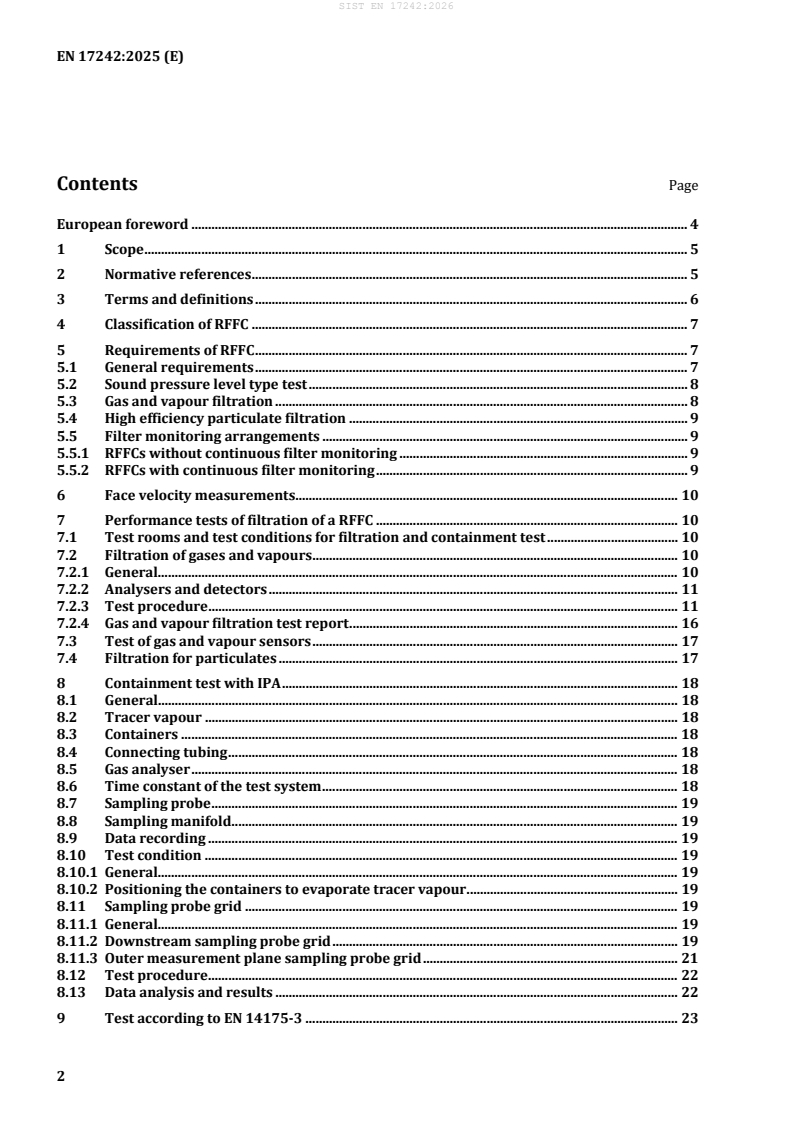
Contents Page
European foreword . 4
1 Scope . 5
2 Normative references . 5
3 Terms and definitions . 6
4 Classification of RFFC . 7
5 Requirements of RFFC . 7
5.1 General requirements . 7
5.2 Sound pressure level type test . 8
5.3 Gas and vapour filtration . 8
5.4 High efficiency particulate filtration . 9
5.5 Filter monitoring arrangements . 9
5.5.1 RFFCs without continuous filter monitoring . 9
5.5.2 RFFCs with continuous filter monitoring . 9
6 Face velocity measurements . 10
7 Performance tests of filtration of a RFFC . 10
7.1 Test rooms and test conditions for filtration and containment test . 10
7.2 Filtration of gases and vapours . 10
7.2.1 General. 10
7.2.2 Analysers and detectors . 11
7.2.3 Test procedure . 11
7.2.4 Gas and vapour filtration test report . 16
7.3 Test of gas and vapour sensors . 17
7.4 Filtration for particulates . 17
8 Containment test with IPA . 18
8.1 General. 18
8.2 Tracer vapour . 18
8.3 Containers . 18
8.4 Connecting tubing . 18
8.5 Gas analyser . 18
8.6 Time constant of the test system . 18
8.7 Sampling probe . 19
8.8 Sampling manifold . 19
8.9 Data recording . 19
8.10 Test condition . 19
8.10.1 General. 19
8.10.2 Positioning the containers to evaporate tracer vapour . 19
8.11 Sampling probe grid . 19
8.11.1 General. 19
8.11.2 Downstream sampling probe grid . 19
8.11.3 Outer measurement plane sampling probe grid . 21
8.12 Test procedure . 22
8.13 Data analysis and results . 22
9 Test according to EN 14175-3 . 23
10 On site testing of RFFC’s . 24
10.1 General . 24
10.2 Test report for commissioning of type tested RFFCs . 24
10.3 Test report for routine testing of type tested RFFCs. 25
11 Marking . 25
12 Product manual . 26
Annex A (normative) Filtration test protocol for inorganic acid filters . 28
Annex B (informative) Information on national and European regulations and guidelines that
may impact the usage of RFFCs . 29
Bibliography . 31
European foreword
This document (EN 17242:2025) has been prepared by Technical Committee CEN/TC 332 “Laboratory
equipment”, the secretariat of which is held by DIN.
This European Standard shall be given the status of a national standard, either by publication of an
identical text or by endorsement, at the latest by May 2026, and conflicting national standards shall be
withdrawn at the latest by May 2026.
Attention is drawn to the possibility that some of the elements of this document may be the subject of
patent rights. CEN shall not be held responsible for identifying any or all such patent rights.
Any feedback and questions on this document should be directed to the users’ national standards body.
A complete listing of these bodies can be found on the CEN website.
According to the CEN-CENELEC Internal Regulations, the national standards organisations of the
following countries are bound to implement this European Standard: Austria, Belgium, Bulgaria, Croatia,
Cyprus, Czech Republic, Denmark, Estonia, Finland, France, Germany, Greece, Hungary, Iceland, Ireland,
Italy, Latvia, Lithuania, Luxembourg, Malta, Netherlands, Norway, Poland, Portugal, Republic of North
Macedonia, Romania, Serbia, Slovakia, Slovenia, Spain, Sweden, Switzerland, Türkiye and the United
Kingdom.
1 Scope
This document is applicable to recirculatory filtration fume cabinets (RFFC).
Recirculatory filtration fume cabinets are devices intended to protect their users by means of:
— the ability to contain hazardous concentrations or quantities of airborne contaminants;
— the ability to remove hazardous concentrations or quantities of airborne contaminants from air
exhausted from inside the fume cabinet by means of filtration before the air is recirculated to the
room in which the fume cabinet is located.
This document specifies design and manufacturing requirements together with type and on-site testing
procedures.
This document does not specify requirements for the use of a mixture of chemicals but provides guidance
on how to proceed.
NOTE For special applications and usage such as Carcinogenic, Mutagenic, Reprotoxic Substances (CMR)
substances, local regulation can apply. These local regulations can result on restriction of usage.
This document is not intended to address fume cupboards, or devices used as animal accommodation.
For fume cupboards, the EN 14175 series applies. For microbiological safety cabinets, EN 12469 applies.
2 Normative references
The following documents are referred to in the text in such a way that some or all of their content
constitutes requirements of this document. For dated references, only the edition cited applies. For
undated references, the latest edition of the referenced document (including any amendments) applies.
EN 1822-1, High efficiency air filters (EPA, HEPA and ULPA) — Part 1: Classification, performance testing,
marking
EN 14175-1, Fume cupboards — Part 1: Vocabulary
EN 14175-2:2003, Fume cupboards — Part 2: Safety and performance requirements
EN 14175-3:2019, Fume cupboards — Part 3: Type test methods
EN 14175-4:2004, Fume cupboards — Part 4: On-site test methods
CEN/TS 14175-5:2006, Fume cupboards — Part 5: Recommendations for installation and maintenance
EN 61010-1, Safety requirements for electrical equipment for measurement, control, and laboratory use —
Part 1: General requirements
EN 61672-1, Electroacoustics — Sound level meters — Part 1: Specifications
EN ISO 14644-3:2019, Cleanrooms and associated controlled environments — Part 3: Test methods (ISO
14644-3:2019, Corrected version 2020-06)
EN ISO 3744, Acoustics — Determination of sound power levels and sound energy levels of noise sources
using sound pressure — Engineering methods for an essentially free field over a reflecting plane (ISO 3744)
3 Terms and definitions
For the purpose of this document, the terms and definitions given in EN 14175-1 and the following apply.
ISO and IEC maintain terminology databases for use in standardization at the following addresses:
— ISO Online browsing platform: available at https://www.iso.org/obp/
— IEC Electropedia: available at https://www.electropedia.org/
3.1
filtration system
assembly of components that are used to remove/trap airborne contaminants
Note 1 to entry: It can be arranged to remove/trap particulates and/or gases/vapours by means of a single filter or
a combination of two or more filters.
3.2
recirculatory filtration fume cabinet
RFFC
fume cabinet equipped to move air (with a fan) and remove quantities or concentrations of hazardous
airborne contaminants from the air stream before recirculation to the room in which it is located
3.3
gas and vapour filter
filter used to remove vapours or gases from an air stream
EXAMPLE An activated carbon filter.
3.4
particulate filter
filter used to remove particulates from an air stream
EXAMPLE A High-efficiency Particulate Air-Filter (HEPA filter) or an Ultra Low penetration Air Filter (ULPA
filter) according to EN 1822-1.
3.5
limit value
occupational exposure limit of the challenge chemicals
−6 3
Note 1 to entry: Expressed in Volume Fraction 10 (ppm) or in mg/m .
Note 2 to entry: In this document, the value is the lowest published European limit in the list “International Limit
Values for Chemical Agents“ (GESTIS-ILV).
3.6
integral filter
filter that is part of the fume cabinet
3.7
associated filter
independent filter that is connected to the air exhaust of the fume cabinet
3.8
retention capacity of filter for gas and vapor
mass of a specific chemical that can be trapped by filters before its concentration at the filters
downstream reached 1% of its limit value
4 Classification of RFFC
The RFFC of the present document has the following 3-part classification:
X (general type of application) / Y (filter class) / Z (monitoring arrangement)
The details are set out below.
X: General type of application:
— Class A: RFFCs with integral filters;
— Class B: RFFCs with associated filters.
Y: Filters:
— 1: particulate filter only;
— 2: gas and vapour filter only;
— 3: particulate and gas and vapour filters;
— 4: other filtration devices or arrangements including those for RFFCs having internal, filtered
recirculation.
Z: Filter monitoring arrangements:
— 0: no filter condition monitoring arrangements;
— 1: in-built continuous filter condition monitoring arrangements applicable to the filter application.
EXAMPLE Examples for the designation of a RFFC with integral particulate and gas and vapour filters and
continuous filter conditioning monitoring would be:
Class A/3/1.
5 Requirements of RFFC
5.1 General requirements
When the RFFC is in operation, an air flow indicator shall show unambiguously the correct function of
the cabinet’s air flow. Accurate air flow settings shall be indicated in the user’s manual and any deviation
shall be noted. In addition, means shall be provided to easily check or self-check the correct functioning
of the airflow indicator.
The airflow indicator shall be provided to monitor the air flow, as established in the type test.
It shall incorporate audible and visual alarms to warn the operator in case of incorrect air flow.
RFFC shall comply with EN 61010-1.
RFFC shall comply with the requirements of EN 14175-2:2003, Clause 5, Clause 6 and Clause 7.
Installation of RFFC shall comply to CEN/TS 14175-5:2006 Clause 4.
5.2 Sound pressure level type test
When tested in accordance with EN ISO 3744, the sound pressure level shall be measured using a sound
meter conforming to EN 61672-1. The sampling microphone shall be mounted centrally at a distance of
1 000 mm from the face of the RFFC and at a height of 1 500 mm from floor, with the RFFC operating at
nominal operating speed, according to manufacturer’s recommendations. The sound pressure level of the
RFFC in operation shall not exceed 65 dB(A), when the background noise level is less than 55 dB(A). If
the background noise level exceeds 55 dB(A) then the corrected A-weighted level should not exceed 65
dB(A).
NOTE The sound pressure test is a measurement to provide information about the impact of equipment on the
sound pressure on the room.
5.3 Gas and vapour filtration
The manufacturer shall label installed filters in such a way as to clearly identify the type of chemicals that
can be trapped. The labelling shall be visible from the front of the cabinet. For the use of a mixture of
chemicals a risk assessment shall be performed with the help of the instructions for use in order to select
the appropriate filter(s).
NOTE 1 A suitable method to label filters is to follow the codification defined in EN 14387:2021, Table 2.
According to the risk assessment and RFFCs capability, the user of the RFFC should clearly indicate the
list of chemicals that are allowed to be used on a label visible from the front of the cabinet. Each time an
application that is performed in the RFFC is modified, the risk assessment shall be updated and corrective
measures adopted.
Local regulations can result in restriction of usage of specific chemicals (see Annex B).
For filtration evaluation, reference should be made to the GESTIS International Limit Values from which
the lowest European limit values should be used. When a particular chemical under consideration is not
in this list, an individual risk assessment shall be carried to select the appropriate protection device.
The filtration system utilized in filtration fume cabinets shall be resistant to chemical agents being used
in the filtration fume cabinet.
The design of the filtration system shall be such that filters can be changed by someone suitably trained
without them requiring physical contact with the filter itself. Safe methods of changing filters shall be
fully described in the product manual.
The filter installation date and its latest projected replacement date shall be indicated on the front of the
RFFC or in the fume cabinet log book attached to the fume cabinet manual. The manufacturer shall
provide space to indicate the date on which the filter should be replaced, and instruction on how to assess
this date. The estimated date of filter replacement shall be visible from the operator’s workstation.
NOTE 2 Back-up gas and vapour filters, located after the primary gas and vapour filter can be requested by
regulations, guidelines or recommendation in some countries.
RFFCs shall be submitted to the following tests:
— in the case of filters designed to be used with volatile organic chemicals: two successive type tests
shall be made, one with cyclohexane (C H ; CAS n° 110-82-7) and the other with isopropanol (IPA;
6 12
C3H8O; CAS n° 67-63-0). Each test shall be performed with a new filter following the procedure
described in 7.2;
— for RFFCs with filters design designed to be used with acid vapours, they shall be tested with
Hydrochloric acid, (HCl; CAS n° 7647-01-0) following the procedure described in Annex A.
The RFFCs manufacturer shall publish the retention capacities of the tested RFFC in its documentation
(see Clause 11) for each challenge chemical (IPA, Cyclohexane). The filtration system of RFFCs shall not
have a release at the filter or filters exhaust of more than 1 % of the limit value within the adsorption or
chemisorption of the retention capacities of chemicals listed in 7.2.1.
5.4 High efficiency particulate filtration
RFFCs of type 1 or type 3 shall have a high efficiency particulate filter fitted, according to EN 1822-1.
Their efficiency shall be at least H13 according to this document. RFFCs of type 1 or type 3 shall be tested
according to 7.4.
During the service life of the filter, its pressure drop will increase as it loads. This should be monitored to
ensure that the manufacturer's recommendations are not exceeded.
The increase of pressure drop may result on a drop of face velocity. When this occurs, particulate filters
shall be replaced.
A label on the front of the RFFC shall clearly indicate HEPA filters efficiency.
The date on which the filter was installed and the date of the next inspection shall be indicated on the
front of the RFFC or in the inspection book appended to the fume cupboard manual.
Local regulations can result in restriction of usage of specific chemicals (see Annex B).
5.5 Filter monitoring arrangements
5.5.1 RFFCs without continuous filter monitoring
RFFC’s without continuous filter monitoring shall have a procedure for checking the condition of the
filter. A sampling port shall be equipped on the RFFC in order to allow this routine testing.
NOTE This can include an audible and visual alarm triggered by an adjustable hours run counter that informs
the user of the need to perform a routine test of the filters efficiency. The filter replacement interval time will
typically be set following a risk assessment.
Particulate filter saturation can be checked with, for example, a manometer or a flow sensor.
Gas and vapour filters can be checked measuring the air quality at the filter exhaust using portable
detection equipment such as Photoionization detector (PID), Flame Ionization Detector (FID), Gas
Chromatography (GC), Colorimetric tubes or similar devices.
5.5.2 RFFCs with continuous filter monitoring
RFFCs with continuous filter monitoring shall automatically and continuously measure the efficiency of
the filtering system.
In case of gas and vapour filters an audible and visual alarm shall inform the user when the concentration
at the filter exhaust reaches a level of 1 % of the limit value of chemical vapours used in the RFFC. When
detectors are not able to achieve detection of 1 % of the limit value, the manufacturer shall clearly inform
users about detection limits of embedded sensors in its documentation.
All sensors shall be calibrated to the manufacturer's requirements and recommendations.
EXAMPLE Filters monitors of gas and vapour filters are: Photoionization sensors; electrochemical sensors;
metal oxide array sensor.
6 Face velocity measurements
The test organization shall define the location of face velocity reading grid points according to the shape
of RFFC’s openings. Face velocities at the points of the defined grid shall be measured with an
anemometer, for at least 60 s for each point.
NOTE A suitable placement for the measuring points is between the side boundaries, in the area of the
openings, at a distance of minimum 10 cm of any edge of the side boundaries.
The anemometer shall be of the unidirectional type with a directional sensitivity of ± 20°. The time
constant of the anemometer shall be less than 0,5 s, uncertainty shall not exceed 0,02 m/s with a
maximum uncertainty of ±5 % of reading, in the range of 0,2 m/s to 1 m/s. An anemometer with a valid
calibration certificate shall be used.
Type test report shall describe how face velocities are measured depending on face opening(s) dimension
and shape.
7 Performance tests of filtration of a RFFC
7.1 Test rooms and test conditions for filtration and containment test
The test rooms that are used to perform tests described in Clause 7 and Clause 8 shall fulfil the definition
below.
The room air temperature shall be maintained between 20 °C and 25 °C, and relative humidity between
30 % and 70 % for the duration of the test.
The test room shall extend a minimum 1,5 m in front of the fume cabinet and a minimum 1,0 m from the
outer sidewalls of the cabinet over the full room height.
The air renewal in the test room shall be lower than 0,1 air change per hour during the test.
For tests referring to EN 14175-3 that are described in Clause 9, the test room definition is given in
EN 14175-3:2019, 4.2.
7.2 Filtration of gases and vapours
7.2.1 General
The RFFC to be tested shall be equipped with a new set of filters and placed into a test room.
Arrangements shall be put in place in order to avoid exposure of the occupants to chemicals used during
testing.
The test is carried out at the RFFC nominal flow rate.
RFFC equipped with specific filters for organic vapours shall be tested according to 7.2.3.
RFFC equipped with specific filters for Inorganic acid, shall be tested following the additional optional
test that is described in Annex A.
When the tests are carried out they are not necessarily continuous. The test shall be of the minimum of
8 h and if stopped and subsequently restarted they shall be an interval of at least 12 h. This cycle shall be
repeated until a chemical breakthrough occurs.
NOTE 1 The total duration of the test varies, depending on the retention capacities of tested RFFCs.
The chemical agent concentration at the filtration system exhaust shall be measured at least every twenty
minutes during the testing period of the RFFC and shall be expressed as ppm.
NOTE 2 The average concentration in the enclosure is a function of the speed of evaporation of the chemical and
the airflow.
7.2.2 Analysers and detectors
The selected detector shall be capable of measuring a quantification threshold of less than 1 % of the limit
value of the challenge chemical. It can be as example a calibrated Photoionization detector with the
appropriate setting and accuracy or any methods that could guarantee the same performance.
7.2.3 Test procedure
The challenge chemicals to be used for the test shall be evaporated within the RFFCs so as to obtain an
average constant concentration in the fume cabinet during all operating phases of:
— 200 ppm ± 5 % for the IPA test;
— 200 ppm ± 5 % for the cyclohexane test.
The temperature and relative humidity shall be measured and recorded at least every twenty minutes
during the testing period of the RFFC.
The challenge chemical used for the test shall be released at the centre of the work surface, no higher
than 20 cm from the surface.
NOTE 1 An example of a suitable evaporation method is given in Figure 1.
It is important to take all necessary precautions during testing to avoid changes in the sample between
the sampling zone and the analyser. In particular:
— the tubing material shall be selected to avoid pollution of the air sample or loss of sample by
adsorption of the challenge chemical on its surface;
— fittings between tube, analysers, traps and other items shall be arranged to avoid leakage and
resulting dilution of the air sample;
— the distance between each sampling port and the analyser should be the same in order to avoid
different pressure drop in the tubes since these can affect the measurement of chemical
concentrations. A potentially suitable arrangement is shown in Figure 2.
a) side view b) front view
Key
1 sampling zone: concentration measuring grid 6 precision balance
downstream the filtration system
2 air flow in the workspace 7 chemical container (bottle)
3 front sash or front door 8 peristaltic pump
4 filtration system 9 heating plate
5 fan air flow direction
Figure 1 — Operational assembly diagram (Evaporation principle and air sampling zones)
Dimensions in millimetres
Key
1 sampling syringe 4 T connector
2 Polytetrafluoroethylene (PTFE) connection tubing 5 filtration surface
3 sampling port # air direction
Figure 2 — Suitable arrangement for sampling port and analyser
During the testing period, the air shall be sampled in the sampling zone at different times:
— 5 min after the beginning of evaporation;
— when the evaporation capacity of the filter has been reached for the chemical being tested, according
to the values published by RFFCs manufacturer.
Sampling zone: readings shall be taken from sampling probes located to obtain an average value of the
concentration at the filter(s) exhaust. If a concentration lower than 1 % of the limit values cannot be
maintained for the first three measurements in sampling zone the test shall be stopped.
When air directly exhausts from the filter outlet surface, the probes’ grid position shall be at 30 cm ± 3 cm
downstream from the filter outlet surface.
When there is an upper plenum after the filtration system or fan, the position and arrangement of the
probes shall be as shown in Figure 1.
When the outlet of the filtration system does not allow the location of the probe grid as described above
it should be located at a maximum distance of 30 mm from the first “reference” surface that is contacted
by the air (as shown in the example in Figure 3). This is to avoid the effects of air leakage. In the case that
the reference plane is problematic to define, fences should be located around the outlet surfaces to
overcome such a difficulty (as shown in the example in Figure 4 and Figure 5).
EN 17242:20
...