

EN 14526:2026
(Main)Foodstuffs - Determination of saxitoxin-group toxins in shellfish - HPLC method using pre-column derivatization with peroxide or periodate oxidation
General Information
- Abstract
This document specifies a method [1] for the quantitative determination of saxitoxin (STX), decarbamoyl saxitoxin (dcSTX), neosaxitoxin (NEO), decarbamoyl neosaxitoxin (dcNEO), gonyautoxin 1 and 4 (GTX1,4; sum of isomers), gonyautoxin 2 and 3 (GTX2,3; sum of isomers), gonyautoxin 5 (GTX5), gonyautoxin 6 (GTX6), decarbamoyl gonyautoxin 2 and 3 (dcGTX2,3; sum of isomers), N-sulfocarbamoyl gonyautoxin 2 and 3 (C1,2; sum of isomers) and N-sulfocarbamoyl gonyautoxin 1 and 4 (C3,4; sum of isomers) in (raw) mussels, oysters, scallops and clams. Laboratory experience has shown that this document can also be applied to other marine invertebrates [2], [3] and processed products of those species, however, no complete interlaboratory validation study according to ISO 5725-2 [21] has been carried out so far. The method described was validated in an interlaboratory study [4], [5] and was also verified in a European Union Reference Laboratory for Marine Biotoxins (EURLMB)-performance test aiming the total toxicity of the samples [6]. Toxins which were not available in the first interlaboratory study [4], [5] as dcGTX2,3 and dcNEO were validated in two additional interlaboratory studies [7], [8]. The lowest validated levels [4], [5], [8], are given as mass fraction of toxin (free base) in µg/kg shellfish tissue and also as µmol/kg shellfish tissue and are listed in Table 1.
[Table 1 - Lowest validated levels]
A quantitative determination of GTX6 was not included in the first interlaboratory study but several laboratories detected this toxin directly after solid phase extraction with ion-exchange (SPE-COOH) clean-up and reported a mass fraction (free base) of 30 µg/kg or higher in certain samples. For that reason, the present method is applicable to quantify GTX6 directly, depending on the availability of the standard substance. Whenever GTX6 standard is not commercially available, it is possible to determine GTX6 after hydrolysis of Fraction 2 of the SPE-COOH clean-up, described in 7.4, as NEO. The indirect quantification of GTX6 was validated in two additional interlaboratory studies [7], [8]. A study to compare direct and indirect GTX6 quantification was conducted at the EURLMB [16].
A quantitative determination of C3,4 was included in the first interlaboratory study. The present method is applicable to quantify C3,4 directly, depending on the availability of the standard substance. If no standard substances are available, C3,4 can only be quantified as GTX1,4 if the same hydrolysis protocol used for GTX6 (7.4) is applied to Fraction 1 of the SPE-COOH clean-up [10]. A study to compare direct and indirect C3,4 quantification was conducted at the EURLMB [16].
- Status
- Published
- Publication Date
- 07-Apr-2026
- Technical Committee
- CEN/TC 275 - Food analysis - Horizontal methods
- Drafting Committee
- CEN/TC 275/WG 14 - Marine Biotoxins
- Current Stage
- 6060 - Definitive text made available (DAV) - Publishing
- Start Date
- 08-Apr-2026
- Due Date
- 31-Dec-2025
- Completion Date
- 08-Apr-2026

Overview
EN 14526:2026 is a European standard developed by CEN that provides a validated method for the quantitative determination of saxitoxin-group toxins in shellfish. This standard focuses on the analysis of paralytic shellfish poisoning (PSP) toxins-including saxitoxin (STX), decarbamoyl saxitoxins, neosaxitoxins, and multiple gonyautoxins-in raw mussels, oysters, scallops, clams, and potentially other marine invertebrates and their processed products. The method described uses high-performance liquid chromatography (HPLC) with pre-column derivatization and employs peroxide or periodate oxidation for increased detection specificity.
Laboratory studies have shown successful application of this standard in routine testing and regulatory monitoring, making it an essential reference for seafood producers, regulatory agencies, and food testing laboratories seeking compliance with European food safety regulations.
Key Topics
- Target Toxins: Includes saxitoxin, decarbamoyl saxitoxin, neosaxitoxin, decarbamoyl neosaxitoxin, several gonyautoxins, and N-sulfocarbamoyl gonyautoxins.
- Analysis Methodology:
- Pre-column derivatization: Either peroxide or periodate oxidation is applied for enhanced fluorescence detection.
- Sample Preparation: Involves extraction from homogenized shellfish tissue, solid phase extraction (SPE) clean-ups, and precise HPLC separation.
- Quantitative Determination: The method allows for the accurate quantification of individual toxins, accounting for isomeric species and enabling both direct and indirect quantification routes.
- Validation and Quality Control:
- Validated through multiple interlaboratory studies, including those by the European Union Reference Laboratory for Marine Biotoxins (EURLMB).
- Specifies minimum recovery requirements and guides on validating chromatography columns and SPE cartridges for robust results.
- Safety Considerations: Highlights the hazardous nature of PSP toxins and the need for appropriate laboratory safety protocols.
Applications
EN 14526:2026 is utilized in a wide range of applications including:
- Routine Food Safety Testing: Ensuring shellfish products do not exceed legal limits of PSP toxins.
- Regulatory Compliance: Meeting European Union requirements for seafood safety, especially regarding monitoring programs for shellfish beds.
- Quality Assurance in Seafood Production: Supporting the traceability and safety of aquaculture and wild-caught shellfish through laboratory testing.
- Research and Development: Providing a standardized, scientifically validated approach for researchers studying the prevalence and detection of marine biotoxins.
- Adaptability to Other Marine Invertebrates: Although initially validated for major molluscan shellfish, the method has been shown applicable to other marine species and processed products, broadening its practical value.
Related Standards
EN 14526:2026 works in conjunction with several related international and European standards:
- EN ISO/IEC 17025: General requirements for the competence of testing and calibration laboratories-referenced for laboratory accreditation and competence.
- EN ISO 3696: Specifications for laboratory water quality, important for reagent preparation and analytical procedures.
- ISO 5725-2: Guidance on accuracy (trueness and precision) for measurement methods and results-crucial for validation studies.
- Other CEN and ISO standards: Additional methods for the detection of other marine biotoxins or contaminants in seafood to support comprehensive food safety frameworks.
By following EN 14526:2026, laboratories adopt a harmonized, high-confidence protocol for the detection of saxitoxin-group toxins in shellfish, helping protect public health while supporting regulatory enforcement and international trade in seafood.
Keywords: EN 14526:2026, saxitoxin, PSP toxins, shellfish toxins, HPLC, marine biotoxins, food safety, CEN standard, fluorescence detection, seafood testing, regulatory compliance, laboratory validation
Relations
- Effective Date
- 04-Oct-2023
- Effective Date
- 29-Apr-2026
Get Certified
Connect with accredited certification bodies for this standard

BSI Group
BSI (British Standards Institution) is the business standards company that helps organizations make excellence a habit.

Bureau Veritas
Bureau Veritas is a world leader in laboratory testing, inspection and certification services.

DNV
DNV is an independent assurance and risk management provider.
Sponsored listings
Frequently Asked Questions
EN 14526:2026 is a standard published by the European Committee for Standardization (CEN). Its full title is "Foodstuffs - Determination of saxitoxin-group toxins in shellfish - HPLC method using pre-column derivatization with peroxide or periodate oxidation". This standard covers: This document specifies a method [1] for the quantitative determination of saxitoxin (STX), decarbamoyl saxitoxin (dcSTX), neosaxitoxin (NEO), decarbamoyl neosaxitoxin (dcNEO), gonyautoxin 1 and 4 (GTX1,4; sum of isomers), gonyautoxin 2 and 3 (GTX2,3; sum of isomers), gonyautoxin 5 (GTX5), gonyautoxin 6 (GTX6), decarbamoyl gonyautoxin 2 and 3 (dcGTX2,3; sum of isomers), N-sulfocarbamoyl gonyautoxin 2 and 3 (C1,2; sum of isomers) and N-sulfocarbamoyl gonyautoxin 1 and 4 (C3,4; sum of isomers) in (raw) mussels, oysters, scallops and clams. Laboratory experience has shown that this document can also be applied to other marine invertebrates [2], [3] and processed products of those species, however, no complete interlaboratory validation study according to ISO 5725-2 [21] has been carried out so far. The method described was validated in an interlaboratory study [4], [5] and was also verified in a European Union Reference Laboratory for Marine Biotoxins (EURLMB)-performance test aiming the total toxicity of the samples [6]. Toxins which were not available in the first interlaboratory study [4], [5] as dcGTX2,3 and dcNEO were validated in two additional interlaboratory studies [7], [8]. The lowest validated levels [4], [5], [8], are given as mass fraction of toxin (free base) in µg/kg shellfish tissue and also as µmol/kg shellfish tissue and are listed in Table 1. [Table 1 - Lowest validated levels] A quantitative determination of GTX6 was not included in the first interlaboratory study but several laboratories detected this toxin directly after solid phase extraction with ion-exchange (SPE-COOH) clean-up and reported a mass fraction (free base) of 30 µg/kg or higher in certain samples. For that reason, the present method is applicable to quantify GTX6 directly, depending on the availability of the standard substance. Whenever GTX6 standard is not commercially available, it is possible to determine GTX6 after hydrolysis of Fraction 2 of the SPE-COOH clean-up, described in 7.4, as NEO. The indirect quantification of GTX6 was validated in two additional interlaboratory studies [7], [8]. A study to compare direct and indirect GTX6 quantification was conducted at the EURLMB [16]. A quantitative determination of C3,4 was included in the first interlaboratory study. The present method is applicable to quantify C3,4 directly, depending on the availability of the standard substance. If no standard substances are available, C3,4 can only be quantified as GTX1,4 if the same hydrolysis protocol used for GTX6 (7.4) is applied to Fraction 1 of the SPE-COOH clean-up [10]. A study to compare direct and indirect C3,4 quantification was conducted at the EURLMB [16].
This document specifies a method [1] for the quantitative determination of saxitoxin (STX), decarbamoyl saxitoxin (dcSTX), neosaxitoxin (NEO), decarbamoyl neosaxitoxin (dcNEO), gonyautoxin 1 and 4 (GTX1,4; sum of isomers), gonyautoxin 2 and 3 (GTX2,3; sum of isomers), gonyautoxin 5 (GTX5), gonyautoxin 6 (GTX6), decarbamoyl gonyautoxin 2 and 3 (dcGTX2,3; sum of isomers), N-sulfocarbamoyl gonyautoxin 2 and 3 (C1,2; sum of isomers) and N-sulfocarbamoyl gonyautoxin 1 and 4 (C3,4; sum of isomers) in (raw) mussels, oysters, scallops and clams. Laboratory experience has shown that this document can also be applied to other marine invertebrates [2], [3] and processed products of those species, however, no complete interlaboratory validation study according to ISO 5725-2 [21] has been carried out so far. The method described was validated in an interlaboratory study [4], [5] and was also verified in a European Union Reference Laboratory for Marine Biotoxins (EURLMB)-performance test aiming the total toxicity of the samples [6]. Toxins which were not available in the first interlaboratory study [4], [5] as dcGTX2,3 and dcNEO were validated in two additional interlaboratory studies [7], [8]. The lowest validated levels [4], [5], [8], are given as mass fraction of toxin (free base) in µg/kg shellfish tissue and also as µmol/kg shellfish tissue and are listed in Table 1. [Table 1 - Lowest validated levels] A quantitative determination of GTX6 was not included in the first interlaboratory study but several laboratories detected this toxin directly after solid phase extraction with ion-exchange (SPE-COOH) clean-up and reported a mass fraction (free base) of 30 µg/kg or higher in certain samples. For that reason, the present method is applicable to quantify GTX6 directly, depending on the availability of the standard substance. Whenever GTX6 standard is not commercially available, it is possible to determine GTX6 after hydrolysis of Fraction 2 of the SPE-COOH clean-up, described in 7.4, as NEO. The indirect quantification of GTX6 was validated in two additional interlaboratory studies [7], [8]. A study to compare direct and indirect GTX6 quantification was conducted at the EURLMB [16]. A quantitative determination of C3,4 was included in the first interlaboratory study. The present method is applicable to quantify C3,4 directly, depending on the availability of the standard substance. If no standard substances are available, C3,4 can only be quantified as GTX1,4 if the same hydrolysis protocol used for GTX6 (7.4) is applied to Fraction 1 of the SPE-COOH clean-up [10]. A study to compare direct and indirect C3,4 quantification was conducted at the EURLMB [16].
EN 14526:2026 is classified under the following ICS (International Classification for Standards) categories: 67.120.30 - Fish and fishery products. The ICS classification helps identify the subject area and facilitates finding related standards.
EN 14526:2026 has the following relationships with other standards: It is inter standard links to EN 14526:2017, EN ISO 3696:1995. Understanding these relationships helps ensure you are using the most current and applicable version of the standard.
EN 14526:2026 is available in PDF format for immediate download after purchase. The document can be added to your cart and obtained through the secure checkout process. Digital delivery ensures instant access to the complete standard document.
Standards Content (Sample)
SLOVENSKI STANDARD
01-junij-2026
Nadomešča:
SIST EN 14526:2017
Živila - Določanje toksinov iz skupine saksitoksinov v školjkah - Metoda HPLC z
uporabo predkolonske derivatizacije s peroksidno ali perjodatno oksidacijo
Foodstuffs - Determination of saxitoxin-group toxins in shellfish - HPLC method using
pre-column derivatization with peroxide or periodate oxidation
Lebensmittel - Bestimmung von Toxinen der Saxitoxingruppe in Schalentieren - HPLC-
Verfahren mit Vorsäulenderivatisierung und Peroxid- oder Periodatoxidation
Produits alimentaires - Détermination de la teneur en toxines du groupe de la saxitoxine
dans les coquillages - Méthode par CLHP avec dérivation pré-colonne et par oxydation
au peroxyde ou au periodate
Ta slovenski standard je istoveten z: EN 14526:2026
ICS:
67.050 Splošne preskusne in General methods of tests and
analizne metode za živilske analysis for food products
proizvode
67.120.30 Ribe in ribji proizvodi Fish and fishery products
2003-01.Slovenski inštitut za standardizacijo. Razmnoževanje celote ali delov tega standarda ni dovoljeno.
EN 14526
EUROPEAN STANDARD
NORME EUROPÉENNE
April 2026
EUROPÄISCHE NORM
ICS 67.120.30 Supersedes EN 14526:2017
English Version
Foodstuffs - Determination of saxitoxin-group toxins in
shellfish - HPLC method using pre-column derivatization
with peroxide or periodate oxidation
Produits alimentaires - Détermination de la teneur en Lebensmittel - Bestimmung von Toxinen der
toxines du groupe de la saxitoxine dans les coquillages Saxitoxingruppe in Schalentieren - HPLC-Verfahren mit
- Méthode par CLHP avec dérivation pré-colonne et par Vorsäulenderivatisierung und Peroxid- oder
oxydation au peroxyde ou au périodate Periodatoxidation
This European Standard was approved by CEN on 24 November 2025.
CEN members are bound to comply with the CEN/CENELEC Internal Regulations which stipulate the conditions for giving this
European Standard the status of a national standard without any alteration. Up-to-date lists and bibliographical references
concerning such national standards may be obtained on application to the CEN-CENELEC Management Centre or to any CEN
member.
This European Standard exists in three official versions (English, French, German). A version in any other language made by
translation under the responsibility of a CEN member into its own language and notified to the CEN-CENELEC Management
Centre has the same status as the official versions.
CEN members are the national standards bodies of Austria, Belgium, Bulgaria, Croatia, Cyprus, Czech Republic, Denmark, Estonia,
Finland, France, Germany, Greece, Hungary, Iceland, Ireland, Italy, Latvia, Lithuania, Luxembourg, Malta, Netherlands, Norway,
Poland, Portugal, Republic of North Macedonia, Romania, Serbia, Slovakia, Slovenia, Spain, Sweden, Switzerland, Türkiye and
United Kingdom.
EUROPEAN COMMITTEE FOR STANDARDIZATION
COMITÉ EUROPÉEN DE NORMALISATION
EUROPÄISCHES KOMITEE FÜR NORMUNG
CEN-CENELEC Management Centre: Rue de la Science 23, B-1040 Brussels
© 2026 CEN All rights of exploitation in any form and by any means reserved Ref. No. EN 14526:2026 E
worldwide for CEN national Members.
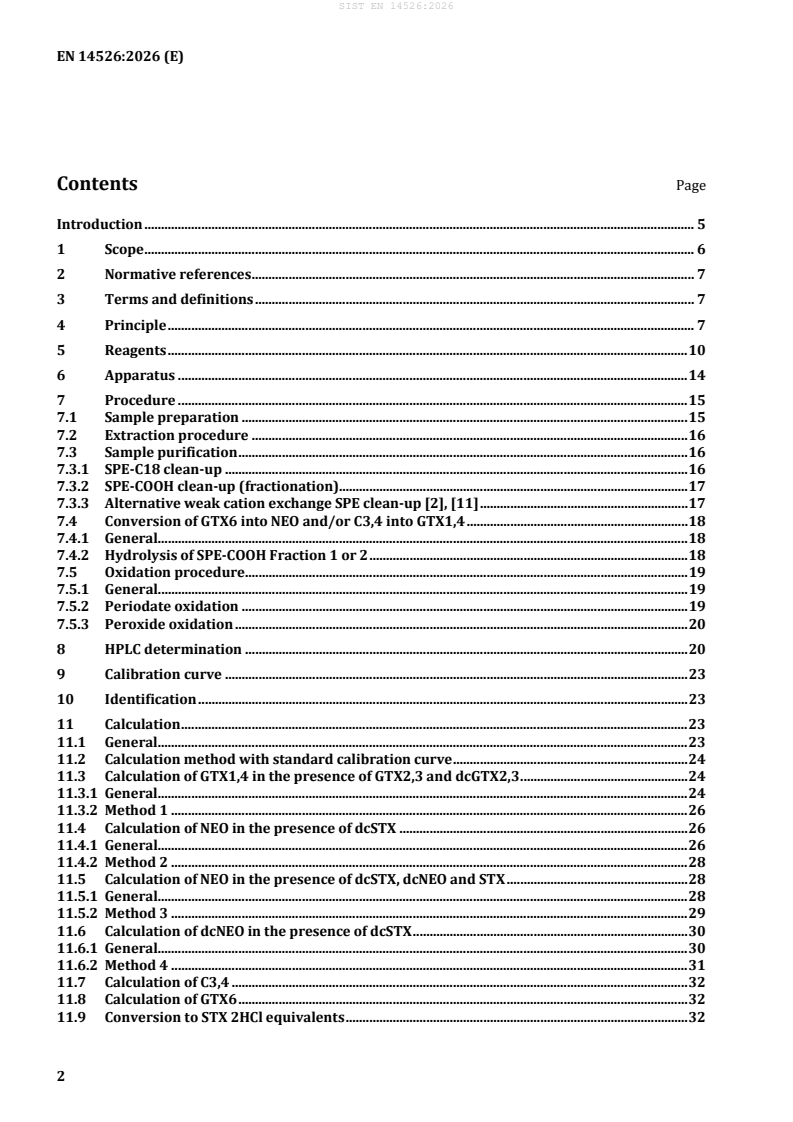
Contents Page
Introduction . 5
1 Scope . 6
2 Normative references . 7
3 Terms and definitions . 7
4 Principle . 7
5 Reagents . 10
6 Apparatus . 14
7 Procedure . 15
7.1 Sample preparation . 15
7.2 Extraction procedure . 16
7.3 Sample purification . 16
7.3.1 SPE-C18 clean-up . 16
7.3.2 SPE-COOH clean-up (fractionation). 17
7.3.3 Alternative weak cation exchange SPE clean-up [2], [11] . 17
7.4 Conversion of GTX6 into NEO and/or C3,4 into GTX1,4 . 18
7.4.1 General. 18
7.4.2 Hydrolysis of SPE-COOH Fraction 1 or 2 . 18
7.5 Oxidation procedure . 19
7.5.1 General. 19
7.5.2 Periodate oxidation . 19
7.5.3 Peroxide oxidation . 20
8 HPLC determination . 20
9 Calibration curve . 23
10 Identification . 23
11 Calculation . 23
11.1 General. 23
11.2 Calculation method with standard calibration curve . 24
11.3 Calculation of GTX1,4 in the presence of GTX2,3 and dcGTX2,3 . 24
11.3.1 General. 24
11.3.2 Method 1 . 26
11.4 Calculation of NEO in the presence of dcSTX . 26
11.4.1 General. 26
11.4.2 Method 2 . 28
11.5 Calculation of NEO in the presence of dcSTX, dcNEO and STX . 28
11.5.1 General. 28
11.5.2 Method 3 . 29
11.6 Calculation of dcNEO in the presence of dcSTX . 30
11.6.1 General. 30
11.6.2 Method 4 . 31
11.7 Calculation of C3,4 . 32
11.8 Calculation of GTX6 . 32
11.9 Conversion to STX 2HCl equivalents . 32
12 Quality controls . 33
12.1 General . 33
12.2 Acceptance criteria series of analysis . 33
12.3 Overall recovery . 34
13 Verification . 34
14 Test report . 35
Annex A (informative) Precision data . 36
Annex B (informative) Chromatograms . 64
Annex C (normative) Alternative calculation methods. 68
Bibliography . 76
European foreword
This document (EN 14526:2026) has been prepared by Technical Committee CEN/TC 275 “Food
analysis – Horizontal methods”, the secretariat of which is held by DIN.
This European Standard shall be given the status of a national standard, either by publication of an
identical text or by endorsement, at the latest by October 2026, and conflicting national standards shall
be withdrawn at the latest by October 2026.
Attention is drawn to the possibility that some of the elements of this document may be the subject of
patent rights. CEN shall not be held responsible for identifying any or all such patent rights.
This document supersedes EN 14526:2017.
— new Figure 2 detailing a schematic overview of procedure added;
— mandatory Clause 3 Terms and definitions added;
— new Clause 12 specifying quality controls added;
— new Clause 13 specifying verification added;
— new Annex B with example chromatograms added;
— new Annex C with alternative calculation methods added and deleted from Clause 11.
Any feedback and questions on this document should be directed to the users’ national standards body.
A complete listing of these bodies can be found on the CEN website.
According to the CEN-CENELEC Internal Regulations, the national standards organisations of the
following countries are bound to implement this European Standard: Austria, Belgium, Bulgaria, Croatia,
Cyprus, Czech Republic, Denmark, Estonia, Finland, France, Germany, Greece, Hungary, Iceland, Ireland,
Italy, Latvia, Lithuania, Luxembourg, Malta, Netherlands, Norway, Poland, Portugal, Republic of North
Macedonia, Romania, Serbia, Slovakia, Slovenia, Spain, Sweden, Switzerland, Türkiye and the United
Kingdom.
Introduction
Paralytic shellfish poisoning (PSP) toxins are derivatives of saxitoxin. These toxins have been detected in
filter-feeding bivalve molluscs in various parts of the world. Paralytic shellfish poisoning is characterized
by symptoms varying from slight tingling sensation or numbness around the lips to fatal respiratory
paralysis. This document describes an analytical method for the quantification of these PSP toxins by
extraction from shellfish tissue followed by several clean-up steps and a separation by high performance
liquid chromatography (HPLC) with fluorescence detection (FLD).
WARNING — The use of this document can involve hazardous materials, operations and equipment. This
document does not purport to address all the safety problems associated with its use. It is the
responsibility of the user of this document to take appropriate measures to ensure the safety and health
of personnel prior to application of this document and fulfil statutory and regulatory requirements for
this purpose.
1 Scope
This document specifies a method [1] for the quantitative determination of saxitoxin (STX), decarbamoyl
saxitoxin (dcSTX), neosaxitoxin (NEO), decarbamoyl neosaxitoxin (dcNEO), gonyautoxin 1 and 4 (GTX1,4;
sum of isomers), gonyautoxin 2 and 3 (GTX2,3; sum of isomers), gonyautoxin 5 (GTX5), gonyautoxin 6
(GTX6), decarbamoyl gonyautoxin 2 and 3 (dcGTX2,3; sum of isomers), N-sulfocarbamoyl gonyautoxin 2
and 3 (C1,2; sum of isomers) and N-sulfocarbamoyl gonyautoxin 1 and 4 (C3,4; sum of isomers) in (raw)
mussels, oysters, scallops and clams. Laboratory experience has shown that this document can also be
applied to other marine invertebrates [2], [3] and processed products of those species, however, no
complete interlaboratory validation study according to ISO 5725-2 [21] has been carried out so far. The
method described was validated in an interlaboratory study [4], [5] and was also verified in a European
Union Reference Laboratory for Marine Biotoxins (EURLMB)-performance test aiming the total toxicity
of the samples [6]. Toxins which were not available in the first interlaboratory study [4], [5] as dcGTX2,3
and dcNEO were validated in two additional interlaboratory studies [7], [8]. The lowest validated levels
[4], [5], [8], are given as mass fraction of toxin (free base) in µg/kg shellfish tissue and also as µmol/kg
shellfish tissue and are listed in Table 1.
Table 1 — Lowest validated levels
mass fraction
molality
(free base)
Toxin
µg/kg µmol/kg
c c
saxitoxin (STX) [5] 22 0,07
b b
gonyautoxin 2,3 (GTX2,3) [5] 114 0,29
c c
gonyautoxin 5 (GTX5) [5] 27 0,07
c c
decarbamoyl saxitoxin (dcSTX) [5] 8 0,03
c c
neosaxitoxin (NEO) [5] 33 0,10
c c
gonyautoxin 1,4 (GTX1,4) [5] 61,4 0,15
c c
N-sulfocarbamoyl gonyautoxin 2,3 (C1,2) [5] 93 0,20
b b
N-sulfocarbamoyl gonyautoxin 1,4 (C3,4) [5] 725 1,48
gonyautoxin 6 (GTX6) direct [4] 30 0,08
b b
indirect [9] 834 2,11
a a
decarbamoyl gonyautoxin 2,3 (dcGTX2,3) [8] 271 0,77
b b
decarbamoyl neosaxitoxin (dcNEO) [8] 594 2,18
a
lowest spiked level; mean recovery: 58 % [8]
b
lowest concentration tested
c
lowest concentration tested with a HorRat < 2 [4], [5]
A quantitative determination of GTX6 was not included in the first interlaboratory study but several
laboratories detected this toxin directly after solid phase extraction with ion-exchange (SPE-COOH)
clean-up and reported a mass fraction (free base) of 30 µg/kg or higher in certain samples. For that
reason, the present method is applicable to quantify GTX6 directly, depending on the availability of the
standard substance. Whenever GTX6 standard is not commercially available, it is possible to determine
GTX6 after hydrolysis of Fraction 2 of the SPE-COOH clean-up, described in 7.4, as NEO. The indirect
quantification of GTX6 was validated in two additional interlaboratory studies [7], [8]. A study to compare
direct and indirect GTX6 quantification was conducted at the EURLMB [16].
A quantitative determination of C3,4 was included in the first interlaboratory study. The present method
is applicable to quantify C3,4 directly, depending on the availability of the standard substance. If no
standard substances are available, C3,4 can only be quantified as GTX1,4 if the same hydrolysis protocol
used for GTX6 (7.4) is applied to Fraction 1 of the SPE-COOH clean-up [10]. A study to compare direct and
indirect C3,4 quantification was conducted at the EURLMB [16].
2 Normative references
The following documents are referred to in the text in such a way that some or all of their content
constitutes requirements of this document. For dated references, only the edition cited applies. For
undated references, the latest edition of the referenced document (including any amendments) applies.
EN ISO 3696, Water for analytical laboratory use — Specification and test methods (ISO 3696)
EN ISO/IEC 17025, General requirements for the competence of testing and calibration laboratories
(ISO/IEC 17025)
3 Terms and definitions
No terms and definitions are listed in this document.
ISO and IEC maintain terminology databases for use in standardization at the following addresses:
— ISO Online browsing platform: available at https://www.iso.org/obp
— IEC Electropedia: available at https://www.electropedia.org/
4 Principle
WARNING — PSP toxins are neurotoxins which can be taken up by inhalation or orally. Therefore,
adequate protection measures are to be applied.
Paralytic shellfish poisoning (PSP) toxins are extracted from shellfish tissue homogenate by heating with
acetic acid. After centrifugation the supernatant is purified by solid phase extraction (SPE) using a C18
clean-up cartridge. It is analysed by HPLC after oxidation with periodate or peroxide with fluorescence
detection. Most toxins (STX, C1,2, GTX5, dcSTX, GTX2,3 and dcGTX2,3) can be quantified after SPE-C18
clean-up .
Oxidation of PSP toxins leads to several reaction products that are separated by reversed phase HPLC and
detected by fluorescence detection. The obtained reaction products for PSP toxins after oxidation with
peroxide and periodate are listed in Table 2. Additionally, the corresponding chromatograms are shown
in Figure 1.
The gonyautoxins GTX2 and GTX3 as well as GTX1 and GTX4 and decarbamoyl gonyautoxins dcGTX2 and
dcGTX3 and the N-sulfocarbamoyl gonyautoxins C1 and C2 as well as C3 and C4 are structural isomers
and lead with both oxidation modes to the same reaction products. The amount of structural isomers is
determined as the sum of both toxins.
STX reacts to a single specific oxidation product regardless of the kind of oxidation reaction (whether
peroxide or periodate). The same is valid for GTX2,3 as well as GTX5 and C1,2. In contrast, dcSTX and
dcGTX2,3 produce each two different oxidation products in both oxidation reactions, see also Table 2.
The toxin dcNEO is oxidized into two oxidation products only with the periodate oxidation. Each of the
This document is based on a procedure described by Lawrence et al. [4] and was also published as AOAC Official
Method 2005.06 [1].
toxins NEO, GTX6, GTX1,4 and C3,4 produce three peaks after periodate oxidation but normally the
second eluting peak is used for quantification (peroxide oxidation cannot be used for quantification).
Co-occurrence of different PSP toxins in shellfish can influence the analytical results, because some of the
PSP toxins can (partially) lead to the same reaction products (see Table 2, Figure 1 and Annex B). So, the
chromatograms shall be carefully interpreted after a SPE C18 clean-up.
Table 2 — Reaction products after oxidation with periodate and peroxide
Oxidation products and Oxidation product at the same retention
Toxin Intensity
HPLC-eluting order time as
b b b b
peroxide periodate peroxide periodate peroxide periodate
a
STX one one ++ + NEO (3) NEO (3); GTX6 (3)
dcSTX first (1) first (1) ++ - dcNEO (1)
a
second (2) second (2) + + NEO (2) NEO (2); GTX6 (2);
dcNEO (2)
NEO no first (1) — + GTX6 (1)
second (2) second (2) - ++ dcSTX (2) GTX6 (2); dcSTX (2);
dcNEO (2)
third (3) third (3) - + STX STX; GTX6 (3)
C1,2 one one ++ +
C3,4 no first (1) — + GTX1,4 (1)
no second (2) — ++ GTX1,4 (2); dcGTX2,3 (2)
no third (3) — + GTX1,4 (3); GTX2,3
GTX1,4 no first (1) — + C3,4 (1)
no second (2) — ++ C3,4 (2); dcGTX2,3 (2)
third (3) third (3) - ++ GTX2,3 C3,4 (3); GTX2,3
a
GTX2,3 one one ++ ++ GTX1,4 (3) C3,4 (3);
GTX1,4 (3)
GTX5 one one ++ -
GTX6 no first (1) — + NEO (1)
no second (2) — ++ NEO (2); dcSTX (2); dcNEO (2)
no third (3) — - NEO (3); STX
dcGTX2,3 first (1) first (1) ++ +
second (2) second (2) + ++ C3,4 (2); GTX1,4 (2)
dcNEO first (1) first (1) - ++ dcSTX (1)
second (2) second (2) - + dcSTX (2) dcSTX (2); NEO (2); GTX6 (2)
Intensity: — not visible
- very low
+ low
++ high
a
High concentration of the indicated toxin can influence the quantification by simulating an increased content.
b
Numbers in brackets are the elution order.
a) non-N1-hydroxylated toxins: peroxide b) non-N1-hydroxylated toxins: periodate
c) N1-hydroxylated toxins: peroxide d) N1-hydroxylated toxins: periodate
Key
Y detection response (V)
X time (min)
Figure 1 — Reaction products after derivatization with peroxide and periodate (peaks for
quantification are marked with arrows)
For the quantitative determination of most N1-hydroxylated toxins, a fractionation by SPE-COOH clean-
up is necessary (shown in Table 4) because the oxidation products of some PSP toxins (NEO and GTX6,
GTX1,4 and C3,4) are identical. This step separates the PSP toxins into three distinct groups, namely the
C toxins, the GTX toxins and the saxitoxin group by elution with mobile phases of different ionic strength.
For example, with Bakerbond Carboxylic Acidsilane (6.11), the C toxins (C1,2 and C3,4) elute unretained
with water in Fraction 1, the GTX toxins (GTX2,3, GTX1,4, GTX5, GTX6 and dcGTX2,3) elute with
0,05 mol/l NaCl in Fraction 2 while the saxitoxin group (STX, NEO, dcNEO and dcSTX) requires 0,3 mol/l
NaCl for elution in Fraction 3. These fractions can be analysed by HPLC-FLD after oxidation with
periodate or peroxide.
5 Reagents
If not otherwise specified, reagents of pro analysis and solvents suitable for HPLC-FLD shall be used.
Water shall be distilled in glass vessels or demineralized before use or shall be of equivalent purity
according to EN ISO 3696.
If not already specified, stability of solutions should be determined by the laboratory.
5.1 Methanol, HPLC quality.
5.2 Acetonitrile, HPLC quality.
5.3 Ammonium formate:
5.3.1 Ammonium formate solution, substance concentration c = 0,3 mol/l.
Dissolve 1,892 g of ammonium formate (crystalline powder) (5.3) in 100 ml of water.
5.4 Glacial acetic acid:
5.4.1 Acetic acid solution 1, mass fraction w ≈ 1 %.
Dilute 1 ml of glacial acetic acid (5.4) to 100 ml with water.
5.4.2 Acetic acid solution 2, c ≈ 0,1 mol/l.
Dilute 572 µl of glacial acetic acid (5.4) to 100 ml with water.
5.4.3 Acetic acid solution 3, c ≈ 0,1 mmol/l.
Dilute 100 µl of acetic acid solution 2 (5.4.2) to 100 ml with water.
5.4.4 Acetic acid solution 4, mass fraction w ≈ 0,6 %.
Dilute 0,6 ml of glacial acetic acid (5.4) to 100 ml with water.
Bakerbond Carboxylic Acidsilane is an example of a suitable product available commercially. This information is
given for the convenience of users of this document and does not constitute an endorsement by CEN of this product.
Throughout the document, the term “substance concentration” commonly used in the laboratory is used for the
symbol c instead of the normative term “amount-of-substance concentration” according to EN ISO 80000-9:2019,
9-12.1.
5.5 Ammonium acetate:
5.5.1 Ammonium acetate solution 1, c = 0,1 mol/l.
Dissolve 0,77 g of ammonium acetate (5.5) to 100 ml with water.
5.5.2 Ammonium acetate solution 2, c = 0,01 mol/l.
Dilute 10 ml of ammonium acetate solution 1 (5.5.1) to 100 ml with water.
5.6 Sodium chloride:
5.6.1 Sodium chloride solution 1, c = 0,05 mol/l.
Dissolve 0,29 g of sodium chloride (5.6) to 100 ml with water.
5.6.2 Sodium chloride solution 2, c = 0,3 mol/l.
Dissolve 1,75 g of sodium chloride (5.6) to 100 ml with water.
5.7 Hydrochloric acid, c = 1 mol/l.
5.8 Disodium hydrogenphosphate or disodium hydrogenphosphate 7-hydrate:
5.8.1 Disodium hydrogenphosphate solution, c = 0,3 mol/l.
Dissolve 4,26 g of disodium hydrogenphosphate (5.8) to 100 ml in water or dissolve 8,04 g of disodium
hydrogenphosphate 7-hydrate (5.8) to 100 ml in water.
5.9 Sodium hydroxide:
5.9.1 Sodium hydroxide solution 1, c = 1 mol/l.
Dissolve 4 g of sodium hydroxide (5.9) to 100 ml with water.
5.9.2 Sodium hydroxide solution 2, c = 0,2 mol/l.
Dilute 10 ml of sodium hydroxide solution 1 (5.9.1) to 50 ml with water.
5.10 Hydrogen peroxide, w = 30 %:
5.10.1 Hydrogen peroxide solution, w ≈ 10 %.
Dilute 3 ml of hydrogen peroxide solution (5.10), of mass fraction w = 30 % with 6 ml of water. Prepare
fresh every day. Keep both solutions in the dark at approximately +4 °C.
5.11 Periodic acid:
5.11.1 Periodic acid solution 1, c = 0,1 mol/l.
Dissolve 0,2279 g of periodic acid (5.11) in 10 ml of water.
5.11.2 Periodic acid solution 2, c = 0,034 mol/l.
Dilute 3,4 ml of periodic acid solution 1 (5.11.1) with 6,6 ml of water. Keep in a refrigerator in the dark at
approximately +4 °C. Prepare fresh every day.
5.12 Periodate oxidation reagent
Mix one volume part of periodic acid solution 2 (5.11.2) with one volume part of disodium
hydrogenphosphate solution (5.8.1) and one volume part of ammonium formate solution (5.3.1). Bring
the mixture to pH 8,2 ± 0,3 by drop wise adding sodium hydroxide solution 2 (5.9.2) and check the pH by
using a pH meter (6.16) or pH indicator paper (6.15). Prepare fresh every day of analysis.
5.13 PSP toxin standard substances:
5.13.1 PSP toxin stock solutions
For convenience, standard substances can be combined into four or more mixtures by appropriate
dilution of standard solutions in water. Table 3 shows suitable concentration for each PSP toxin in four
stock solution mixtures. Keep the solutions in the dark at approximately +4 °C and check the mass
concentrations regularly after 2 weeks or keep in the dark at approximately –18 °C or below and check
the mass concentrations regularly after 6 months.
Table 3 — Example of suitable compositions and concentrations for each PSP toxin in four stock
solution mixtures
Toxin concentrations
Stock solution mixtures
(free base)
nmol/ml
µg/ml
GTX1,4 0,41 1,0
Mix 1
NEO 0,32 1,0
GTX2,3 0,40 1,0
GTX5 0,38 1,0
STX 0,30 1,0
Mix 2
dcSTX 0,26 1,0
dcGTX2,3 0,35 1,0
C1,2 0,48 1,0
Mix 3 dcNEO 0,27 1,0
GTX6 0,40 1,0
Mix 4
C3,4 0,49 1,0
NOTE 1 Ampoules containing separately GTX1,4, NEO, GTX2,3, GTX5, STX, dcSTX, dcGTX2,3, C1,2, dcNEO, GTX6,
C3,4 standard substances in aqueous hydrochloric acid or aqueous acetic acid with concentrations ranging from
.
10 µmol/l to 200 µmol/l are currently commercially available
Suitable calibration solutions can be obtained from the National Research Council Canada, Halifax, Canada.
Further information on suitable calibration solutions is e. g. available on the homepage of the European Reference
Laboratory on Marine Biotoxins https://www.aesan.gob.es/en/CRLMB/. This information is given for the
convenience of the users of this European Standard and does not constitute an endorsement by CEN of this source
of supply. Equivalent products may be used if they can be shown to lead to the same results.
NOTE 2 For chromatograms for the mixtures in Table 3, see Annex B.
Some of the standard substances can be contaminated with other PSP toxins; therefore, the impurities
shall be taken into account for calibration purposes (by quantifying impurities, running different
calibration curves or including it in uncertainty measurements).
5.13.2 PSP toxin calibration solutions
Prepare a calibration with at least five points for the determination of PSP toxins for example evenly
distributed points in the range of (20 – 400) pmol/ml diluted from the PSP stock solution (5.13.1) with
0,1 mmol/l of acetic acid solution 3 (5.4.3). This range corresponds to (60 – 1191) µg STX 2HCl eq/kg in
a sample in the C18 fraction for PSP toxins with a TEF of 1. PSP toxin calibration solutions may be also
prepared by diluting stock solution mixtures with water. Keep in the dark at –18 °C and check the mass
concentration regularly after 6 months.
NOTICE —It is important to keep diluted standard solutions in plastic vials or in deactivated glass
containers which can e.g. be achieved by soaking the vials overnight in sodium hydroxide, rinsed with
water followed by methanol (5.1), and dried.
For the interlaboratory study described in Clause A.1 [4], [5], three calibration points were used.
However, in order to increase the robustness of the method, it is advised to use at least five calibration
points.
NOTE Another method to prepare the calibration solution is to implement this in the oxidation step (7.5.2 and
7.5.3). Different aliquots from the PSP toxin stock solution are used and made up to 100 µl final volume with
0,1 mmol/l acetic acid solution 3 (5.4.3).
5.13.3 PSP-solution for checking the efficiency of the cartridges
Prepare solutions of toxins of the appropriate mass concentration for checking the recovery of the toxins
on the SPE-cartridges.
One option is to prepare each standard mix in 0,6 % acetic acid solution (5.4.4) to check recovery for SPE-
C18 and prepare each standard mixing water adjusted to pH 6,5 ± 0,3 to check SPE-COOH.
A second option is to prepare the mix(es) which contain non-N1-hydroxylated toxins (mixture 2
according to Table 3) in 0,6 % acetic acid solution 4 (5.4.4); Toxins quantified after peroxide oxidation:
dcGTX2,3; C1,2; dcSTX; GTX2,3; GTX5 and STX will be only checked after SPE-C18.
For all other toxins checks will be done after both SPE-C18 and SPE-COOH clean-ups. For this, standard
mix(es) which contain N1-hydroxylated toxins (mixtures 1, 3 and 4 according to Table 3) will be passed
through both clean-ups sequentially after the SPE-C18 the pH is adjusted to 6,5 ± 0,3 and recovery will
be evaluated after each clean-up. For example, the standards used for these checks can have a 0,8 µM
concentration.
5.14 Matrix modifier (MM) for periodate oxidation
Use a blank extract (PSP free) from oysters as described in 7.1 and 7.2. If kept frozen at −20 °C, this initial
PSP-free crude oyster extract is stable and can be used within at least two months. For use as matrix
modifier, clean-up according to 7.3.1 and adjust the extract to pH 6,5 ± 0,3 with sodium hydroxide
solution 1 (5.9.1). Filter the supernatant using a 0,45 µm filter (6.18) and keep the obtained matrix
modifier in a refrigerator. Analyse the matrix modifier for PSP toxins by periodate and peroxide oxidation
to ensure absence of toxins before use. It should be prepared every two weeks (i.e. again cleaned up from
the crude extract).
NOTICE —Different batches of matrix modifier could affect enormously the recovery of N1-hydroxylated
toxins, in particular NEO, due to matrix effects. Therefore, when selecting matrix modifier for periodate
oxidation it is important to check if the matrix modifier is affecting the recovery of these toxins.
5.15 HPLC eluents:
Prepare eluents A and B fresh before each analytical series [12].
5.15.1 Eluent A: Ammonium formate, c = 0,1 mol/l.
Dissolve 6,31 g of ammonium formate (5.3) in 1 l water and adjust to pH 6,0 ± 0,3 by adding
approximately 6 ml of acetic acid solution 2 (5.4.2).
5.15.2 Eluent B: Ammonium formate, c = 0,1 mol/l in 5 % (volume fraction) acetonitrile.
Dissolve 6,31 g of ammonium formate (5.3) in 950 ml water and add 50 ml of acetonitrile (5.2). Adjust to
pH 6,0 ± 0,3 by adding approximately 6 ml of acetic acid solution 2 (5.4.2). The composition can be
adjusted.
6 Apparatus
Usual laboratory glassware and equipment and, in particular, the following:
6.1 Grinder
6.2 Balance, capable of weighing to the nearest 0,01 g.
6.3 Analytical balance, capable of weighing to the nearest 0,1 mg.
6.4 Plastic centrifuge tubes, polypropylene, 50 ml, with caps.
6.5 Centrifuge, capable to reach 3 600 g at the outer end of the centrifuge tubes.
6.6 Pipettes, autopipettes with disposable plastic tips.
6.7 Vortex mixer
6.8 Water bath
6.9 Graduated conical test tube, 15 ml polypropylene or deactivated glass tubes.
6.10 SPE-C18 cartridges, e.g. 500 mg per 3 ml volume.
Check each new batch of SPE-C18 cartridges (e.g. Supelcoclean LC18) with standard solutions (5.13.3) to
ensure that minimum recovery obtained with the C18-cartridge is 80 %. This check is necessary due to
experiences gathered during method development as it was observed that variations can occur.
6.11 SPE-COOH ion exchange cartridges, e.g. 500 mg per 3 ml volume.
Check each new batch of SPE-COOH cartridges (e.g. Bakerbond Carboxylic Acidsilane or, optional, a weak
® 6
cation exchanger, e.g. StrataX-CW from Phenomenex ) with standard solutions (5.13.3) to ensure that
−2
g = 9,81 m · s .
Strata-X-CW is the trade name of a product supplied by Phenomenex. This information is given for the convenience
of users of this document and does not constitute an endorsement by CEN of the product named. Equivalent
products may be used if they can be shown to lead to the same results.
minimum recovery obtained with the COOH-cartridge is 80 % and the correct elution patterns are
obtained according to 7.3.2. This check is necessary due to experiences gathered during method
development as it was observed that variations can occur.
6.12 Manifold or automatic SPE station (for the SPE clean-ups)
6.13 Block heater (or similar) for the hydrolysis step
6.14 Reaction tubes for hydrolysis, e.g. 1,5 ml glass tubes with screw caps.
6.15 pH indicator paper, able to precisely identify a pH of 6,5 ± 0,3.
6.16 pH meter, with micro-electrode.
6.17 Rotary evaporator or similar equipment with suitable glass containers, optionally for samples
with low concentrations.
6.18 Membrane filter, for aqueous solutions, with a pore size of 0,45 μm, e.g. regenerated cellulose.
6.19 HPLC vials, e.g. amber glass or polypropylene vials.
6.20 HPLC system, comprising the following:
6.20.1 Injector, preferably a refrigerated injector, capable of refrigerating at (6 ± 2) °C and injection up
to 100 µl.
NOTE Some toxin oxidation products are unstable when using an auto sampler at room temperature, therefore
the responses of these toxins (e.g. dcNEO and NEO) can decrease during a sequence. This could be improved by
using a cooled auto sampler [12].
6.20.2 Pump, capable of gradient elution.
6.20.3 Column oven able to heat between (30 ± 2) °C and (45 ± 2) °C.
6.20.4 Analytical column, e.g. RP C18, particle size 5 µm, 150 mm (length) × 4,6 mm (diameter).
The measurement may be carried out with different separation columns (dimension, manufacturer).
However, the PSP oxidation products shall be chromatographically baseline separated.
6.20.5 Fluorescence detector, excitation wavelength of λ = 340 nm and emission wavelength of
λ = 395 nm, suitable for sensitivity specified in Clause 8.
7 Procedure
7.1 Sample preparation
Thoroughly clean outside of the shellfish with tap water. Open by cutting adductor muscle. Rinse shells
with tap water once to remove sand and foreign material. Remove the shellfish tissue from shells by
separating adductor muscles and tissue connecting at the hinge. After removal from shellfish, drain
tissues 5 min in a sieve. Homogenize the shellfish tissue in a grinder (6.1). At least 100 g of pooled
homogenized shellfish tissue should be taken. If not directly proceeding with the analysis it is advised to
keep the homogenized shellfish in the freezer.
7.2 Extraction procedure
Defrost the homogenized sample in the refrigerator or at room temperature or use it directly after
grinding (7.1).
Do not heat the sample.
Keep all extracts and solutions refrigerated when not in use.
Weigh a test portion of 5 g ± 0,1 g of homogenized shellfish in a 50 ml centrifuge tube (6.4) and mix for at
least 30 s with 3 ml of 1 % acetic acid solution 1 (5.4.1) on a vortex mixer. Cap it loosely to avoid pressure
build up during heating and place in a boiling water bath (100 °C) (6.8) so that the contents of the tube
are below the water line. Heat the samples for 5 min.
Make sure that the water bath has reached the boiling point before inserting samples into it and starting
to count the heating time. Do not place too many tubes in the bath at once in order to avoid that the water
bath stops boiling for more than 30 s. Start measuring the 5 min as soon as water resumed boiling.
Remove samples from the water bath, remix for at least 30 s on a Vortex mixer and cool it by placing in a
refrigerator or a beaker of cold water for 5 min and centrifuge for 10 min at 3 600 g. Decant the
supernatant into a 15 ml graduated conical test tube (6.9).
Add 3 ml of 1 % acetic acid solution 1 (5.4.1) to the centrifuge tube containing the once extracted sample
(solid residue), mix for at least 30 s on a Vortex mixer and centrifuge again for 10 min at 3 600 g. Decant
and collect the supernatant into the same graduated conical test tube (6.9) that contains the first portion
of the crude extract and adjust accurately to 10 ml with water.
The procedure can be stopped at this point and the crude extract can be kept for at least of 5 days in a
refrigerator 2 °C to 8 °C or frozen a longer period.
NOTE Crude extracts can be kept frozen (−20 °C) for at least 3 years except for bivalve mollusc species with
high PSP biotransformation ability like Spisula solida [17], [18] or razor clams (Ensis siliqua, Ensis ensis and Solen
marginatus).
7.3 Sample purification
7.3.1 SPE-C18 clean-up
Condition the cartridge according to the manufacturers' instructions, e.g. condition the 3 ml SPE-C18
cartridge (6.10) with 6 ml of methanol (5.1) followed by 6 ml of water. Discard the solutions which have
passed the cartridge. Place a graduated conical test tube (6.9) under the cartridge. Add 1 ml (0,5 g
shellfish tissue equivalent) of the crude extract (7.2) to the cartridge. Keep the flow rate between
2 ml/min to 3 ml/min for all elutions. Collect the eluate in the graduated conical test tube. Wash the
cartridge with 2 ml of water and combine the washings with the eluate to get the purified extract.
Avoid running dry the cartridges during the complete process.
Adjust this purified extract to pH 6,5 ± 0,3 with 1 mol/l of NaOH (5.9.1) using a pH meter (6.16) or pH
indicator paper (6.15) and then adjust the volume exactly to 4 ml with water. For screening purposes the
sample purification can be stopped at this point. The extract from SPE-C18 clean-up is stable for 5 days
in the refrigerator and at least one year at ≤ −18 °C.
Aliquots of this extract may be used for oxidation with periodate and peroxide as described in 7.5.2 and
7.5.3.
If N1-hydroxylated PSP toxins are detected in this extract, continue with the SPE-COOH ion exchange
clean-up as described below.
NOTE For investigation of whole king scallops (Pecten maximus) and whole queen scallops (Aequipecten
opercularis) contaminated with NEO and GTX1,4, the use of 1,5 ml of the crude extract for the SPE-C18 clean-up
increases the sensitivity of GTX1,4 and NEO [3]. The volume of extract analysed can be adjusted when calculating
results (in accordance with section 11.2).
7.3.2 SPE-COOH clean-up (fractionation)
Fractionate only extracts from SPE-C18 clean-up that contain N1-hydroxylated PSP toxins (e.g. NEO,
dcNEO, C3,4; GTX6 and GTX1,4) after SPE-C18 clean-up (see Table 4).
Condition the cartridge according to the manufacturers’ instructions, e.g. condition the 3 ml SPE-COOH
cartridge (6.11) by passing 10 ml of 0,01 mol/l ammonium acetate solution 2 (5.5.2) through it. Keep the
flow rate between 2 ml/min to 3 ml/min for all elutions. Discard the eluate.
Fraction 1: Pass a 2 ml aliquot (0,25 g shellfish tissue equivalent) of shellfish extract from SPE-C18 clean-
up (7.3.1) through the cartridge and collect the eluate in a graduated conical test tube (6.9) labelled as
Fraction 1. Then pass 4 ml of water through the cartridge and collect into the same tube. Adjust final
volume to 6 ml in total. This fraction contains the C toxins. Proceed to 7.5.2 and/or 7.5.3 for the oxidation
steps. If C3,4 is present and C3,4 standards are not commercially available, proceed to 7.4.
Fraction 2: Pass 4 ml of 0,05 mol/l NaCl solution 1 (5.6.1) through the same cartridge and collect the
eluate (labelled as Fraction 2) in a graduated conical test tube (6.9). Adjust final volume to 4 ml. This
fraction contains the toxins GTX1,4, GTX2,3, GTX5, GTX6 and dcGTX2,3. Proceed to 7.5.2 and/or 7.5.3 for
the oxidation steps. If GTX6 is present and GTX6 standards are not commercially available, proceed to
7.4.
Fraction 3: Pass 5 ml of 0,3 mol/l NaCl solution 2 (5.6.2) through the cartridge and collect in a graduated
conical test tube (6.9) marked as Fraction 3. Adjust final volume to 5 ml. This fraction contains STX, NEO,
dcNEO and dcSTX. Proceed to 7.5.2 and/or 7.5.3 for the oxidation steps.
Avoid running dry the cartridges during the complete process
...