

EN 14491:2006
(Main)Dust explosion venting protective systems
General Information
- Abstract
This European Standard specifies the basic requirements of design for the selection of a dust explosion venting protective system. The standard is one of a series including prEN 14797 Explosion venting device and prEN 14460 Explosion resistant equipment. The three standards together represent the concept of dust explosion venting. To avoid transfer of explosions to other communicating equipment one should also consider applying prEN 15089 Explosion isolation systems.
This European Standard covers:
- vent sizing to protect an enclosure against the internal pressure effects of a dust explosion;
- flame and pressure effects outside the enclosure;
- recoil forces;
- influence of vent ducts.
This European Standard is not intended to provide design and application rules against effects generated by detonation reactions or runaway exothermic reactions. This European Standard does not cover fire risks arising from either materials processed, used or released by the equipment or materials that make up equipment and buildings. This European Standard does not cover the design, construction, testing and certification of explosion venting devices that are used to achieve explosion venting).
- Status
- Withdrawn
- Publication Date
- 28-Mar-2006
- Withdrawal Date
- 07-Aug-2012
- Current Stage
- 9960 - Withdrawal effective - Withdrawal
- Start Date
- 08-Aug-2012
- Completion Date
- 08-Aug-2012
- Directive
- 94/9/EC - Equipment and protective systems intended for use in potentially explosive atmospheres (ATEX)OJ Ref: C, C 168 OJ Date: 20-Jul-2006

Relations
- Effective Date
- 08-Jun-2022
- Effective Date
- 28-Jan-2026
- Effective Date
- 28-Jan-2026
Get Certified
Connect with accredited certification bodies for this standard

CIS Institut d.o.o.
Personal Protective Equipment (PPE) certification body. Notified Body NB-2890 for EU Regulation 2016/425 PPE.

Kiwa BDA Testing
Building and construction product certification.
Kmetijski inštitut Slovenije
Agricultural Institute of Slovenia. Soil testing, plant health, agricultural product analysis.
Sponsored listings
Frequently Asked Questions
EN 14491:2006 is a standard published by the European Committee for Standardization (CEN). Its full title is "Dust explosion venting protective systems". This standard covers: This European Standard specifies the basic requirements of design for the selection of a dust explosion venting protective system. The standard is one of a series including prEN 14797 Explosion venting device and prEN 14460 Explosion resistant equipment. The three standards together represent the concept of dust explosion venting. To avoid transfer of explosions to other communicating equipment one should also consider applying prEN 15089 Explosion isolation systems. This European Standard covers: - vent sizing to protect an enclosure against the internal pressure effects of a dust explosion; - flame and pressure effects outside the enclosure; - recoil forces; - influence of vent ducts. This European Standard is not intended to provide design and application rules against effects generated by detonation reactions or runaway exothermic reactions. This European Standard does not cover fire risks arising from either materials processed, used or released by the equipment or materials that make up equipment and buildings. This European Standard does not cover the design, construction, testing and certification of explosion venting devices that are used to achieve explosion venting).
This European Standard specifies the basic requirements of design for the selection of a dust explosion venting protective system. The standard is one of a series including prEN 14797 Explosion venting device and prEN 14460 Explosion resistant equipment. The three standards together represent the concept of dust explosion venting. To avoid transfer of explosions to other communicating equipment one should also consider applying prEN 15089 Explosion isolation systems. This European Standard covers: - vent sizing to protect an enclosure against the internal pressure effects of a dust explosion; - flame and pressure effects outside the enclosure; - recoil forces; - influence of vent ducts. This European Standard is not intended to provide design and application rules against effects generated by detonation reactions or runaway exothermic reactions. This European Standard does not cover fire risks arising from either materials processed, used or released by the equipment or materials that make up equipment and buildings. This European Standard does not cover the design, construction, testing and certification of explosion venting devices that are used to achieve explosion venting).
EN 14491:2006 is classified under the following ICS (International Classification for Standards) categories: 13.230 - Explosion protection. The ICS classification helps identify the subject area and facilitates finding related standards.
EN 14491:2006 has the following relationships with other standards: It is inter standard links to EN 14491:2012, EN 1034-17:2012, EN 14373:2005. Understanding these relationships helps ensure you are using the most current and applicable version of the standard.
EN 14491:2006 is associated with the following European legislation: EU Directives/Regulations: 94/9/EC; Standardization Mandates: M/BC/CEN/92/46. When a standard is cited in the Official Journal of the European Union, products manufactured in conformity with it benefit from a presumption of conformity with the essential requirements of the corresponding EU directive or regulation.
EN 14491:2006 is available in PDF format for immediate download after purchase. The document can be added to your cart and obtained through the secure checkout process. Digital delivery ensures instant access to the complete standard document.
Standards Content (Sample)
2003-01.Slovenski inštitut za standardizacijo. Razmnoževanje celote ali delov tega standarda ni dovoljeno.Dust explosion venting protective systemsSystemes de protection par évent contre les explosions de poussieresSchutzsysteme zur Druckentlastung von StaubexplosionenTa slovenski standard je istoveten z:EN 14491:2006SIST EN 14491:2006en13.230ICS:SLOVENSKI
STANDARDSIST EN 14491:200601-september-2006
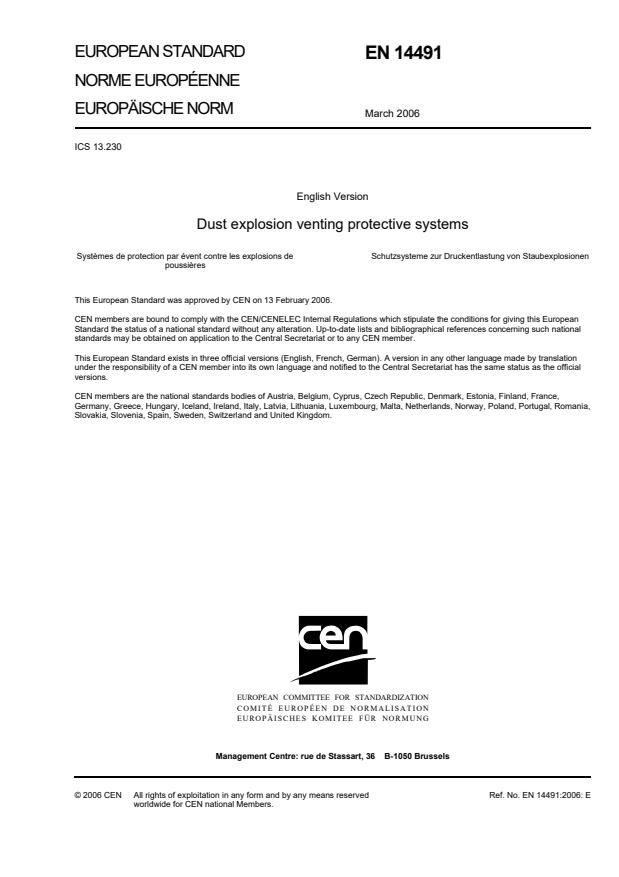
EUROPEAN STANDARDNORME EUROPÉENNEEUROPÄISCHE NORMEN 14491March 2006ICS 13.230 English VersionDust explosion venting protective systemsSystèmes de protection par évent contre les explosions depoussièresSchutzsysteme zur Druckentlastung von StaubexplosionenThis European Standard was approved by CEN on 13 February 2006.CEN members are bound to comply with the CEN/CENELEC Internal Regulations which stipulate the conditions for giving this EuropeanStandard the status of a national standard without any alteration. Up-to-date lists and bibliographical references concerning such nationalstandards may be obtained on application to the Central Secretariat or to any CEN member.This European Standard exists in three official versions (English, French, German). A version in any other language made by translationunder the responsibility of a CEN member into its own language and notified to the Central Secretariat has the same status as the officialversions.CEN members are the national standards bodies of Austria, Belgium, Cyprus, Czech Republic, Denmark, Estonia, Finland, France,Germany, Greece, Hungary, Iceland, Ireland, Italy, Latvia, Lithuania, Luxembourg, Malta, Netherlands, Norway, Poland, Portugal, Romania,Slovakia, Slovenia, Spain, Sweden, Switzerland and United Kingdom.EUROPEAN COMMITTEE FOR STANDARDIZATIONCOMITÉ EUROPÉEN DE NORMALISATIONEUROPÄISCHES KOMITEE FÜR NORMUNGManagement Centre: rue de Stassart, 36
B-1050 Brussels© 2006 CENAll rights of exploitation in any form and by any means reservedworldwide for CEN national Members.Ref. No. EN 14491:2006: E
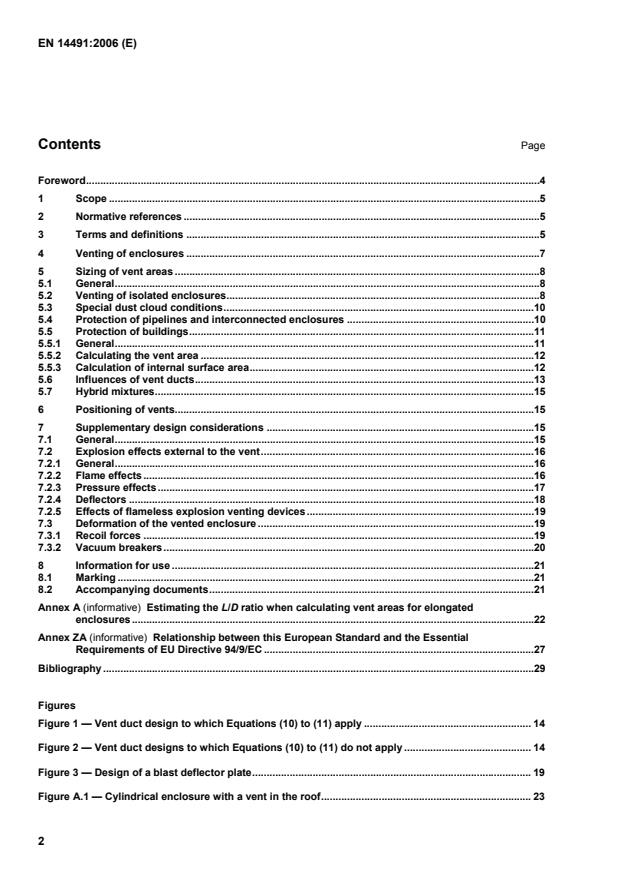
Estimating the L/D ratio when calculating vent areas for elongated enclosures.22 Annex ZA (informative)
Relationship between this European Standard and the Essential Requirements of EU Directive 94/9/EC.27 Bibliography.29 Figures Figure 1 — Vent duct design to which Equations (10) to (11) apply.14 Figure 2 — Vent duct designs to which Equations (10) to (11) do not apply.14 Figure 3 — Design of a blast deflector plate.19 Figure A.1 — Cylindrical enclosure with a vent in the roof.23
1) This is covered in the European Standard prEN 14797.
For enclosures the following equations allow the calculation of the required vent area Av. The required vent area can, in practical applications, be divided into several smaller areas as long as the total area equals the required vent area: a) 0,1 bar overpressure ≤ pred, max < 1,5 bar overpressure ()D/LlogCBA×+=1in m2 (1) with ()[]753,05,0maxred,stat569,0maxred,Stmax51,027,010264,3VpppKpB××−×+××××=−−− (2) ()758,0log305,4maxred,+×−=pC fEAAv/=
(Ef: venting efficiency) (3) b) 1,5 bar overpressure ≤ pred, max ≤ 2,0 bar overpressure BA= fvE/AA=
(Ef: venting efficiency) (4) The equations are valid for: enclosures volume 0,1 m3 ≤ V ≤ 10 000 m3 ; static activation overpressure of the venting device 0,1 bar ≤ pstat ≤ 1 bar; for pstat < 0,1 bar, use pstat = 0,1 bar; maximum reduced explosion overpressure pstat ≤ pred, max ≤ 2 bar. It is recommended that pred, max shall at least be 0,12 bar; maximum explosion overpressure 5 bar ≤ pmax ≤ 10 bar for a dust specific parameter of 10 bar m s–1 ≤ KSt ≤ 300 bar m s–1; maximum explosion overpressure 5 bar ≤ pmax ≤ 12 bar for a dust specific parameter of 300 bar m s–1 < KSt ≤ 800 bar m s–1; atmospheric conditions conditions of the surrounding medium where the atmospheric pressure can vary between 80 kPa and 110 kPa, the temperature between – 20 °C and 60 °C (the variation of temperature being less then 0,5 °C/min), the relative humidity between 5 % volume fraction and 85 % volume fraction and oxygen content (20,9 ± 0,2) % volume fraction; length-to-diameter ratio 1 ≤ L/D ≤ 20 (Examples for calculating L/D are given in Annex A). If one or more of the above conditions are not fulfilled the applicability of the above equation shall be proven. A is the venting area that shall be fitted to the enclosure assuming the venting efficiency factor of the venting device is 1 and thus the effective venting area is equal to the physical venting area. Some venting devices have a venting efficiency factor less than 1, and the effective venting area is thus less than the geometric
...