

EN 14276-1:2006
(Main)Pressure equipment for refrigerating systems and heat pumps - Part 1: Vessels - General requirements
General Information
- Abstract
This European Standard specifies the requirements for material, design, manufacturing, testing and documentation for stationary pressure vessels intended for use in refrigerating systems and heat pumps. These systems are refer-enced in this standard as refrigerating systems as defined in EN 378-1.
This European Standard applies to vessels including welded or brazed attachments up to and including the nozzle flanges, screwed, welded or brazed connectors or to the edge to be welded or brazed at the first circumferential joint connecting piping or other elements.
This European Standard applies to pressure vessels with an internal pressure down to – 1 bar, to account for the evacuation of the vessel prior to charging with refrigerant.
This European Standard applies to both the mechanical loading conditions and thermal conditions as defined in EN 13445-3 associated with refrigerating systems. It applies to pressure vessels subject to the maximum allowable temperatures for which nominal design stresses for materials are derived using EN 13445-2 and EN 13445-3 or as specified in this standard. In addition vessels designed to this standard should have a maximum design tempera-ture not exceeding 200 °C and a maximum design pressure not exceeding 64 bars. Outside of these limits, it is es-sential that EN 13445 be used for the design, construction and inspection of the vessel. Under these circumstances it is important that the unique nature of refrigerating plant, as indicated in the introduction to this standard, also be taken into account.
It is important that pressure vessels used in refrigerating systems and heat pumps of category less than II as de-fined in Annex H comply with other relevant clauses of EN 378-2 for vessels.
This European Standard applies to pressure vessels where the main pressure bearing parts are manufactured from metallic ductile materials as defined in Clause 4 and Annex I of this standard.
This European Standard does not apply to vessels of t
- Status
- Withdrawn
- Publication Date
- 04-Jul-2006
- Withdrawal Date
- 22-Feb-2011
- Technical Committee
- CEN/TC 182 - Refrigerating systems, safety and environmental requirements
- Current Stage
- 9960 - Withdrawal effective - Withdrawal
- Start Date
- 23-Feb-2011
- Completion Date
- 23-Feb-2011
- Directive
- 97/23/EC - Pressure equipmentOJ Ref: C, C 118 OJ Date: 15-Apr-2011

Relations
- Effective Date
- 19-Jan-2023
- Effective Date
- 28-Jan-2026
- Referred By
EN 12284:2003 - Refrigerating systems and heat pumps - Valves - Requirements, testing and marking - Effective Date
- 28-Jan-2026
- Effective Date
- 27-Mar-2010
Get Certified
Connect with accredited certification bodies for this standard

DNV
DNV is an independent assurance and risk management provider.

Lloyd's Register
Lloyd's Register is a global professional services organisation specialising in engineering and technology.
DNV Energy Systems
Energy and renewable energy certification.
Sponsored listings
Frequently Asked Questions
EN 14276-1:2006 is a standard published by the European Committee for Standardization (CEN). Its full title is "Pressure equipment for refrigerating systems and heat pumps - Part 1: Vessels - General requirements". This standard covers: This European Standard specifies the requirements for material, design, manufacturing, testing and documentation for stationary pressure vessels intended for use in refrigerating systems and heat pumps. These systems are refer-enced in this standard as refrigerating systems as defined in EN 378-1. This European Standard applies to vessels including welded or brazed attachments up to and including the nozzle flanges, screwed, welded or brazed connectors or to the edge to be welded or brazed at the first circumferential joint connecting piping or other elements. This European Standard applies to pressure vessels with an internal pressure down to – 1 bar, to account for the evacuation of the vessel prior to charging with refrigerant. This European Standard applies to both the mechanical loading conditions and thermal conditions as defined in EN 13445-3 associated with refrigerating systems. It applies to pressure vessels subject to the maximum allowable temperatures for which nominal design stresses for materials are derived using EN 13445-2 and EN 13445-3 or as specified in this standard. In addition vessels designed to this standard should have a maximum design tempera-ture not exceeding 200 °C and a maximum design pressure not exceeding 64 bars. Outside of these limits, it is es-sential that EN 13445 be used for the design, construction and inspection of the vessel. Under these circumstances it is important that the unique nature of refrigerating plant, as indicated in the introduction to this standard, also be taken into account. It is important that pressure vessels used in refrigerating systems and heat pumps of category less than II as de-fined in Annex H comply with other relevant clauses of EN 378-2 for vessels. This European Standard applies to pressure vessels where the main pressure bearing parts are manufactured from metallic ductile materials as defined in Clause 4 and Annex I of this standard. This European Standard does not apply to vessels of t
This European Standard specifies the requirements for material, design, manufacturing, testing and documentation for stationary pressure vessels intended for use in refrigerating systems and heat pumps. These systems are refer-enced in this standard as refrigerating systems as defined in EN 378-1. This European Standard applies to vessels including welded or brazed attachments up to and including the nozzle flanges, screwed, welded or brazed connectors or to the edge to be welded or brazed at the first circumferential joint connecting piping or other elements. This European Standard applies to pressure vessels with an internal pressure down to – 1 bar, to account for the evacuation of the vessel prior to charging with refrigerant. This European Standard applies to both the mechanical loading conditions and thermal conditions as defined in EN 13445-3 associated with refrigerating systems. It applies to pressure vessels subject to the maximum allowable temperatures for which nominal design stresses for materials are derived using EN 13445-2 and EN 13445-3 or as specified in this standard. In addition vessels designed to this standard should have a maximum design tempera-ture not exceeding 200 °C and a maximum design pressure not exceeding 64 bars. Outside of these limits, it is es-sential that EN 13445 be used for the design, construction and inspection of the vessel. Under these circumstances it is important that the unique nature of refrigerating plant, as indicated in the introduction to this standard, also be taken into account. It is important that pressure vessels used in refrigerating systems and heat pumps of category less than II as de-fined in Annex H comply with other relevant clauses of EN 378-2 for vessels. This European Standard applies to pressure vessels where the main pressure bearing parts are manufactured from metallic ductile materials as defined in Clause 4 and Annex I of this standard. This European Standard does not apply to vessels of t
EN 14276-1:2006 is classified under the following ICS (International Classification for Standards) categories: 23.020.30 - Pressure vessels, gas cylinders; 27.080 - Heat pumps; 27.200 - Refrigerating technology. The ICS classification helps identify the subject area and facilitates finding related standards.
EN 14276-1:2006 has the following relationships with other standards: It is inter standard links to EN 14276-1:2006+A1:2011, EN 378-2:2008+A2:2012, EN 12284:2003, EN 14276-1:2006/FprA1. Understanding these relationships helps ensure you are using the most current and applicable version of the standard.
EN 14276-1:2006 is associated with the following European legislation: EU Directives/Regulations: 97/23/EC; Standardization Mandates: M/071. When a standard is cited in the Official Journal of the European Union, products manufactured in conformity with it benefit from a presumption of conformity with the essential requirements of the corresponding EU directive or regulation.
EN 14276-1:2006 is available in PDF format for immediate download after purchase. The document can be added to your cart and obtained through the secure checkout process. Digital delivery ensures instant access to the complete standard document.
Standards Content (Sample)
2003-01.Slovenski inštitut za standardizacijo. Razmnoževanje celote ali delov tega standarda ni dovoljeno.Pressure equipment for refrigerating systems and heat pumps - Part 1: Vessels - General requirements]DKWHYHEquipements sous pression pour systemes de réfrigération et pompes a chaleur - Partie 1: Récipients - Exigences généralesDruckgeräte für Kälteanlagen und Wärmepumpen - Teil 1: Behälter - Allgemeine AnforderungenTa slovenski standard je istoveten z:EN 14276-1:2006SIST EN 14276-1:2007en27.200Hladilna tehnologijaRefrigerating technology27.080Heat pumps23.020.30MHNOHQNHPressure vessels, gas cylindersICS:SLOVENSKI
STANDARDSIST EN 14276-1:200701-januar-2007
EUROPEAN STANDARDNORME EUROPÉENNEEUROPÄISCHE NORMEN 14276-1July 2006ICS 23.020.30; 27.080; 27.200 English VersionPressure equipment for refrigerating systems and heat pumps -Part 1: Vessels - General requirementsAppareils à pression pour systèmes de réfrigération et depompes à chaleur - Partie 1: Récipients - PrescriptionsgénéralesDruckgeräte für Kälteanlagen und Wärmepumpen - Teil 1:Behälter - Allgemeine AnforderungenThis European Standard was approved by CEN on 24 May 2006.CEN members are bound to comply with the CEN/CENELEC Internal Regulations which stipulate the conditions for giving this EuropeanStandard the status of a national standard without any alteration. Up-to-date lists and bibliographical references concerning such nationalstandards may be obtained on application to the Central Secretariat or to any CEN member.This European Standard exists in three official versions (English, French, German). A version in any other language made by translationunder the responsibility of a CEN member into its own language and notified to the Central Secretariat has the same status as the officialversions.CEN members are the national standards bodies of Austria, Belgium, Cyprus, Czech Republic, Denmark, Estonia, Finland, France,Germany, Greece, Hungary, Iceland, Ireland, Italy, Latvia, Lithuania, Luxembourg, Malta, Netherlands, Norway, Poland, Portugal, Romania,Slovakia, Slovenia, Spain, Sweden, Switzerland and United Kingdom.EUROPEAN COMMITTEE FOR STANDARDIZATIONCOMITÉ EUROPÉEN DE NORMALISATIONEUROPÄISCHES KOMITEE FÜR NORMUNGManagement Centre: rue de Stassart, 36
B-1050 Brussels© 2006 CENAll rights of exploitation in any form and by any means reservedworldwide for CEN national Members.Ref. No. EN 14276-1:2006: E
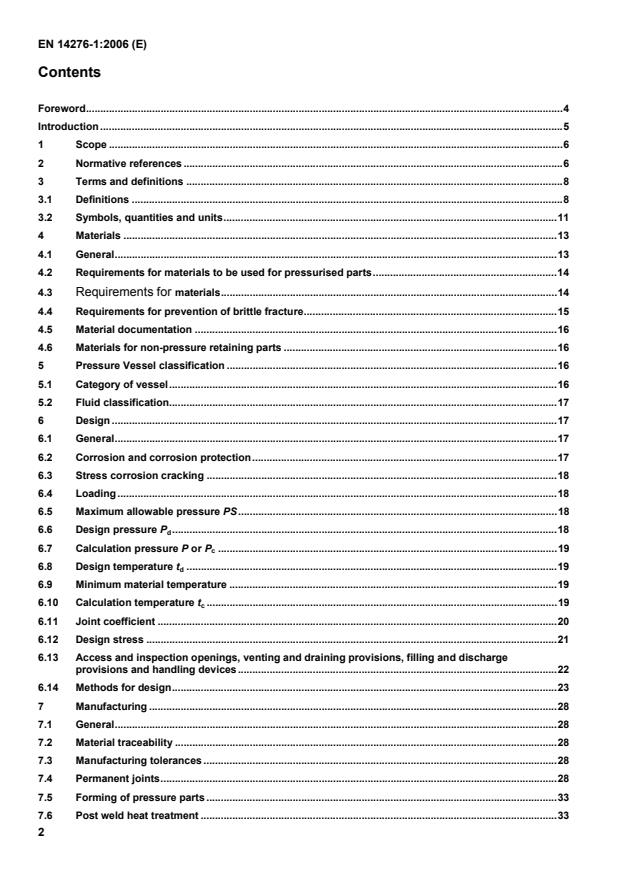
2 Contents Foreword.4 Introduction.5 1 Scope.6 2 Normative references.6 3 Terms and definitions.8 3.1 Definitions.8 3.2 Symbols, quantities and units.11 4 Materials.13 4.1 General.13 4.2 Requirements for materials to be used for pressurised parts.14 4.3 Requirements for materials.14 4.4 Requirements for prevention of brittle fracture.15 4.5 Material documentation.16 4.6 Materials for non-pressure retaining parts.16 5 Pressure Vessel classification.16 5.1 Category of vessel.16 5.2 Fluid classification.17 6 Design.17 6.1 General.17 6.2 Corrosion and corrosion protection.17 6.3 Stress corrosion cracking.18 6.4 Loading.18 6.5 Maximum allowable pressure PS.18 6.6 Design pressure Pd.18 6.7 Calculation pressure P or Pc.19 6.8 Design temperature td.19 6.9 Minimum material temperature.19 6.10 Calculation temperature tc.19 6.11 Joint coefficient.20 6.12 Design stress.21 6.13 Access and inspection openings, venting and draining provisions, filling and discharge provisions and handling devices.22 6.14 Methods for design.23 7 Manufacturing.28 7.1 General.28 7.2 Material traceability.28 7.3 Manufacturing tolerances.28 7.4 Permanent joints.28 7.5 Forming of pressure parts.33 7.6 Post weld heat treatment.33
3 7.7 Internal cleanness.33 7.8 Repairs/Reworks.34 7.9 Finishing operations.34 8 Testing and inspection.34 8.1 Performance of inspection and testing.34 8.2 Design documentation, review and approval.34 8.3 Type approval.36 8.4 Calibration.36 8.5 Material.37 8.6 Manufacturing.37 8.7 Non destructive testing.37 8.8 Subcontracted elements.37 8.9 Final inspection.37 8.10 Marking.38 8.11 Documentation.39 Annex A (normative)
Alternative requirements for prevention of brittle fracture: Method according to temperature stress cases.41 Annex B (normative)
Specification and approval of brazing procedures, brazers and brazing
operators.45 Annex C (normative)
Pressure testing.59 Annex D (informative)
Relations between the different pressures.63 Annex E (normative)
Experimental methods.64 Annex F (normative)
Material characteristics for design.69 Annex G (informative)
Component classification in the sense of the
Pressure Equipment Directive (PED).71 Annex H (informative)
Selection of module of conformity.72 Annex I (normative)
Grouping system for materials.74 Annex J (informative)
DN System.76 Annex K (normative)
Specification and approval of expansion procedures and operators.77 Annex ZA (informative)
Relationship between this European Standard and the Essential Requirements of EU Directive 97/23/EC.83 Bibliography.85
4 Foreword This document (EN 14276-1:2006) has been prepared by Technical Committee CEN/TC 182 “Refrigerating sys-tems, safety and environmental requirements”, the secretariat of which is held by DIN. This European Standard shall be given the status of a national standard, either by publication of an identical text or by endorsement, at the latest by January 2007, and conflicting national standards shall be withdrawn at the latest by January 2007. This document has been prepared under a mandate given to CEN by the European Commission and the European Free Trade Association to support Essential Requirements of EU Directive 97/23/EC concerning Pressure Equip-ment. For relationship with EU directive 97/23/EC see informative Annex ZA, which is an integral part of this document. This document consists of the following parts under the general title "Pressure equipment for refrigerating systems and heat pumps": Part 1: Vessels – General requirements Part 2: Piping – General requirements According to the CEN/CENELEC Internal Regulations, the national standards organizations of the following coun-tries are bound to implement this European Standard: Austria, Belgium, Cyprus, Czech Republic, Denmark, Esto-nia, Finland, France, Germany, Greece, Hungary, Iceland, Ireland, Italy, Latvia, Lithuania, Luxembourg, Malta, Netherlands, Norway, Poland, Portugal, Romania, Slovakia, Slovenia, Spain, Sweden, Switzerland and United Kingdom.
5 Introduction This standard recognises the unique nature of vessels for refrigerating systems or heat pumps and is intended to address the specific needs of the refrigeration and heat pump industry. This standard should be read in conjunction with the various parts of EN 13445. When the text of this standard modifies or supplements a clause within EN 13445, then this standard should pre-vail. Where this standard does not modify or supplement the requirements of a clause, the requirements of EN 13445 should prevail.
The unique nature of a refrigerating system is defined as follows: a) the purpose of the refrigerating system is to extract and reject heat (this involves both cooling and heating); b) to operate the refrigerating system a pressure-imposing element (e.g. a compressor or an energy source) is necessary; c) the refrigerating system has a defined refrigerant charge in a closed circuit; d) the refrigerant has a chemical composition and purity defined in the relevant standards; e) the pressure of the refrigerant decreases when the temperature decreases (see typical curve in Annex A of this standard); f) due to the maximum temperature limit of 200 °C and the maximum pressure limit of 64 bar, the time depend-ant creep and fatigue due to pressure variation or vibrations are not significant design factors except for some materials such as aluminium, copper and titanium where the fatigue shall be taken into account; g) the risk of overpressure is due to: — the pressure imposing element; — an external heat source (e.g. fire or hot water); — improper operation. h) the refrigerating system is designed to minimise refrigerant emissions and the ingress of contaminants. Only hermetic compressors are covered by this standard.
6 1 Scope This European Standard specifies the requirements for material, design, manufacturing, testing and documentation for stationary pressure vessels intended for use in refrigerating systems and heat pumps. These systems are refer-enced in this standard as refrigerating systems as defined in EN 378-1. This European Standard applies to vessels including welded or brazed attachments up to and including the nozzle flanges, screwed, welded or brazed connectors or to the edge to be welded or brazed at the first circumferential joint connecting piping or other elements. This European Standard applies to pressure vessels with an internal pressure down to – 1 bar, to account for the evacuation of the vessel prior to charging with refrigerant. This European Standard applies to both the mechanical loading conditions and thermal conditions as defined in EN 13445-3 associated with refrigerating systems. It applies to pressure vessels subject to the maximum allowable temperatures for which nominal design stresses for materials are derived using EN 13445-2 and EN 13445-3 or as specified in this standard. In addition vessels designed to this standard should have a maximum design tempera-ture not exceeding 200 °C and a maximum design pressure not exceeding 64 bars. Outside of these limits, it is im-portant that EN 13445 be used for the design, construction and inspection of the vessel. Under these circum-stances it is important that the unique nature of refrigerating plant, as indicated in the introduction to this standard, also be taken into account.
It is important that pressure vessels used in refrigerating systems and heat pumps of category less than II as de-fined in Annex H comply with other relevant clauses of EN 378-2 for vessels. This European Standard applies to pressure vessels where the main pressure bearing parts are manufactured from metallic ductile materials as defined in Clause 4 and Annex I of this standard.
This European Standard does not apply to vessels of the following types: — vessels of riveted construction;
— multilayered, autofrettaged or prestressed vessels; — vessels directly heated by a flame; — « roll bond » heat exchangers. 2 Normative references The following referenced documents are indispensable for the application of this document. For dated references, only the edition cited applies. For undated references, the latest edition of the referenced document (including any amendments) applies. EN 287-1:2004, Qualification test of welders — Fusion welding — Part 1: Steels EN 378-1:2000, Refrigerating systems and heat pumps — Safety and environmental requirements — Part 1: Basic requirements, definitions, classification and selection criteria EN 378-2:2000, Refrigerating systems and heat pumps — Safety and environmental requirements — Part 2: De-sign, construction, testing, marking and documentation EN 378-4:2000, Refrigerating systems and heat pumps — Safety and environmental requirements — Part 4: Op-eration, maintenance, repair and recovery EN 764-1:2004, Pressure equipment - Part 1: Terminology - Pressure, temperature, volume, nominal size EN 764-2:2002, Pressure equipment — Part 2: Quantities, symbols and units EN 764-3:2002, Pressure equipment — Part 3: Definition of parties involved EN 764-4:2002, Pressure equipment — Part 4: Establishment of technical delivery conditions for metallic materials
7 EN 764-5:2002, Pressure equipment — Part 5: Compliance and inspection documentation of materials EN 837-1:1996, Pressure gauges — Part 1: Bourdon tube pressure gauges — Dimensions, metrology, require-ments and testing EN 910:1996, Destructive tests on welds in metallic materials — Bend tests EN 1005-2:2003, Safety of machinery — Human physical performance — Part 2: Manual handling of machinery and component parts of machinery EN 1044:1999, Brazing - Filler metals EN 1045:1997, Brazing — Fluxes for brazing — Classification and technical delivery conditions EN 1173:1995, Copper and copper alloys — Material condition or temper designation EN 1418:1997, Welding personnel — Approval testing of welding operators for fusion welding and resistance weld
setters for fully mechanized and automatic welding of metallic materials EN 10002-1:2001, Metallic materials — Tensile testing — Part 1: Method of test at ambient temperature EN 10111:1998, Continuously hot-rolled low carbon steel sheet and strip for cold forming — Technical delivery con-ditions EN 10130:1991 + A1:1998 , Cold-rolled low carbon steel flat products for cold forming — Technical delivery condi-tions EN 10160:1999, Ultrasonic testing of steel flat product of thickness equal or greater than 6 mm (reflection method) EN 10164:2004, Steel products with improved deformation properties perpendicular to the surface of the product — Technical delivery conditions EN 10204:2004, Metallic products — Types of inspection documents EN 12517:1998 + A1:2002 + AC :2003, Non-destructive examination of welds — Radiographic examination of welded joints — Acceptance levels EN 12797:2000 + A1:2003, Brazing — Destructive tests of brazed joints EN 12799:2000 + A1:2003, Brazing — Non-destructive examination of brazed joints EN 13445-2:2002, Unfired pressure vessels — Part 2: Materials EN 13445-3:2002, Unfired pressure vessels — Part 3: Design EN 13445-4:2002, Unfired pressure vessels — Part 4: Fabrication EN 13445-5:2002 + A2:2005, Unfired pressure vessels — Part 5: Inspection and testing EN 13445-6:2002 + A1:2004, Unfired pressure vessels — Part 6: Requirements for the design and fabrication of pressure vessels and pressure vessel parts constructed from spheroidal graphite cast iron prEN 13445-8:2003, Unfired pressure vessels – Part 8: Additional requirements for pressure vessels of aluminium and aluminium alloys EN 22553:1994, Welded, brazed and soldered joints — Symbolic representation on drawings (ISO 2553:1992) EN ISO 3677:1995, Filler metal for soft soldering, brazing and braze welding — Designation (ISO 3677:1992) EN ISO 4063:2000, Welding and allied processes — Nomenclature of processes and reference numbers
(ISO 4063:1998) EN ISO 7438:2005, Metallic materials - Bend test (ISO 7438:2005) EN ISO 10012:2003, Measurement management systems — Requirements for measurement processes and measuring equipment (ISO 10012:2003) EN ISO 15607:2003, Specification and qualification of welding procedures for metallic materials — General rules
(ISO 15607:2003) EN ISO 15609-1:2004, Specification and qualification of welding procedures for metallic materials — Welding pro-cedure specification — Part 1: Arc welding (ISO 15609-1:2004)
8 EN ISO 15611:2003, Specification and qualification of welding procedures for metallic materials — Qualification based on previous welding experience (ISO 15611:2003)
EN ISO 15612:2004, Specification and qualification of welding procedures for metallic materials — Qualification by adoption of a standard welding procedure (ISO 15612:2004)
EN ISO 15614-1:2004, Specification and qualification of welding procedures for metallic materials — Welding pro-cedure test — Part 1: Arc and gas welding of steels and arc welding of nickel and nickel alloys (ISO 15614-1:2004) EN ISO 15614-8:2002, Specification and qualification of welding procedures for metallic materials — Welding pro-cedure test — Part 8: Welding of tubes to tube-plate joints (ISO 15614-8:2002) ISO 817:2005, Refrigerants – Designation system ISO 857-1:1998, Welding and allied processes — Vocabulary — Part 1: Metal welding processes ISO 5187:1985, Welding and allied processes — Assemblies made with soft solders and brazing filler metals — Mechanical test methods 3 Terms and definitions For the purposes of this document, the terms and definitions listed in EN 378-1:2000, EN 764-1:2004, EN 764-2:2002, EN 764-3:2002, EN 764-4:2002 EN 764-5:2002, ISO 857-1:1998 and the following apply. 3.1
Definitions 3.1.1 Temperatures stress cases 3.1.1.1 min t0 100 lowest temperature at which pressurised parts are allowed to be used at a stress of up to 100 % of the design stress at 20 °C (standard design stress) 3.1.1.2 min t0 75 lowest temperature at which pressurised parts are allowed to be used when their stress is a maximum of 75 % of the design stress at 20 °C (reduced stress) 3.1.1.3 min t0 50 lowest temperature at which pressurised parts are allowed to be used when their stress is a maximum of 50 % of the design stress at 20 °C (medium stress) 3.1.1.4 min t0 25
lowest temperature at which pressurised parts are allowed to be used when their stress is a maximum of 25 % of the design stress at 20 °C (low stress) 3.1.2 corrosion all forms of material wastage (e.g. oxidation, erosion, wear and abrasion) 3.1.3 material safety data sheet
document which gives all necessary information for prevention, safety, storage, transportation, labelling, use and disposal of substances and preparations which have a risk for health, safety or environment 3.1.4 maximum design temperature highest temperature that can occur during operation or standstill of the refrigerating system or during testing under test conditions NOTE This temperature is equivalent to the maximum allowable temperature as defined in article 1.2.4 of the PED.
9 3.1.5 minimum design temperature lowest temperature that can occur during operation or standstill of the refrigerating system or during testing under test conditions NOTE This temperature is equivalent to the minimum allowable temperature as defined in article 1.2.4 of the PED. 3.1.6 main pressure bearing part
components of the vessel retaining the pressure and contributing to the vessel strength such as shell, tubesheet, end plate, dished ends, connection or fitting
3.1.7 volume internal volume of a compartment ready for operation, including the volume of nozzles to the first connection (flange, coupling, weld, braze) and excluding the volume of permanent internal part 3.1.8 « roll bond » heat exchanger
heat exchanger consisting of two plates which are weld-bonded together with the exception of the printed circuit forming the refrigerant passage which is obtained by inflation under pressure 3.1.9 maximum operating pressure
maximum pressure which the vessel can withstand without the operation of any safety accessory with a continuous operation of the pressure generator (compressor, heat source.) NOTE This pressure determines the maximum operating conditions for equipment users. 3.1.10 maximum standstill pressure
maximum pressure which the vessel can withstand without operation of any safety accessory when the pressure generator is not in operation. This pressure occurs during transportation, storage or shut down of the pressure generator 3.1.11 deep drawing process of forming by stamping when the ratio of depth (H) by diameter (D) is greater than or equal to 0,45, see Figure 1
Key H depth D diameter Figure 1 — Deep drawing 3.1.12 manual brazing brazing operation performed and controlled by hand 3.1.13 semi-automatic brazing brazing with equipment which controls only the brazing filler metal feed.
NOTE The advance of the brazing is manually controlled 3.1.14 machine brazing brazing with equipment which performs the brazing operation under the constant control of a brazing operator 3.1.15 automatic brazing brazing with equipment which performs the brazing operation without constant observation and adjustment by a brazing operator 3.1.16 brazer person who performs a manual or semiautomatic brazing operation 3.1.17 brazing operator person who operates a machine or automatic brazing equipment 3.1.18 semiautomatic expansion expansion with equipment which controls the operation and where the operator manually introduces the equipment to the inside of the tube 3.1.19 machine expansion expansion with equipment which performs the expansion operation under the constant control of operator 3.1.20 automatic expansion expansion with equipment which performs the expansion operation without constant observation and adjustment by an expansion operator 3.1.21 expansion operator person who makes an expansion joint
11 3.1.22 rolling
plastic cold forming of tubes by means of a tool which have several rolls turning during the operation 3.2 Symbols, quantities and units Symbols, quantities and units used in this standard are listed in Table 1.
12 Table 1 — Symbols, quantities and units Symbol Quantity Unit A elongation after fracture % At strengthened area tube side
mm² AV strengthened mm² AW effective area of expanded joint mm² c corrosion allowance mm dtube nominal outside diameter of tubes mm de external diameter of tube mm di internal diameter of tube mm Ds internal shell diameter mm DN Nominal diameter — e thickness mm eact actual thickness mm eb brazing joint size of tube in the tubesheet mm eW welding joint size of tube in the tubesheet mm en nominal thickness mm Etube Elasticity modulus for tube material at design temperature MPa f nominal design stress at design temperature MPa ftube nominal design stress of tube material at design temperature t °C MPa fttest
nominal design stress at test temperature t °C MPa Fs tube force generated by shell side N Ftube tube force generated by tube side N ltx expanded length on tube inside tubesheet mm lk unsupported tube length
mm L0
gauge length for tensile test mm Ntube Number of tube for a tubular heat exchanger — p tube pitch for tubesheet mm Pc calculation pressure (in formula, Pc can be replaced by P)
MPa or bara
Pd design pressure MPa or bara
P(max) maximum design pressure
MPa or bara PS maximum allowable pressure MPa or bara
Ptest
test pressure MPa or bara
Pv shell side calculation pressure MPa or bara
Ptube tube side calculation pressure MPa or bara
PED Pressure Equipment Directive n° 97/23/EC — Qtube tube force due to tube side N QV tube force due to tubesheet N
13 Table 1
(continued) Symbol Quantity Unit ReH
upper yield strength MPa Rm tensile strength MPa Rm min minimum tensile strength
MPa Rm avg average value of tensile strength of several test specimens MPa Rm max maximum tensile strength specified in the standard
MPa Rm/t tensile strength at temperature t °C MPa Rm/ttest tensile strength at test temperature t °C MPa Rp avg average value of proof strength of several test specimens MPa Rp0,2 0,2 % proof strength
MPa Rp0,2/t 0,2 % proof strength at temperature t °C MPa Rp0,2/ttest 0,2 % proof strength at test temperature t °C MPa Rp1,0 1,0 % proof strength
MPa Rp1,0/t 1,0 % proof strength at temperature t °C MPa Rp1,0/ttest 1,0 % proof strength at test temperature t °C MPa S0 original cross section area
mm2 SF safety factor
— tc calculation temperature °C td design temperature °C tha temperature of heat absorbing fluid °C the temperature of heat emitting fluid °C z joint coefficient — α thermal expansion
— δe negative wall thickness tolerance mm ν Poisson's ratio — µ basic ligament efficiency of the tubesheet — a 1 bar = 100 000 Pa = 0,1 MPa = 0,1 N/mm2
4 Materials 4.1
General The requirements for materials referenced in this standard shall conform to EN 13445-2, unless modified by the clauses of this section. This standard or reference to other relevant standards shall cover materials not included in EN 13445-2. It is permitted to use non-metallic materials (e.g. gaskets, coatings, insulating materials, sightglasses) provided they are compatible with the other materials, refrigerants and lubricants present.
14 4.2
Requirements for materials to be used for pressurised parts Materials listed in this standard have been identified for use in refrigerating vessels. If it is required to utilise a mate-rial not listed in this standard, the requirements of EN 13445-2 shall be followed where applicable and the unique nature of refrigerating plant requirements shall also be taken into account.
4.3
Requirements for materials 4.3.1 Vessels manufactured from the following materials satisfy the requirements of this standard for the pressurised parts: 4.3.1.1 Where mechanical properties may be modified by the vessel manufacturing process, the material shall be selected from the following material groups as defined in Annex I — Steel groups: 1.1, 1.2, 8.1 in accordance with Annex I; — Aluminium and aluminium alloys groups: 21, 22 with a limitation of 150 °C of maximum allowable temperature; — Copper group: 31, 34 with a limitation of 150 °C of maximum allowable temperature; — Spheroidal graphite cast iron: EN 13445-6. Tubular products for heat exchange surfaces or for connection with DN less than or equal to 50 can also be se-lected from the following material groups: — Copper and copper alloys groups 32, 33, 35 with a limitation of 150 °C of maximum allowable temperature; — Titanium with a limitation of 150 °C of maximum allowable temperature. 4.3.1.2 For deep drawing, the following steels are particularly suitable: — EN 10130, all grades excluding Fe P 01; — EN 10111: grade DD12, DD13, DD14. After forming and possible heat treatment, the material selected shall have a minimum elongation of 14 % when measured as defined in 4.3.3.3, and the test sample is taken close to the edge of the end cap. Other materials can be considered provided they conform to this requirement. 4.3.1.3 Where the vessel manufacturing process does not modify mechanical properties, metallic materials other than those quoted in 4.3.1.1 can be used. 4.3.2 Cladding The base metal of clad materials shall be selected from steel groups listed in 4.3.1.1. The cladding materials may be selected from other material groups. The requirements of Annex C of EN 13445-2:2002 shall apply when the strength of the cladding material is in-cluded in the design calculation. 4.3.3 Special considerations
4.3.3.1 Copper and copper alloys shall be ordered in material condition R or Y as defined in the material stan-dard in accordance with the designation system given in EN 1173.
15 4.3.3.2 With steel grades, where the vessel manufacturer perceives that there is a risk of lamellar tearing due to joint design and loading, one of the following solutions shall be employed: — Testing in accordance with EN 10164 with a minimum value of Z15 — Ultrasonic inspection of the area where the joint is made. The minimum area to be inspected is a band of mate-rial equivalent to five times the weld joint width. The inspection shall be carried out to EN 10160 with class S3 or E4 acceptance levels. The examination shall be conducted after manufacturing processes to the part in question are complete. 4.3.3.3 The minimum values for the elongation after fracture (A) specified for gauge length 0065,5SL= are: — Steel for transverse direction: — Steel for longitudinal direction: — Aluminium and aluminium alloys: — Copper and copper alloys in wrought condition: — Copper alloys in cast condition: — Titanium: 14 %; 16 %; 14 %; 14 %; 12 %; 14 %. In case of tubular copper and copper alloy material where the elongation values fall below the values given above, their use shall be restricted to use within the following limits: — PS x DN = 50 000 bar mm and PS = 64 bar for A > 5 %; — PS x DN = 10 000 bar mm and PS = 20 bar for A ≤ 5 %. 4.3.3.4 When the gauge length is different from 0065,5SL=and for a non-proportional gauge length, the requirements of EN 10002-1 shall apply to determine the minimum value of elongation after fracture. 4.3.3.5 Design temperatures above room temperature These are specified for steel in EN 13445-2. The values for aluminium and its alloys, copper and its alloys and for titanium may be determined by the material standard or by the Annex F of this standard. The values specified at room temperature may be used for temperature equal to or less than 50 °C. 4.4
Requirements for prevention of brittle fracture 4.4.1 General For pressure vessels the allowed stress at the minimum design temperature is applied as per Annex B of EN 13445-2:2002 or Annex A of this standard. Annex A takes into account that due to the physical conditions during the phase change in refrigerating systems, the pressure in the refrigerant containing part of the vessel drops when the refrigerant temperature decreases. Thus at lower temperatures the stresses due to refrigerant pressure are always lower than the stresses at the de-sign pressure according to the relevant table of EN 378-2 (vapour pressure curve of a common refrigerant, see Fig-ure A.1). In the case of fluids without phase change, e.g. brine, the pressure does not change at low temperatures, therefore in Annex A the permissible stress of the component parts is determined by higher safety factors (see Table A.1).
16 4.4.2 Material requirements For steel materials listed in 4.3.1.1 the test temperature and the minimum value of the impact test energy measured on an ISO V notch bending test specimen are determined in accordance with Annex B of EN 13445-2:2002 or An-nex A of this standard. For spheroidal cast iron, refer to EN 13445-6 requirements. The copper, copper alloys with the exception of alloy groups 32.2 and 35, aluminium, aluminium alloys and titanium are not susceptible to brittle fracture due to low temperature and no special provisions are necessary for their use to a minimum design temperature of – 196 °C. 4.5
Material documentation The material of the main pressure bearing parts of vessels of categories II, III, IV shall be delivered with a specific product control document as defined in EN 10204 (e.g: 3.1, 3.2).
The materials for other pressure bearing parts, and for vessels where the category is I or lower, shall be delivered with a test report 2.2 as defined in EN 10204. Filler materials used for welding and brazing shall be delivered with a certificate of compliance with the order type 2.2 as defined in EN 10204. The EN 764-5 gives the requirements for the selection between the different types of material certificate.
NOTE It should be noted that EN 764-5:2002 is based on the requirements of EN 10204:1991 which has been replaced by EN 10204:2004 4.6
Materials for non-pressure retaining parts Materials for non pressurised parts, such as lifting lugs, supporting skirts, baffles etc., which are permanently joined to pressurised parts of the vessel, and welding and brazing consumables, shall be selected by the vessel manufac-turer in order to avoid undesirable effects with the material to which they are attached. The materials shall be sup-plied against materials specifications covering as a minimum the requirements for chemical composition and tensile properties. The vessel manufacturer shall specify impact properties when required by the design conditions. These materials shall be compatible with the materials to which they are attached. 5 Pressure Vessel classification 5.1
Category of vessel The pressure vessels are classified into 4 categories in accordance with the following: a) the product of maximum allowable pressure in bar times the volume in litres; b) the fluid classification as defined in 5.2; c) the fluid state: 1) gases, liquefied gases, gases dissolved under pressure and those liquids whose vapour pressure at the maximum allowable temperature is greater than 0,5 bar; 2) liquids having a vapour pressure at the maximum allowable temperature of not more than 0,5 bar. For this standard, the refrigerant containing parts are always considered as a gas circuit. The informative Annex H of this standard defines the limits of the 4 categories.
17 5.2
Fluid classification 5.2.1 Refrigerants Refrigerants are classified as follows: — Group 1: refrigerants within the groups L2 and L3 of EN 378-1 with the exemption of refrigerants R-30, R-123, and R-141b. — Group 2: refrigerants within the group L1 of EN 378-1 including refrigerants R-30, R-123, and R-141b. 5.2.2 Other fluids Other fluids used shall be classified according to their Material Safety Data Sheets as follows: — Group 1 (dangerous fluids): fluids recognised as dangerous substances with the following risks associated with them (where R denotes “risk” and not “refrigerant”) in the following list: R2, R3, R7, R8, R9, R10, R11, R12, R15, R17, R23, R24, R25, R26, R27, R28, R39-23, R39-R24, R39-R25, R39-23-24, R39-23-25, R39-24-25, R39-23-24-25, R39-26, R39-R27, R39-R28, R39-26-27, R39-26-28, R39-27-28, R39-26-27-28, R48-26, R48-R27, R48-R28, R48-26-27, R48-26-28, R48-27-28, R48-26-27-28. — Group 2 (non-dangerous fluids): fluids with no risk or other risks not quoted above associated with them. When a mixture of fluids contains at least one fluid classified as Group 1, the mixture shall be classified as Group 1 unless there is evidence available either in the details given in the material safety data sheet or in the manufac-turer’s supporting documents to classify the mixture as Group 2. 6 Design 6.1 General This clause covers pressure vessels constructed of materials as defined in Clause 4. The dimensions of pressur-ised parts shall withstand the design pressure (Pd) at the design temperature (td). The requirements for design referenced in this standard shall meet the requirements of EN 13445-3 unless modi-fied by the clauses of this section. 6.2 Corrosion and corrosion protection 6.2.1 General The corrosion allowances specified in this clause are based on the assumption that the vessel shall be maintained as prescribed in EN 378-2. If it is intended to maintain the system to any other requirement, the other allowances may have to be used and stated in the vessel documentation. 6.2.2 Internal corrosion For surfaces in contact with HFC's/HCFC's and CFC's type refrigerants listed in EN 378-1, internal corrosion is negligible and the minimum corrosion allowance may be taken to be 0 mm. Other values, greater than zero, may be selected by the manufacturer. For other types of refrigerant and for other fluids, the minimum corrosion allowance shall be assumed to be 0 mm. Other values, greater than zero, may be selected by the manufacturer.
18 6.2.3 External corrosion External corrosion allowance shall be either: — 0 mm for pressurised parts, if appropriate protection (e.g: paint, zinc plating, vapour barriers, non corrosive ma-terials) is applied prior to putting into service, and the protection is properly maintained by the end user during the operational lifetime and checked at least according to EN 378-2:2000 (Annex B and D); — Not less than 1 mm if pressurised parts are not protected during the operational life time as prescribed above; — As specified by the contracting parties at the time of order. NOTE The low temperatures associated with the operation of evaporators vessels and other vessels working on the “low pressure side” of the system may result in condensation forming of the cold surfaces. Special attention should be given to these vessels, by for example properly applying insulation and vapour seal, to avoid corrosion of the surface. 6.2.4 Corrosion allowance information The corrosion allowance value shall be stated on the vessel documentation. 6.3 Stress corrosion cracking Pressure vessels in contact with refrigerants other than ammonia are not subject to stress corrosion cracking. For vessels containing ammonia, stress corrosion cracking does not occur if vessels are made from steel with
ReH ≤ 360 N/mm2 and the refrigerating system is designed, operated and maintained according to EN 378-1 to EN 378-4. If by design or contract both of the above conditions do not apply, then it may be necessary to stress relieve the vessel according to EN 13445-4. Under these conditions the manufacturer shall assess the conditions that may exist in the plant and stress relieve the vessel when it is considered necessary. 6.4 Loading The requirements of EN 13445-3 shall apply. 6.5 Maximum allowable pressure PS The pressures determined according to EN 378-2:2000, Table 1 are minimum values for the maximum allowable pressure PS of the refrigerant containing parts. For fluids other than refrigerants the maximum allowable pressure shall be determined according to the relevant section of EN 13445-3. The maximum allowable pressure PS shall not be exceeded except during the short period of time necessary for the safety accessory to operate and the maximum value of pressure shall be 1,1
...