

EN 13063-2:2005
(Main)Chimneys - System chimneys with clay/ceramic flue liners - Part 2: Requirements and test methods under wet conditions
General Information
- Abstract
This European Standard specifies the requirements and test methods for multiwall system chimneys working under wet conditions (in the following expressed as "wet chimney") with pressure
type N1, N2 or P1 according to EN 1443 and a working temperature below or equal T600 according to prEN 13063-1, in which the products of combustion are conveyed to the atmosphere through clay/ceramic flue liners. Marking and inspection are also covered by this document.
This European Standard does not apply to structurally independent (free standing or self supporting) system chimneys.
The wet chimney may comprise the following appropriate components:
- clay/ceramic flue liners;
- insulation layer;
- outer walls;
- acid resistant mortar for jointing flue liners or elastomeric sealant;
- mortar for jointing outer walls;
- terminal;
- chimney base;
- condensate collector;
- condensate outlet;
- cladding;
- opening section;
- cleaning and inspection door;
- distance piece;
- reinforcement.
The wet system chimney covers a combination of compatible chimney components, obtained or specified from one manufacturing source with product responsibility for the whole system chimney.
NOTE This document does not cover soot fire resistance chimneys.
- Status
- Withdrawn
- Publication Date
- 17-May-2005
- Withdrawal Date
- 17-Jul-2007
- Technical Committee
- CEN/TC 166 - Chimneys
- Drafting Committee
- CEN/TC 166 - Chimneys
- Current Stage
- 9960 - Withdrawal effective - Withdrawal
- Start Date
- 18-Jul-2007
- Completion Date
- 18-Jul-2007
89/106/EEC - Construction productsOJ Ref: C, C 319 OJ Date: 14-Dec-2005

Relations
- Effective Date
- 18-Jan-2023
- Effective Date
- 28-Jan-2026
Get Certified
Connect with accredited certification bodies for this standard

DIBt (Deutsches Institut für Bautechnik)
German Institute for Building Technology.
DIN CERTCO
DIN Group product certification.

Aboma Certification B.V.
Specialized in construction, metal, and transport sectors.
Sponsored listings
Frequently Asked Questions
EN 13063-2:2005 is a standard published by the European Committee for Standardization (CEN). Its full title is "Chimneys - System chimneys with clay/ceramic flue liners - Part 2: Requirements and test methods under wet conditions". This standard covers: This European Standard specifies the requirements and test methods for multiwall system chimneys working under wet conditions (in the following expressed as "wet chimney") with pressure type N1, N2 or P1 according to EN 1443 and a working temperature below or equal T600 according to prEN 13063-1, in which the products of combustion are conveyed to the atmosphere through clay/ceramic flue liners. Marking and inspection are also covered by this document. This European Standard does not apply to structurally independent (free standing or self supporting) system chimneys. The wet chimney may comprise the following appropriate components: - clay/ceramic flue liners; - insulation layer; - outer walls; - acid resistant mortar for jointing flue liners or elastomeric sealant; - mortar for jointing outer walls; - terminal; - chimney base; - condensate collector; - condensate outlet; - cladding; - opening section; - cleaning and inspection door; - distance piece; - reinforcement. The wet system chimney covers a combination of compatible chimney components, obtained or specified from one manufacturing source with product responsibility for the whole system chimney. NOTE This document does not cover soot fire resistance chimneys.
This European Standard specifies the requirements and test methods for multiwall system chimneys working under wet conditions (in the following expressed as "wet chimney") with pressure type N1, N2 or P1 according to EN 1443 and a working temperature below or equal T600 according to prEN 13063-1, in which the products of combustion are conveyed to the atmosphere through clay/ceramic flue liners. Marking and inspection are also covered by this document. This European Standard does not apply to structurally independent (free standing or self supporting) system chimneys. The wet chimney may comprise the following appropriate components: - clay/ceramic flue liners; - insulation layer; - outer walls; - acid resistant mortar for jointing flue liners or elastomeric sealant; - mortar for jointing outer walls; - terminal; - chimney base; - condensate collector; - condensate outlet; - cladding; - opening section; - cleaning and inspection door; - distance piece; - reinforcement. The wet system chimney covers a combination of compatible chimney components, obtained or specified from one manufacturing source with product responsibility for the whole system chimney. NOTE This document does not cover soot fire resistance chimneys.
EN 13063-2:2005 is classified under the following ICS (International Classification for Standards) categories: 91.060.40 - Chimneys, shafts, ducts. The ICS classification helps identify the subject area and facilitates finding related standards.
EN 13063-2:2005 has the following relationships with other standards: It is inter standard links to EN 13063-2:2005+A1:2007, EN 13063-3:2007. Understanding these relationships helps ensure you are using the most current and applicable version of the standard.
EN 13063-2:2005 is associated with the following European legislation: EU Directives/Regulations: 305/2011, 89/106/EEC; Standardization Mandates: M/105. When a standard is cited in the Official Journal of the European Union, products manufactured in conformity with it benefit from a presumption of conformity with the essential requirements of the corresponding EU directive or regulation.
EN 13063-2:2005 is available in PDF format for immediate download after purchase. The document can be added to your cart and obtained through the secure checkout process. Digital delivery ensures instant access to the complete standard document.
Standards Content (Sample)
2003-01.Slovenski inštitut za standardizacijo. Razmnoževanje celote ali delov tega standarda ni dovoljeno.Chimneys - System chimneys with clay/ceramic flue liners - Part 2: Requirements and test methods under wet conditionsConduits de cheminées - Conduits de cheminées résistant aux feux de cheminées a paroi intérieure en terre cuite/céramique - Partie 2 : Exigences et méthodes d'essai en conditions humidesAbgasanlagen - System-Abgasanlagen mit Keramikinnenrohren - Teil 2: Anforderungen und Prüfungen für feuchte BetriebsweiseTa slovenski standard je istoveten z:EN 13063-2:2005SIST EN 13063-2:2005en91.060.40Dimniki, jaški, kanaliChimneys, shafts, ductsICS:SLOVENSKI
STANDARDSIST EN 13063-2:200501-september-2005
EUROPEAN STANDARDNORME EUROPÉENNEEUROPÄISCHE NORMEN 13063-2May 2005ICS 91.060.40English versionChimneys - System chimneys with clay/ceramic flue liners - Part2: Requirements and test methods under wet conditionsConduits de cheminées - Conduits de cheminées resistantaux feux de cheminées à paroi intérieure en terrecuite/céramique - Partie 2: Exigences et methods d'essaien conduits humidesAbgasanlagen - System-Abgasanlagen mit Keramik-Innenrohren - Teil 2: Anforderungen und Prüfungen fürfeuchte BetriebsweiseThis European Standard was approved by CEN on 1 April 2005.CEN members are bound to comply with the CEN/CENELEC Internal Regulations which stipulate the conditions for giving this EuropeanStandard the status of a national standard without any alteration. Up-to-date lists and bibliographical references concerning such nationalstandards may be obtained on application to the Central Secretariat or to any CEN member.This European Standard exists in three official versions (English, French, German). A version in any other language made by translationunder the responsibility of a CEN member into its own language and notified to the Central Secretariat has the same status as the officialversions.CEN members are the national standards bodies of Austria, Belgium, Cyprus, Czech Republic, Denmark, Estonia, Finland, France,Germany, Greece, Hungary, Iceland, Ireland, Italy, Latvia, Lithuania, Luxembourg, Malta, Netherlands, Norway, Poland, Portugal, Slovakia,Slovenia, Spain, Sweden, Switzerland and United Kingdom.EUROPEAN COMMITTEE FOR STANDARDIZATIONCOMITÉ EUROPÉEN DE NORMALISATIONEUROPÄISCHES KOMITEE FÜR NORMUNGManagement Centre: rue de Stassart, 36
B-1050 Brussels© 2005 CENAll rights of exploitation in any form and by any means reservedworldwide for CEN national Members.Ref. No. EN 13063-2:2005: E
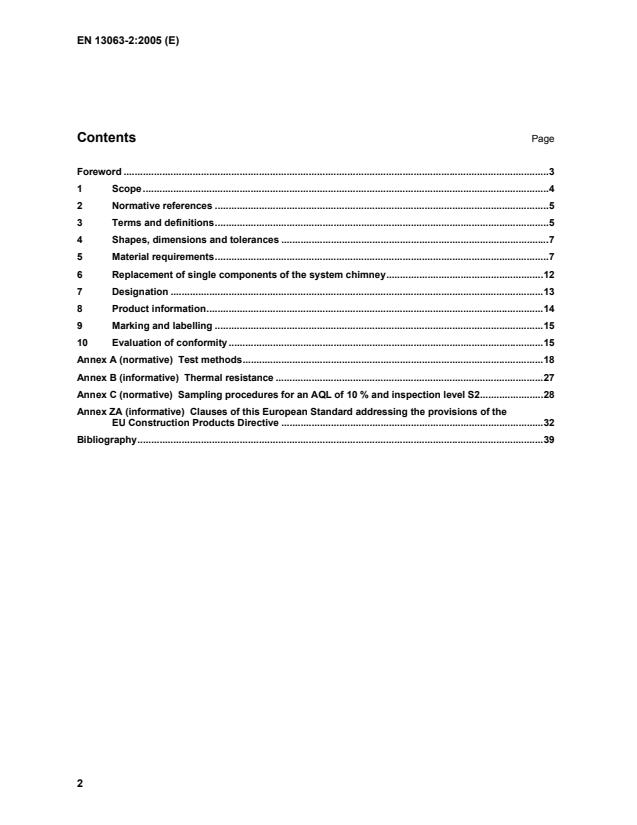
Test methods.18 Annex B (informative)
Thermal resistance.27 Annex C (normative)
Sampling procedures for an AQL of 10 % and inspection level S2.28 Annex ZA (informative)
Clauses of this European Standard addressing the provisions of the EU Construction Products Directive.32 Bibliography.39
type N1, N2 or P1 according to EN 1443 and a working temperature below or equal T600 according to prEN 13063-1, in which the products of combustion are conveyed to the atmosphere through clay/ceramic flue liners. Marking and inspection are also covered by this document. This European Standard does not apply to structurally independent (free standing or self-supporting) system chimneys. The wet chimney may comprise the following appropriate components: clay/ceramic flue liners; insulation layer; outer walls; acid resistant mortar for jointing flue liners or elastomeric sealant; mortar for jointing outer walls; terminal; chimney base; condensate collector; condensate outlet; cladding; opening section; cleaning and inspection door; distance piece; reinforcement. The wet system chimney covers a combination of compatible chimney components, obtained or specified from one manufacturing source with product responsibility for the whole system chimney. NOTE This document does not cover soot fire resistance chimneys.
3 Terms and definitions For the purposes of this European Standard, the terms and definitions given in EN 1443:2003, EN 13216-1:2004, prEN 13063-1:2002 and the following apply. 3.1 system chimney under wet conditions system chimney is a multiwall construction, consisting mainly of an outer wall, an insulation layer and the inner clay/ceramic flue liner that can work under wet conditions (see Figure 1)
Key 1 flue liner 2 insulation layer 3 outer wall 4 back ventilation 5 cavities for structural reinforcement 6 non ventilated air gap Figure 1 — Examples of construction of a chimney for wet conditions 3.2 wet operating conditions conditions when the chimney is designed to operate normally with the temperature of the inner surface of the flue liner at and below the water dew point 3.3 condensate collector flue liner base unit for collecting the condensates with an opening for discharging the condensates 3.4 condensate outlet drain to ensure the discharge of the condensates from the condensates collector 3.5 jointing materials for flue liners 3.5.1 prefabricated elastomeric seals prefabricated element made of elastomeric material, which ensures a gastight seal in a joint
EN 12446:2003, Clause 7; clay/ceramic outer walls:
prEN 13069:1997, Clause 6; metal outer walls:
prEN 13063-1:2002, Annex B. 4.4 Cleaning and inspection doors Dimensions and tolerances shall be declared by the manufacturers. 5 Material requirements 5.1 General requirements for components 5.1.1 Flue liners Flue liners shall meet the requirements of EN 14571999
8.1, 9.1, 9.2, Clauses 10, 11, 12 and 13. If the requirement of EN 1457:1999
13.1 "Water vapour permeability" is not fulfilled, the flue liner may be used for wet chimneys, if the system test for system chimneys under wet conditions according to EN 13216-1:2004, 5.5, is passed according to the requirements in.
5.1.5 Outer wall elements Outer wall elements shall fulfil EN 12446 for concrete outer wall elements, prEN 13069 for clay/ceramic outer wall or Annex B of prEN 13063-1:2002 for metal outer walls. 5.1.6 Jointing material for outer wall elements Jointing materials used for jointing outer walls according to EN 12446 for concrete outer wall elements and prEN 13069 for clay/ceramic outer walls, where supplied with the system chimney, shall comply with the system chimney manufacturer's declared specification and shall be at least M2,5 according to EN 998-2:2003, 5.3.1, Table 1. 5.1.7 Wind load The freestanding part of the chimney above the last lateral support of the system chimney shall withstand a wind load of 1,5 kN/m2. The maximum permissible height of a chimney outside the building of a system chimney shall be calculated according to calculation methods applicable in the place of use of the chimney, taking into account the tilt momentum of the outer wall element. Alternatively the tilt momentum of the complete construction can be taken into account. A test method to evaluate the tilt momentum is given in A.2.4. 5.2 Safety in use 5.2.1 Thermal shock resistance The wet chimney shall be tested at the normal operating conditions in accordance with the heat stress test method described in EN 13216-1:2004, 5.7.5.1, for the required temperature types according to Table 1. 5.2.2 Distance to combustible materials 5.2.2.1 General The distance to combustible materials shall be tested at the normal operating condition in accordance with EN 13216-1:2004, 5.7.5.1, the test assembly shall be the corner installation. The distance between the outer surface of the chimney and the adjacent combustible material shall be declared as O(xx), where (xx) is the minimum distance in mm. 5.2.2.2 Normal operating conditions The wet chimney shall be tested in accordance with the heat stress test method described in
EN 13216-1:2004, 5.7.5.1 for the required temperature types according to Table 1. The maximum surface temperature of combustible materials adjacent to the test wet chimney shall not be greater than 85 °C, when related to an ambient temperature of 20 °C.
5.3 Hygiene, health and environment 5.3.1 Gas tightness When a chimney is tested according to the test methods described in EN 13216-1:2004, 5.3, the leakage rate shall not be greater than that given in Table 3, both before and after the thermal performance test.
5.3.2 Durability 5.3.2.1 Condensate resistance Wet chimneys shall have either clay/ceramic flue liners which are designated W according to EN 1457:1999
Clause 13, or clay/ceramic flue liners which are designated D according to EN 1457:1999 if the chimney, when tested according to EN 13216-1:2004, 5.5, shows no water vapour saturation in any part of the system chimney. Prefabricated elastomeric seals and on site applied elastomeric sealant shall comply with prEN 14241-1 condensate class W at the designated temperature class of the wet chimney 5.3.2.2 Corrosion resistance of flue liners and jointing material The mass loss of clay/ceramic flue liners shall not exceed 2 % when tested according to EN 1457:1999, 16.9. Prefabricated elastomeric seals and on site applied elastomeric sealant shall comply with prEN 14241-1 corrosion class 1 or 2 at the designated temperature class of the wet chimney. 5.3.3 Flow resistance of flue liners and fittings The flow resistance shall be measured according to EN 13216-1:2004, 5.11. The friction coefficient ζ and the mean roughness r shall be calculated according to EN 13216-1. NOTE For clay/ceramic flue liners the roughness value r = 0,001 5 m and the friction coefficient ζ for typical fittings can be taken from EN 13384-1. 5.4 Cleaning and inspection doors The increase of the surface temperature of the outer surface of the cleaning and inspection doors shall not exceed 140 K during thermal testing, the test shall be carried out in accordance with EN 13216-1:2004, 5.7.5.1. NOTE It is recommended that the distance to combustible materials should not be less than 400 mm from cleaning and inspection doors. When tested in accordance with EN 13216-1, the complete system with cleaning and inspection doors shall not have a leakage rate greater than the values given in Table 3. The inspection opening shall not hinder the relative movement of the flue liner and no water shall occur at the outside of the cleaning and inspection doors. 5.5 Cladding and accessory exposed to freeze/thaw The freeze/thaw resistance of the flue liner and the outer wall of the system chimney shall be tested according to EN 14297. The product shall not present any damage of types 7, 8, 9 and 10 in accordance with EN 14297:2004, Table 1.
6.3 Change of opening sections The opening sections shall be tested as described in A.2.3. The minimum load shall be equal or more than the original value. 6.4 Change of insulation To change the type of insulation, the new values of each characteristic shall be compared to the original flue liner and shall not deviate more than the values given in Table 5. Table 5 — Requirements of insulation for exchange Characteristic of insulation Requirement compared to originally used insulation flue linerTest method for comparison Thermal conductivity Equal or lower EN 13162:2001, 4.2.1 Layer thickness Equal or greater EN 13162 :2001, 4.2.3 Durability At least equal A.2.1 6.5 Change of jointing materials for flue liners To change the jointing materials for flue liners, the new values of each characteristic shall be compared to the original flue liner and shall not deviate more than the values given in Table 6.
6.6 Change of outer wall elements If concrete outer wall elements have to be changed they shall be according to EN 12446 and the flue liner shall be designated W. Otherwise the system test for system chimneys under wet conditions according to EN 13216-1:2004, 5.5, shall be applied. 6.7 Change of cleaning and inspection doors If a cleaning and inspection door shall be tested separately from the initial type test of the system chimney (e.g. for exchange of component or use in more than one system), the doors shall be tested according to A.2.5. The increase of surface temperature before and after thermal testing shall be less than 100 K. The gas tightness before and after thermal testing shall be within the leakage rate given in Table 3. The door shall not hinder the movement of the flue liner. No condensate shall occur at the outside of the door when tested. 7 Designation The following shall be used for the designation of system chimneys with clay/ceramic flue liners under wet conditions: denomination; standard number; temperature class (see Table 1); resistance to condensate class (see 5.3.2.1); corrosion condensate class (see 5.3.2.2); soot fire resistance class followed by the distance to combustible materials (see 5.2.2); NOTE The CE marking the distance to combustible material should not be indicated. pressure class (see 5.3.1).
System chimney EN 13063 –2T400 N1 W2O50
Denomination
Standard number
Temperature class
Pressure class
Resistance to condensate class
Corrosion resistance class
Soot fire resistance class followed by the distance to combustible materials
8 Product information The installation instructions shall be available in the language of the country in which the product is placed on the market and shall meet the criteria, if stated, in the national building regulations. The following information shall be included: manufacturer identification; product designation with explanation; installation drawing typical of the application; method of jointing the components; method of installing sections or fittings and accessories; minimum distance to combustibles; limitations of height and location of exposed section of the chimney; location of the inspection doors; resistance to fire external to external; values for performance calculation according to EN 13384-1: nominal temperature of the chimney; gas tightness of the chimney;
EN 1457; insulation
EN 13162; clay/ceramic outer wall elements prEN 13069; concrete outer wall elements
EN 12446; metal outer wall elements
Annex B.
Thermal shock conditions 5.2.1
Thermal resistance 5.2.4
Gas tightness 5.3.1
Flow resistance of inner liners and fittings 5.3.3
Wet chimney Freeze/thaw resistance
5.5 5.5 flue liners 4.1 5.1.1 6.2 Insulation 4.2 5.1.4 6.4 opening section - 5.1.2 6.3 jointing material 5.1.3.1.1 5.1.6 6.5 outer wall elements: clay/ceramic - 5.1.5 6.6 outer wall elements: concrete - 5.1.5 6.6 outer wall elements: metal prEN 13063-1:2002, B.2 prEN 13063-1:2002, B.3 not possible cleaning and inspection doors 4.4 5.4 6.7
10.5 Factory production control To achieve compliance with this document the manufacturer shall establish and maintain an effective documented quality system. Factory production control tests are carried out by the manufacturer to monitor the quality of product. (see Table 7).
1 200 (see Annex C). Batches rejected under
...