

EN 15877-2:2013
(Main)Railway applications - Markings of railway vehicles - Part 2: External markings on coaches, motive power units, locomotives and on track machines
General Information
- Abstract
This part of the European Standard identifies the information required or recommended to be marked on coaches, motive power units, locomotives and On Track Machines, relating to their technical and operational characteristics. It defines the characteristics of these markings, the requirements pertaining to their presentation, their shape and position on a vehicle and their meaning. Some markings are accompanied with note(s) where appropriate.
Service markings relating to passenger information are not addressed by this standard.
The provisions of this standard cover external markings on vehicles as required by:
- the TSIs;
- the COTIF regulations.
In addition to the markings shown in this European Standard, there might be other markings and text applied to these vehicles, e.g. instructions and warnings concerning the use of equipment specific to the vehicle. Such additional markings are not in contravention of this standard provided they do not interfere with, create ambiguity or in any other way affect the markings in this standard.
This European Standard is applicable to all railway motive power units, coaches, baggage and mail vans and car carrying coaches intended to be included in passenger trains, locomotives and On Track Machines operating within and between Member States of the European Union, the European Economic Area Member States and States which are member of OTIF (Intergovernmental Organisation for International Carriage by Rail) and it satisfies the legal requirements within these institutions.
- Status
- Published
- Publication Date
- 15-Oct-2013
- Withdrawal Date
- 29-Apr-2014
- Technical Committee
- CEN/TC 256 - Railway applications
- Drafting Committee
- CEN/TC 256/WG 26 - Freight wagons
- Current Stage
- 9092 - Decision on results of review/2YR ENQ - revise - Review Enquiry
- Start Date
- 01-Jun-2022
- Completion Date
- 30-Sep-2026

Overview
EN 15877-2:2013 (CEN) - Railway applications - Markings of railway vehicles - Part 2: External markings on coaches, motive power units, locomotives and On Track Machines - specifies the information that must or should be displayed on the exterior of passenger rolling stock, locomotives and track machines. The standard defines the characteristics, presentation, shape, position and meaning of external markings used to communicate technical, operational and safety information. It supports TSIs and COTIF requirements and aligns with EU Directive 2008/57/EC for interoperability.
Key topics and technical requirements
EN 15877-2:2013 covers a wide range of marking types and rules, including:
- Identification markings: European Vehicle Number (EVN), Vehicle Keeper Marking (VKM), train-set and vehicle numbers.
- Operational data: vehicle mass, braked weight, axle/wheel numbering and dimensional data.
- Interoperability and regulatory markings: symbols and notes required by TSIs and COTIF.
- Safety and emergency markings: electrical hazard, emergency ladder, emergency coupler and rescue information.
- Maintenance and operation info: date of last overhaul, home depot, battery isolation switches, filling and draining points (sanitary water, fuel, sandboxes), brake inscriptions and changeover devices.
- Special vehicle considerations: markings for On Track Machines (OTMs), pressure pulse sensitivity, lifting/re-railing points, and restrictions (e.g., radius curve limits).
- Visual/graphic rules: colour, contrast (LRV), retro-reflecting materials, positioning, stencils and acceptable application methods (decals, painting).
Normative references include EN 15663 and ISO 3864-4 for colour and material properties.
Applications and users
This standard is practical for:
- Rolling stock manufacturers and designers - to ensure exterior markings meet regulatory and interoperability rules.
- Railway undertakings and vehicle keepers - for correct vehicle identification (EVN/VKM), operational markings and maintenance scheduling.
- Maintenance teams and depots - to locate overhaul dates, isolation points, lifting/railing marks and brake instructions quickly.
- Infrastructure managers, inspectors and rescue services - to interpret safety and emergency markings on site.
- Regulatory and certification bodies - to verify compliance with TSIs, COTIF and EU interoperability requirements.
Practical value
Applying EN 15877-2 ensures consistent, unambiguous external markings across fleets operating within the EU/EEA and OTIF states - improving safety, maintenance efficiency and cross‑border interoperability. It also reduces ambiguity by specifying colour contrast, location and meaning of essential markings.
Related standards
- EN 15877-1 (Freight wagons) - companion part for freight vehicle markings.
- TSIs (Technical Specifications for Interoperability) and COTIF regulations - legal frameworks supported by this standard.
- EN 15663 and ISO 3864-4 - referenced for vehicle mass definitions and sign material properties.
Relations
- Effective Date
- 09-Feb-2026
- Effective Date
- 28-Jan-2026
- Effective Date
- 20-May-2026
- Referred By
EN 16404:2014 - Railway applications - Re-railing and recovery requirements for railway vehicles - Effective Date
- 28-Jan-2026
- Effective Date
- 28-Jan-2026
- Effective Date
- 28-Jan-2026
- Referred By
EN 16404:2016 - Railway applications - Re-railing and recovery requirements for railway vehicles - Effective Date
- 28-Jan-2026
- Referred By
EN 16507:2014 - Railway applications - Ground based service - Diesel refuelling equipment - Effective Date
- 28-Jan-2026
- Referred By
EN 16362:2013 - Railway applications - Ground based services - Water restocking equipment - Effective Date
- 28-Jan-2026
- Effective Date
- 28-Jan-2026
- Effective Date
- 28-Jan-2026
- Referred By
EN 15877-1:2012 - Railway applications - Marking on railway vehicles - Part 1: Freight wagons - Effective Date
- 28-Jan-2026
- Effective Date
- 28-Jan-2026
- Effective Date
- 01-Jan-2020
- Effective Date
- 08-Jun-2022
Get Certified
Connect with accredited certification bodies for this standard

IRIS Certification (UNIFE)
International Railway Industry Standard certification.

TÜV SÜD Rail GmbH
TÜV SÜD railway certification services.

Bureau Veritas Railway Certification
Railway and transportation certification.
Sponsored listings
Frequently Asked Questions
EN 15877-2:2013 is a standard published by the European Committee for Standardization (CEN). Its full title is "Railway applications - Markings of railway vehicles - Part 2: External markings on coaches, motive power units, locomotives and on track machines". This standard covers: This part of the European Standard identifies the information required or recommended to be marked on coaches, motive power units, locomotives and On Track Machines, relating to their technical and operational characteristics. It defines the characteristics of these markings, the requirements pertaining to their presentation, their shape and position on a vehicle and their meaning. Some markings are accompanied with note(s) where appropriate. Service markings relating to passenger information are not addressed by this standard. The provisions of this standard cover external markings on vehicles as required by: - the TSIs; - the COTIF regulations. In addition to the markings shown in this European Standard, there might be other markings and text applied to these vehicles, e.g. instructions and warnings concerning the use of equipment specific to the vehicle. Such additional markings are not in contravention of this standard provided they do not interfere with, create ambiguity or in any other way affect the markings in this standard. This European Standard is applicable to all railway motive power units, coaches, baggage and mail vans and car carrying coaches intended to be included in passenger trains, locomotives and On Track Machines operating within and between Member States of the European Union, the European Economic Area Member States and States which are member of OTIF (Intergovernmental Organisation for International Carriage by Rail) and it satisfies the legal requirements within these institutions.
This part of the European Standard identifies the information required or recommended to be marked on coaches, motive power units, locomotives and On Track Machines, relating to their technical and operational characteristics. It defines the characteristics of these markings, the requirements pertaining to their presentation, their shape and position on a vehicle and their meaning. Some markings are accompanied with note(s) where appropriate. Service markings relating to passenger information are not addressed by this standard. The provisions of this standard cover external markings on vehicles as required by: - the TSIs; - the COTIF regulations. In addition to the markings shown in this European Standard, there might be other markings and text applied to these vehicles, e.g. instructions and warnings concerning the use of equipment specific to the vehicle. Such additional markings are not in contravention of this standard provided they do not interfere with, create ambiguity or in any other way affect the markings in this standard. This European Standard is applicable to all railway motive power units, coaches, baggage and mail vans and car carrying coaches intended to be included in passenger trains, locomotives and On Track Machines operating within and between Member States of the European Union, the European Economic Area Member States and States which are member of OTIF (Intergovernmental Organisation for International Carriage by Rail) and it satisfies the legal requirements within these institutions.
EN 15877-2:2013 is classified under the following ICS (International Classification for Standards) categories: 45.060.20 - Trailing stock. The ICS classification helps identify the subject area and facilitates finding related standards.
EN 15877-2:2013 has the following relationships with other standards: It is inter standard links to ISO 3864-4:2011, EN 15663:2017+A2:2024, EN 14198:2026, EN 16404:2014, EN 16834:2019, EN 17065:2018, EN 16404:2016, EN 16507:2014, EN 16362:2013, EN 16922:2017+A1:2019, EN 16922:2017, EN 15877-1:2012, EN 14033-1:2017, EN 15877-2:2013/prA1, FprEN 15877-2. Understanding these relationships helps ensure you are using the most current and applicable version of the standard.
EN 15877-2:2013 is associated with the following European legislation: EU Directives/Regulations: 2001/16/EC, 2008/57/EC; Standardization Mandates: M/334, M/483. When a standard is cited in the Official Journal of the European Union, products manufactured in conformity with it benefit from a presumption of conformity with the essential requirements of the corresponding EU directive or regulation.
EN 15877-2:2013 is available in PDF format for immediate download after purchase. The document can be added to your cart and obtained through the secure checkout process. Digital delivery ensures instant access to the complete standard document.
Standards Content (Sample)
2003-01.Slovenski inštitut za standardizacijo. Razmnoževanje celote ali delov tega standarda ni dovoljeno.Železniške naprave - Oznake na železniških vozilih - 2. del: Zunanje oznake na potniških vagonih, motornih garniturah, lokomotivah in motornih vozilih za posebne nameneBahnanwendungen - Kennzeichnungen von Schienenfahrzeugen - Teil 2: Außenanschriften an Personenfahrzeugen, Triebfahrzeugeinheiten, Lokomotiven und GleisbaumaschinenApplications ferroviaires - Inscriptions pour véhicules ferroviaires - Partie 2: Inscriptions extérieures sur voitures voyageurs, rames automotrices, locomotives et engins de travauxRail applications - Markings on railway vehicles - Part 2: External markings on coaches, motives power units, locomotives and on track machines45.060.20Železniški vagoniTrailing stock01.075Simboli za znakeCharacter symbolsICS:Ta slovenski standard je istoveten z:EN 15877-2:2013SIST EN 15877-2:2014en,fr,de01-julij-2014SIST EN 15877-2:2014SLOVENSKI
STANDARD
EUROPEAN STANDARD NORME EUROPÉENNE EUROPÄISCHE NORM
EN 15877-2
October 2013 ICS 45.060.20 English Version
Railway applications - Markings of railway vehicles - Part 2: External markings on coaches, motive power units, locomotives and on track machines
Applications ferroviaires - Inscriptions pour véhicules ferroviaires - Partie 2: Inscriptions extérieures pour voitures, engins moteur, locomotives et engins de pose de voie
Bahnanwendungen - Kennzeichnungen von Schienenfahrzeugen - Teil 2: Außenanschriften an Personenfahrzeugen, Triebwagen, Lokomotiven und Gleisbaumaschinen This European Standard was approved by CEN on 24 August 2013.
CEN members are bound to comply with the CEN/CENELEC Internal Regulations which stipulate the conditions for giving this European Standard the status of a national standard without any alteration. Up-to-date lists and bibliographical references concerning such national standards may be obtained on application to the CEN-CENELEC Management Centre or to any CEN member.
This European Standard exists in three official versions (English, French, German). A version in any other language made by translation under the responsibility of a CEN member into its own language and notified to the CEN-CENELEC Management Centre has the same status as the official versions.
CEN members are the national standards bodies of Austria, Belgium, Bulgaria, Croatia, Cyprus, Czech Republic, Denmark, Estonia, Finland, Former Yugoslav Republic of Macedonia, France, Germany, Greece, Hungary, Iceland, Ireland, Italy, Latvia, Lithuania, Luxembourg, Malta, Netherlands, Norway, Poland, Portugal, Romania, Slovakia, Slovenia, Spain, Sweden, Switzerland, Turkey and United Kingdom.
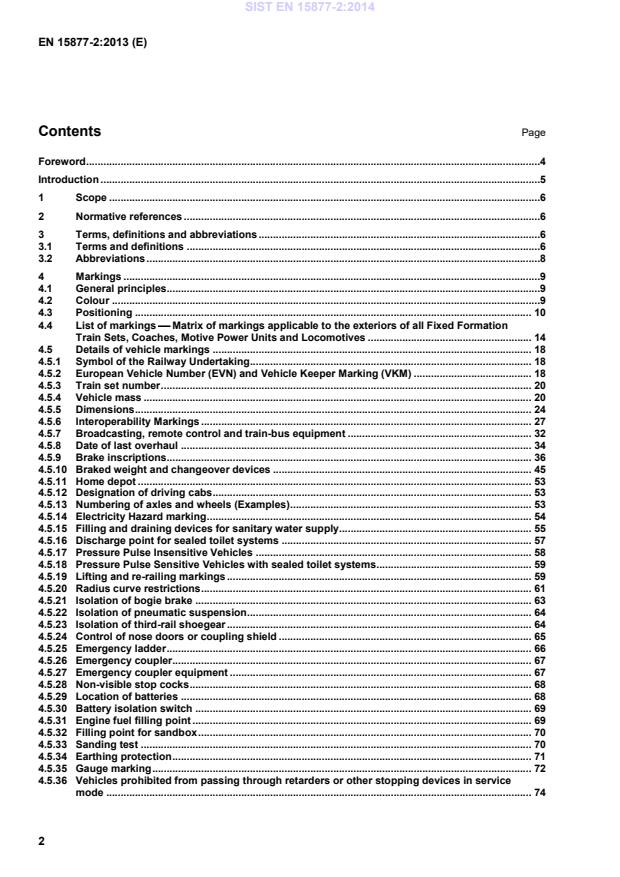
EUROPEAN COMMITTEE FOR STANDARDIZATION
COMITÉ EUROPÉEN DE NORMALISATION EUROPÄISCHES KOMITEE FÜR NORMUNG
CEN-CENELEC Management Centre:
Avenue Marnix 17,
B-1000 Brussels © 2013 CEN All rights of exploitation in any form and by any means reserved worldwide for CEN national Members. Ref. No. EN 15877-2:2013: ESIST EN 15877-2:2014
Relationship between this European Standard and the Essential Requirements of EU Directive 2008/57/EC . 75 Bibliography . 77
2) Traffic Operation and Management; b) the Convention Concerning International Carriage by Rail (COTIF) of 9th May 1980 in the Version of the Protocol of Modification of 3rd June 1999 which entered into force on 1st July 2006. It therefore supports the essential requirements of: Directive 2008/57/EC on the Interoperability of the Railway System; COTIF 1999, Appendix F, Annex 1-A. It is intended to be used by all parties concerned with the marking of railway vehicles. SIST EN 15877-2:2014
LRV • total quantity of visible light that is reflected by a surface at all wavelengths and directions when illuminated by a light source, or • proportion of visible light reflected by a surface, weighted for the sensitivity to light of the human eye SIST EN 15877-2:2014
K perception of a difference visually between one surface or element of a railway vehicle and another by reference to their light reflectance values (LRV) Note 1 to entry: When applying colour to two adjacent surfaces, to provide sufficient contrast, the contrast between the colours will be determined by the light reflectance value. For the purposes of this standard, “contrast” will be assessed by the diffused light reflectance value. Contrast by the diffused light reflectance value’ will mean contrast of surfaces described in the following formula: hhLLLLK+−=00)( where K
is the contrast; L0
is the diffused light reflectance value of the object; Lh
is the diffused light reflectance value of the background or adjacent surface. 3.1.4 marking lettering or symbols applied to a vehicle by means of decals, hand painting or by another agreed method with the purpose of providing information concerning the vehicle 3.1.5 retro-reflecting material material which reflects radiation (light) in a direction close to the opposite of the direction from which it came 3.1.6 stencil template for the required lettering 3.1.7 vehicle in this standard, smallest part in a train (a single vehicle) which features an individual bodyshell lying on its own sets of bogies or wheels or sharing them with adjacent vehicles 3.1.8 railway vehicle vehicle suitable for circulation on its own wheels on railway lines with or without traction 3.1.9 motive power unit self-propelled unit capable of carrying passengers and/or luggage/mail 3.1.10 train operational formation consisting of one or more vehicles SIST EN 15877-2:2014
OTMs vehicles specially designed for construction and maintenance of the track and infrastructure including Infrastructure inspection vehicles 3.1.13 locomotive traction vehicle (or a combination of several vehicles) that is not intended to carry a payload and has the ability to uncouple in normal operation from a train and to operate independently. This definition also covers shunting locomotives 3.1.14 coach in this standard, non traction vehicle in a fixed or variable formation capable of carrying passengers, including restaurant cars, sleeping cars, couchettes cars, etc., and luggage / mail 3.2 Abbreviations Term Definition ATMF Appendix G to COTIF (Admission procedures) CEN European Committee for Standardisation CIE International Commission on Illumination, Vienna, Austria. http://www.cie.co.at
COTIF Convention concerning International Carriage by Rail (COTIF) in the version of the Protocol of Modification of 3 June 1999 EBO Emergency Brake Override ECM Entity in Charge of Maintenance EN European Standard ep Electropneumatic brake ERA European Railway Agency EU European Union OTIF Intergovernmental Organisation for International Carriage by Rail RAL colour standardisation system of the German Institute for Quality Assurance and Certification RIC (Regolamento Internationale delle Carrozze) Agreement governing the exchange and use of coaches in international traffic. RID RID means the Regulations concerning the International Carriage of Dangerous Goods (Appendix C to COTIF 1999) (RID is also Annex to EU Council Directive 96/49/EC) TSI Technical Specification for Interoperability: the specifications by which each subsystem or part subsystem is covered in order to meet the essential requirements and ensure the interoperability of the trans-European rail system TEN Trans European Network UIC International Union of Railways VKM Vehicle Keeper Marking SIST EN 15877-2:2014
4 Markings 4.1 General principles 4.1.1 The markings and the content of information are as given in 4.5. Where a marking is defined in this standard, then other markings indicating the same function/facility shall not be applied. 4.1.2 A marking shall be located on the vehicle at a position easily visible by staff standing and presented in a way clearly understandable to persons concerned. If the marking is intended to be read by a person standing at ground level, it should not be located at a level higher than 2 000 mm above the rail surface1). The visibility shall also be ensured if the marking needs to be read from a position other than ground level or if it is placed on a non-vertical surface. Hazard Markings, e.g. the warning marking for live catenary, shall be located in such a position that they can be seen before the hazard zone is actually reached. 4.1.3 Advertising, designs or other text or pictures not relating to markings applied to a vehicle shall not affect the visibility and the clear and unambiguous understanding of the marking. Such advertising or markings shall not encroach within 100 mm of the markings defined in this standard. 4.1.4 Unless otherwise indicated in the diagrams, the markings shall be placed on both sides of the vehicle. 4.1.5 A marking shall ensure durable, non-degraded marking for a period of at least 6 years under a temperature range of -40 °C to +90 °C. It shall be weather-resistant and resistant to cleaning agents, high pressure water or air cleaning and cleaning machines with brushes. 4.1.6 Markings shall use Latin characters and Arabic numerals. The font to be used shall be non-italic, sans serif and of a type such as Univers 67, Helvetica, Arial. 4.1.7 The dimensions indicated in this document may have a tolerance of plus or minus 10 % when the marking is hand produced. 4.2 Colour 4.2.1 Colours used shall conform to ISO 3864-4:2011. Examples are given in Annex E of that standard. A combination of the colours Red and Green is not allowed for contrast. NOTE For the colour Orange, which is not included in Table E.1 of ISO 3864-4:2011 but is specified in RID, RAL 2003 or NCS S 0570-Y50R or equivalent can be used. RAL® and NCS® are not normative for colour matching, but are examples from industry colour order systems to indicate what the respective colours look like. 4.2.2 Unless otherwise indicated in the diagrams, the colours need not be made of retro reflecting material. 4.2.3 The luminance contrast K shall be greater than 0,6. 4.2.4 If there is no colour specification indicated with the specification of a marking, the colour of the informative part (the symbol, letters/numbers, borders and lines) shall be black on a light uniform background or white on a dark uniform background. The background for decals, stencils and painted markings may be
1) For the assessment of the location criteria, the ground level should not be lower than 200 mm below the rail surface; in accordance with anthropometric data, the eye level of the reading person should not be less than 1 500 mm above ground; and the reading distance should be minimum 700 mm from the side of the vehicle. Tilting the head back, it should be possible to look up at an angle of 45 degrees above horizontal; a calculation using these parameters gives the limitation 2 000 mm. SIST EN 15877-2:2014
a)
b) Key See 4.4. Figure 1 - Leading/Trailing vehicles of fixed formation train sets or motive power units SIST EN 15877-2:2014
a)
b) Key See 4.4. Figure 2 - Coaches SIST EN 15877-2:2014
a)
b) Key See 4.4. Figure 3 - Locomotives SIST EN 15877-2:2014
All vehicles Leading/Trailing vehicles only
1 Symbol of the Railway Undertaking - R R R 4.5.1 2 European Vehicle Number (EVN) and Vehicle Keeper Marking (VKM) O - O O 4.5.2 3 Train set number C O - - 4.5.3 4 Vehicle mass - - - - 4.5.4 Design mass in working order, Operational mass under normal payload and number of seats - - O - 4.5.4.1 UNI-Class coaches - - O - 4.5.4.1.1 Two-Class coaches - - O - 4.5.4.1.2 Baggage and mail vans - - O - 4.5.4.1.3 Passenger vehicles with baggage compartment - - O - 4.5.4.1.4 Vehicle mass (locomotive only) - - - O 4.5.4.2 Design mass in working order of fixed formation train set C C - - 4.5.4.3 5 Dimensions
4.5.5
Length over buffers or length between couplers for vehicles fitted with automatic couplers C - O O 4.5.5.1 Length of a fixed formation train set - O - - 4.5.5.2 Distance between bogie pivots C - O O 4.5.5.3 Distance. between outer axles within bogie O - O O 4.5.5.4 Distance between end axles on vehicles without bogies - - - O 4.5.5.5 SIST EN 15877-2:2014
All vehicles Leading/Trailing vehicles only
6 Interoperability markings
4.5.6
Coaches, baggage and mail vans - C C - 4.5.6.1
Maximum speed - O O
Approval regime - C C -
Conforming to specific national conditions - C C -
Restrictions asterisk - C C -
Other track gauges - C C -
Ferry capability
- C C -
Locomotive or fixed formation train set - C - C 4.5.6.2
Approval regime - C - C
Conforming to specific national conditions - C - C
Restrictions asterisk and ferry capability - C - C
Provision of auxiliary electric power C R O C 4.5.6.3 7 Broadcasting, remote control and train-bus equipment - C C C 4.5.7 8 Date of last overhaul C O O O 4.5.8 9 Brake inscriptions C C O O 4.5.9 10 Braked weight and changeover devices
4.5.10
Marking for vehicles fitted with a “passenger only” changeover device C C O O 4.5.10.2
Markings for vehicles fitted with one “freight-passenger” changeover device C C O O 4.5.10.3
Vehicles bearing inscriptions of braked weight values which are not the same under “freight system” and under “passenger system” C C O O 4.5.10.4
Vehicles bearing the inscription of a braked weight value which is the same under “freight” system and under “passenger” system C C O O 4.5.10.5
Vehicles with only one type of braking system: ”freight” or “passenger” C C O O 4.5.10.6 SIST EN 15877-2:2014
All vehicles Leading/Trailing vehicles only
Braked-weights for locomotives (Examples) C C O O 4.5.10.7
Manually applied parking brake C C O O 4.5.10.8
Accumulator spring brake C C O O 4.5.10.9
Control for accumulator spring brake O - O O 4.5.10.9.1
Position of handle for releasing the accumulator spring brake without compressed air O - O O 4.5.10.9.2
Unlocking ring of brake immobilisation equipment O - O O 4.5.10.9.3
ON/OFF brake indicator O - O O 4.5.10.9.4 11 Home Depot - R R R 4.5.11 12 Designation of driving cabs - - - R 4.5.12 13 Numbering of axles and wheels (Examples) O - O O 4.5.13 14 Electricity hazard marking O - O O 4.5.14 15 Filling and draining devices for sanitary water supply O - O - 4.5.15 16 Discharge point for sealed toilet systems O - O - 4.5.16 17 Pressure pulse insensitive vehicles - O O O 4.5.17 18 Pressure pulse sensitive vehicles with sealed toilet systems
- O O - 4.5.18 19 Lifting and re-railing markings O - O O 4.5.19 20 Radius curve restrictions
4.5.20
Minimum radius horizontal curve - O O O 4.5.20.1
Shunting prohibited on humps with a small vertical curve radius or not to be hump shunted Maximum ferry ramp angle -
- O
O O
O O
O 4.5.20.2
4.5.20.3 21
Isolation of bogie brake O - O O 4.5.21 SIST EN 15877-2:2014
All vehicles Leading/Trailing vehicles only
22 Isolation of pneumatic suspension O - O - 4.5.22 23 Isolation of third-rail shoegear O - - O 4.5.23 24 Control of nose doors or coupling shield - O - O 4.5.24 25 Emergency Ladder O - O O 4.5.25 26 Emergency coupler O - - O 4.5.26 27 Emergency coupler equipment O - - O 4.5.27 28 Non visible stop cocks O - O O 4.5.28 29 Location of batteries O - O O 4.5.29 30 Battery isolation switch
O - O O 4.5.30 31 Engine fuel filling point O - O O 4.5.31 32 Filling point for sandbox O - - O 4.5.32 33 Sanding test O - - O 4.5.33 34 Earthing protection O - O O 4.5.34 35 Gauge Marking - O O O 4.5.35 36 Vehicles prohibited from passing through retarders or other stopping devices in service mode C C C C 4.5.36 O = Obligatory (if fitted with the particular function). R = Recommended. C = Conditional (to be applied when design or operating conditions apply). SIST EN 15877-2:2014
Position:
As required by the Railway Undertaking. Meaning:
Symbol of the Railway Undertaking. NOTE These are samples only. Figure 4 4.5.2 European Vehicle Number (EVN) and Vehicle Keeper Marking (VKM) 4.5.2.1 General The markings shall be inscribed on the vehicle bodywork as in the following examples: SIST EN 15877-2:2014
Meaning: (based on the examples above);- F: Country in which the vehicle is registered, in this example France SNCF: Vehicle keeper (VKM); this information is compulsory if the full name of the Company complete with address is not given 91:
Fitness for interoperability (2 digits) 87:
Country in which the vehicle is registered (2 digits) 0001:
Principal technical characteristics (4 digits) 323: Generic number of the vehicle in its registration series -1: Self-check digit SIST EN 15877-2:2014
Key 1 Design mass in working order including 50 % of consumables. 2 Operational mass under normal payload (Gross Laden Weight (GLW)). 3 The number of seats. Position:
Low down on the centre of the body side in proximity to the brake markings. Meaning: For definitions of vehicle weight refer to EN 15663. Figure 5 SIST EN 15877-2:2014
Key 1) Design mass in working order including 50 % of consumables. 2) Operational mass under normal payload (Gross Laden Weight (GLW)). 3) The number of seats (The number on the left side indicating the number of seats in 1st class and higher). Position:
Low down on the centre of the body side in proximity to the brake markings. Meaning: For definitions of vehicle weight refer to EN 15663. Figure 6 SIST EN 15877-2:2014
Key 1) Design mass in working order including 50 % of consumables. 2) Operational mass under normal payload (Gross Laden Weight (GLW)). 3) The maximum permitted load. Position:
Low down on the centre of the body side in proximity to the brake markings. Meaning: For definitions of vehicle weight refer to EN 15663. Figure 7 SIST EN 15877-2:2014
Key 1 Design mass in working order including 50 % of consumables. 2 Operational mass under normal payload (Gross Laden Weight (GLW)). 3 The number of seats. 4 The maximum permitted load of the baggage. Position:
Low down on the centre of the body side in proximity to the brake markings. Meaning: For definitions of vehicle weight refer to EN 15663. Figure 8 4.5.4.2 Vehicle Mass (locomotive only) XXX t Position: In 60 mm characters in proximity to the brake markings. Meaning: The design mass in working order. For definitions of vehicle weight refer to EN 15663. 4.5.4.3 Design mass in working order of fixed formation train set XXX t Position: In 60 mm characters in proximity to the brake markings. Meaning: For definitions of vehicle weight refer to EN 15663. SIST EN 15877-2:2014
Position: In accordance with position diagram Figure 1 to Figure 3. Meaning: The length in metres over buffers or the length between couplers for vehicles fitted with automatic couplers. Figure 9 SIST EN 15877-2:2014
Position: In accordance with position diagram Figure 1 to Figure 3. Meaning: The total length in metres of the train set over buffers or over end couplers for trains fitted with automatic couplers. Figure 10 4.5.5.3 Distance between bogie pivots Dimensions in millimetres
Position: In accordance with position diagram Figure 1 to Figure 3. Meaning: The distance in metres between bogie pivots. Figure 11 SIST EN 15877-2:2014
Position : In accordance with position diagram Figure 1 to Figure 3. Meaning : The distance in metres between outer axles within bogie. Figure 12 4.5.5.5 Distance between end axles on vehicles without bogies Dimensions in millimetres
Position : In accordance with position diagram Figure 1 to Figure 3. Meaning : The distance in metres between end axles. Figure 13 SIST EN 15877-2:2014
Position: In accordance with Position Diagram Figure 1 to Figure 3. Meaning 1) Maximum permitted operating speed in km/h. 2) TEN+: (all EU and COTIF) marking for a coach which complies with the following conditions: • it complies with all relevant TSIs/UTPs which are in force at the moment of “placing in service”/”admission to operation”; and
o it has been authorised to be placed in service according to Article 22(1) of EU Directive 2008/57/EC or it has been admitted to operation according to Article 6 §§ 1 and 3 of ATMF; and
o the conditions listed a) and b) in Article 3a §§ 1 or 2 of ATMF are fulfilled; or
• it has received individual authorisations in all EU Member States and individual admissions to operation in all COTIF Contracting States in accordance with Article 6 §§ 1 and 4 of ATMF. TEN: (EU only) marking for a coach which complies with the following conditions: • it is provided with an authorisation valid in all EU Member States in accordance with article 23(1) EU Directive 2008/57/EC or, as an alternative, it has received individual authorisations by all EU Member States. or RIC: marking for a coach which is subject to bi/multilateral agreements. 3) Coaches marked with the Country codes listed in the OPE TSI and/or with Country codes of OTIF Contracting States, may circulate within the whole of the national networks of those countries. Where exceptions occur on the network then the Country code shall be suffixed with an asterisk. Indication of a Country covered by the group marking in box 2 is not to be included in box 3, except if the Country requires the asterisk condition. If marked with RIC the relevant regulations of RIC apply.
4) Additional marking for coaches fulfilling running conditions within the networks of:
1 668 mm track gauge (Spain and Portugal): E SIST EN 15877-2:2014
1 520/1 524 mm track gauge (Russia, Ukraine, Finland and other): R. 5) Vehicles complying with the requirements for operating on train ferries listed in box 6. In cases where tying down points are not readily recognisable or accessible, they shall be marked by means of an upright yellow painted triangle with sides measuring 40 mm.
6) The official abbreviated designation of the train ferries with which the vehicle complies. 7) This box contains the inscriptions relating to the type of current, the voltage and the maximum permissible current strength in the train line and its type of source supply as defined in 4.5.6.3. Any boxes may be eliminated from the marking if not required. Figure 14 4.5.6.2 Locomotive or fixed formation train set Dimensions in millimetres
Position:
In accordance with position diagram Figures 1 to 3. Meaning: 1) TEN+: (all EU and COTIF) Marking for a locomotive or fixed formation train sets which complies with the following conditions: • it complies with all relevant TSIs/UTPs which are in force at the moment of “placing in service”/”admission to operation”; and
o it has been authorised to be placed in service according to Article 22(1) of EU Directive 2008/57/EC or it has been admitted to operation according to Article 6 §§ 1 and 3 of ATMF; and
o the conditions listed a) and b) in Article 3a §§ 1 or 2 of ATMF are fulfilled;
or • it has received individual authorisations in all EU Member States and individual admissions to operation in all COTIF Contracting States in accordance with Article 6 §§ 1 and 4 of ATMF SIST EN 15877-2:2014
Or
TEN: (EU only) Marking for a locomotive or fixed formation train sets which complies with the following conditions: It is provided with an authorisation valid in all EU Member States in accordance with article 23(1) EU Directive 2008/57/EC or, as an alternative, it has received individual authorisations by all EU Member States.
or
UIC: Marking for locomotives or fixed formation train sets which are subject to bi/multilateral agreements and which comply with UIC requirements. 2) Locomotives or fixed formation trains marked with the Country codes listed in the OPE TSI and/or with Country codes of OTIF Contracting States, may circulate within the whole of the national networks of those countries. Where exceptions occur on the network then the Country code is suffixed with an asterisk. Indication of a Country covered by the group marking in box 1 is not to be included in box 2, except if the Country requires the asterisk condition and/or the anchor for fixed formation train sets. If marked with UIC the relevant Countries shall always be indicated. The anchor marking shown next to the Country code indicates that the vehicle complies with the requirements for operating on train ferries of that Country 3) This box contains the inscriptions relating to the type of current and the voltage for the train line as defined in 4.5.6.3.
Any boxes may be eliminated from the table if not required. Figure 15 SIST EN 15877-2:2014
Key
See Figure 17. Figure 16 — Example SIST EN 15877-2:2014
Key 1 Content as defined in 4.5.6.1 and 4.5.6.2. 2 For a train line capable of a current of 800 A, the indication shall be “800 A” 3 Only for vehicles capable of also being supplied under 1 000 V, 50 Hz 4 The indication 0000 V concerns the maximum nominal voltage for which the train line is designed. If the vehicle is not designed for 00 ~ (00 Hz alternating current), the indication 00 ~ shall be replaced by a horizontal bar.
If in Figure 16 no frequency is indicated to the right of the voltage, the indication is for DC current. 5 Only for vehicles capable of also being supplied with 1 500 V, 16 2/3 Hz 6 e (to be depicted without a frame) indicates that only the vehicle heating is supplied by the train line whereas the battery is recharged by an axle generator
ee
indicates that all consumer loads including the battery are supplied by the train line Both symbols indicate that the energy supply is possible with both train line or axle generator. Position: On each side of the vehicle in the designated area of the right-hand section of the frame of the markings 4.5.6.1 and 4.5.6.2. Meaning: Details of the voltages for which the vehicle’s electrical equipment has been designed. Details of nominal voltages that cannot be used shall be replaced by a horizontal bar
Figure 16 Vehicles with electric energy supply through the train line to power-using installations and, more particularly, to battery-charging equipment
Figure 17 Vehicles fitted only with a continuous train line Figure 17 — Example SIST EN 15877-2:2014
EN 15877
...