

EN 16404:2014
(Main)Railway applications - Re-railing and recovery requirements for railway vehicles
General Information
- Abstract
This European Standard is applicable to all railway vehicles that will operate under the Interoperability Directives taking into consideration the recommendations given in Annex E on the application of the standard (migration rule).
Rolling stock of the following types are excluded from the scope of this European Standard:
- metros, tramways, and other light rail vehicles;
- vehicles for the operation of local, urban or suburban passenger services on networks that are functionally separate from the rest of the railway system;
- vehicles exclusively used on privately owned railway infrastructure that exist solely for use by the owner for its own freight operations;
- vehicles reserved for a strictly local, historical or touristic use.
On track machines are in the scope of this European Standard only when in transport (running) configuration on their own rail wheels, either self-propelled or hauled.
However, the requirements may be appropriate for other applications that have similar operational conditions. It specifies the principles and processes to be followed to achieve satisfactory arrangements for re-railing or recovery of railway vehicles and to validate the design against the relevant performance and safety requirements.
The interface between the re-railing and recovery equipment and vehicle structure is considered as the interface between the jack contact faces or the lifting bracket contact areas. The structural requirements for the vehicle structures are set out in EN 12663 1 and EN 12663-2.
NOTE Railway vehicles that will operate under the Interoperability Directives correspond to the categories L, P-I, P-II, F-I and F-II defined in EN 12663-1.
- Status
- Withdrawn
- Publication Date
- 25-Feb-2014
- Withdrawal Date
- 29-Sep-2026
- Technical Committee
- CEN/TC 256 - Railway applications
- Drafting Committee
- CEN/TC 256/WG 42 - Vehicle Lifting
- Current Stage
- 9960 - Withdrawal effective - Withdrawal
- Start Date
- 20-Jan-2016
- Completion Date
- 30-Sep-2026
- Directive
- 2008/57/EC - DIRECTIVE 2008/57/EC OF THE EUROPEAN PARLIAMENT AND OF THE COUNCIL of 17 June 2008 on the interoperability of the rail system within the Community (Recast)OJ Ref: C 249/04 OJ Date: 08-Jul-2016

Relations
- Replaced By
EN 16404:2016 - Railway applications - Re-railing and recovery requirements for railway vehicles - Effective Date
- 16-Nov-2014
- Effective Date
- 28-Jan-2026
- Refers
EN 15877-1:2024 - Railway applications - Markings of railway vehicles - Part 1: Freight wagons - Effective Date
- 28-Jan-2026
- Effective Date
- 28-Jan-2026
- Effective Date
- 28-Jan-2026
- Effective Date
- 28-Jan-2026
- Effective Date
- 28-Jan-2026
- Effective Date
- 28-Jan-2026
- Effective Date
- 28-Jan-2026
Get Certified
Connect with accredited certification bodies for this standard

IRIS Certification (UNIFE)
International Railway Industry Standard certification.

TÜV SÜD Rail GmbH
TÜV SÜD railway certification services.

Bureau Veritas Railway Certification
Railway and transportation certification.
Sponsored listings
Frequently Asked Questions
EN 16404:2014 is a standard published by the European Committee for Standardization (CEN). Its full title is "Railway applications - Re-railing and recovery requirements for railway vehicles". This standard covers: This European Standard is applicable to all railway vehicles that will operate under the Interoperability Directives taking into consideration the recommendations given in Annex E on the application of the standard (migration rule). Rolling stock of the following types are excluded from the scope of this European Standard: - metros, tramways, and other light rail vehicles; - vehicles for the operation of local, urban or suburban passenger services on networks that are functionally separate from the rest of the railway system; - vehicles exclusively used on privately owned railway infrastructure that exist solely for use by the owner for its own freight operations; - vehicles reserved for a strictly local, historical or touristic use. On track machines are in the scope of this European Standard only when in transport (running) configuration on their own rail wheels, either self-propelled or hauled. However, the requirements may be appropriate for other applications that have similar operational conditions. It specifies the principles and processes to be followed to achieve satisfactory arrangements for re-railing or recovery of railway vehicles and to validate the design against the relevant performance and safety requirements. The interface between the re-railing and recovery equipment and vehicle structure is considered as the interface between the jack contact faces or the lifting bracket contact areas. The structural requirements for the vehicle structures are set out in EN 12663 1 and EN 12663-2. NOTE Railway vehicles that will operate under the Interoperability Directives correspond to the categories L, P-I, P-II, F-I and F-II defined in EN 12663-1.
This European Standard is applicable to all railway vehicles that will operate under the Interoperability Directives taking into consideration the recommendations given in Annex E on the application of the standard (migration rule). Rolling stock of the following types are excluded from the scope of this European Standard: - metros, tramways, and other light rail vehicles; - vehicles for the operation of local, urban or suburban passenger services on networks that are functionally separate from the rest of the railway system; - vehicles exclusively used on privately owned railway infrastructure that exist solely for use by the owner for its own freight operations; - vehicles reserved for a strictly local, historical or touristic use. On track machines are in the scope of this European Standard only when in transport (running) configuration on their own rail wheels, either self-propelled or hauled. However, the requirements may be appropriate for other applications that have similar operational conditions. It specifies the principles and processes to be followed to achieve satisfactory arrangements for re-railing or recovery of railway vehicles and to validate the design against the relevant performance and safety requirements. The interface between the re-railing and recovery equipment and vehicle structure is considered as the interface between the jack contact faces or the lifting bracket contact areas. The structural requirements for the vehicle structures are set out in EN 12663 1 and EN 12663-2. NOTE Railway vehicles that will operate under the Interoperability Directives correspond to the categories L, P-I, P-II, F-I and F-II defined in EN 12663-1.
EN 16404:2014 is classified under the following ICS (International Classification for Standards) categories: 45.060.01 - Railway rolling stock in general. The ICS classification helps identify the subject area and facilitates finding related standards.
EN 16404:2014 has the following relationships with other standards: It is inter standard links to EN 16404:2016, EN 12663-2:2010+A1:2023, EN 15877-1:2024, EN 12663-1:2010+A2:2023, EN 13155:2020+A1:2025, EN 22768-1:1993, EN 15663:2017+A2:2024, EN 15877-2:2013, EN 12663-1:2010+A1:2014. Understanding these relationships helps ensure you are using the most current and applicable version of the standard.
EN 16404:2014 is associated with the following European legislation: EU Directives/Regulations: 2008/57/EC; Standardization Mandates: M/334, M/483. When a standard is cited in the Official Journal of the European Union, products manufactured in conformity with it benefit from a presumption of conformity with the essential requirements of the corresponding EU directive or regulation.
EN 16404:2014 is available in PDF format for immediate download after purchase. The document can be added to your cart and obtained through the secure checkout process. Digital delivery ensures instant access to the complete standard document.
Standards Content (Sample)
2003-01.Slovenski inštitut za standardizacijo. Razmnoževanje celote ali delov tega standarda ni dovoljeno.Železniške naprave - Zahteve za ponovno utirjenje in obnovitev železniških vozilBahnanwendungen - Anforderungen für das Aufgleisen und Bergen von SchienenfahrzeugenApplications ferroviaires - Exigences relatives au réenraillement et au rétablissement de véhicules ferroviairesRailway applications - Re-railing and recovery requirements for railway vehicles45.060.01Železniška vozila na splošnoRailway rolling stock in generalICS:Ta slovenski standard je istoveten z:EN 16404:2014SIST EN 16404:2014en,fr01-maj-2014SIST EN 16404:2014SLOVENSKI
STANDARD
EUROPEAN STANDARD NORME EUROPÉENNE EUROPÄISCHE NORM
EN 16404
February 2014 ICS 45.060.01 English Version
Railway applications - Re-railing and recovery requirements for railway vehicles
Applications ferroviaires - Exigences relatives au réenraillement et au rétablissement de véhicules ferroviaires
Bahnanwendungen - Anforderungen für das Aufgleisen und Bergen von Schienenfahrzeugen This European Standard was approved by CEN on 9 November 2013.
CEN members are bound to comply with the CEN/CENELEC Internal Regulations which stipulate the conditions for giving this European Standard the status of a national standard without any alteration. Up-to-date lists and bibliographical references concerning such national standards may be obtained on application to the CEN-CENELEC Management Centre or to any CEN member.
This European Standard exists in three official versions (English, French, German). A version in any other language made by translation under the responsibility of a CEN member into its own language and notified to the CEN-CENELEC Management Centre has the same status as the official versions.
CEN members are the national standards bodies of Austria, Belgium, Bulgaria, Croatia, Cyprus, Czech Republic, Denmark, Estonia, Finland, Former Yugoslav Republic of Macedonia, France, Germany, Greece, Hungary, Iceland, Ireland, Italy, Latvia, Lithuania, Luxembourg, Malta, Netherlands, Norway, Poland, Portugal, Romania, Slovakia, Slovenia, Spain, Sweden, Switzerland, Turkey and United Kingdom.
EUROPEAN COMMITTEE FOR STANDARDIZATION
COMITÉ EUROPÉEN DE NORMALISATION EUROPÄISCHES KOMITEE FÜR NORMUNG
CEN-CENELEC Management Centre:
Avenue Marnix 17,
B-1000 Brussels © 2014 CEN All rights of exploitation in any form and by any means reserved worldwide for CEN national Members. Ref. No. EN 16404:2014 ESIST EN 16404:2014
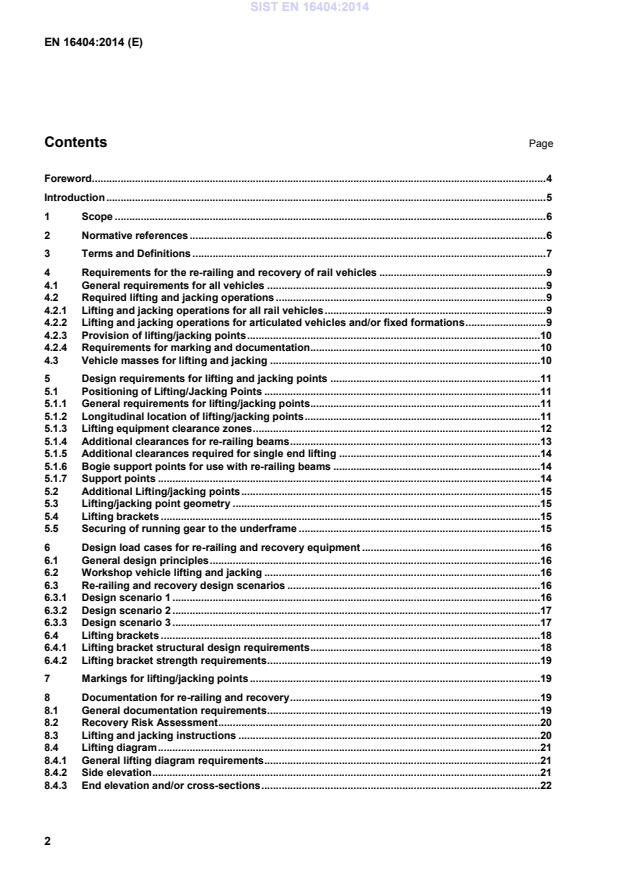
Space envelopes for re-railing equipment . 23 Annex B (normative)
Lifting/jacking bracket (100 kN to 220 kN) . 26 Annex C (normative)
Lifting/jacking bracket (for up to 335 kN). 31 Annex D (normative)
Lifting/jacking bracket (for up to 170 kN). 36 Annex E (informative)
Migration rule for this European Standard. 39 Annex ZA (informative)
Relationship between this European Standard and the Essential Requirements of EU Directive 2008/57/EC . 40
Figure 1 — Conventional vehicles: single end and full vehicle lifting It shall be possible to lift a rail vehicle for re-railing or recovery purposes with the running gear secured to the car body (see 5.5). For re-railing or recovery, it shall be possible to raise or lower a vehicle end or a complete vehicle using only jacking equipment (and lifting brackets if these are required). NOTE For re-railing and recovery operations, lifting/jacking is undertaken by designated personnel who are trained and qualified by knowledge and practical experience to enable the re-railing and recovery operations to be carried out in accordance with the re-railing and recovery instructions for the vehicle (see Clause 8). 4.2.2 Lifting and jacking operations for articulated vehicles and/or fixed formations For articulated vehicles and/or fixed formations it shall be possible to simultaneously lift the end or ends of adjacent vehicles in order to achieve the objectives set out above for lifting vehicles (see Figure 2 and Figure 3). Any restrictions or particular requirements shall be included in the recovery documentation (see Clause 8).
Figure 3 — Articulated vehicles with three point support: single end and full vehicle lifting 4.2.3 Provision of lifting/jacking points Lifting/jacking points for re-railing and recovery shall be provided by — the provision of dedicated lifting/jacking points for re-railing and recovery, and/or — the use of lifting/jacking points which are also intended for maintenance purposes, and/or — removable lifting brackets with compatible attachment points or lifting pockets. In all cases conformity with the requirements of this European Standard shall be demonstrated. Permanent, built-in lifting/jacking points shall be provided on the rail vehicle except where it can be demonstrated that due to, for example, the vehicle bodyside profile and/or gauging restrictions the required access cannot be achieved without compromising other aspects of the vehicle design (see 5.1.3). For heavy vehicles, for example locomotives or fully loaded freight vehicles, the vehicle should be lifted using the running gear supporting the car body instead of lifting the vehicle with the running gear suspended from the car body structure to avoid structural collapse or damage. If permanent built-in lifting/jacking points for re-railing and recovery are not provided for some or all vehicle lifting positions, attachment points or lifting pockets shall be provided to allow removable lifting brackets to be fitted in accordance with the requirements of 5.4 and 6.4. 4.2.4 Requirements for marking and documentation Each lifting/jacking point shall be marked in accordance with the requirements of Clause 7 to clearly identify the intended function or functions of the lifting/jacking point. 4.3 Vehicle masses for lifting and jacking The minimum vehicle mass, denoted MV, shall be the design mass in working order as defined by EN 15663, less the mass of any staff. SIST EN 16404:2014
For freight vehicles, as set out in EN 15663, the maximum vehicle mass is the vehicle mass in working order plus the maximum payload specified for the vehicle. For freight vehicles, staff and/or passenger masses are zero. 5 Design requirements for lifting and jacking points 5.1 Positioning of Lifting/Jacking Points 5.1.1 General requirements for lifting/jacking points All lifting/jacking points placed along the vehicle car body sides or at the ends of the vehicle shall be arranged with a matching lifting/jacking point on the opposite side of the vehicle, i.e. arranged in pairs. There shall be a minimum of four lifting/jacking points on the vehicle car body, arranged as two pairs, with at least one pair located at each vehicle end. It is recommended that in the vicinity of each set of running gear two pairs of lifting/jacking points are provided. Lifting/jacking points provided for a full vehicle lift shall also be suitable for single end lifting. Pairs of lifting/jacking points shall be separated laterally by at least 860 mm. For articulated vehicles at positions where the running gear is shared, recovery lifting/jacking points shall be arranged to allow adjacent vehicle ends to be lifted simultaneously. For freight wagons constructed in accordance with Annex C of the Freight Wagons TSI, there shall be at least one re-railing position at each vehicle end, i.e. a pair of lifting/jacking points that comply with the requirements of 5.1.4. For other freight wagons and other types of vehicle, there shall be at least one pair of lifting/jacking points at each vehicle end where running gear is attached which shall permit the use of re-railing beams (see 5.1.4). At these points the height of the lifting/jacking points shall lie within the range specified in 5.1.4. Elsewhere the heights of additional lifting/jacking points shall be part of the vehicle specification. 5.1.2 Longitudinal location of lifting/jacking points Lifting/jacking points for re-railing and recovery shall be located longitudinally according to Figure 4: — inboard or outboard of the running gear (zones 1 and 4 as shown in Figure 4), or — in a restricted zone, subject to satisfying the requirements of 5.1.3 and 5.1.4, at a position which is greater than or equal to 360 mm longitudinally from the centreline of a designated re-railing beam space envelope (zone 2 as shown in Figure 4). SIST EN 16404:2014
Key 1 outboard zone for lifting/jacking points 2 restricted zone for location of lifting/jacking points (See 5.1.3) 3 zone where lifting/jacking points for re-railing and recovery should not be located (See 5.1.6) 4 inboard zone for lifting/jacking points 5 space envelope for re-railing beam (hatched area) NOTE The dimensions set out in Figure 4 refer to the vertical axis of a jack that is contained in a cylindrical space envelope of 180 mm radius and a space envelope for a re-railing beam of 360 mm width. Figure 4 — Lifting/jacking point positions relative to running gear 5.1.3 Lifting equipment clearance zones Clearance shall be provided underneath and around each lifting/jacking point to allow for the installation of lifting equipment and accessories. SIST EN 16404:2014
...