

EN 13525:2005+A1:2007
(Main + Amendment)Forestry machinery - Wood chippers - Safety
General Information
- Abstract
This document specifies safety requirements and their verification for design and construction of transportable, i.e. self-propelled, mounted, semi-mounted and trailed, wood chippers used in forestry, agriculture, horticulture and landscaping.
This document applies to chippers, used when stationary, which are manually loaded with wood through a horizontal or near horizontal infeed chute and where the infeed action is performed by the chipping components acting as infeed components or by separate integrated infeed components such as rollers or chain conveyors integral to the infeed chute. The included wood chippers may be powered either by an external power take-off, hydraulics etc. or by an integral power source such as an internal combustion engine.
This document does not cover:
- requirements relating to national road regulations arising from transport between work sites;
- hazards arising from any self-propelled function;
- hazards arising from the transmission of power from an external power source - e.g. power take-off drive shafts;
- any machines where the infeed chute is fitted with an extension table or the integrated chain conveyor is protruding beyond the outermost lower edge of the infeed chute;
- hazards arising from the engine pull starting of an integral power source;
- hazards arising from mechanical loading;
- vertical infeed chute chippers;
- electromagnetic aspects of the chippers;
- shredders/chippers to be covered by EN 13683;
- any machines where the infeed chute is fitted with a belt type conveyor;
- mechanical discharge systems.
This document deals with all significant hazards, hazardous situations and events relevant to wood chippers, when they are used as intended and under the conditions foreseen by the manufacturer (see Annex A).
In addition, it specifies the type of information to be provided by the manufacturer on the safe use of these machines.
It is not applicable to environmental hazards (except noise).
This doc
- Status
- Withdrawn
- Publication Date
- 15-May-2007
- Withdrawal Date
- 20-Oct-2009
- Technical Committee
- CEN/TC 144 - Tractors and machinery for agriculture and forestry
- Drafting Committee
- CEN/TC 144/WG 8 - Forestry machinery
- Current Stage
- 9960 - Withdrawal effective - Withdrawal
- Start Date
- 21-Oct-2009
- Completion Date
- 21-Oct-2009
- Directive
- 98/37/EC - Machinery

Relations
- Effective Date
- 19-Jan-2023
- Effective Date
- 18-Jan-2023
- Effective Date
- 22-Dec-2008
Get Certified
Connect with accredited certification bodies for this standard

Control Union Certifications
Global certification for agriculture and sustainability.

ECOCERT
Organic and sustainability certification.

FSC International
Forest Stewardship Council certification.
Sponsored listings
Frequently Asked Questions
EN 13525:2005+A1:2007 is a standard published by the European Committee for Standardization (CEN). Its full title is "Forestry machinery - Wood chippers - Safety". This standard covers: This document specifies safety requirements and their verification for design and construction of transportable, i.e. self-propelled, mounted, semi-mounted and trailed, wood chippers used in forestry, agriculture, horticulture and landscaping. This document applies to chippers, used when stationary, which are manually loaded with wood through a horizontal or near horizontal infeed chute and where the infeed action is performed by the chipping components acting as infeed components or by separate integrated infeed components such as rollers or chain conveyors integral to the infeed chute. The included wood chippers may be powered either by an external power take-off, hydraulics etc. or by an integral power source such as an internal combustion engine. This document does not cover: - requirements relating to national road regulations arising from transport between work sites; - hazards arising from any self-propelled function; - hazards arising from the transmission of power from an external power source - e.g. power take-off drive shafts; - any machines where the infeed chute is fitted with an extension table or the integrated chain conveyor is protruding beyond the outermost lower edge of the infeed chute; - hazards arising from the engine pull starting of an integral power source; - hazards arising from mechanical loading; - vertical infeed chute chippers; - electromagnetic aspects of the chippers; - shredders/chippers to be covered by EN 13683; - any machines where the infeed chute is fitted with a belt type conveyor; - mechanical discharge systems. This document deals with all significant hazards, hazardous situations and events relevant to wood chippers, when they are used as intended and under the conditions foreseen by the manufacturer (see Annex A). In addition, it specifies the type of information to be provided by the manufacturer on the safe use of these machines. It is not applicable to environmental hazards (except noise). This doc
This document specifies safety requirements and their verification for design and construction of transportable, i.e. self-propelled, mounted, semi-mounted and trailed, wood chippers used in forestry, agriculture, horticulture and landscaping. This document applies to chippers, used when stationary, which are manually loaded with wood through a horizontal or near horizontal infeed chute and where the infeed action is performed by the chipping components acting as infeed components or by separate integrated infeed components such as rollers or chain conveyors integral to the infeed chute. The included wood chippers may be powered either by an external power take-off, hydraulics etc. or by an integral power source such as an internal combustion engine. This document does not cover: - requirements relating to national road regulations arising from transport between work sites; - hazards arising from any self-propelled function; - hazards arising from the transmission of power from an external power source - e.g. power take-off drive shafts; - any machines where the infeed chute is fitted with an extension table or the integrated chain conveyor is protruding beyond the outermost lower edge of the infeed chute; - hazards arising from the engine pull starting of an integral power source; - hazards arising from mechanical loading; - vertical infeed chute chippers; - electromagnetic aspects of the chippers; - shredders/chippers to be covered by EN 13683; - any machines where the infeed chute is fitted with a belt type conveyor; - mechanical discharge systems. This document deals with all significant hazards, hazardous situations and events relevant to wood chippers, when they are used as intended and under the conditions foreseen by the manufacturer (see Annex A). In addition, it specifies the type of information to be provided by the manufacturer on the safe use of these machines. It is not applicable to environmental hazards (except noise). This doc
EN 13525:2005+A1:2007 is classified under the following ICS (International Classification for Standards) categories: 65.060.80 - Forestry equipment. The ICS classification helps identify the subject area and facilitates finding related standards.
EN 13525:2005+A1:2007 has the following relationships with other standards: It is inter standard links to EN 13525:2005+A2:2009, EN 13525:2005, EN 13525:2005/prA1. Understanding these relationships helps ensure you are using the most current and applicable version of the standard.
EN 13525:2005+A1:2007 is associated with the following European legislation: EU Directives/Regulations: 98/37/EC; Standardization Mandates: M/079. When a standard is cited in the Official Journal of the European Union, products manufactured in conformity with it benefit from a presumption of conformity with the essential requirements of the corresponding EU directive or regulation.
EN 13525:2005+A1:2007 is available in PDF format for immediate download after purchase. The document can be added to your cart and obtained through the secure checkout process. Digital delivery ensures instant access to the complete standard document.
Standards Content (Sample)
2003-01.Slovenski inštitut za standardizacijo. Razmnoževanje celote ali delov tega standarda ni dovoljeno.Forestry machinery - Wood chippers - SafetyGozdarski stroji - Sekalniki - VarnostMachines forestieres - Déchiqueteuses - SécuritéForstmaschinen - Buschholzhacker - SicherheitTa slovenski standard je istoveten z:EN 13525:2005+A1:2007SIST EN 13525:2005+A1:2007en,fr,de65.060.80Gozdarska opremaForestry equipmentICS:SLOVENSKI
STANDARDSIST EN 13525:2005+A1:200701-september-2007
EUROPEAN STANDARD NORME EUROPÉENNE EUROPÄISCHE NORM
EN 13525:2005+A1
May 2007 ICS 65.060.80 Supersedes EN 13525:2005English Version
Forestry machinery - Wood chippers - Safety
Machines forestières - Déchiqueteuses - Sécurité
Forstmaschinen - Buschholzhacker - Sicherheit This European Standard was approved by CEN on 8 December 2004 and includes Amendment 1 approved by CEN on 13 April 2007.
CEN members are bound to comply with the CEN/CENELEC Internal Regulations which stipulate the conditions for giving this European Standard the status of a national standard without any alteration. Up-to-date lists and bibliographical references concerning such national standards may be obtained on application to the CEN Management Centre or to any CEN member.
This European Standard exists in three official versions (English, French, German). A version in any other language made by translation under the responsibility of a CEN member into its own language and notified to the CEN Management Centre has the same status as the official versions.
CEN members are the national standards bodies of Austria, Belgium, Bulgaria, Cyprus, Czech Republic, Denmark, Estonia, Finland, France, Germany, Greece, Hungary, Iceland, Ireland, Italy, Latvia, Lithuania, Luxembourg, Malta, Netherlands, Norway, Poland, Portugal, Romania, Slovakia, Slovenia, Spain, Sweden, Switzerland and United Kingdom.
EUROPEAN COMMITTEE FOR STANDARDIZATION
COMITÉ EUROPÉEN DE NORMALISATION EUROPÄISCHES KOMITEE FÜR NORMUNG
Management Centre: rue de Stassart, 36
B-1050 Brussels © 2007 CEN All rights of exploitation in any form and by any means reserved worldwide for CEN national Members. Ref. No. EN 13525:2005+A1:2007: E
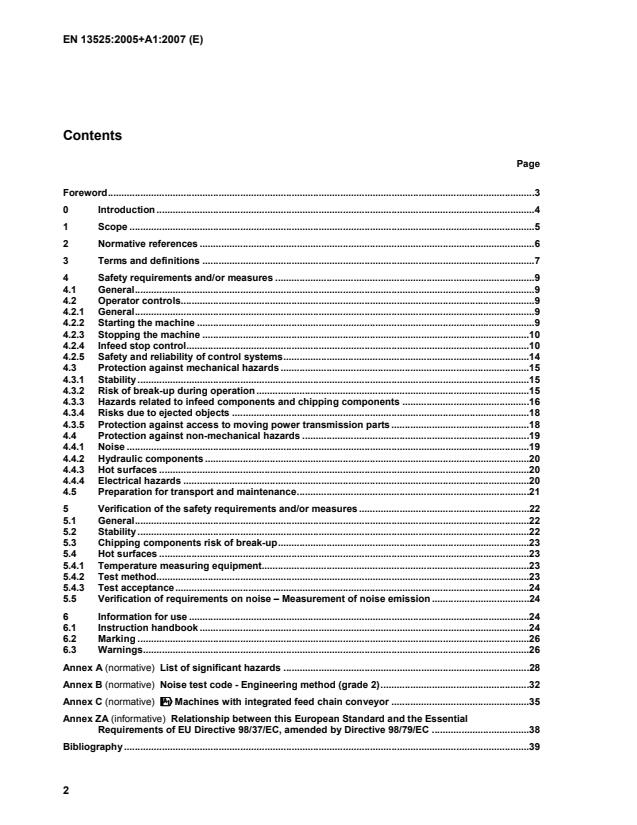
List of significant hazards.28 Annex B (normative)
Noise test code - Engineering method (grade 2).32 Annex C (normative)
!!!!Machines with integrated feed chain conveyor.35 Annex ZA (informative)
Relationship between this European Standard and the Essential Requirements of EU Directive 98/37/EC, amended by Directive 98/79/EC.38 Bibliography.39
Foreword This document (EN 13525:2005+A1:2007) has been prepared by Technical Committee CEN/TC 144 “Tractors and machinery for agriculture and forestry”, the secretariat of which is held by AFNOR. This European Standard shall be given the status of a national standard, either by publication of an identical text or by endorsement, at the latest by November 2007 and conflicting national standards shall be withdrawn at the latest by November 2007. This document includes Amendment 1, approved by CEN on 2007-04-13. This document supersedes EN 13525:2005. The start and finish of text introduced or altered by amendment is indicated in the text by tags ! ". This document has been prepared under a mandate given to CEN by the European Commission and the European Free Trade Association, and supports essential requirements of EU Directive(s). For relationship with EU Directive(s), see informative Annex ZA, which is an integral part of this document. According to the CEN/CENELEC Internal Regulations, the national standards organizations of the following countries are bound to implement this European Standard: Austria, Belgium, Bulgaria, Cyprus, Czech Republic, Denmark, Estonia, Finland, France, Germany, Greece, Hungary, Iceland, Ireland, Italy, Latvia, Lithuania, Luxembourg, Malta, Netherlands, Norway, Poland, Portugal, Romania, Slovakia, Slovenia, Spain, Sweden, Switzerland and United Kingdom.
Key a Reference plane b Operator
NOTE This example is a functional representation of a wood chipper and does not illustrate the safety measures required by this document. Figure 1 – Example of wood chipper and reference plane 4 Safety requirements and/or measures 4.1 General Machines shall comply with the safety requirements and/or protective measures of this clause. In addition, the machine shall be designed according to the principles of EN ISO 12100 for hazards relevant but not significant, which are not dealt with by this document (e.g. sharp edges).
Unless otherwise specified in this document all opening and safety distances shall comply with Tables 1, 3, 4 and 6 of EN 294:1992 and other aspects shall comply with the relevant parts of EN ISO 12100. 4.2 Operator controls 4.2.1 General All machines shall have separate controls for starting/stopping the chipping components and for starting/stopping the infeed action meeting the requirements given below in 4.2.2, 4.2.3, 4.2.4. The safety and reliability of control system shall meet the requirements given in 4.2.5. Controls for stopping the chipping components shall also stop the infeed action. 4.2.2 Starting the machine 4.2.2.1 Where the machine is powered by an external power source, e.g. a tractor power take-off or a hydraulic system, the tractor power-take-off start control or hydraulic system control is regarded as the operator's control for starting the chipping components, infeed components and integral conveyors (where fitted).
Key h Height of the chute side Figure 2 – Location and coverage of the infeed stop control on type A machines 4.2.4.2.3 For type B machines, the infeed stop control shall be located at the sides and at the upper edge of the chute, see Figure 3. Dimensions in millimetres
Key h Height of the chute side Figure 3 – Location and coverage of the infeed stop control on type B machines 4.2.4.2.4 In either location, the position of the infeed stop control in relation to the outermost edge of the infeed chute shall be in accordance with the appropriate Figure 4 or Figure 5 such that: all positions of the infeed stop control that allow or cause infeed action are in front of the outermost edge of the infeed chute, i.e. zone B; from those positions, the infeed stop control shall be able to be moved to a position known as the ‘emergency stop position’, i.e. position C; and this emergency stop position is in the position closest to the outermost edge of infeed chute but sufficiently in front of that edge for the emergency stop position to be successfully engaged, i.e. the respective operation completed, by the operator in the manner described in 4.2.4.1 in the event of entanglement. 4.2.4.2.5 The positions/functions of the infeed stop control shall be clearly indicated on both sides of the infeed chute and also in the instruction handbook. The colour of the infeed stop control shall be preferably red or yellow. Where other colours are used, they shall be bright and in contrast to the background colour of the infeed chute.
Key
AA Behind the outermost edge of the infeed chute BB In front of the outermost edge of the infeed chute A Infeed chute B Zone for all positions of infeed stop control that allow or cause infeed or reverse action C Emergency stop position D Outermost lower edge of the infeed chute E Optional additional position for the infeed stop control where the only permitted function is reverse of a hold-to-run type F Direction of infeed G Operator’s position Figure 4 — Schematic representation of the relationship between the positions of the infeed stop control, the outermost lower edge of the infeed chute and the position of the operator when feeding type A machines
Key AA
Behind the outermost edge of the infeed chute BB
In front of the outermost edge of the infeed chute A
Infeed chute B
Zone for all positions of infeed stop control that allow or cause infeed or reverse action C
Emergency stop position D
Outermost upper edge of the infeed chute E
Optional additional position for the infeed stop control where the only permitted function is reverse of a hold-to-run type F
Direction of infeed G
Operator’s position H
Position of the infeed stop control where the only permitted functions are stop or reverse Figure 5 — Schematic representation of the relationship between the positions of the infeed stop control, the outermost upper edge of the infeed chute and the position of the operator when feeding type B machines 4.2.4.3 Functional requirements 4.2.4.3.1 All machines shall comply with 4.2.4.3.2 to 4.2.4.3.6 inclusive. Type B machines shall also meet the requirements of 4.2.4.3.7. Where the infeed stop control incorporates other functions for controlling the infeed components, they shall meet the appropriate requirements of 4.2.4.3.8 to 4.2.4.3.10. 4.2.4.3.2 Actuation of any part of the infeed stop control shall have the same functional result. 4.2.4.3.3 Movement of the infeed stop control from zone B to position C, as defined in 4.2.4.2.4, shall stop infeed action. Actuation to the emergency stop position shall have priority over any other controls used to operate the infeed components as defined in 4.2.4.3.6. 4.2.4.3.4 The force required to actuate the infeed stop control from zone B to position C (see Figures 4 and 5) shall not exceed 150 N on the horizontal part of the infeed stop control (including those provided on machines with an integrated feed conveyor) and 200 N on other parts along the length 0,75 x h as specified in 4.2.4.2.1. The force required shall be measured in a horizontal direction ±15°, or in the case of a pivoting infeed stop control, in the tangential direction of its movement.
infeed direction
operator optional reverse (hold-to-run), [chute edge], emergency stop function, infeed; optional reverse (hold-to-run), [chute edge], emergency stop function, reverse, infeed; optional reverse (hold-to-run), [chute edge], emergency stop function, infeed, reverse; optional reverse (hold-to-run), [chute edge], emergency stop function, reverse, stop, infeed. 4.2.4.3.11 For type B machines, where the infeed stop control provides other functions to control the infeed components (including the requirements of 4.2.4.3.7) examples of permitted control patterns include: reference plane
infeed direction
operator optional reverse (hold-to-run), [chute edge], emergency stop function, infeed, stop; optional reverse (hold-to-run), [chute edge], emergency stop function, infeed, reverse; optional reverse (hold-to-run), [chute edge], emergency stop function, infeed, reverse, stop; optional reverse (hold-to-run), [chute edge], emergency stop function, reverse, infeed, stop; optional reverse (hold-to-run), [chute edge], emergency stop function, infeed, stop. 4.2.5 Safety and reliability of control systems 4.2.5.1 The safety related control systems shall comply with category 1 of EN 954-1:1996, 6.2.
tool tip circle d
Minimum steel thickness (S235JR)
d ≤ 600 4 600 < d ≤ 800 6 800 < d ≤ 1 000 8 d > 1 000 10 In case the rotational speed exceeds 1 000 min-1 or other materials or designs such as screw-type chippers are used, the casing shall provide equivalent protection. 4.3.3 Hazards related to infeed components and chipping components 4.3.3.1 !Infeed chutes" 4.3.3.1.1 For type A machines where the working position of the outermost lower edge of the infeed chute is equal to or more than 1 000 mm from the ground, the minimum horizontal distance from the chute outer edge to the reference plane shall be according to EN 294:1992, Table 2, see Figure 6. Dimensions in millimetres
Key a Reference plane Figure 6 – Infeed chute length, high chute location Machines with an infeed chute not more than 700 mm wide shall meet the dimensions given in Figure 7 whereby: the distance from the outermost lower edge of infeed chute to the reference plane shall be at least
1 200 mm; the distance from the outermost upper edge of the infeed chute to where the floor of the chute meets the infeed components shall be at least 1 000 mm; the distance between the outermost lower and upper edges measured in parallel with the reference plane shall be not more than 400 mm.
Key a Reference plane Figure 7 – Infeed chute length, high chute location, alternative design 4.3.3.1.2 For type A machines where the working position of the lower edge of the infeed chute is between 600 mm to 1 000 mm from the ground, the minimum horizontal distance shall be 1 500 mm from the reference plane to any part of the chute outer edges below 1 000 mm. Where the chute outer edges extend above
1 000 mm, EN 294:1992, Table 2 applies. See Figure 8. Dimensions in millimetres
Key a Reference plane Figure 8 – Infeed chute length, low chute location 4.3.3.1.3 In machines where the working position of the lower edge of the infeed chute is less than 600 mm from the ground, type B machines, the minimum horizontal distance from the chute outer edge to the reference plane shall be 1 200 mm at the whole chute edge, !see Figure 9". In addition the following requirements apply: the height from the centre line of the infeed control to the lower edge of the chute shall be not greater than 1 000 mm; and the bottom of the chute shall be sloping away from the infeed components towards the chute outer edge.
Key a Reference plane Figure 9 – Infeed chute length and control to chute lower edge height, type B machines 4.3.3.2 !Infeed chain conveyors See Annex C." 4.3.3.3 !Chipping components" For guarding the chipping components from directions other than the infeed chute the following applies. The access to chipping components shall be prevented by use of either: a fixed guard where the time required to remove it is longer than the run-down time of the chipping components; or an interlocking guard with guard locking, in accordance with EN 953. In case of a fixed guard, visual means, e.g. a dual-colour axle end under a transparent cover, shall be provided to indicate whether the chipping components are moving or not. 4.3.4 Risks due to ejected objects 4.3.4.1 The chipper shall not eject wood or chips from the infeed chute, which by virtue of their shape, size, velocity or direction, pose a risk to an operator or bystander. NOTE Means of achieving this requirement will be considered at the next revision of this document. 4.3.4.2 Where a machine provides for reversing of the infeed components, the speed of wood, when reversed, shall not exceed 1,0 m/s if the control for engaging reverse function is positioned where the operator may be at risk of being struck by wood as it is reversed. 4.3.4.3 The discharge chute shall be designed to minimise the risk of ejected objects to workers. Means shall be provided to prevent discharge towards the infeed area of the chipper, e.g. by limiting the discharge chute movement. 4.3.5 Protection against access to moving power transmission parts 4.3.5.1 All moving parts of the power transmission system shall be designed, constructed, positioned or otherwise provided with guards or protective devices to prevent all risk of contact. 4.3.5.2 To ensure protection against hazards related to accessible moving power transmission parts, the machines shall be fitted with guards according to EN 953.
EN ISO 11688-2 gives useful information on noise generation mechanisms in machinery. The main sources causing noise in wood chippers include e.g.: infeed mechanism; chipping components; chip discharge; power source.
...