


prEN 12878
(Main)Pigments for the colouring of building materials based on cement and/or lime - Specifications and methods of test
Pigments for the colouring of building materials based on cement and/or lime - Specifications and methods of test
This document specifies the characteristics and the methods of test for pigments for use in the colouring of building materials based on cement and cement/lime combinations.
Pigments covered by this document may also be used in pure lime mortar. For this application, see EN 459-1 and EN 459-2.
Pigments for this purpose may be single pigments, blends of pigments, or blends of pigments and extenders, in powder or granular form, or aqueous preparations.
Pigments typically belong to one of the following classes of compounds:
- synthetic or natural oxides and hydroxides of iron;
- oxides of chromium, titanium and manganese;
- complex inorganic pigments, for example combinations of the above mentioned metal oxides and hydroxides with cobalt, aluminium, nickel and antimony oxides and hydroxides;
- ultramarine pigments;
- phthalocyanine blue and green;
- elemental carbon (shall be regarded as an inorganic pigment);
- blends of the above materials (which may also include extenders).
Pigmente zum Einfärben von zement- und/oder kalkgebundenen Baustoffen - Anforderungen und Prüfverfahren
Dieses Dokument legt die Merkmale und Prüfverfahren für Pigmente fest, die zum Einfärben von Baustoffen aus Zement und Zement-/Kalkmischungen verwendet werden.
Pigmente nach diesem Dokument dürfen auch in reinem Kalkmörtel verwendet werden. Für diese Anwendung siehe EN 459-1 und EN 459-2.
Pigmente für diese Anwendung dürfen Einzelpigmente, Pigment-Mischungen oder Pigment/Füllstoff-Mischungen in pulveriger oder granulierter Form oder wässrige Präparationen sein.
Pigmente gehören üblicherweise zu einer der folgenden Klassen von Stoffen:
- synthetische oder natürliche Oxide und Hydroxide des Eisens;
- Oxide von Chrom, Titan und Mangan;
- komplexe anorganische Pigmente, z. B. Kombinationen aus den o. g. Metalloxiden und -hydroxiden mit Cobalt-, Aluminium-, Nickel- und Antimonoxiden und -hydroxiden;
- Ultramarin-Pigmente;
- Phthalocyaninblau und -grün;
- elementarer Kohlenstoff (ist als anorganisches Pigment zu betrachten);
- Mischungen der o. g. Materialien (die auch Füllstoffe enthalten dürfen).
Pigments de coloration des matériaux de construction à base de ciment et/ou de chaux - Spécifications et méthodes d'essai
La présente Norme européenne spécifie les caractéristiques et les méthodes d'essai qui s'appliquent aux pigments de coloration des matériaux de construction à base de ciment et de combinaisons ciment/chaux.
Les pigments couverts par la présente Norme européenne peuvent également être utilisés dans du mortier de chaux pure. Pour cette application, se reporter à l'EN 459-1 et à l'EN 459-2.
Les pigments destinés à cet usage peuvent être des pigments simples, des mélanges de pigments ou des mélanges de pigments et de matières de charge, sous forme de poudre, de granules ou de préparations aqueuses.
Les pigments appartiennent généralement à l'une des classes de composés suivantes :
- oxydes et hydroxydes de fer, synthétiques ou naturels ;
- oxydes de chrome, de titane et de manganèse ;
- pigments minéraux complexes, par exemple combinaisons des oxydes et hydroxydes métalliques mentionnés ci-dessus avec des oxydes et hydroxydes de cobalt, d’aluminium, de nickel et d’antimoine ;
- pigments d'outremer ;
- bleu et vert phtalocyanine ;
- carbone élémentaire (doit être considéré comme un pigment minéral) ;
- mélanges des matières ci-dessus (qui peuvent aussi comprendre des matières de charge).
Pigmenti za obarvanje gradbenih materialov na osnovi cementa in/ali apna - Specifikacije in metode preskušanja
General Information
- Status
- Not Published
- Publication Date
- 08-Dec-2019
- Withdrawal Date
- 08-Jun-2020
- Technical Committee
- CEN/TC 298 - Pigments and extenders
- Drafting Committee
- CEN/TC 298 - Pigments and extenders
- Current Stage
- 4098 - Decision to abandon - Enquiry
- Start Date
- 17-Jan-2020
- Completion Date
- 28-Jan-2026
Relations
- Effective Date
- 18-Jan-2023
Overview
prEN 12878 - "Pigments for the colouring of building materials based on cement and/or lime - Specifications and methods of test" (CEN draft, May 2018) defines the characteristics and test methods for pigments used to colour cement‑based and cement/lime building materials. The standard covers single pigments, pigment blends and pigment+extender mixes in powder, granular or aqueous form, and addresses composition, performance and safety aspects relevant to colouring concrete, mortar and lime mortars (see also EN 459‑1/2 for pure lime applications).
Key topics and requirements
prEN 12878 specifies technical requirements and laboratory methods relevant to pigment selection and quality control, including:
- Effect on concrete/mortar properties: tests for setting time and compressive strength to confirm pigments do not adversely affect cementitious performance.
- Composition and purity: identification of pigment classes (iron oxides/hydroxides, chromium/titanium/manganese oxides, complex inorganic pigments, ultramarine, phthalocyanines, elemental carbon, blends) and testing for water‑soluble substances.
- Chloride content: soluble and total chloride determination to avoid reinforcement corrosion risks.
- Physical and chemical properties: loss on ignition, residue on sieve, pH value, alkali stability, thermal stability and resistance to weathering.
- Colour performance: relative colour strength measurement and comparison against standard pigments using specified mortar formulations and instrumental/visual procedures.
- Safety and compliance: emission of radioactivity, release of dangerous substances and requirements for assessment and verification of constancy of performance (AVCP), including type testing and factory production control (FPC).
Applications and users
This standard is practical for:
- Pigment manufacturers - product specification, formulation and declaration of properties for cementitious use.
- Concrete and mortar producers - acceptance testing and quality control of coloured concretes, renders and mortars.
- Specifiers and architects - reliable selection of pigments that meet durability, colour and safety criteria.
- Testing laboratories and certification bodies - standardized test methods and AVCP procedures for compliance verification.
- Suppliers of coloured building materials - ensuring consistency of shade, stability and compatibility with cement/lime binders.
Keywords: pigments for cement, colouring building materials, prEN 12878, pigment test methods, alkali stability, chloride content, colour strength, cement pigments.
Related standards
Relevant normative references included or cross‑referenced:
- EN 459‑1 / EN 459‑2 (lime mortars)
- EN 196‑1, EN 196‑3 (cement test methods)
- EN 197‑1 (common cements)
- EN 934‑1 (admixtures)
- EN ISO 591‑1, EN ISO 787 (general pigment test methods)

Get Certified
Connect with accredited certification bodies for this standard

ICC Evaluation Service
Building products evaluation and certification.

QAI Laboratories
Building and construction product testing and certification.

Aboma Certification B.V.
Specialized in construction, metal, and transport sectors.
Sponsored listings
Frequently Asked Questions
prEN 12878 is a draft published by the European Committee for Standardization (CEN). Its full title is "Pigments for the colouring of building materials based on cement and/or lime - Specifications and methods of test". This standard covers: This document specifies the characteristics and the methods of test for pigments for use in the colouring of building materials based on cement and cement/lime combinations. Pigments covered by this document may also be used in pure lime mortar. For this application, see EN 459-1 and EN 459-2. Pigments for this purpose may be single pigments, blends of pigments, or blends of pigments and extenders, in powder or granular form, or aqueous preparations. Pigments typically belong to one of the following classes of compounds: - synthetic or natural oxides and hydroxides of iron; - oxides of chromium, titanium and manganese; - complex inorganic pigments, for example combinations of the above mentioned metal oxides and hydroxides with cobalt, aluminium, nickel and antimony oxides and hydroxides; - ultramarine pigments; - phthalocyanine blue and green; - elemental carbon (shall be regarded as an inorganic pigment); - blends of the above materials (which may also include extenders).
This document specifies the characteristics and the methods of test for pigments for use in the colouring of building materials based on cement and cement/lime combinations. Pigments covered by this document may also be used in pure lime mortar. For this application, see EN 459-1 and EN 459-2. Pigments for this purpose may be single pigments, blends of pigments, or blends of pigments and extenders, in powder or granular form, or aqueous preparations. Pigments typically belong to one of the following classes of compounds: - synthetic or natural oxides and hydroxides of iron; - oxides of chromium, titanium and manganese; - complex inorganic pigments, for example combinations of the above mentioned metal oxides and hydroxides with cobalt, aluminium, nickel and antimony oxides and hydroxides; - ultramarine pigments; - phthalocyanine blue and green; - elemental carbon (shall be regarded as an inorganic pigment); - blends of the above materials (which may also include extenders).
prEN 12878 is classified under the following ICS (International Classification for Standards) categories: 87.060.10 - Pigments and extenders; 91.100.10 - Cement. Gypsum. Lime. Mortar. The ICS classification helps identify the subject area and facilitates finding related standards.
prEN 12878 has the following relationships with other standards: It is inter standard links to EN 12878:2014. Understanding these relationships helps ensure you are using the most current and applicable version of the standard.
prEN 12878 is associated with the following European legislation: EU Directives/Regulations: 305/2011; Standardization Mandates: M/128. When a standard is cited in the Official Journal of the European Union, products manufactured in conformity with it benefit from a presumption of conformity with the essential requirements of the corresponding EU directive or regulation.
prEN 12878 is available in PDF format for immediate download after purchase. The document can be added to your cart and obtained through the secure checkout process. Digital delivery ensures instant access to the complete standard document.
Standards Content (Sample)
SLOVENSKI STANDARD
01-junij-2018
Pigmenti za obarvanje gradbenih materialov na osnovi cementa in/ali apna -
Specifikacije in metode preskušanja
Pigments for the colouring of building materials based on cement and/or lime -
Specifications and methods of test
Pigmente zum Einfärben von zement- und/oder kalkgebundenen Baustoffen -
Anforderungen und Prüfverfahren
Pigments de coloration des matériaux de construction à base de ciment et/ou de chaux -
Spécifications et méthodes d'essai
Ta slovenski standard je istoveten z: prEN 12878
ICS:
87.060.10 Pigmenti in polnila Pigments and extenders
91.100.10 Cement. Mavec. Apno. Malta Cement. Gypsum. Lime.
Mortar
2003-01.Slovenski inštitut za standardizacijo. Razmnoževanje celote ali delov tega standarda ni dovoljeno.
DRAFT
EUROPEAN STANDARD
NORME EUROPÉENNE
EUROPÄISCHE NORM
May 2018
ICS 91.100.10; 87.060.10 Will supersede EN 12878:2014
English Version
Pigments for the colouring of building materials based on
cement and/or lime - Specifications and methods of test
Pigments de coloration des matériaux de construction Pigmente zum Einfärben von zement- und/oder
à base de ciment et/ou de chaux - Spécifications et kalkgebundenen Baustoffen - Anforderungen und
méthodes d'essai Prüfverfahren
This draft European Standard is submitted to CEN members for enquiry. It has been drawn up by the Technical Committee
CEN/TC 298.
If this draft becomes a European Standard, CEN members are bound to comply with the CEN/CENELEC Internal Regulations
which stipulate the conditions for giving this European Standard the status of a national standard without any alteration.
This draft European Standard was established by CEN in three official versions (English, French, German). A version in any other
language made by translation under the responsibility of a CEN member into its own language and notified to the CEN-CENELEC
Management Centre has the same status as the official versions.
CEN members are the national standards bodies of Austria, Belgium, Bulgaria, Croatia, Cyprus, Czech Republic, Denmark, Estonia,
Finland, Former Yugoslav Republic of Macedonia, France, Germany, Greece, Hungary, Iceland, Ireland, Italy, Latvia, Lithuania,
Luxembourg, Malta, Netherlands, Norway, Poland, Portugal, Romania, Serbia, Slovakia, Slovenia, Spain, Sweden, Switzerland,
Turkey and United Kingdom.
Recipients of this draft are invited to submit, with their comments, notification of any relevant patent rights of which they are
aware and to provide supporting documentation.
Warning : This document is not a European Standard. It is distributed for review and comments. It is subject to change without
notice and shall not be referred to as a European Standard.
EUROPEAN COMMITTEE FOR STANDARDIZATION
COMITÉ EUROPÉEN DE NORMALISATION
EUROPÄISCHES KOMITEE FÜR NORMUNG
CEN-CENELEC Management Centre: Rue de la Science 23, B-1040 Brussels
© 2018 CEN All rights of exploitation in any form and by any means reserved Ref. No. prEN 12878:2018 E
worldwide for CEN national Members.
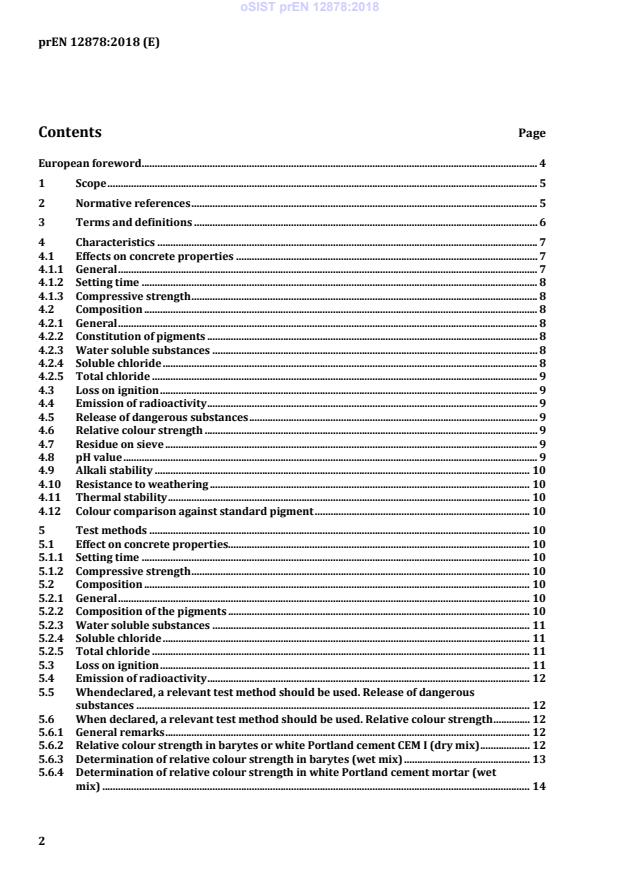
Contents Page
European foreword . 4
1 Scope . 5
2 Normative references . 5
3 Terms and definitions . 6
4 Characteristics . 7
4.1 Effects on concrete properties . 7
4.1.1 General . 7
4.1.2 Setting time . 8
4.1.3 Compressive strength . 8
4.2 Composition . 8
4.2.1 General . 8
4.2.2 Constitution of pigments . 8
4.2.3 Water soluble substances . 8
4.2.4 Soluble chloride . 8
4.2.5 Total chloride . 9
4.3 Loss on ignition . 9
4.4 Emission of radioactivity . 9
4.5 Release of dangerous substances . 9
4.6 Relative colour strength . 9
4.7 Residue on sieve . 9
4.8 pH value . 9
4.9 Alkali stability . 10
4.10 Resistance to weathering . 10
4.11 Thermal stability . 10
4.12 Colour comparison against standard pigment . 10
5 Test methods . 10
5.1 Effect on concrete properties. 10
5.1.1 Setting time . 10
5.1.2 Compressive strength . 10
5.2 Composition . 10
5.2.1 General . 10
5.2.2 Composition of the pigments . 10
5.2.3 Water soluble substances . 11
5.2.4 Soluble chloride . 11
5.2.5 Total chloride . 11
5.3 Loss on ignition . 11
5.4 Emission of radioactivity . 12
5.5 Whendeclared, a relevant test method should be used. Release of dangerous
substances . 12
5.6 When declared, a relevant test method should be used. Relative colour strength . 12
5.6.1 General remarks . 12
5.6.2 Relative colour strength in barytes or white Portland cement CEM I (dry mix) . 12
5.6.3 Determination of relative colour strength in barytes (wet mix) . 13
5.6.4 Determination of relative colour strength in white Portland cement mortar (wet
mix) . 14
5.7 Residue on sieve . 15
5.8 pH-value . 15
5.9 Alkali stability . 15
5.9.1 General remarks . 15
5.9.2 Preparation of test pieces . 15
5.9.3 Test procedure . 15
5.10 Resistance to weathering . 16
5.11 Thermal stability . 16
5.12 Colour comparison against the standard pigment . 16
5.12.1 General . 16
5.12.2 Equipment and test materials . 17
5.12.3 Mortar formulation . 17
5.12.4 Test procedure . 17
5.12.5 Evaluation of test . 18
6 Assessment and verification of constancy of performance – AVCP . 18
6.1 General . 18
6.2 Type testing . 18
6.2.1 General . 18
6.2.2 Test samples, testing and compliance criteria . 19
6.2.3 Test reports . 21
6.2.4 Shared other party results . 21
6.2.5 Cascading determination of the product type results . 21
6.3 Factory production control (FPC) . 22
6.3.1 General . 22
6.3.2 Requirements . 23
6.3.3 Product specific requirements . 25
6.3.4 Initial inspection of factory and of FPC . 26
6.3.5 Continuous surveillance of FPC . 26
6.3.6 Procedure for modifications . 26
Annex A (informative) Further information regarding test methods . 27
A.1 Reference to 5.6.2 “Relative colour strength in barites white Portland cement CEM
(dry mix)” and 5.6.3 “Determination of relative colour strength in barytes (wet mix)” . 27
A.2 Reference to 5.9 “Alkali stability” . 27
A.3 Reference to 5.10 “Resistance to weathering” . 27
Annex ZA (informative) Relationship of this European Standard with Regulation (EU)
No.305/2011 . 28
ZA.1 Scope and relevant characteristics . 28
ZA.2 System of Assessment and Verification of Constancy of Performance (AVCP) . 29
ZA.3 Assignment of AVCP tasks . 29
Bibliography . 31
European foreword
This document (prEN 12878:2018) has been prepared by Technical Committee CEN/TC 298 “Pigments
and extenders”, the secretariat of which is held by DIN.
This document is currently submitted to the CEN Enquiry.
This document will supersede EN 12878:2014.
This document has been prepared under a standardization request given to CEN by the European
Commission and the European Free Trade Association.
For relationship with EU Directive, see informative Annex ZA, which is an integral part of this
document.
The main changes with respect to the previous edition are listed below:
a) revision according to TFN548rev1, TFN 577 and TFN687rev1;
b) correction of the “chlorine” to “chloride”;
c) general editorial revision.
1 Scope
This document specifies the characteristics and the methods of test for pigments for use in the
colouring of building materials based on cement and cement/lime combinations.
Pigments covered by this document may also be used in pure lime mortar. For this application, see
EN 459-1 and EN 459-2.
Pigments for this purpose may be single pigments, blends of pigments, or blends of pigments and
extenders, in powder or granular form, or aqueous preparations.
Pigments typically belong to one of the following classes of compounds:
— synthetic or natural oxides and hydroxides of iron;
— oxides of chromium, titanium and manganese;
— complex inorganic pigments, for example combinations of the above mentioned metal oxides and
hydroxides with cobalt, aluminium, nickel and antimony oxides and hydroxides;
— ultramarine pigments;
— phthalocyanine blue and green;
— elemental carbon (shall be regarded as an inorganic pigment);
— blends of the above materials (which may also include extenders).
2 Normative references
The following documents, in whole or in part, are normatively referenced in this document and are
indispensable for its application. For dated references, only the edition cited applies. For undated
references, the latest edition of the referenced document (including any amendments) applies.
EN 196-1:2016, Methods of testing cement — Part 1: Determination of strength
EN 196-3, Methods of testing cement — Part 3: Determination of setting times and soundness
EN 197-1, Cement — Part 1: Composition, specifications and conformity criteria for common cements
EN 934-1:2008, Admixtures for concrete, mortar and grout — Part 1: Common requirements
EN ISO 591-1, Titanium dioxide pigments for paints — Part 1: Specifications and methods of test (ISO 591-
1)
EN ISO 787-3, General methods of test for pigments and extenders — Part 3: Determination of matter
soluble in water — Hot extraction method (ISO 787-3)
EN ISO 787-7, General methods of test for pigments and extenders — Part 7: Determination of residue on
sieve — Water method — Manual procedure (ISO 787-7)
EN ISO 787-9, General methods of test for pigments and extenders — Part 9: Determination of pH value of
aqueous suspension (ISO 787-9)
EN ISO 787-13, General methods of test for pigments and extenders — Part 13: Determination of water-
soluble sulfates, chlorides and nitrates (ISO 787-13)
EN ISO 1248, Iron oxide pigments — Specifications and methods of test (ISO 1248:2006 including
Technical Corrigendum 1:2007)
EN ISO 15528, Paints, varnishes and raw materials for paints and varnishes — Sampling (ISO 15528)
EN ISO 18451-1, Pigments, dyestuffs and extenders — Terminology — Part 1: General terms (ISO 18451-
1)
EN ISO 18451-2, Pigments, dyestuffs and extenders — Terminology — Part 2: Classification of colouring
materials according to colouristic and chemical aspects (ISO 18451-2)
ISO 788, Ultramarine pigments for paints
ISO 3310-1, Test sieves — Technical requirements and testing — Part 1: Test sieves of metal wire cloth
ISO 4621, Chrome oxide green pigments — Specifications and methods of test
ISO 9277, Determination of the specific surface area of solids by gas adsorption — BET method
3 Terms and definitions
For the purposes of this document, the terms and definitions given in EN ISO 18451-1, EN ISO 18451-2
and the following apply.
3.1
pigment
colourant consisting of particles, insoluble in the application medium (e.g. coating material or plastic)
Note 1 to entry: Pigments can be further described on the basis of their chemical composition, their optical or
technical properties, e.g. inorganic pigment, organic pigment, coloured pigment, white pigment, effect pigment,
corrosion-inhibiting pigment, magnetic pigment.
Note 2 to entry: Pigments for ceramics, glass and vitreous enamels are called stains.
Note 3 to entry: Whether a given substance is to be considered as pigment or extender depends on its
application.
[SOURCE: EN ISO 18451-1:2017, definition 2.95]
3.2
single pigment
pigment that is of singular (chemical) composition
Note 1 to entry: Single pigments contain no substances other than those originating from the pigment
manufacturing process.
Note 2 to entry: Surface treatment of the primary pigment particles is considered as a part of the pigment
manufacturing process.
3.3
pigment blend
blend of at least two single pigments, or at least one single pigment and an extender
3.4
aqueous pigment preparation
preparation in which a pigment (single pigment or pigment blend) is dispersed in water, with or
without a dispersion or other agent
EXAMPLES of agents are:
— dispersants;
— binding agents (resins);
— solvents;
— wetting agents;
— or combinations thereof.
3.5
pigment in granular form
preparation in which a pigment (single pigment or pigment blend) is converted into granules, by the
use of the binding agent which retains the integrity of the granule
3.6
reference sample; standard pigment
sample of a single pigment or a blend (powder, or preparation) retained by the interested parties for
comparison for the evaluation of the product properties (e.g. colour)
3.7
extender
substance in granular or powder form, insoluble in the medium (e.g. coating material) and used to
modify or influence certain physical properties
Note 1 to entry: The German terms “Extender”, “Extenderpigment”, “Pigmentextender” or “Verschnittmittel”
should be avoided.
Note 2 to entry: Whether a given substance is to be considered as pigment or extender depends on its application.
[SOURCE: EN ISO 18451-1:2017, definition 2.34]
4 Characteristics
4.1 Effects on concrete properties
4.1.1 General
Pigments for steel reinforced concrete shall additionally meet all Category B characteristics given in
4.1.3, 4.2.3 to 4.2.5.
The inorganic pigment dosage shall be 5,0 % solids, carbon black and organic pigment dosage of 2,0 %
solids, by mass, based on the cement amount for testing according 5.1.
If a higher dosage of pigment is recommended the tests shall be carried out with that dosage.
The dosage in percent by mass shall be specified by the manufacturer.
4.1.2 Setting time
4.1.2.1 Initial setting time
The initial setting time of cement with the single pigment or a blend (both as powder, granulate or
preparation), determined in accordance with 5.1.1, shall be not less than 60 min.
The maximum difference between the initial setting time of mixes with and without the single pigment
or a blend (both as powder, granulate or preparation) shall be not greater than 60 min.
4.1.2.2 Final setting time
The final setting time of cement with the single pigment or a blend (both as powder, granulate or
preparation), determined in accordance with 5.1.1, shall not be longer than 720 min. The maximum
difference between the final setting time of mixes with and without the single pigment or a blend (both
as powder, granulate or preparation) shall be not greater than 120 min.
4.1.3 Compressive strength
The 28 day compressive strength of mixes with the single pigment or a blend (both as powder,
granulate or preparation), determined in accordance with 5.1.2, shall not be reduced in comparison
with the mix without pigment more than:
— Category A: the manufacturer’s declared value;
— Category B: 8 %.
4.2 Composition
4.2.1 General
The stability of a pigment with respect to colour shall be linked to the intended end use conditions.
The solids content, as a percentage (%) of aqueous preparations, shall be declared by the manufacturer.
4.2.2 Constitution of pigments
The main constituents of the pigments are determined in accordance with 5.2.1 and 5.2.2.
4.2.3 Water soluble substances
The content of water soluble substances, determined in accordance with 5.2.3, shall not be greater than:
— Category A: the manufacturer's declared value;
— Category B: 0,5 % by mass for single pigments and pigment blends. Where additives such as
dispersion agents, binding agents and/or grinding aids are used for powder and non-powder
preparations, their total water soluble content shall be equal to or less than 5,0 % (8,0 % for carbon
black) by mass, based on solids. The used additives shall conform to EN 934-1:2008, Annex A.1.
For pigment blends in powder form, evidence of compliance may be calculated from data recorded for
constituent single pigments.
4.2.4 Soluble chloride
The soluble chloride content of a single pigment or a blend (powder, granulate or preparation),
determined in accordance with 5.2.4, shall not be greater than:
— Category A: the manufacturer's declared value;
— Category B: 0,10 % by mass.
For pigment blends in powder form, evidence of compliance may be calculated from data recorded for
constituent single pigments.
Where pigment blends, pigment/extender mixtures, or granulates or aqueous preparations thereof, are
used in excess of 5 % based on cement, the total content of halides which are admitted into the concrete
should not exceed 0,005 % based on the cement.
4.2.5 Total chloride
The total chloride content of a single pigment or a blend (powder, granulate or preparation),
determined in accordance with 5.2.5, shall not be greater than:
— Category A: the manufacturer's declared value;
— Category B: 0,10 % by mass.
For pigment blends in powder form, evidence of compliance may be calculated from data recorded for
constituent single pigments.
4.3 Loss on ignition
The loss on ignition of a single pigment or a blend (powder, granulate or preparation) shall be
determined in accordance with 5.3.
4.4 Emission of radioactivity
When declared, the emission of radioactivity by a single pigment or a blend (powder, granulate or
preparation) shall be assessed.
4.5 Release of dangerous substances
The release of dangerous substances by a single pigment or a blend (powder, granulate or preparation)
shall be declared.
National regulations on dangerous substances, other than those already covered in other clauses of this
standard, may require verification and declaration on release, and sometimes content, when
construction products covered by this standard are placed on those markets.
NOTE An informative database covering European and national provisions on dangerous substances is
available at the Construction website on EUROPA accessed through:
https://ec.europa.eu/growth/tools-databases/cp-ds_en
4.6 Relative colour strength
The relative colour strength in comparison with the standard pigment, determined in accordance with
5.6, shall be 100 % ± 5 %.
4.7 Residue on sieve
The residue on the sieve of pigment in powder form shall bedetermined in accordance with 5.7.
4.8 pH value
The pH value, determined in accordance with 5.8, shall conform with the manufacturer's specified
value ± 2.
4.9 Alkali stability
For alkali stability the pigment shall be tested in accordance with 5.9.
4.10 Resistance to weathering
The resistance of weathering of the pigment shall be assessed in accordance with 5.10.
4.11 Thermal stability
The termal stability of the pigment shall be tested in accordance with 5.11.
4.12 Colour comparison against standard pigment
*
The Δ E value, compared against the standard pigment, shall be tested in accordance with 5.12.
ab
NOTE Research into the repeatability and reproducibility of this test method has shown that samples
*
prepared using the same pigments at five separate laboratories produced results within a Δ E range of 0,5.
ab
5 Test methods
5.1 Effect on concrete properties
5.1.1 Setting time
The influence on the setting time of cement shall be tested using the test method described in EN 196-3,
using a paste made with Portland cement CEM I 42,5 R conforming to EN 197-1, with and without the
addition of pigment.
5.1.2 Compressive strength
The influence of a pigment on the 28 day compressive strength of the mortar shall be tested in
accordance with EN 196-1. The mortar shall be made with Portland cement CEM I 42,5 R conforming to
EN 197-1 (same cement as in 5.1.1) with and without the addition of pigment.
The water content of aqueous pigment preparations shall be taken into account.
5.2 Composition
5.2.1 General
Any physical effects are determined by way of comparative tests on pigmented and unpigmented
cement paste, mortar or concrete mixes, as appropriate. When using pigment preparations (3.4 and
3.5), the pigment solids content shall be taken into consideration in the mix composition.
Generally, an amount of not more than 10,0 % pigment should be added to cement or lime.
Sampling shall be in accordance with 6.2.
5.2.2 Composition of the pigments
Determine the chemical composition of the pigments (4.2.2) in accordance with the relevant standard
in Table 1. If no standard exists, appropriate up-to-date analytical procedures shall be used.
Table 1 — Pigments with relevant standards
Pigment Relevant standard
Titanium dioxide pigments EN ISO 591-1
Iron oxide pigments EN ISO 1248
Ultramarine pigments ISO 788
Chromium oxide green pigments ISO 4621
5.2.3 Water soluble substances
The determination of the water soluble content shall be performed in accordance with EN ISO 787-3. In
pigment preparations (3.4 and 3.5) the quantity to be used is chosen so that it contains the amount of
solids indicated in EN ISO 787-3.
5.2.4 Soluble chloride
Conduct the test for water soluble chloride in accordance with EN ISO 787-13. For pigment
preparations (3.4 and 3.5), the quantity to be used is chosen so that it contains the amount of solids
indicated in EN ISO 787-3.
5.2.5 Total chloride
5.2.5.1 Reagents
5.2.5.1.1 Sodium carbonate, anhydrous.
5.2.5.1.2 Nitric acid 1:1 (1 volume 65 % nitric acid (density 1,4 g/cm ) and 1 volume water).
5.2.5.1.3 0,1 N silver nitrate solution.
5.2.5.2 Procedure
Measure (1,000 ± 0,001) g of the sample (mass M) and completely mix it with 6 g to 8 g sodium
carbonate (5.2.5.1.1). Heat the mixture carefully in a porcelain or nickel crucible until a clear melt is
obtained. After cooling, crush the melt in a pestle and take it up in water. Wash with diluted (hot)
sodium carbonate solution until the filtrate is sulphate free (no turbidity of barium sulphate solution).
Slightly acidify the filtrate with nitric acid (5.2.5.1.2). Measure the total chloride content in the filtrate
by potentiometric titration with 0,1 N silver nitrate solution (5.2.5.1.3) using a semi-micro burette
(consumption a). A blank value shall be measured.
The total chloride content in % is:
0,003 546
(1)
Total chloride content = ⋅ 100
M
where
a is the consumption of 0,1 N silver nitrate solution in cubic centimeter;
M is the weighed sample mass in grams.
5.3 Loss on ignition
Weigh 2 g to 5 g (to an accuracy of 1 mg) of pigment (m1) that has been dried to constant mass at
105 °C ± 5 °C and calcine it to constant mass at (1 000 ± 50) °C. Cool in a dessicator to room
temperature and weigh again (m2). Calculate the loss on ignition L as a percentage by mass using the
following formula:
mm−
L ⋅ 100 (2)
m
where
m mass, in grams, of the pigment under test;
m mass, in grams, of the residue after ignition and cooling.
5.4 Emission of radioactivity
5.5 Whendeclared, a relevant test method should be used. Release of dangerous
substances
5.6 When declared, a relevant test method should be used. Relative colour strength
5.6.1 General remarks
The relative colour strength attained in coloured cement or cement/lime bound construction materials
is determined by means of the following special test methods.
Pigments in powder form shall be tested by dry mixing with a white material in fine powder form, in
accordance with 5.6.2, or by wet mixing, in accordance with 5.6.3 or 5.6.4. The relative colour strength
of aqueous pigment preparations and granulates shall be tested in accordance with 5.6.3 or in a wet mix
with cement in accordance with 5.6.4. Testing may be carried out in accordance with alternative test
methods with a proven correlation to the standard methods.
The test method 5.6.4 shall be the reference method.
The measurement of colour strength shall be carried out well below the point of colour saturation in a
given formulation. This is the point at which an increase in pigment loading produces no noticeable
change in colour intensity.
5.6.2 Relative colour strength in barytes or white Portland cement CEM I (dry mix)
5.6.2.1 Equipment and test materials
5.6.2.1.1 Analytical balance, capable of weighing to the nearest 0,1 mg.
5.6.2.1.2 200 ml jars, thick-walled, for shaking the mix.
5.6.2.1.3 Stainless steel balls, (5,0 ± 0,5) mm in diameter.
5.6.2.1.4 Stopwatch.
5.6.2.1.5 Sieve, for separating the stainless steel balls.
5.6.2.1.6 Spatula.
5.6.2.1.7 Paper with rough surface texture.
2 2
5.6.2.1.8 Barytes of 1 m /g to 2 m /g specific surface area measured by the BET method as
described in ISO 9277, or white Portland cement CEM I.
=
5.6.2.1.9 Pigment in powder form, to be used as a reference sample.
5.6.2.1.10 Mechanical sieve machine or shaker.
5.6.2.2 Test procedure
The pigment sample (0,1 g to 0,5 g weighed to the nearest 0,1 mg) and 10,00 g of the white material are
weighed into the shaker jar. After adding 200 stainless steel balls, mix for 3 min with the mechanical
sieve machine or shaker. If a suitable machine is not available the jar may be hand-shaken until a
thorough mix is obtained. Abraded glass shaking jars and corroded steel balls shall be discarded.
Sieve the contents of the jar to remove the stainless steel balls. The resultant dry powder mix shall
appear without streaks when spread and smoothed out with the spatula on the rough paper. If streaks
are apparent, the test shall be repeated using a longer shaking time.
Prepare a mix of the reference sample in a similar manner.
To determine the colour strength, place the mixes alongside each other on the paper and draw down
with the spatula, so that the mixes touch but do not intermix.
Compare the drawdowns visually and, if different, adjust the amount of pigment in the test mix and
repeat until parity with the reference sample mix is achieved.
5.6.2.3 Calculation of result
The relative colour strength F, in %, of the pigment tested is calculated using the formula:
m
R
F ⋅ 100 (3)
m
T
where
m is the mass of the reference sample, in grams, in the mix;
R
m is the mass, in grams, of the test pigment, in the mix.
T
NOTE In this formula, a stronger pigment relative to the reference sample will give a value exceeding 100 %.
5.6.3 Determination of relative colour strength in barytes (wet mix)
5.6.3.1 Equipment and test material
As indicated in 5.6.2.1, together with:
5.6.3.1.1 Film applicator or drawdown bar, giving a wet film thickness of 500 μm.
5.6.3.1.2 Glass plates.
5.6.3.1.3 Forced-air drying oven.
5.6.3.1.4 Aqueous preparation (or pigment in powder or granular form) and a reference sample.
5.6.3.1.5 Tap water.
5.6.3.2 Test procedure
The pigment sample (0,3 g to 1,5 g weighed to the nearest 0,1 mg) and 30,00 g of barytes are weighed
into the shaker jar. Add 300 stainless steel balls and sufficient water to produce a free flowing
=
suspension. The suspension shall separate easily from the stainless steel balls and be easily drawn
down.
Shake the jar as described in 5.6.2.2.
Sieve the aqueous suspension directly after the shake cycle.
Draw out the aqueous suspension on a glass plate, using the film applicator, and dry in the oven at
105 °C ± 5 °C for 15 min. Scrape the dried mixture from the glass plate and follow the dry mix procedure
in accordance with 5.6.2.2; mix for 1 min to pulverize the mix.
Prepare a mix using the reference sample in similar manner and compare.
Compare the drawdowns visually and, if different, adjust the amount of pigment in the test mix and
repeat until parity with the reference sample mix is achieved.
Calculate the test results in accordance with 5.6.2.3.
NOTE For further details, see Annex A.
5.6.4 Determination of relative colour strength in white Portland cement mortar (wet mix)
5.6.4.1 Test procedure
Mortar test pieces are made using the pigment to be tested and the reference sample. After curing, the
test pieces are split and their split faces are compared.
5.6.4.2 Preparation of test pieces
The making of the mortar mix and the preparation, compaction and storage of the test pieces are all
performed in accordance with EN 196-1. Cement from the same batch shall be used for the pigment to
be tested and for the reference sample.
The following deviations from EN 196-1 are permitted:
— The prescribed work area climate need not be adhered to.
— Smaller test mixes may be used provided that they have the same ratio of ingredients.
— The amount of pigment to be used will normally lie between 1,0 % and 5,0 % by mass of dry solids
on the basis of the cement.
— The norm sand may be substituted by a clean sand passing a 2 mm sieve and retained on a 63 μm
sieve, both in accordance with ISO 3310-1.
— To optimize dispersion of the pigment, whether a powder, granule or a liquid preparation, it is
recommended that the sand and the pigment should be dispersed first and mixed for 20 s. Then add
the water, mix for 20 s, add the cement, and continue mixing for a further 30 s to 60 s; the same
procedure shall be used for the reference sample.
— The water content of liquid preparations shall be taken into account in the mix design.
— The mould should provide a cross-sectional area of not less than 30 mm by 30 mm. Other suitable
moulds may be used instead of the steel mould.
— If a vibration-table or shock-table is not available, the effect may be simulated by repeatedly
tapping the mould on a hard surface. To deaerate the mix, the mould should be filled and
compacted in stages.
— If a humidified air chamber is not available for curing the test pieces, they may be stored for up to
48 h at ambient temperature in a desiccator filled to just below the support plate with water.
— The test sample and the reference sample shall be compacted and cured under identical conditions.
5.6.4.3 Evaluation of test
After curing for an additional 24 h under ambient conditions, split the test and the reference pieces and
visually assess the colour strength of the split faces. If different, adjust the amount of pigment in the test
mix and repeat 5.6.4.2 (with a new reference sample) until parity with the reference sample mix is
achieved.
Calculate the test result in accordance with 5.6.2.3.
NOTE For further details, see Annex A.
5.7 Residue on sieve
For pigments in powder form determine the residue on a 90 µm sieve in accordance with EN ISO 787-7.
For pigment blends, evidence of compliance is calculated from data recorded for constituent single
pigments.
5.8 pH-value
Determine the pH-value in accordance with EN ISO 787-9.
5.9 Alkali stability
5.9.1 General remarks
The test assesses the stability of pigments against the alkalinity of cement- and/or lime-based materials
without the influence of outdoor weathering.
5.9.2 Preparation of test pieces
Prepare the test pieces in accordance with 5.6.4.2 using a cement as specified in 5.1.1.
5.9.3 Test procedure
Take the test pieces out of the mould after 24 h curing, place them in a desiccator filled with water to
just below the supporting plate, and store for 6 d.
Store for a further 6 d in a covered glass or plastic container completely filled with water; replace the
water after 2 d and after 4 d.
Allow the test pieces to dry for 3 d at room temperature in air, avoiding exposure to direct sunlight. At
the same time prepare fresh reference pieces for comparison purposes. Cure under the same conditions
for 24 h, take out of the mould and allow to dry for 2 d in air at room temperature, avoiding exposure to
direct sunlight.
Test and reference pieces are split and compared visually, both on the split face and the smooth
surfaces. If necessary, remove efflorescence by washing with diluted (approximately 5,0 %)
hydrochloric or formic acid, thoroughly rewash with water and dry.
The pigment is regarded as being alkali stable if the test sample has remained similar to the reference
sample.
Different cements can lead to a lightening of the split faces of the specimen as a result of the ongoing
hydration process. Should testing point to an unsatisfactory colour stability of the pigment in the
cement, the test shall be repeated using a pigment with established colour stability to determine
whether the lightening of the split face is traceable to the hydration of the cement.
NOTE For further details, see Annex A.
5.10 Resistance to weathering
Resistance to weathering is evaluated by comparing a weathered specimen with an unweathered
reference specimen; the test method shall be agreed between the interested parties.
Outdoor weathering shall be the reference method. The following basic rules apply:
— The test shall be conducted in the same building material to be coloured by the pigment.
— If several pigments are tested in relation to each other the test specimen shall be produced in an
identical manner.
— Test specimen shall be free of coatings on their weather-exposed surfaces; for example pigmented
or transparent acrylate coatings, mould release oils, water repellent impregnation's (e.g. silicones),
etc.
— Reference specimen used for comparison shall be stored dry and in the dark. During the course of
time a small degree of efflorescence may occur. This should be taken into account when comparing
test and reference specimens.
— The test specimen shall be exposed at an angle of 45°, facing south.
— To avoid misinterpretation of the results, the first evaluation of the test specimen shall not take
place until the unavoidable efflorescence has been removed by weathering. Experience
demonstrates that this is usually the case after two years. This is recommended as the minimum
exposure period subject to the agreement by the two parties.
— Exposure in one weathering location allows a reliable statement with respect to the resistance to
weathering for that location only. If results are to be generalized
...
Questions, Comments and Discussion
Ask us and Technical Secretary will try to provide an answer. You can facilitate discussion about the standard in here.
Loading comments...