

EN 13757-4:2013
(Main)Communication systems for meters and remote reading of meters - Part 4: Wireless meter readout (Radio meter reading for operation in SRD bands)
General Information
- Abstract
This European Standard specifies the requirements of parameters for the physical and the link layer for systems using radio to read remote meters. The primary focus is to use the Short Range Device (SRD) unlicensed telemetry bands. The standard encompasses systems for walk-by, drive-by and fixed installations. As a broad definition, this European Standard can be applied to various application layers.
- Status
- Withdrawn
- Publication Date
- 13-Aug-2013
- Withdrawal Date
- 29-Sep-2026
- Technical Committee
- CEN/TC 294 - Communication systems for meters and remote reading of meters
- Drafting Committee
- CEN/TC 294/WG 5 - Radio meter data exchange
- Current Stage
- 9960 - Withdrawal effective - Withdrawal
- Start Date
- 01-May-2019
- Completion Date
- 30-Sep-2026

Relations
- Effective Date
- 21-Aug-2013
- Replaced By
EN 13757-4:2019 - Communication systems for meters - Part 4: Wireless M-Bus communication - Effective Date
- 30-Dec-2015
- Effective Date
- 09-Feb-2026
- Effective Date
- 09-Feb-2026
- Effective Date
- 28-Jan-2026
- Effective Date
- 28-Jan-2026
- Referred By
EN 13757-7:2018 - Communication systems for meters - Part 7: Transport and security services - Effective Date
- 28-Jan-2026
- Effective Date
- 28-Jan-2026
- Effective Date
- 28-Jan-2026
Get Certified
Connect with accredited certification bodies for this standard

BSI Group
BSI (British Standards Institution) is the business standards company that helps organizations make excellence a habit.

NYCE
Mexican standards and certification body.

ANCE
Mexican certification and testing association.
Sponsored listings
Frequently Asked Questions
EN 13757-4:2013 is a standard published by the European Committee for Standardization (CEN). Its full title is "Communication systems for meters and remote reading of meters - Part 4: Wireless meter readout (Radio meter reading for operation in SRD bands)". This standard covers: This European Standard specifies the requirements of parameters for the physical and the link layer for systems using radio to read remote meters. The primary focus is to use the Short Range Device (SRD) unlicensed telemetry bands. The standard encompasses systems for walk-by, drive-by and fixed installations. As a broad definition, this European Standard can be applied to various application layers.
This European Standard specifies the requirements of parameters for the physical and the link layer for systems using radio to read remote meters. The primary focus is to use the Short Range Device (SRD) unlicensed telemetry bands. The standard encompasses systems for walk-by, drive-by and fixed installations. As a broad definition, this European Standard can be applied to various application layers.
EN 13757-4:2013 is classified under the following ICS (International Classification for Standards) categories: 33.200 - Telecontrol. Telemetering; 35.100.10 - Physical layer; 35.100.20 - Data link layer. The ICS classification helps identify the subject area and facilitates finding related standards.
EN 13757-4:2013 has the following relationships with other standards: It is inter standard links to EN 13757-4:2005, EN 13757-4:2019, EN 60870-5-1:1993, EN 60870-5-2:1993, EN 13757-3:2013, EN 13757-1:2021, EN 13757-7:2018, EN 13757-5:2015, EN 13757-1:2014. Understanding these relationships helps ensure you are using the most current and applicable version of the standard.
EN 13757-4:2013 is associated with the following European legislation: Standardization Mandates: M/441, M/490. When a standard is cited in the Official Journal of the European Union, products manufactured in conformity with it benefit from a presumption of conformity with the essential requirements of the corresponding EU directive or regulation.
EN 13757-4:2013 is available in PDF format for immediate download after purchase. The document can be added to your cart and obtained through the secure checkout process. Digital delivery ensures instant access to the complete standard document.
Standards Content (Sample)
2003-01.Slovenski inštitut za standardizacijo. Razmnoževanje celote ali delov tega standarda ni dovoljeno.Kommunikationssysteme für Zähler und deren Fernablesung - Teil 4: Zählerauslesung über Funk (Fernablesung von Zählern im SRD-Band)Systèmes de communication et de télérelevé de compteurs - Partie 4: Échange de données des compteurs par radio (Lecture de compteurs dans la bande SRD)Communication systems for meters and remote reading of meters - Part 4: Wireless meter readout (Radio meter reading for operation in SRD bands)35.100.20Podatkovni povezovalni slojData link layer35.100.10Physical layer33.200Daljinsko krmiljenje, daljinske meritve (telemetrija)Telecontrol. TelemeteringICS:Ta slovenski standard je istoveten z:EN 13757-4:2013SIST EN 13757-4:2013en,fr,de01-oktober-2013SIST EN 13757-4:2013SLOVENSKI
STANDARDSIST EN 13757-4:20051DGRPHãþD
EUROPEAN STANDARD NORME EUROPÉENNE EUROPÄISCHE NORM
EN 13757-4
August 2013 ICS 33.200; 35.100.10; 35.100.20 Supersedes EN 13757-4:2005English Version
Communication systems for meters and remote reading of meters - Part 4: Wireless meter readout (Radio meter reading for operation in SRD bands)
Systèmes de communication et de télérelevé des compteurs - Partie 4: Echange de données des compteurs par radio (Lecture de compteurs dans la bande SRD)
Kommunikationssysteme für Zähler und deren Fernablesung - Teil 4: Zählerauslesung über Funk (Fernablesung von Zählern im SRD-Band) This European Standard was approved by CEN on 29 June 2013.
CEN members are bound to comply with the CEN/CENELEC Internal Regulations which stipulate the conditions for giving this European Standard the status of a national standard without any alteration. Up-to-date lists and bibliographical references concerning such national standards may be obtained on application to the CEN-CENELEC Management Centre or to any CEN member.
This European Standard exists in three official versions (English, French, German). A version in any other language made by translation under the responsibility of a CEN member into its own language and notified to the CEN-CENELEC Management Centre has the same status as the official versions.
CEN members are the national standards bodies of Austria, Belgium, Bulgaria, Croatia, Cyprus, Czech Republic, Denmark, Estonia, Finland, Former Yugoslav Republic of Macedonia, France, Germany, Greece, Hungary, Iceland, Ireland, Italy, Latvia, Lithuania, Luxembourg, Malta, Netherlands, Norway, Poland, Portugal, Romania, Slovakia, Slovenia, Spain, Sweden, Switzerland, Turkey and United Kingdom.
EUROPEAN COMMITTEE FOR STANDARDIZATION
COMITÉ EUROPÉEN DE NORMALISATION EUROPÄISCHES KOMITEE FÜR NORMUNG
Management Centre:
Avenue Marnix 17,
B-1000 Brussels © 2013 CEN All rights of exploitation in any form and by any means reserved worldwide for CEN national Members. Ref. No. EN 13757-4:2013: ESIST EN 13757-4:2013
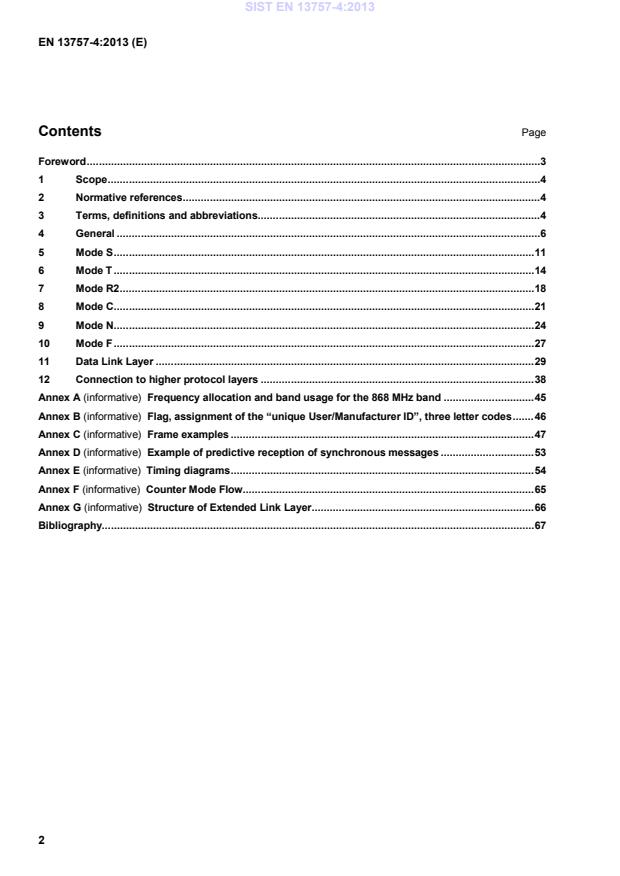
Frequency allocation and band usage for the 868 MHz band . 45 Annex B (informative)
Flag, assignment of the “unique User/Manufacturer ID”, three letter codes . 46 Annex C (informative)
Frame examples . 47 Annex D (informative)
Example of predictive reception of synchronous messages . 53 Annex E (informative)
Timing diagrams . 54 Annex F (informative)
Counter Mode Flow . 65 Annex G (informative)
Structure of Extended Link Layer . 66 Bibliography. 67
3 Terms, definitions and abbreviations 3.1 Terms and definitions For the purposes of this document, the following terms and definitions apply. 3.1.1 BER bit error rate 3.1.2 frame unit of transmission at the Data Link Layer SIST EN 13757-4:2013
Configuration Word (refer to EN 13757-3) 4 General 4.1 Introduction The “meters” may communicate with “other” system components, for example mobile readout devices, stationary receivers, data collectors, multi-utility concentrators or system network components. Such devices are in this document named “Other Device”. For the meter side, it is assumed that the communication function will work without any operator’s intervention or need for battery replacement over the full lifetime of the radio part of the meter. Other components such as the mobile readout or stationary equipment may have a shorter battery lifetime or require an external power supply as dictated by the technical parameters and use. Several different modes of operation are defined for the communication with the meter. Many of the physical and link layer parameters of these different modes are identical, allowing the use of common hardware and software. However, due to the operational and technical requirements of these modes some parameters will differ.
The name of a mode is specified by a letter and a number. The letter specifies a mode and the number specifies whether the modes supports unidirectional (=1) or bidirectional (=2) data transfer.
a) “Stationary mode”, mode S is intended for unidirectional or bidirectional communications between the meter and a stationary or mobile device. A special transmit only sub-mode S1 is optimised for stationary battery operated devices with a long header and the sub-mode S1-m is specialised for mobile receivers. b) “Frequent transmit mode”, mode T. In this mode, the meter transmits a very short frame (typically 3 ms to 8 ms) every few seconds, thus allowing walk-by and/or drive-by readout.
Transmit only sub-mode T1. It is the minimal transmission of a meter ID plus a readout value, which is sent periodically. The bidirectional sub-mode T2 transmits frequently a short frame containing at least its ID and then waits for a very short period after each transmission for the reception of a response. The reception of a response will open a bidirectional communication channel. Alternatively, the initial frame contains the readout value as well, and the response is a reverse channel only used for special services. c) “Frequent receive mode”, mode R. In this mode only R2 is relevant, as R1 makes no sense. The meter listens every few seconds for the reception of a wakeup message from a mobile transceiver. After receiving such a wakeup, the device will prepare for a few seconds of communication dialog with the initiating transceiver. In this mode a “multi-channel receive mode” allows the simultaneous readout of several meters, each one operating on a different frequency channel. This mode is as well applicable to stationary Other Device's. d) “Compact Mode” mode C. This mode is similar to mode T but it allows for transmission of more data within the same energy budget and with the same duty cycle. It supports the sub-modes C1 and C2 for unidirectional and bidirectional devices. It is suitable for walk-by and/or drive-by readout. The common reception of mode T and mode C frames with a single receiver is possible.
e) “Narrowband VHF”, mode N. Optimised for narrowband operation in the 169 MHz frequency band, allocated for meter reading and a few other services. Transmit only sub-modes N1a-f, and bidirectional sub-modes N2a-f. The range of sub-modes can be extended using repeaters. Sub-mode N2g is intended for, but not limited to, long range secondary communication using multi-hop repeaters.
S2 2 All meter types. Stationary readout 32,768 1 % Manchester and
short header or optionally long header Meter unit with a receiver either continuously enabled or synchronised requiring no extended preamble for wakeup. Also usable for node transponders or concentrators. A long header is optional. T1 1 Frequent transmission (short frame meters) 100 0,1 % 3 to 6
and short header Transmit only with short data bursts typically 3 ms to 8 ms every few seconds, operates in the 0,1 % duty cycle frequency band. T2 2 Frequent transmission (short frame meter with two way capability) Meter to Other Device:
Other Device to Meter 32,768 0,1 %
1 %
3 to 6 and short header
Manchester and
short header Meter unit transmits on a regular basis like Type T1 and its receiver is enabled for a short period after the end of each transmission and locks on, if an acknowledge (at 32,768 kcps) is received. Further bidirectional communication in the 0,1 %-frequency band using 100 kcps (meter transmit) and 32,768 kcps (meter receive) may follow. Note that the communication from the meter to the "other" component uses the physical layer of the T1 mode, while the physical layer parameters for the reverse direction are identical to the S2-mode. R2 2 Frequent reception (long range) 4,8 1 % Manchester and
medium header Meter receiver with possible battery economiser, requiring extended preamble for wake-up. Optionally, it may have up to 10 frequency channels with a high precision frequency division multiplexing. Meter response with 4,8 kcps wake-up followed by a 4,8 kcps header. C1 1 Frequent transmit only 100 0,1 % NRZ Transmit only, on a regular basis, with short data bursts < 22 ms, operates in the 0,1 % duty cycle frequency SIST EN 13757-4:2013
Other Device to Meter: 50 Meter to Other Device: 0,1 % Other Device to Meter 10 % NRZ + Short header Meter unit transmits on a regular basis like Type C1 and its receiver is enabled for a short period after the end of each transmission and locks on if a proper preamble and synchronisation word is detected. Data frames received by the meter are used for protocol updates and commands. N1a-f 1 Long range transmit for stationary readout.
2,4 or 4,8 10 % c NRZ Transmit only; transmits on a regular basis to a stationary receiving point. N2a-f 2 Long range two-way communi-cation for stationary readout. 2,4 or 4,8 10 % c NRZ Meter unit transmits on a regular basis like mode N1 and its receiver is enabled for a short period after the end of each transmission and locks on if a proper preamble and synchronisation word is detected. N2g 2 Long range communication 9,6
(19,2 kbps) 10 % c NRZ Secondary communication using multi-hop repeaters, or bidirectional communication similar to mode N2a-f. F2-m 2 Long range two-way communication 2,4 10 %
NRZ Meter receiver with possible battery economiser, requiring extended preamble for wake-up. F2 2 Long range two-way communication for stationary readout. 2,4 10 %
NRZ Meter unit transmits on a regular basis. Its receiver is enabled for a short period after the end of each transmission. It locks on if a proper preamble and synchronisation word is detected.
All
Multi-mode option
A system component may operate simultaneously, sequentially or by command in more than one mode as long as it fulfils all the requirements of each of these modes. a The duty cycle limitation shall conform to the frequency band allocation defined for operation in the applicable frequency bands
according to CEPT/ERC/REC 70-03. b The total occupancy of the channel shall be limited to < 10 %. This implies that the duty cycle per meter shall be limited to 0,02 % per
hour with 500 metering devices installed within transmission range. c The duty-cycle limit is according to EU Commission Decision 2005/928/EC.
Figure 1 — Meter communication typesSIST EN 13757-4:2013
(mode R, S, T, C) Meter to Other Device +3 dBm
(mode F) Other Device to Meter +8 dBm
(mode R, S, T, C) Other Device to Meter +7 dBm
(mode F) 20 dBm (mode N)
Table 3 — Receiver performance Classes Receiver Class Typical application Description Maximum usable sensitivity P0 Antenna gain dBi Ga LR Lowest performance Limited sensitivity, minimum blocking performances –80 dBm (mode R,S,T,C) –90 dBm (mode N) –105 dBm (mode F) a
MR Medium performance Medium sensitivity, good blocking performances –90 dBm (mode R,S,T,C) –100 dBm (mode N) –110 dBm (mode F) a HR Highest performance Best sensitivity and best blocking performances see, Table 6, Table 9, Table 13, Table 16, Table 20 and Table 23 a a Refer to 8.1 and for integral or dedicated antenna, refer to E.2 in ETSI EN 300 220-1 V2.4.1:2012.
0,02 1 % Transmitter duty cycle S1 & S1-m c
0,02 % a This European Standard is optimised for the 868 MHz to 870 MHz band, although
with an appropriate transmission licence, other frequency bands could be used. b Duty cycle as defined by ETSI EN 300 220-1, V2.4.1:2012. c The duty cycle is limited to 0,02 % per hour to limit the total occupancy of the
channel, see Table 1, Footnote b.
NOTE See Figure A.1 for additional information on frequency and power recommendations. 5.2 Mode S: Transmitter The parameters for the transmitter shall be as listed in Table 5 below: SIST EN 13757-4:2013
868,25 868,30 868,35 MHz ~ 60 × 10-6 (ppm) Centre frequency (Other Device and S2-mode)
868,278 868,300 868,322 MHz ~ 25 × 10-6 (ppm) FSK Deviation
± 40 ± 50 ± 80 kHz
Chip rate transmit
fchip
32,768
kcps
Chip rate tolerance
± 1,5 %
Digital bit jitter a
± 3 us
Data rate (Manchester) b
fchip × ½
bps
Preamble length including bit/byte-sync, both directions S2, S1-M
chips
Preamble length including bit/byte-sync S1 PL 576
chips Optional for S2 Postamble (trailer) length c
8 chips
Response delay d
(Other Device to Meter communication)
tRO 3
50 ms
FAC Transmission delay e f S2 tTxD N×1 000
–0,5 N×1 000 N×1 000+0,5 ms N=2, 3,or 5 FAC Time out g
S2 tTO 25
30 s
a The bit jitter shall be measured at the output of the micro-controller or encoder circuit. b Each bit shall be coded as 2 chips (Manchester encoding). c The postamble (trailer) shall consist of n=1 to 4 "ones" i.e. the chip sequence is n × (01). d Response delay: The receiver shall be ready for the reception of a response in a time shorter than the minimum response
delay, and shall be receiving at least until the maximum response delay (referred to the end of previous transmission). e FAC Transmission delay: describes the duration which a meter shall delay the first response to a received message from Other
Device referred to its last transmission. This delay shall also be applied between the first response of the Meter and the next
repeated response of the Meter and all following repeated responses during the Frequent Access Cycle (FAC). The reference
time point shall be the end of preamble (end of sync sequence) of the meter transmission. For timing diagrams see Annex E. f The selected timeslot N shall be the same throughout the Frequent Access Cycle. g FAC Time out: is the time period between the last successful reception of a frame from the Other Device during the Frequent
Access Cycle (FAC) and the moment where the repetition of the last response of the Meter shall be stopped (end of Frequent
Access Cycle).
5.3 Mode S: Receiver The parameters for the receiver shall be as listed in Table 6 below. SIST EN 13757-4:2013
HR Po –100 -105
dBm
Blocking performance b
LR
Category
Blocking performance b c
MR
Category
Blocking performance b c d
HR
Category
Acceptable chip rate tolerance
Dfchip
± 2 %
Chip rate (Meter)
fchip
32,768
kcps
a At a frame size of 20 bytes. b Receiver category according to ETSI EN 300 220-1, V2.4.1:2012, 4.1.1. c Additional requirement for Class MR and Class HR receivers: The equipment shall meet the immunity requirements as specified in
ETSI EN 301 489-1, V1.9.2:2011, 9.2. d Additional requirement for Class HR receivers: Adjacent band selectivity shall be > 40 dB when measured according to
ETSI EN 300 220-1, V2.4.1:2012, 8.3.
5.4 Mode S: Data encoding 5.4.1 Mode S: Manchester encoding Manchester encoding shall be used for this mode to allow simple encoding/decoding and occupy a narrower base-band. Each bit shall be encoded as either a "10" chip sequence representing a “zero” or as a “01” representing a “one”. The lower frequency shall correspond to a chip value of “0”. 5.4.2 Mode S: Order of transmission of the encoded data Each data byte shall be transmitted with the most significant bit first. The order of multi byte fields is defined in 11.2. 5.4.3 Mode S: Preamble and synchronisation pattern The total preamble (header + synchronisation) chip sequence for this mode shall be n × (01) 0001110110 10010110:
with n ≥ 279 for the sub-mode S1 (long header) with n ≥ 15 for the sub-mode S2 (short header) with n ≥ 279 for the sub-mode S2 optional long header All chips of each frame, including pre- and postamble, shall form an uninterrupted sequence. After this preamble a frame of the format A shall follow. NOTE In Manchester coding, the chip sequence 000111 is invalid but it is used near the end of the header to allow a receiver to detect the start of a new or a stronger transmission. This applies even during reception of a weaker transmission. The capture effect allows efficient communication even in a channel where many weak transmitters from a large area might otherwise effectively block the reception of a nearer (stronger) transmitter. In addition, it allows pulsed receivers to distinguish safely between the start of a valid frame and the detection of an accidental “sync” sequence within an ongoing transmission. SIST EN 13757-4:2013
T1, T2 868,7 868,95 869,2 MHz Frequency band: Other Device to Meter a T2 868,0 868,3 868,6 MHz a This European Standard is optimised for the 868 MHz to 870 MHz band, although with an appropriate
transmission licence, other frequency bands could be used.
NOTE See Figure A.1 for additional information on frequency and power recommendations. 6.2 Mode T: Transmitter The parameters for the transmitter shall be as given in Table 8: SIST EN 13757-4:2013
868,90 868,95 869,00 MHz ~ 60 × 10-6 (ppm) Centre frequency (Other Device to Meter) T2
868,278 868,300 868,322 MHz ~ 25 × 10-6 (ppm) FSK Deviation (Meter to Other Device) T1, T2
± 40 ± 50 ± 80 kHz
FSK Deviation (Other Device to Meter) T2
± 40 ± 50 ± 80 kHz
Chip rate transmit (Meter to Other Device) T1, T2 fchip2 90 100 110 kcps
Rate variation within header + frame (meter) T1, T2 Dfchip
0 ± 1 %
Data rate a
(Meter to Other Device, 3 out of 6 encoding) T1, T2 fchip2
fchip × 2/3
bps
Chip rate transmit (Other Device to Meter) T2
32,768
kcps
Chip rate tolerance (Other Device to Meter) T2
± 1,5 %
Digital bit jitter b
T2
± 3 µs
Data rate (Other Device to Meter, Manchester encoding) T2
fchip2 × ½
bps
Preamble length including bit/byte-sync, both directions T1, T2 PL 48
chips
Postamble (trailer) length c
T1, T2
8 chips
Response delay d (Other Device to Meter communication) T2 tRO 2
3 ms
FAC Transmission delay e f T2 tTxD N×1 000
–0,5 N×1 000 N×1 000+0,5 ms N=2, 3,or 5 FAC Time out g T2 tTO 25
30 s
a Each nibble (4 bits) shall be coded as 6 chips, see Table 10. b The bit jitter shall be measured at the output of the microprocessor or encoder circuit. c The postamble (trailer) shall consists of at least two alternating chips. If the last chip of the CRC was a zero, then the
minimum
postamble shall be “10”, otherwise it shall be “01”. d Response delay: The receiver shall be ready for the reception of a response in a time shorter than the minimum response delay, and
shall be receiving at least until the maximum response delay (referred to the end of previous transmission). e FAC Transmission delay: describes the duration which a Meter shall delay the first response to a received message from Other
Device referred to its last transmission. This delay shall also be applied between the first response of the Meter and the next
repeated response of the Meter and all following repeated responses during the Frequent Access Cycle (FAC). The reference time
point shall be the end of preamble (end of sync sequence) of the Meter transmission. For timing diagrams see Annex E. f The selected timeslot N shall be the same throughout the Frequent Access Cycle. g FAC Time out: is the time period between the last successful reception of a frame from the Other Device during the Frequent
Access
Cycle (FAC) and the moment where the repetition of the last response of the Meter shall be stopped (end of Frequent
Access
Cycle). SIST EN 13757-4:2013
(PER < 0,8) a HR Po –100 –105
dBm
Blocking performance b LR
Category
Blocking performance b c MR
Category
Blocking performance b c d HR
Category
Acceptable header chip rate range: (Other Device) T1, T2 fchip 88 100 112 kcps ~± 12 % Acceptable chip rate variation during header and frame: (Other Device) T1, T2 Dfchip
0 ± 2 %
Chip rate (Meter) T2 fchip
32,768
kcps
Acceptable chip rate tolerance (Meter) T2 Dfchip2
0 ± 2 %
a At a frame size of 20 bytes.
b Receiver category according to ETSI EN 300 220-1, V2.4.1:2012, 4.1.1. c Additional requirement for Class MR and Class HR receivers: The equipment shall meet the immunity requirements as
specified in ETSI EN 301 489-1, V1.9.2:2011, 9.2. d Additional requirement for Class HR receivers: Adjacent band selectivity shall be > 40 dB when measured according to
ETSI EN 300 220-1, V2.4.1:2012, 8.3.
6.4 Mode T: Data encoding 6.4.1 General In the mode T1 and T2, for optimum fast transmission, the data going from the meter to the reader device (Other Device) shall be encoded by the efficient “3 out of 6” code. In the mode T2, the reader may send back a message to the meter. This message shall be encoded by the Manchester code (see 6.4.3). 6.4.2 Mode T: Meter transmit: “3 out of 6” data encoding 6.4.2.1 General “3 out of 6” encoding shall be used for the T1 and T2 mode to achieve an improved efficiency compared to Manchester encoding. Unique codes shall be used for specific control functions such as preamble, message start, etc. The encoding shall be performed as given in Table 10. Each 4-bit nibble of data shall be encoded as a 6-bit word. Only those words, out of the 64 combinations, with an equal number of zeros and ones and with a minimum of two transitions, have been selected. The lower frequency shall correspond to a chip value of “0”. SIST EN 13757-4:2013
6.4.2.2 Mode T: Meter transmit: Order of transmission of the encoded data The data coded as “3 out of 6” shall be transmitted with most significant bit (MSB = Left bit of the 6-bit code) first and with the most significant nibble (MSN) first. Each data byte shall be transmitted with the most significant bit first. The order of multi byte fields is defined in 11.2. 6.4.2.3 Mode T1 and T2: Meter transmit: Preamble and synchronisation pattern The total preamble (header + synchronisation) chips sequence for this mode shall be n × (01) 0000111101 with n ≥ 19. After this preamble, a frame of the format A shall follow. The chip sequence 0101010101 has been reserved for the transmission preamble so that a receiver can start sampling at the maximum chip rate and then determine the actual chip rate from these patterns. Moreover, the high number of transitions ensures the best detection of the actual chip rate. Within the frame, the maximum number of contiguous zeroes or ones is four, but neither the pattern “00001111” nor the pattern “11110000” will ever occur inside a “3 out of 6” encoded chip sequence. The pattern can therefore be used for synchronisation. The chip sequence 0101010101 will never occur during a normal chip sequence. The decoder may use this to detect that the receiver has captured another transmission. In that case, the receiver shall stop the analysis of the current frame and start detecting a new frame. This “capture detect” feature increases the communication capacity of the system in presence of many users. SIST EN 13757-4:2013
868,0 868,33 868,6 MHz Channel spacing a
kHz a This European Standard is optimised for the 868 MHz to 870 MHz band, although with an
appropriate transmission licence, other frequency bands could be used.
NOTE See Figure A.1 for additional information on frequency and power recommendations. 7.2 Mode R2: Transmitter The parameters for the transmitter shall be as listed in Table 12. SIST EN 13757-4:2013
868,330
MHz
Centre frequency (Meter)
868,030
+n × 0,06
MHz
Frequency tolerance (Meter/Other Device)
0 ± 17 kHz ~20 × 10-6 (ppm) FSK Deviation
± 4,8 ± 6 ± 7,2 kHz
Chip rate (wakeup and communications)
4,8
kcps
Chip rate tolerance (wakeup and communications)
0 ± 1,5 %
Digital bit jitter a
± 15 µs
Data rate (Manchester encoding) b
fchip × ½
bps
Preamble length including bit/byte-sync PL 96
chips
Postamble (trailer) length c
8 chips
Response delay d (Other Device to Meter communication) tRO 3
50 ms
Response delay d (Meter to Other Device communication) tRM 10
10 000 ms
FAC Transmission delay e f tTxD N×1 000
–1 N×1 000 N×1 000 +1 ms N=5, 7 or 13 FAC Time out g
tTO 25
30 s
a The bit jitter shall be measured at the output of the micro-controller or encoder circuit. b Each bit shall be coded as 2 chips (Manchester encoding). c The postamble (trailer) shall consists of 1 ≤ n ≤ 4 “ones” i.e. the chip sequence shall be n × (01). d Response delay: The receiver shall be ready for the reception of a response in a time shorter than the minimum
response delay, and shall be receiving at least until the maximum response delay (referred to the end of previous
transmission). The response delay tRO shall be used if the CI-field of received frame is 81h, otherwise the response
delay tRM shall be used. e FAC Transmission delay: describes the duration which a Meter shall delay the first response to a received message
from Other Device referred to its last transmission. This delay shall also be applied between the first response of the
Meter and the next repeated response of the Meter and all following repeated responses during the Frequent Access
Cycle (FAC). The reference time point shall be the end of preamble (end of sync sequence) of the Meter transmission. f The selected timeslot N shall be the same throughout the Frequent Access Cycle. g FAC Time out: is the time period between the last successful reception of a frame from the Other Device during the
Frequent Access Cycle (FAC) and the moment where the repetition of the last response of the Meter shall be stopped
(end of Frequent Access Cycle). SIST EN 13757-4:2013
dBm
Blocking performance b LR
Category
Blocking performance b c MR
Category
Blocking performance b c d HR
Category
Acceptable chip rate range
fchip 4,7 4,8 4,9 kcps ~ ±2 % Acceptable chip rate variation during header and frame
Dfchip
0 ±0,2 %
a
At a frame size of 20 bytes. b Receiver category shall be according to ETSI EN 300 220-1 V2.4.1:2012, 4.1.1. c Additional requirement for Class MR and Class HR receivers: The equipment shall meet the immunity requirements as
specified in ETSI EN 301 489-1, V1.9.2:2011, 9.2. d Additional requirement for Class HR receivers: Adjacent band selectivity shall be > 40 dB when measured according to
ETSI EN 300 220-1, V2.4.1:2012, 8.3.
7.4 Mode R2: Data encoding 7.4.1 Mode R2: Manchester encoding Manchester encoding shall be used for this mode to allow simple encoding/decoding and a narrow base-band. Each bit shall be encoded either as a “10” chip sequence representing a “zero” or as a “01” representing a “one”. The lower frequency corresponds to a chip value of “0”. 7.4.2 Mode R2: Order of transmission of the encoded data Each data byte shall be transmitted with the most significant bit first.
The order of multi byte fields is defined in 11.2. 7.4.3 Mode R2: Preamble and synchronisation pattern The total preamble (header + synchronisation) chip sequence for this mode shall be n × (01) 0001110110 10010110 with n ≥ 39. All chips of each frame shall form an uninterrupted chip sequence. After this preamble, a frame of the format A shall follow. NOTE 1 In Manchester coding, the chip sequence 000111 is invalid, but it is used near the end of the header to allow a receiver to detect the start of a new or a stronger transmission. This applies even during reception of a weaker transmission. The capture effect allows efficient communication even in a channel where many weak transmitters from a large area might otherwise effectively block the reception of a nearer (stronger) transmitter. In addition, it allows pulsed receivers to distinguish safely between the start of a valid frame and the detection of an accidental “sync” sequence within an ongoing transmission. NOTE 2 The data encoding is the same as used in mode S
...