

FprEN 18252
(Main)Soil improvers and growing media - Determination of the chloride content
General Information
- Abstract
This document specifies a method for the determination of the chloride (Cl-) content by potentiometric titration. This method is applicable to growing media and soil improvers.
NOTE 1 It is possible to use other analytical techniques (e.g. ion chromatography, discrete analyser, continuous flow analyser); in this case a validation is carried out by the laboratory for the procedure and data generated.
NOTE 2 This method has been validated in an interlaboratory study with specific products that were present on the market during the study (as included in Annex B, (composted bark, green compost, solid digestate, soil improver in pellet form and growing media blend 1 (peat + green compost + wood fibre + liming material + inorganic fertilizer)).
- Status
- Not Published
- Publication Date
- 13-Jan-2027
- Technical Committee
- CEN/TC 223 - Soil improvers and growing media
- Drafting Committee
- CEN/TC 223/WG 4 - Analytical methods
- Current Stage
- 5020 - Submission to Vote - Formal Approval
- Start Date
- 24-Sep-2026
- Due Date
- 21-Dec-2024
- Completion Date
- 24-Sep-2026

Overview
FprEN 18252 is a draft European standard developed by CEN (European Committee for Standardization) that provides a method for determining the chloride (Cl-) content in soil improvers and growing media. The standard specifies the use of potentiometric titration for the analysis and is applicable to a wide range of materials intended to improve soil quality or serve as plant growth media. Understanding chloride levels is critical for ensuring compliance with quality and environmental requirements in agriculture and horticulture.
Key Topics
- Chloride Content Determination: The main focus is on the accurate quantification of chloride ions in soil amendments and growing substrates.
- Potentiometric Titration: The specified technique uses silver nitrate titration, with the endpoint detected potentiometrically using appropriate electrodes.
- Applicability: The method covers various forms of soil improvers and growing media, including solid, pre-shaped, and liquid products.
- Alternative Techniques: Ion chromatography, discrete analyzers, and continuous flow analyzers are permitted, but must be validated by the testing laboratory.
- Validation and Performance: The method was validated through an interlaboratory study involving multiple soil improver types, ensuring robust reproducibility and repeatability.
- Test Reporting: Adherence to strict reporting requirements for results and validation processes ensures transparency and comparability.
Applications
By providing a reliable method for measuring chloride content, FprEN 18252 plays a vital role in several practical areas:
- Soil Health Monitoring: Helps agronomists and producers assess and control salt levels, which is essential for optimizing plant growth and preventing soil degradation.
- Product Quality Control: Enables manufacturers and suppliers of soil amendments and growing media to demonstrate compliance with European quality and safety regulations, particularly Regulation (EU) 2019/1009 on fertilizing products.
- Environmental Compliance: Supports efforts to maintain environmentally sustainable practices by monitoring potential salt build-up resulting from the use of soil improvers.
- Research and Development: Provides a standardized approach that researchers in agriculture, horticulture, and environmental science can use for comparative analysis and product innovation.
Related Standards
The effectiveness and compatibility of FprEN 18252 with industry best practices is strengthened by its alignment with related standards:
- CEN/TS 17732:2022 - Soil improvers and growing media – Terminology
- EN 12579:2024 - Soil improvers and growing media – Sampling
- prEN 13040-1:2025 - Soil improvers and growing media - Sample preparation for chemical/physical tests
- EN 16195:2012 - Fertilizers – Determination of chlorides in the absence of organic material
- DIN 38405-1:1985 - Determination of chloride ions in water, wastewater, and sludge
- ISO 5725-2:2019 - Accuracy (trueness and precision) of measurement methods and results
These standards together form a robust framework for the reliable assessment of soil amendments and growing media throughout the supply chain, ensuring consistent product performance and regulatory compliance.
Keywords: chloride content, soil improvers, growing media, potentiometric titration, CEN standard, quality control, environmental compliance, fertilizer regulation, European standards
Get Certified
Connect with accredited certification bodies for this standard

Control Union Certifications
Global certification for agriculture and sustainability.

ECOCERT
Organic and sustainability certification.

FSC International
Forest Stewardship Council certification.
Sponsored listings
Frequently Asked Questions
FprEN 18252 is a draft published by the European Committee for Standardization (CEN). Its full title is "Soil improvers and growing media - Determination of the chloride content". This standard covers: This document specifies a method for the determination of the chloride (Cl-) content by potentiometric titration. This method is applicable to growing media and soil improvers. NOTE 1 It is possible to use other analytical techniques (e.g. ion chromatography, discrete analyser, continuous flow analyser); in this case a validation is carried out by the laboratory for the procedure and data generated. NOTE 2 This method has been validated in an interlaboratory study with specific products that were present on the market during the study (as included in Annex B, (composted bark, green compost, solid digestate, soil improver in pellet form and growing media blend 1 (peat + green compost + wood fibre + liming material + inorganic fertilizer)).
This document specifies a method for the determination of the chloride (Cl-) content by potentiometric titration. This method is applicable to growing media and soil improvers. NOTE 1 It is possible to use other analytical techniques (e.g. ion chromatography, discrete analyser, continuous flow analyser); in this case a validation is carried out by the laboratory for the procedure and data generated. NOTE 2 This method has been validated in an interlaboratory study with specific products that were present on the market during the study (as included in Annex B, (composted bark, green compost, solid digestate, soil improver in pellet form and growing media blend 1 (peat + green compost + wood fibre + liming material + inorganic fertilizer)).
FprEN 18252 is classified under the following ICS (International Classification for Standards) categories: 65.080 - Fertilizers. The ICS classification helps identify the subject area and facilitates finding related standards.
FprEN 18252 is associated with the following European legislation: EU Directives/Regulations: 2019/1009; Standardization Mandates: M/564, M/564 Amd 1, M/564 Amd 2. When a standard is cited in the Official Journal of the European Union, products manufactured in conformity with it benefit from a presumption of conformity with the essential requirements of the corresponding EU directive or regulation.
FprEN 18252 is available in PDF format for immediate download after purchase. The document can be added to your cart and obtained through the secure checkout process. Digital delivery ensures instant access to the complete standard document.
Standards Content (Sample)
SLOVENSKI STANDARD
01-december-2025
Izboljševalci tal in rastni substrati - Določanje klorida
Soil improvers and growing media - Determination of the chloride content
Bodenverbesserungsmittel und Kultursubstrate - Bestimmung des Chloridgehaltes
Amendements du sol et supports de culture - Détermination de la teneur en chlorures
Ta slovenski standard je istoveten z: prEN 18252
ICS:
65.080 Gnojila Fertilizers
2003-01.Slovenski inštitut za standardizacijo. Razmnoževanje celote ali delov tega standarda ni dovoljeno.
DRAFT
EUROPEAN STANDARD
prEN 18252
NORME EUROPÉENNE
EUROPÄISCHE NORM
October 2025
ICS 65.080
English Version
Soil improvers and growing media - Determination of the
chloride content
Amendements du sol et supports de culture - Bodenverbesserungsmittel und Kultursubstrate -
Détermination de la teneur en chlorures Bestimmung des Chloridgehaltes
This draft European Standard is submitted to CEN members for enquiry. It has been drawn up by the Technical Committee
CEN/TC 223.
If this draft becomes a European Standard, CEN members are bound to comply with the CEN/CENELEC Internal Regulations
which stipulate the conditions for giving this European Standard the status of a national standard without any alteration.
This draft European Standard was established by CEN in three official versions (English, French, German). A version in any other
language made by translation under the responsibility of a CEN member into its own language and notified to the CEN-CENELEC
Management Centre has the same status as the official versions.
CEN members are the national standards bodies of Austria, Belgium, Bulgaria, Croatia, Cyprus, Czech Republic, Denmark, Estonia,
Finland, France, Germany, Greece, Hungary, Iceland, Ireland, Italy, Latvia, Lithuania, Luxembourg, Malta, Netherlands, Norway,
Poland, Portugal, Republic of North Macedonia, Romania, Serbia, Slovakia, Slovenia, Spain, Sweden, Switzerland, Türkiye and
United Kingdom.
Recipients of this draft are invited to submit, with their comments, notification of any relevant patent rights of which they are
aware and to provide supporting documentation.
Warning : This document is not a European Standard. It is distributed for review and comments. It is subject to change without
notice and shall not be referred to as a European Standard.
EUROPEAN COMMITTEE FOR STANDARDIZATION
COMITÉ EUROPÉEN DE NORMALISATION
EUROPÄISCHES KOMITEE FÜR NORMUNG
CEN-CENELEC Management Centre: Rue de la Science 23, B-1040 Brussels
© 2025 CEN All rights of exploitation in any form and by any means reserved Ref. No. prEN 18252:2025 E
worldwide for CEN national Members.
prEN 18252:2025 (E)
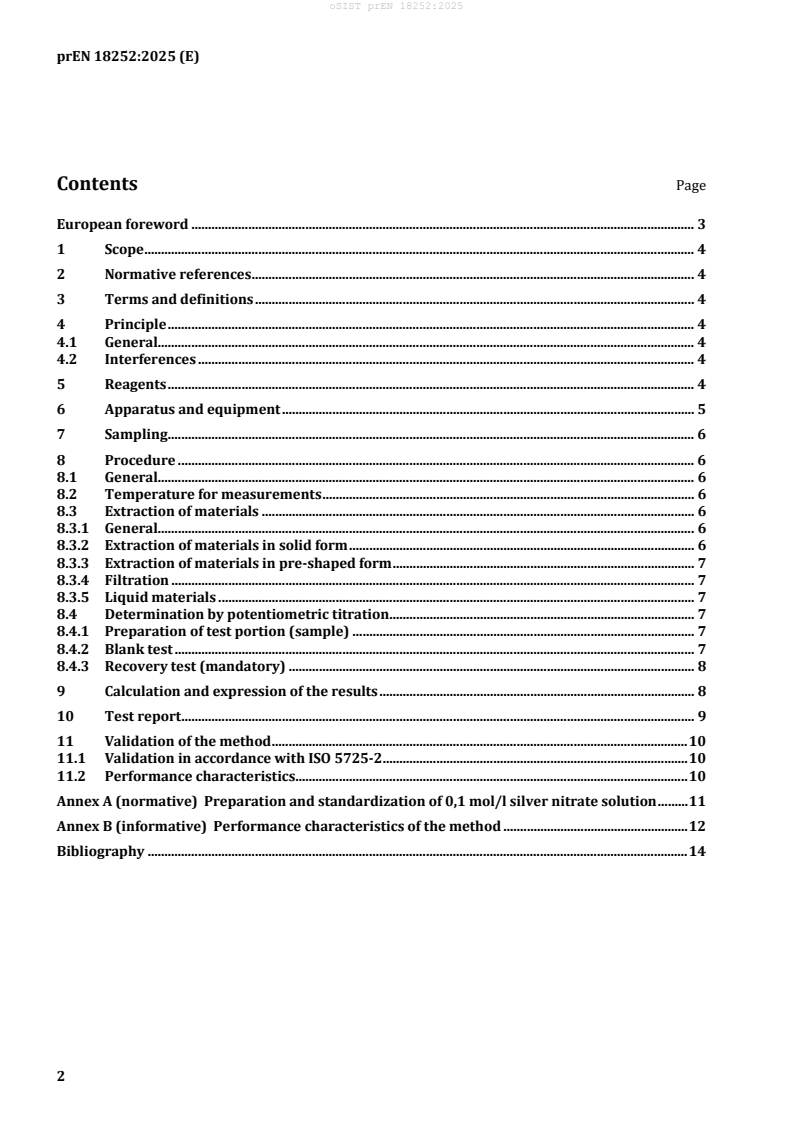
Contents Page
European foreword . 3
1 Scope . 4
2 Normative references . 4
3 Terms and definitions . 4
4 Principle . 4
4.1 General. 4
4.2 Interferences . 4
5 Reagents . 4
6 Apparatus and equipment . 5
7 Sampling . 6
8 Procedure . 6
8.1 General. 6
8.2 Temperature for measurements . 6
8.3 Extraction of materials . 6
8.3.1 General. 6
8.3.2 Extraction of materials in solid form . 6
8.3.3 Extraction of materials in pre-shaped form . 7
8.3.4 Filtration . 7
8.3.5 Liquid materials . 7
8.4 Determination by potentiometric titration . 7
8.4.1 Preparation of test portion (sample) . 7
8.4.2 Blank test . 7
8.4.3 Recovery test (mandatory) . 8
9 Calculation and expression of the results . 8
10 Test report . 9
11 Validation of the method . 10
11.1 Validation in accordance with ISO 5725-2. 10
11.2 Performance characteristics. 10
Annex A (normative) Preparation and standardization of 0,1 mol/l silver nitrate solution . 11
Annex B (informative) Performance characteristics of the method . 12
Bibliography . 14
prEN 18252:2025 (E)
European foreword
This document (prEN 18252:2025) has been prepared by Technical Committee CEN/TC 223 “Soil
improvers and growing media”, the secretariat of which is held by NEN. This document was prepared in
collaboration with CEN/TC 260 “Fertilizers and liming materials”.
This document is currently submitted to the CEN Enquiry.
This document has been prepared under a standardization request addressed to CEN by the European
Commission. The Standing Committee of the EFTA States subsequently approves these requests for its
Member States.
prEN 18252:2025 (E)
1 Scope
-
This document specifies a method for the determination of the chloride (Cl ) content by potentiometric
titration. This method is applicable to growing media and soil improvers.
NOTE It is possible to use other analytical techniques (e.g. ion chromatography, discrete analyser, continuous
flow analyser); in this case a validation is carried out by the laboratory for the procedure and data generated.
2 Normative references
The following documents are referred to in the text in such a way that some or all of their content
constitutes requirements of this document. For dated references, only the edition cited applies. For
undated references, the latest edition of the referenced document (including any amendments) applies.
CEN/TS 17732:2022, Soil improvers and growing media - Terminology
EN 12579:2024, Soil improvers and growing media - Sampling
prEN 13040-1:2025, Soil improvers and growing media — Sample preparation — Part 1: Sample
preparation for chemical and physical tests, determination of dry matter content, moisture content and
laboratory bulk density
3 Terms and definitions
For the purposes of this document, the following terms and definitions given in CEN/TS 17732:2022 and
the following apply.
3.1
chloride content
mass fraction of chlorides, expressed in g/kg of dry matter, determined in accordance with the procedure
described in this document
4 Principle
4.1 General
Soluble chlorides are extracted from the sample with water containing nitric acid. The chloride content
of the solution is titrated with silver nitrate standard solution. The end point is determined
potentiometrically by using either a silver ion selective electrode plus a reference electrode or a
combined electrode.
4.2 Interferences
-
Maintaining the sample at a lower pH can avoid the silver ion from interacting with OH to precipitate as
silver oxide (Ag O), it minimizes the interference of other anions with AgCl formation, and it improves
the binding between the titrant and the analyte.
5 Reagents
Only reagents of recognized analytical grade shall be used.
5.1 Water, with a specific conductivity not higher than 0,2 mS/m at 25 °C, free from the elements shall
be used.
5.2 Nitric acid concentrated, 70 % w/v, p.a.
prEN 18252:2025 (E)
5.3 Nitric acid solution
It shall dilute 1:1 concentrated nitric acid (5.2) in water (5.1).
5.4 Silver nitrate standard solution, c = 0,1 mol/l solution.
The silver nitrate solution of 0,1 mol/l in water (5.1) shall be prepared. Many silver nitrate solutions
ready-to-use are commercially available with the certified concentration.
If an in-house solution is prepared, it shall be standardized following the instructions in Annex A.
5.5 Polyvinyl alcohol (PVA) solution, acidified with nitric acid.
It is recommended to use an acidified protector colloid medium for the potentiometric titration.
2 g of polyvinyl alcohol (PVA) shall be mixed with 400 ml of hot water (approximately 90 °C) in a 1 000 ml
one-mark volumetric glass flask (6.3) and let it cool to room temperature. Nitric acid (5.3) shall be added
for an amount of 10ml, then filled up with water to 1 000 ml.
5.6 Sodium chloride, p.a., for the standardization of silver nitrate solution (5.4)
For the preparation of sodium chloride solution, the instructions in Annex A shall be followed.
Many solutions ready-to-use are commercially available with concentration c = 0,01 mol/l.
6 Apparatus and equipment
This method describes manual titrations. Automatic titrators may be used. Ordinary laboratory
equipment and the following shall be used.
6.1 Electromagnetic stirrer and polytetrafluoroethylene (PTFE) coated magnetic bars.
6.2 Glass burettes, class A or AS [4], with a reading accuracy of 0,02 ml, or automatic pipettes with a
reading accuracy of 0,002 ml.
6.3 One-mark volumetric glass flasks, Class A [5], capacity 150 ml, 500 ml and 1 000 ml.
6.4 Glass beaker [6], capacity 300 ml.
6.5 Glass conical (Erlenmeyer) flask, capacity 250 ml.
6.6 Potentiometer, with a reading accuracy of 0,1 mV, equipped with an electrode suitable for the
measurement of chloride (e.g. a silver electrode or ion selective electrode for chloride) and a reference
electrode (e.g. a mercury(I) sulphate electrode). Alternatively, use a suitable combination electrode.
6.7 HPE bottles or containers, sufficiently large (500 ml to 2 000 ml) with screw cap to accommodate
the volume of the sample, extractant and at least 10 % air volume.
6.8 Analytical balance with an accuracy of 0,001 g.
6.9 Technical balance with an accuracy of 0,01 g.
6.10 Qualitative filter paper, cellulose-based ashless type.
NOTE Centrifugation is an acceptable alternative: a centrifuge with a speed of at least 3 000 rpm.
6.11 Orbital shaker, capable of holding the plastic bottles or containers (6.7) and maintaining the
sample in suspension without damaging the structure of the sample.
prEN 18252:2025 (E)
6.12 Pipettes, class AS with an accuracy of 0,1 ml.
6.13 Graduated glass cylinder, class A, with capacity 50 ml, 100 ml and 250 ml.
6.14 pH testing device, e.g. pH meter, pH indicator paper, or pH rapid test.
7 Sampling
Sampling is not part of the method specified in this document. EN 12579:2024 shall be followed dealing
with soil improvers and growing media. It is important that the laboratory receives a sample that is
representative of the product under consideration. The sample should not have been damaged or
changed during transport or storage.
8 Procedure
8.1 General
Tests conducted according to this document shall be carried out by suitably trained staff. Persons using
this document should be familiar with usual laboratory practice. This document does not purport to
address all of the safety issues, if any, associated with its use. It is the responsibility of the user to establish
appropriate health and safety practices and to ensure compliance with any national regulatory
conditions.
8.2 Temperature for measurements
To reduce the effects of thermal and electric hysteresis, the temperatures of the electrodes, the water
used for washing, the standard solutions and the test solution shall be as close to each other as possible.
The temperatures of the standard solutions and the test solution shall not differ by more than 1 °C. The
measurement temperature should be 23 °C ± 3 °C whenever possible.
8.3 Extraction of
...