

FprEN 17732
(Main)Soil improvers and growing media - Terminology
General Information
- Abstract
This document specifies terminology for soil improvers and growing media.
Annex A contains an overview of all terms defined in this document in alphabetical order.
- Status
- Not Published
- Publication Date
- 06-Jan-2027
- Technical Committee
- CEN/TC 223 - Soil improvers and growing media
- Drafting Committee
- CEN/TC 223/WG 3 - Sampling
- Current Stage
- 5020 - Submission to Vote - Formal Approval
- Start Date
- 17-Sep-2026
- Due Date
- 04-Nov-2026
- Completion Date
- 17-Sep-2026

Overview
FprEN 17732: Soil Improvers and Growing Media - Terminology is a draft European Standard developed by CEN/TC 223. This document establishes a standardized set of terms and definitions for soil improvers and growing media, providing a clear, harmonized vocabulary for industry professionals, manufacturers, regulators, and stakeholders across Europe. By using a common terminology, the standard streamlines communication, supports regulatory compliance, and ensures consistency in the development, marketing, labeling, and application of products within the horticulture and agriculture sectors.
Annex A of the document offers a comprehensive alphabetical overview of all the defined terms, further enhancing usability and cross-referencing.
Key Topics
FprEN 17732 covers terminology essential for the classification, composition, labeling, processing, and testing of soil improvers and growing media. The main topics include:
- General Terminology: Key concepts such as labeling, packaging, and intended use.
- Product Definitions: Detailed terms distinguishing various soil improvers, growing media, and their components (e.g., peat, compost, biochar, wood fibre, coir).
- Component Descriptions: Material origins, including organic matter, virgin materials, and by-products such as digestate and industrial sludge.
- Processing and Manufacturing: Processes such as composting, anaerobic digestion, drying, fiberization, pyrolysis, and extraction.
- Sampling, Testing, and Properties: Terms related to physical, chemical, and biological properties (e.g., bulk density, particle size distribution, nutrient solubility, pathogen testing) alongside sampling methods and laboratory procedures.
- Safety and Compliance: Definitions of contaminants, pollutants, potential hazards, and risk, as well as sanitary and sterilization considerations.
Together, these topics ensure comprehensive standardization across the supply chain, from raw materials to finished soil amendment and growing media products.
Applications
The adoption of FprEN 17732 terminology supports a wide range of practical applications in the soil improvement and horticultural sectors, including:
- Product Development and Manufacturing: Facilitates clear communication across research, sourcing, and production by using standardized definitions.
- Product Labeling and Marketing: Assists manufacturers in providing accurate, transparent, and compliant product information to customers across EU member states.
- Regulatory Compliance: Supports regulators and inspection bodies in enforcing requirements under the EU Fertilising Products Regulation (EU 2019/1009) by referencing harmonized terms.
- Trade and Procurement: Enables clear specifications and reduces ambiguity in commercial contracts and supply chain agreements involving soil improvers and growing media products.
- Scientific Research and Testing: Provides a common framework for laboratory analysis, performance testing, product comparisons, and reporting.
- Education and Training: Assists in the consistent education of technical staff, agronomists, and students in the agriculture and horticulture industries.
The clear structure of terms also improves clarity on health, safety, and environmental aspects associated with soil improvers and growing media use.
Related Standards
FprEN 17732 interfaces with several related international and European standards, including:
- CEN/TS 17732:2022 (Superseded): The previous technical specification replaced by this draft standard.
- Regulation (EU) 2019/1009: Lays down rules on the making available on the market of EU fertilising products.
- ISO and IEC Terminology Databases: ISO Online Browsing Platform and IEC Electropedia for harmonized international vocabularies.
- ISO 4880:1997: Burning behaviour of textiles and textile products – Vocabulary.
- ISO/IEC Guide 51: Safety aspects – Guidelines for inclusion in standards.
By aligning with these standards and regulatory frameworks, FprEN 17732 helps foster a unified approach to soil health, sustainable agriculture, and safe horticultural practices throughout Europe.
Relations
- Effective Date
- 16-Sep-2026
- Effective Date
- 28-Jan-2026
- Effective Date
- 28-Jan-2026
- Effective Date
- 28-Jan-2026
- Effective Date
- 28-Jan-2026
- Effective Date
- 28-Jan-2026
- Effective Date
- 28-Jan-2026
- Effective Date
- 28-Jan-2026
- Effective Date
- 28-Jan-2026
- Effective Date
- 28-Jan-2026
- Effective Date
- 20-Nov-2024
- Revises
CR 13456:1999 - Soil improvers and growing media - Labelling, specifications and product schedules - Effective Date
- 19-Jan-2023
- Effective Date
- 06-Nov-2019
Get Certified
Connect with accredited certification bodies for this standard

Control Union Certifications
Global certification for agriculture and sustainability.

ECOCERT
Organic and sustainability certification.

FSC International
Forest Stewardship Council certification.
Sponsored listings
Frequently Asked Questions
FprEN 17732 is a draft published by the European Committee for Standardization (CEN). Its full title is "Soil improvers and growing media - Terminology". This standard covers: This document specifies terminology for soil improvers and growing media. Annex A contains an overview of all terms defined in this document in alphabetical order.
This document specifies terminology for soil improvers and growing media. Annex A contains an overview of all terms defined in this document in alphabetical order.
FprEN 17732 is classified under the following ICS (International Classification for Standards) categories: 01.040.65 - Agriculture (Vocabularies); 65.080 - Fertilizers. The ICS classification helps identify the subject area and facilitates finding related standards.
FprEN 17732 has the following relationships with other standards: It is inter standard links to EN 16202:2026, EN ISO 14630:2024, EN ISO 17665:2024, EN ISO 16061:2021, EN ISO 7199:2024, EN ISO 11607-1:2020, EN ISO 5840-1:2021, EN ISO 8637-2:2024, CEN ISO/TS 16775:2021, EN ISO 20695:2020, CEN/TS 17732:2022, CR 13456:1999, CR 13455:1999. Understanding these relationships helps ensure you are using the most current and applicable version of the standard.
FprEN 17732 is associated with the following European legislation: EU Directives/Regulations: 2019/1009; Standardization Mandates: M/564, M/564 Amd 1, M/564 Amd 2. When a standard is cited in the Official Journal of the European Union, products manufactured in conformity with it benefit from a presumption of conformity with the essential requirements of the corresponding EU directive or regulation.
FprEN 17732 is available in PDF format for immediate download after purchase. The document can be added to your cart and obtained through the secure checkout process. Digital delivery ensures instant access to the complete standard document.
Standards Content (Sample)
SLOVENSKI STANDARD
oSIST prEN 17732:2026
01-januar-2026
Izboljševalci tal in rastni substrati - Terminologija
Soil improvers and growing media - Terminology
Bodenverbesserungsmittel und Kultursubstrate - Vokabular und Kennzeichnung
Amendements du sol et supports de culture - Terminologie
Ta slovenski standard je istoveten z: prEN 17732
ICS:
01.040.65 Kmetijstvo (Slovarji) Agriculture (Vocabularies)
65.080 Gnojila Fertilizers
oSIST prEN 17732:2026 en,fr,de
2003-01.Slovenski inštitut za standardizacijo. Razmnoževanje celote ali delov tega standarda ni dovoljeno.
oSIST prEN 17732:2026
oSIST prEN 17732:2026
DRAFT
EUROPEAN STANDARD
prEN 17732
NORME EUROPÉENNE
EUROPÄISCHE NORM
December 2025
ICS 01.040.65; 65.080 Will supersede CEN/TS 17732:2022
English Version
Soil improvers and growing media - Terminology
Amendements du sol et supports de culture - Bodenverbesserungsmittel und Kultursubstrate -
Terminologie Vokabular und Kennzeichnung
This draft European Standard is submitted to CEN members for enquiry. It has been drawn up by the Technical Committee
CEN/TC 223.
If this draft becomes a European Standard, CEN members are bound to comply with the CEN/CENELEC Internal Regulations
which stipulate the conditions for giving this European Standard the status of a national standard without any alteration.
This draft European Standard was established by CEN in three official versions (English, French, German). A version in any other
language made by translation under the responsibility of a CEN member into its own language and notified to the CEN-CENELEC
Management Centre has the same status as the official versions.
CEN members are the national standards bodies of Austria, Belgium, Bulgaria, Croatia, Cyprus, Czech Republic, Denmark, Estonia,
Finland, France, Germany, Greece, Hungary, Iceland, Ireland, Italy, Latvia, Lithuania, Luxembourg, Malta, Netherlands, Norway,
Poland, Portugal, Republic of North Macedonia, Romania, Serbia, Slovakia, Slovenia, Spain, Sweden, Switzerland, Türkiye and
United Kingdom.
Recipients of this draft are invited to submit, with their comments, notification of any relevant patent rights of which they are
aware and to provide supporting documentation.
Warning : This document is not a European Standard. It is distributed for review and comments. It is subject to change without
notice and shall not be referred to as a European Standard.
EUROPEAN COMMITTEE FOR STANDARDIZATION
COMITÉ EUROPÉEN DE NORMALISATION
EUROPÄISCHES KOMITEE FÜR NORMUNG
CEN-CENELEC Management Centre: Rue de la Science 23, B-1040 Brussels
© 2025 CEN All rights of exploitation in any form and by any means reserved Ref. No. prEN 17732:2025 E
worldwide for CEN national Members.
oSIST prEN 17732:2026
prEN 17732:2025 (E)
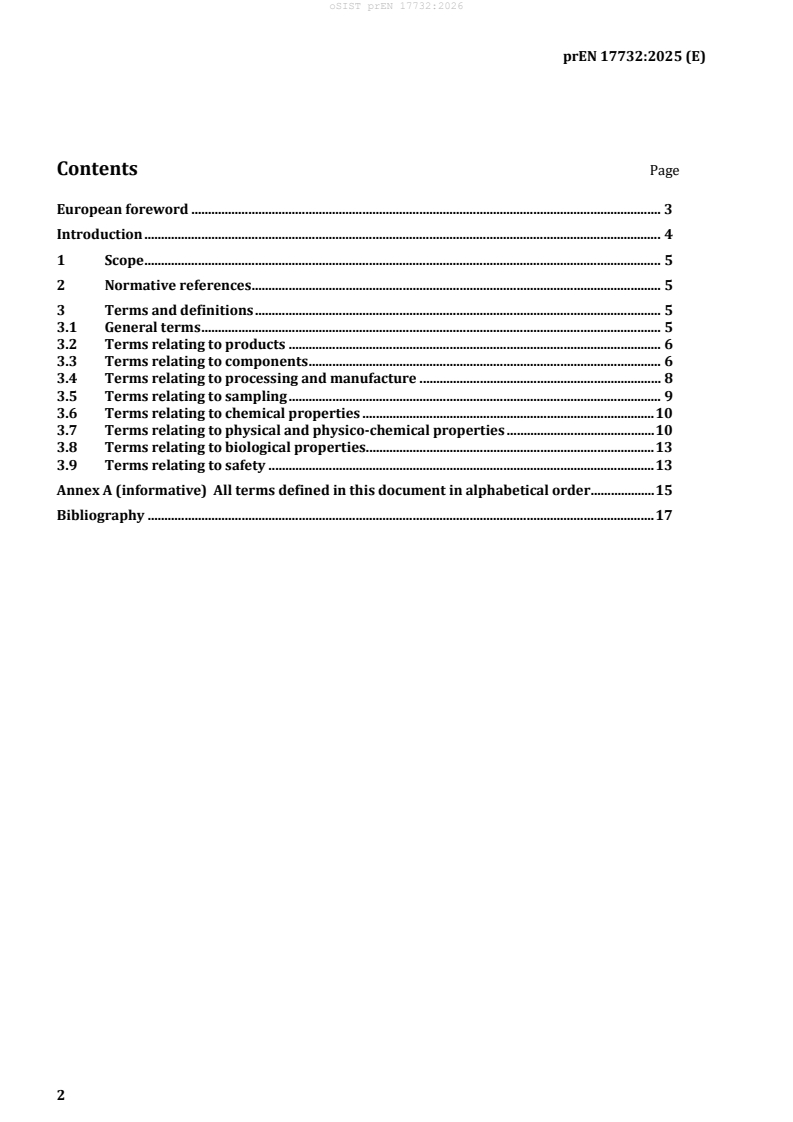
Contents Page
European foreword . 3
Introduction . 4
1 Scope . 5
2 Normative references . 5
3 Terms and definitions . 5
3.1 General terms . 5
3.2 Terms relating to products . 6
3.3 Terms relating to components . 6
3.4 Terms relating to processing and manufacture . 8
3.5 Terms relating to sampling . 9
3.6 Terms relating to chemical properties . 10
3.7 Terms relating to physical and physico-chemical properties . 10
3.8 Terms relating to biological properties . 13
3.9 Terms relating to safety . 13
Annex A (informative) All terms defined in this document in alphabetical order . 15
Bibliography . 17
oSIST prEN 17732:2026
prEN 17732:2025 (E)
European foreword
This document (prEN 17732:2025) has been prepared by Technical Committee CEN/TC 223 “Soil
improvers and growing media”, the secretariat of which is held by NEN.
This document is currently submitted to the CEN Enquiry.
This document will supersede CEN/TS 17732:2022.
prEN 17732:2025 includes the following significant technical changes with respect to
CEN/TS 17732:2022:
— Redundant information has been removed from the Introduction;
— Several definitions have been updated in Clause 3, Terms and definitions.
This document has been prepared under a Standardization Request given to CEN by the European
Commission and the European Free Trade Association.
oSIST prEN 17732:2026
prEN 17732:2025 (E)
Introduction
Standards requested in Standardization Request M/564 related to soil improvers and growing media use
common terminology. For ease of reference, to simplify standardization work and to avoid unnecessary
repetitions such common terminology is included in this document. In this way, any document where the
relevant terminology is used could refer to this document.
oSIST prEN 17732:2026
prEN 17732:2025 (E)
1 Scope
This document specifies terminology for soil improvers and growing media.
Annex A contains an overview of all terms defined in this document in alphabetical order.
2 Normative references
There are no normative references in this document.
3 Terms and definitions
For the purposes of this document, the following terms and definitions apply.
ISO and IEC maintain terminology databases for use in standardization at the following addresses:
— ISO Online browsing platform: available at https://www.iso.org/obp/
— IEC Electropedia: available at https://www.electropedia.org/
3.1 General terms
3.1.1
additional labelling
information which can be shown on the package, label or on the accompanying documents
3.1.2
container
receptacle or vessel in which material is delivered, including a lorry, ship, boat and packaging
3.1.3
intended use
application of a product, process or service in accordance with information provided by the supplier
3.1.4
labelling requirements
information which is shown on the package, label or on the accompanying documents
3.1.5
package
container and materials contained therein which are delivered and where the packaging remains with
the material after delivery
Note 1 to entry: A package may be a loose-filled sack, a big bale or a compressed block in packaging.
3.1.6
strike
transparent sheet of flat material, for instance toughened glass or acrylic glass which is easily large
enough to cover the top of the measuring cylinder
Note 1 to entry: Used to calibrate measuring cylinder.
3.1.7
user
anybody applying the product, including professional and non-professional (amateur) persons
oSIST prEN 17732:2026
prEN 17732:2025 (E)
3.2 Terms relating to products
3.2.1
growing medium
material, other than soil in situ, in which plants or mushrooms are grown
3.2.2
growing medium component
material which is suitable as an ingredient of growing media
3.2.3
pre-shaped growing medium
solid, regular shaped, stable growing medium, which is ready for use as a growing medium, where the
dimensions are stable, including mineral wool and polyurethane products
3.2.4
soil improver
material added to soil in situ primarily to maintain, improve or protect the physical or chemical
properties, the structure or the biological activity of the soil
3.2.5
soil improver component
material which is suitable as an ingredient of soil improvers
3.3 Terms relating to components
3.3.1
ash
residual mineral matter remaining after the destruction of organic matter/material by controlled burning
Note 1 to entry: Such residues may be used as fertilizers, for example, plant ash and animal ash, containing mainly
potassium salts and phosphates.
3.3.2
biochar
porous, carbonaceous material that is produced by pyrolysis of organic material
3.3.3
coir
fibrous husk (mesocarp) of the coconut (Cocos nucifera), underlying the smooth outermost layer
(exocarp), surrounding the hard woody layer (endocarp)
Note 1 to entry: Coir consists of fibres and pith.
3.3.4
compost
solid particulate material that is the result of a thermophilic aerobic composting of biodegradable matter
by microorganisms, which has been sanitised and stabilised
3.3.5
digestate
solid or liquid product that is the result of anaerobic digestion of biodegradable materials by
microorganisms
oSIST prEN 17732:2026
prEN 17732:2025 (E)
3.3.6
digestate other than fresh crop digestate
component material designated as CMC 5
Note 1 to entry: Further information can be found in the Regulation (EU) 2019/1009.
3.3.7
fresh crop digestate
component material designated as CMC 4
Note 1 to entry: Further information can be found in the Regulation (EU) 2019/1009.
3.3.8
industrial sludge
semi-liquid residue or slurry that remains after the treatment of industrial water and wastewater
3.3.9
leonardite
soft waxy, black or brown, shiny, vitreous mineraloid
Note 1 to entry: Leonardite is an oxidation product of lignite, associated with near-surface mining.
3.3.10
lignite
fossil, soft, brown, combustible, sedimentary rock formed from naturally compressed organic material in
the absence of oxygen (coalification)
Note 1 to entry: Lignite is often referred to as brown coal.
3.3.11
organic material
material of plant and/or animal origin
3.3.12
peat
weakly to strongly decomposed (humified) plant material consisting of non-fossil organic matter that has
sedentarily accumulated in a water-saturated environment (mire) in the absence of oxygen
3.3.13
Sphagnum
plant genus of peat mosses
Note 1 to entry: The division Bryophyta, comprising the family Sphagnaceae contains one genus, Sphagnum, to
which 292 (worldwide) known species of peat mosses are assigned to.
3.3.14
virgin material
raw material that has been mined, extracted or harvested and has never been previously used, developed,
or processed
3.3.15
wood fibre
fiberized wood chips to which, if necessary, conditioning agents are added during the mechanical-thermal
or steam-treatment fiberization process to stabilize the nitrogen imbalance or to dye the fibres
oSIST prEN 17732:2026
prEN 17732:2025 (E)
3.4 Terms relating to processing and manufacture
3.4.1
anaerobic digestion
controlled decomposition of biodegradable materials which is predominately anaerobic and at
temperatures suitable for mesophilic or thermophilic bacteria
3.4.2
composting
controlled decomposition of biodegradable materials, which is predominantly aerobic and which allows
the development of temperatures suitable for thermophilic bacteria as a result of biologically produced
heat
3.4.3
drying
process to dry a material in order to reduce its moisture content, which can be achieved under natural
conditions (e.g. drying of extracted peat or coir by wind and sun) or thermally (e.g. in a drying oven)
3.4.4
extraction
process of removing inorganic raw material (e.g. perlite, diabas) or organic raw material (e.g. peat) from
its natural deposit for further processing
3.4.5
fiberization
mechanical-thermal extrusion or steam treatment of wood chips, the purpose of which is to generate high
pressure and high temperatures up to 150 °C or higher, breaking the wood chips into wood fibres which
are used as a growing media component
3.4.6
frost treatment
natural, in the field freezing through of extracted strongly decomposed peat to improve its physical
properties (water capacity and air capacity) as a growing media component
3.4.7
hydraulic retention time
HRT
average residence time of the material in the digester vessel, determined by the loading rate and
operational digester capacity
Note 1 to entry: The hydraulic retention time can be calculated by dividing the digester working volume (in m ) by
the rate of flow of input materials into the digester (in m per day).
3.4.8
milling
process of grinding, cutting, pressing or crushing a material in a mill or by using a milling machine
3.4.9
pyrolysis
chemical decomposition of organic mate
...