

EN 16486:2014+A1:2020
(Main + Amendment)Machines for compacting waste materials or recyclable fractions - Compactors - Safety requirements
General Information
- Abstract
This European Standard specifies the safety requirements for the design, manufacture and information for the safe use of compactors that compact waste material or recyclable fractions (e. g. paper, plastics, textiles, cans, cardboard, mixed waste), hereafter referred to as materials.
This European Standard applies to:
- compactors using a horizontally moving screw, pendulum or plate as compacting part and where the materials move horizontally; and
- compactors that are mechanically fed and/or fed by hand.
These compactors can be:
- static compactors;
- transportable compactors;
- traversing systems.
The scope includes:
- any integral mechanical feed equipment (e.g. bin lift);
- feed hoppers/openings;
- any integral pre-conditioning equipment in the hopper (e.g. perforators, pre-crushing devices and shredders);
- any integral material flow control equipment;
- the interface between the compactor and any feed equipment (except those excluded from the scope).
The scope of this European Standard does not cover:
- compactors that are covered by EN 1501 (all parts);
- underground compactors, however if these compactors can be used above ground this standard applies;
- compactors using thermal technologies for compaction;
- vacuum compactors;
- compactors where materials are compacted vertically;
- containers for static compactors, however the interface between the compaction unit and the container is included;
- bins in which materials are collected for feeding into the compactor;
- any up-stream pre-treatment equipment that is not integral to the machine and is used to treat the materials before they are fed into the feed opening of the compactor;
- vehicles including lifting equipment used to collect and transport the compactor or container;
- cranes, lift trucks or other transportable plant used to load materials into the feed hopper/opening and the hazards arising out of using this equipment to load;
- any suction or dust control equipment.
This European standard does not cover the lifting and transport of transportable compactors.
This European Standard does not apply to hazards arising from the materials being processed (e.g. asbestos, clinical waste, aerosol containers).
All hazards mentioned in Clause 4 are dealt with in this European Standard.
This European Standard is not applicable for compactors which are manufactured before the date of its publication as an EN.
- Status
- Published
- Publication Date
- 18-Aug-2020
- Withdrawal Date
- 27-Feb-2021
- Technical Committee
- CEN/TC 397 - Project Committee - Baling presses - Safety requirements
- Drafting Committee
- CEN/TC 397 - Project Committee - Baling presses - Safety requirements
- Current Stage
- 9093 - Decision to confirm - Review Enquiry
- Start Date
- 03-Sep-2025
- Completion Date
- 30-Sep-2026
- Directive
- 2006/42/EC - Directive 2006/42/EC of the European Parliament and of the Council of 17 May 2006 on machinery, and amending Directive 95/16/EC (recast)OJ Ref: L, L 366 OJ Date: 15-Oct-2021


Overview
EN 16486:2014+A1:2020 is the CEN European Standard that sets out safety requirements for compactors used to compact waste materials or recyclable fractions (e.g. paper, plastics, textiles, cans, cardboard, mixed waste). It covers design, manufacture and information for safe use of compactors that use a horizontally moving screw, pendulum or plate and where materials move horizontally. This standard is a Type C machinery standard (per EN ISO 12100) and includes Amendment 1 (2020).
Key topics and technical requirements
- Scope & exclusions: applies to static, transportable and traversing compactors that are mechanically fed or hand-fed. Includes integral feed equipment, hoppers, pre-conditioning devices (perforators, shredders), flow control and interfaces. Excludes vertical, thermal, vacuum, underground (unless used above ground), machines covered by EN 1501, non‑integral upstream pre‑treatment, containers, vehicle lifting/transport and hazards from processed materials (e.g. asbestos).
- Hazard analysis: Clause 4 lists significant hazards specific to compaction machinery.
- Safety measures (Clause 5): mechanical guarding, safe feed area design, protection around compaction chamber and behind compacting parts, container interface, emptying and handling of transportable compactors, traversing systems.
- Control systems & emergency functions: prevention of unexpected start-up, requirements for control devices, prevention of unauthorised operation, emergency stop and required performance levels (PL).
- Electrical, hydraulic and ergonomic requirements: safe electrical equipment (EN 60204-1 referenced), hydraulic safety, prevention of slips/trips/falls, ergonomic design to reduce operator risk.
- Noise: Annex A provides a noise test code and instructions for declaring and verifying noise emission values.
- Verification & information for use (Clauses 6–7): testing/verification of safety measures, marking (manufacturer’s plate, safety signs), installation/maintenance instructions, blockages, spare parts, inspection regimes and operator information.
- Normative references: refers to standards such as EN 349, EN 574, EN 953, EN 60204-1 and others for detailed safety provisions.
Applications and who uses it
- Machine manufacturers designing and building waste compactors to meet EU safety requirements.
- Product designers and safety engineers implementing guards, control systems, hydraulics and noise mitigation.
- Waste management companies and recyclers selecting, commissioning and operating compactors safely.
- Compliance officers and notified bodies assessing conformity with the Machinery Directive and CEN requirements.
- Maintenance teams and trainers using the standardized information and inspection schedules to reduce downtime and injuries.
Related standards
- EN ISO 12100 (machine risk assessment principles)
- EN 60204-1 (electrical equipment of machines)
- EN 1501 (compactors covered by that series are excluded from EN 16486)
EN 16486:2014+A1:2020 is essential for ensuring safe design and operation of horizontal compactors in recycling and waste-handling environments. Keywords: EN 16486, compactors, waste compacting safety, recyclable fractions, CEN, machine safety, feed hopper, noise test code.
Relations
- Effective Date
- 19-Jan-2023
- Effective Date
- 19-Jan-2023
- Effective Date
- 09-Feb-2026
- Effective Date
- 09-Feb-2026
- Effective Date
- 09-Feb-2026
- Effective Date
- 09-Feb-2026
- Effective Date
- 09-Feb-2026
- Effective Date
- 09-Feb-2026
- Effective Date
- 28-Jan-2026
- Effective Date
- 28-Jan-2026
- Effective Date
- 28-Jan-2026
- Effective Date
- 28-Jan-2026
- Effective Date
- 28-Jan-2026
- Effective Date
- 28-Jan-2026
- Effective Date
- 28-Jan-2026
Get Certified
Connect with accredited certification bodies for this standard

TÜV Rheinland
TÜV Rheinland is a leading international provider of technical services.

TÜV SÜD
TÜV SÜD is a trusted partner of choice for safety, security and sustainability solutions.

DEKRA Certification Inc.
DEKRA US certification services.
Sponsored listings
Frequently Asked Questions
EN 16486:2014+A1:2020 is a standard published by the European Committee for Standardization (CEN). Its full title is "Machines for compacting waste materials or recyclable fractions - Compactors - Safety requirements". This standard covers: This European Standard specifies the safety requirements for the design, manufacture and information for the safe use of compactors that compact waste material or recyclable fractions (e. g. paper, plastics, textiles, cans, cardboard, mixed waste), hereafter referred to as materials. This European Standard applies to: - compactors using a horizontally moving screw, pendulum or plate as compacting part and where the materials move horizontally; and - compactors that are mechanically fed and/or fed by hand. These compactors can be: - static compactors; - transportable compactors; - traversing systems. The scope includes: - any integral mechanical feed equipment (e.g. bin lift); - feed hoppers/openings; - any integral pre-conditioning equipment in the hopper (e.g. perforators, pre-crushing devices and shredders); - any integral material flow control equipment; - the interface between the compactor and any feed equipment (except those excluded from the scope). The scope of this European Standard does not cover: - compactors that are covered by EN 1501 (all parts); - underground compactors, however if these compactors can be used above ground this standard applies; - compactors using thermal technologies for compaction; - vacuum compactors; - compactors where materials are compacted vertically; - containers for static compactors, however the interface between the compaction unit and the container is included; - bins in which materials are collected for feeding into the compactor; - any up-stream pre-treatment equipment that is not integral to the machine and is used to treat the materials before they are fed into the feed opening of the compactor; - vehicles including lifting equipment used to collect and transport the compactor or container; - cranes, lift trucks or other transportable plant used to load materials into the feed hopper/opening and the hazards arising out of using this equipment to load; - any suction or dust control equipment. This European standard does not cover the lifting and transport of transportable compactors. This European Standard does not apply to hazards arising from the materials being processed (e.g. asbestos, clinical waste, aerosol containers). All hazards mentioned in Clause 4 are dealt with in this European Standard. This European Standard is not applicable for compactors which are manufactured before the date of its publication as an EN.
This European Standard specifies the safety requirements for the design, manufacture and information for the safe use of compactors that compact waste material or recyclable fractions (e. g. paper, plastics, textiles, cans, cardboard, mixed waste), hereafter referred to as materials. This European Standard applies to: - compactors using a horizontally moving screw, pendulum or plate as compacting part and where the materials move horizontally; and - compactors that are mechanically fed and/or fed by hand. These compactors can be: - static compactors; - transportable compactors; - traversing systems. The scope includes: - any integral mechanical feed equipment (e.g. bin lift); - feed hoppers/openings; - any integral pre-conditioning equipment in the hopper (e.g. perforators, pre-crushing devices and shredders); - any integral material flow control equipment; - the interface between the compactor and any feed equipment (except those excluded from the scope). The scope of this European Standard does not cover: - compactors that are covered by EN 1501 (all parts); - underground compactors, however if these compactors can be used above ground this standard applies; - compactors using thermal technologies for compaction; - vacuum compactors; - compactors where materials are compacted vertically; - containers for static compactors, however the interface between the compaction unit and the container is included; - bins in which materials are collected for feeding into the compactor; - any up-stream pre-treatment equipment that is not integral to the machine and is used to treat the materials before they are fed into the feed opening of the compactor; - vehicles including lifting equipment used to collect and transport the compactor or container; - cranes, lift trucks or other transportable plant used to load materials into the feed hopper/opening and the hazards arising out of using this equipment to load; - any suction or dust control equipment. This European standard does not cover the lifting and transport of transportable compactors. This European Standard does not apply to hazards arising from the materials being processed (e.g. asbestos, clinical waste, aerosol containers). All hazards mentioned in Clause 4 are dealt with in this European Standard. This European Standard is not applicable for compactors which are manufactured before the date of its publication as an EN.
EN 16486:2014+A1:2020 is classified under the following ICS (International Classification for Standards) categories: 43.160 - Special purpose vehicles. The ICS classification helps identify the subject area and facilitates finding related standards.
EN 16486:2014+A1:2020 has the following relationships with other standards: It is inter standard links to EN 16486:2014/FprA1, EN 16486:2014, EN 60204-1:2006, CLC/TS 61496-2:2006, EN 61496-1:2004, EN 60529:1991, EN 62262:2002, CLC/TS 61496-3:2008, EN ISO 11202:2010, EN ISO 13856-2:2013, EN ISO 3747:2010, EN 574:1996+A1:2008, EN ISO 14122-1:2001, EN 953:1997+A1:2009, EN ISO 13857:2008. Understanding these relationships helps ensure you are using the most current and applicable version of the standard.
EN 16486:2014+A1:2020 is associated with the following European legislation: EU Directives/Regulations: 2006/42/EC; Standardization Mandates: M/396. When a standard is cited in the Official Journal of the European Union, products manufactured in conformity with it benefit from a presumption of conformity with the essential requirements of the corresponding EU directive or regulation.
EN 16486:2014+A1:2020 is available in PDF format for immediate download after purchase. The document can be added to your cart and obtained through the secure checkout process. Digital delivery ensures instant access to the complete standard document.
Standards Content (Sample)
SLOVENSKI STANDARD
01-februar-2021
Stroji za stiskanje odpadkov ali reciklirnih materialov - Kompaktorji (zgoščevalniki)
- Varnostne zahteve
Machines for compacting waste materials or recyclable fractions - Compactors - Safety
requirements
Maschinen zum Verdichten von Abfällen oder recyclebaren Materialien - Verdichter -
Sicherheitsanforderungen
Machines de compactage pour déchets ou matières recyclables - Compacteurs -
Prescriptions de sécurité
Ta slovenski standard je istoveten z: EN 16486:2014+A1:2020
ICS:
13.030.40 Naprave in oprema za Installations and equipment
odstranjevanje in obdelavo for waste disposal and
odpadkov treatment
2003-01.Slovenski inštitut za standardizacijo. Razmnoževanje celote ali delov tega standarda ni dovoljeno.
EN 16486:2014+A1
EUROPEAN STANDARD
NORME EUROPÉENNE
August 2020
EUROPÄISCHE NORM
ICS 43.160 Supersedes EN 16486:2014
English Version
Machines for compacting waste materials or recyclable
fractions - Compactors - Safety requirements
Machines de compactage pour déchets ou matières Maschinen zum Verdichten von Abfällen oder
recyclables - Compacteurs - Prescriptions de sécurité recyclebaren Materialien - Verdichter -
Sicherheitsanforderungen
This European Standard was approved by CEN on 28 May 2014 and includes Amendment 1 approved by CEN on 7 March 2020.
CEN members are bound to comply with the CEN/CENELEC Internal Regulations which stipulate the conditions for giving this
European Standard the status of a national standard without any alteration. Up-to-date lists and bibliographical references
concerning such national standards may be obtained on application to the CEN-CENELEC Management Centre or to any CEN
member.
This European Standard exists in three official versions (English, French, German). A version in any other language made by
translation under the responsibility of a CEN member into its own language and notified to the CEN-CENELEC Management
Centre has the same status as the official versions.
CEN members are the national standards bodies of Austria, Belgium, Bulgaria, Croatia, Cyprus, Czech Republic, Denmark, Estonia,
Finland, France, Germany, Greece, Hungary, Iceland, Ireland, Italy, Latvia, Lithuania, Luxembourg, Malta, Netherlands, Norway,
Poland, Portugal, Republic of North Macedonia, Romania, Serbia, Slovakia, Slovenia, Spain, Sweden, Switzerland, Turkey and
United Kingdom.
EUROPEAN COMMITTEE FOR STANDARDIZATION
COMITÉ EUROPÉEN DE NORMALISATION
EUROPÄISCHES KOMITEE FÜR NORMUNG
CEN-CENELEC Management Centre: Rue de la Science 23, B-1040 Brussels
© 2020 CEN All rights of exploitation in any form and by any means reserved Ref. No. EN 16486:2014+A1:2020 E
worldwide for CEN national Members.
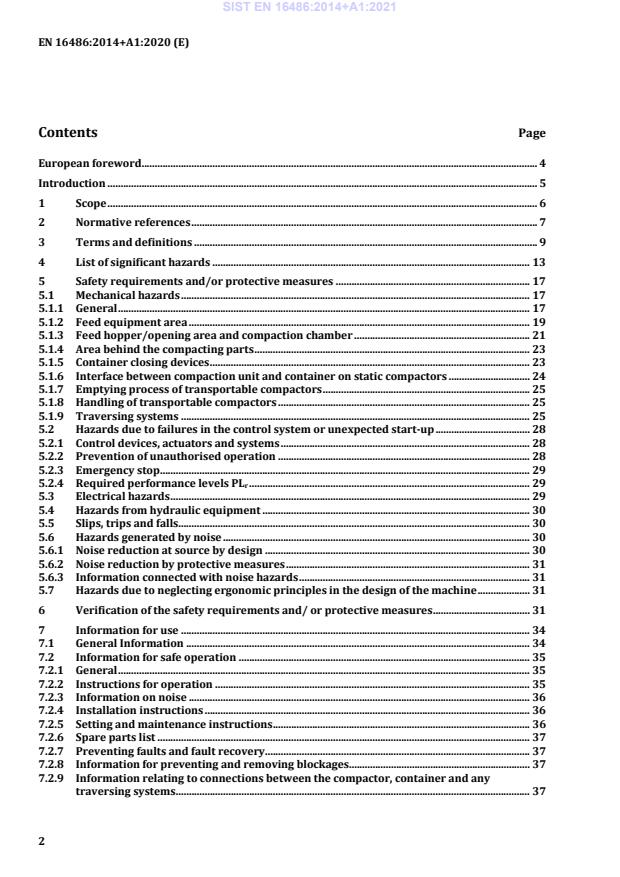
Contents Page
European foreword . 4
Introduction . 5
1 Scope . 6
2 Normative references . 7
3 Terms and definitions . 9
4 List of significant hazards . 13
5 Safety requirements and/or protective measures . 17
5.1 Mechanical hazards . 17
5.1.1 General . 17
5.1.2 Feed equipment area . 19
5.1.3 Feed hopper/opening area and compaction chamber . 21
5.1.4 Area behind the compacting parts . 23
5.1.5 Container closing devices . 23
5.1.6 Interface between compaction unit and container on static compactors . 24
5.1.7 Emptying process of transportable compactors . 25
5.1.8 Handling of transportable compactors . 25
5.1.9 Traversing systems . 25
5.2 Hazards due to failures in the control system or unexpected start-up . 28
5.2.1 Control devices, actuators and systems . 28
5.2.2 Prevention of unauthorised operation . 28
5.2.3 Emergency stop . 29
5.2.4 Required performance levels PL . 29
r
5.3 Electrical hazards . 29
5.4 Hazards from hydraulic equipment . 30
5.5 Slips, trips and falls. 30
5.6 Hazards generated by noise . 30
5.6.1 Noise reduction at source by design . 30
5.6.2 Noise reduction by protective measures . 31
5.6.3 Information connected with noise hazards . 31
5.7 Hazards due to neglecting ergonomic principles in the design of the machine . 31
6 Verification of the safety requirements and/ or protective measures . 31
7 Information for use . 34
7.1 General Information . 34
7.2 Information for safe operation . 35
7.2.1 General . 35
7.2.2 Instructions for operation . 35
7.2.3 Information on noise . 36
7.2.4 Installation instructions . 36
7.2.5 Setting and maintenance instructions . 36
7.2.6 Spare parts list . 37
7.2.7 Preventing faults and fault recovery . 37
7.2.8 Information for preventing and removing blockages . 37
7.2.9 Information relating to connections between the compactor, container and any
traversing systems . 37
7.2.10 Transportable compactors . 38
7.2.11 Information on examinations and/or inspections . 38
7.3 Marking . 39
7.3.1 Manufacturer's plate . 39
7.3.2 Safety signs . 39
Annex A (normative) Noise test code . 41
A.1 Scope . 41
A.2 Determination of emission sound pressure level at the work station(s) . 41
A.2.1 Basic standards . 41
A.2.2 Measurement uncertainty . 42
A.3 Determination of sound power levels . 42
A.3.1 Basic standards . 42
A.3.2 Measurement uncertainty . 42
A.4 Installation and mounting conditions for the noise measurement . 43
A.5 Operating conditions . 43
A.6 Information to be recorded and reported . 43
A.6.1 General . 43
A.6.2 Compactor data . 43
A.6.3 Standards used . 43
A.6.4 Noise data . 43
A.6.5 Installation and operating conditions . 43
A.7 Declaration and verification of noise emission values . 43
Annex B (informative) Preliminary dialogue between manufacturer and user . 45
Annex ZA (informative) Relationship between this European Standard and the essential
requirements of Directive 2006/42/EC machinery, and amending Directive
95/16/EC (recast) [2006 L157] aimed to be covered . 46
Bibliography . 50
European foreword
This document (EN 16486:2014+A1:2020) has been prepared by Technical Committee CEN/TC 397
“Project Committee - Baling presses - Safety requirements”, the secretariat of which is held by DIN.
This European Standard shall be given the status of a national standard, either by publication of an
identical text or by endorsement, at the latest by November 2020 and conflicting national standards
shall be withdrawn at the latest by November 2020.
Attention is drawn to the possibility that some of the elements of this document may be the subject of
patent rights. CEN shall not be held responsible for identifying any or all such patent rights.
This document supersedes !EN 16486:2014".
This document includes Amendment 1 approved by CEN on 3 March 2020.
The start and finish of text introduced or altered by amendment is indicated in the text by tags !".
This document has been prepared under a mandate given to CEN by the European Commission and the
European Free Trade Association, and supports essential requirements of EU Directive.
For relationship with EU Directive, see informative Annex ZA, which is an integral part of this
document.
According to the CEN-CENELEC Internal Regulations, the national standards organisations of the
following countries are bound to implement this European Standard: Austria, Belgium, Bulgaria,
Croatia, Cyprus, Czech Republic, Denmark, Estonia, Finland, France, Germany, Greece, Hungary, Iceland,
Ireland, Italy, Latvia, Lithuania, Luxembourg, Malta, Netherlands, Norway, Poland, Portugal, Republic of
North Macedonia, Romania, Serbia, Slovakia, Slovenia, Spain, Sweden, Switzerland, Turkey and the
United Kingdom.
Introduction
This European Standard is a type C standard as stated in EN ISO 12100:2010.
The machinery concerned and the extent to which hazards, hazardous situations and hazardous events
are covered are indicated in the scope of this document.
When provisions of this type C standard are different from those which are stated in type A or B
standards, the provisions of this type C standard take precedence over the provisions of the other
standards for machines that have been designed and built in accordance with the provisions of this type
C standard.
1 Scope
This European Standard specifies the safety requirements for the design, manufacture and information
for the safe use of compactors that compact waste material or recyclable fractions (e. g. paper, plastics,
textiles, cans, cardboard, mixed waste), hereafter referred to as materials.
This European Standard applies to:
— compactors using a horizontally moving screw, pendulum or plate as compacting part and where
the materials move horizontally; and
— compactors that are mechanically fed and/or fed by hand.
These compactors can be:
— static compactors;
— transportable compactors;
— traversing systems.
The scope includes:
— any integral mechanical feed equipment (e.g. bin lift);
— feed hoppers/openings;
— any integral pre-conditioning equipment in the hopper (e.g. perforators, pre-crushing devices and
shredders);
— any integral material flow control equipment;
— the interface between the compactor and any feed equipment (except those excluded from the
scope).
The scope of this European Standard does not cover:
— compactors that are covered by EN 1501 (all parts);
— underground compactors, however if these compactors can be used above ground this standard
applies;
— compactors using thermal technologies for compaction;
— vacuum compactors;
— compactors where materials are compacted vertically;
— containers for static compactors, however the interface between the compaction unit and the
container is included;
— bins in which materials are collected for feeding into the compactor;
— any up-stream pre-treatment equipment that is not integral to the machine and is used to treat the
materials before they are fed into the feed opening of the compactor;
— vehicles including lifting equipment used to collect and transport the compactor or container;
— cranes, lift trucks or other transportable plant used to load materials into the feed hopper/opening
and the hazards arising out of using this equipment to load;
— any suction or dust control equipment.
This European standard does not cover the lifting and transport of transportable compactors.
This European Standard does not apply to hazards arising from the materials being processed (e.g.
asbestos, clinical waste, aerosol containers).
All hazards mentioned in Clause 4 are dealt with in this European Standard.
This European Standard is not applicable for compactors which are manufactured before the date of its
publication as an EN.
2 Normative references
The following documents, in whole or in part, are normatively referenced in this document and are
indispensable for its application. For dated references, only the edition cited applies. For undated
references, the latest edition of the referenced document (including any amendments) applies.
EN 349:1993+A1:2008, Safety of machinery - Minimum gaps to avoid crushing of parts of the human body
EN 574:1996+A1:2008, Safety of machinery - Two-hand control devices - Functional aspects - Principles
for design
EN 620:2002+A1:2010, Continuous handling equipment and systems - Safety and EMC requirements for
fixed belt conveyors for bulk materials
EN 953:1997+A1:2009, Safety of machinery - Guards - General requirements for the design and
construction of fixed and movable guards
EN 1837:1999+A1:2009, Safety of machinery - Integral lighting of machines
EN 60204-1:2006, Safety of machinery - Electrical equipment of machines - Part 1: General requirements
EN 60529:1991, Degrees of protection provided by enclosures (IP Code)
EN 61496-1:2004, Safety of machinery - Electro-sensitive protective equipment - Part 1: General
requirements and tests
CLC/TS 61496-2:2006, Safety of machinery – Electro-sensitive protective equipment – Part 2: Particular
requirements for active opto-electronic protective devices (AOPDs) (IEC 61496-2:2006)
CLC/TS 61496-3:2008, Safety of machinery – Electro-sensitive protective equipment – Part 3: Particular
requirements for active opto-electronic protective devices responsive to diffuse reflection (AOPDDR)
(IEC 61496-3:2008)
EN 62262:2002, Degrees of protection provided by enclosures for electrical equipment against external
mechanical impacts (IK code) (IEC 62262:2002)
EN ISO 3744:2010, Acoustics - Determination of sound power levels and sound energy levels of noise
sources using sound pressure - Engineering methods for an essentially free field over a reflecting plane
(ISO 3744:2010)
EN ISO 3746:2010, Acoustics - Determination of sound power levels and sound energy levels of noise
sources using sound pressure - Survey method using an enveloping measurement surface over a reflecting
plane (ISO 3746:2010)
EN ISO 3747:2010, Acoustics - Determination of sound power levels and sound energy levels of noise
sources using sound pressure - Engineering/survey methods for use in situ in a reverberant environment
(ISO 3747:2010)
EN ISO 4413:2010, Hydraulic fluid power - General rules and safety requirements for systems and their
components (ISO 4413:2010)
EN ISO 4871:2009, Acoustics - Declaration and verification of noise emission values of machinery and
equipment (ISO 4871:1996)
EN ISO 9614-2:1996, Acoustics - Determination of sound power levels of noise sources using sound
intensity - Part 2: Measurement by scanning (ISO 9614-2:1996)
EN ISO 11200:2014, Acoustics - Noise emitted by machinery and equipment - Guidelines for the use of
basic standards for the determination of emission sound pressure levels at a work station and at other
specified positions (ISO 11200:2014)
EN ISO 11201:2010, Acoustics - Noise emitted by machinery and equipment - Determination of emission
sound pressure levels at a work station and at other specified positions in an essentially free field over a
reflecting plane with negligible environmental corrections (ISO 11201:2010)
EN ISO 11202:2010, Acoustics - Noise emitted by machinery and equipment - Determination of emission
sound pressure levels at a work station and at other specified positions applying approximate
environmental corrections (ISO 11202:2010)
EN ISO 11204:2010, Acoustics - Noise emitted by machinery and equipment - Determination of emission
sound pressure levels at a work station and at other specified positions applying accurate environmental
corrections (ISO 11204:2010)
EN ISO 12100:2010, Safety of machinery - General principles for design - Risk assessment and risk
reduction (ISO 12100:2010)
EN ISO 13849-1:2008, Safety of machinery - Safety-related parts of control systems - Part 1: General
principles for design (ISO 13849-1:2006)
EN ISO 13850:2008, Safety of machinery - Emergency stop - Principles for design (ISO 13850:2006)
EN ISO 13855:2010, Safety of machinery - Positioning of safeguards with respect to the approach speeds
of parts of the human body (ISO 13855:2010)
EN ISO 13856-1:2013, Safety of machinery - Pressure-sensitive protective devices - Part 1: General
principles for design and testing of pressure-sensitive mats and pressure-sensitive floors (ISO 13856-
1:2013)
EN ISO 13856-2:2013, Safety of machinery - Pressure-sensitive protective devices - Part 2: General
principles for design and testing of pressure-sensitive edges and pressure-sensitive bars (ISO 13856-
2:2013)
EN ISO 13857:2008, Safety of machinery - Safety distances to prevent hazard zones being reached by
upper and lower limbs (ISO 13857:2008)
EN ISO 14119:2013, Safety of machinery - Interlocking devices associated with guards - Principles for
design and selection (ISO 14119:2013)
EN ISO 14122-1:2001, Safety of machinery - Permanent means of access to machinery - Part 1: Choice of
fixed means of access between two levels (ISO 14122-1:2001)
EN ISO 14122-2:2001, Safety of machinery - Permanent means of access to machinery - Part 2: Working
platforms and walkways (ISO 14122-2:2001)
EN ISO 14122-3:2001, Safety of machinery - Permanent means of access to machinery - Part 3: Stairs,
stepladders and guard-rails (ISO 14122-3:2001)
EN ISO 14122-4:2004, Safety of machinery - Permanent means of access to machinery - Part 4: Fixed
ladders (ISO 14122-4:2004)
3 Terms and definitions
For the purposes of this document, the terms and definitions given in EN ISO 12100:2010 and the
following apply.
3.1
compactor
machine, consisting of a compaction unit and container that compacts loose materials into a container
(materials can include, but are not limited to, paper, plastics, textiles, cans, cardboard and mixed waste)
Note 1 to entry: A compactor can consist of e. g. a control system and control station, mechanical feed
equipment such as a bin lift, feed hopper, compaction chamber, compacting equipment, container and any
associated container closing device. Compactors can be manually or mechanically fed.
Note 2 to entry: Compactors can be:
— static, i. e. the compaction unit is fixed at one location and the container is transportable;
— transportable and used at different locations, i. e. it is transported to and from different locations by
e.g. road vehicles;
— part of a traversing system.
3.1.1
static compactor
compactor on which the compaction unit is fixed and the container is not integral with the compactor
Figure 1 — Example of a static compactor
3.1.2
transportable compactor
self-contained compaction unit and container, which can be transported as a complete unit
Figure 2 — Example of a transportable compactor
3.2
container
the material-receiving container into which the loose material is compacted by the compaction unit
Note 1 to entry: On a transportable compactor the container is an integral part of the compactor.
Note 2 to entry: On a static compactor the container is not an integral part of the compactor, however the
interface between the compaction unit and the container is covered in this standard, see Scope.
3.3
coupling device
mechanism for clamping the container to the main body of the compaction unit and holding it in
position
3.4
traversing system
installation composed of:
— either several containers that are placed on a carrier system that traverses (e.g. on rails) in front of
a static compactor;
— or several containers that are placed in front of a traversing compactor (e.g. on rails)
Note 1 to entry: Where the containers traverse only the compactor, the carrier system and the interface
between the compactor and containers are covered by this standard
3.5
integral pre-conditioning equipment
equipment that is mounted/fixed to the compactor and is used to treat the material being fed into the
compactor to help compaction, e.g. perforators, rufflers, pre-crushers and shredders
Note 1 to entry: These devices can be fixed, or inserted into and retracted from, the feed hopper.
3.6
integral material flow control equipment
equipment that is mounted/fixed to the compactor and helps material in the feed opening flow into the
compaction chamber and/or prevent blockages or bridging, e.g. forced feeding device for screw
compactors
3.7
feed equipment
equipment used for feeding materials to be compacted into the compaction chamber
3.8
integral feed equipment
mechanical feed equipment i.e. conveyor or bin lift that is:
— mounted/fixed to the compactor;
— the power supply and control system of which are linked into the compactors systems
3.9
bin lift
mechanical feed equipment for lifting a bin containing materials and tipping the contents into the
compaction chamber of the compactor
3.10
bin
container, usually fitted with wheels, in which material are collected ready for feeding into the
compaction chamber of the compactor
3.11
feed hopper
chute through which materials being fed to the compactor are guided into the compaction chamber
3.12
feed opening
opening through which materials are fed into the compaction chamber
3.13
manual feeding
loading materials directly into the feed hopper/opening by hand
3.14
mechanical feeding
loading materials into the feed hopper/opening by mechanical means, e.g. conveyors, bin lifts
3.15
compaction chamber
chamber into which material is fed and in which one or more compacting parts move to press and
compact the material into the receiving container
3.16
compacting part
device for the compacting process/movement; the device can be a plate, a screw or a pendulum
3.17
compacting equipment
all components directly involved in pressing the loose materials into the container and compacting
them inside the container (e.g. hydraulic system, compacting parts, compaction chamber)
3.18
compaction unit
the part of the compactor containing the compacting equipment
3.19
cycle of the compacting part
complete forward and reverse movement of the compacting part or a complete 360° rotation
3.20
multiple cycle
operating mode in which the machine cycles during a pre-set time, then stops automatically
3.21
automatic initiation of cycles
operating mode in which the successive cycles of compacting equipment are initiated by either a
sensing device detecting the presence of materials to be compacted or by time delay
3.22
container closing device
device inserted across the container feed opening to prevent the compacted materials falling out of the
container when it is separated from the compaction unit for transport. This device can be e. g.:
— a series of pins and tubes, or
— a frame, or
— cables, or
— a power or manually-operated door
3.23
discharge door
door that allows emptying compacted materials out of the container
3.24
control station
place from which the compactor is started, stopped or controlled by an operator
3.25
access platform
permanent platform that allows access at height for operating and feeding the compactor (including
viewing the interior of the feed hopper and/or compacting chamber), troubleshooting or maintenance
Note 1 to entry: Access platforms can be fixed to the compactor, floor or building structure.
3.26
work station
a position in the vicinity of the machine which is intended for the operator
EXAMPLES: control station, feeding position, bin lift operation control station.
3.27
maintenance
combination of all technical, administrative and managerial actions during the life cycle of an item
intended to retain it in, or restore it to, a state in which it can perform the required function
[SOURCE: 2.1 of EN 13306:2010]
3.28
troubleshooting
identification and rectification of operational failures (e. g. clearing blockages or removing unwanted
items from the compaction chamber)
3.29
sensitive protective equipment (SPE)
equipment for detecting persons or parts of persons which generates an appropriate signal to the
control system to reduce risks to the persons detected
Note 1 to entry: The signal can be generated when a person or part of a person goes beyond a predetermined
limit – for example enters a hazard zone – (tripping) or when a person is detected in a predetermined zone
(presence sensing), or in both cases.
[SOURCE: 3.28.5 of EN ISO 12100:2010]
4 List of significant hazards
Table 1 lists the significant hazards that are present on compactors. It cross-references the subclauses
of this standard in which the corresponding safety requirements and/or protective measures are
specified.
Table 1 — List of significant hazards
Significant hazards Applicable
subclauses
4.1 Mechanical hazards
4.1.1 General 5.1.1,
Impact or crushing when the compactor or container is being placed 5.2.4,
into its normal operating position.
!5.3,"
Impact, crushing or shearing while clearing blockages.
7.2.2,
Impact, crushing or shearing by unintended movement of the
7.2.4,
compacting parts and any powered vertically operating ancillary
7.2.5,
equipment attached to the compactor (e.g. powered dejamming or
7.2.8
closing device).
Injury during cleaning and maintenance procedures.
Impact or crushing by movement of a power-operated movable
guard.
!Injury due to incorrect phase order."
4.1.2 Feed equipment area 5.1.1.2,
Impact, crushing and shearing between the bin lift and the 5.1.2,
compactor, or between moving parts of the bin lift, or being picked
5.2.1,
up by moving parts of the bin lift mechanism.
5.2.4,
Drawing-in and crushing between moving transmission parts of the
7.2.4,
bin lift.
7.3.2
Being struck by the bin in the event of it falling out of the bin lift
while in a raised position.
Being struck by material falling from the bin when it is in a raised
position.
Falling onto the conveyor.
Falling when walking on conveyors.
Drawing-in and crushing between moving transmission parts of
conveyors.
Being struck by material falling from the conveyor.
Significant hazards Applicable
subclauses
4.1.3 Feed hopper/opening area and compaction chamber 5.1.1.1,
Reaching into, or falling down the feed hopper/opening into the 5.1.1.2,
compaction chamber during loading, cleaning, troubleshooting or
5.1.3,
maintenance, followed by crushing or shearing by the compacting
5.2.1,
parts.
5.2.4,
Crushing, shearing, drawing-in or impact by integral pre-
5.3,
conditioning/material flow control equipment in the feed hopper
5.4,
including residual rotation during retraction.
7.2.2,
Crushing and shearing between the integral pre-conditioning
equipment and fixed parts when the equipment is inserted into, or
7.2.5,
retracted from, the feed hopper.
7.3.2
Crushing, shearing or impact by the compacting parts during
compaction.
Drawing into the screw by material on screw compactors.
Crushing and shearing by the compacting parts after entering the
feed hopper/opening for troubleshooting, cleaning and maintenance.
Crushing or shearing by the compacting parts after gaining access
into the compaction chamber through maintenance and inspection
openings.
Crushing, shearing or impact by unintended movement of the
compacting part caused by failure of an electrical or hydraulic
component.
Impact from being struck by objects ejected from the compactor.
Being struck by materials being fed into the compaction chamber
during troubleshooting, cleaning or maintenance.
Being struck or buried by material when clearing a blockage in a feed
hopper equipped with an access door.
Impact due to a horizontally-hinged lid or door, used for closing the
feed hopper/opening, unexpectedly falling into the closed or open
position.
4.1.4 Area behind the compacting parts 5.1.1.2,
Crushing by moving parts associated with the drive mechanism or 5.1.4,
hydraulic ram powering the compacting parts.
5.2.4,
Crushing and/or shearing between the compacting parts and fixed
parts.
4.1.5 Container closing devices 5.1.1.2,
Impact or crushing by moving parts of the container closing devices. 5.1.5,
Impact, crushing or shearing by moving compacting parts where it is 5.2.4,
possible to reach through holes designed for container closing
7.2.9
devices.
Significant hazards Applicable
subclauses
4.1.6 Interface between compaction unit and container on static 5.1.6,
compactors
5.2.4,
Impact or crushing by the closing and opening of the coupling device.
7.2.4,
Crushing or shearing by the compacting parts after gaining access
7.2.9
into the compaction chamber through the opening at the interface
between the compaction unit and the container.
Impact caused by a breakage of container closing devices that consist
of pins (e.g. Polytetrafluoroethylene (PTFE) pins) or cables.
4.1.7 Emptying process of transportable compactors 5.1.7
Impact or crushing as a result of the discharge door opening.
Impact or crushing due to sudden opening of the discharge door as a
result of pressure from the compacted materials or as a result of
failure of the main closing system.
4.1.8 Handling of transportable compactors 5.1.8,
Impact, shearing or crushing from handling transportable 7.2.10
compactors.
4.1.9 Traversing systems 5.1.9,
Impact or crushing from the traversing operation. 5.2.2,
Crushing and shearing between moving and fixed/moving parts. 5.2.4,
Impact from falling off the traversing compactor. 5.3,
Impact from materials being loaded during traversing. 7.2.9
Electric shock or burns from electrical components.
Crushing, shearing or impact as a result of derailment.
Tripping or falling on the guiding device for a traversing system.
Tripping, entanglement or electrical hazards by cables or hoses
dragging on the floor or becoming entangled in the compactor.
4.2 Hazards due to failures in the control system or unexpected 5.2
start-up
7.2.2
4.3 Electrical hazards 5.3,
Electric shock or burns due to direct or indirect contact with live 7.2.2
parts.
!Injury due to incorrect phase order."
4.4 Hazards from hydraulic equipment 5.4
Hazards arising from unintentional release of liquids under pressure 7.2.2
from the hydraulic system, particularly from hoses and their fittings.
4.5 Slip, trip and fall hazards 5.5
Impact resulting from tripping or slipping on access platforms
and/or associated steps or stairways provided at working positions
to which access is needed for operation, maintenance, cleaning or
troubleshooting.
Impact due to an external fall from height from any raised working
position to which access is required for operation, maintenance,
Significant hazards Applicable
subclauses
cleaning or troubleshooting.
4.6 Hazards generated by noise 5.6, 7.2.3,
Hearing loss, tinnitus, physiological disorders, loss of balance or Annex A
awareness, tiredness, accidents due to interference with auditory
signals and speech communication due to noise, generated by
movement of the compacting equipment, integral pre-conditioning,
material flow control and feed equipment.
4.7 Hazards due to neglecting ergonomic principles in the design of 5.7
the machine
Musculoskeletal disorders resulting from:
— repetitive efforts to load materials into the feed hopper or
compaction chamber;
— bending, lifting and reaching when installing or removing
container closing devices or as a result of excessive efforts to put
the container closing devices into place when the container is
overfilled;
— bending, lifting and reaching when installing or removing
coupling devices;
— excessive efforts or bad postures when opening the discharge
door;
— poor ergonomic design of traversing systems.
4.8 Hazards due to poor or non-existent organisation, training or 7
instructions
5 Safety requirements and/or protective measures
5.1 Mechanical hazards
5.1.1 General
5.1.1.1 Basic requirements
Compactors shall comply with the safety requirements and/or protective measures of this clause. In
addition, the machines shall be designed in accordance with the principles of EN ISO 12100:2010 for
relevant but not significant hazards, which are not dealt with by this document (e. g. sharp edges).
It is advisable that a dialogue take place between the manufacturer and the user regarding the
installation and positioning of the machine (see informative Annex B).
Compactors shall be designed and constructed to allow safe access for cleaning. Access points shall be
safeguarded in accordance with EN 953:1997+A1:2009. Other design features (e. g. collection trays)
should be considered to reduce the need for access to clean.
Compactors shall be designed in such a way that mirrors or closed circuit television cameras can be
installed in order to give the operator a good view into the feed hopper or the compaction chamber.
Compactors with closed feed hoppers/openings are exempted from this requirement.
The control station shall be arranged to allow the operator a good view of the compactor, especially of
the conveyor or bin lift and the feed hopper/opening. A good view can be direct and/or with visibility
aids.
Compactors shall be designed and constructed so that the risk of blockages of the material being
processed is reduced to the lowest level.
NOTE Measures for reducing the risk of blockages include e. g.:
— where a series of conveyors is used to transfer materials to the feed hopper/opening then the speed
should increase from one conveyor to the next;
— swan neck conveyors;
— level detection sensors monitoring the feeding and the compacting processes;
— automatic diversion flaps and chutes that divert the continuously fed material elsewhere;
— material levelling devices that act to limit the depth of the material travelling on the conveyor;
— feed hoppers with smooth internal surfaces that include no ledges (on which material might bridge);
— feed hoppers that have a uniform cross section (as opposed to a reducing cross section) for the whole
of their length;
— on compactors fed by bin lifts, ensuring that the internal volume of the compacting chamber and/or
hopper is greater than the volume of the biggest bin;
— on compactors fed by bin lifts where the feed hopper will not take the whole volume of the bin,
ensuring that the bin lift cannot tip the contents of a bin into the feed hopper until the compacting part is fully
retracted;
— retention devices to prevent the compacted material moving backwards into the compaction chamber
(e.g. flaps, non- return safety catches or teeth).
Compactors shall be designed and constructed so that any blockages that do occur can be cleared
without a person having to gain direct access onto, or into, the hazard areas listed in 4.1.3, e. g. by
providing a powered dejamming device (such as a pneumatic ram) above the feed hopper. If this is not
possible, see 7.2.8.
Unintended movement of the compacting parts and any powered vertically operating ancillary
equipment (e.g. powered dejamming or closing device) attached to the compactor shall be prevented by
one of the following:
— a check valve fitted to the hydraulic or pneumatic cylinders to protect against dangerous movement
in the event of a hose or pipe failure in the hydraulic or pneumatic system;
— a self-locking irreversible transmission with mechanical drive;
— a spring-applied brake with motor fitted to the mechanical drive;
— a mechanical restraint device.
Compactors shall be equipped with a lockable power isolator for maintenance. See also 7.2.5.
Maintenance and inspection doors shall be designed as interlocking guards in accordance with 5.1.1.2
and 5.2.4.
5.1.1.2 Safeguards
The design of the compactor shall ensure that wherever possible crushing, shearing, impact, puncture
and drawing-in points are eliminated. Where these hazards cannot be eliminated, safeguarding shall be
applied using one or a combination of the following.
— Fixed guards that are in accordance with EN 953:1997+A1:2009.
— Movable interlocking guards that are in accordance with EN 953:1997+A1:2009 and
EN ISO 14119:2013. The interlocking guards shall be positioned in accordance with
EN ISO 13855:2010 so that opening one of them stops the movement of any dangerous part of
machinery before any part of a person enters the danger zone.
— Sensitive protective equipment (SPE) as defined in EN ISO 12100:2010, 3.28.5, that is in accordance
with the relevant standards: EN ISO 13855:2010, EN
...