

EN 15273-2:2013
(Main)Railway applications - Gauges - Part 2: Rolling stock gauge
General Information
- Abstract
This document is applicable to the authorities involved in all types of railway operation.
This European Standard is applicable to new vehicle designs, to modifications and to the checking of the gauge for vehicles already in use.
The application of the rules of this European Standard makes it possible to determine the maximum dimensions of vehicles related to the structures.
This European Standard contains:
- the associated rules for all the gauges for rolling stock;
- the requirements for composing the technical gauge report to submit to the Acceptance Authority in order to confirm vehicle conformity to this standard;
- the requirements for maintaining the vehicle characteristics influencing gauging throughout its operational life.
- Status
- Withdrawn
- Publication Date
- 07-May-2013
- Withdrawal Date
- 29-Sep-2026
- Technical Committee
- CEN/TC 256 - Railway applications
- Drafting Committee
- CEN/TC 256/WG 32 - Vehicle gauge
- Current Stage
- 9960 - Withdrawal effective - Withdrawal
- Start Date
- 16-Nov-2016
- Completion Date
- 30-Sep-2026
- Directive
- 2008/57/EC - DIRECTIVE 2008/57/EC OF THE EUROPEAN PARLIAMENT AND OF THE COUNCIL of 17 June 2008 on the interoperability of the rail system within the Community (Recast)OJ Ref: C, C 345 OJ Date: 26-Nov-2013

Relations
- Effective Date
- 15-May-2013
- Effective Date
- 18-Jan-2023
- Effective Date
- 09-Feb-2026
- Refers
EN 12299:2024 - Railway applications - Ride comfort for passengers - Measurement and evaluation - Effective Date
- 28-Jan-2026
- Effective Date
- 28-Jan-2026
- Effective Date
- 28-Jan-2026
- Effective Date
- 28-Jan-2026
- Effective Date
- 28-Jan-2026
- Effective Date
- 28-Jan-2026
- Effective Date
- 28-Jan-2026
- Effective Date
- 08-Jul-2015
Get Certified
Connect with accredited certification bodies for this standard

IRIS Certification (UNIFE)
International Railway Industry Standard certification.

TÜV SÜD Rail GmbH
TÜV SÜD railway certification services.

Bureau Veritas Railway Certification
Railway and transportation certification.
Sponsored listings
Frequently Asked Questions
EN 15273-2:2013 is a standard published by the European Committee for Standardization (CEN). Its full title is "Railway applications - Gauges - Part 2: Rolling stock gauge". This standard covers: This document is applicable to the authorities involved in all types of railway operation. This European Standard is applicable to new vehicle designs, to modifications and to the checking of the gauge for vehicles already in use. The application of the rules of this European Standard makes it possible to determine the maximum dimensions of vehicles related to the structures. This European Standard contains: - the associated rules for all the gauges for rolling stock; - the requirements for composing the technical gauge report to submit to the Acceptance Authority in order to confirm vehicle conformity to this standard; - the requirements for maintaining the vehicle characteristics influencing gauging throughout its operational life.
This document is applicable to the authorities involved in all types of railway operation. This European Standard is applicable to new vehicle designs, to modifications and to the checking of the gauge for vehicles already in use. The application of the rules of this European Standard makes it possible to determine the maximum dimensions of vehicles related to the structures. This European Standard contains: - the associated rules for all the gauges for rolling stock; - the requirements for composing the technical gauge report to submit to the Acceptance Authority in order to confirm vehicle conformity to this standard; - the requirements for maintaining the vehicle characteristics influencing gauging throughout its operational life.
EN 15273-2:2013 is classified under the following ICS (International Classification for Standards) categories: 45.020 - Railway engineering in general; 45.060.01 - Railway rolling stock in general. The ICS classification helps identify the subject area and facilitates finding related standards.
EN 15273-2:2013 has the following relationships with other standards: It is inter standard links to EN 15273-2:2009, EN 15273-2:2013+A1:2016, EN 50119:2020, EN 12299:2024, EN 14363:2016+A2:2022, EN 15663:2017+A2:2024, EN 15273-3:2013, EN 14033-1:2017, EN 15954-1:2013, EN 15273-1:2013, EN 15273-2:2013/FprA1. Understanding these relationships helps ensure you are using the most current and applicable version of the standard.
EN 15273-2:2013 is associated with the following European legislation: EU Directives/Regulations: 2008/57/EC; Standardization Mandates: M/483. When a standard is cited in the Official Journal of the European Union, products manufactured in conformity with it benefit from a presumption of conformity with the essential requirements of the corresponding EU directive or regulation.
EN 15273-2:2013 is available in PDF format for immediate download after purchase. The document can be added to your cart and obtained through the secure checkout process. Digital delivery ensures instant access to the complete standard document.
Standards Content (Sample)
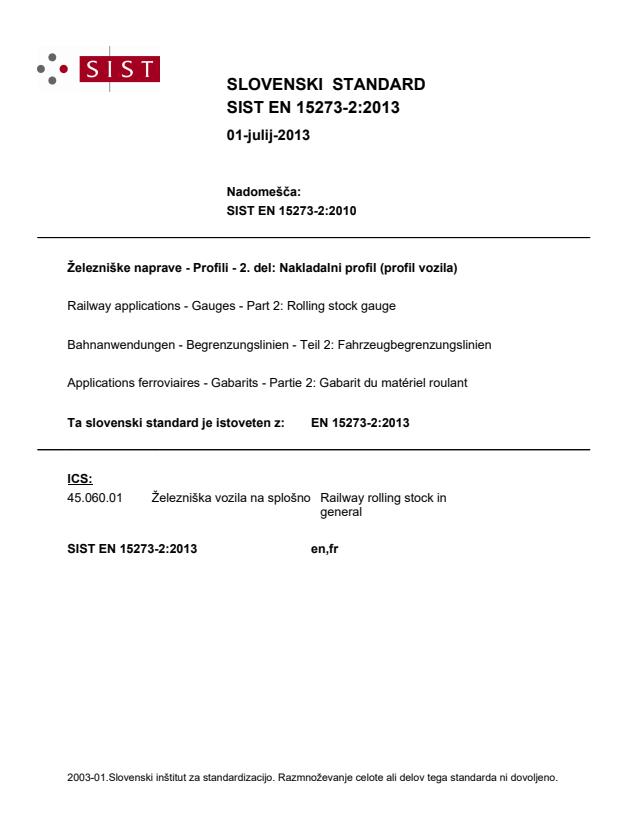
2003-01.Slovenski inštitut za standardizacijo. Razmnoževanje celote ali delov tega standarda ni dovoljeno.Železniške naprave - Profili - 2. del: Nakladalni profil (profil vozila)Bahnanwendungen - Begrenzungslinien - Teil 2: FahrzeugbegrenzungslinienApplications ferroviaires - Gabarits - Partie 2: Gabarit du matériel roulantRailway applications - Gauges - Part 2: Rolling stock gauge45.060.01Železniška vozila na splošnoRailway rolling stock in generalICS:Ta slovenski standard je istoveten z:EN 15273-2:2013SIST EN 15273-2:2013en,fr01-julij-2013SIST EN 15273-2:2013SLOVENSKI
STANDARDSIST EN 15273-2:20101DGRPHãþD
EUROPEAN STANDARD NORME EUROPÉENNE EUROPÄISCHE NORM
EN 15273-2
May 2013 ICS 45.020; 45.060.01 Supersedes EN 15273-2:2009English Version
Railway applications - Gauges - Part 2: Rolling stock gauge
Applications ferroviaires - Gabarits - Partie 2: Gabarit du matériel roulant
Bahnanwendungen - Begrenzungslinien - Teil 2: Fahrzeugbegrenzungslinien This European Standard was approved by CEN on 15 December 2012.
CEN members are bound to comply with the CEN/CENELEC Internal Regulations which stipulate the conditions for giving this European Standard the status of a national standard without any alteration. Up-to-date lists and bibliographical references concerning such national standards may be obtained on application to the CEN-CENELEC Management Centre or to any CEN member.
This European Standard exists in three official versions (English, French, German). A version in any other language made by translation under the responsibility of a CEN member into its own language and notified to the CEN-CENELEC Management Centre has the same status as the official versions.
CEN members are the national standards bodies of Austria, Belgium, Bulgaria, Croatia, Cyprus, Czech Republic, Denmark, Estonia, Finland, Former Yugoslav Republic of Macedonia, France, Germany, Greece, Hungary, Iceland, Ireland, Italy, Latvia, Lithuania, Luxembourg, Malta, Netherlands, Norway, Poland, Portugal, Romania, Slovakia, Slovenia, Spain, Sweden, Switzerland, Turkey and United Kingdom.
EUROPEAN COMMITTEE FOR STANDARDIZATION
COMITÉ EUROPÉEN DE NORMALISATION EUROPÄISCHES KOMITEE FÜR NORMUNG
Management Centre:
Avenue Marnix 17,
B-1000 Brussels © 2013 CEN All rights of exploitation in any form and by any means reserved worldwide for CEN national Members. Ref. No. EN 15273-2:2013: ESIST EN 15273-2:2013
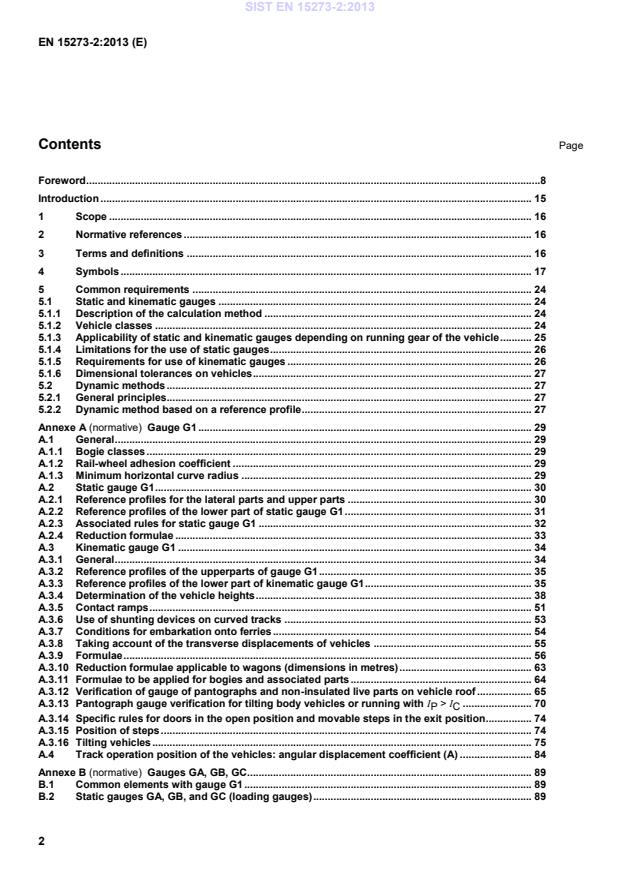
Page Foreword .8 Introduction . 15 1 Scope . 16 2 Normative references . 16 3 Terms and definitions . 16 4 Symbols . 17 5 Common requirements . 24 5.1 Static and kinematic gauges . 24 5.1.1 Description of the calculation method . 24 5.1.2 Vehicle classes . 24 5.1.3 Applicability of static and kinematic gauges depending on running gear of the vehicle . 25 5.1.4 Limitations for the use of static gauges . 26 5.1.5 Requirements for use of kinematic gauges . 26 5.1.6 Dimensional tolerances on vehicles . 27 5.2 Dynamic methods . 27 5.2.1 General principles. 27 5.2.2 Dynamic method based on a reference profile . 27 Annexe A (normative)
Gauge G1 . 29 A.1 General . 29 A.1.1 Bogie classes . 29 A.1.2 Rail-wheel adhesion coefficient . 29 A.1.3 Minimum horizontal curve radius . 29 A.2 Static gauge G1 . 30 A.2.1 Reference profiles for the lateral parts and upper parts . 30 A.2.2 Reference profiles of the lower part of static gauge G1 . 31 A.2.3 Associated rules for static gauge G1 . 32 A.2.4 Reduction formulae . 33 A.3 Kinematic gauge G1 . 34 A.3.1 General . 34 A.3.2 Reference profiles of the upperparts of gauge G1 . 35 A.3.3 Reference profiles of the lower part of kinematic gauge G1 . 35 A.3.4 Determination of the vehicle heights . 38 A.3.5 Contact ramps . 51 A.3.6 Use of shunting devices on curved tracks . 53 A.3.7 Conditions for embarkation onto ferries . 54 A.3.8 Taking account of the transverse displacements of vehicles . 55 A.3.9 Formulae . 56 A.3.10 Reduction formulae applicable to wagons (dimensions in metres) . 63 A.3.11 Formulae to be applied for bogies and associated parts . 64 A.3.12 Verification of gauge of pantographs and non-insulated live parts on vehicle roof . 65 A.3.13 Pantograph gauge verification for tilting body vehicles or running with IP > IC . 70 A.3.14 Specific rules for doors in the open position and movable steps in the exit position . 74 A.3.15 Position of steps . 74 A.3.16 Tilting vehicles . 75 A.4 Track operation position of the vehicles: angular displacement coefficient (A) . 84 Annexe B (normative)
Gauges GA, GB, GC. 89 B.1 Common elements with gauge G1 . 89 B.2 Static gauges GA, GB, and GC (loading gauges) . 89 SIST EN 15273-2:2013
Gauges GB1, GB2 . 102 C.1 Static gauges GB1 and GB2 . 102 C.1.1 Reference profile of static gauge GB1 . 102 C.1.2 Kinematic gauges GB1 and GB2 . 104 Annexe D (normative)
Kinematic gauge GI3 . 106 D.1 Reference profile GI3 . 106 D.2 Associated rules for the kinematic reference profile to determine the maximum vehicle profile . 107 D.2.1 Traction units (except motor coaches) . 107 D.2.2 Motor coaches . 109 D.2.3 Coaches and vans . 110 D.2.4 Wagons . 112 Annexe E (normative)
Gauge G2 . 115 E.1 Static gauge G2 . 115 E.1.1 Reference profile for static gauge G2 . 115 E.1.2 Reference profile of kinematic gauge G2. 116 Annexe F (normative)
Finnish gauge FIN1 . 117 F.1 General . 117 F.2 Associated rules . 117 F.2.1 Vertical position of the vehicle . 117 F.2.2 Lower parts of the rolling stock . 117 F.2.3 Rolling stock parts close to the wheel flanges . 117 F.2.4 Rolling stock width . 118 F.2.5 Movable steps and access doors opening outwards for coaches and motor coaches . 118 F.2.6 Pantographs and non-insulated roof-mounted parts . 118 F.2.7 Rules and instructions . 118 F.3 Reduction formulae . 118 F.3.1 General rules . 118 F.3.2 Reduction formulae . 119 F.4 Reference profiles of gauge FIN1 . 120 F.5 Increase in the minimum height of the lower part of the rolling stock able to pass over marshalling humps and rail brakes . 121 F.6 Increase in the minimum height of the lower part of the rolling stock unable to pass over marshalling humps and rail brakes . 121 F.7 Passage over transitions and humps . 122 F.7.1 Position of rail brakes and other shunting devices . 122 F.7.2 Running over marshalling hump passing track . 123 F.8 Gauge of the vehicle lower step . 123 F.8.1 General . 123 F.8.2 Requirements for the distance between the step and the platform in the transverse plane . 124 F.8.3 Gauge check . 124 F.9 Gauge of outwards opening doors and of folded down steps for coaches and motor coaches . 124 F.9.1 General . 124 F.9.2 Requirements for the distance between the door and the fixed equipment in the transverse plane . 125 F.9.3 Gauge check . 125 SIST EN 15273-2:2013
French gauge FR 3.3 . 127 G.1 General . 127 G.2 Reference profile of kinematic gauge FR 3.3 . 128 G.3 Reference kinematic profiles for lower parts . 128 G.4 Associated rules for kinematic gauge FR 3.3 for determining the kinematic gauge . 128 G.4.1 Vertical reductions. 128 G.4.2 Transversal reductions for heights h > 3,250 m . 129 G.4.3 Verification of gauge of pantographs and non-insulated live parts on vehicle roof . 134 Annexe H (normative)
Belgian gauges BE1, BE2 and BE3 . 135 H.1 General . 135 H.2 Associated rules . 135 H.2.1 Rules for the lower parts . 135 H.2.2 Upwards vertical displacements . 135 H.2.3 Side doors in the open position . 136 H.2.4 Movable step rules. 136 H.2.5 Pantograph rules . 136 H.3 Kinematic reference profiles for the upper parts . 137 H.4 Reduction formulae . 139 H.4.1 Reduction formulae for traction units . 139 H.4.2 Reduction formulae for hauled vehicles . 142 H.5 Kinematic gauge of the 3 kV and 25 kV pantograph in the collection position on the Belgian network . 145 H.5.1 General principles. 145 H.5.2 Verification of pantographs located between the end wheelsets or between the bogie centres (verification of stationary vehicle on a canted track) . 145 H.5.3 Verification of pantographs located beyond the end wheelsets or beyond the bogie centres (verification in operation on an insufficiently canted track) . 146 H.5.4 Pantographs in the lowered position . 146 H.5.5 Other non-insulated roof-mounted parts . 146 Annexe I (normative)
Portuguese gauges PTb, PTb+, PTc . 148 I.1 General . 148 I.2 Kinematic reference profiles . 149 I.3 Reference profiles for the lower part . 152 I.4 Associated rules for PT gauges . 153 I.4.1 Vertical displacements . 153 I.4.2 Transverse displacements . 153 I.4.3 Associated rules for the parts of height h < 400 mm above the running surface . 153 I.4.4 Reduction formulae . 154 I.5 Associated rules for pantographs and other roof-mounted parts . 158 I.5.1 Reference profile for pantographs . 158 I.5.2 Pantograph in collecting position . 159 I.5.3 Pantograph in the lowered position and other roof-mounted parts . 160 I.6 Associated rules for tilting body vehicles . 160 I.6.1 Quasi-static displacements (zp) . 160 I.6.2 Calculation of the reductions . 161 I.6.3 Requirement for adjusting the tilting system for vehicles fitted with active systems . 162 I.6.4 Limits related to the speed of tilting body vehicles . 163 Annexe J (normative)
Swedish gauges SEa and SEc . 164 J.1 Swedish dynamic gauges SEa and SEc: General . 164 J.2 Reference profiles. 165 J.3 Reference profile of gauge SEa . 165 J.4 Reference profile for lower part of gauges SEa and SEc . 166 J.5 Pantograph reference profile for gauge SEa . 166 J.6 Dynamic reference profile SEc . 167 J.6.1 Reference profile for parts below 0,15 m of gauge SEc . 167 J.6.2 Reference profile for pantograph for gauge SEc . 168 SIST EN 15273-2:2013
Static gauges OSJD . 191 K.1 Static reference profiles of the upper parts (for rolling stock) . 191 K.2 Associated rules . 193 K.2.1 Additional overthrows for h 3,220 m . 193 K.2.2 Reduction formulae . 193 K.3 Determination of the allowable vertical dimensions . 195 K.4 Static reference profiles for the lower parts . 196 Annexe L (normative)
German gauges DE1, DE2, DE3 . 198 L.1 Gauge DE1 . 198 L.1.1 Kinematic reference profile . 198 L.1.2 Associated rules . 199 L.2 Kinematic gauge DE2 . 200 L.2.1 Kinematic reference profile . 200 L.2.2 Associated rules . 201 L.3 Kinematic gauge DE3 . 202 L.3.1 Kinematic reference profile . 202 L.3.2 Associated rules . 202 L.4 Absolute gauging of pantographs . 203 L.4.1 General . 203 L.4.2 Associated rules . 203 L.4.3 Contact wire . 205 L.4.4 Responsibility for input data . 205 Annexe M (normative)
Netherlands gauges NL1 and NL2 . 208 M.1 Reference profiles of kinematic gauges NL1 and NL2 . 208 SIST EN 15273-2:2013
UK gauging methods . 210 N.1 General . 210 N.1.1 Gauge types . 210 N.1.2 Maintenance . 210 N.1.3 Tolerances . 210 N.1.4 Multiple operation . 210 N.1.5 Configuration . 210 N.1.6 Reference axes . 211 N.1.7 Vehicle data . 211 N.2 Static gauging . 211 N.2.1 Principles . 211 N.2.2 Vehicle geometry . 212 N.2.3 Suspension displacements . 213 N.3 Dynamic gauging . 214 N.3.1 Principles . 214 N.3.2 Geometric gauging . 214 N.3.3 Absolute gauging. 216 N.3.4 Comparative gauging . 218 N.3.5 Vehicle shape and size . 221 N.3.6 Range of operating conditions . 222 N.3.7 Suspension movements . 225 N.3.8 Calculating swept envelopes . 225 N.3.9 Dynamic reference profiles . 232 N.3.10 Assessing the vehicle . 235 N.4 UK geometric gauges . 236 Annexe O (informative)
Recommended practice for dynamic gauging . 237 O.1 Vehicle models . 237 O.1.1 Principles . 237 O.1.2 Vehicle conditions . 237 O.1.3 Masses . 237 O.1.4 Suspension modelling . 238 O.1.5 Stiffness . 238 O.1.6 Dampers . 238 O.1.7 Air springs . 238 O.1.8 Swing links . 239 O.1.9 Friction . 239 O.1.10 Active devices . 239 O.1.11 Inter-vehicle connections . 239 O.1.12 Suspension component tolerances . 240 O.1.13 Suspension maintenance allowances . 240 O.1.14 Suspension failure modes . 240 O.1.15 Vehicle modelling accuracy . 240 O.2 Validation of vehicle modelling . 240 O.2.1 General notes on validation tests . 240 O.2.2 Simulation model . 242 O.2.3 Matching accuracy. 243 O.2.4 Weighbridge test . 243 O.2.5 Bogie rotation test . 244 O.2.6 Sway test . 244 O.2.7 Dynamic ride test . 245 O.3 Simulation method. 246 O.3.1 Principles . 246 O.3.2 Dynamic analysis . 246 O.3.3 Track data . 247 O.3.4 Cant, speed and curve radius: general cases . 247 O.3.5 Cant, speed and curve radius: specific cases . 248 O.3.6 Application of cant and curve radius. 248 SIST EN 15273-2:2013
Spanish gauges GHE16, GEA16, GEB16, GEC16, GEC14, GEE10 and GED10 . 259 P.1 General . 259 P.2 Static gauges GHE16, GEA16, GEB16, GEC16, GEE10 and GED10 . 260 P.2.1 Reference profiles for static gauges . 260 P.2.2 Associated rules . 268 P.3 Kinematic gauges GHE16, GEA16, GEB16, GEC16, GEC14, GEE10 and GED10 . 271 P.3.1 Reference profiles for kinematic gauges.
...