


prEN 13598-2
(Main)Plastics piping systems for non-pressure underground drains and sewers - Unplasticized poly(vinyl chloride) (PVC-U), polypropylene (PP) and polyethylene (PE) - Part 2: Specifications for manholes and inspection chambers
General Information
- Abstract
This document is part of a System Standard for plastics piping systems of a particular material for a specified application.
System Standards are based on the results of the work being undertaken in ISO/TC 138 "Plastics pipes, fittings and valves for the transport of fluids", which is a Technical Committee of the International Organization for Standardization (ISO).
They are supported by separate standards on test methods to which references are made throughout the System Standard.
The System Standards are consistent with general standards on functional requirements and on recommended practice for installation.
This document does not cover sewage pump chambers, valve chambers and similar products.
This document specifies the definitions and requirements for unplasticized polyvinyl chloride (PVC-U), polypropylene (PP) and polyethylene (PE) manholes and inspection chambers having a base with a flow channel and their joints to the piping system, intended for use in non-pressure underground drains and sewers for wastewater, up to a maximum depth of 6 m from ground level to the invert of the flow channel.
This document is applicable to manholes and inspection chambers, intended for use buried in the ground outside a building structure only; reflected by the marking of products by "U".
This document is applicable to manholes and inspection chambers intended for use in pedestrian or vehicular trafficked areas.
NOTE 2 Products complying with this document can also be used in non-traffic areas.
NOTE 3 Products complying with this document can be installed in underground applications without additional static calculation.
Manhole and inspection chamber components can be manufactured by various methods e.g. extrusion, injection moulding, rotational moulding, low-pressure moulding or factory fabricated.
Manholes and inspection chambers complying with EN 13598-2 are made from a prescribed set of components that are assembled together or manufactured as a single unit.
NOTE 4 The complete manhole or inspection chamber assembly also includes items which are not specified in this document (for example near surface or surface components such as covers, frames and gratings complying with the relevant part of EN 124[1]).
NOTE 5 Manholes and inspection chambers can be subject to national regulations and / or local provisions.
- Status
- Not Published
- Publication Date
- 13-Jan-2027
- Technical Committee
- CEN/TC 155 - Plastics piping systems and ducting systems
- Current Stage
- 4599 - Dispatch of FV draft to CMC - Finalization for Vote
- Start Date
- 31-Jul-2026
- Due Date
- 07-Jan-2027
- Completion Date
- 31-Jul-2026

Overview
prEN 13598-2 (CEN) specifies requirements for manholes and inspection chambers made from unplasticized poly(vinyl chloride) (PVC‑U), polypropylene (PP) and polyethylene (PE) for use in non‑pressure underground drains and sewers. The document covers products with a base incorporating a flow channel and their joints to the piping system for wastewater applications up to a maximum depth of 6 m (ground level to invert). It applies to buried installations outside buildings (marked by “U”) and to units intended for pedestrian or vehicular trafficked areas. This draft standard will supersede EN 13598‑2:2020.
Key topics and requirements
- Scope and exclusions: Covers PVC‑U, PP and PE manholes and inspection chambers; excludes sewage pump chambers, valve chambers and similar products.
- Materials: Requirements for compounds/formulations for bases, risers, cones and telescopic adaptors for PVC‑U, PP and PE components.
- Geometrical and mechanical characteristics: Defines dimensions for manholes and inspection chambers, base connections to pipework, steps and ladders, and general mechanical/physical characteristics.
- Sealing and joints: Specifies sealing ring requirements and jointing to the piping system; references elastomeric seal standards.
- Performance & durability: Performance requirements and test methods are set out, including normative annexes for durability, structural integrity and impact resistance of bases.
- Manufacture and marking: Recognises multiple manufacturing routes (extrusion, injection moulding, rotational moulding, low‑pressure moulding, factory fabrication). Requires product marking (including “U”) and additional documentation; surface components (covers/frames/gratings) are outside this part and typically comply with EN 124.
- Recycled content: Annex D addresses utilisation of recyclates and related material provisions.
- Compatibility with system standards: Part of a system standard aligned with ISO/TC 138 and consistent with installation and functional requirement standards.
Applications and users
Who uses EN 13598‑2:
- Manufacturers of plastic manholes and inspection chambers (PVC‑U, PP, PE)
- Civil and sewer design engineers specifying non‑pressure drainage systems
- Contractors and installers of underground drainage and sewer networks
- Procurement teams and public authorities responsible for streetworks, utilities and municipal sewer infrastructure Practical applications include specification, testing and conformity assessment of manholes and inspection chambers for stormwater and wastewater gravity sewer systems up to 6 m depth.
Related standards
Commonly referenced standards include:
- EN 124 (covers, frames, gratings)
- EN 1401‑1 (PVC‑U piping systems)
- EN 12666‑1 (PE piping systems)
- EN 13476 series (structured‑wall piping)
- EN 681 series (elastomeric seals)
- EN ISO test methods cited in normative references
This standard is essential for ensuring safe, durable and interoperable plastic manhole and inspection chamber solutions in non‑pressure underground drainage and sewer networks. Keywords: EN 13598‑2, manholes, inspection chambers, PVC‑U, PP, PE, non‑pressure drains, CEN standard.
Relations
- Effective Date
- 09-Oct-2024
Get Certified
Connect with accredited certification bodies for this standard

Institut za varilstvo d.o.o. (Welding Institute)
Slovenia's leading welding institute since 1952. ISO 3834, EN 1090, pressure equipment certification, NDT personnel, welder qualification. Only IIW Au
Zavod za gradbeništvo Slovenije (ZAG) - Inšpekcija
ZAG inspection body for construction products, structures, and materials.
Sponsored listings
Frequently Asked Questions
prEN 13598-2 is a draft published by the European Committee for Standardization (CEN). Its full title is "Plastics piping systems for non-pressure underground drains and sewers - Unplasticized poly(vinyl chloride) (PVC-U), polypropylene (PP) and polyethylene (PE) - Part 2: Specifications for manholes and inspection chambers". This standard covers: This document is part of a System Standard for plastics piping systems of a particular material for a specified application. System Standards are based on the results of the work being undertaken in ISO/TC 138 "Plastics pipes, fittings and valves for the transport of fluids", which is a Technical Committee of the International Organization for Standardization (ISO). They are supported by separate standards on test methods to which references are made throughout the System Standard. The System Standards are consistent with general standards on functional requirements and on recommended practice for installation. This document does not cover sewage pump chambers, valve chambers and similar products. This document specifies the definitions and requirements for unplasticized polyvinyl chloride (PVC-U), polypropylene (PP) and polyethylene (PE) manholes and inspection chambers having a base with a flow channel and their joints to the piping system, intended for use in non-pressure underground drains and sewers for wastewater, up to a maximum depth of 6 m from ground level to the invert of the flow channel. This document is applicable to manholes and inspection chambers, intended for use buried in the ground outside a building structure only; reflected by the marking of products by "U". This document is applicable to manholes and inspection chambers intended for use in pedestrian or vehicular trafficked areas. NOTE 2 Products complying with this document can also be used in non-traffic areas. NOTE 3 Products complying with this document can be installed in underground applications without additional static calculation. Manhole and inspection chamber components can be manufactured by various methods e.g. extrusion, injection moulding, rotational moulding, low-pressure moulding or factory fabricated. Manholes and inspection chambers complying with EN 13598-2 are made from a prescribed set of components that are assembled together or manufactured as a single unit. NOTE 4 The complete manhole or inspection chamber assembly also includes items which are not specified in this document (for example near surface or surface components such as covers, frames and gratings complying with the relevant part of EN 124[1]). NOTE 5 Manholes and inspection chambers can be subject to national regulations and / or local provisions.
This document is part of a System Standard for plastics piping systems of a particular material for a specified application. System Standards are based on the results of the work being undertaken in ISO/TC 138 "Plastics pipes, fittings and valves for the transport of fluids", which is a Technical Committee of the International Organization for Standardization (ISO). They are supported by separate standards on test methods to which references are made throughout the System Standard. The System Standards are consistent with general standards on functional requirements and on recommended practice for installation. This document does not cover sewage pump chambers, valve chambers and similar products. This document specifies the definitions and requirements for unplasticized polyvinyl chloride (PVC-U), polypropylene (PP) and polyethylene (PE) manholes and inspection chambers having a base with a flow channel and their joints to the piping system, intended for use in non-pressure underground drains and sewers for wastewater, up to a maximum depth of 6 m from ground level to the invert of the flow channel. This document is applicable to manholes and inspection chambers, intended for use buried in the ground outside a building structure only; reflected by the marking of products by "U". This document is applicable to manholes and inspection chambers intended for use in pedestrian or vehicular trafficked areas. NOTE 2 Products complying with this document can also be used in non-traffic areas. NOTE 3 Products complying with this document can be installed in underground applications without additional static calculation. Manhole and inspection chamber components can be manufactured by various methods e.g. extrusion, injection moulding, rotational moulding, low-pressure moulding or factory fabricated. Manholes and inspection chambers complying with EN 13598-2 are made from a prescribed set of components that are assembled together or manufactured as a single unit. NOTE 4 The complete manhole or inspection chamber assembly also includes items which are not specified in this document (for example near surface or surface components such as covers, frames and gratings complying with the relevant part of EN 124[1]). NOTE 5 Manholes and inspection chambers can be subject to national regulations and / or local provisions.
prEN 13598-2 is classified under the following ICS (International Classification for Standards) categories: 23.040.05 - Pipeline and its parts for external sewage systems; 23.040.20 - Plastics pipes; 93.030 - External sewage systems. The ICS classification helps identify the subject area and facilitates finding related standards.
prEN 13598-2 has the following relationships with other standards: It is inter standard links to EN 13598-2:2020. Understanding these relationships helps ensure you are using the most current and applicable version of the standard.
prEN 13598-2 is available in PDF format for immediate download after purchase. The document can be added to your cart and obtained through the secure checkout process. Digital delivery ensures instant access to the complete standard document.
Standards Content (Sample)
SLOVENSKI STANDARD
01-januar-2026
Cevni sistemi iz polimernih materialov za odpadno vodo in kanalizacijo, ki delujejo
po težnostnem principu in so položeni v zemljo - Nemehčan polivinilklorid (PVC-
U), polipropilen (PP) in polietilen (PE) - 2. del: Specifikacije za vstopne in revizijske
jaške
Plastics piping systems for non-pressure underground drains and sewers - Unplasticized
poly(vinyl chloride) (PVC-U), polypropylene (PP) and polyethylene (PE) - Part 2:
Specifications for manholes and inspection chambers
Kunststoff-Rohrleitungssysteme für erdverlegte drucklose Abwasserkanäle und -
leitungen - Weichmacherfreies Polyvinylchlorid (PVC-U), Polypropylen (PP) und
Polyethylen (PE) - Teil 2: Anforderungen an Einsteigschächte und Kontrollschächte
Systèmes de canalisations en plastique pour les branchements et les collecteurs
d’assainissement enterrés sans pression — Poly(chlorure de vinyle) non plastifié
(PVC‐U), polypropylène (PP) et polyéthylène (PE) — Partie 2 : Spécifications relatives
aux regards et aux boîtes d’inspection et de branchement
Ta slovenski standard je istoveten z: prEN 13598-2
ICS:
23.040.05 Cevovodi za zunanje Pipeline and its parts for
sisteme za odpadno vodo in external sewage systems
njihovi deli
93.030 Zunanji sistemi za odpadno External sewage systems
vodo
2003-01.Slovenski inštitut za standardizacijo. Razmnoževanje celote ali delov tega standarda ni dovoljeno.
DRAFT
EUROPEAN STANDARD
NORME EUROPÉENNE
EUROPÄISCHE NORM
November 2025
ICS 93.030 Will supersede EN 13598-2:2020
English Version
Plastics piping systems for non-pressure underground
drains and sewers - Unplasticized poly(vinyl chloride)
(PVC-U), polypropylene (PP) and polyethylene (PE) - Part
2: Specifications for manholes and inspection chambers
Systèmes de canalisations en plastique pour les Kunststoff-Rohrleitungssysteme für erdverlegte
branchements et les collecteurs d'assainissement drucklose Abwasserkanäle und -leitungen -
enterrés sans pression - Poly(chlorure de vinyle) non Weichmacherfreies Polyvinylchlorid (PVC-U),
plastifié (PVC-U), polypropylène (PP) et polyéthylène Polypropylen (PP) und Polyethylen (PE) - Teil 2:
(PE) - Partie 2 : Spécifications relatives aux regards et Anforderungen an Einsteigschächte und
aux boîtes d'inspection et de branchement Kontrollschächte
This draft European Standard is submitted to CEN members for enquiry. It has been drawn up by the Technical Committee
CEN/TC 155.
If this draft becomes a European Standard, CEN members are bound to comply with the CEN/CENELEC Internal Regulations
which stipulate the conditions for giving this European Standard the status of a national standard without any alteration.
This draft European Standard was established by CEN in three official versions (English, French, German). A version in any other
language made by translation under the responsibility of a CEN member into its own language and notified to the CEN-CENELEC
Management Centre has the same status as the official versions.
CEN members are the national standards bodies of Austria, Belgium, Bulgaria, Croatia, Cyprus, Czech Republic, Denmark, Estonia,
Finland, France, Germany, Greece, Hungary, Iceland, Ireland, Italy, Latvia, Lithuania, Luxembourg, Malta, Netherlands, Norway,
Poland, Portugal, Republic of North Macedonia, Romania, Serbia, Slovakia, Slovenia, Spain, Sweden, Switzerland, Türkiye and
United Kingdom.
Recipients of this draft are invited to submit, with their comments, notification of any relevant patent rights of which they are
aware and to provide supporting documentation.
Warning : This document is not a European Standard. It is distributed for review and comments. It is subject to change without
notice and shall not be referred to as a European Standard.
EUROPEAN COMMITTEE FOR STANDARDIZATION
COMITÉ EUROPÉEN DE NORMALISATION
EUROPÄISCHES KOMITEE FÜR NORMUNG
CEN-CENELEC Management Centre: Rue de la Science 23, B-1040 Brussels
© 2025 CEN All rights of exploitation in any form and by any means reserved Ref. No. prEN 13598-2:2025 E
worldwide for CEN national Members.
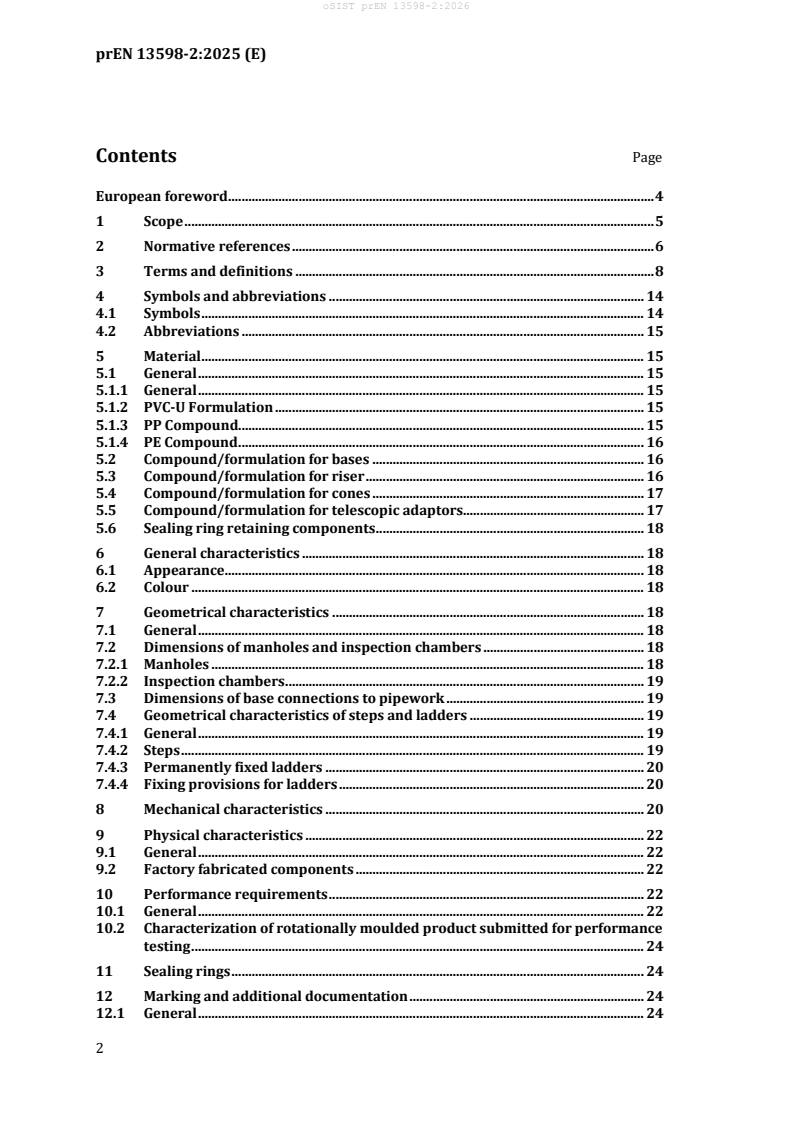
Contents Page
European foreword . 4
1 Scope . 5
2 Normative references . 6
3 Terms and definitions . 8
4 Symbols and abbreviations . 14
4.1 Symbols . 14
4.2 Abbreviations . 15
5 Material . 15
5.1 General . 15
5.1.1 General . 15
5.1.2 PVC-U Formulation . 15
5.1.3 PP Compound. 15
5.1.4 PE Compound . 16
5.2 Compound/formulation for bases . 16
5.3 Compound/formulation for riser . 16
5.4 Compound/formulation for cones . 17
5.5 Compound/formulation for telescopic adaptors . 17
5.6 Sealing ring retaining components . 18
6 General characteristics . 18
6.1 Appearance . 18
6.2 Colour . 18
7 Geometrical characteristics . 18
7.1 General . 18
7.2 Dimensions of manholes and inspection chambers . 18
7.2.1 Manholes . 18
7.2.2 Inspection chambers . 19
7.3 Dimensions of base connections to pipework . 19
7.4 Geometrical characteristics of steps and ladders . 19
7.4.1 General . 19
7.4.2 Steps . 19
7.4.3 Permanently fixed ladders . 20
7.4.4 Fixing provisions for ladders . 20
8 Mechanical characteristics . 20
9 Physical characteristics . 22
9.1 General . 22
9.2 Factory fabricated components . 22
10 Performance requirements . 22
10.1 General . 22
10.2 Characterization of rotationally moulded product submitted for performance
testing . 24
11 Sealing rings . 24
12 Marking and additional documentation . 24
12.1 General . 24
12.2 Marking of bases . 25
12.3 Minimum marking of components other than bases . 26
12.4 Additional documentation . 26
Annex A (normative) Test method for durability . 27
Annex B (normative) Test method for structural integrity of bases . 31
Annex C (normative) Test method for impact resistance of bases . 32
Annex D (normative) Utilization of recyclates . 33
Bibliography . 38
European foreword
This document (prEN 13598-2:2025) has been prepared by Technical Committee CEN/TC 155
“Plastics piping systems and ducting systems”, the secretariat of which is held by NEN.
This document is currently submitted to the CEN Enquiry.
This document will supersede EN 13598-2:2020.
EN 13598-2:2020:
1) the terminology has been updated to align with the TC155 Oslo agreement and EN 14541-1.
Additional terms and definitions have also been included.
2) material clauses and Annex D have been updated;
3) the format of units and symbols in tables has been updated.
EN 13598 consists of the following parts under the general title Plastics piping systems for non-
pressure underground drains and sewers — Unplasticized polyvinyl chloride (PVC-U),
polypropylene (PP) and polyethylene (PE):
— Part 1: Specification for ancillary fittings and shallow chambers (under revision);
— Part 2: Specifications for manholes and inspection chambers (this document);
— Part 3: Assessment of conformity (CEN/TS under revision).
1 Scope
This document is part of a System Standard for plastics piping systems of a particular material for
a specified application.
System Standards are based on the results of the work being undertaken in ISO/TC 138 “Plastics
pipes, fittings and valves for the transport of fluids”, which is a Technical Committee of the
International Organization for Standardization (ISO).
They are supported by separate standards on test methods to which references are made
throughout the System Standard.
The System Standards are consistent with general standards on functional requirements and on
recommended practice for installation.
This document does not cover sewage pump chambers, valve chambers and similar products.
This document specifies the definitions and requirements for unplasticized polyvinyl chloride
(PVC-U), polypropylene (PP) and polyethylene (PE) manholes and inspection chambers having a
base with a flow channel and their joints to the piping system, intended for use in non-pressure
underground drains and sewers for wastewater, up to a maximum depth of 6 m from ground level
to the invert of the flow channel.
This document is applicable to manholes and inspection chambers, intended for use buried in the
ground outside a building structure only; reflected by the marking of products by “U”.
This document is applicable to manholes and inspection chambers intended for use in pedestrian
or vehicular trafficked areas.
NOTE 2 Products complying with this document can also be used in non-traffic areas.
NOTE 3 Products complying with this document can be installed in underground applications without
additional static calculation.
Manhole and inspection chamber components can be manufactured by various methods e.g.
extrusion, injection moulding, rotational moulding, low-pressure moulding or factory fabricated.
Manholes and inspection chambers complying with EN 13598-2 are made from a prescribed set
of components that are assembled together or manufactured as a single unit.
NOTE 4 The complete manhole or inspection chamber assembly also includes items which are not
specified in this document (for example near surface or surface components such as covers, frames and
gratings complying with the relevant part of EN 124[1]).
NOTE 5 Manholes and inspection chambers can be subject to national regulations and / or local
provisions.
2 Normative references
The following documents are referred to in the text in such a way that some or all of their content
constitutes requirements of this document. For dated references, only the edition cited applies.
For undated references, the latest edition of the referenced document (including any
amendments) applies.
EN 476, General requirements for components used in drains and sewers
EN 681-1, Elastomeric seals — Materials requirements for pipe joint seals used in water and
drainage applications — Part 1: Vulcanized rubber
EN 681-2, Elastomeric Seals — Materials requirements for pipe joint seals used in water and
drainage applications — Part 2: Thermoplastic elastomers
EN 681-3, Elastomeric seals — Materials requirements for pipe joint seals used in water and
drainage applications — Part 3: Cellular materials of vulcanized rubber
EN 681-4, Elastomeric seals — Materials requirements for pipe joint seals used in water and
drainage applications — Part 4: Cast polyurethane sealing elements
EN 1401-1, Plastics piping systems for non-pressure underground drainage and sewerage —
Unplasticized polyvinyl chloride (PVC-U) — Part 1: Specifications for pipes, fittings and the system
EN 1852-1, Plastics piping systems for non-pressure underground drainage and sewerage —
Polypropylene (PP) — Part 1: Specifications for pipes, fittings and the system
EN 12099, Plastics piping systems — Polyethylene piping materials and components —
Determination of volatile content
EN 12666-1, Plastics piping systems for non-pressure underground drainage and sewerage
Polyethylene (PE) — Part 1: Specifications for pipes, fittings and the system
EN 13101:2002, Steps for underground man entry chambers — Requirements, marking, testing and
evaluation of conformity
EN 13476 (all parts) Plastics piping systems for non-pressure underground drainage and sewerage
— Structured-wall piping systems of unplasticized polyvinyl chloride (PVC-U), polypropylene (PP)
and polyethylene (PE)
EN 13476-2, Plastics piping systems for non-pressure underground drainage and sewerage —
Structured-wall piping systems of unplasticized polyvinyl chloride (PVC-U), polypropylene (PP) and
polyethylene (PE) — Part 2: Specifications for pipes and fittings with smooth internal and external
surface and the system, Type A
EN 13476-3, Plastics piping systems for non-pressure underground drainage and sewerage —
Structured-wall piping systems of unplasticized polyvinyl chloride (PVC-U), polypropylene (PP) and
polyethylene (PE) — Part 3: Specifications for pipes and fittings with smooth internal and profiled
external surface and the system, Type B
EN 14396, Fixed ladders for manholes
EN 14758-1, Plastics piping systems for non-pressure underground drainage and sewerage —
Polypropylene with mineral modifiers (PP-MD) — Part 1: Specifications for pipes, fittings and the
system
EN 15344:2025, Plastics — Recycled plastics — Characterisation of Polyethylene (PE) recyclates
CEN/TS 17627, Plastics — Recycled plastics — Determination of solid contaminants content
EN ISO 527-2, Plastics — Determination of tensile properties — Test conditions for moulding and
extrusion plastics (ISO 527-2)
EN ISO 1043-1, Plastics — Symbols and abbreviated terms — Part 1: Basic polymers and their
special characteristics (ISO 1043-1)
EN ISO 1133-1, Plastics — Determination of the melt mass-flow rate (MFR) and melt volume-flow
rate (MVR) of thermoplastics — Part 1: Standard method (ISO 1133-1)
EN ISO 1158, Plastics — Vinyl chloride homopolymers and copolymers — Determination of chlorine
content (ISO 1158)
EN ISO 1183-1, Plastics — Methods for determining the density of non-cellular plastics — Part 1:
Immersion method, liquid pyknometer method and titration method (ISO 1183-1)
EN ISO 1183-2, Plastics — Methods for determining the density of non-cellular plastics — Part 2:
Density gradient column method (ISO 1183-2)
EN ISO 2507-1, Thermoplastics pipes and fittings — Vicat softening temperature — Part 1: General
test method (ISO 2507-1)
EN ISO 3126, Plastics piping systems — Plastics components — Determination of dimensions
(ISO 3126)
EN ISO 3127, Thermoplastics pipes — Determination of resistance to external blows — Round-the-
clock method (ISO 3127)
EN ISO 3451-1, Plastics — Determination of ash — Part 1: General methods (ISO 3451-1)
EN ISO 3451-5, Plastics — Determination of ash — Part 5: Polyvinyl chloride (ISO 3451-5)
EN ISO 9967:2016, Thermoplastics pipes — Determination of creep ratio (ISO 9967:2016)
EN ISO 11357-6, Plastics — Differential scanning calorimetry (DSC) — Part 6: Determination of
oxidation induction time (isothermal OIT) and oxidation induction temperature (dynamic OIT)
(ISO 11357-6)
EN ISO 13229, Thermoplastics piping systems for non-pressure applications — Unplasticized
polyvinyl chloride (PVC-U) pipes and fittings — Determination of the viscosity number and K-value
(ISO 13229)
EN ISO 13254, Thermoplastics piping systems for non-pressure applications — Test method for
watertightness (ISO 13254)
EN ISO 13259:2020, Thermoplastics piping systems for underground non-pressure applications —
Test method for leaktightness of elastomeric sealing ring type joints (ISO 13259:2020)
EN ISO 13263, Thermoplastics piping systems for non-pressure underground drainage and
sewerage — Thermoplastics fittings — Test method for impact strength (ISO 13263)
EN ISO 13266, Thermoplastics piping systems for non-pressure underground drainage and
sewerage — Thermoplastics shafts or risers for inspection chambers and manholes —
Determination of resistance against surface and traffic loading (ISO 13266)
EN ISO 13267:2023, Thermoplastics piping systems for non-pressure underground drainage and
sewerage — Thermoplastics inspection chamber and manhole bases — Test methods for buckling
resistance (ISO 13267:2022)
EN ISO 13268, Thermoplastics piping systems for non-pressure underground drainage and
sewerage — Thermoplastics shafts or risers for inspection chambers and manholes —
Determination of ring stiffness (ISO 13268)
3 Terms and definitions
For the purposes of this document, the terms, definitions and abbreviations given in
EN ISO 1043-1 and the following apply.
ISO and IEC maintain terminology databases for use in standardization at the following
addresses:
— IEC Electropedia: available at https://www.electropedia.org/
— ISO Online browsing platform: available at https://www.iso.org/obp/ui
3.1
application area code “U”
code for the area more than 1 m from the building to which the buried piping system is connected
3.2
drain
pipeline, usually underground, designed to carry wastewater from a source to a sewer
[SOURCE: EN 16323:2014, 2.2.3.1]
3.3
sewer
pipeline or other construction, usually underground, designed to carry wastewater from more
than one source
[SOURCE: EN 16323:2014, 2.2.3.12]
3.4
wastewater
water composed of any combination of water discharged from domestic, industrial or commercial
premises, surface run-off and accidentally any sewer infiltration water
[SOURCE: EN 16323:2014, 2.3.10.65, modified – sewage (deprecated) deleted]
3.4.1
foul wastewater
wastewater comprising domestic wastewater and/or industrial wastewater
[SOURCE: EN 16323:2014, 2.1.2.6]
3.4.2
surface water
water from precipitation, which has not seeped into the ground and is discharged to the drain or
sewer system directly from the ground or from exterior building surfaces
[SOURCE: EN 16323:2014, 2.1.1.3, modified – Reference to Figure 1 deleted]
3.4.3
domestic wastewater
water polluted by the human life, including water discharged from kitchens, laundry rooms,
lavatories, bathrooms, toilets and similar facilities
[SOURCE: EN 16323:2014, 2.1.2.3, modified – sewage (deprecated) deleted]
3.4.4
industrial wastewater
wastewater discharge resulting from any industrial or commercial activity
[SOURCE: EN 16323:2014, 2.1.2.7 modified – trade wastewater (deprecated) and trade effluent
(deprecated) deleted]
3.5
manhole
chamber with a removable cover constructed in a drain or sewer to permit entry by personnel,
with a riser of 800 mm minimum inside diameter
Note 1 to entry: Figure 1 shows typical manholes.
Note 2 to entry: See EN 476 for dimensions of non-circular manholes.
Note 3 to entry: Manholes are subject to national safety regulations and / or local provisions regarding
man-entry limitations.
3.6
inspection chamber
chamber with a removable cover constructed in a drain or sewer that permits the introduction of
cleaning and inspection equipment from surface level, but does not provide access for personnel,
with a riser of 200 mm minimum outer diameter
Note 1 to entry: Figure 2 shows typical inspection chambers.
Note 2 to entry: See EN 476 for non-circular chambers.
3.7
base
bottom part of a manhole or inspection chamber, allowing direct connection to buried drain or
sewer pipes and including integrally formed flow channels with benching as appropriate
Note 1 to entry: In case of a one-piece manhole or inspection chamber, for testing purposes the base
component ends at a distance of minimum 300 mm measured from the top of the main channel. Above
300 mm the section should be considered as a riser and tested accordingly.
Note 2 to entry: Bases having a spherical design may be used. National regulations can apply.
3.8
flow channel
open and accessible continuation of the sewer network in a manhole or inspection chamber to
allow directional changes maintaining the hydraulic performance of a sewer system
Note 1 to entry: The term flow profile is also used.
3.9
benching
sloped surface adjacent to the channel in a manhole or inspection chamber
3.10
riser
component which is connected onto a base and which defines the nominal size of the manhole or
inspection chamber
Note 1 to entry: The riser can be supplied either as one or more separate items, for site jointing to the
base, or integrated with the base.
Note 2 to entry: In case of a one-piece manhole or inspection chamber, for testing purposes the riser
component starts at a distance of minimum 300 mm measured from the top of the main channel. Below
300 mm the section should be considered as a base and tested accordingly.
3.11
telescopic adaptor
part of the assembly on top of the riser or cone that allows adjustment of the surface component
or near surface component
Note 1 to entry: Telescopic adaptors allow accommodation of settlement during lifetime and eliminate
the transmission of vehicular loading down the riser.
3.12
cone
adapter allowing change in diameter, close to ground level
3.13
surface component
components such as covers, frames and gratings that are located at the surface level and which
comply with the relevant part of EN 124
3.14
near-surface component
component intended to spread vehicular loading directly to the soil and/or provide a seating for
the cover and its frame
3.15
cover solution
a set of components comprising at least surface components and near surface components
3.16
assembly
items collectively forming a manhole or inspection chamber
Note 1 to entry: See typical examples in Figures 1 and 2.
3.17
invert
lowest point of the internal surface of the barrel of a pipe or channel at any cross section
3.18
maximum height of groundwater above invert
H
w
height of water column, expressed in meters above the invert that the manhole or inspection
chamber can withstand during use
3.19
factory fabricated component
component produced from pipe and/or from injection-or rotomoulded sub-components by
thermoforming, adhesive joint, welding or mechanical jointing
3.20
virgin material
plastics material in the form of pellets, granules, powder, floc, etc. that has not been subjected to
use or processing other than that required for its initial manufacture
Note 1 to entry: Does not contain any reworked plastics material and/or plastics recyclate.
Note 2 to entry: Also referred to as “primary material” or “primary plastics feedstock”
Note 3 to entry: It is understood that the addition of additives such as stabilizers and pigments is still
resulting into a virgin (plastics) material.
[SOURCE: ISO 472:2013, 2.1231, modified – Note 1 to entry, Note 2 to entry and Note 3 to entry
added]
3.21
reworked material
plastics material from rejected unused products or trimmings capable of being reclaimed within
the same process that generated it
Note 1 to entry: Reworked material does not change the status of the feedstock.
Note 2 to entry: This definition does not cover the conditions for the use of reworked material, which
can be found in the applicable product standard.
Note 3 to entry: Previously referred to as “own reprocessed material”
3.22
pre-consumer material
plastics material diverted from the waste stream during a manufacturing process, excluding
reworked (plastics) material
Note 1 to entry: Previously referred to as “post-industrial material”.
Note 2 to entry: Different categories of pre-consumer material may be considered in the applicable
product standard.
[SOURCE: ISO 14021:2016, 7.8.1.1 modified – “plastics” added, text deleted after “rework” and 2
Notes to entry introduced]
3.23
post-consumer material
plastics material generated by households or by commercial, industrial and institutional facilities
in their role as end-users of the product which can no longer be used for its intended purpose
Note 1 to entry: This includes returns of material from the distribution chain.
Note 2 to entry: Different categories of post-consumer material may be considered in the applicable
product standard.
[SOURCE: ISO 14021:2016, 7.8.1.1 modified – “plastics” added, last sentence changed into Note 1
to entry and Note 2 to entry introduced]
3.24
recyclate
plastics material resulting from the recycling of pre-consumer and post-consumer plastics
products
Note 1 to entry: Also referred to as “secondary raw material” or “recycled plastics” or “regenerate”.
Note 2 to entry: Recycling can be chemical, physical or mechanical.
[SOURCE: ISO 472:2013, 2.1705, modified – Note 1 to entry and Note 2 to entry deleted, new Note
1 to entry and Note 2 to entry introduced and “plastic waste” changed into “pre-consumer and
post-consumer plastics products”]
3.25
agreed specification
specification of the relevant material characteristics agreed between the supplier of the recylate
and the pipe and/or fitting manufacturer
Note 1 to entry: The agreed specification is often considered in the context of certification by a third
party organization
[SOURCE: EN 16323:2014, 2.3.10.65, modified – sewage (deprecated) deleted]
Key
a surface components (not covered by this 1 inlet
document)
b near surface component (not covered by this 2 outlet
document)
c telescopic adaptor 3 invert
d cone 4 inside diameter
e1 riser 5 benching
e2 considered as riser 6 flow channel
f1 base
f2 considered as base
g connection
h provision for ladder
i ladder or steps
Figure 1 — Typical manholes
Key
a surface components (not covered by this 1 inlet
document)
b near surface component (not covered by this 2 outlet
document)
c telescopic adaptor 3 invert
e riser 4 inside diameter
e considered as riser 5 benching
f1 base 6 flow channel
f2 considered as base
g connection
Figure 2 — Typical inspection chambers
4 Symbols and abbreviations
4.1 Symbols
For the purposes of this document, the following symbols apply.
d nominal outside diameter
n
d mean outside diameter
em
dsm mean inside diameter of socket
H maximum height of groundwater above invert
w
4.2 Abbreviations
For the purposes of this document, the following abbreviations apply.
MFR melt mass-flow rate
OIT oxidation induction time
PE polyethylene
PP polypropylene
PVC-U unplasticized poly(vinyl chloride)
5 Material
5.1 General
5.1.1 General
Components of manholes and inspection chambers may be manufactured from different
compounds/formulations.
The material shall be one of the following: unplasticized polyvinyl chloride (PVC-U),
polypropylene (PP) or polyethylene (PE).
The use of material, that has been classified as re-worked material in this document or in other
standards according to Table 2, originating from the same compound/formulation, is permitted
without additional requirements.
NOTE 1 If a component comprises of sub-components of mixed materials (e.g PP and PVC-U) or the sub-
components are generated using different processes, care is to be taken to ensure separation prior to use
as reworked material.
NOTE 2 Reworked material generated from fittings complying with e.g. EN 1401-1 can be used, if the
same formulation is used for the production of components complying with this document.
The use of recyclates is permitted, provided they comply with Annex D.
Recyclates can also be added to virgin or to reworked material or a mixture of these materials.
The durability is tested according to 5.2 to 5.5 on the relevant components.
NOTE 3 Attention is drawn to changing of European and/or national regulations regarding e.g. heavy
metals.
5.1.2 PVC-U Formulation
The formulation for production of manholes and inspection chambers components shall be
PVC-resin to which additives are included to enable conformity with the requirements of this
document. The dosage level of each component of the formulation shall be specified.
PVC material may be virgin material, reworked material or recyclates (pre- or post-consumer).
5.1.3 PP Compound
The compound for production of manholes and inspection chambers components shall be PP-
base material to which additives are included to enable conformity with the requirements of this
document.
PP material may be virgin material, reworked material or recyclates (pre- or post-consumer).
5.1.4 PE Compound
The compound for production of manholes and inspection chambers components shall be PE-
base material to which additives are included to enable conformity with the requirements of this
document.
PE material may be virgin material, reworked material or recyclates (pre- or post-consumer).
5.2 Compound/formulation for bases
The base shall be tested according to Table 1.
Table 1 — Durability requirements for bases
Test parameters
Test
Characteristic Requirement
method
Parameter Value
a d e
Durability No cracks or crazes Maximum height of groundwater 2,0 ≤ H ≤ 5,0 Annex A
w
b
above invert, H (m)
w
Rating factor, R Shall conform to
Table A.1
c
Test pressure (bar) −0,1 × H /R
w
Duration (h) 3 000
Test temperature (°C) Shall conform to
Table A.1
a
When viewed without magnification
b
Test in accordance with the manufacturer's declared maximum height of groundwater.
5 2
c 1 bar = 10 N/m = 0,1 MPa.
d
The minimum value of 2 m of groundwater above invert is based on the need to safeguard durability where
there is no groundwater present.
e When testing for the durability of materials elastomeric ring seal joints can be replaced by welding.
The duration in Table 1 may be reduced to 1 000 h, provided that the material used for the
manufacture of the base complies with the material clause in one of the standards listed in
Table 2.
Table 2 — Materials and corresponding European standards
Material Corresponding European standard
Unplasticized polyvinyl chloride (PVC-U) EN 1401-1, EN 13476-2 type A2, EN 13476-3
Polypropylene (PP) EN 1852-1, EN 13476-2 type A2, EN 13476-3,
EN 14758-1
Polyethylene (PE) EN 12666-1, EN 13476-2 type A2, EN 13476-3
5.3 Compound/formulation for riser
The riser shall be tested according to Table 3.
Components manufactured from compound/formulation complying with Table 1 or Table 2 are
deemed to comply with this requirement without further testing.
Table 3 — Durability requirements for riser
Test parameters
Test
Characteristic Requirement
method
Parameter Value
b c
Durability No cracks Maximum height of 2,0 ≤ Hw ≤ 5,0 Annex A
a
or crazes groundwater above
invert, H (m)
w
Rating factor, R Shall conform to
Table A.1
Test pressure (bar) −0,1 × H /R
w
Duration (h) 1 000
Test Temperature (°C) Shall conform to
Table A.1
Test samples length (mm) Minimum 200
a
When viewed without magnification
b
Test in accordance with the manufacturer's declared maximum allowable height of ground water.
c
When testing for the durability of compound / formulation at higher temperatures, plates welded to both ends
of the riser may be used to seal the connections. The test assembly should be sufficient to avoid contact between
the plates during the test.
5.4 Compound/formulation for cones
The cones shall be tested according to Table 4.
Components manufactured from compound/formulation complying with Table 1, Table 2 or
Table 3 are deemed to comply with this requirement without further testing.
Table 4 — Durability requirements for cones
Test parameters
Test
Characteristic Requirement
method
Parameter Value
b
Durability No cracks Rating factor, R Shall conform to Annex A
a
or crazes Table A.1
Test pressure (bar) −0,2/R
Duration (h) 1 000
Test temperature (°C) Shall conform to
Table A.1
a
When viewed without magnification
b
When testing for the durability of compound/formulation at higher temperatures, plates welded to both ends
of the cone may be used to seal the connections. The test assembly should be sufficient to avoid contact between
the plates during the test.
5.5 Compound/formulation for telescopic adaptors
The telescopic adaptors shall be tested according to Table 5.
Components manufactured from compound/formulation complying with Table 1, Table 2,
Table 3 or Table 4 are deemed to comply with this requirement without further testing.
Table 5 — Durability requirements for telescopic adaptors
Test parameters
Test
Characteristic Requirement
method
Parameter Value
b
Durability No cracks Rating factor, R Shall conform to Annex A
a
or crazes Table A.1
Test pressure (bar) −0,1/R
Duration (h) 1 000
Test temperature (°C) Shall conform to
Table A.1
a
When viewed without magnification
b
When testing for the durability of compound/formulation at higher temperatures, plates welded to both ends
of the telescopic adaptor may be used to seal the connections. The test assembly should be sufficient to avoid
contact between the plates during the test.
5.6 Sealing ring retaining components
It is permitted that sealing rings are retained using means made from polymers other than
PVC-U, PP or PE.
6 General characteristics
6.1 Appearance
When viewed without magnification, the internal and external surfaces of manholes and
inspection chambers shall be smooth, clean and free from defects likely to prevent conformity
with this document.
Pipe ends or spigots shall be cleanly cut and square with their axis.
6.2 Colour
Any colour may be used.
7 Geometrical characteristics
7.1 General
The manufacturer shall specify the relevant geometrical characteristics and the tolerances.
All dimensions shall be measured in accordance with EN ISO 3126.
7.2 Dimensions of manholes and inspection chambers
7.2.1 Manholes
The diameter of the riser shall be used to designate the nominal size of manholes.
In the absence of national regulations the diameter of the clear opening of the manhole cover
according to EN 124 (all parts) shall be ≥ 600 mm.
For a manhole with circular section, the nominal inside diameter of the riser shall be ≥ 1 000 mm
(see Figure 1).
NOTE National or local safety - regulations or the relevant authority can specify larger minimum
dimensions e.g. for the access.
In specific circumstances, where national regulations allow, manholes may have smaller
dimensions. In this case for a manhole with circular section, the nominal inside diameter of the
riser shall be ≥ 800 mm.
For this type of manhole special entry equipment (e.g. harness and winch) is required.
7.2.2 Inspection chambers
The diameter of the riser shall be used to designate the nominal size of inspection chambers.
For an inspection chamber with circular section, the nominal inside diameter of the riser shall
be ≥ 200 mm (see Figure 2).
7.3 Dimensions of base connections to pipework
The wall thickness of the spigot/socket for pipe connections shall not be less than those specified
either in EN 1401-1 or EN 13476 (all parts).
Socket (d ) and spigot (d ) diameters, length of engagement (A), length of spigots (L ) and their
sm em 1
tolerances shall enable compatibility to pipe work in accordance with the product standards of
the pipes that they are intended to be connected to.
NOTE The requirement for wall thickness of the spigot/socket for pipe connections is not applicable
for riser to base assembly or sockets or spigots of risers, cones or telescopic adaptors.
When tested in the factory, joints for base connections to pipework shall have a continuity of
invert within the following calculated maximum tolerances:
— ≤ DN/OD 315 or DN/ID 300: maximum step 6 mm;
— > DN/OD 315 or DN/ID 300: maximum step 0,02 mm × DN limited to 30 mm.
7.4 Geometrical characteristics of steps and ladders
7.4.1 General
Manholes can be provided with man entry equipment such as:
— steps;
— permanently fixed ladders (can be fitted either before or after installation);
— fixing provisions for ladders.
7.4.2 Steps
Plastics steps shall comply with the following requirements:
— these steps shall have a minimum width of step profile of 20 mm;
— these steps shall have a minimum width for single steps of 145 mm or for double steps a
minimum width of 250 mm;
— these steps shall have a minimum projection of 120 mm from the internal wall of the riser
(see Figure 3c);
— the vertical spacing within a finished structure shall relate to the internal height of the
manholes and shall be within the range 250 mm to 350 mm (see Figure 3c);
— single steps shall be fixed, with a tolerance of ± 10 mm, alternatively at centres in vertical
plan within the range 270 mm and 300 mm (see Figure 3b);
— double steps shall be fixed vertically above each other (see Figure 3a).
Steps that are totally or partly manufactured from cast iron, steel or aluminium shall comply with
EN 13101.
Dimensions in millimetres
a) Plan: Double step in b) Plan: Single steps in c) Elevation A-A
rectangular manhole circular or elliptical
manhole
Key
1 range 270 mm to 300 mm
2 range 250 mm to 350 mm
Figure 3 — Typical single or double steps
7.4.3 Permanently fixed ladders
When a manhole includes a fixed ladder, the ladder including fixing provisions shall conform to
the requirements of EN 14396.
7.4.4 Fixing provisions for ladders
When a manhole is supplied with fixing provisions for a ladder, these shall conform to the
relevant requirements of EN 14396.
8 Mechanical characteristics
When tested as detailed in Tables 6, 7 and 8, as applicable, the manhole or inspection chamber
shall conform to the corresponding requirements.
Table 6 — Mechanical characteristics of bases
Characteristic Requirements Test parameters Test method
Parameter Value
c
Structural integrity No collapse or cracks Test pressure −0,1 × Hw Annex B
(bar)
Predicted 50-year
vertical deflection H of
b
Hw (m) 2,0 ≤ Hw ≤ 5,0
the main channel
a
diameter ≤ 5 %
Test 20 to 25
Predicted 50-year
temperature (°C)
horizontal deflection W
of the main channel
Duration (h) ≥ 1 008
a
diameter ≤ 10 %
Impact resistance No cracks or other Test temperature (23 ± 2) Annex C
damages impairing the (°C)
function of the base.
Impact strength No cracks or other Fall height, (mm) 500 EN ISO 13263
d
(Drop test) damages impairing the
Impact point Weakest point
function of the base.
Test temperature (− 10 ± 2)
(°C)
a
Values are related to an extrapolated 50 years prediction. When the deflection in the horizontal direction
(width of main channel) is ≤ 10 %, normal inspection and cleaning equipment can be entered in the sewer
system. When the deflection
...