

CEN/TS 13387-4:2025
(Main)Child care articles - General safety guidelines - Part 4: Thermal hazards
General Information
- Abstract
This document provides guidance information on thermal hazards that are taken into consideration when developing safety standards for child care articles. In addition, these guidelines can assist those with a general professional interest in child safety.
- Status
- Published
- Publication Date
- 11-Nov-2025
- Technical Committee
- CEN/TC 252 - Child use and care articles
- Drafting Committee
- CEN/TC 252/WG 6 - General and common safety specifications
- Current Stage
- 6060 - Definitive text made available (DAV) - Publishing
- Start Date
- 12-Nov-2025
- Due Date
- 02-Oct-2025
- Completion Date
- 12-Nov-2025

Overview
CEN/TS 13387-4:2025 provides comprehensive safety guidelines related to thermal hazards in child care articles. Developed by the European Committee for Standardization (CEN), this technical specification offers a framework for recognizing and mitigating risks associated with temperature, such as burns, scalds, flammability, and overheating in products intended for children. The guidance is crucial for manufacturers, standards developers, and professionals involved in child safety, aiming to promote higher safety standards across a broad range of child care equipment.
Key Topics
- Thermal Hazards: The standard addresses risks caused by exposure to high or low temperatures, highlighting dangers from hot or cold surfaces, liquids, and food.
- Flammability and Burning Hazards: Guidance is provided on evaluating and limiting the flammability of materials used in child care articles, with requirements aligned to EN 71-2:2020.
- Contact with Flames: The document stresses the importance of preventing children's access to open flames and ensuring protective products are effective.
- Hyperthermia and Hypothermia: Special attention is given to hazards arising from both overheating (hyperthermia) and excessive cooling (hypothermia), particularly for infants under twelve months of age.
- Safe Use of Materials: Recommendations include avoiding highly flammable materials such as celluloid and pile surfaces likely to flash, as well as eliminating flammable gases and liquids from products.
Applications
CEN/TS 13387-4:2025 is intended to assist:
- Manufacturers of Child Care Articles: By integrating these thermal safety guidelines, manufacturers can design safer products, minimize the risk of burns and overheating, and appropriately manage flammability concerns.
- Standards Developers: The document serves as a reference in drafting product-specific safety standards, ensuring a harmonized approach across the European market.
- Child Safety Professionals: Provides authoritative guidance for assessing thermal risks in various child care environments, reinforcing best practices.
- Product Information and Warnings: The specification highlights the need for clear and effective warnings within product documentation, alerting caregivers to potential thermal hazards like hot surfaces and risks of overheating.
Typical products in scope include feeding bottles, bedding, toys, high chairs, prams, and bath accessories, where contact with hot or cold elements is possible. Adhering to these guidelines is vital for reducing accidents and enhancing consumer confidence in child care products.
Related Standards
For a holistic approach to child safety, CEN/TS 13387-4:2025 should be used alongside other relevant standards, including:
- CEN/TS 13387-1: Safety philosophy and safety assessment
- CEN/TS 13387-2: Chemical hazards
- CEN/TS 13387-3: Mechanical hazards
- CEN/TS 13387-5: Product information
- EN 71-2:2020: Safety of toys - Flammability (key reference for flammability testing methods)
- EN ISO 13732-1: Guidance on temperatures of hot surfaces likely to be touched
- CLC/Guide 29: Guidance document for safe surface temperatures
By following these harmonized European safety standards, manufacturers and stakeholders can ensure a comprehensive approach to minimizing thermal hazards in child care articles, helping to safeguard children across diverse care settings.
Keywords: child care articles, thermal hazards, flammability, child safety standards, EN 71-2, overheating, product safety, CEN/TS 13387-4:2025, burns, safe materials, European standards
Relations
- Effective Date
- 21-Feb-2024
- Effective Date
- 28-Jan-2026
- Effective Date
- 10-Feb-2026
- Effective Date
- 28-Jan-2026
Frequently Asked Questions
CEN/TS 13387-4:2025 is a technical specification published by the European Committee for Standardization (CEN). Its full title is "Child care articles - General safety guidelines - Part 4: Thermal hazards". This standard covers: This document provides guidance information on thermal hazards that are taken into consideration when developing safety standards for child care articles. In addition, these guidelines can assist those with a general professional interest in child safety.
This document provides guidance information on thermal hazards that are taken into consideration when developing safety standards for child care articles. In addition, these guidelines can assist those with a general professional interest in child safety.
CEN/TS 13387-4:2025 is classified under the following ICS (International Classification for Standards) categories: 97.190 - Equipment for children. The ICS classification helps identify the subject area and facilitates finding related standards.
CEN/TS 13387-4:2025 has the following relationships with other standards: It is inter standard links to CEN/TR 13387-4:2015, EN 71-2:2020, CEN/CLC Guide 14:2009, EN 13126-5:2011+A1:2014. Understanding these relationships helps ensure you are using the most current and applicable version of the standard.
CEN/TS 13387-4:2025 is available in PDF format for immediate download after purchase. The document can be added to your cart and obtained through the secure checkout process. Digital delivery ensures instant access to the complete standard document.
Standards Content (Sample)
SLOVENSKI STANDARD
01-januar-2026
Nadomešča:
SIST-TP CEN/TR 13387-4:2015
Izdelki za otroke - Smernice za splošno varnost - 4. del: Nevarnosti zaradi
toplotnih lastnosti
Child care articles - General safety guidelines - Part 4: Thermal hazards
Artikel für Säuglinge und Kleinkinder - Sicherheitsleitfaden - Teil 4: Thermische
Gefährdungen
Articles de puériculture - Conseils relatifs à la sécurité - Partie 4: Risques thermiques
Ta slovenski standard je istoveten z: CEN/TS 13387-4:2025
ICS:
97.190 Otroška oprema Equipment for children
2003-01.Slovenski inštitut za standardizacijo. Razmnoževanje celote ali delov tega standarda ni dovoljeno.
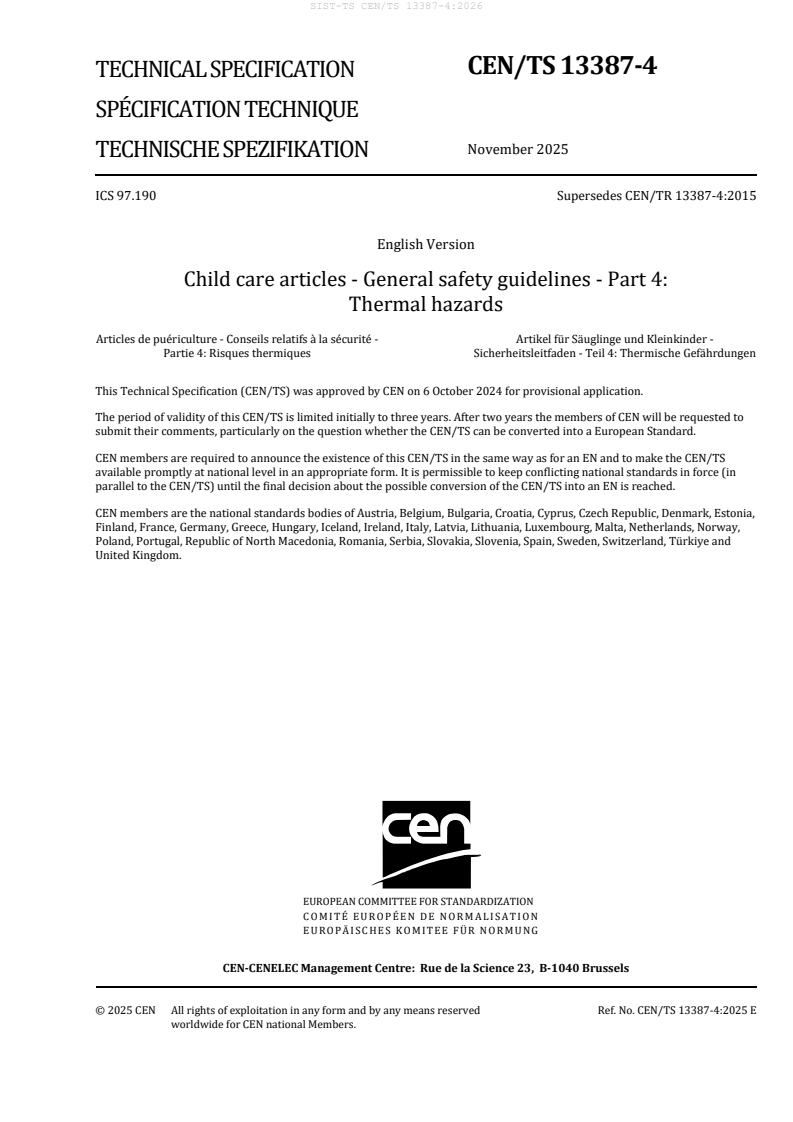
CEN/TS 13387-4
TECHNICAL SPECIFICATION
SPÉCIFICATION TECHNIQUE
November 2025
TECHNISCHE SPEZIFIKATION
ICS 97.190 Supersedes CEN/TR 13387-4:2015
English Version
Child care articles - General safety guidelines - Part 4:
Thermal hazards
Articles de puériculture - Conseils relatifs à la sécurité - Artikel für Säuglinge und Kleinkinder -
Partie 4: Risques thermiques Sicherheitsleitfaden - Teil 4: Thermische Gefährdungen
This Technical Specification (CEN/TS) was approved by CEN on 6 October 2024 for provisional application.
The period of validity of this CEN/TS is limited initially to three years. After two years the members of CEN will be requested to
submit their comments, particularly on the question whether the CEN/TS can be converted into a European Standard.
CEN members are required to announce the existence of this CEN/TS in the same way as for an EN and to make the CEN/TS
available promptly at national level in an appropriate form. It is permissible to keep conflicting national standards in force (in
parallel to the CEN/TS) until the final decision about the possible conversion of the CEN/TS into an EN is reached.
CEN members are the national standards bodies of Austria, Belgium, Bulgaria, Croatia, Cyprus, Czech Republic, Denmark, Estonia,
Finland, France, Germany, Greece, Hungary, Iceland, Ireland, Italy, Latvia, Lithuania, Luxembourg, Malta, Netherlands, Norway,
Poland, Portugal, Republic of North Macedonia, Romania, Serbia, Slovakia, Slovenia, Spain, Sweden, Switzerland, Türkiye and
United Kingdom.
EUROPEAN COMMITTEE FOR STANDARDIZATION
COMITÉ EUROPÉEN DE NORMALISATION
EUROPÄISCHES KOMITEE FÜR NORMUNG
CEN-CENELEC Management Centre: Rue de la Science 23, B-1040 Brussels
© 2025 CEN All rights of exploitation in any form and by any means reserved Ref. No. CEN/TS 13387-4:2025 E
worldwide for CEN national Members.
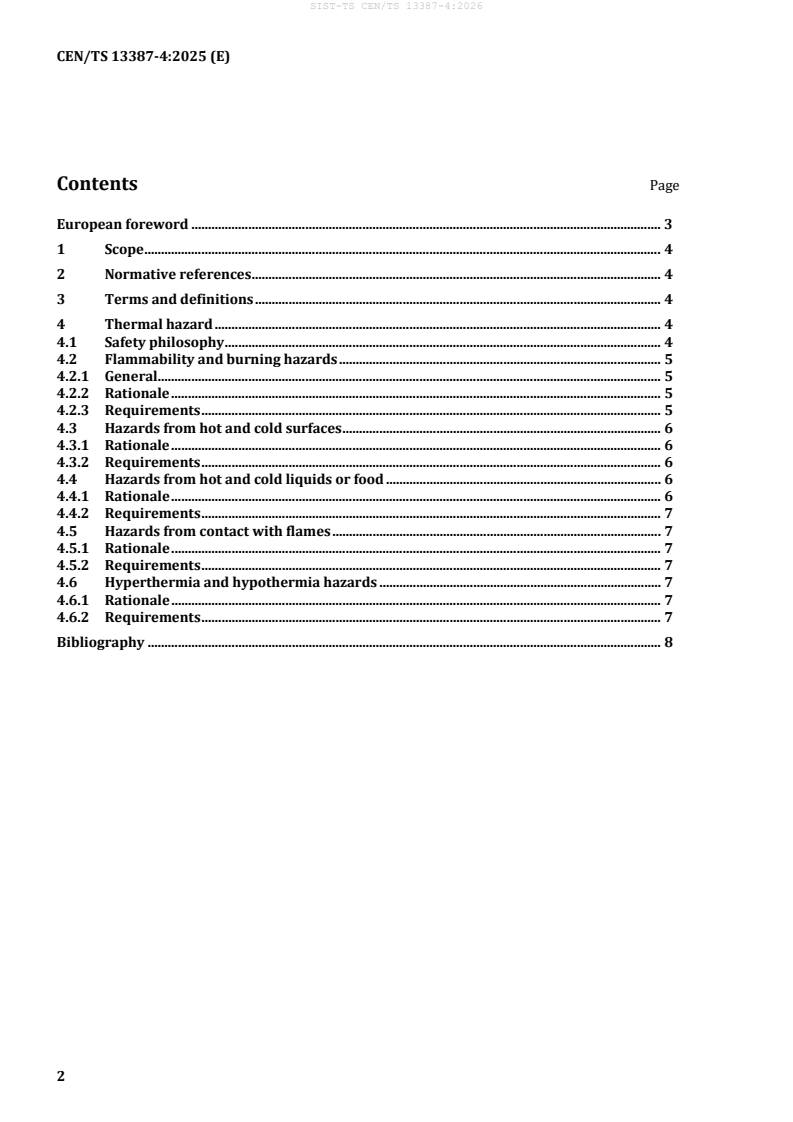
Contents Page
European foreword . 3
1 Scope . 4
2 Normative references . 4
3 Terms and definitions . 4
4 Thermal hazard . 4
4.1 Safety philosophy . 4
4.2 Flammability and burning hazards . 5
4.2.1 General. 5
4.2.2 Rationale . 5
4.2.3 Requirements . 5
4.3 Hazards from hot and cold surfaces . 6
4.3.1 Rationale . 6
4.3.2 Requirements . 6
4.4 Hazards from hot and cold liquids or food . 6
4.4.1 Rationale . 6
4.4.2 Requirements . 7
4.5 Hazards from contact with flames . 7
4.5.1 Rationale . 7
4.5.2 Requirements . 7
4.6 Hyperthermia and hypothermia hazards . 7
4.6.1 Rationale . 7
4.6.2 Requirements . 7
Bibliography . 8
European foreword
This document (CEN/TS 13387-4:2025) has been prepared by Technical Committee CEN/TC 252 “Child
care articles”, the secretariat of which is held by AFNOR.
Attention is drawn to the possibility that some of the elements of this document may be the subject of
patent rights. CEN shall not be held responsible for identifying any or all such patent rights.
This document supersedes CEN/TR 13387-4:2015.
CEN/TR 13387-4:2015:
— Flammability and burning hazards: Test methods aligned with EN 71-2:2020.
The CEN/TS 13387 series, with the general title Child care articles - General safety guidelines, comprises
the following five parts:
— Part 1: Safety philosophy and safety assessment;
— Part 2: Chemical hazards;
— Part 3: Mechanical hazards;
— Part 4: Thermal hazards;
— Part 5: Product information.
CEN/TS 13387-4 is intended to be used in conjunction with CEN/TS 13387-1.
Any feedback and questions on this document should be directed to the users’ national standards body.
A complete listing of these bodies can be found on the CEN website.
According to the CEN/CENELEC Internal Regulations, the national standards organisations of the
following countries are bound to announce this Technical Specification: Austria, Belgium, Bulgaria,
Croatia, Cyprus, Czech Republic, Denmark, Estonia, Finland, France, Germany, Greece, Hungary, Iceland,
Ireland, Italy, Latvia, Lithuania, Luxembourg, Malta, Netherlands, Norway, Poland, Portugal, Republic of
North Macedonia, Romania, Serbia, Slovakia, Slovenia, Spain, Sweden, Switzerland, Türkiye and the
United Kingdom.
1 Scope
This document provides guidance information on thermal hazards that are taken into consideration
when developing safety standards for child care articles. In addition, these guidelines can assist those
with a general professional interest in child safety.
2 Normative references
The following documents are referred to in the text in such a way that some or all of their content
constitutes requirements of this document. For dated references, only the edition cited applies. For
undated references, the latest edition of the referenced document (including
...