

prEN 14175-9
(Main)Fume cupboards — Part 9: Fume cupboards, ducted with filtered internal recirculation
General Information
- Abstract
This document specifies characteristics concerning the design and performance requirements together with type testing and on-site testing procedures especially for ducted filtration fume cupboards (DFFCs) not described in the other parts of EN 14175. Filters in DFFCs can be specific filters or a combination of filters dependent on the characteristics of the contaminants to be removed.
This part of EN 14175 is related to and refers to other parts of EN 14175 regarding definitions, technologies, testing methodologies, design factors and functional aspects and is read in conjunction with these.
This standard covers the specific layout version of ducted fume cupboards with integral filtration. These devices called ducted filtration fume cupboards can be designed to partially reuse filtered air for internal dilution. Therefore, the term “hybrid” fume cupboards is sometimes used.
Fume cupboards with associated filters are considered as standard fume cupboards according EN 14175 1 to EN 14175 3.
NOTE Their filter requirements, description and testing are listed in Annex A for information.
The requirements for fume cupboards and filters for radioactive work are described in detail in EN 14175 8.
Recirculatory filtration fume cabinets which return the filtered exhaust air back into the surrounding room are not part of this document but described in prEN 17242.
DFFCs are not foreseen for work with pathogens. Appropriate microbiological cabinets are described in the EN 12469 series.
- Status
- Not Published
- Publication Date
- 11-Aug-2027
- Technical Committee
- CEN/TC 332 - Laboratory equipment
- Drafting Committee
- CEN/TC 332/WG 4 - Fume cupboards
- Current Stage
- 4060 - Closure of enquiry - Enquiry
- Start Date
- 06-Aug-2026
- Due Date
- 16-Jun-2026
- Completion Date
- 06-Aug-2026

Overview
prEN 14175-9 is a draft European Standard from CEN that focuses on the design and performance of ducted filtration fume cupboards (DFFCs) with filtered internal recirculation. This part of the EN 14175 series specifies requirements and test procedures for fume cupboards that feature integrated filters capable of removing hazardous contaminants before air is ducted outside. These systems can optionally reuse a portion of filtered air internally, leading to energy savings, enhanced containment, and better protection for operators and the environment.
DFFCs are especially important as laboratories handle increasingly hazardous substances. By incorporating advanced filtration, DFFCs minimize contaminant emissions into the atmosphere and reduce the exposure risk for maintenance personnel. DFFCs are not intended for work with pathogens-other EN standards, such as the EN 12469 series, address those applications.
Key Topics
Ducted Filtration Fume Cupboards (DFFCs):
- Specialized fume cupboards with built-in, high-efficiency filters.
- Designed for environments where containing and capturing airborne contaminants is critical.
- Can recirculate a portion of the filtered air within the device.
Performance and Safety Requirements:
- Comprehensive design criteria, including airflow management and filter integration.
- Specific testing methods, such as containment performance tests, face velocity, and pressure drop measurements.
- Continuous monitoring requirements for filters, airflow, and alarm systems.
Filter Types and Monitoring:
- Use of HEPA filters, activated carbon, and specialty media to address a wide range of contaminants (particles, vapors, gases).
- “Safe change” procedures for filter replacement to protect maintenance staff.
- Regular filter testing and verification, including integrity and capacity retention tests.
Operator and Environmental Protection:
- Enhanced containment to reduce occupational health risks.
- Reduction of contaminants vented to the atmosphere.
- Labeling and documentation to ensure correct usage and maintenance.
Applications
Ducted filtration fume cupboards in accordance with prEN 14175-9 are vital in various laboratory settings, particularly where hazardous chemicals, particulates, aerosols, or vapors are present. Key application areas include:
- Chemical Laboratories: For handling volatile solvents, corrosive chemicals, or other hazardous substances.
- Educational Institutions: Ensuring student and staff safety in teaching labs.
- Pharmaceutical and Research Facilities: Providing reliable containment for sensitive or hazardous experimental processes.
- Industrial R&D: Where space or facility limitations preclude increasing ventilation capacity, DFFCs offer efficient contaminant control and energy savings.
These hybrid fume cupboards support laboratories to manage risk, maintain compliance, and meet environmental objectives by effectively filtering air and controlling emissions.
Related Standards
DFFCs and their integration in laboratory ventilation systems must be considered alongside related European standards:
- EN 14175-1: Vocabulary for fume cupboards.
- EN 14175-2: Safety and performance requirements.
- EN 14175-3: Laboratory type test methods.
- EN 14175-4: On-site test methods.
- EN 14175-6: Variable air volume fume cupboards.
- EN 14175-8: Fume cupboards for radioactive work.
- EN 12469: Microbiological safety cabinets (for work with pathogens).
- prEN 17242: Recirculatory filtration fume cabinets.
- EN 14387: Colour coding for filter identification.
- ISO 14644-3: Cleanroom and HEPA filter test procedures.
Laboratories implementing DFFCs should ensure compatibility with ventilation infrastructure and adhere to maintenance, labeling, and documentation requirements as set by the relevant parts of EN 14175 and associated standards.
Keywords: Ducted filtration fume cupboards, DFFC, laboratory safety, filtered recirculation, CEN standard, air containment, fume cupboard filters, EN 14175-9, exhaust filtration, laboratory equipment standards.
Get Certified
Connect with accredited certification bodies for this standard

ECOCERT
Organic and sustainability certification.

Eurofins Food Testing Global
Global leader in food, environment, and pharmaceutical product testing.

Intertek Bangladesh
Intertek certification and testing services in Bangladesh.
Sponsored listings
Frequently Asked Questions
prEN 14175-9 is a draft published by the European Committee for Standardization (CEN). Its full title is "Fume cupboards — Part 9: Fume cupboards, ducted with filtered internal recirculation". This standard covers: This document specifies characteristics concerning the design and performance requirements together with type testing and on-site testing procedures especially for ducted filtration fume cupboards (DFFCs) not described in the other parts of EN 14175. Filters in DFFCs can be specific filters or a combination of filters dependent on the characteristics of the contaminants to be removed. This part of EN 14175 is related to and refers to other parts of EN 14175 regarding definitions, technologies, testing methodologies, design factors and functional aspects and is read in conjunction with these. This standard covers the specific layout version of ducted fume cupboards with integral filtration. These devices called ducted filtration fume cupboards can be designed to partially reuse filtered air for internal dilution. Therefore, the term “hybrid” fume cupboards is sometimes used. Fume cupboards with associated filters are considered as standard fume cupboards according EN 14175 1 to EN 14175 3. NOTE Their filter requirements, description and testing are listed in Annex A for information. The requirements for fume cupboards and filters for radioactive work are described in detail in EN 14175 8. Recirculatory filtration fume cabinets which return the filtered exhaust air back into the surrounding room are not part of this document but described in prEN 17242. DFFCs are not foreseen for work with pathogens. Appropriate microbiological cabinets are described in the EN 12469 series.
This document specifies characteristics concerning the design and performance requirements together with type testing and on-site testing procedures especially for ducted filtration fume cupboards (DFFCs) not described in the other parts of EN 14175. Filters in DFFCs can be specific filters or a combination of filters dependent on the characteristics of the contaminants to be removed. This part of EN 14175 is related to and refers to other parts of EN 14175 regarding definitions, technologies, testing methodologies, design factors and functional aspects and is read in conjunction with these. This standard covers the specific layout version of ducted fume cupboards with integral filtration. These devices called ducted filtration fume cupboards can be designed to partially reuse filtered air for internal dilution. Therefore, the term “hybrid” fume cupboards is sometimes used. Fume cupboards with associated filters are considered as standard fume cupboards according EN 14175 1 to EN 14175 3. NOTE Their filter requirements, description and testing are listed in Annex A for information. The requirements for fume cupboards and filters for radioactive work are described in detail in EN 14175 8. Recirculatory filtration fume cabinets which return the filtered exhaust air back into the surrounding room are not part of this document but described in prEN 17242. DFFCs are not foreseen for work with pathogens. Appropriate microbiological cabinets are described in the EN 12469 series.
prEN 14175-9 is classified under the following ICS (International Classification for Standards) categories: 71.040.10 - Chemical laboratories. Laboratory equipment. The ICS classification helps identify the subject area and facilitates finding related standards.
prEN 14175-9 is available in PDF format for immediate download after purchase. The document can be added to your cart and obtained through the secure checkout process. Digital delivery ensures instant access to the complete standard document.
Standards Content (Sample)
SLOVENSKI STANDARD
01-julij-2026
Digestoriji - 9. del: Digestoriji, opremljeni s filtriranim notranjim kroženjem zraka
Fume cupboards - Part 9: Fume cupboards, ducted with filtered internal recirculation
Abzüge - Teil 9: Abzüge, kanalisiert mit interner gefilterter Umwälzung
Sorbonnes - Partie 9 : Sorbonnes à recirculation partielle de l'air
Ta slovenski standard je istoveten z: prEN 14175-9
ICS:
71.040.10 Kemijski laboratoriji. Chemical laboratories.
Laboratorijska oprema Laboratory equipment
2003-01.Slovenski inštitut za standardizacijo. Razmnoževanje celote ali delov tega standarda ni dovoljeno.
DRAFT
EUROPEAN STANDARD
NORME EUROPÉENNE
EUROPÄISCHE NORM
May 2026
ICS
English Version
Fume cupboards - Part 9: Fume cupboards, ducted with
filtered internal recirculation
EN 14175-9: Sorbonnes - Partie 9: Sorbonnes à filtres EN 14175-9: Laborabzüge - Teil 9: Angeschlossene
raccordées Filterlaborabzüge
This draft European Standard is submitted to CEN members for enquiry. It has been drawn up by the Technical Committee
CEN/TC 332.
If this draft becomes a European Standard, CEN members are bound to comply with the CEN/CENELEC Internal Regulations
which stipulate the conditions for giving this European Standard the status of a national standard without any alteration.
This draft European Standard was established by CEN in three official versions (English, French, German). A version in any other
language made by translation under the responsibility of a CEN member into its own language and notified to the CEN-CENELEC
Management Centre has the same status as the official versions.
CEN members are the national standards bodies of Austria, Belgium, Bulgaria, Croatia, Cyprus, Czech Republic, Denmark, Estonia,
Finland, France, Germany, Greece, Hungary, Iceland, Ireland, Italy, Latvia, Lithuania, Luxembourg, Malta, Netherlands, Norway,
Poland, Portugal, Republic of North Macedonia, Romania, Serbia, Slovakia, Slovenia, Spain, Sweden, Switzerland, Türkiye and
United Kingdom.
Recipients of this draft are invited to submit, with their comments, notification of any relevant patent rights of which they are
aware and to provide supporting documentation.
Warning : This document is not a European Standard. It is distributed for review and comments. It is subject to change without
notice and shall not be referred to as a European Standard.
EUROPEAN COMMITTEE FOR STANDARDIZATION
COMITÉ EUROPÉEN DE NORMALISATION
EUROPÄISCHES KOMITEE FÜR NORMUNG
CEN-CENELEC Management Centre: Rue de la Science 23, B-1040 Brussels
© 2026 CEN All rights of exploitation in any form and by any means reserved Ref. No. prEN 14175-9:2026 E
worldwide for CEN national Members.
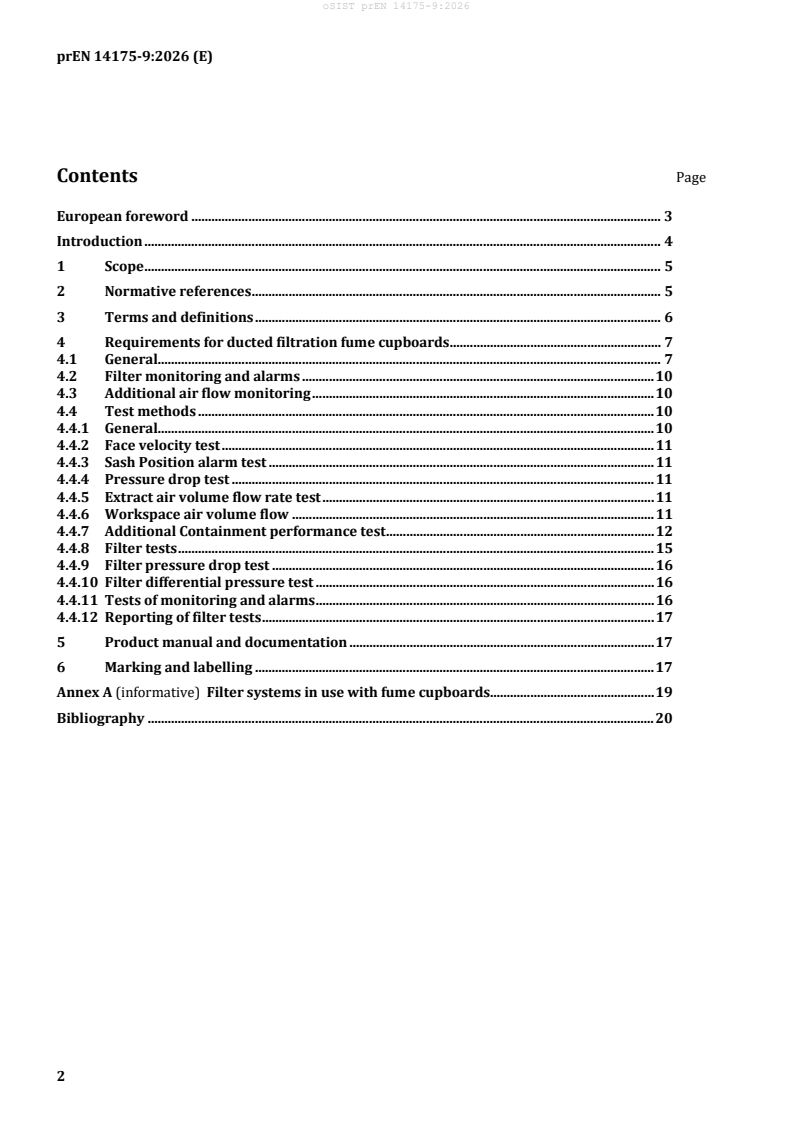
Contents Page
European foreword . 3
Introduction . 4
1 Scope . 5
2 Normative references . 5
3 Terms and definitions . 6
4 Requirements for ducted filtration fume cupboards . 7
4.1 General. 7
4.2 Filter monitoring and alarms . 10
4.3 Additional air flow monitoring . 10
4.4 Test methods . 10
4.4.1 General. 10
4.4.2 Face velocity test . 11
4.4.3 Sash Position alarm test . 11
4.4.4 Pressure drop test . 11
4.4.5 Extract air volume flow rate test . 11
4.4.6 Workspace air volume flow . 11
4.4.7 Additional Containment performance test . 12
4.4.8 Filter tests . 15
4.4.9 Filter pressure drop test . 16
4.4.10 Filter differential pressure test . 16
4.4.11 Tests of monitoring and alarms . 16
4.4.12 Reporting of filter tests . 17
5 Product manual and documentation . 17
6 Marking and labelling . 17
Annex A (informative) Filter systems in use with fume cupboards. 19
Bibliography . 20
European foreword
This document (prEN 14175-9:2026) has been prepared by Technical Committee CEN/TC 332
“Laboratory equipment”, the secretariat of which is held by DIN.
This document is currently submitted to the CEN Enquiry.
Introduction
Ducted Filtration Fume Cupboards (DFFC) are especially adapted devices intended to protect their users
and/or the external environment by means of:
— The ability to contain potentially hazardous materials.
— The ability to remove potentially hazardous materials from air exhausted from within the fume
cupboard housing by means of filtration before the air is discharged to the external environment.
The protection of operators is the main purpose of fume cupboards. As health risks are rising from more
and more potent hazardous products, additional barriers may be necessary. Regarding the installation
sites of cupboards there are growing efforts to improve environmental protection by additional filtration
of contaminated air directly at the source. As dilution is not a solution to pollution, the intention is to
minimise the discharge of contaminants into the atmosphere as well as to protect the exhaust air system,
to make the maintenance safer of this, and to prevent burden to the public environment. Use of filtration
also reduces the potential for re-entrainment of contaminated exhaust air through the air intakes. With
the possibility of partial filtered air reuse such ducted fume cupboards may reduce the volume of exhaust
air discharged. So, they may serve as an alternative solution, where building make up air ventilation is at
capacity limit, contributing to climate protection and energy saving.
The types of potentially hazardous materials to be removed include particulates, gases, vapours, aerosols,
and combinations of these. This objective is driven by aspects of performance based on health risks,
nuisance effects, environmental impacts, or a combination of these. The guidance for filter use is based
upon an operator risk assessment considering particulate or chemical hazards and work processes.
1 Scope
This document specifies characteristics concerning the design and performance requirements together
with type testing and on-site testing procedures especially for ducted filtration fume cupboards not
described in the other parts of EN 14175. Filter in DFFCs can be specific filters or a combination of filters
dependent on the characteristics of the contaminants to be removed.
This document is related to and will refer to other parts of EN 14175 regarding definitions, technologies,
testing methodologies, design factors and functional aspects.
This document covers the specific layout version of ducted fume cupboards with integral filtration. These
devices called Ducted Filtration Fume Cupboards (DFFC) may be designed to partially reuse filtered air
for internal dilution.
Fume cupboards fitted with filters which only act on the extracted air stream are not covered by this part.
Their filter requirements, description and testing could be taken from this standard, in particular in
Annex A.
Recirculatory Filtration Fume Cabinets which return the filtered exhaust air back into the surrounding
room are not part of this standard but described in the EN 17242.
The requirements for fume cupboards and filters for radioactive work are described in detail in
EN 14175-8.
DFFCs are not foreseen for work with pathogens. Appropriate microbiological cabinets are described in
EN 12469.
2 Normative references
The following documents are referred to in the text in such a way that some or all of their content
constitutes requirements of this document. For dated references, only the edition cited applies. For
undated references, the latest edition of the referenced document (including any amendments) applies.
EN 14175-1, Fume cupboards – Part 1: Vocabulary
EN 14175-2:2003, Fume cupboards - Part 2: Safety and performance requirements
EN 14175-3:2019, Fume cupboards - Part 3: Type test methods
EN 14175-4, Fume cupboards – Part 4 : On-site test methods
EN 14175-6, Fume cupboards – Part 6 : Variable air volume fume cupboards
EN 14175-7, Fume cupboards – Part 7: Fume cupboards for high heat and acidic load
EN 14175-8, Fume cupboard – Part 8: Fume cupboards for work with radioactive materials
3 Terms and definitions
For the purposes of this document, the terms and definitions given in EN 14175 (all parts), and the
following apply.
ISO and IEC maintain terminology databases for use in standardization at the following addresses:
— ISO Online browsing platform: available at https://www.iso.org/obp/
— IEC Electropedia: available at https://www.electropedia.org/
3.1
air curtain
additional (for instance vertical) air flow barrier in the front opening of a fume cupboard to support
containment efficiency in separating the inside from the outside of the workspace
3.2
filter
container or a frame containing a collecting filter medium to separate and trap impurities or solid
particles from a liquid or gases passed through it
3.3
filtration system
assembly of one or more filter components or devices that are used to remove/trap airborne
contaminants, including filter, fittings, seals and other connecting parts
Note 1 to entry: A non-exclusive list of types may include one or several particulate filters, chemical absorptive and
physical adsorptive filters (such as e.g., activated carbon), electrostatic precipitators, cyclones, washers, and
scrubbers; see Annex A.
3.4
integral filtration system
filtration system that is fully integrated into the construction of a fume cupboard insofar as it can be
regarded as a coherent, self-contained unit
Note 1 to entry: Fume cupboards with integral filtration systems may also be connected to associated filtration
systems.
3.5
associated filtration system
filtration system that is separate from, but associated with, a fume cupboard and is in the ductwork
between the fume cupboard(s) and the point of discharge from the laboratory
3.6
Ducted Filtration Fume Cupboard
DFFC
ducted fume cupboard equipped with integrated filters to enable internal recirculation of the air as part
of the make up air
3.7
prefilter
initial filtering stage used to remove particulates and/or gases/vapours to protect or improve other
components (e.g. of a filtration system) having higher removal efficiencies
3.8
extract air flow control arrangement
an installation, a control system or sub-system to provide consistent extract air flow conditions
3.9
‘Safe change’ of filters
provisions that allow safe replacement and disposal of filters and prefilters to reduce potential exposure
(e.g., inhalation, skin contact contamination) of the maintenance operator to potentially harmful material
or conditions
3.10
plenum
enclosure part of fume cupboards and cabinets, connected on the one hand to a filter system and on the
other hand to an air supply or an extract air system to isolate zones of air volumes of different pressure
levels
3.11
draught
uncontrolled air flow pattern, directed or turbulent, interfering with intended flow pattern
Note 1 to entry: As a result, draughts may influence the containment performance of fume cupboards.
Note 2 to entry: Low and high temperature draughts (e.g. from air conditioning or ceiling outlets) are often
particularly influential.
3.12
containment
resistance to egress or ingress of contents
Note 1 to entry: A device with containment is a containment enclosure.
3.13
containment performance test
specific test procedure to test the containment performance with a sequence of predetermined process
steps to evaluate containment, robustness, and air exchange efficiency in one pass
4 Requirements for ducted filtration fume cupboards
4.1 General
Fume cupboards (FC) with associated filtration systems are devices complying with EN 14175-2. They
are particularly characterised by the fact that they discharge all air exhausted from within them to the
duct after being filtered to reduce the levels of potential contaminants.
Ducted filtration fume cupboards (DFFC) have a layout with integral filters combined with partial internal
reuse of filtered air. For a schematic example, see figure 1. An overview of different filter systems is found
in the Annex A.
A variety of functional objectives may be addressed using a DFFC including:
— reduction in concentration of materials discharged that potentially present health risks;
— reduction in the level of contamination to exhaust ductwork installations;
— reduction in environmental impact of the fumes discharged;
— reduction in concentration of materials discharged that may represent a nuisance (odour, dust,
particulates as examples);
— protection from spillage effects;
— to overcome capacity limitations of air extract systems;
— energy savings.
The specific layout is characterised by the fact that all air volume flow to the exhaust is filtered before
discharge to the natural environment and thereby protecting it. A partial fraction of the filtered air
volume, e.g. 50 %, may be returned to the workspace within the fume cupboard to support retention of
contaminants. This principle may require or be supported by integral fans to overcome the pressure drop
of the filters and/or serve additional purposes.
Key
1 filtered exhaust air
2 filtered air
3 filtered air, returned to workspace as air curtain
4 potentially contaminated air
5 sash
6 supply air
7 workspace air volume flow
8 filter(s)
9 plenum for filtered air
10 fan
flow path of filtered air
flow path of supply air
potentially contaminated air
Figure 1 — Example for a DFFC concept
Solid arrows show the extraction of potentially contaminated air from the workspace through filters
underneath the work surface. The grey dashed arrows demonstrate the flow paths of the filtered air: One
fraction of the filtered air is released to duct and the other fraction returns to the workspace within the
fume cupboard envelope. Filter(s) may be positioned elsewhere within the overall envelope of the DFFC.
The specific requirements for DFFCs result from above concept example and shall be based on a risk
assessment and manufacturers recommendation. This could include:
— categories and quantities of chemicals being handled;
— special demands for retention of contaminants and containment;
— air flow capacities of the lab ventilation;
— filtration system and type;
— filter change procedure (Safe change of filters);
— sampling or filter testing;
— containment performance class of the fume cupboard.
NOTE CEN/TS 17441 “Ventilation systems in laboratories” can be a helpful reference.
The type of filters installed, and their intended use must always be clearly visible to the operator in front
of the fume cupboard.
DFFCs may have low face velocities and use an air curtain by design to improve the operator’s protection
at the work opening (see figure 2).
Key
1 potentially contaminated air
2 sash
3 supply air
4 air curtain
5 work surface
6 workspace air volume flow
flow path of filtered air
flow path of supply air
potentially contaminated air
Figure 2 — Example for a DFFC sash opening equipped with air curtain
The light grey dashed arrows demonstrate the flow path of the vertical air curtain to the work surface.
Dark grey solid arrows show the extraction of potentially contaminated air underneath the work surface.
4.2 Filter monitoring and alarms
Certain types of filters will have air flow resistances that increase with use, most typically due to
particulate loading of the filter media. Such increase in resistance is likely to affect (reduce) volume flow
rates of DFFCs. Active carbon filters are loaded with chemicals reducing their capture capacity and
efficiency as is the stripping agent in washers/scrubbers. Therefore, DFFCs should include continuous
monitoring and alarm(s) for:
— filter retention or saturation of active carbon filter(s), e.g. with solvent sensor or PID;
— filter pressure drop for particle filters, where appropriate;
— filters are an integral part of DFFCs and should be subject to regular maintenance and testing as part
of local safety regulations and manufacturer’s recommendations.
NOTE Other filter systems (see Annex A) can require additional items to be monitored (e.g. stripping liquid of
washers, e.g. with photometer or pH-meter).
4.3 Additional air flow monitoring
If the DFFC is equipped with an air curtain in the front opening, the efficiency of it is depending on the
airflow balance between inflow and downflow. An air curtain is fragile by design and may react
sensitively to draughts. The correct function of it assures the containment and therefore, it shall be
measured with a robustness test or containment test, e.g. see 4.3.6. Both the values of the total filtered
air volume and extract air volume flows must be monitored and determined alternatively.
The monitoring of the inflow, total filtered and extract air volume flow rates shall be in accordance with
EN 14175-2:2003, 8.2.
4.4 Test methods
4.4.1 General
The test methods of EN 14175-2, EN 14175-3 and EN 14175-4 apply.
Due to the specific characteristics of DFFCs some of the standard test methods need to be more detailed
hereafter. If the respective containment tests cannot be performed accordingly due to the fume cupboard
design and/or filter materials used an adapted testing described under 4.4.7 or additional containment
performance test described under 4.4.8 hereafter shall be carried out.
For the type testing of DFFC three test procedures shall be conducted in a type test laboratory according
to EN 14175-3:2019, Clause 4:
• the s
...