

EN 12285-1:2003
(Main)Workshop fabricated steel tanks - Part 1: Horizontal cylindrical single skin and double skin tanks for the underground storage of flammable and non-flammable water polluting liquids
General Information
- Abstract
The Standard specifies the requirements for shop fabricated cylindrical, horizontal tanks, single and double skin for underground storage of water polluting liquids (both flammable and non-flammable). The standard is applicable for normal operating conditions (-20°C to +50°C). Where temperatures can fall below this range, additional requirements shall be taken into account. Quittance on liquid material combinations is given in annex B. The standard is not applicable for liquids causing special danger. The standard does not deal with internal coating.
- Status
- Withdrawn
- Publication Date
- 04-Mar-2003
- Withdrawal Date
- 29-Sep-2026
- Technical Committee
- CEN/TC 265 - Site built metallic tanks for the storage of liquids
- Drafting Committee
- CEN/TC 221/SC 1/WG 1 - Underground tanks
- Current Stage
- 9960 - Withdrawal effective - Withdrawal
- Start Date
- 04-Jul-2018
- Completion Date
- 30-Sep-2026



Relations
- Effective Date
- 08-Jun-2022
- Effective Date
- 08-Jun-2022
- Effective Date
- 28-Jan-2026
- Effective Date
- 28-Jan-2026
- Effective Date
- 28-Jan-2026
- Effective Date
- 28-Jan-2026
- Effective Date
- 28-Jan-2026
- Effective Date
- 28-Jan-2026
- Effective Date
- 28-Jan-2026
- Effective Date
- 28-Jan-2026
- Effective Date
- 28-Jan-2026
- Effective Date
- 28-Jan-2026
- Effective Date
- 28-Jan-2026
- Effective Date
- 28-Jan-2026
- Effective Date
- 28-Jan-2026
Get Certified
Connect with accredited certification bodies for this standard

CIS Institut d.o.o.
Personal Protective Equipment (PPE) certification body. Notified Body NB-2890 for EU Regulation 2016/425 PPE.
Institut za varilstvo d.o.o. (Welding Institute)
Slovenia's leading welding institute since 1952. ISO 3834, EN 1090, pressure equipment certification, NDT personnel, welder qualification. Only IIW Au

Kiwa BDA Testing
Building and construction product certification.
Sponsored listings
Frequently Asked Questions
EN 12285-1:2003 is a standard published by the European Committee for Standardization (CEN). Its full title is "Workshop fabricated steel tanks - Part 1: Horizontal cylindrical single skin and double skin tanks for the underground storage of flammable and non-flammable water polluting liquids". This standard covers: The Standard specifies the requirements for shop fabricated cylindrical, horizontal tanks, single and double skin for underground storage of water polluting liquids (both flammable and non-flammable). The standard is applicable for normal operating conditions (-20°C to +50°C). Where temperatures can fall below this range, additional requirements shall be taken into account. Quittance on liquid material combinations is given in annex B. The standard is not applicable for liquids causing special danger. The standard does not deal with internal coating.
The Standard specifies the requirements for shop fabricated cylindrical, horizontal tanks, single and double skin for underground storage of water polluting liquids (both flammable and non-flammable). The standard is applicable for normal operating conditions (-20°C to +50°C). Where temperatures can fall below this range, additional requirements shall be taken into account. Quittance on liquid material combinations is given in annex B. The standard is not applicable for liquids causing special danger. The standard does not deal with internal coating.
EN 12285-1:2003 is classified under the following ICS (International Classification for Standards) categories: 13.300 - Protection against dangerous goods; 23.020.10 - Stationary containers and tanks. The ICS classification helps identify the subject area and facilitates finding related standards.
EN 12285-1:2003 has the following relationships with other standards: It is inter standard links to EN 12285-3:2019, EN 12285-1:2018, EN ISO 9606-1:2017, EN ISO 8501-1:2007, EN ISO 15614-1:2017, EN 13160-5:2016+A1:2024, EN ISO 898-1:2013, EN ISO 15607:2019, EN 13160-2:2016+A1:2024, EN 10204:1991, EN ISO 15609-1:2019, EN 13160-3:2016+A1:2024, EN 13160-7:2016+A1:2024, EN 13160-1:2016, EN 13160-6:2003. Understanding these relationships helps ensure you are using the most current and applicable version of the standard.
EN 12285-1:2003 is associated with the following European legislation: EU Directives/Regulations: 305/2011, 89/106/EEC. When a standard is cited in the Official Journal of the European Union, products manufactured in conformity with it benefit from a presumption of conformity with the essential requirements of the corresponding EU directive or regulation.
EN 12285-1:2003 is available in PDF format for immediate download after purchase. The document can be added to your cart and obtained through the secure checkout process. Digital delivery ensures instant access to the complete standard document.
Standards Content (Sample)
2003-01.Slovenski inštitut za standardizacijo. Razmnoževanje celote ali delov tega standarda ni dovoljeno.Werksgefertigte Tanks aus Stahl - Teil 1:Liegende zylindrische ein- und doppelwandige Tanks zur unterirdischen Lagerung von brennbaren und nicht brennbaren wassergefährdenden FlüssigkeitenRéservoirs en aciers fabriqués en atelier - Partie 1:Réservoirs horizontaux cylindriques a simple et double paroi pour le stockage enterré de liquides inflammables et non-inflammables polluant l'eauWorkshop fabricated steel tanks - Part 1: Horizontal cylindrical single skin and double skin tanks for the underground storage of flammable and non-flammable water polluting liquids23.020.10UH]HUYRDUMLStationary containers and tanks13.300Varstvo pred nevarnimi izdelkiProtection against dangerous goodsICS:Ta slovenski standard je istoveten z:EN 12285-1:2003SIST EN 12285-1:2003en01-december-2003SIST EN 12285-1:2003SLOVENSKI
STANDARD
EUROPEAN STANDARDNORME EUROPÉENNEEUROPÄISCHE NORMEN 12285-1March 2003ICS 13.300; 23.020.10English versionWorkshop fabricated steel tanks - Part 1: Horizontal cylindricalsingle skin and double skin tanks for the underground storage offlammable and non-flammable water polluting liquidsRéservoirs en aciers fabriqués en atelier - Partie1:Réservoirs horizontaux cylindriques à simple et doubleparoi pour le stockage enterré de liquides inflammables etnon-inflammables polluant l'eauWerksgefertigte Tanks aus Stahl - Teil 1:Liegendezylindrische ein- und doppelwandige Tanks zurunterirdischen Lagerung von brennbaren undnichtbrennbaren wassergefährdenden FlüssigkeitenThis European Standard was approved by CEN on 4 November 2002.CEN members are bound to comply with the CEN/CENELEC Internal Regulations which stipulate the conditions for giving this EuropeanStandard the status of a national standard without any alteration. Up-to-date lists and bibliographical references concerning such nationalstandards may be obtained on application to the Management Centre or to any CEN member.This European Standard exists in three official versions (English, French, German). A version in any other language made by translationunder the responsibility of a CEN member into its own language and notified to the Management Centre has the same status as the officialversions.CEN members are the national standards bodies of Austria, Belgium, Czech Republic, Denmark, Finland, France, Germany, Greece,Hungary, Iceland, Ireland, Italy, Luxembourg, Malta, Netherlands, Norway, Portugal, Slovak Republic, Spain, Sweden, Switzerland andUnited Kingdom.EUROPEAN COMMITTEE FOR STANDARDIZATIONCOMITÉ EUROPÉEN DE NORMALISATIONEUROPÄISCHES KOMITEE FÜR NORMUNGManagement Centre: rue de Stassart, 36
B-1050 Brussels© 2003 CENAll rights of exploitation in any form and by any means reservedworldwide for CEN national Members.Ref. No. EN 12285-1:2003 ESIST EN 12285-1:2003
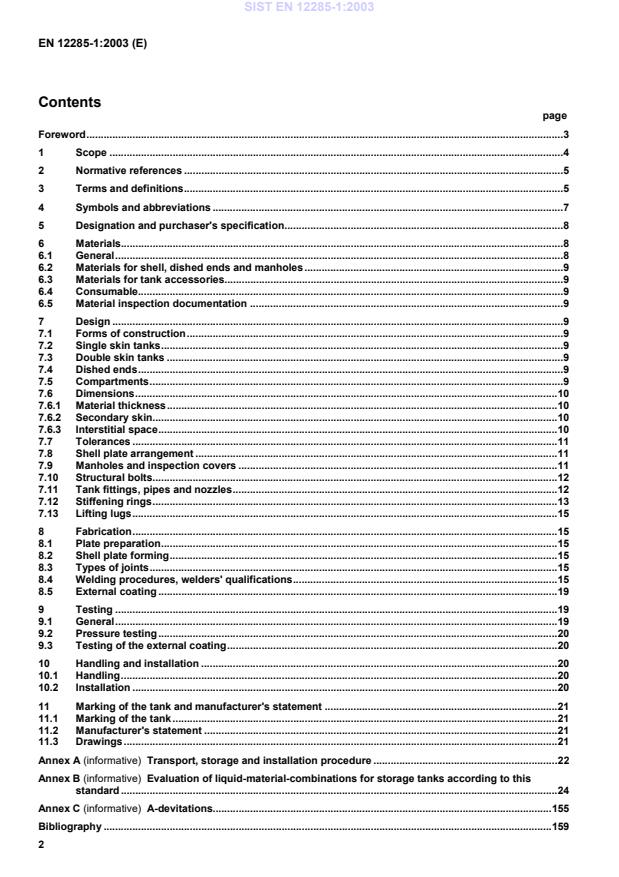
Transport, storage and installation procedure.22Annex B (informative)
Evaluation of liquid-material-combinations for storage tanks according to thisstandard.24Annex C (informative)
A-devitations.155Bibliography.159SIST EN 12285-1:2003
(ISO 898-1:1999).EN ISO 8501–1, Preparation of steel substrates before application of paints and related products - Visualassessment of surface cleanliness — Part 1: Rust grades and preparation grades of uncoated steel substrates andof steel substrates after overall removal of previous coatings (ISO 8501-1:1988).3 Terms and definitionsFor the purposes of this European Standard, the following terms and definitions apply.3.1tanksworkshop fabricated cylindrical containments for the storage of liquids. They are made of steel, equipped with dishedends and consist of one or more compartmentsSIST EN 12285-1:2003
the dished endkpPitch circle diameterlcLength of the compartment of a tank without dished endsloOverall length of the tanklzLength of the tank without dished endsr1Crown radius of dished endsr2Knuckle radius of dished endsr3Knuckle radius of the outer dished ends1Nominal thickness of inner skin and inner dished endss2Interstitial spaces3Nominal thickness of outer skins4Nominal thickness of outer dished endss5Nominal thickness of compartment dished endss6Nominal thickness of manhole flange and covers7Plate thickness of manhole bodyincline angle for T-joint weldingSIST EN 12285-1:2003
r1 £ d1
r2 ³ d1/30.7.5 CompartmentsThe nominal wall thicknesses of dished ends separating the compartments (compartment dished ends) are given inTable 3. For classes A and B a different form of dished ends separating the compartments is possible, where r1 = d1,but without knuckle radius r2 and without straight flange.A compartment dished end with a knuckle radius and a straight flange is equivalent to a reinforcement ring at thesame position.SIST EN 12285-1:2003
71120108018--20M 1648aIf a manhole is required and no specification is given by the purchaser this diameter shall be used.bFor tanks of class C inside diameters of the manhole (d2) exceeding 800 mm are not permitted.Instead of the manhole covers shown in the figure 3 and dimensioned in Table 4, ribbed or embossed covers maybe used in class A tanks with a plate thickness at least equal to the thickness of the inner tank s1. A ribbed orembossed cover shall withstand the test pressure pt1.Inspection covers for tanks of class A with d1 £ 1250 mm and tanks of classes B and C with d1 £ 1000 mm. Thediameter of the inspection cover shall not be larger than 300 mm and not smaller than 120 mm, and the thicknessof the inspection cover shall be equal to the minimum thickness of the inner tank.7.10 Structural boltsStructural bolts used shall be in accordance with EN ISO 898-1, with a property class being at least 4.6. Thematerial chosen shall be compatible with the tank material.7.11 Tank fittings, pipes and nozzlesAll tank fittings, pipes and nozzles, shall be situated on the manhole cover or in the single skin top of the tank. Fortanks of class C only the set-through nozzles shall be used. A penetration of the double skin is not allowed(exception: nozzles for leak detection system). Fittings and all other openings shall have a minimum distance of50 mm to welded seams.SIST EN 12285-1:2003
160Rz·aGaskets shall be suitable for the purpose.bFor set-through-nozzles a vent of 10 mm diameter or equivalent openingshall be provided in the manhole neck at the highest practical point.cConnection for earthing and use for cathodic corrosion protection if required.Figure 3 — Examples for manhole7.12 Stiffening ringsThe following methods of construction may be used:T 80 x 80 according to EN 10055, or100 x 12.SIST EN 12285-1:2003
+ = s11(rounded up to full mm)(rounded up to full mm)7.13 Lifting lugsEach tank shall be provided with lifting lugs. The number of liftings lugs shall be at least 1 for a tank up to 20 m3nominal volume and not less than 2 above 20 m3. The lug(s) shall be positioned to enable the tank to be lifted in ahorizontal position.Lifting lugs fully welded to the tanks shall be provided in sufficient size and quantity to enable the empty tank to belifted.The lifting lugs shall be provided with a lifting hole of at least 60 mm minimum diameter.In order to prevent deformation and for maintaining integrity of the coating, a reinforcement plate shall be providedor the lifting lug(s) shall be made of suitable size.8 Fabrication8.1 Plate preparationThe plate edges shall be visually examined for laminations by the manufacturer. Where such faults are found theplate shall be deemed unsuitable for fabrication of the tank.8.2 Shell plate formingAll plates shall be formed to the required curvature over the full width or length of the plate as might be applicable.The manufacturer shall ensure that there is continuity of curvature at the longitudinal butt welds.8.3 Types of jointsThe types of welded joints shall be in accordance with Table 6. All internal attachments shall be continuouslywelded.8.4 Welding procedures, welders' qualificationsWelding procedures shall be in accordance with EN 288–1, EN 288–2, EN 288–3 and welders' qualifications shallbe in accordance with EN 287–1.SIST EN 12285-1:2003
0,3 s3 or 2mm2aJoggled butt jointFor class A and hydrocarbon liquidsFor double and single skinNot permissible with inner coating2bJoggled butt jointFor class A, B and C3aOverlap jointFor class A, B and CFor outer skina = 0,7 s33bOverlap jointFor class A, B and CFor outer skina = 0,7 s3SIST EN 12285-1:2003
Marking of the tankEach tank shall be marked using a durable label which shall be corrosion resistant and resistant to the storedproduct.The label shall be fixed to the tank on or close to the manhole of the tank.The label shall contain the following information as a minimum:¾ Name and address of manufacturer¾ Year of manufacture¾ Serial number of tank¾ Designation in accordance with 3¾ Type of coatings¾ Mass of empty tank¾ Type of leak detection liquid (when supplied)In addition each compartment shall be provided with a label indicating the nominal volume in m³ of that compart-ment.11.2 Manufacturer's statementThe manufacturer shall provide a statement for each tank giving at least the information included in 10.1 and thematerial chosen.
DrawingsThe manufacturer shall provide a drawing showing all important dimensions, compartments and connections.SIST EN 12285-1:2003
is demonstrated by using the form shownin appendix 1, laboratory tests or relevant literature.If required by national regulation, the references by laboratory tests or relevant literature should be confirmedaccording to the national rules.NOTEInformation usually is sent to the national competent authority.B.4Use of the positive-liquid-listB.4.1Classification1)
of the flammable liquids into danger classes (Table B.2 column 5)1) Danger class A:Liquids with a flamepoint not exceeding 100°C, which do not show any property ofdanger class B regarding water solubility, namelyDanger class A I:Liquids with a flash point below 21°C,Danger class A II:Liquids with a flash point of 21°C up to 55°C,Danger class A III:Liquids with a flash point above 55°C up to 100°C
1)Danger classes of liquids of this Standard should not be interpreted as tank classes defined in 3.1.4SIST EN 12285-1:2003
...