

EN 17319:2020
(Main)Railway applications - Infrastructure - Performance requirements of rail fastening systems for tramways
General Information
- Abstract
This document is applicable to fastening systems used with grooved rails for tram, urban rail and industrial tracks, with maximum design axle loads and minimum curve radii in accordance with Table 1.
This document is for type approval of a complete fastening assembly only.
Table 1
The requirements apply to fastening systems for the grooved rail profiles in EN 14811 which act on the foot and/or web of the rail.
This document is not applicable to fastening systems for other rail sections or special fastening systems used at bolted joints or glued joints or in switches and crossings for grooved rails.
NOTE Requirements for fastenings for use with Vignole rails are included in the EN 13481 series of standards.
- Status
- Published
- Publication Date
- 26-May-2020
- Withdrawal Date
- 29-Nov-2020
- Technical Committee
- CEN/TC 256 - Railway applications
- Drafting Committee
- CEN/TC 256/SC 1/WG 17 - Fastening systems
- Current Stage
- 9093 - Decision to confirm - Review Enquiry
- Start Date
- 03-Dec-2025
- Completion Date
- 30-Sep-2026



Overview
EN 17319:2020 - Railway applications - Infrastructure - Performance requirements of rail fastening systems for tramways - is a CEN European standard that defines performance and type‑approval criteria for complete rail fastening assemblies used with grooved rails in tram, urban rail and industrial tracks. It applies to fastening systems that act on the rail foot and/or web (grooved rail profiles per EN 14811) and sets categories and limits for maximum design axle loads and minimum curve radii (see Table 1 in the standard). EN 17319:2020 is intended for type approval of a complete fastening assembly only and excludes special fastenings for bolted/glued joints and switches and crossings.
Key topics and technical requirements
The standard specifies tests, limits and documentation needed to demonstrate fitness for purpose. Major technical topics include:
- Fastening categories (A+, A, B) with defined maximum axle loads and minimum curve radii for selection and design.
- Test specimens and scope for embedded track, ballasted track and ballastless track with rails on the surface.
- Longitudinal rail restraint and longitudinal stiffness requirements and test methods.
- Vertical assembly stiffness and pad stiffness requirements for load distribution.
- Effect of repeated loading (fatigue/performance under cyclic traffic loading).
- Clamping force, uplift restraint and uplift stiffness test methods (Annex B and C include normative test methods).
- Electrical insulation requirements (track circuits, stray current protection) with guidance in Annex A.
- Performance in corrosive environments, material durability and proof load/pull‑out resistance.
- Attenuation of noise and vibration, environmental vibration calculations and noise guidance (informative Annex D).
- Marking, labelling and packaging, and statements of fitness for purpose.
Applications and who uses this standard
EN 17319:2020 is practical for:
- Fastening system manufacturers seeking type approval of complete assemblies for tramway use.
- Testing laboratories conducting standardized mechanical, electrical and environmental tests.
- Infrastructure owners, tram operators and procurers specifying compliant fastening systems for embedded, ballasted or ballastless tram tracks.
- Design and maintenance engineers evaluating fastening performance for curve radii, axle load classes and urban track conditions.
- Standards bodies and certification authorities implementing CEN requirements.
Related standards
- EN 14811 (grooved rail profiles)
- EN 13146 series (test methods for fastening systems) - referenced for specific test procedures
- EN 13481 series (fastenings for Vignole rails)
Keywords: EN 17319:2020, rail fastening systems, tramways, grooved rails, type approval, uplift stiffness, longitudinal restraint, clamping force, noise and vibration, electrical insulation.
Relations
- Effective Date
- 28-Jan-2026
- Effective Date
- 28-Jan-2026
- Effective Date
- 28-Jan-2026
- Effective Date
- 28-Jan-2026
- Effective Date
- 28-Jan-2026
- Effective Date
- 28-Jan-2026
- Effective Date
- 28-Jan-2026
Get Certified
Connect with accredited certification bodies for this standard

IRIS Certification (UNIFE)
International Railway Industry Standard certification.

TÜV SÜD Rail GmbH
TÜV SÜD railway certification services.

Bureau Veritas Railway Certification
Railway and transportation certification.
Sponsored listings
Frequently Asked Questions
EN 17319:2020 is a standard published by the European Committee for Standardization (CEN). Its full title is "Railway applications - Infrastructure - Performance requirements of rail fastening systems for tramways". This standard covers: This document is applicable to fastening systems used with grooved rails for tram, urban rail and industrial tracks, with maximum design axle loads and minimum curve radii in accordance with Table 1. This document is for type approval of a complete fastening assembly only. Table 1 The requirements apply to fastening systems for the grooved rail profiles in EN 14811 which act on the foot and/or web of the rail. This document is not applicable to fastening systems for other rail sections or special fastening systems used at bolted joints or glued joints or in switches and crossings for grooved rails. NOTE Requirements for fastenings for use with Vignole rails are included in the EN 13481 series of standards.
This document is applicable to fastening systems used with grooved rails for tram, urban rail and industrial tracks, with maximum design axle loads and minimum curve radii in accordance with Table 1. This document is for type approval of a complete fastening assembly only. Table 1 The requirements apply to fastening systems for the grooved rail profiles in EN 14811 which act on the foot and/or web of the rail. This document is not applicable to fastening systems for other rail sections or special fastening systems used at bolted joints or glued joints or in switches and crossings for grooved rails. NOTE Requirements for fastenings for use with Vignole rails are included in the EN 13481 series of standards.
EN 17319:2020 is classified under the following ICS (International Classification for Standards) categories: 45.140 - Metro, tram and light rail equipment; 93.100 - Construction of railways. The ICS classification helps identify the subject area and facilitates finding related standards.
EN 17319:2020 has the following relationships with other standards: It is inter standard links to EN 13146-6:2012, EN ISO 7500-1:2018, EN 13146-7:2012, EN 13146-9:2009+A1:2011, EN 13146-4:2012+A1:2014, EN ISO 22074-3:2024, EN 13481-5:2022. Understanding these relationships helps ensure you are using the most current and applicable version of the standard.
EN 17319:2020 is associated with the following European legislation: Standardization Mandates: M/486. When a standard is cited in the Official Journal of the European Union, products manufactured in conformity with it benefit from a presumption of conformity with the essential requirements of the corresponding EU directive or regulation.
EN 17319:2020 is available in PDF format for immediate download after purchase. The document can be added to your cart and obtained through the secure checkout process. Digital delivery ensures instant access to the complete standard document.
Standards Content (Sample)
SLOVENSKI STANDARD
01-september-2020
Železniške naprave - Infrastruktura - Zahtevane lastnosti sistemov za pritrjevanje
tirnic za tramvaje
Railway applications - Infrastructure - Performance requirements of rail fastening
systems for tramways
Bahnanwendungen - Infrastruktur - Leistungsanforderungen für
Schienenbefestigungssysteme für Straßenbahnen
Applications ferroviaires - Infrastructure - Exigences de performance relatives aux
systèmes de fixation de rail pour tramways
Ta slovenski standard je istoveten z: EN 17319:2020
ICS:
45.140 Oprema za podzemne vlake, Metro, tram and light rail
tramvaje in lahka tirna vozila equipment
93.100 Gradnja železnic Construction of railways
2003-01.Slovenski inštitut za standardizacijo. Razmnoževanje celote ali delov tega standarda ni dovoljeno.
EN 17319
EUROPEAN STANDARD
NORME EUROPÉENNE
May 2020
EUROPÄISCHE NORM
ICS 45.140; 93.100
English Version
Railway applications - Infrastructure - Performance
requirements of rail fastening systems for tramways
Applications ferroviaires - Infrastructure - Exigences Bahnanwendungen - Infrastruktur -
de performance relatives aux systèmes de fixation de Leistungsanforderungen für
rail pour tramways Schienenbefestigungssysteme für Straßenbahnen
This European Standard was approved by CEN on 20 April 2020.
CEN members are bound to comply with the CEN/CENELEC Internal Regulations which stipulate the conditions for giving this
European Standard the status of a national standard without any alteration. Up-to-date lists and bibliographical references
concerning such national standards may be obtained on application to the CEN-CENELEC Management Centre or to any CEN
member.
This European Standard exists in three official versions (English, French, German). A version in any other language made by
translation under the responsibility of a CEN member into its own language and notified to the CEN-CENELEC Management
Centre has the same status as the official versions.
CEN members are the national standards bodies of Austria, Belgium, Bulgaria, Croatia, Cyprus, Czech Republic, Denmark, Estonia,
Finland, France, Germany, Greece, Hungary, Iceland, Ireland, Italy, Latvia, Lithuania, Luxembourg, Malta, Netherlands, Norway,
Poland, Portugal, Republic of North Macedonia, Romania, Serbia, Slovakia, Slovenia, Spain, Sweden, Switzerland, Turkey and
United Kingdom.
EUROPEAN COMMITTEE FOR STANDARDIZATION
COMITÉ EUROPÉEN DE NORMALISATION
EUROPÄISCHES KOMITEE FÜR NORMUNG
CEN-CENELEC Management Centre: Rue de la Science 23, B-1040 Brussels
© 2020 CEN All rights of exploitation in any form and by any means reserved Ref. No. EN 17319:2020 E
worldwide for CEN national Members.
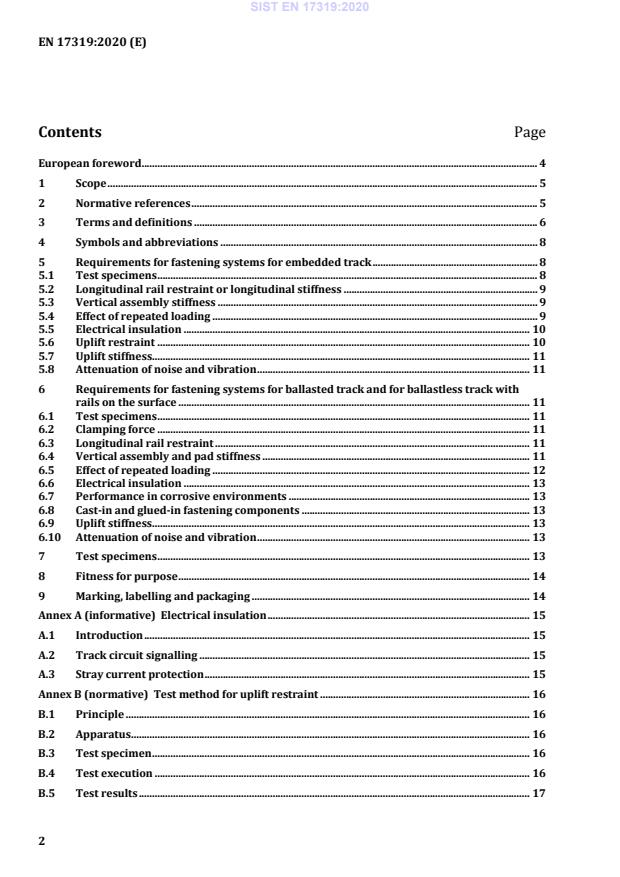
Contents Page
European foreword . 4
1 Scope . 5
2 Normative references . 5
3 Terms and definitions . 6
4 Symbols and abbreviations . 8
5 Requirements for fastening systems for embedded track . 8
5.1 Test specimens . 8
5.2 Longitudinal rail restraint or longitudinal stiffness . 9
5.3 Vertical assembly stiffness . 9
5.4 Effect of repeated loading . 9
5.5 Electrical insulation . 10
5.6 Uplift restraint . 10
5.7 Uplift stiffness . 11
5.8 Attenuation of noise and vibration . 11
6 Requirements for fastening systems for ballasted track and for ballastless track with
rails on the surface . 11
6.1 Test specimens . 11
6.2 Clamping force . 11
6.3 Longitudinal rail restraint . 11
6.4 Vertical assembly and pad stiffness . 11
6.5 Effect of repeated loading . 12
6.6 Electrical insulation . 13
6.7 Performance in corrosive environments . 13
6.8 Cast-in and glued-in fastening components . 13
6.9 Uplift stiffness . 13
6.10 Attenuation of noise and vibration . 13
7 Test specimens . 13
8 Fitness for purpose . 14
9 Marking, labelling and packaging . 14
Annex A (informative) Electrical insulation . 15
A.1 Introduction . 15
A.2 Track circuit signalling . 15
A.3 Stray current protection . 15
Annex B (normative) Test method for uplift restraint . 16
B.1 Principle . 16
B.2 Apparatus . 16
B.3 Test specimen . 16
B.4 Test execution . 16
B.5 Test results . 17
Annex C (normative) Test method for uplift stiffness . 18
C.1 Principle . 18
C.2 Apparatus . 18
C.3 Test specimen . 18
C.4 Test execution . 18
C.5 Test results . 18
Annex D (informative) Noise and vibration . 19
D.1 General . 19
D.2 Symbols . 19
D.3 Parameters for environmental vibration calculations . 19
D.4 Calculating the vibration attenuation . 19
D.5 Environmental noise . 20
Bibliography . 21
European foreword
This document (EN 17319:2020) has been prepared by Technical Committee CEN/TC 256 “Railway
applications”, the secretariat of which is held by DIN.
This European Standard shall be given the status of a national standard, either by publication of an
identical text or by endorsement, at the latest by November 2020, and conflicting national standards
shall be withdrawn at the latest by November 2020.
Attention is drawn to the possibility that some of the elements of this document may be the subject of
patent rights. CEN shall not be held responsible for identifying any or all such patent rights.
This document is supported by the test methods in the series EN 13146 “Railway applications – Track –
Test methods for fastening systems”.
According to the CEN-CENELEC Internal Regulations, the national standards organisations of the
following countries are bound to implement this European Standard: Austria, Belgium, Bulgaria,
Croatia, Cyprus, Czech Republic, Denmark, Estonia, Finland, France, Germany, Greece, Hungary, Iceland,
Ireland, Italy, Latvia, Lithuania, Luxembourg, Malta, Netherlands, Norway, Poland, Portugal, Republic of
North Macedonia, Romania, Serbia, Slovakia, Slovenia, Spain, Sweden, Switzerland, Turkey and the
United Kingdom.
1 Scope
This document is applicable to fastening systems used with grooved rails for tram, urban rail and
industrial tracks, with maximum design axle loads and minimum curve radii in accordance with Table 1.
This document is for type approval of a complete fastening assembly only.
Table 1 — Fastening category criteria
Fastening category Maximum design axle load Minimum curve radius
kN m
A+ 130 18
A 130 40
B 180 80
NOTE The maximum axle load limit does not apply to maintenance vehicles
The requirements apply to fastening systems for the grooved rail profiles in EN 14811 which act on the
foot and/or web of the rail.
This document is not applicable to fastening systems for other rail sections or special fastening systems
used at bolted joints or glued joints or in switches and crossings for grooved rails.
NOTE Requirements for fastenings for use with Vignole rails are included in the EN 13481 series of
standards.
2 Normative references
The following documents are referred to in the text in such a way that some or all of their content
constitutes requirements of this document. For dated references, only the edition cited applies. For
undated references, the latest edition of the referenced document (including any amendments) applies.
EN 13146-1:2017, Railway applications – Track – Test methods for fastening systems – Part 1:
Determination of longitudinal restraint
EN 13146-4:2012+A1:2014, Railway applications - Track - Test methods for fastening systems - Part 4:
Effect of repeated loading
EN 13146-6:2012, Railway applications - Track - Test methods for fastening systems - Part 6: Effect of
severe environmental conditions
EN 13146-7:2012, Railway applications – Track – Test methods for fastening systems – Part 7:
Determination of clamping force and uplift stiffness
EN 13146-9:2009+A1:2011, Railway applications – Track – Test methods for fastening systems – Part 9:
Determination of stiffness
EN 13146-10, Railway applications - Track - Test methods for fastening systems - Part 10: Proof load test
for pull-out resistance
EN ISO 7500-1, Metallic materials — Calibration and verification of static uniaxial testing machines —
Part 1: Tension/compression testing machines — Calibration and verification of the force-measuring
system (ISO 7500-1)
3 Terms and definitions
For the purposes of this document, the following terms and definitions apply.
ISO and IEC maintain terminological databases for use in standardization at the following addresses:
• IEC Electropedia: available at http://www.electropedia.org/
• ISO Online browsing platform: available at https://www.iso.org/obp
3.1
grooved rail
rail which has a grooved head that provides the space for the wheel flange
Note 1 to entry: For examples and further information see EN 14811
3.2
fastening system
assembly of components which secures a rail to the supporting structure and retains it in the required
position whilst permitting any necessary vertical, lateral and longitudinal movement
Note 1 to entry: Such an assembly includes components to distribute the loads from the rail into the supporting
structure, and where necessary to prevent wear of the contact surfaces on the supporting structure and to
electrically insulate the rail from the supporting structure.
[SOURCE: EN 13481-1:2012, 3.16]
3.3
fastening assembly
single unit of a (rail) fastening system mounted according the specifications to be used as a test
specimen
3.4
embedded track
track which is under a closed surface (e.g. a road surface, so that other vehicles can be driven across it),
with no more than the head of the rails exposed
3.5
embedded rails
rails, usually applied in embedded track, which are continuously supported with elastic and/or rigid
elements under the rail foot as well as elements on both sides of the rail that provide lateral support
Note 1 to entry: Fastening systems for embedded track with elements on both sides of the rail web that do not
provide lateral support are considered – for the purpose of this standard – as fastening systems for slab track with
rails on the surface.
Note 2 to entry: Embedded rails may be laid in a constructed channel (thus with rigid sides and a base)
separating the fastening system from the surrounding structure. Alternatively, embedded rails may be laid
directly in road surfaces such that the fastening system is in direct contact with the road surface construction
materials.
3.6
adhesive fastening system for embedded rails
system used to fasten embedded rails in which the principal means is an adhesive bond between the
rail and the channel or the road surface construction materials
3.7
mechanical fastening system for embedded rails
system used to fasten embedded rails in which the principal means is a mechanical connection between
the rail and the channel or the road surface construction materials
Note 1 to entry: A waterproof seal applied between the rail and the channel or the road surface construction
materials in mechanical fastening systems for embedded rails, is not considered to be a part of the fastening
system. However, if the supplier claims that the fastening system itself incorporates waterproofing elements,
those elements are considered to be a part of the fastening.
3.8
grass track
track which has a surface that is covered with vegetation in such a way that is does not impair rail
traffic operation
Note 1 to entry: The underlying track structure can be ballasted track or ballastless track.
3.9
category A+ fastening system
fastening system designed for tramways, urban rail or industrial tracks with a typical axle load of
100 kN, a typical curve radius of 30 m and, in applications with discrete supports, a typical support
spacing of 800 mm
Note 1 to entry: This definition includes typical values of parameters. Limiting values are given in Table 1.
Further information is included in CEN/TR 17320.
3.10
category A fastening system
fastening system designed for tramways, urban rail or industrial tracks with a typical axle load of
100 kN, a typical curve radius of 80 m and, in applications with discrete supports, a typical support
spacing of 800 mm
Note 1 to entry: This definition includes typical values of parameters. Limiting values are given in Table 1.
Further information is included in CEN/TR 17320.
[SOURCE: EN 13481-1:2012, 3.1.1]
3.11
category B fastening system
fastening system designed for tramways, urban rail or industrial tracks with a typical axle load of
160 kN, a typical curve radius of 100 m and, in applications with discrete supports, a typical support
spacing of 600 mm
Note 1 to entry: This definition includes typical values of parameters. Limiting values are given in Table 1.
Further information is included in CEN/TR 17320.
[SOURCE: EN 13481-1:2012, 3.1.2]
3.12
purchaser
entity approving the use of the fastening system, usually the operator, owner or user
3.13
supplier
entity responsible for applying this standard, which may also be the manufacturer
4 Symbols and abbreviations
D minimum displacement in uplift stiffness test, in MN/m/m
L
D maximum longitudinal displacement of embedded rail with adhesive fastening system, in
r
mm
D maximum displacement in uplift stiffness test, in MN/m/m
u
F maximum axial load on the rail without non-elastic displacement occurring, during a
longitudinal restraint test, in kN
F proof load applied in an uplift restraint test, in kN
L
F minimum force applied in measurement of dynamic low frequency stiffness of assembly,
LFA1
in kN
F maximum force applied in measurement of dynamic low frequency stiffness of assembly,
LFAmax
in kN
F notional fastening clip force assumed for measurement of low frequency dynamic
LFP1
stiffness of pad defined in EN 13146-9, in kN
F force applied to pad in measurement of low frequency dynamic stiffness of pad defined in
LFPmax
EN 13146-9, in kN
F maximum force applied in longitudinal restraint test defined in EN 13146-1, in kN
max
F minimum force applied in measurement of static stiffness of assembly, in kN
SA1
F maximum force applied in measurement of static stiffness of assembly, in kN
SAmax
F notional fastening clip force assumed for measurement of static stiffness of pad defined in
SP1
EN 13146-9, in kN
F force applied to pad in measurement of static stiffness of pad defined in EN 13146-9, in kN
SPmax
k longitudinal stiffness of embedded rail with adhesive fastening system, in MN/m/m
L
k low frequency dynamic stiffness of assembly, in MN/m or in MN/m/m
LFA
k static stiffness of assembly, in MN/m or MN/m/m
SA
k uplift stiffness of fastening system, in MN/m or MN/m/m
U
P component of load parallel to the running surface of the rails, defined in EN 13146-4, in
L
kN
P component of load normal to the running surface of the rails, defined in EN 13146-4, in kN
V
X distance between the line of application of P and the centre of the gauge corner radius of
L
the rail head, defined in EN 13146-4, in mm
α angle between the load line and a line normal to the running surface of the rails defined in
EN 13146-4, in °
5 Requirements for fastening systems for embedded track
5.1 Test specimens
For category A+ and category A fastenings, tests shall be carried out on a specimen with an embedded
rail with a supported length of (0,8 ± 0,01) m.
For category B fastenings, tests shall be carried out on a specimen with an embedded rail with a
supported length of (0,6 ± 0,01) m.
5.2 Longitudinal rail restraint or longitudinal stiffness
The determination of longitudinal rail restraint or the longitudinal stiffness is necessary for the
assessment of the transfer of longitudinal forces in the rail to the supporting structure. The
measurements of the restraint or stiffness are part of the repeated loading test as described in 5.4.
For a mechanical fastening system for embedded rails, the requirement for the mean longitudinal rail
restraint of the system shall be a minimum of 7 kN, determined using the method set out in EN 13146-1.
For an adhesive fastening system for embedded rails, the longitudinal stiffness k shall be measured in
L
accordance with EN 13146-1, between 0 mm and D mm relative displacement per equivalent length of
r
support without visible damage. The requirement for D shall be agreed between the supplier and the
r
purchaser and the minimum longitudinal force shall be 7kN. If no other value is agreed, then D shall be
r
7 mm.
On structures such as long bridges, the longitudinal force transmitted between the track and the
structure may be calculated by the method in EN 1991-2. The value of F measured in accordance with
max
EN 13146-1 may be used in the calculation. In such cases and subject to agreement between the
purchaser and supplier, the minimum requirement for longitudinal rail restraint F, or the longitudinal
force F at D , may be reduced.
r
If the rail fastening system is claimed to be designed to provide a waterproof seal between the rail and
the road surface or channel, there shall be no visible damage on the top surface during or after the test.
5.3 Vertical assembly stiffness
The determination of vertical assembly stiffness is necessary for the assessment of the transfer of
vertical forces in the rail to the supporting structure. The measurements of the vertical assembly
stiffness are required within the repeat
...